
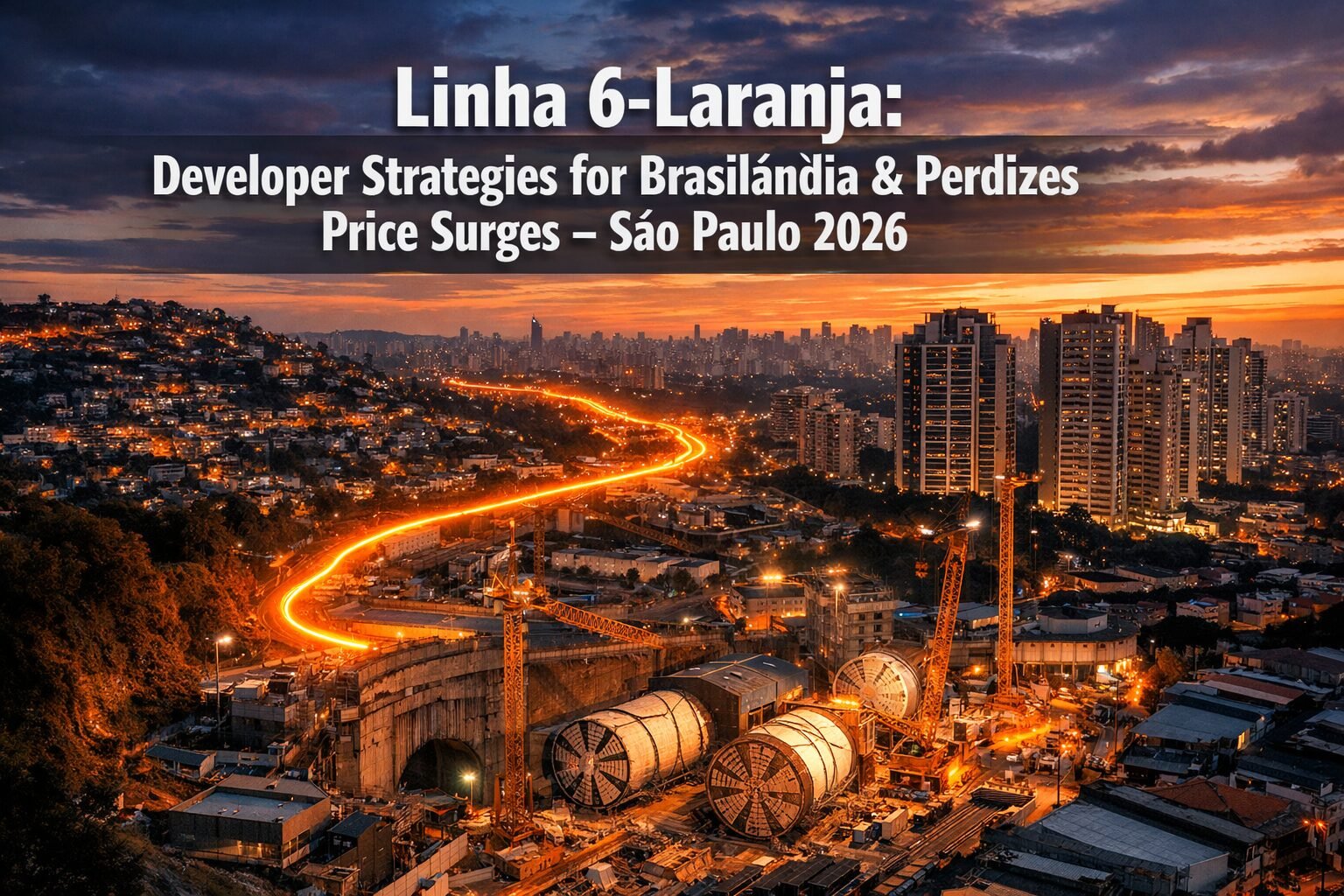
São Paulo’s real estate market has a well-documented pattern: property values within 500 meters of a new metro station rise an average of 20–30% in the 24 months surrounding opening day. With Linha 6-Laranja now at 80% construction completion and its first section — the Brasilândia-to-Perdizes corridor — targeting delivery in the second half of 2026, that window is open right now [1][2]. Developers who move before the commuter influx arrives will capture the steepest part of the appreciation curve. Those who wait until the ribbon is cut will pay for it.
This article breaks down the Linha 6-Laranja Metro Impact: Developer Strategies for Brasilândia and Perdizes Price Surges in São Paulo 2026, covering construction milestones, zoning tactics, pricing dynamics, and the specific moves that separate winning projects from overpriced inventory.
Key Takeaways 🔑
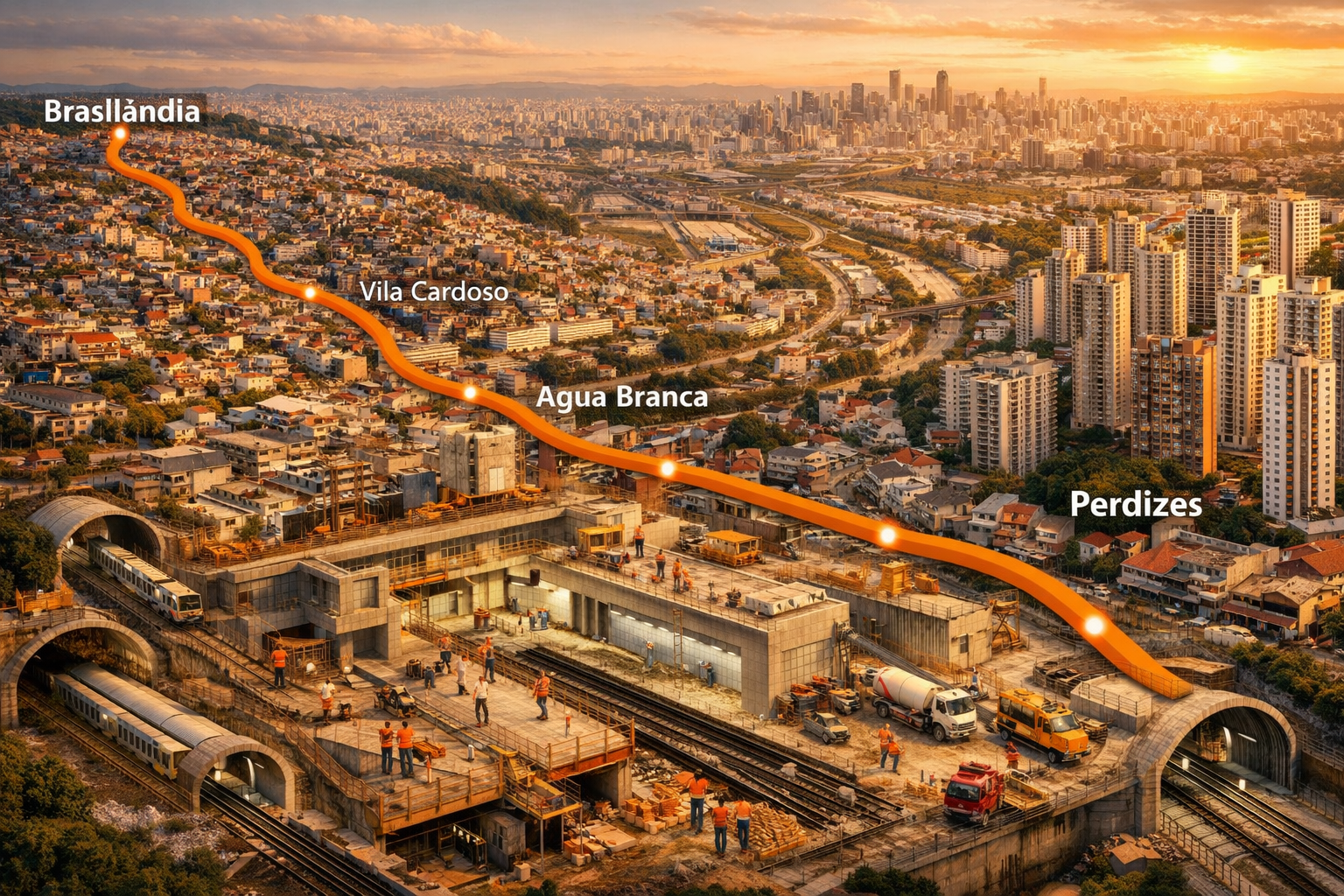
- Linha 6-Laranja is 80% complete as of late March 2026, with the Brasilândia–Perdizes section targeting H2 2026 delivery [1][2].
- Estação Água Branca leads at 97% completion, with Perdizes and Santa Marina above 91% [3].
- The line will reduce the Brasilândia–center commute from ~90 minutes by bus to just 23 minutes by metro [1][5].
- Over 630,000 daily passengers are projected once fully operational, creating massive demand pressure on transit-adjacent housing [5].
- Developers using mixed-use zoning and pre-launch strategies near station entrances stand to capture 20–30% premium yields ahead of the commuter wave.
The Infrastructure Milestone Reshaping São Paulo’s North Zone
Construction Progress by the Numbers
The scale of Linha 6-Laranja is hard to overstate. The line stretches 15.3 kilometers, connects 15 stations, and links Brasilândia in the North Zone all the way to São Joaquim station in the city center — passing through Freguesia do Ó, Higienópolis, Pacaembu, and Bela Vista along the way [4][5].
As of April 2026, the project hit a symbolic milestone: the first train was transported by road to the Morro Grande depot, with 19 kilometers of tracks already installed and four tunnel boring machines (tuneladoras) having completed most of their tunnel connections [4]. The project is structured as a Public-Private Partnership (PPP) with an estimated R$ 15 billion investment, operated by concessionária LinhaUni — an Acciona partnership with the São Paulo State Government [4].
| Station | Completion % (April 2026) |
|---|---|
| Água Branca | 97% ✅ |
| Perdizes | 91%+ ✅ |
| Santa Marina | 91%+ ✅ |
| Brasilândia | ~90% 🔄 |
| João Paulo I | ~90% 🔄 |
Sources: [1][2][3]
Why the “Line of Universities” Tag Matters for Developers
Linha 6-Laranja is officially nicknamed the “line of universities” — it will directly serve seven higher education institutions along its route [2]. This is not a minor detail for real estate strategy. University proximity creates sustained, year-round rental demand from students, faculty, and administrative staff. For developers targeting studios and compact one-bedroom units, this demographic is a reliable anchor tenant base that supports higher occupancy rates and lower vacancy risk.
💡 Pull Quote: “A metro line that serves 630,000 daily passengers and seven universities is not just an infrastructure project — it is a demand generator for every transit-adjacent residential project within a 1-kilometer radius.”
The fleet supporting this demand consists of 22 new trains designed with enhanced energy efficiency [2]. Upon full completion, the line will integrate with Lines 1-Blue (at São Joaquim), 4-Yellow (at Higienópolis-Mackenzie), and 7-Ruby (at Água Branca), dramatically improving passenger distribution across the entire São Paulo metro network [2][4].
For developers exploring Brazil’s broader investment landscape, understanding how transit infrastructure drives value is foundational. The best places to invest in Brazil property consistently share one trait: proximity to mobility infrastructure.
Developer Strategies for Brasilândia and Perdizes Price Surges in São Paulo 2026
The Two-Market Reality Along the Corridor
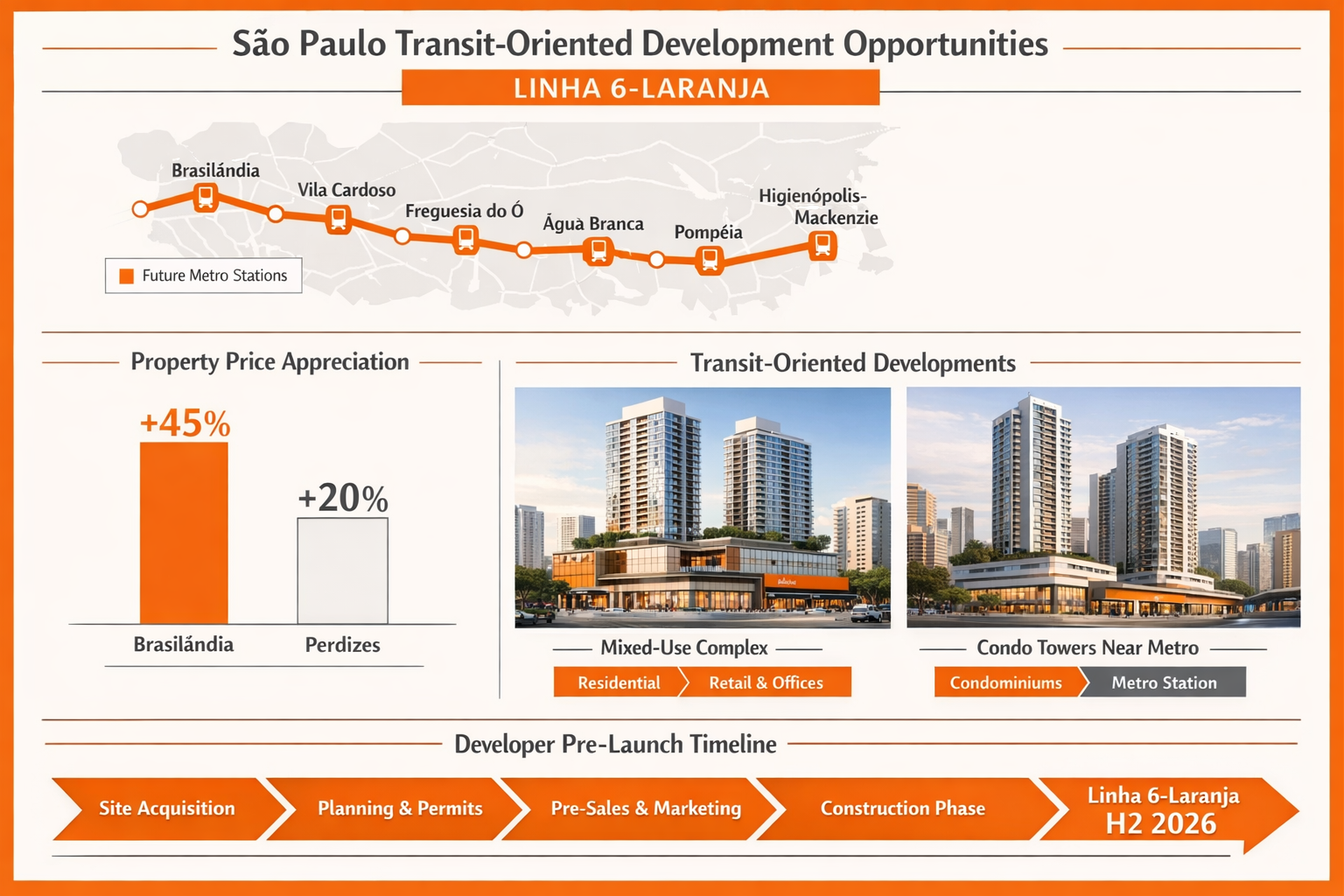
The Linha 6-Laranja Metro Impact: Developer Strategies for Brasilândia and Perdizes Price Surges in São Paulo 2026 requires understanding that this single metro line runs through two fundamentally different real estate markets — and the strategies for each are not interchangeable.
Brasilândia (North Zone):
- Historically underserved by rapid transit
- Higher proportion of lower-middle-income residents
- Land costs significantly below São Paulo average
- Strong pent-up demand for affordable units with metro access
- Pre-launch pricing can be aggressive because buyers understand the transformation story
Perdizes (West Zone):
- Already an established middle-to-upper-middle-class neighborhood
- Existing infrastructure and amenities are mature
- Land costs are substantially higher
- Buyers are more sophisticated and price-sensitive to premium justification
- The metro adds convenience, not transformation — pricing premiums must be earned through product quality
This distinction is critical. A developer applying a Perdizes pricing strategy to a Brasilândia project will price themselves out of the target market. A developer applying a Brasilândia land-cost assumption to a Perdizes acquisition will face margin compression.
Mixed-Use Zoning: The Multiplier Strategy 🏗️
The most effective tool available to developers along the Linha 6-Laranja corridor in 2026 is mixed-use zoning. São Paulo’s Plano Diretor (Master Plan) actively incentivizes mixed-use development near transit nodes through higher floor-area ratios (FAR/coeficiente de aproveitamento) and reduced parking minimums.
Here is how the mixed-use approach maximizes land value near station entrances:
- Ground-floor retail activation — Captures foot traffic from the projected 630,000+ daily passengers [5], generating rental income that cross-subsidizes residential construction costs.
- Upper-floor residential — Studios and one-bedrooms targeting students and young professionals who prioritize commute time over unit size.
- Reduced parking requirements — Near transit nodes, São Paulo allows significant reductions in mandatory parking spaces, freeing up construction budget for more sellable area.
- Bonus FAR through social housing quotas — Developers who include a percentage of HIS (Habitação de Interesse Social) units can unlock additional buildable area, improving overall project economics.
🔑 Key Insight: Near Brasilândia station, a mixed-use project with ground-floor retail and 80 residential units can achieve a 15–20% higher effective FAR than a purely residential project on the same plot — without additional land cost.
Pre-Launch Timing: The 18-Month Window
With the first section targeting delivery in H2 2026 [1][2], the pre-launch window is narrowing fast. Historical data from São Paulo metro expansions (Lines 4-Yellow and 5-Lilac) shows a consistent pattern:
- 24–18 months before opening: Early movers acquire land at pre-announcement prices
- 18–12 months before opening: Pre-launch sales begin; buyers accept construction risk for price advantage
- 12–6 months before opening: Price discovery accelerates; land costs spike near confirmed station entrances
- Opening day and after: Secondary market premiums are fully priced in; new launches must compete on product differentiation
In 2026, the market is squarely in the 12–6 month window. Developers who have not yet secured land near Brasilândia and Perdizes stations are now competing at elevated land prices. The remaining opportunity lies in product differentiation and pre-launch marketing execution — not land arbitrage.
For investors evaluating off-plan purchases, understanding why buying off-plan can amplify investment gains is essential context for transit-adjacent opportunities like Linha 6-Laranja.
Pricing Dynamics and Investment Outlook for 2026 and Beyond
Understanding the Linha 6-Laranja Metro Impact on Price Per Square Meter
The Linha 6-Laranja Metro Impact: Developer Strategies for Brasilândia and Perdizes Price Surges in São Paulo 2026 is already visible in transaction data across the corridor. While precise neighborhood-level figures shift monthly, the directional trends are clear:
| Metric | Brasilândia Zone | Perdizes Zone |
|---|---|---|
| Pre-announcement baseline | Low (historically undervalued) | Medium-high (established) |
| Current appreciation trend | Steep upward | Moderate upward |
| Primary buyer profile | First-time buyers, investors | Upgraders, investors |
| Rental yield potential | Higher (%) | Lower (%), but stable |
| Development risk profile | Medium-high | Low-medium |
The Commute-Time Value Equation
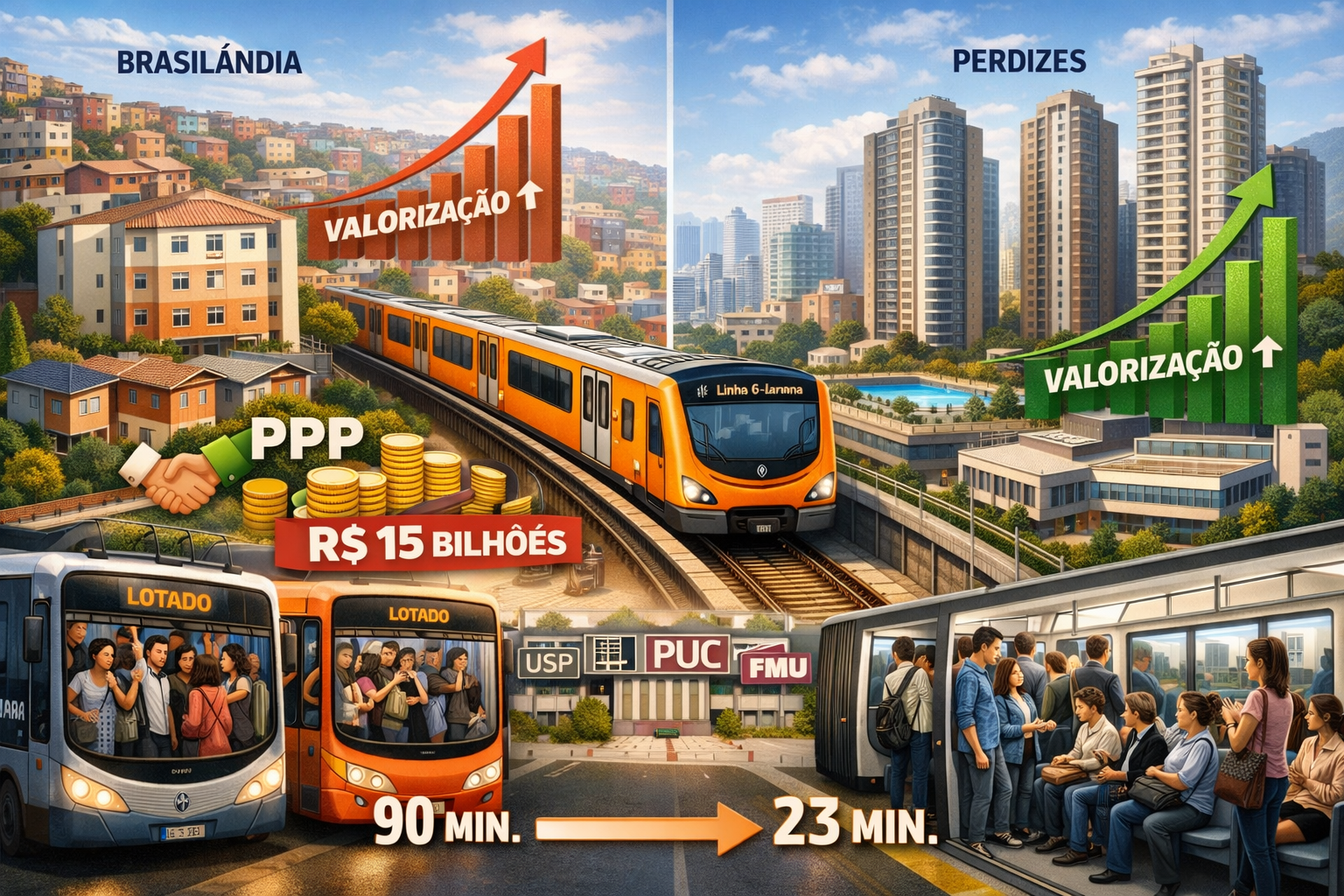
One of the most compelling arguments for transit-adjacent pricing premiums is the commute-time value equation. The journey from Brasilândia to the city center currently takes approximately 1 hour 30 minutes by bus. Linha 6-Laranja will reduce that to 23 minutes [1][2][5].
That is a 67-minute daily savings per trip — or over two hours per day for a round-trip commuter. Research consistently shows that São Paulo workers place significant monetary value on commute time reduction. A 20–25% price premium on a transit-adjacent apartment, when amortized over a 20-year mortgage, often represents a net financial gain compared to a cheaper unit requiring a 90-minute commute.
This is the core argument developers should be making in their marketing materials right now.
Connectivity Premium: The Triple Integration Effect
When Linha 6-Laranja reaches full operation, it will connect to three existing metro lines [2][4]:
- 🔵 Line 1-Blue at São Joaquim
- 🟡 Line 4-Yellow at Higienópolis-Mackenzie
- 🔴 Line 7-Ruby at Água Branca
This triple integration is rare in São Paulo’s network and creates a connectivity premium that extends beyond the immediate corridor. Properties near interchange stations — particularly Água Branca (97% complete) and Higienópolis-Mackenzie — command the highest premiums because they offer access to multiple lines from a single boarding point [3].
Developers with projects near these interchange nodes should emphasize multi-line connectivity in all marketing, not just Linha 6-Laranja access.
Risk Factors Developers Must Price In ⚠️
No investment thesis is complete without an honest risk assessment:
- Delivery timeline risk: The Perdizes-to-São Joaquim section is not scheduled until 2027 [1][2][3]. Projects marketed on full-line connectivity must account for this phased delivery.
- Construction cost inflation: Brazil’s construction input costs have risen significantly. Developers must stress-test pro formas against 10–15% cost overruns.
- Regulatory changes: São Paulo’s zoning rules evolve. Mixed-use FAR bonuses available today may be adjusted in future Plano Diretor revisions.
- Macro interest rate environment: Brazil’s Selic rate directly impacts mortgage accessibility. Higher rates compress buyer purchasing power and can slow absorption.
For developers and investors looking to diversify beyond São Paulo, real estate investment opportunities in other Brazilian growth markets offer useful benchmarks for risk-adjusted return comparison.
Tactical Playbook: What Smart Developers Are Doing Right Now
Five Moves That Separate Winners From Waiters
1. Secure air rights and corner plots near station entrances The 200-meter radius around station entrances is the highest-value zone. Corner plots allow larger floor plates and better retail activation. Air rights deals (direito de superfície) can unlock development potential without full land acquisition cost.
2. Pre-launch with a commute-time narrative Marketing materials that quantify the 67-minute daily time savings resonate more powerfully than square-meter price comparisons. Buyers are purchasing time, not just space.
3. Design for the student and young professional renter With seven universities on the line [2], compact units with high-quality finishes, co-working spaces, and strong digital infrastructure command premium rents from a reliable tenant pool.
4. Integrate retail at ground level Even small-scale retail activation (coffee shops, pharmacies, convenience stores) improves the residential product’s perceived value and generates income during the residential sales cycle.
5. Stage delivery to align with metro opening Projects that deliver keys within 6 months of station opening benefit from maximum media attention and buyer urgency. Phase construction timelines accordingly.
For developers wanting to understand how sales performance drives project success in competitive urban markets, the real estate sales performance transformation offers transferable lessons applicable to São Paulo’s transit corridor dynamics.
Investors interested in how studio-format developments perform in transit-dense environments will find relevant analysis in this guide to investing in studio apartments, which examines the economics from a developer’s perspective.
For those tracking the latest market movements and project launches along Brazil’s emerging corridors, the Quadragon news and insights hub provides ongoing coverage of infrastructure-driven real estate trends.
Conclusion: The Clock Is Running ⏱️
The Linha 6-Laranja Metro Impact: Developer Strategies for Brasilândia and Perdizes Price Surges in São Paulo 2026 represents one of the most significant transit-driven real estate opportunities in Brazil’s largest city in over a decade. With 80% of construction complete [1][2], the first section opening in H2 2026, and over 630,000 daily passengers projected [5], the demand fundamentals are not speculative — they are engineering certainties.
Actionable next steps for developers and investors:
- ✅ Audit your land bank for plots within 500 meters of confirmed station entrances — particularly Água Branca, Perdizes, and Brasilândia.
- ✅ Engage a São Paulo zoning specialist to model mixed-use FAR scenarios under the current Plano Diretor before any acquisition.
- ✅ Launch pre-sales now — the 12–6 month pre-opening window is the sweet spot for price discovery and buyer urgency.
- ✅ Build the commute-time story into every marketing touchpoint. The 23-minute journey is your most powerful sales tool [1][5].
- ✅ Monitor the Perdizes-to-São Joaquim section (2027 completion) for the second wave of appreciation in the central corridor [1][2][3].
The developers who will look back on 2026 as a defining year are the ones acting on these strategies today — not the ones waiting for the ribbon-cutting ceremony to confirm what the data already shows.
References
[1] Obras Da Linha 6 Laranja Atingem 80 E Avancam Na Expansao De Metro Em Sp – https://www.agenciasp.sp.gov.br/obras-da-linha-6-laranja-atingem-80-e-avancam-na-expansao-de-metro-em-sp/
[2] Linha 6 Laranja Atinge 80 Das Obras E Deve Iniciar Operacao Em 2026 – https://exame.com/brasil/linha-6-laranja-atinge-80-das-obras-e-deve-iniciar-operacao-em-2026/
[3] Estacao Da Linha 6 Laranja Chega A 97 De Conclusao – https://viatrolebus.com.br/2026/04/estacao-da-linha-6-laranja-chega-a-97-de-conclusao/
[4] Primeiro Trem Da Linha 6 Laranja Passa Pela Brasilândia E Marca Novo Capítulo Na Mobilidade Da Zona Norte – https://prefeitura.sp.gov.br/web/freguesia_brasilandia/w/primeiro-trem-da-linha-6-laranja-passa-pela-brasil%C3%A2ndia-e-marca-novo-cap%C3%ADtulo-na-mobilidade-da-zona-norte
[5] Linha 6 Laranja – https://www.linhauni.com.br/linha-6-laranja