
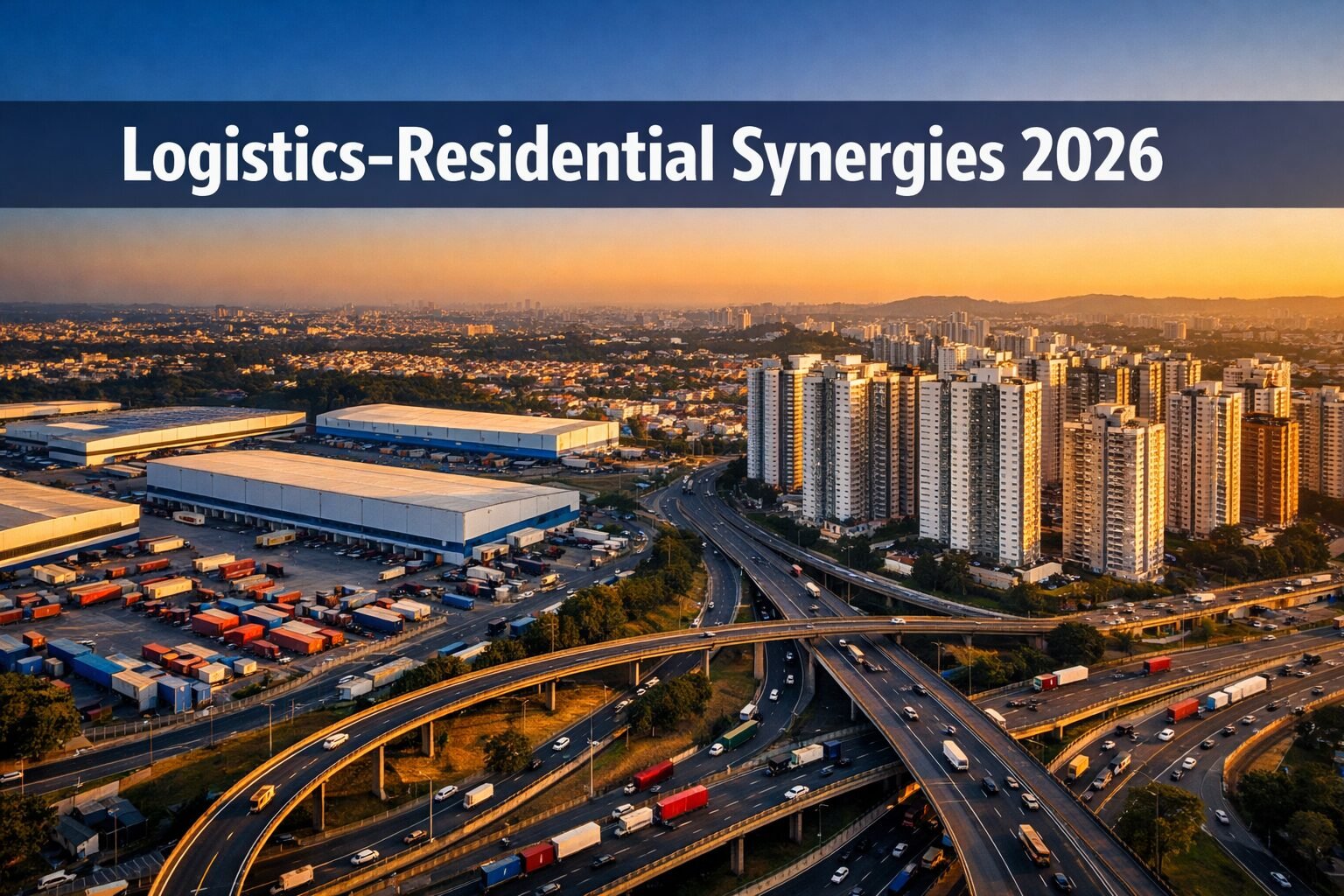
Every 10 kilometers closer a worker lives to their logistics job, turnover drops by an estimated 18% — a figure that quietly reshapes how developers, municipalities, and investors are rethinking land use across South America’s most active trade corridors. In 2026, Logistics-Residential Synergies 2026: Developing Housing Near ABC Region and Mercosur Hubs has moved from urban planning theory to a bankable investment thesis, driven by surging e-commerce volumes, nearshoring momentum, and the transformative EU-Mercosur trade agreement now in force.
The ABC Region — Santo André, São Bernardo do Campo, and São Caetano do Sul — sits at the epicenter of this shift. Flanked by the Port of Santos, Brazil’s busiest maritime gateway, and threaded by federal highways that feed Mercosur’s southern cone network, the area is witnessing a convergence of industrial expansion and residential demand that few markets can match in 2026.
Key Takeaways 📌
- Location arbitrage is real: Housing built within logistics corridors near Santos and the ABC Region commands lower land costs but benefits from strong rental demand from warehouse and distribution workers.
- Mercosur trade growth is a demand multiplier: The EU-Mercosur agreement and nearshoring trends are accelerating freight volumes, creating sustained employment and housing pressure near major hubs [8].
- MCMV peripheries offer resilient yields: Brazil’s Minha Casa Minha Vida program targets exactly the income brackets that fill logistics roles, making government-backed affordable housing a natural fit for these zones.
- Mixed-use integration reduces vacancy risk: Developments combining last-mile logistics bays with residential floors are proving more financially stable than single-use projects.
- Regional connectivity is expanding fast: From Uruguay’s Zonamerica to Colombia’s Pacific ports, new logistics nodes are creating replicable models for residential co-development [1][5].
Why Logistics Corridors Are the New Residential Frontier
The Structural Demand Behind the Opportunity
Brazil’s e-commerce sector grew by double digits again in 2025, and 2026 shows no signs of reversal. Every new fulfillment center, cold-chain warehouse, or last-mile hub requires a workforce — and that workforce needs affordable, accessible housing. The ABC Region, historically Brazil’s industrial heartland, is experiencing this dynamic at full intensity.
Three forces are converging simultaneously:
- 🏭 Industrial expansion — Nearshoring trends are pushing manufacturers and logistics operators to consolidate operations near Santos, one of Latin America’s highest-throughput ports [5].
- 🏠 Housing deficit — Greater São Paulo’s affordable housing gap remains acute, particularly in the southern industrial belt where land is cheaper but transit links are improving.
- 📦 E-commerce logistics density — Last-mile and mid-mile distribution centers are clustering along the Anchieta and Imigrantes highways, creating employment nodes that attract workers from across the metropolitan region.
“The smartest real estate plays in 2026 are not where luxury demand is highest — they are where workforce demand is most underserved.”
This is precisely why Logistics-Residential Synergies 2026: Developing Housing Near ABC Region and Mercosur Hubs has become a guiding framework for forward-thinking developers and institutional investors.
The MCMV Advantage in Logistics Zones
Brazil’s Minha Casa Minha Vida (MCMV) program provides subsidized financing for households earning between R$2,000 and R$8,000 per month — the exact income range that dominates logistics employment. Warehouse operators, truck dispatchers, inventory clerks, and last-mile couriers all fall within this bracket.
Developing MCMV-eligible units within 5–10 kilometers of major logistics hubs creates a self-reinforcing ecosystem:
| Factor | Impact on Developer | Impact on Resident |
|---|---|---|
| Government subsidy | Lower financing cost | Affordable monthly payments |
| Proximity to employment | Lower vacancy rates | Reduced commute cost |
| Infrastructure investment | Rising land values | Better services over time |
| Logistics job growth | Sustained rental demand | Job security |
For investors seeking high-return property opportunities in Brazil, the ABC Region’s logistics-residential corridor represents one of the most structurally sound yield plays available in 2026.
Mercosur Trade Dynamics Reshaping Regional Housing Demand

The EU-Mercosur Agreement as a Demand Catalyst
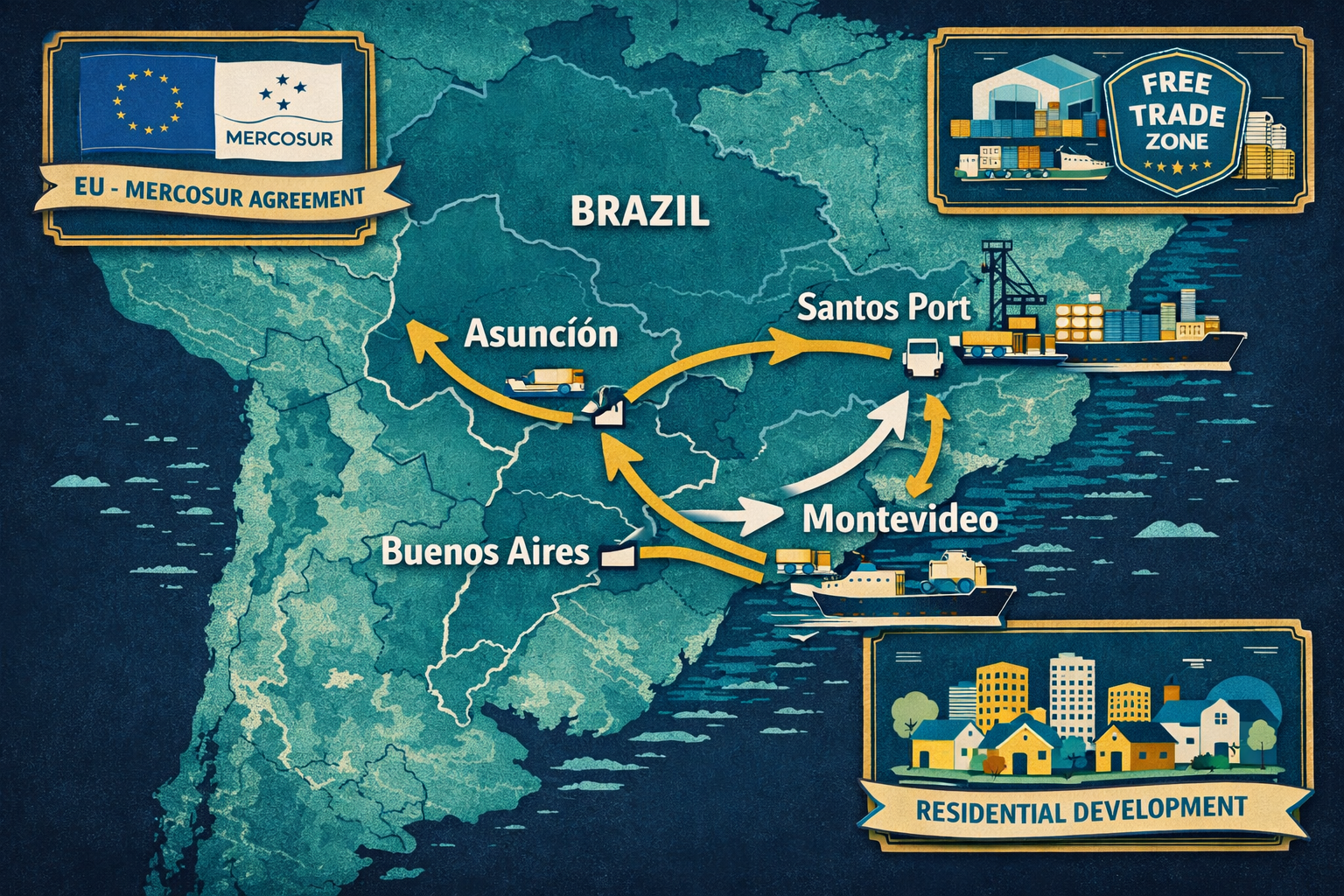
The EU-Mercosur trade agreement, now effective in 2026, is more than a tariff reduction framework — it is a spatial reorganization of economic activity across the southern cone. The agreement legally protects over 350 European Geographical Indications in Uruguay, reduces import tariffs by up to 35%, and is already generating demand for upgraded commercial and residential infrastructure in coastal and port-adjacent zones [4].
In practical terms, this means:
- More freight volume through Santos, Montevideo, and Buenos Aires ports, requiring expanded warehousing and distribution capacity [8].
- Higher-quality workforce demand as European companies establish regional distribution hubs, attracting skilled logistics professionals who need quality housing.
- Commercial real estate pressure in secondary cities, creating spillover residential demand as mixed-use districts develop around new trade infrastructure [6].
Uruguay’s Zonamerica: A Blueprint Worth Studying
On March 30, 2026, Costa Oriental opened its fifth logistics facility — Costa Park V — within Zonamerica, Uruguay’s premier free trade zone. The addition of 10,000 square meters brought total operational capacity to 50,000 square meters, a 25% increase that positions the complex as the largest logistics center within Uruguay’s free trade zone network [1].
This expansion is not happening in isolation. In January 2026, Lamaignere launched a joint commercial plan between its Uruguay and Chile subsidiaries, specifically designed to strengthen logistics connectivity and generate operational synergies across the Mercosur region [2]. The result is an emerging logistics spine running from Montevideo northward through southern Brazil — and every node along that spine creates residential demand.
What the Zonamerica model teaches ABC Region developers:
- ✅ Clustering logistics facilities creates critical mass that attracts workforce housing investment
- ✅ Free trade zone adjacency accelerates employment growth faster than general industrial zones
- ✅ Mixed-use planning from the outset (not retrofitted later) delivers better long-term returns
- ✅ Secondary cities with strong logistics infrastructure outperform primary markets on yield
Nearshoring and the Latin America Trade Shift
Supply chain regionalization is accelerating across Latin America as global companies move production closer to end markets [5]. While Mexico has emerged as the primary nearshoring beneficiary due to USMCA proximity, Brazil’s Mercosur position makes the ABC Region a compelling secondary hub — particularly for companies serving South American consumer markets.
Strategic shipping hubs are also emerging throughout the region. Colombia’s Pacific ports and the Dominican Republic’s Port of Caucedo are positioning as critical nodes for US-Latin America trade [5]. Each new logistics corridor creates a replicable template: employment concentration → housing demand → investment opportunity.
For developers already active in Brazil’s real estate market, understanding these real estate market trends and growth projections provides essential context for evaluating logistics-adjacent residential plays.
Developing Housing Near ABC Region and Mercosur Hubs: A Practical Framework
Site Selection Criteria for Logistics-Residential Projects
Not every location near a warehouse qualifies as a strong residential development opportunity. The following criteria separate viable projects from speculative bets:
🔍 Tier 1 Criteria (Non-Negotiable)
- Within 8 kilometers of an active logistics park or distribution center with 200+ employees
- Access to at least one major federal highway (BR-101, BR-116, or SP-150 in the ABC context)
- Municipal zoning that permits mixed residential-industrial use or has active rezoning in progress
- MCMV eligibility confirmed for the income profile of target residents
🔍 Tier 2 Criteria (Strong Preference)
- Proximity to planned or existing public transit (BRT corridors, CPTM rail lines)
- Presence of anchor employers with multi-year lease commitments in adjacent logistics parks
- Municipal incentive programs for affordable housing development
- Land cost below R$400/m² for greenfield or R$600/m² for infill sites
🔍 Tier 3 Criteria (Value Enhancers)
- Planned infrastructure upgrades (road widening, new interchanges)
- University or technical school presence creating workforce pipeline
- Existing retail and service amenity density within walking distance
Mixed-Use Integration: The Financial Case
Pure residential projects near logistics hubs leave significant value on the table. The most financially resilient model integrates:
- Ground floor: Last-mile logistics bays, convenience retail, and service businesses catering to shift workers
- Floors 2–4: Commercial offices for logistics operators, staffing agencies, and compliance services
- Floors 5+: Residential units, prioritizing studio and one-bedroom formats for single workers and young families
This stacking model distributes income across multiple tenant categories, reducing vacancy risk dramatically. When one sector softens, the others typically compensate.
Developers exploring off-plan property investment advantages will recognize that logistics-adjacent mixed-use projects often deliver the steepest appreciation curves from launch to delivery, precisely because employment growth in these zones is predictable and measurable.
Financing Structures That Work in 2026
The capital stack for logistics-residential projects in 2026 typically combines:
| Funding Layer | Source | Typical Share |
|---|---|---|
| MCMV subsidy/FGTS | Federal government | 30–45% |
| Construction financing | CEF / private banks | 25–35% |
| Equity (developer + investors) | Private capital | 15–25% |
| Pre-sales revenue | End buyers / investors | 10–20% |
The MCMV layer is critical — it de-risks the demand side by ensuring qualified buyers exist before construction begins. For institutional investors, this government backstop transforms what might appear to be a speculative peripheral play into a structured, yield-generating asset.
Emerging financing innovations, including cryptocurrency and real estate tokenization, are also beginning to appear in logistics-residential project structures, allowing fractional investment in larger mixed-use developments that individual buyers could not previously access.
Risk Factors to Monitor
No investment thesis is complete without a clear-eyed view of risks:
- ⚠️ Zoning delays: Municipal rezoning processes in the ABC Region can extend timelines by 12–24 months
- ⚠️ Logistics employer concentration: Projects anchored by a single large employer face demand cliff risk if that employer relocates
- ⚠️ Infrastructure lag: Housing can be delivered before promised road or transit improvements materialize
- ⚠️ MCMV program changes: Federal subsidy parameters can shift with budget cycles, affecting buyer qualification rates
- ⚠️ Environmental compliance: Industrial adjacency requires careful environmental impact assessment, particularly for soil contamination in legacy industrial zones
Mitigating these risks requires deep local knowledge. Working with developers who have proven track records in complex urban environments — and who understand both the logistics and residential sides of the equation — is essential. Exploring active real estate developments in growth corridors provides a useful benchmark for evaluating project quality and execution capability.
The Broader Opportunity: Secondary Cities and Innovation Districts
Gensler’s 2026 South America design forecast identifies secondary cities including Montevideo as attracting increased investment through mixed-use district development, university-linked innovation hubs, and lifestyle-driven infrastructure [6]. This trend directly supports the logistics-residential thesis: as secondary cities build out logistics capacity to serve Mercosur trade flows, they simultaneously attract the residential and commercial development that makes those cities livable for a growing workforce.
The pattern is consistent across the region:
- Logistics investment → Employment growth
- Employment growth → Housing demand
- Housing demand → Mixed-use development
- Mixed-use development → Urban quality of life improvement
- Urban quality of life improvement → Further investment attraction
This virtuous cycle is already visible in the ABC Region, in Montevideo’s Zonamerica surroundings, and in emerging logistics clusters along Brazil’s southern coast. Investors who position early in this cycle — particularly in the MCMV periphery zones where land costs remain accessible — stand to benefit from both yield income and capital appreciation as the cycle matures.
For those evaluating Brazilian coastal markets alongside logistics-corridor opportunities, understanding quality of life and infrastructure growth in emerging residential zones offers a useful comparative framework.
Conclusion: Actionable Next Steps for 2026
Logistics-Residential Synergies 2026: Developing Housing Near ABC Region and Mercosur Hubs represents one of the most structurally sound investment themes available to real estate developers and investors operating in South America today. The convergence of Mercosur trade expansion, EU-Mercosur agreement implementation, nearshoring momentum, and Brazil’s persistent affordable housing deficit creates a demand environment that is both deep and durable.
Actionable Next Steps 🚀
Map the employment nodes. Identify logistics parks within the ABC Region with confirmed multi-year tenant commitments and workforce headcounts above 300. These are your demand anchors.
Engage municipal planning offices early. Zoning is the longest lead-time variable. Begin rezoning conversations 18–24 months before intended groundbreaking.
Structure for MCMV eligibility from day one. Design unit sizes, pricing, and amenity packages to qualify for MCMV financing before finalizing project specifications.
Build mixed-use from the ground up. Reserve ground-floor commercial space for logistics-adjacent businesses. This diversifies income and strengthens community economics.
Monitor Mercosur corridor expansion. New logistics nodes emerging from the EU-Mercosur agreement will create the next wave of residential demand opportunities — track them now to position ahead of the curve [8][9].
Partner with experienced local developers. Execution risk in complex logistics-adjacent zones is real. Connect with specialists who understand both the regulatory environment and the market dynamics of Brazil’s industrial corridors.
The window for first-mover positioning in the most compelling logistics-residential zones is open in 2026 — but it will not remain open indefinitely. As freight volumes grow and employment density increases, land costs in the best-positioned corridors will rise to reflect the opportunity. The time to act is now.
References
[1] Costa Oriental Expands Its Logistics Hub Reaching 50 000 M Of Operating Space In Uruguay – https://www.uruguayxxi.gub.uy/en/news/article/costa-oriental-expands-its-logistics-hub-reaching-50-000-m-of-operating-space-in-uruguay/
[2] Lamaignere Launches Commercial Plan Between Uruguay And Chile To Boost Regional Logistics Connectivity – https://www.mundomaritimo.net/noticias/lamaignere-launches-commercial-plan-between-uruguay-and-chile-to-boost-regional-logistics-connectivity
[3] Logistics Trends 2026 The Future Has Already Begun – https://grupozeit.com/en/logistics-trends-2026-the-future-has-already-begun/
[4] Uruguay Real Estate Eu Mercosur Geographical Indications – https://www.realestate-in-uruguay.com/blog/uruguay-real-estate-eu-mercosur-geographical-indications/
[5] Latin America Trade Shifts Changes Exporters – https://eplogistics.com/blog/latin-america-trade-shifts-changes-exporters/
[6] South America – https://www.gensler.com/df26/south-america
[7] Logistics Investment 2026 E Commerce Nearshoring Tech Trends – https://mexicobusiness.news/logistics/news/logistics-investment-2026-e-commerce-nearshoring-tech-trends
[8] Mercosur Avanza En Su Agenda Externa Durante El Primer Semestre De 2026 – https://aduananews.com/en/mercosur-avanza-en-su-agenda-externa-durante-el-primer-semestre-de-2026/
[9] Eu Mercosur Key Developments Shaping The Trade Agreement – https://www.tradecomplianceresourcehub.com/2026/02/18/eu-mercosur-key-developments-shaping-the-trade-agreement/