
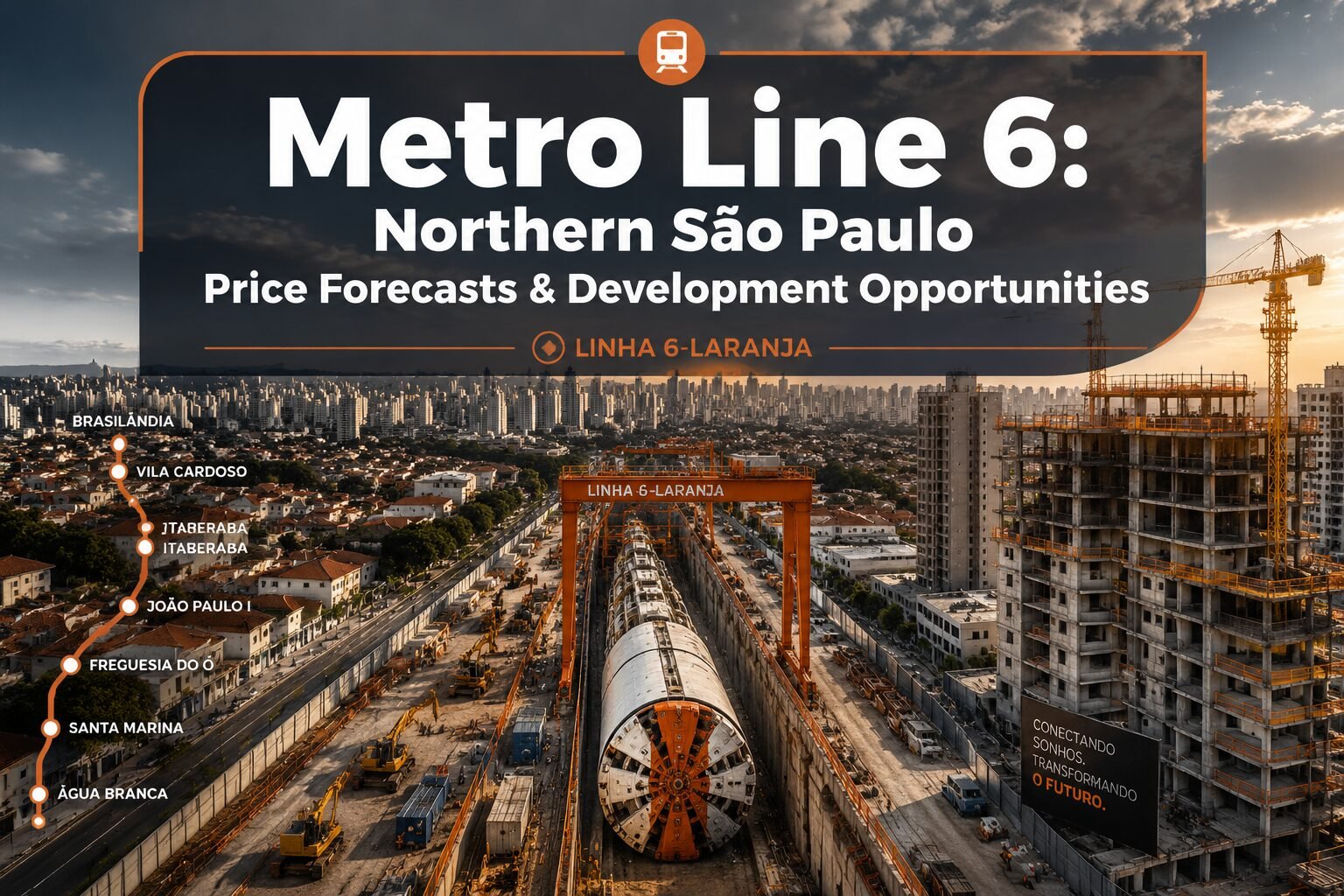
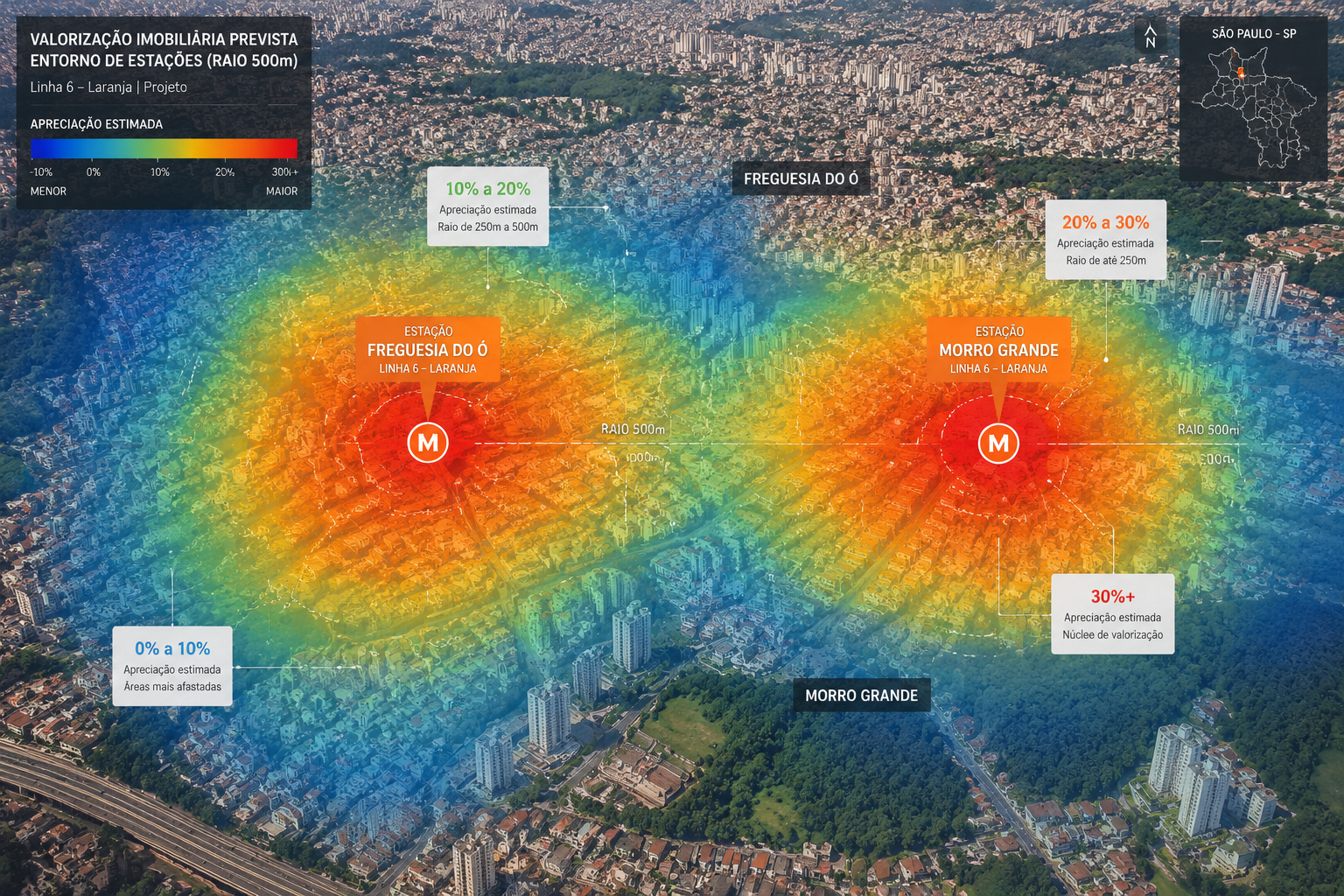
Properties within 500 meters of new São Paulo metro stations have historically gained 20–30% in value within two years of a station opening [2]. That pattern is now playing out in real time across the city’s northern districts, where São Paulo’s Line 6-Laranja — a R$19 billion public-private partnership — is reshaping land economics before a single paying passenger has boarded [1].
Understanding the Metro Line 6 impact on northern São Paulo neighborhoods, along with credible 5-year price forecasts and development opportunities, is no longer optional for serious investors. The window for pre-completion entry is narrowing fast.
Key Takeaways
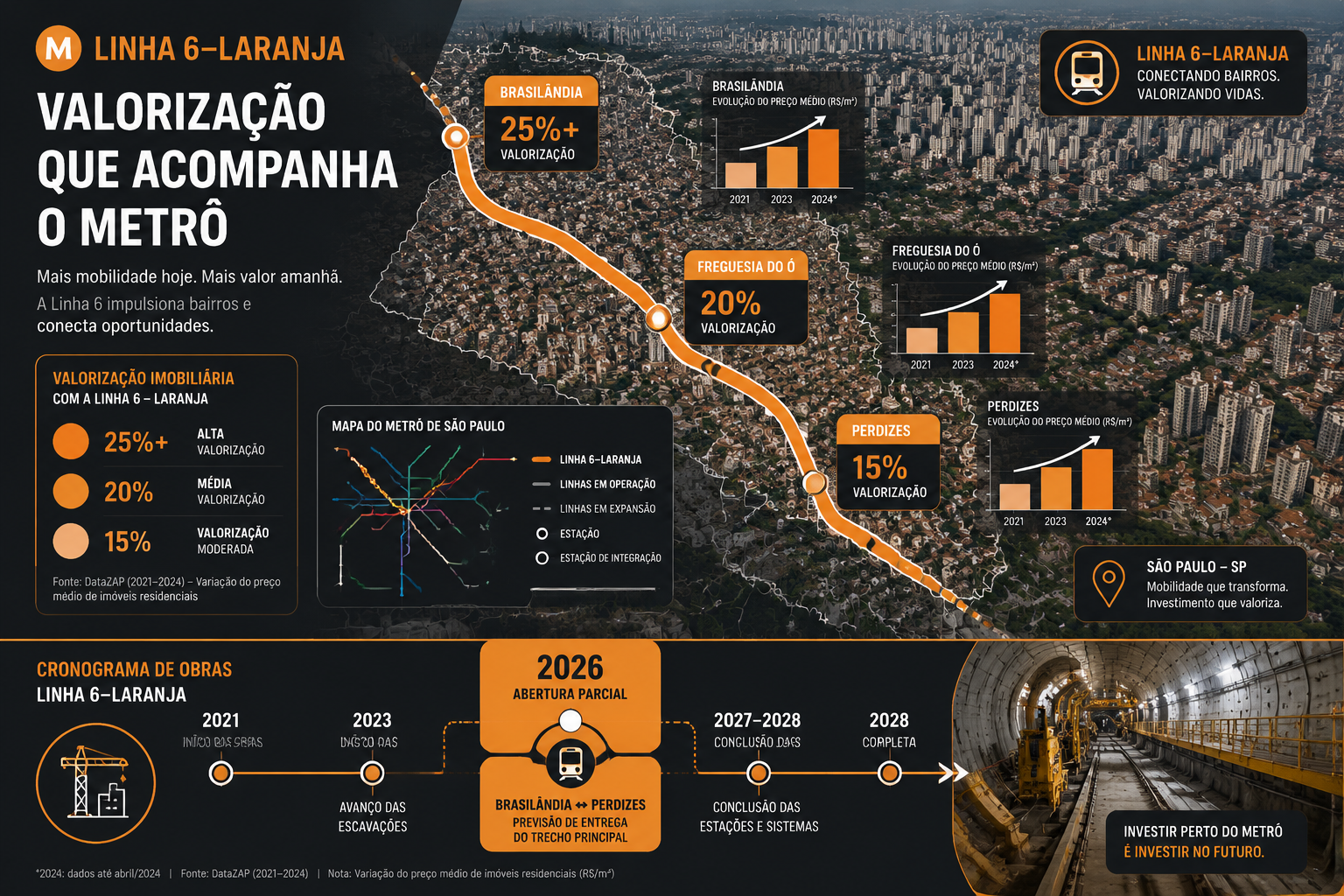
- Line 6’s first segment (Brasilândia to Perdizes) is scheduled to begin partial operations in late 2026, cutting travel times from 90 minutes to 23 minutes [1].
- Properties near planned stations in Brasilândia, Freguesia do Ó, and Morro Grande have already recorded appreciation of up to 30% ahead of opening [3].
- Investors who entered 12–24 months before completion have historically captured the strongest premiums, with cumulative gains of 50–80% possible over a full five-year horizon [2].
- Brasilândia offers the highest upside (25%+ over five years) at land costs 40–60% below central São Paulo, while Perdizes offers more conservative 10–15% gains with lower risk [4].
- A planned 7-kilometer extension with six additional stations could extend the appreciation corridor further south and east [6].
Construction Status and the 2026 Opening Milestone
As of mid-2026, construction on Line 6 is more than 80% complete, with crews operating around the clock to meet the projected opening schedule [1]. The first operational segment will connect Brasilândia, in the far north, to Perdizes, a middle-to-upper-class neighborhood closer to the city center. That single corridor will collapse a commute that currently takes roughly 90 minutes by bus down to approximately 23 minutes by metro — a transformation that fundamentally reprices the time cost of living in the north [1].
The project is structured as a public-private partnership valued at approximately R$19 billion (roughly US$3.8 billion), one of the largest urban infrastructure investments in Brazilian history [1]. Once fully operational across all planned stations, Line 6 is projected to serve around 630,000 passengers daily, adding a significant new artery to São Paulo’s transit network [1].
Why the opening date matters for investors: Real estate markets tend to price in infrastructure improvements gradually, with the sharpest appreciation spikes occurring in the 12–24 months immediately before and after an opening. Developers and buyers who wait for confirmed operations often pay a premium that has already been baked in.
For those exploring broader investment opportunities in Brazil’s real estate market, a detailed overview of the best places to invest in Brazil for high returns provides useful context on how infrastructure-led appreciation compares across different cities and corridors.
Neighborhood-by-Neighborhood Price Forecasts
The Metro Line 6 impact on northern São Paulo neighborhoods is not uniform. Each district along the corridor carries a distinct risk-reward profile shaped by current land costs, existing infrastructure, demographic composition, and proximity to the central business district.
Brasilândia: Highest Upside, Highest Transformation
Brasilândia sits at the northern terminus of Line 6 and represents the most dramatic opportunity on the corridor. Land acquisition costs here run 40–60% below those in central São Paulo, and analysts project appreciation exceeding 25% over the next five years as the station becomes operational and new commercial activity follows [4].
Even before construction completion, early data already shows the market reacting. Property values in Brasilândia have begun climbing as developers and individual buyers position ahead of the opening [3]. The neighborhood’s relative affordability means that even a moderate percentage gain translates into strong absolute returns for investors who entered early.
Risk factors to consider:
- Infrastructure beyond the metro station itself (roads, utilities, retail) will take time to mature.
- Gentrification pressures may face political and community resistance [5].
- Liquidity for resale may be lower than in more established neighborhoods during the early post-opening period.
Freguesia do Ó: Balanced Risk and Reward
Freguesia do Ó occupies the middle ground on the Line 6 corridor. It is an established neighborhood with existing commercial activity, schools, and community infrastructure, which means the metro arrival is additive rather than transformative. Analysts project moderate appreciation in the 15–20% range over five years [4].
This profile makes Freguesia do Ó attractive to investors who want exposure to the Line 6 appreciation story without taking on the full development risk of a peripheral neighborhood. Rental demand is likely to strengthen quickly once commute times to the center drop, supporting income-generating strategies alongside capital appreciation plays.
Properties in Freguesia do Ó have already recorded value increases of up to 30% in anticipation of the line’s opening, suggesting that some of the near-term premium may already be priced in [3]. Buyers entering now should model a more conservative near-term gain and focus on the medium-term (three-to-five-year) horizon.
Morro Grande: Emerging Corridor Opportunity
Morro Grande is notable for two reasons. First, it has already seen significant pre-opening appreciation alongside Brasilândia and Freguesia do Ó [3]. Second, it appears in the São Paulo government’s authorized study for a 7-kilometer extension of Line 6, which would add six new stations including a stop at Morro Grande itself [6].
If that extension proceeds, Morro Grande could experience a second wave of appreciation as the new station plans become concrete. Investors with a longer time horizon — five years or beyond — should monitor the extension study closely.
Perdizes: Stability Over Speculation
Perdizes is the southern anchor of the first operational segment and already functions as a middle-to-upper-class residential and commercial hub. Projected appreciation here sits at 10–15% over five years [4], reflecting a market that is already relatively mature and well-served by existing transit options.
For investors seeking stability rather than maximum upside, Perdizes offers a lower-risk entry into the Line 6 story. The arrival of a direct metro connection to the northern districts may also attract new commercial tenants and mixed-use developers looking to serve the increased foot traffic.
| Neighborhood | Land Cost vs. Central SP | 5-Year Appreciation Forecast | Risk Profile |
|---|---|---|---|
| Brasilândia | 40–60% below | 25%+ | High upside, higher risk |
| Morro Grande | 30–50% below | 20–25% (extension dependent) | Medium-high |
| Freguesia do Ó | 20–35% below | 15–20% | Moderate |
| Perdizes | At or near market | 10–15% | Lower risk |
Development Opportunities Along the Line 6 Corridor
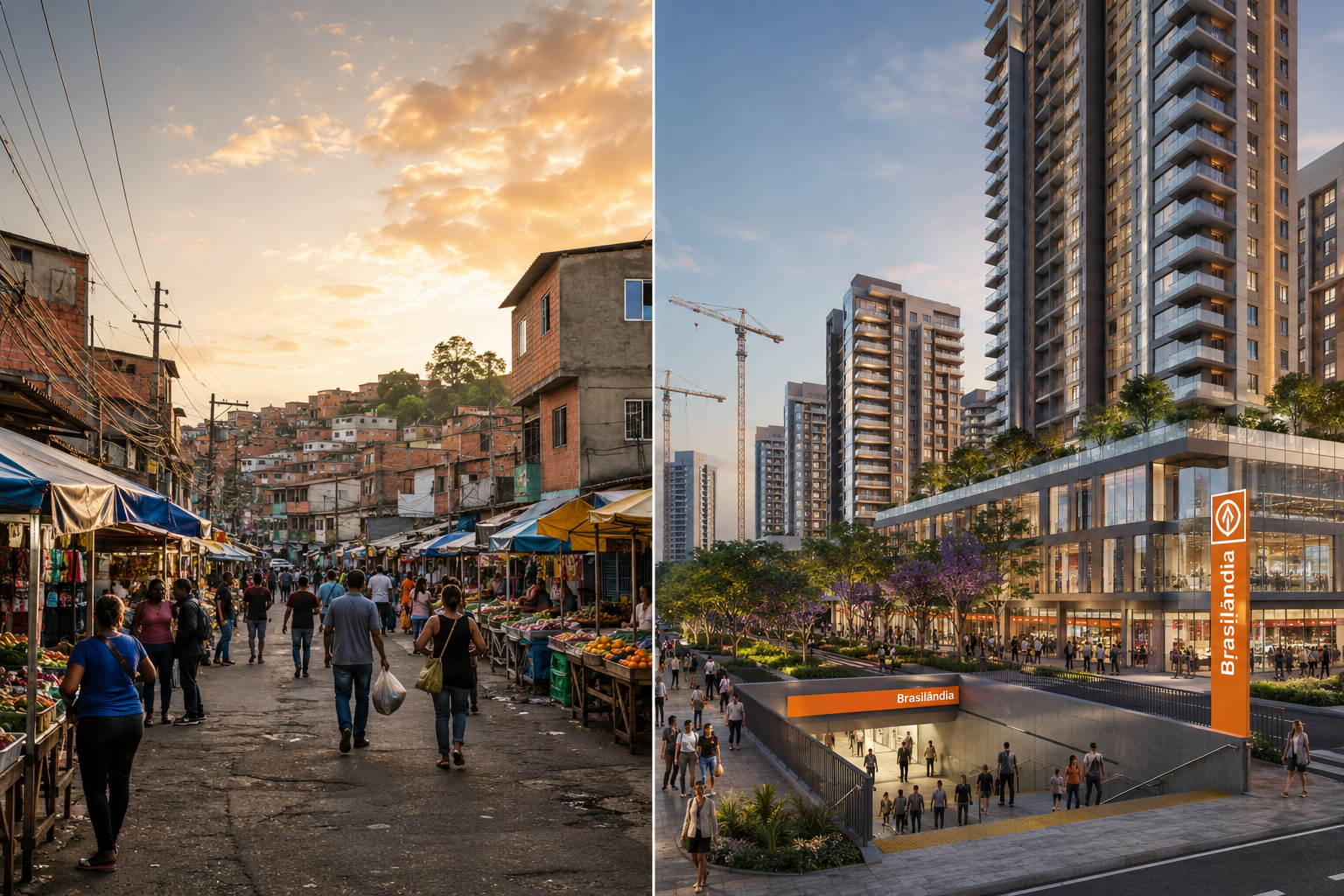
The Metro Line 6 impact on northern São Paulo neighborhoods extends well beyond residential price appreciation. The corridor is generating a range of development opportunities across asset classes and project types.
Residential Development: Timing the Launch Window
Developers who launch projects 12–24 months before a metro station opens have historically captured the strongest combination of low land costs and rising pre-sales prices. That window is now closing for Line 6’s first segment, but it remains open for neighborhoods tied to the planned extension [2].
For residential projects, the key variables are unit mix and price point. Brasilândia’s demographic profile favors affordable and mid-market units, while Perdizes can support premium pricing. Mixed-income projects that align with municipal housing incentives may also benefit from expedited permitting in northern districts where the city has signaled a desire to encourage densification.
Understanding how off-plan purchases can amplify returns is critical for developers and buyers alike. A detailed analysis of why buying off-plan in real estate can significantly boost your gains explains the mechanics of pre-completion appreciation in the Brazilian market context.
Commercial and Mixed-Use Projects
Metro station areas generate predictable pedestrian flows that support retail, food and beverage, and service businesses. Developers building mixed-use projects with ground-floor commercial space near Line 6 stations are positioning to capture both the residential appreciation story and the commercial rental income that follows increased foot traffic.
The 630,000 daily riders projected for the full Line 6 system represent a substantial captive audience for station-adjacent retail [1]. Early movers who secure commercial space or development sites near the busiest stations — particularly Brasilândia and Perdizes, which serve as terminus points — are likely to benefit disproportionately.
Studio and Compact Unit Strategies
One of the clearest demand signals in metro-adjacent markets is the surge in interest from young professionals and students who prioritize commute time over living space. Studio and compact one-bedroom units near Line 6 stations are expected to see strong rental demand as the line becomes operational.
For investors interested in this strategy, the dynamics of investing in studio apartments from a real estate development perspective offer a useful framework, even though the geographic context differs. The underlying logic — that transit access drives compact-unit demand — applies directly to the Line 6 corridor.
The Gentrification Risk and Community Considerations
No honest assessment of development opportunities along Line 6 can ignore the gentrification dynamic. Rising property values and living costs in northern neighborhoods like Brasilândia may displace long-term residents who cannot afford the new market rates [5]. This is not merely a social concern — it is a business risk.
Municipalities that face strong community resistance to gentrification sometimes respond with rent controls, zoning restrictions, or mandatory affordable housing set-asides that can affect project economics. Developers entering northern São Paulo neighborhoods should engage with community stakeholders early and consider how their projects can contribute to neighborhood improvement rather than simple displacement.
“The neighborhoods that benefit most from transit investment are those where developers and communities find ways to grow together rather than in opposition.”
The Extension Study and Long-Term Corridor Vision
The São Paulo state government has authorized a feasibility study for a 7-kilometer extension of Line 6, which would add six new stations: Aclimação, Cambuci, Vila Monumento, São Carlos/Mooca, Morro Grande, and Velha Campinas [6]. If approved and funded, this extension would significantly expand the geographic footprint of the Line 6 appreciation corridor.
Investors and developers tracking the Metro Line 6 impact on northern São Paulo neighborhoods should treat the extension study as a leading indicator. Historically, the announcement of a feasibility study is enough to begin moving land prices in affected areas, even before any construction commitment is made.
The extension also changes the calculus for Morro Grande, which currently benefits from pre-opening appreciation on the main line but would gain even more if it becomes a station on the extended route. Buyers with a five-to-seven-year horizon who can tolerate extension uncertainty may find Morro Grande one of the most compelling positions on the entire corridor.
For investors comparing multiple Brazilian real estate markets and infrastructure plays, it is worth noting how São Paulo’s metro expansion strategy compares to growth dynamics in other major urban centers. Resources covering real estate investment opportunities across Brazil’s top locations can help contextualize relative value.
Timing Strategy: How to Capture 50–80% Cumulative Gains
The historical data on São Paulo metro corridors points to a clear timing pattern [2]:
- Pre-announcement phase: Land prices reflect existing neighborhood fundamentals. This is the optimal entry point but requires the highest conviction and tolerance for uncertainty.
- Construction phase (12–24 months pre-opening): Appreciation accelerates as the opening date becomes credible. This is where the 10–25% premium referenced in market analysis begins to materialize [4].
- Opening phase: A final appreciation spike as the station becomes operational and commute time improvements are confirmed. Media coverage drives additional buyer interest.
- Post-opening maturation (years 2–5): Appreciation continues at a slower pace as new supply enters the market and the neighborhood’s character stabilizes. Cumulative gains of 50–80% from early entry are achievable over this full cycle [2].
For developers, the implication is clear: projects launched during the construction phase — ideally 18–24 months before opening — benefit from low land costs, rising pre-sales prices, and strong buyer confidence driven by visible construction progress. Projects launched after opening face higher land costs and more competition.
Those seeking guidance on navigating real estate development investments and understanding how to time market entry effectively can explore insights on real estate development investment strategies for additional perspective.
Conclusion
The Metro Line 6 impact on northern São Paulo neighborhoods represents one of the most clearly defined infrastructure-driven investment opportunities in Brazil’s real estate market in 2026. With construction over 80% complete, partial operations scheduled for late 2026, and 630,000 daily riders projected at full capacity, the economic logic is straightforward: reduced commute times reprice northern neighborhoods relative to the city center, and that repricing is still in progress.
Actionable next steps for investors and developers:
- Conduct site-specific due diligence in Brasilândia and Morro Grande now, before post-opening pricing fully reflects the transit premium.
- Model three scenarios — base case (15% appreciation), upside (25%+), and extension scenario (30%+) — to stress-test investment theses against different outcomes.
- Monitor the extension feasibility study closely; a positive outcome would open a second appreciation window in Morro Grande, Cambuci, and São Carlos/Mooca.
- For residential developers, target project launches that allow delivery 12–18 months post-opening to capture both pre-sales momentum and post-opening demand.
- Engage community stakeholders in northern neighborhoods early to reduce gentrification-related regulatory risk.
- Consult with specialists who understand the São Paulo market’s legal, zoning, and financing landscape before committing capital.
For those ready to explore specific development projects or seek expert guidance on positioning within Brazil’s evolving real estate landscape, reaching out to experienced real estate development professionals is a practical first step toward capturing the Line 6 opportunity before the window closes.
References
[1] Sao Paulo Metro Line 6 Laranja Urban Development June 2026 – https://www.riotimesonline.com/sao-paulo-metro-line-6-laranja-urban-development-june-2026/?utm_source=openai
[2] Metro Linked Gentrification Playbook 2026 Timing Entry Points In Sao Paulos Linha 6 Laranja Rios Transbrasil And Belo Horizontes Linha 2 Corridors – https://quadragon.com.br/metro-linked-gentrification-playbook-2026-timing-entry-points-in-sao-paulos-linha-6-laranja-rios-transbrasil-and-belo-horizontes-linha-2-corridors/?utm_source=openai
[3] Engenharia Compartilhada – Line 6 Property Appreciation Data – https://www.engenhariacompartilhada.com.br/noticia/exibir/573834?utm_source=openai
[4] Western Sao Paulo Metro Zone Boom Line 6s 10 25 Premium For 2026 Developments – https://quadragon.com.br/western-sao-paulo-metro-zone-boom-line-6s-10-25-premium-for-2026-developments/?utm_source=openai
[5] Linha 6 Laranja Do Metro Espalha Canteiros De Obras E Muda Rotina De Tres Regioes De Sp – https://www.terra.com.br/noticias/brasil/cidades/linha-6-laranja-do-metro-espalha-canteiros-de-obras-e-muda-rotina-de-tres-regioes-de-sp%2C1385a347ecd34a5e2bd2b48825ec5c09xs98ycpd.html?utm_source=openai
[6] Metro Estudo Ampliacao Linha 6 – https://www.metropoles.com/sao-paulo/metro-estudo-ampliacao-linha-6?utm_source=openai