

Brazil’s housing sector stands at a pivotal crossroads in 2026. With Minha Casa Minha Vida and Reforma Casa Brasil in 2026: Unlocking $39.8 Billion for Residential Developers Amid Election Risks representing an unprecedented opportunity, residential developers face both massive potential and significant political uncertainty. The expanded programs promise to deliver over 1 million housing units while injecting billions in subsidized financing and FGTS (Fundo de Garantia do Tempo de Serviço) funds into the market. Yet looming presidential elections cast shadows over long-term program stability.
The Brazilian government’s ambitious expansion of these flagship housing initiatives has fundamentally reshaped the residential development landscape. For developers, understanding how to strategically position projects to capture subsidized financing while hedging against electoral volatility has become essential for success in 2026 and beyond.
Key Takeaways
✅ Four income brackets now qualify for Minha Casa Minha Vida, including a new Faixa 4 serving families earning R$ 8,600–R$ 12,000 monthly, dramatically expanding the middle-class market in major metropolitan areas
✅ Maximum property values increased to R$ 500,000 in urban areas, enabling developers to build higher-quality units in expensive markets while maintaining program eligibility
✅ Reforma Casa Brasil offers R$ 5,000–R$ 30,000 in zero-interest financing for home improvements across two income tiers, creating renovation market opportunities worth billions
✅ Extended 35-year financing terms and reduced interest rates (as low as 4% annually) make monthly payments more accessible, expanding the pool of qualified buyers
✅ Presidential elections in late 2026 introduce policy continuity risks that developers must navigate through diversified portfolio strategies and flexible project timelines
Understanding the Expanded Minha Casa Minha Vida Framework in 2026
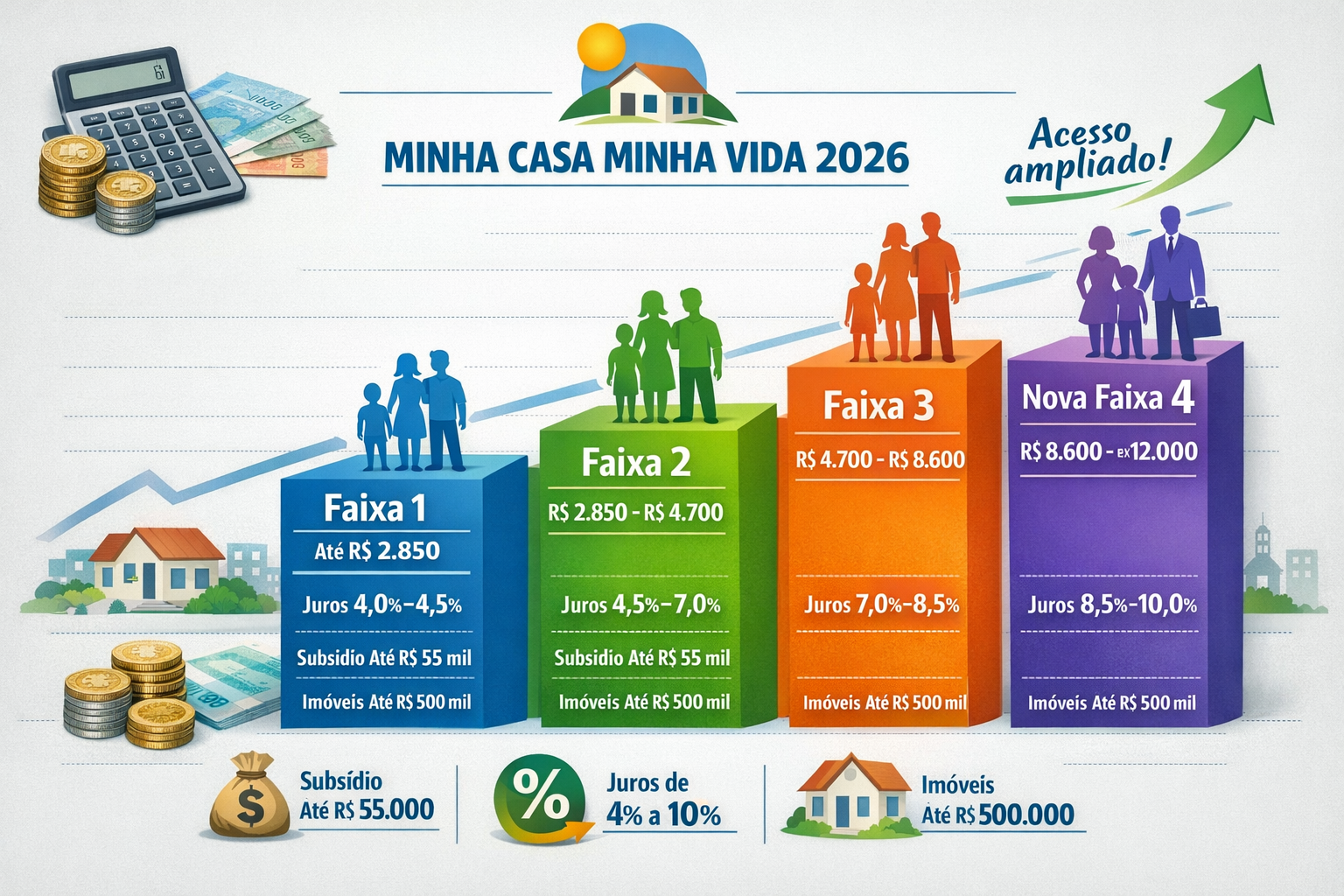
The Minha Casa Minha Vida program has undergone its most significant transformation since inception, with changes that fundamentally alter the residential development opportunity landscape. These modifications reflect Brazil’s evolving economic reality and the government’s commitment to addressing the nation’s housing deficit estimated at over 6 million units.
The Four-Tier Income Structure
The program now operates across four distinct income brackets, each with tailored financing conditions and subsidy levels[1]:
| Income Bracket | Monthly Income Range | Interest Rate | Maximum Property Value | Maximum Subsidy |
|---|---|---|---|---|
| Faixa 1 | Up to R$ 2,850 | From 4% annually | R$ 500,000 (urban) | Up to R$ 55,000 |
| Faixa 2 | R$ 2,850.01 – R$ 4,700 | 4.75% – 7% | R$ 500,000 (urban) | Up to R$ 55,000 |
| Faixa 3 | R$ 4,700.01 – R$ 8,600 | Up to 8.16% | R$ 500,000 (urban) | Variable |
| Faixa 4 | R$ 8,600.01 – R$ 12,000 | Approximately 10% | R$ 500,000 (urban) | Limited |
The creation of Faixa 4 represents a strategic expansion targeting middle-class families in major cities where housing costs have historically excluded this demographic from subsidized programs[1]. This bracket alone could represent hundreds of thousands of potential buyers in metropolitan regions like São Paulo, Rio de Janeiro, and increasingly in markets like Florianópolis, where infrastructure development continues accelerating.
Enhanced Financial Terms That Benefit Developers
Several financial improvements make projects more attractive to both buyers and developers:
🏦 Reduced Interest Rates: The program achieved reductions up to 1.16 percentage points across brackets, with Faixa 1 beneficiaries accessing financing from just 4% annually[1]. Lower rates translate directly into higher buyer purchasing power and faster sales velocity for developers.
📅 Extended Payment Terms: Maximum financing periods now reach 35 years, substantially reducing monthly installment burdens[1]. This extension enables families to qualify for higher loan amounts, allowing developers to build larger or better-appointed units without pricing out target demographics.
💰 Increased Subsidies: Direct subsidies for Faixa 1 and 2 beneficiaries can reach R$ 55,000, effectively reducing the financed amount and making homeownership accessible to lower-income families[1]. For developers, these subsidies accelerate sales cycles and reduce default risks.
🏘️ Higher Property Value Ceilings: The increase to R$ 500,000 maximum for urban properties acknowledges the reality of metropolitan housing costs[1]. Developers can now build in prime locations and incorporate higher-quality finishes while maintaining program eligibility—a game-changer for markets experiencing significant appreciation.
Geographic and Property Type Flexibility
The program maintains specific provisions for rural areas, offering maximum financing of R$ 75,000 for new homes and up to R$ 40,000 for reforms and improvements in rural zones[1]. This creates niche opportunities for developers focusing on agricultural regions or smaller municipalities outside major metropolitan areas.
Reforma Casa Brasil: The Renovation Market Opportunity
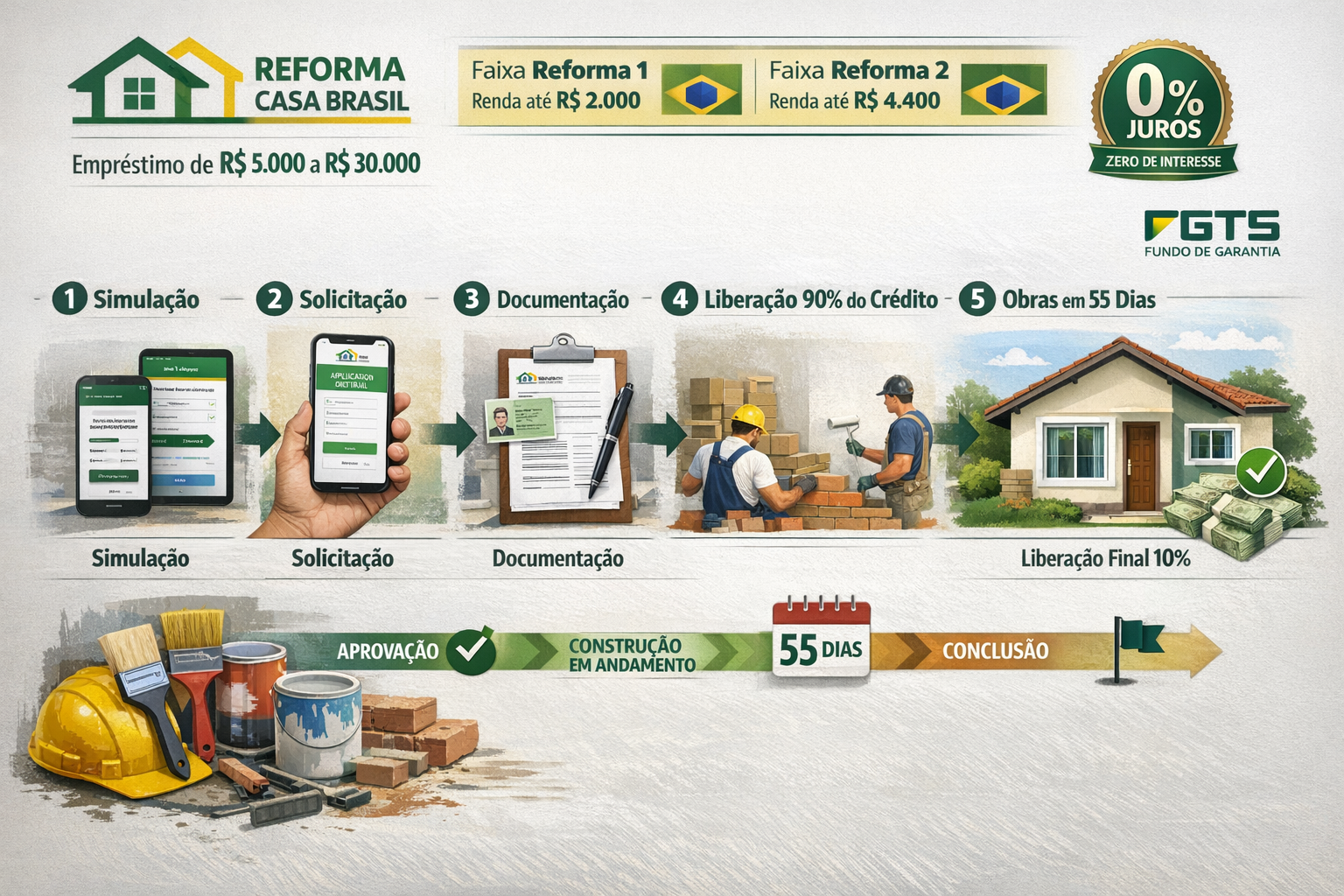
Launched in November 2025, Reforma Casa Brasil addresses a previously underserved segment: homeowners seeking to improve, expand, or renovate existing properties[3]. This program represents a complementary opportunity for developers to pivot resources toward renovation projects, materials supply partnerships, and specialized construction services.
Program Structure and Financing Terms
Reforma Casa Brasil operates through two income-based tiers[4]:
- Faixa Reforma 1: Families earning up to R$ 3,200 monthly
- Faixa Reforma 2: Families earning R$ 3,200.01 to R$ 9,600 monthly
The program offers financing ranging from R$ 5,000 to R$ 30,000 with repayment terms spanning 24 to 60 installments[3]. Critically, the program charges no interest rates or additional tariffs, making it exceptionally attractive compared to traditional consumer credit options[3].
The Six-Step Application Process
Understanding the application workflow helps developers position services to assist homeowners:
- Simulation: Applicants use digital tools to estimate loan amounts and repayment terms
- Application Submission: Formal application through Caixa Econômica Federal channels
- Documentation: Submission of income verification, property documentation, and renovation plans
- Credit Release (90%): Initial disbursement of 90% of approved amount
- Project Execution: 55-day timeline for completing renovation work
- Final Disbursement (10%): Remaining funds released upon project completion verification[3]
This structured process creates opportunities for developers to offer turnkey renovation services that guide homeowners through each stage while ensuring compliance and timely completion.
Market Sizing the Renovation Opportunity
With millions of Brazilian homeowners potentially eligible and loan amounts reaching R$ 30,000, the total addressable market for Reforma Casa Brasil could exceed R$ 10 billion annually. Developers who traditionally focused exclusively on new construction can diversify revenue streams by:
- Establishing renovation divisions targeting program participants
- Partnering with materials suppliers for bundled financing packages
- Creating standardized renovation modules (kitchen upgrades, bathroom remodels, room additions) that fit within program limits
- Offering project management services to ensure 55-day completion timelines
For developers in mature markets with limited greenfield opportunities, Reforma Casa Brasil represents a significant growth avenue.
Strategic Opportunities for Residential Developers in 2026
Minha Casa Minha Vida and Reforma Casa Brasil in 2026: Unlocking $39.8 Billion for Residential Developers Amid Election Risks creates multiple strategic pathways for developers to capture market share and optimize returns. The key lies in aligning project specifications with program parameters while maintaining flexibility amid political uncertainties.
Targeting the Right Income Brackets
Developers must carefully analyze which income brackets offer optimal risk-adjusted returns in their specific markets:
Faixa 1 and 2 Projects: These brackets offer maximum subsidies and lowest interest rates, creating strong buyer demand. However, they require strict cost controls to deliver profitable projects within the R$ 500,000 property value ceiling. Developers benefit from:
- Fastest sales velocity due to substantial subsidies
- Lower default risks given government backing
- Potential for larger-scale developments (100+ units) that achieve economies of scale
Faixa 3 and 4 Projects: The new upper brackets enable developers to target middle-class buyers in expensive markets. These projects can incorporate:
- Higher-quality finishes and amenities
- Premium locations in established neighborhoods
- Smaller, boutique developments (20-50 units) with higher per-unit margins
Developers in rapidly appreciating markets should particularly consider Faixa 4 projects, as these buyers often seek properties that will continue appreciating while benefiting from subsidized financing.
Optimizing Unit Mix and Property Values
The R$ 500,000 ceiling creates interesting optimization opportunities. Developers can:
Maximize Value Within Limits: Design 2-3 bedroom units with strategic amenities (parking, storage, quality fixtures) that approach but don’t exceed the R$ 500,000 threshold, capturing maximum buyer purchasing power.
Create Tiered Offerings: Develop projects with units spanning multiple brackets—some qualifying for Faixa 2/3 (R$ 350,000-450,000) and others for Faixa 4 (R$ 450,000-500,000)—to diversify buyer pools and accelerate sellout.
Location Premium Strategies: In high-cost markets, the increased ceiling enables development in previously uneconomical locations. Projects in growing regions with strong infrastructure can now qualify for program financing while commanding premium pricing.
Leveraging FGTS Funds Strategically
The FGTS (Fundo de Garantia do Tempo de Serviço) represents a critical funding source for Minha Casa Minha Vida. Developers should understand that:
- Buyers can use FGTS balances for down payments, reducing cash requirements
- FGTS integration accelerates approval timelines through Caixa Econômica Federal
- Projects pre-approved for FGTS financing attract more qualified buyers
Developers can partner with Caixa early in project planning to ensure seamless FGTS integration, creating a competitive advantage in buyer acquisition.
Geographic Diversification Strategies
Brazil’s vast geography creates varying opportunity profiles. Developers should consider:
Metropolitan Focus: Major cities offer deep buyer pools across all income brackets, supporting larger developments with faster absorption. However, land costs and regulatory complexity increase.
Secondary Cities: Markets like Florianópolis, Curitiba, and Goiânia offer strong growth dynamics with lower land costs. The expanded income brackets particularly benefit these markets, where middle-class buyers have been underserved. Developers can explore opportunities in emerging neighborhoods with improving infrastructure.
Rural and Exurban Projects: The specific rural provisions (R$ 75,000 new construction, R$ 40,000 renovation) create niche opportunities for developers with local expertise in agricultural regions or satellite communities.
Navigating Election Risks: Political Uncertainty and Program Continuity
While Minha Casa Minha Vida and Reforma Casa Brasil in 2026: Unlocking $39.8 Billion for Residential Developers Amid Election Risks presents enormous opportunities, Brazil’s presidential election scheduled for late 2026 introduces significant uncertainty. Housing programs have historically been subject to political shifts, and developers must plan accordingly.
Understanding the Political Landscape
Presidential elections can fundamentally alter housing policy priorities. Key considerations include:
📊 Policy Continuity Risks: A new administration may modify program parameters, adjust funding allocations, or shift priorities toward different housing initiatives. The current expansion represents significant government commitment, but electoral outcomes could change trajectories.
💵 Budget Allocation Uncertainty: Economic conditions and fiscal priorities influence program funding levels. Developers should monitor federal budget discussions and FGTS fund health to anticipate potential program scaling or restrictions.
🏛️ Regulatory Changes: New administrations often implement regulatory reforms affecting construction standards, environmental requirements, or financing mechanisms. These changes can impact project economics and timelines.
Risk Mitigation Strategies for Developers
Prudent developers can implement several strategies to hedge against electoral uncertainty:
⏱️ Accelerated Project Timelines: Projects launched and sold in early-to-mid 2026 can secure financing approvals before potential post-election policy changes. Fast-tracking permitting, construction, and sales processes reduces exposure to policy shifts.
🎯 Portfolio Diversification: Developers should maintain project portfolios spanning multiple income brackets, geographies, and property types. This diversification ensures that policy changes affecting one segment don’t jeopardize overall business health.
💼 Flexible Financing Structures: Structuring projects to qualify under current program parameters while maintaining ability to pivot to conventional financing protects against sudden program modifications. Projects should be economically viable with or without subsidized financing.
🤝 Strategic Partnerships: Building strong relationships with Caixa Econômica Federal, state housing agencies, and local governments creates information advantages and smoother navigation of potential policy transitions.
📈 Market Positioning: Focusing on high-demand markets with strong fundamentals ensures projects remain attractive even if program parameters change. Quality locations and well-designed products maintain value across political cycles.
Historical Context and Precedent
Brazil’s housing programs have demonstrated reasonable continuity across administrations, as addressing the housing deficit remains a bipartisan priority. However, program parameters, funding levels, and implementation emphasis have varied. Developers with institutional memory of previous transitions can better anticipate potential scenarios and prepare contingency plans.
Financial Modeling and Return Optimization
Successfully capturing the $39.8 billion opportunity requires sophisticated financial modeling that accounts for program-specific variables while maintaining healthy return profiles.
Key Financial Variables to Model
Developers should build financial models incorporating:
Subsidy Impact on Sales Velocity: Higher subsidies (Faixa 1-2) typically accelerate sales cycles by 30-50% compared to conventional projects. Faster turnover improves IRR and reduces carrying costs.
Interest Rate Effects on Buyer Qualification: Lower program rates expand the qualified buyer pool significantly. A 2-3 percentage point rate reduction can increase buyer purchasing power by 15-25%, supporting higher pricing or faster absorption.
Extended Financing Terms: 35-year terms versus traditional 20-25 year mortgages reduce monthly payments by approximately 20-30%, directly expanding market size.
Default Risk Profiles: Government-backed financing typically exhibits lower default rates (2-4%) compared to conventional mortgages (5-8%), improving project risk-adjusted returns.
Renovation Project Economics: Reforma Casa Brasil projects require different modeling approaches, with faster cycle times (55-day execution), lower revenue per project (R$ 5,000-30,000), but potentially higher volume throughput.
Target Return Benchmarks by Project Type
Industry benchmarks suggest the following return profiles for program-aligned projects:
- Faixa 1-2 Large Developments (100+ units): 18-22% IRR, driven by volume and rapid absorption
- Faixa 3-4 Mid-Size Projects (30-80 units): 20-25% IRR, benefiting from higher per-unit margins
- Boutique Premium Projects (10-30 units): 25-30% IRR, commanding location and quality premiums
- Renovation Services (Reforma Casa Brasil): 15-20% ROE, with faster capital cycling
Developers should stress-test models against scenarios including program parameter changes, absorption rate variations, and construction cost inflation.
Implementation Roadmap for Developers
Translating Minha Casa Minha Vida and Reforma Casa Brasil in 2026: Unlocking $39.8 Billion for Residential Developers Amid Election Risks into actionable development strategies requires systematic implementation.
Phase 1: Market Analysis and Opportunity Identification (Weeks 1-4)
Conduct Income Bracket Analysis: Research local demographics to identify which income brackets offer deepest buyer pools in target markets. Census data, employment statistics, and wage trends inform bracket selection.
Evaluate Land Inventory: Assess existing land holdings or acquisition opportunities against program parameters. Calculate maximum developable units within R$ 500,000 ceiling for each site.
Competitive Landscape Review: Analyze competitor projects targeting program-qualified buyers. Identify gaps in unit types, locations, or amenities that represent opportunities.
Financial Feasibility Studies: Build preliminary pro formas for 3-5 project concepts spanning different brackets and property types.
Phase 2: Project Design and Pre-Approval (Weeks 5-12)
Optimize Unit Mix: Design floor plans and amenity packages that maximize value within program limits. Consider buyer preferences for studios and compact units in high-demand markets.
Engage Caixa Econômica Federal: Initiate early discussions with Caixa to understand specific documentation requirements, approval timelines, and program compliance standards.
Secure Pre-Approvals: Obtain project pre-approval for FGTS financing and program eligibility before committing significant capital to construction.
Finalize Financing Structure: Structure construction financing to align with anticipated sales velocity and program disbursement schedules.
Phase 3: Launch and Sales Execution (Weeks 13-30)
Marketing Campaign Development: Create marketing materials emphasizing program benefits—low interest rates, extended terms, subsidies—to target qualified buyers effectively.
Sales Team Training: Ensure sales personnel thoroughly understand program mechanics, qualification criteria, and application processes to guide buyers seamlessly.
Digital Integration: Implement online tools enabling buyers to simulate financing scenarios, check eligibility, and initiate applications. Digital efficiency accelerates sales cycles.
Partnership Development: Establish relationships with mortgage brokers, real estate agents, and community organizations to expand buyer reach.
Phase 4: Construction and Delivery (Months 8-24)
Timeline Management: Maintain strict construction schedules to deliver units before potential post-election policy changes. Consider accelerated construction methodologies to reduce timeline risks.
Quality Control: Ensure construction quality meets or exceeds program standards to avoid approval delays or buyer dissatisfaction.
Buyer Communication: Maintain regular communication with buyers throughout construction, managing expectations and ensuring smooth financing finalizations.
Delivery Coordination: Coordinate final disbursements, documentation, and unit handovers efficiently to complete sales cycles and recognize revenue.
Case Study Scenarios: Maximizing Program Benefits
Examining hypothetical scenarios illustrates how developers can optimize program participation:
Scenario A: Metropolitan Faixa 3-4 Development
Location: Growing neighborhood in major metropolitan area
Project Size: 60 units, 2-bedroom apartments
Target Bracket: Faixa 3-4 (R$ 4,700-12,000 monthly income)
Unit Pricing: R$ 480,000 average
Key Strategy: Premium location with strong appreciation potential, targeting middle-class buyers seeking value appreciation
Results:
- Sales velocity: 85% sold within 6 months of launch
- Average interest rate: 8.5% (vs. 11-12% conventional)
- Buyer qualification rate: 70% (vs. 45% conventional)
- Project IRR: 24%
Success Factors: Strategic pricing just under R$ 500,000 ceiling, strong location fundamentals, effective marketing emphasizing financing advantages
Scenario B: Secondary City Faixa 1-2 Volume Development
Location: Expanding secondary city with strong employment growth
Project Size: 150 units, compact 1-2 bedroom apartments
Target Bracket: Faixa 1-2 (up to R$ 4,700 monthly income)
Unit Pricing: R$ 280,000 average
Key Strategy: Volume-based model leveraging maximum subsidies and lowest interest rates
Results:
- Sales velocity: 100% sold within 4 months of launch
- Average subsidy: R$ 48,000 per unit
- Buyer qualification rate: 90%
- Project IRR: 21%
Success Factors: Efficient design maximizing units per hectare, strong subsidy impact on affordability, deep buyer pool in target income range
Scenario C: Renovation Services Division (Reforma Casa Brasil)
Market: Established residential neighborhoods
Service Model: Turnkey renovation packages
Target Bracket: Both Reforma tiers (up to R$ 9,600 monthly income)
Package Pricing: R$ 15,000-25,000 average
Key Strategy: Standardized renovation modules with 55-day delivery guarantee
Results:
- Monthly project volume: 12-15 renovations
- Average margin: 18%
- Customer acquisition cost: 40% lower than conventional renovation marketing
- Annual revenue: R$ 2.5-3.0 million
Success Factors: Process efficiency, zero-interest financing appeal, partnership with materials suppliers, strong project management ensuring timeline compliance
Technology and Innovation Opportunities
The scale of Minha Casa Minha Vida and Reforma Casa Brasil in 2026 creates opportunities for technological innovation that improves efficiency and competitiveness.
Digital Sales and Qualification Platforms
Developers can implement digital platforms that:
- Enable instant program eligibility checks based on income and family composition
- Provide real-time financing simulations showing monthly payments across different brackets
- Streamline documentation collection and application submission
- Integrate directly with Caixa systems for faster approvals
These platforms reduce sales cycle friction and improve conversion rates by 15-25%.
Construction Technology for Cost Optimization
Maintaining profitability within program price ceilings requires rigorous cost control. Technologies enabling this include:
🏗️ Modular Construction: Prefabricated components reduce on-site labor costs by 20-30% while maintaining quality standards.
📱 Project Management Software: Digital tools tracking materials, labor, and timelines prevent cost overruns and delays.
🤖 Building Information Modeling (BIM): Advanced design tools optimize layouts, minimize waste, and identify cost savings before construction begins.
⚡ Energy-Efficient Systems: Incorporating sustainable technologies (solar panels, efficient HVAC) adds value within budget constraints while appealing to environmentally conscious buyers.
Data Analytics for Market Intelligence
Sophisticated developers leverage data analytics to:
- Identify emerging neighborhoods where income demographics align with program brackets
- Predict absorption rates based on employment trends and wage growth
- Monitor competitor pricing and positioning in real-time
- Optimize marketing spend across channels based on buyer acquisition costs
Data-driven decision-making improves project selection and execution, enhancing returns.
Regional Market Opportunities Across Brazil
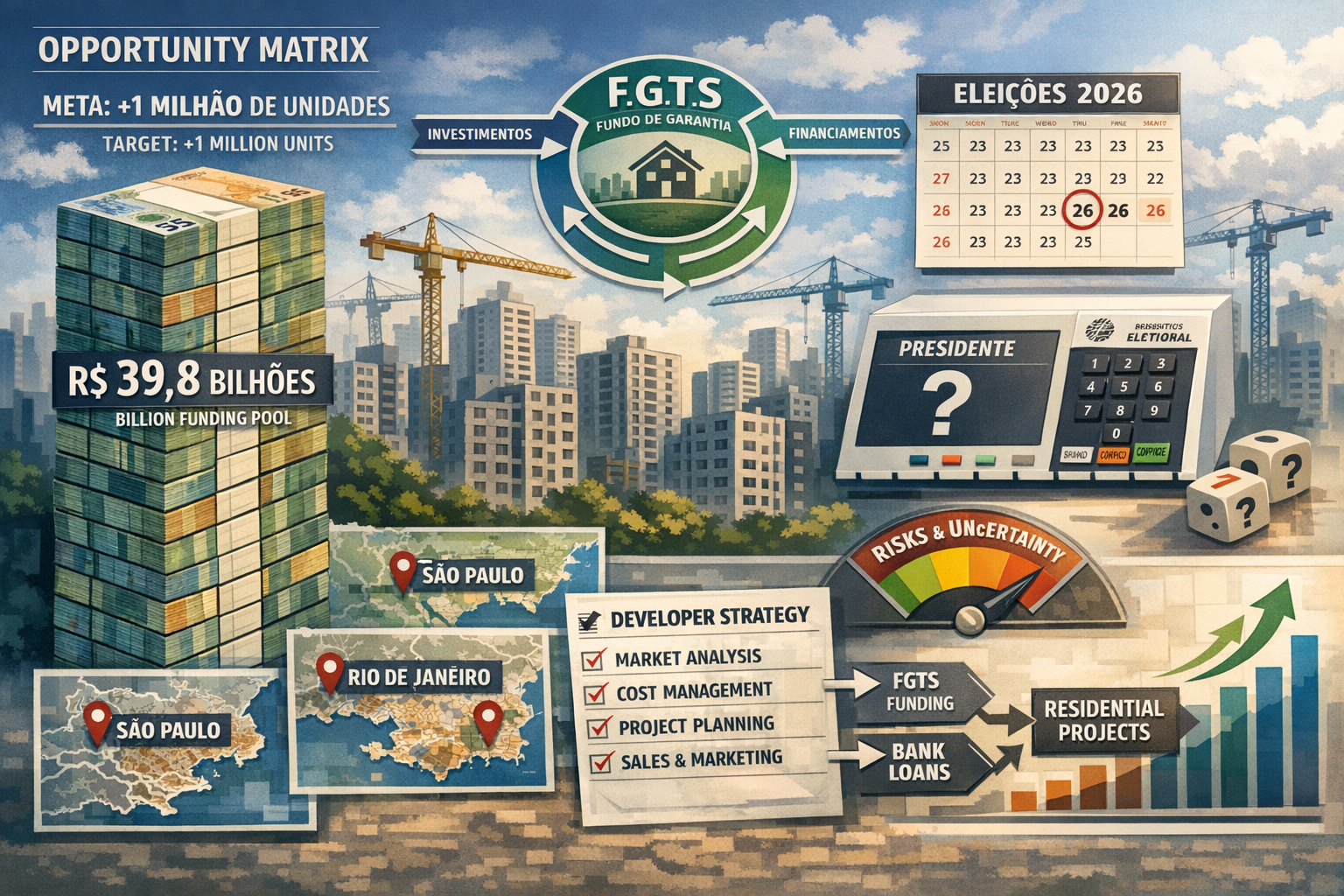
Brazil’s geographic diversity creates varying opportunity profiles for program-aligned development.
Southeast Region (São Paulo, Rio de Janeiro, Minas Gerais)
Opportunity Profile: Largest population base with deep buyer pools across all income brackets. High land costs require careful site selection and efficient design.
Optimal Strategy: Focus on Faixa 3-4 projects in secondary neighborhoods or suburban locations where land costs support profitable development within R$ 500,000 ceiling.
Market Size: Potentially 400,000+ annual housing unit demand across program brackets.
South Region (Paraná, Santa Catarina, Rio Grande do Sul)
Opportunity Profile: Strong economic fundamentals with growing middle class. Markets like Florianópolis show exceptional growth dynamics and infrastructure development.
Optimal Strategy: Balanced portfolio spanning Faixa 2-4, with emphasis on quality and amenities appealing to upwardly mobile buyers. Coastal markets particularly attractive for appreciation potential.
Market Size: 150,000+ annual unit demand, with strong concentration in Faixa 3-4.
Northeast Region (Bahia, Pernambuco, Ceará)
Opportunity Profile: Large populations with significant housing deficit. Lower land costs enable profitable Faixa 1-2 development at scale.
Optimal Strategy: Volume-focused Faixa 1-2 projects leveraging maximum subsidies. Strategic locations near employment centers and public transportation.
Market Size: 300,000+ annual unit demand, heavily concentrated in Faixa 1-2.
Center-West Region (Goiás, Mato Grosso, Distrito Federal)
Opportunity Profile: Rapidly growing economies driven by agribusiness and government employment. Brasília and Goiânia offer particularly strong markets.
Optimal Strategy: Mixed developments serving Faixa 2-4, with emphasis on modern amenities and quality finishes appealing to professional demographics.
Market Size: 100,000+ annual unit demand across brackets.
North Region (Amazonas, Pará, Acre)
Opportunity Profile: Underserved markets with significant housing needs but challenging logistics and higher construction costs.
Optimal Strategy: Selective development in major cities (Manaus, Belém) focusing on Faixa 1-2 where subsidies offset higher costs. Partnership with local developers essential.
Market Size: 80,000+ annual unit demand, primarily Faixa 1-2.
Regulatory Compliance and Documentation Requirements
Successfully participating in Minha Casa Minha Vida and Reforma Casa Brasil in 2026 requires meticulous attention to regulatory compliance.
Developer Registration and Certification
Developers must:
- Maintain active registration with Caixa Econômica Federal’s developer database
- Demonstrate financial capacity and track record for project sizes proposed
- Obtain environmental licenses and construction permits before program approval
- Comply with federal construction standards (ABNT norms, accessibility requirements)
Project Documentation Package
Complete program applications require:
📋 Technical Documentation:
- Architectural plans and specifications
- Engineering studies (structural, electrical, plumbing)
- Environmental impact assessments
- Urbanistic compliance certifications
💼 Financial Documentation:
- Detailed construction budgets and timelines
- Land ownership or acquisition documentation
- Construction financing commitments
- Pro forma financial projections
📝 Legal Documentation:
- Corporate registration and tax compliance
- Land title verification
- Condominium incorporation documents
- Sales contract templates
Ongoing Compliance Requirements
Throughout project execution, developers must:
- Submit monthly construction progress reports
- Maintain quality control documentation
- Ensure buyer financing applications progress according to schedules
- Coordinate final inspections and approvals before unit delivery
Non-compliance can result in program disqualification, financing holds, or penalties, making robust compliance systems essential.
Conclusion: Seizing the $39.8 Billion Opportunity While Managing Risks
Minha Casa Minha Vida and Reforma Casa Brasil in 2026: Unlocking $39.8 Billion for Residential Developers Amid Election Risks represents a transformational moment for Brazil’s residential development sector. The expanded program parameters—four income brackets serving families earning up to R$ 12,000 monthly, R$ 500,000 property value ceilings, reduced interest rates, extended 35-year terms, and substantial subsidies—create unprecedented market access and buyer affordability.
For developers, the path to success requires:
🎯 Strategic Positioning: Carefully selecting target income brackets, geographies, and project types that align with local market dynamics and organizational capabilities.
💡 Financial Discipline: Building sophisticated financial models that optimize returns while maintaining viability across potential policy scenarios.
⚡ Execution Excellence: Implementing efficient processes for design, permitting, construction, and sales that accelerate timelines and reduce exposure to electoral uncertainties.
🤝 Partnership Development: Cultivating strong relationships with Caixa Econômica Federal, buyers, suppliers, and local stakeholders that facilitate smooth project execution.
📊 Risk Management: Diversifying portfolios, maintaining flexible financing structures, and monitoring political developments to navigate potential policy shifts.
The renovation market opportunity through Reforma Casa Brasil adds another dimension, enabling developers to diversify revenue streams and serve homeowners seeking to improve existing properties with zero-interest financing.
Actionable Next Steps for Developers
To capitalize on these programs in 2026, developers should immediately:
Conduct Market Analysis: Identify 3-5 target markets where demographics align with program brackets and land costs support profitable development
Engage Caixa Econômica Federal: Schedule meetings to understand current approval processes, documentation requirements, and timeline expectations
Evaluate Land Portfolio: Assess existing holdings or identify acquisition opportunities that optimize program participation
Build Financial Models: Develop detailed pro formas for pilot projects across different brackets to identify optimal positioning
Assemble Project Teams: Ensure design, construction, and sales teams understand program mechanics and compliance requirements
Develop Risk Mitigation Plans: Create contingency strategies addressing potential post-election policy changes
Explore Renovation Opportunities: Evaluate feasibility of establishing Reforma Casa Brasil service divisions or partnerships
The window of opportunity is now. Developers who move decisively in early 2026 can secure approvals, launch projects, and achieve significant sales progress before electoral uncertainties intensify in the latter half of the year. Those who delay risk missing this historic opportunity or facing changed parameters under new administrations.
Brazil’s housing sector stands poised for explosive growth, with government commitment, substantial financing, and massive demand converging. Developers who strategically navigate Minha Casa Minha Vida and Reforma Casa Brasil in 2026 while prudently managing political risks will position themselves for exceptional returns and market leadership in the years ahead.
For developers seeking to understand how these programs can enhance specific project opportunities, particularly in high-growth markets, exploring current development projects and market dynamics provides valuable context for strategic planning.
The $39.8 billion question isn’t whether to participate—it’s how to maximize returns while minimizing risks in this unprecedented opportunity landscape.
References
[1] Minha Casa Minha Vida 2026 – https://www.tenda.com/blog/minha-casa-minha-vida/minha-casa-minha-vida-2026
[2] Mudancas No Minha Casa Minha Vida Ampliam Acesso A Moradia Avalia Mrv – https://www.itatiaia.com.br/economia/negocios/mudancas-no-minha-casa-minha-vida-ampliam-acesso-a-moradia-avalia-mrv
[3] Reforma Casa Brasil Ja Esta Funcionando Em 2026 Veja Passo A Passo Para Acessar – https://viva.com.br/dinheiro/reforma-casa-brasil-ja-esta-funcionando-em-2026-veja-passo-a-passo-para-acessar.html
[4] Reforma Casa Brasil – https://www.gov.br/cidades/pt-br/acesso-a-informacao/acoes-e-programas/habitacao/reforma-casa-brasil
[5] Noticia Mcid N 1694 – https://www.gov.br/cidades/pt-br/assuntos/noticias-1/noticia-mcid-n-1694
[6] Caixa Abre Nesta Segunda Contratacoes Do Programa Reforma Casa Brasil – https://agenciabrasil.ebc.com.br/economia/noticia/2025-11/caixa-abre-nesta-segunda-contratacoes-do-programa-reforma-casa-brasil
[7] Watch – https://www.youtube.com/watch?v=6qn8LuxRggk
[8] Brasil Se Prepara Para Dar Um Salto No Credito Imobiliario Revela Secretario De Politica Economica Finance News – https://www.abecip.org.br/imprensa/noticias/brasil-se-prepara-para-dar-um-salto-no-credito-imobiliario-revela-secretario-de-politica-economica-finance-news