
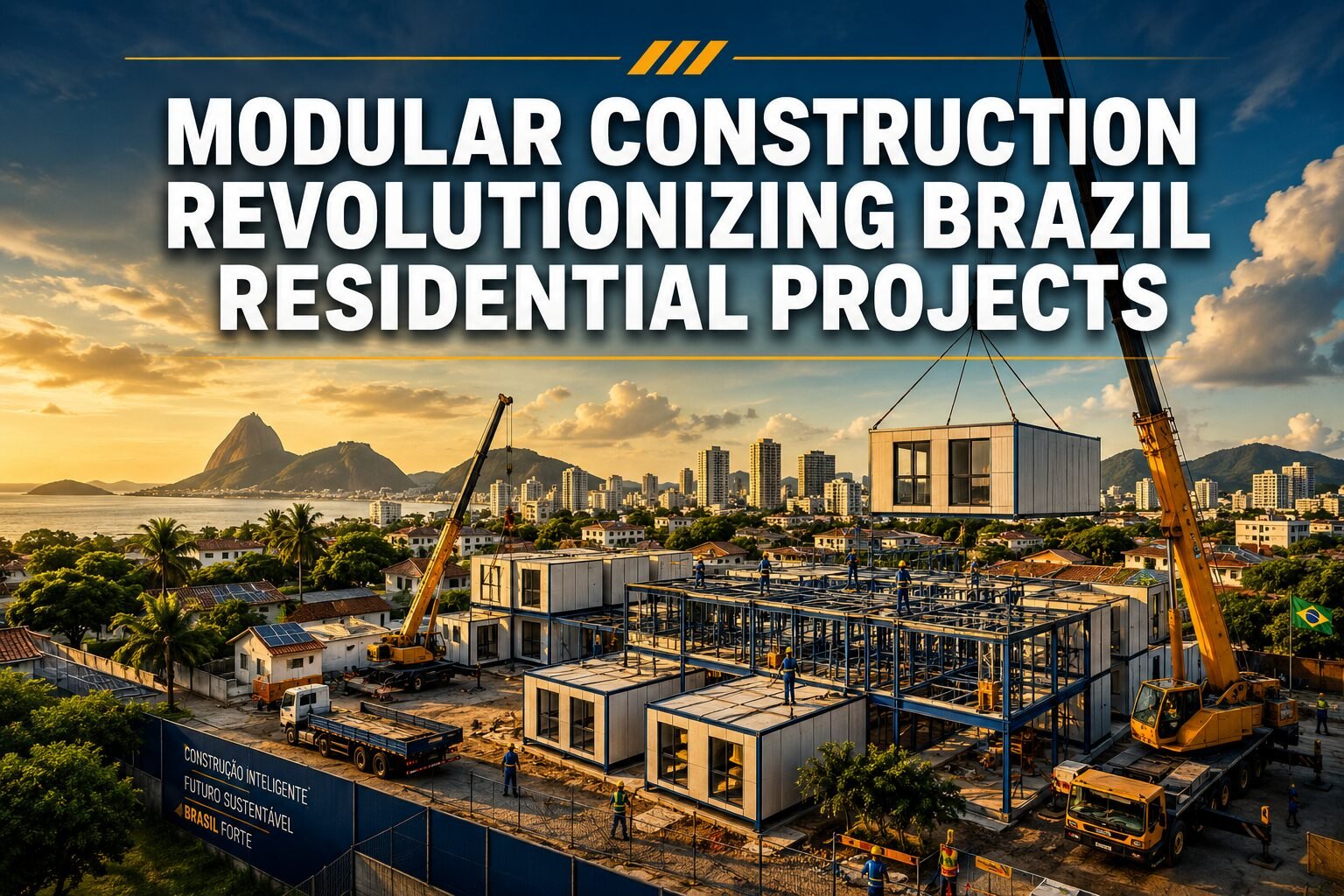
Brazil carries a housing deficit of more than 8 million units — a number so large it exceeds the entire population of Switzerland. Against that backdrop, modular construction revolutionizing Brazil residential projects is no longer a niche experiment. It is becoming the most credible answer to one of the country’s most urgent social and economic challenges, with 2026 marking a genuine inflection point for delivery timelines, affordability, and urban scalability.
Key Takeaways
- Brazil’s housing deficit exceeds 8 million units, creating enormous pressure on developers, governments, and investors to find faster building methods.
- Modular and prefabricated homes can be assembled in as few as 5 to 90 days, compared to 12 to 24 months for conventional construction.
- Costs can run up to 60% lower than traditional builds, making modular housing a viable tool for affordable housing programs like Minha Casa Minha Vida (MCMV).
- The Brazilian modular construction market is projected to grow from USD 660.6 million in 2025 to USD 1,083.2 million by 2033, at a CAGR of 6.4% [4].
- Regulatory gaps and logistics challenges remain the primary barriers to full-scale adoption, but public-private momentum is accelerating solutions.
The Scale of Brazil’s 2026 Housing Crisis
Brazil’s urban housing shortage has been building for decades. Rapid rural-to-urban migration, income inequality, and chronic underinvestment in social infrastructure have combined to push the deficit past 8 million units, concentrated heavily in metropolitan peripheries and low-income communities [5]. The government’s flagship program, Minha Casa Minha Vida (MCMV), has set an ambitious target of delivering over one million affordable housing units, but conventional construction methods are simply too slow and too expensive to close that gap at the required pace [8].
Traditional brick-and-mortar construction in Brazil typically takes 12 to 24 months per project cycle, is highly sensitive to labor shortages, and carries significant cost overruns driven by material price volatility. For developers and policymakers trying to address 2026 housing shortfalls, those timelines are unacceptable.
The core problem is not ambition — it is execution speed. Modular construction directly attacks that bottleneck.
For investors and developers evaluating where capital can generate both returns and social impact, understanding the best places to invest in Brazil property requires understanding which construction methods will actually deliver units on time.
How Modular Construction Is Revolutionizing Brazil Residential Projects
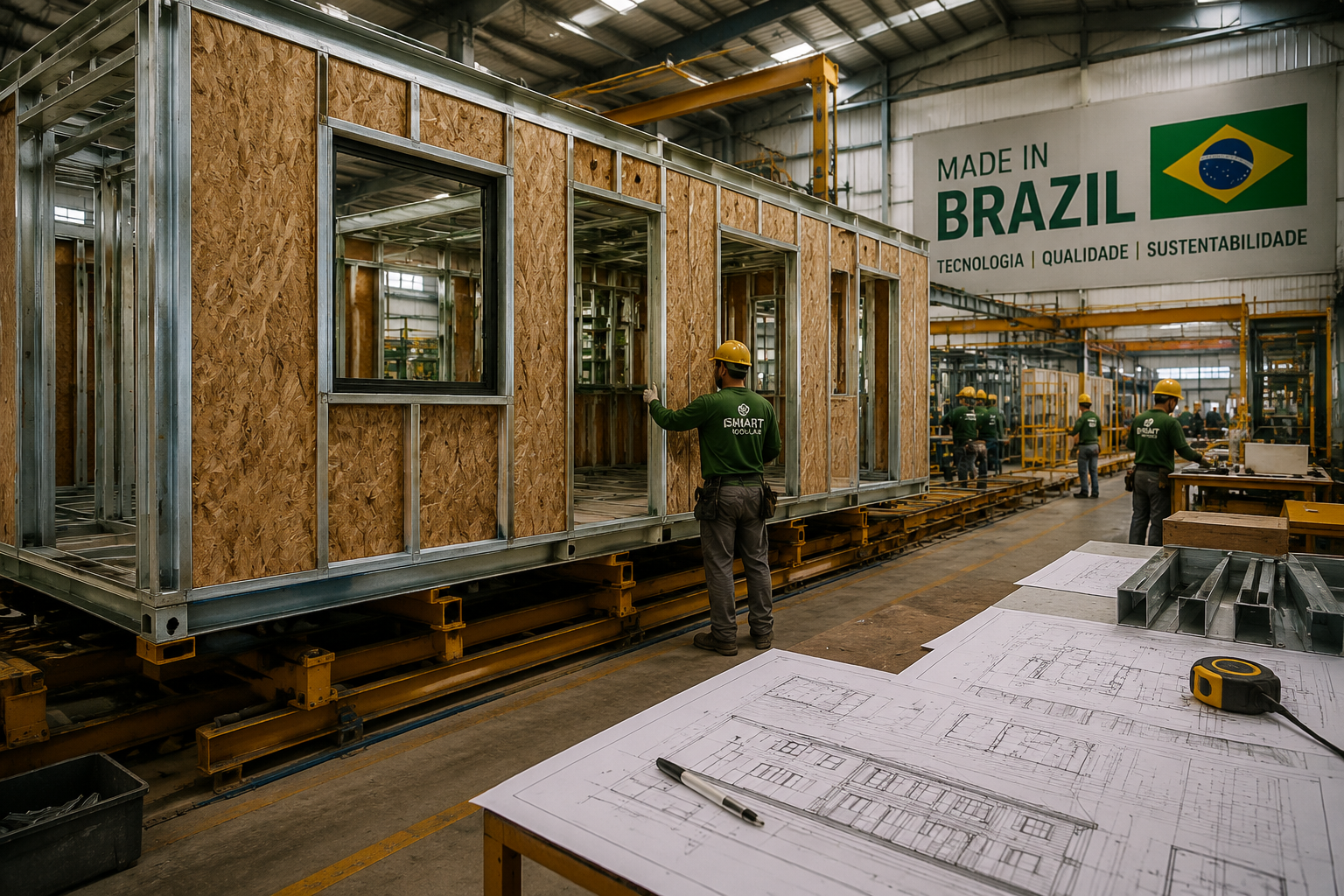
Modular construction involves manufacturing building components — walls, floors, roof panels, utility cores — in a controlled factory environment, then transporting and assembling them on-site. The process eliminates many of the delays associated with weather, on-site labor coordination, and sequential construction phases.
Speed and Cost Advantages
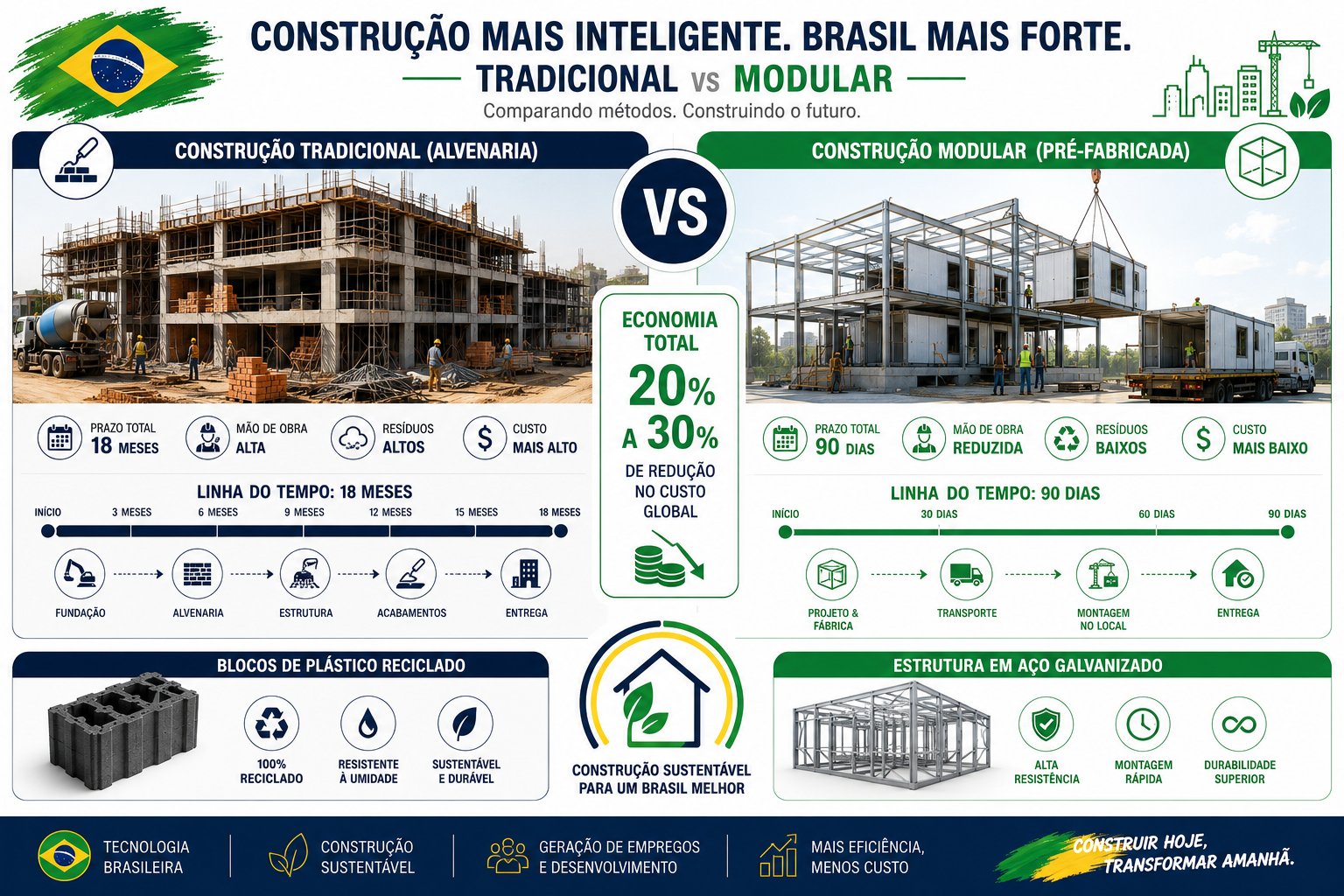
The numbers speak clearly. In October 2025, modular homes measuring 50 m² entered the Brazilian market at R$ 79,000 — ready for occupancy within 90 days of order, featuring acoustic insulation and energy-efficient design, and costing up to 60% less than comparable conventional builds [1]. That price point places homeownership within reach for millions of Brazilians currently locked out of the formal housing market.
Even more striking is the February 2026 initiative by the Amazonas state government, which began constructing 50 m² modular homes using interlocking recycled plastic blocks. These units require no mortar, resist the region’s extreme humidity, and can be fully assembled in as little as five days [3]. That figure — five days — represents a fundamental shift in what is operationally possible.
“The question is no longer whether modular construction can work in Brazil. The question is how fast the ecosystem can scale.”
Key Metrics at a Glance
| Method | Assembly Time | Cost vs. Traditional | Weather Dependency |
|---|---|---|---|
| Conventional brick/mortar | 12-24 months | Baseline | High |
| Steel-frame modular | 60-90 days | 30-40% lower | Low |
| Recycled plastic modular | 5-7 days | Up to 60% lower | Very low |
| Temporary emergency modular | 30-45 days | Variable | Low |
MRV Engenharia and the Industrial Construction Model
MRV Engenharia, Brazil’s largest homebuilder by volume, has been at the forefront of industrializing residential construction. By integrating prefabricated components into its MCMV-aligned project pipelines, MRV has reduced on-site labor requirements, tightened quality control, and compressed delivery windows significantly. The company’s scale — operating across dozens of Brazilian cities simultaneously — means that even incremental efficiency gains translate into thousands of additional units per year.
The broader prefabricated construction sector is undergoing strategic transformation, driven by urban housing demand, infrastructure investment, and domestic manufacturing innovation supported by public-private collaboration [9]. Leaders like MRV are not simply adopting modular methods; they are redesigning their entire supply chains around factory-first production logic.
Government Programs, Emergency Deployments, and Market Growth
MCMV Integration and Policy Support
The Brazilian federal government has moved decisively to embed modular and prefabricated methods within MCMV’s delivery framework. The rationale is straightforward: if the program is to meet its one-million-unit target, it cannot rely exclusively on methods that take two years per development cycle [8]. Modular construction compresses that timeline while maintaining — and in many cases improving — structural and thermal performance standards.
Developers tracking the real estate market in Greater Florianopolis will recognize that southern Brazil’s coastal cities are among the fastest-growing urban markets, where housing supply constraints are most acute and where modular methods offer the clearest competitive advantage.
Emergency Deployment: Rio Grande do Sul Floods
One of the most concrete demonstrations of modular construction’s scalability came in July 2024, when the Rio Grande do Sul state government commissioned 500 temporary modular homes for families displaced by catastrophic flooding. Each 27 m² unit was built with reinforced metal structures for durability and included all essential living spaces [2]. The project proved that modular systems could be mobilized at scale under emergency conditions — a capability with direct relevance to Brazil’s climate vulnerability.
By 2026, flood-resistant modular designs featuring elevated steel frames and waterproof exteriors have become standard specifications in leading modular systems deployed across flood-prone regions [6]. This climate resilience dimension adds significant value beyond pure cost and speed metrics.
Sustainable Innovation: The Alma Marau Example
Modular construction is also proving its credentials in the premium and eco-sensitive segment. The Alma Marau project in Bahia exemplifies how modular techniques can minimize environmental disruption in ecologically sensitive areas, integrating native flora and fauna into architectural design while reducing the construction footprint that conventional methods would require [7]. This demonstrates that modular is not solely a low-cost housing tool — it is a flexible methodology applicable across market segments.
Market Projections
The financial trajectory of the sector reinforces the strategic case. Brazil’s modular construction market is projected to grow from USD 660.6 million in 2025 to USD 1,083.2 million by 2033, representing a CAGR of 6.4% from 2026 to 2033 [4]. That growth rate reflects both the scale of unmet demand and the increasing confidence of institutional investors in modular delivery systems.
For investors considering off-plan property purchases in Brazilian residential developments, the shift toward modular methods directly affects delivery risk — one of the most significant variables in off-plan investment returns.
Challenges Facing Full-Scale Modular Adoption in Brazil
Modular construction revolutionizing Brazil residential projects faces real structural obstacles that must be acknowledged honestly.
Regulatory and Standards Gaps
Brazil’s building codes and technical standards were largely written for conventional construction. Modular systems — particularly those using novel materials like recycled plastic blocks — often require case-by-case regulatory approvals, slowing project timelines and increasing compliance costs for developers [10]. The absence of a unified national modular construction standard remains one of the sector’s most significant institutional barriers.
Progress is being made. Industry associations and government technical bodies are actively working toward standardized certification pathways, but full regulatory alignment is still a work in progress as of 2026.
Logistics and Transportation Constraints
Prefabricated modules must be transported from factories to construction sites. In Brazil’s densely populated coastal cities, traffic infrastructure and crane access can create logistical complications. In remote regions — particularly in the Amazon and interior Northeast — transportation costs can erode the cost advantages that make modular attractive in the first place [10].
Solutions being developed include:
- Regional factory networks that reduce transport distances
- Smaller modular components that fit standard truck dimensions
- Flat-pack designs that maximize shipping efficiency before on-site assembly
Workforce Transition
The modular model shifts labor demand from on-site construction workers to factory-based manufacturing workers. While this improves quality control and working conditions, it requires retraining programs and creates short-term displacement pressures in communities where construction employment is a primary income source. Managing this transition equitably is both a social responsibility and a political prerequisite for sustained government support.
Perception and Cultural Acceptance
In Brazil, as in many markets, prefabricated housing carries historical associations with low quality and impermanence. Overcoming that perception requires sustained demonstration projects, strong warranty programs, and visible endorsement from respected developers and government agencies. The recent wave of high-specification modular launches — with acoustic insulation, energy efficiency, and climate-resilient features — is actively reshaping that narrative.
Urban Scalability: Where Modular Makes the Most Impact
The case for modular construction is strongest in Brazil’s rapidly urbanizing secondary cities and metropolitan peripheries, where land is available, infrastructure investment is accelerating, and housing demand is growing faster than conventional supply chains can respond.
Cities like Florianopolis, with its strong tech economy and quality-of-life profile, illustrate the opportunity clearly. The growth of the Ingleses region in Florianopolis reflects exactly the kind of demand dynamics — rapid population growth, infrastructure investment, rising land values — where modular construction can accelerate supply and capture value for developers simultaneously.
Similarly, the Solis development and other projects in the Quadragon portfolio demonstrate how forward-thinking developers are positioning themselves within Brazil’s evolving residential construction landscape, where speed to market and construction efficiency are becoming core competitive differentiators.
Where Modular Delivers Maximum Value
- Urban peripheries with high MCMV demand and available land
- Flood-prone regions requiring climate-resilient structural solutions
- Remote and Amazon communities where conventional supply chains are prohibitively expensive
- Coastal tourism markets where seasonal demand creates pressure for rapid delivery
- Emergency housing programs requiring mobilization within weeks rather than years
The Investment Case for Modular-Aligned Real Estate in Brazil
For real estate investors, the modular construction shift has direct financial implications. Developments built with modular or prefabricated methods carry lower construction risk, shorter capital exposure periods, and more predictable delivery timelines. Those factors reduce the risk premium that investors must build into their return expectations.
The advantages of investing in studios in Florianopolis are amplified when the underlying construction methodology can compress the development cycle from 24 months to 6-9 months. Faster delivery means faster rental income, faster capital recycling, and lower exposure to macroeconomic volatility during the construction period.
The performance-driven transformation of Florianopolis real estate sales is also relevant here: as developers adopt modular methods, the ability to pre-sell units with credible delivery guarantees becomes a powerful marketing and financing tool.
Conclusion: Actionable Steps for Developers, Investors, and Policymakers
Modular construction revolutionizing Brazil residential projects is not a future scenario — it is a present reality accelerating toward full mainstream adoption. The convergence of a massive housing deficit, government program support, falling modular costs, and growing domestic manufacturing capacity has created conditions for rapid scaling in 2026 and beyond.
For developers, the priority action is to evaluate modular and prefabricated methods for any project where delivery speed is a competitive or financial advantage. Partnering with established domestic manufacturers and engaging early with regulatory bodies on certification pathways will reduce first-mover risk.
For investors, modular-aligned developments deserve a lower risk discount than conventional projects of equivalent scale, given their superior timeline predictability. Due diligence should now routinely include an assessment of the construction methodology alongside location and demand fundamentals.
For policymakers, the most impactful near-term action is accelerating the development of a unified national modular construction standard. Regulatory clarity will unlock private investment far faster than any direct subsidy program.
For communities and homebuyers, the key message is that modular does not mean inferior. The latest generation of Brazilian modular homes offers acoustic insulation, energy efficiency, climate resilience, and design quality that matches or exceeds conventional alternatives — at a fraction of the cost and in a fraction of the time.
The 8-million-unit deficit will not be solved by any single technology or policy. But modular construction, applied at scale and supported by the right regulatory and financing frameworks, can close that gap faster than any alternative currently available. The tools exist. The market is moving. The question for every stakeholder in Brazil’s residential sector is how quickly they will move with it.
References
[1] Casa Modular De 50 M2 Por R 79 Mil Vira Tendencia No Brasil Pronta Em 90 Dias Com Isolamento Acustico Custo 60 Menor Vml97 – https://en.clickpetroleoegas.com.br/casa-modular-de-50-m2-por-r-79-mil-vira-tendencia-no-brasil-pronta-em-90-dias-com-isolamento-acustico-custo-60-menor-vml97?utm_source=openai
[2] Fabrica No Vale Do Sinos Inicia Producao De Casas Temporarias Para Vitimas Das Enchentes No Rs – https://www.terra.com.br/noticias/fabrica-no-vale-do-sinos-inicia-producao-de-casas-temporarias-para-vitimas-das-enchentes-no-rs%2C3498105831a5b5eff3c5bd2261ca997003qzbpss.html?utm_source=openai
[3] Governo Comeca A Construir Casas De Plastico Que Ficam Prontas Em Cinco Dias Com 50 M2 E Estrutura De Encaixe Sem Argamassa Resistente A Umidade Brasileira – https://clickpetroleoegas.com.br/governo-comeca-a-construir-casas-de-plastico-que-ficam-prontas-em-cinco-dias-com-50-m%C2%B2-e-estrutura-de-encaixe-sem-argamassa-resistente-a-umidade-brasileira-afch/?utm_source=openai
[4] Brazil Modular Construction Market Outlook – https://www.grandviewresearch.com/horizon/outlook/modular-construction-market/brazil?utm_source=openai
[5] Brazil Engineering And Modular Construction – https://www.trade.gov/market-intelligence/brazil-engineering-and-modular-construction?utm_source=openai
[6] Climate Resilient Modular Housing 2026 CTE Trends Driving MCMV Upgrades In Flood Prone Northeast Peripheries – https://quadragon.com.br/climate-resilient-modular-housing-2026-cte-trends-driving-mcmv-upgrades-in-flood-prone-northeast-peripheries/?utm_source=openai
[7] AOD 2024 Alma Mara – https://www.modular.org/aod-2024-alma-mara/?utm_source=openai
[8] Modular Prefab Revolution In MCMV Projects 2026 Accelerating 1M Unit Delivery Amid Supply Chain Pressures – https://quadragon.com.br/modular-prefab-revolution-in-mcmv-projects-2026-accelerating-1m-unit-delivery-amid-supply-chain-pressures/?utm_source=openai
[9] Brazil Prefabricated Construction Industry Intelligence Report 2025 – https://www.businesswire.com/news/home/20251008838493/en/Brazil-Prefabricated-Construction-Industry-Intelligence-Report-2025-Urban-Housing-Demand-Infrastructure-Investment-and-Innovation-Drive-Growth—Forecast-to-2029—ResearchAndMarkets.com?utm_source=openai
[10] Sistema De Construcao Modular Um Estudo De Viabilidade Da Construcao Modular Voltado A Moradia Social – https://www.researchgate.net/publication/392542205_Sistema_de_construcao_modular_um_estudo_de_viabilidade_da_construcao_modular_voltado_a_moradia_social?utm_source=openai