
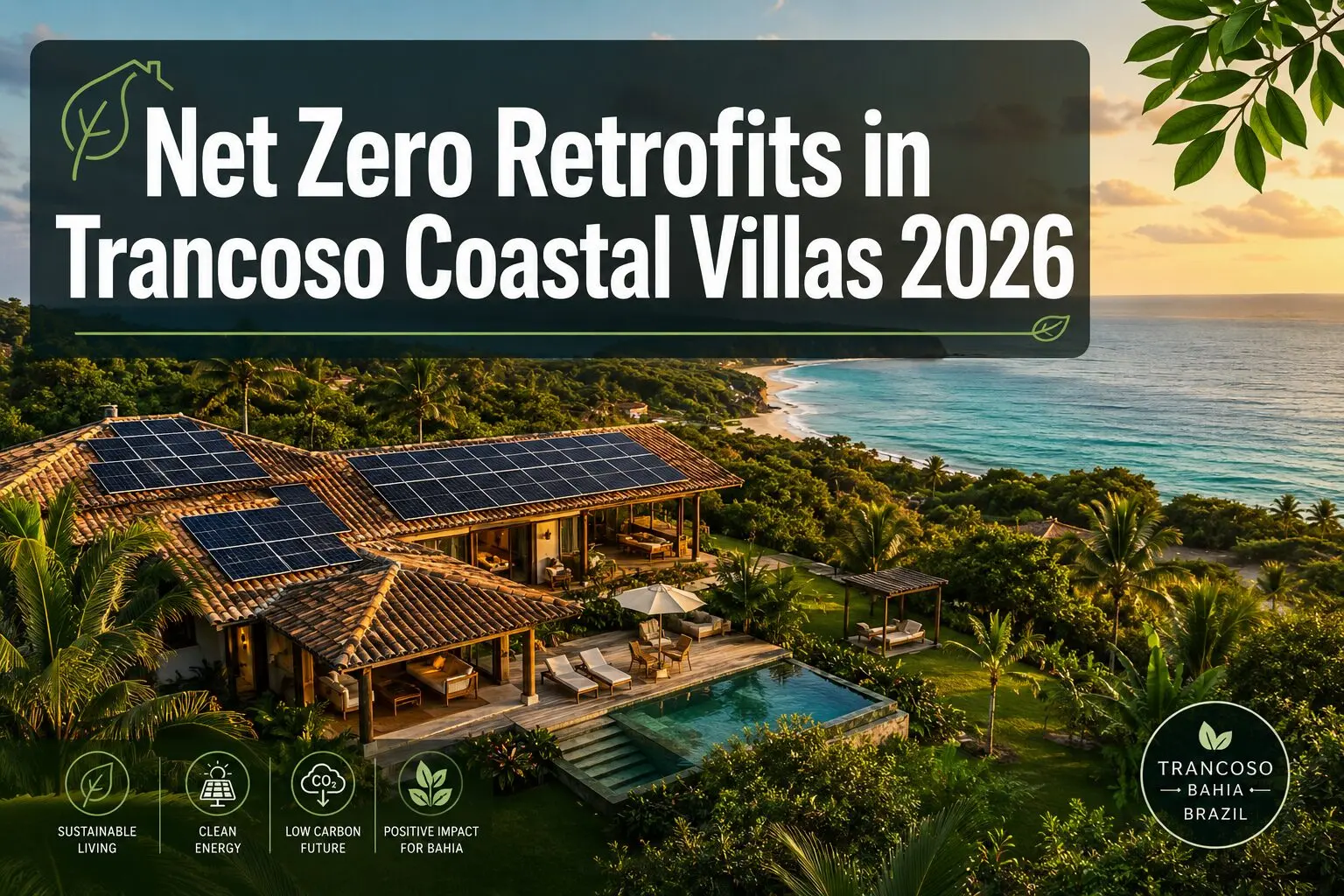
By 2026, 48% of high-net-worth individuals globally consider energy efficiency “important” or “very important” when purchasing a second home — and that number jumps to 59% among buyers under 45, according to Knight Frank’s Wealth Report research. For Trancoso, Bahia’s most celebrated luxury coastal enclave, this shift is not abstract: it is reshaping villa valuations, attracting European ESG-focused capital, and making Net Zero Retrofits in Trancoso Coastal Villas 2026: ESG Premiums for Tourism-Driven Second Homes one of the most consequential conversations in Brazilian luxury real estate right now.
Key Takeaways 🌿
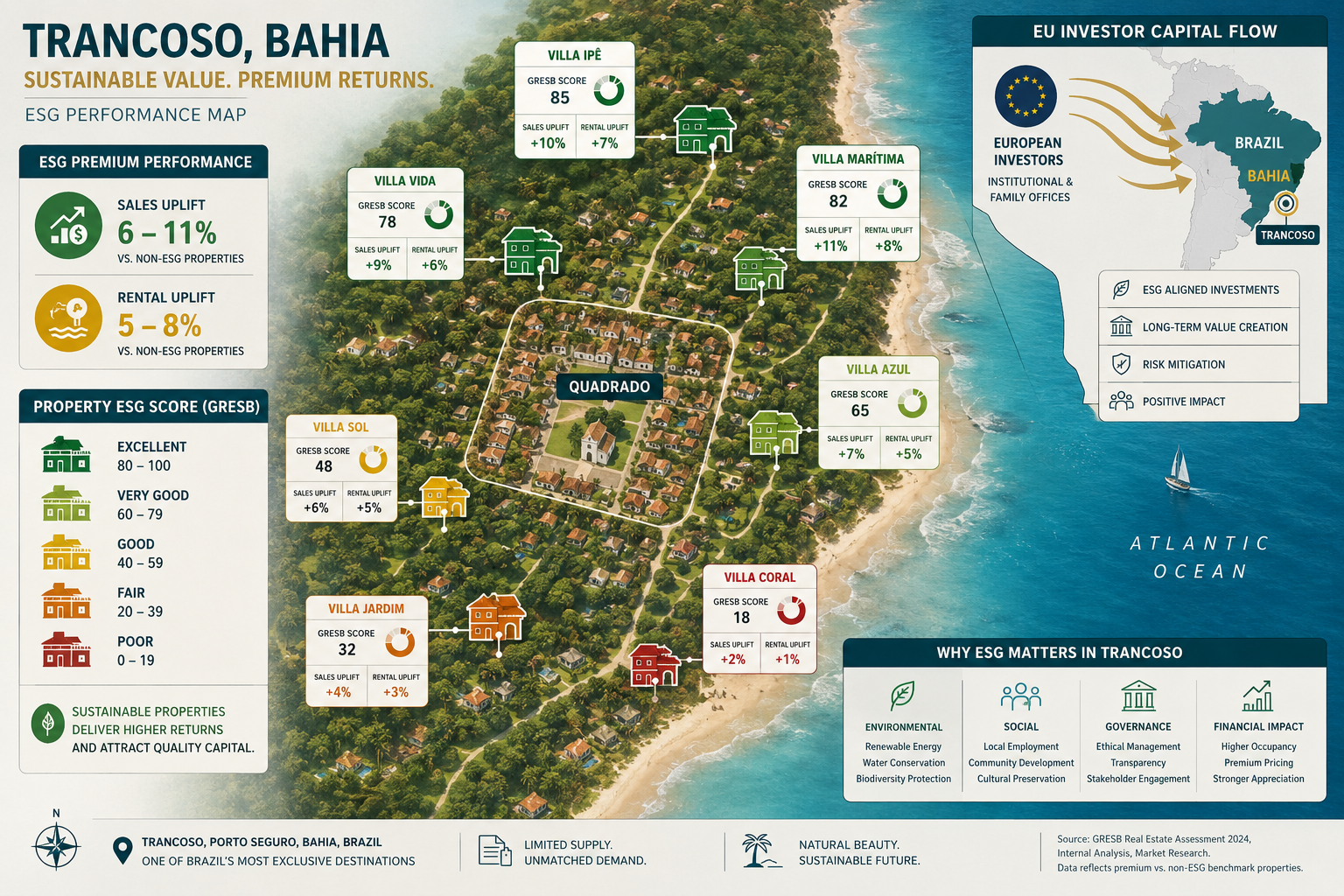
- ESG retrofits command real premiums: Certified green residential buildings globally show sales price premiums of 6–11% and rental premiums of 5–8% vs. conventional comparables.
- Trancoso’s tourism base is growing fast: The Costa do Descobrimento region received 2.4 million visitors in 2023, with rising international high-spend arrivals driving demand for sustainable luxury.
- Brazil’s regulatory environment is tightening: The updated 2024 NDC commits Brazil to a 53% GHG reduction by 2030, creating compliance and reputational incentives for net-zero villa upgrades.
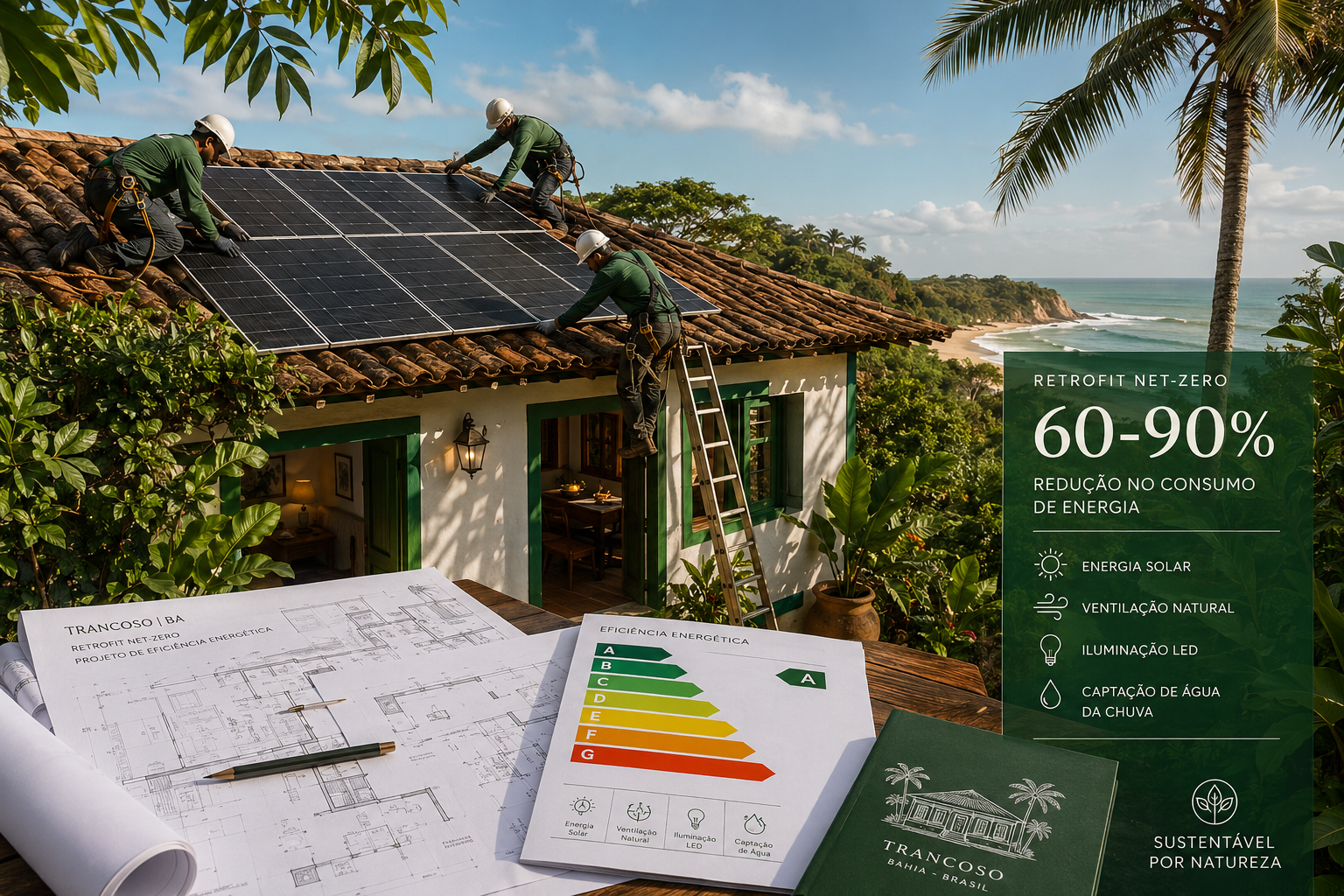
- Technical pathways are proven: Combining rooftop PV, high-performance envelopes, efficient HVAC, and water reuse can achieve 60–90% site-energy reduction in tropical low-rise villas [6].
- EU investors are leading demand: European buyers, subject to strict ESG disclosure rules at home, increasingly require green credentials from international second-home assets.
Why Trancoso Has Become Ground Zero for Sustainable Luxury Investment
Trancoso is not a typical beach town. Its iconic Quadrado — a grass-covered square lined with colorful casas and pousadas — has long attracted a global elite willing to pay premium prices for exclusivity and natural beauty. But by 2026, exclusivity alone is no longer enough. Sustainability has become the new luxury signal.
Bahia’s tourism secretariat (Setur Bahia) reports that the Costa do Descobrimento region, which includes Trancoso and Porto Seguro, welcomed 2.4 million visitors in 2023, with international high-spend tourists among the fastest-growing segments. The regional tourism strategy explicitly positions the area around “sustainable luxury” — a framing that directly rewards villa owners who invest in low-carbon upgrades.
This creates a rare convergence: a world-class destination with strong occupancy fundamentals, a growing international buyer pool with ESG mandates, and a regulatory environment pushing Brazil’s entire building stock toward net-zero performance. For investors exploring the best places to invest in Brazil property, Trancoso’s combination of lifestyle appeal and green-premium potential is increasingly hard to ignore.
💬 “Sustainable luxury is no longer a niche — it is the primary value driver for coastal second homes targeting international buyers in 2026.”
Understanding the ESG Premium: What the Data Shows
Global Evidence for Green Premiums in Residential Assets
The financial case for Net Zero Retrofits in Trancoso Coastal Villas 2026: ESG Premiums for Tourism-Driven Second Homes is grounded in robust global data:
| Metric | Premium Range | Source |
|---|---|---|
| Sales price premium (certified green vs. conventional) | 6–11% | World Green Building Council, 2023 |
| Rental income premium | 5–8% | World Green Building Council, 2023 |
| HNWI buyers citing ESG as “important” | 48% (59% under-45) | Knight Frank Wealth Report 2024 |
| Energy reduction achievable via retrofit | 60–90% | Tropical retrofit studies [6] |
| GHG reduction target, Brazil NDC 2024 | 53% by 2030 | UNFCCC / Brazil NDC |
The Global Real Estate Sustainability Benchmark (GRESB) 2024 further confirms that hospitality and resort assets with higher sustainability scores show lower vacancy rates and more stable cash flows — a direct parallel to Trancoso’s villa-rental market.
Why Tourism-Driven Second Homes Are Especially Sensitive to ESG
Unlike primary residences, tourism-driven second homes in Trancoso face a double ESG exposure:
- The buyer side: International purchasers — especially from the EU, where sustainable finance disclosure regulations (SFDR) are strict — increasingly require green credentials before committing capital.
- The rental side: Luxury travel platforms and high-end booking agencies are actively filtering properties by sustainability ratings. A net-zero villa commands higher nightly rates and attracts longer bookings from eco-conscious travelers.
This dual pressure means that a well-documented retrofit (solar PV + efficient envelope + smart HVAC + water reuse) is not just an ethical choice — it is a revenue optimization strategy.
Technical Pathways: How Net-Zero Retrofits Work in Trancoso’s Tropical Climate
The Retrofit Stack for Coastal Bahia Villas
Trancoso’s warm-humid climate (average temperatures 24–30°C year-round, high solar irradiance, coastal salt exposure) creates specific technical requirements. Research on net-zero retrofits in tropical residential buildings identifies a proven upgrade sequence [6][7]:
☀️ Energy Generation
- Rooftop solar PV (6–8 kW per villa): Bahia’s solar irradiance is among the highest in Brazil, making PV the single highest-return retrofit investment. Corrosion-resistant mounting systems are essential for ocean-exposed sites.
- Solar hot water systems: Replace electric resistance water heating, cutting domestic hot water energy use by up to 70%.
🏠 Building Envelope Upgrades
- High-performance windows with low-E glazing: Reduce solar heat gain without blocking natural light.
- External shading elements (pergolas, brise-soleils): Traditional in Brazilian architecture, these can be upgraded with modern materials for measurable thermal performance gains.
- Improved roof insulation: Critical in Trancoso’s heat, where cooling loads dominate energy consumption [3].
❄️ Efficient HVAC
- Variable Refrigerant Flow (VRF) or inverter split systems: Replace older fixed-speed air conditioning, cutting cooling energy use by 30–50%.
- Natural ventilation design: Strategic window placement and cross-ventilation reduce mechanical cooling demand.
💧 Water and Waste
- Rainwater harvesting and greywater reuse: Reduces municipal water dependence, important in Trancoso’s seasonal water supply context.
- Composting and waste-reduction systems: Increasingly required by luxury eco-certification programs.
What Net-Zero Actually Means in Practice
A net-zero villa in Trancoso produces as much energy on-site (via solar PV) as it consumes annually, with battery storage or grid feed-in balancing seasonal variation. Studies confirm that combining the above measures can achieve 60–90% site-energy reduction in low-rise tropical villas before PV generation is even counted [6]. With a properly sized PV array, true net-zero operation is technically achievable for most Trancoso villa typologies by 2026.
💬 “In Bahia’s solar-rich environment, a well-designed retrofit does not just reduce emissions — it turns a villa into a net energy asset.”
For comparison, passive house and net-zero approaches differ in emphasis: passive house prioritizes eliminating energy demand through the building envelope, while net-zero focuses on balancing remaining demand with on-site generation [3]. For existing Trancoso villas, a hybrid approach — reducing demand through envelope upgrades, then meeting residual demand with PV — is the most cost-effective pathway.
Brazil’s Regulatory Tailwind: Why 2026 Is the Right Moment
The NDC Effect on Coastal Real Estate
Brazil’s updated Nationally Determined Contribution (NDC, March 2024) commits to a 53% GHG reduction by 2030 versus 2005 levels, with net-zero by 2050. Energy efficiency in buildings is explicitly named as a key lever, and the Procel Edifica program continues to drive adoption of high-efficiency building labels in the residential sector.
For Trancoso villa owners, this creates three distinct incentives:
- Regulatory anticipation: Stricter building energy codes are expected to roll out across Brazil’s coastal municipalities. Early retrofitters avoid future compliance costs.
- Reputational alignment: Villas documented as aligned with Brazil’s NDC commitments carry a credibility premium with ESG-oriented international buyers.
- Green finance access: Brazil is actively developing green mortgage and ESG-linked financing instruments. Retrofit projects that meet recognized standards can access preferential financing rates.
The Ministry of Tourism / UNDP “Tourism for a Sustainable Future” program (updated 2024) identifies coastal Bahia destinations for low-carbon tourism roadmaps, with case studies showing boutique hotels achieving 40–60% emissions reductions through solar, efficient HVAC, and water systems. Trancoso’s villa market sits in exactly this profile.
Future Homes Standards: The International Benchmark Raising the Bar
While Brazil does not yet have a direct equivalent to the UK’s Future Homes Standard, the global convergence of building efficiency regulations is creating a de facto international benchmark that sophisticated buyers apply when evaluating cross-border assets. EU investors in particular — familiar with nearly-zero-energy building (NZEB) requirements at home — increasingly apply similar expectations to their international second-home purchases.
This means Trancoso villas that meet or approach NZEB-equivalent performance through retrofit are positioned as future-proof assets in the eyes of the most active international buyer segment. Developers and investors exploring new real estate developments in Brazil are already incorporating these standards into project briefs.
EU Investors and the Trancoso Opportunity: A Case Study Perspective
Why European Capital Is Flowing to Bahia
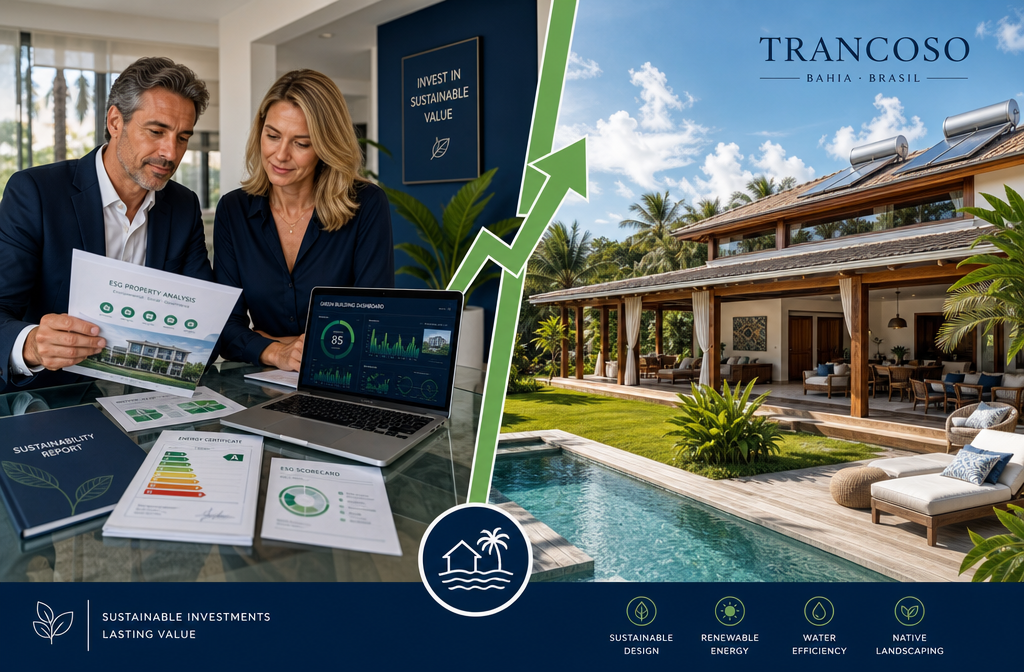
European high-net-worth investors face a unique dynamic in 2026: strict ESG disclosure requirements at home (SFDR, EU Taxonomy) mean that even personal investment decisions are increasingly scrutinized for sustainability alignment. A Trancoso villa that can demonstrate net-zero or near-net-zero performance — with documented energy audits, PV generation data, and recognized efficiency certifications — satisfies this scrutiny in a way that a conventional villa cannot.
The practical implications for Trancoso’s market:
- Higher offer prices: EU buyers with ESG mandates will pay a documented premium for certified green assets, consistent with the 6–11% sales premium data cited above.
- Longer hold periods: ESG-aligned assets tend to attract buy-and-hold investors rather than speculative flippers, improving market stability.
- Stronger rental yields: Green-certified villas on luxury platforms command higher nightly rates and attract the high-spend international travelers that Bahia’s tourism strategy is targeting.
Illustrative Retrofit ROI Scenario
Consider a typical Trancoso coastal villa with a pre-retrofit value of R$ 4 million (approximately €700,000 at 2026 exchange rates):
| Retrofit Investment | Estimated Cost (BRL) | Annual Energy Saving | ESG Premium on Value |
|---|---|---|---|
| Solar PV (8 kW) + battery | R$ 80,000 | R$ 18,000/yr | +4–6% |
| Envelope upgrades (windows, insulation, shading) | R$ 60,000 | R$ 12,000/yr | +2–3% |
| Efficient HVAC (VRF system) | R$ 45,000 | R$ 15,000/yr | +1–2% |
| Water reuse + solar hot water | R$ 25,000 | R$ 8,000/yr | +1% |
| Total | R$ 210,000 | R$ 53,000/yr | +8–12% |
At an 8–12% value premium on a R$ 4 million villa, the retrofit generates R$ 320,000–480,000 in additional asset value — a 1.5x to 2.3x return on retrofit investment, before energy savings are counted. This analysis aligns with global evidence on green premiums [6][7] and is consistent with the Knight Frank HNWI buyer preference data.
For investors already tracking real estate market performance and value appreciation, the retrofit ROI case in Trancoso is compelling precisely because it combines operational savings with capital value uplift.
Challenges and Practical Considerations
What Villa Owners Need to Know Before Starting
Net-zero retrofits in Trancoso are not without complexity. Key challenges include:
- 🔧 Supply chain and skilled labor: Specialized installers for high-performance glazing, VRF systems, and corrosion-resistant PV mounting are less available in southern Bahia than in major urban centers. Project timelines should account for procurement lead times.
- 🏛️ Heritage and planning constraints: Trancoso’s Quadrado area has heritage protections that may restrict visible modifications to building facades. Rooftop PV installations require careful design to comply with local planning rules.
- 📋 Certification complexity: Brazil’s Procel Edifica label and international green certifications (LEED, EDGE) have different documentation requirements. Choosing the right certification pathway early avoids costly rework.
- 💰 Upfront capital: While the ROI case is strong, the upfront investment (R$ 150,000–250,000 for a full retrofit) requires access to capital. Green financing instruments are emerging but not yet widely available for individual villa owners in Bahia.
- 🌊 Coastal durability: Salt air accelerates corrosion of standard equipment. Marine-grade materials add 15–20% to equipment costs but are non-negotiable for oceanfront sites.
The Certification Advantage
Villas with documented, third-party certified green performance consistently outperform self-reported “eco-friendly” properties in buyer surveys. Investing in recognized certification (EDGE, LEED for Homes, or Procel Edifica A-label) is the difference between commanding a premium and merely claiming one.
Investors interested in understanding how sustainability is shaping Florianópolis and broader Brazilian coastal real estate markets will find direct parallels to the dynamics playing out in Trancoso.
The Road Ahead: Trancoso as a Model for Sustainable Coastal Tourism
The convergence of rising international ESG demand, Brazil’s tightening climate commitments, proven retrofit technology, and Trancoso’s world-class tourism fundamentals creates a rare window for villa owners and investors to act ahead of the curve.
By 2026, the question for Trancoso villa owners is no longer whether to retrofit — it is how fast and how comprehensively. Early movers who complete documented net-zero upgrades before the market fully prices in ESG performance will capture the largest premiums. Late movers risk seeing their conventional villas discounted as the green-certified inventory grows.
For those exploring innovative investment strategies in Brazilian real estate, the net-zero retrofit play in Trancoso represents a tangible, asset-backed approach to ESG-aligned returns — one that combines operational income, capital appreciation, and genuine environmental impact.
Conclusion: Actionable Next Steps for Villa Owners and Investors
Net Zero Retrofits in Trancoso Coastal Villas 2026: ESG Premiums for Tourism-Driven Second Homes is not a future trend — it is a present-tense investment decision with measurable financial consequences. The data is clear: certified green villas command 6–11% sales premiums, 5–8% rental premiums, and attract the highest-quality international buyers in Trancoso’s market.
✅ Actionable Next Steps
- Commission an energy audit of your Trancoso villa to establish a baseline and identify the highest-ROI retrofit measures. Focus on envelope, HVAC, and PV as the core stack.
- Choose a certification pathway early — EDGE (IFC-backed, fast, cost-effective) is recommended for most Trancoso villas targeting international buyers.
- Engage a local architect with coastal retrofit experience who understands Trancoso’s heritage planning constraints and can specify marine-grade materials.
- Explore green financing options — Brazil’s development banks (BNDES) and international green lenders are expanding retrofit finance products for tourism assets.
- Document everything — energy generation data, audit reports, certification documents, and contractor warranties. Transparent documentation is what converts a retrofit into a bankable ESG premium at point of sale or rental listing.
- Monitor Brazil’s NDC implementation — regulatory changes in building energy codes will create additional value tailwinds for early-retrofitted properties.
The window to act ahead of the market is open in 2026. Trancoso’s combination of solar abundance, international buyer demand, and tourism growth makes it one of Brazil’s most compelling locations for net-zero retrofit investment. Those who move now will define the benchmark that the rest of the market follows.
For a broader view of premium coastal real estate opportunities in Brazil and how sustainability is reshaping valuations across the country’s most sought-after destinations, the conversation is only just beginning.
References
[1] Net Zero Santas House – loraxllc.com [2] Solarplaza Summit Net Zero Buildings – solarplaza.com [3] Passive House Vs Net Zero In 2026 – ecowindowsusa.com [4] First Net Zero Carbon Multifamily Retrofit New York State – passivehouseaccelerator.com [5] Watch – youtube.com [6] Net Zero Retrofit – journal-buildingscities.org [7] Net Zero Retrofit Building Stock Si – buildingsandcities.org [8] Modeling For Resilience Performance Next Up Pha Live 1 1 – passivehouseaccelerator.com [9] Projects – netzerohomes.build [10] Building Towards Net Zero Carbon Homes – gchu.org.uk