

The Brazilian real estate market is experiencing a fundamental shift in 2026. While traditional hotspots like Rio de Janeiro and São Paulo continue attracting attention, savvy international investors are discovering extraordinary returns in niche lifestyle markets that cater to specific traveler segments. With the Brazilian Real (BRL) maintaining favorable exchange rates against major currencies and emerging destinations showing revenue growth exceeding 37%, the opportunity for high-yield, low-cost Airbnb investments has never been more compelling. This comprehensive guide explores Niche Lifestyle Markets in Brazil 2026: Low-Cost High-Yield Opportunities for International Airbnb Investors, revealing targeted strategies that deliver superior dollar-denominated yields while avoiding the saturation plaguing mainstream markets.
Key Takeaways
- 🎯 Emerging niche markets like Foz do Iguaçu, Curitiba, and eco-tourism destinations show 29-37% revenue growth, significantly outpacing saturated primary markets
- 💰 Break-even occupancy rates sit at just 30-35% (9-11 days monthly), making Brazilian Airbnb investments remarkably forgiving compared to other international markets
- 🏖️ Southern beach communities and interior eco-tourism properties command premium nightly rates ($118-$141 ADR) with lower competition than Rio’s oversaturated Copacabana district
- ⚖️ Condominium bylaws represent the primary legal risk—Brazil’s Superior Court confirmed buildings can ban short-term rentals, making property selection critical
- 📈 Seasonal event strategies during Carnival 2026 and Rock in Rio generate 2-3x normal rates, with single-week revenues matching multiple off-season months
Understanding the Brazilian Airbnb Landscape in 2026
Brazil’s short-term rental market has matured considerably, with Rio de Janeiro alone hosting approximately 28,500 active Airbnb listings as of early 2026 [3]. Despite this substantial inventory, demand continues expanding, with a record 2.1 million international tourists visiting Rio in 2025 [3]. However, this growth masks significant regional disparities that create opportunities for strategic investors.
The Brazilian market offers distinct advantages for international capital. The average nightly rate in Rio stands at R$400 (~$65 USD), with median rates closer to R$320 [3]. When combined with relatively low property acquisition costs compared to North American or European markets, the dollar-denominated yields become particularly attractive for foreign investors benefiting from favorable exchange rates.
Market Saturation vs. Emerging Opportunities
Traditional wisdom suggested concentrating investments in established markets like Rio and São Paulo. However, 2026 data reveals a different story. Rio de Janeiro generates monthly revenue of $1,084.59 with a 42.52% occupancy rate and $106.45 daily average rate [4], but competition intensity varies dramatically by neighborhood.
Copacabana experiences fierce downward rate pressure due to the highest concentration of listings in Rio, while less saturated neighborhoods like Botafogo and Flamengo offer relatively better pricing power [3]. This pattern repeats across Brazil—established markets face increasing competition while niche destinations remain underserved.
For investors seeking best places to invest in Brazil property, the strategic focus has shifted from broad metropolitan areas to targeted lifestyle segments.
Identifying High-Yield Niche Lifestyle Markets in Brazil 2026
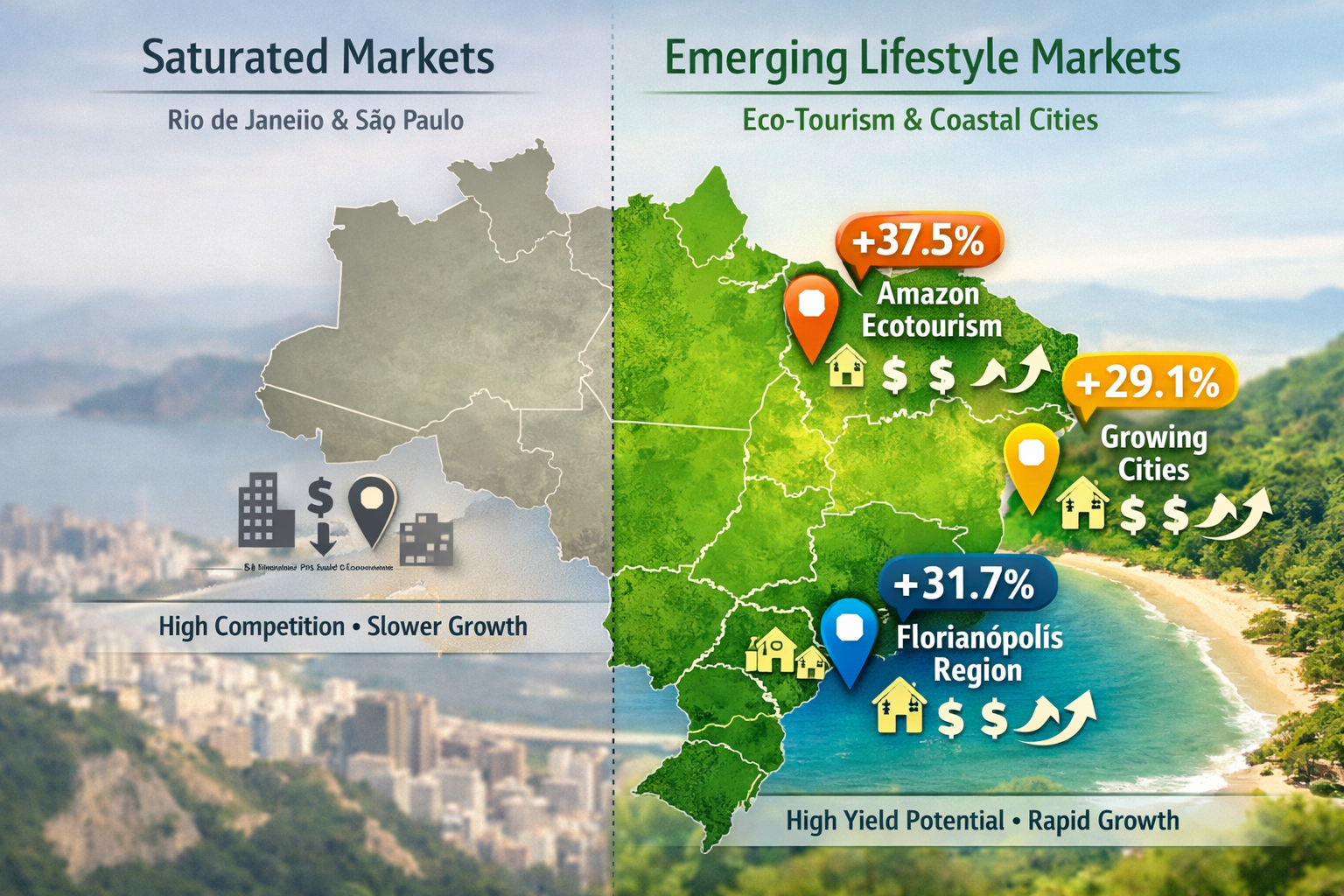
The most compelling Niche Lifestyle Markets in Brazil 2026: Low-Cost High-Yield Opportunities for International Airbnb Investors fall into three distinct categories: eco-tourism interior destinations, Southern beach communities, and emerging secondary cities with specific lifestyle appeals.
Eco-Tourism and Nature-Based Destinations
Brazil’s vast interior regions offer exceptional opportunities for properties catering to eco-conscious travelers seeking authentic experiences beyond traditional beach destinations.
Foz do Iguaçu stands out with remarkable metrics: supply increased 41.0% while revenue grew 37.5% [2], indicating healthy demand absorption despite inventory expansion. This UNESCO World Heritage site attracts visitors year-round to witness the spectacular Iguaçu Falls, creating consistent occupancy patterns that avoid the extreme seasonality of beach markets.
Belém, gateway to the Amazon, experienced extraordinary supply growth of 100.1% alongside revenue increases of 29.1% [2]. This expansion reflects growing international interest in Amazon eco-tourism, with travelers seeking authentic rainforest experiences and cultural immersion in indigenous communities.
Properties in these markets command premium rates due to limited quality inventory. Investors who develop eco-lodges, sustainable properties, or nature-focused accommodations tap into a traveler segment willing to pay significantly above average for authentic environmental experiences.
Southern Beach Communities: The Florianópolis Advantage
Southern Brazil’s coastline offers a compelling alternative to Rio’s crowded beaches. The Florianópolis region has emerged as a lifestyle destination attracting digital nomads, surfers, and quality-conscious travelers seeking pristine beaches without Rio’s urban intensity.
Ilhabela generates $920.12 monthly revenue with an impressive $137.18 average daily rate [4], demonstrating that secondary beach markets can command premium pricing. Similarly, Tamandaré produces $829.95 monthly with $141.81 ADR, while Ipojuca achieves $846.96 monthly with $118.24 ADR [4].
These destinations offer several advantages:
- Lower property acquisition costs compared to Rio or São Paulo
- Less regulatory scrutiny than major metropolitan areas
- Year-round appeal to domestic Brazilian tourists during summer and international visitors seeking winter sun
- Growing infrastructure as remote work enables location-independent professionals to extend stays
The growth of the Ingleses region in Florianópolis exemplifies how targeted infrastructure development drives property appreciation alongside rental income, creating dual revenue streams for investors.
Emerging Secondary Cities with Lifestyle Appeal
Curitiba (supply +36.8%, revenue +31.7%) and Porto Alegre (supply +30.9%, revenue +31.0%) represent secondary city opportunities [2]. These urban centers attract business travelers, medical tourists, and cultural visitors, offering more stable year-round occupancy than beach destinations.
Curitiba’s reputation as Brazil’s most sustainable city attracts environmentally conscious travelers and business visitors to its growing tech sector. Porto Alegre serves as a gateway to Brazil’s wine country and gaucho culture, appealing to culinary tourists and cultural explorers.
Warning signs exist in some markets. Campina Grande (supply +52.6%, revenue +4.2%) and Pelotas (supply +47.7%, revenue -1.4%) show declining revenue growth despite inventory expansion [2], indicating oversupply risks that investors must carefully evaluate before entering any market.
Strategic Investment Approaches for International Airbnb Investors
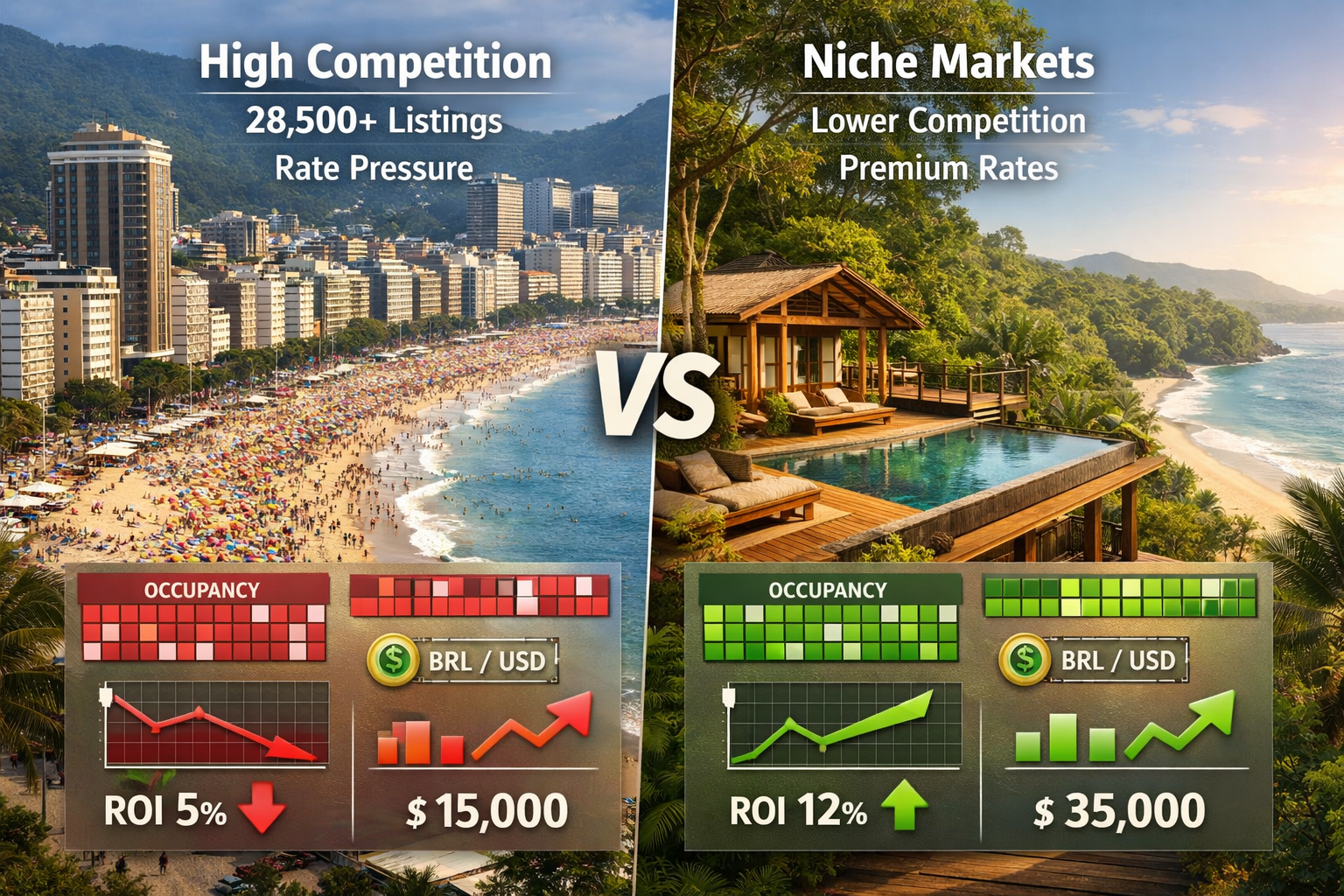
Success in Niche Lifestyle Markets in Brazil 2026: Low-Cost High-Yield Opportunities for International Airbnb Investors requires strategic approaches that differ from conventional real estate investment wisdom.
Property Type Selection for Maximum Returns
Data reveals clear patterns in property performance. Studios and one-bedroom apartments capture 55% of all bookings by volume in Rio, while two-bedroom units offer the best balance between booking frequency and revenue per reservation, accounting for 30% of bookings [3].
For niche lifestyle markets, property selection should align with target guest profiles:
Eco-tourism destinations: Larger properties (2-3 bedrooms) accommodate families and small groups willing to pay premium rates for unique locations. Amenities like outdoor spaces, hammocks, and nature viewing areas justify higher pricing.
Beach communities: Studio and one-bedroom units maximize occupancy with couples and solo travelers, while two-bedroom properties capture family bookings during school holidays.
Secondary cities: One-bedroom apartments serve business travelers and digital nomads seeking monthly stays, providing stable cash flow with reduced turnover costs.
Investors considering studio investments in Florianópolis can leverage the dual demand from short-term tourists and medium-term remote workers.
Seasonal Event Optimization
Brazil’s event calendar creates extraordinary revenue spikes that dramatically improve annual returns. Rio de Janeiro Carnival 2026 demand surged 50%, with occupancy reaching peak levels [1]. Property owners charged two to three times their usual nightly rates during Carnival week, with single-week revenues often matching several off-season months [1].
Rock in Rio music festival in September 2026 creates similar opportunities in Barra da Tijuca and Recreio areas, where hosts can often double their nightly rates during event weekends [3].
Strategic investors structure their calendars around these events:
- Block premium dates 6-12 months in advance at 2-3x normal rates
- Require minimum stays (3-7 nights) during peak events to maximize revenue
- Implement strict cancellation policies to protect against last-minute cancellations
- Invest in professional photography and listings that justify premium positioning
This event-driven strategy transforms annual returns, with 3-4 major events potentially contributing 30-40% of annual revenue in just 10-15 days.
Break-Even Economics and Risk Management
One of Brazil’s most attractive features for international investors is the remarkably low break-even threshold. With break-even occupancy rates sitting at 30-35% (roughly 9-11 booked days per month) [3], investors enjoy substantial margin of safety compared to markets requiring 50-60% occupancy.
This low threshold enables several risk management strategies:
Conservative pricing: Properties can maintain competitive rates without aggressive discounting, preserving brand positioning and attracting quality guests.
Selective booking: Hosts can decline problematic reservations without jeopardizing monthly targets, reducing property damage and negative review risks.
Seasonal closures: Properties in beach markets can close during low seasons for maintenance without devastating annual returns.
Buffer for regulations: If new restrictions limit operating days, properties remain viable with reduced availability.
Understanding these market dynamics in Greater Florianópolis helps investors set realistic expectations and structure appropriate financial models.
Legal Framework and Operational Considerations for Foreign Investors

Navigating Brazil’s legal landscape represents the most critical success factor for international Airbnb investors. Unlike property selection or pricing strategies, legal missteps can completely eliminate investment viability.
The Condominium Bylaws Challenge
Condominium bylaws represent the primary legal risk for Brazilian Airbnb hosts [3]. Brazil’s Superior Court confirmed that residential buildings can legally ban short-term rentals, making property selection critical regardless of municipal regulations [3].
Before purchasing any property, international investors must:
✅ Review condominium bylaws (convenção de condomínio) with qualified legal counsel
✅ Obtain written confirmation from condominium administration regarding short-term rental permissions
✅ Verify no pending bylaw amendments that could restrict rentals post-purchase
✅ Understand enforcement mechanisms and potential penalties for violations
Many newer developments, particularly those designed with investment in mind, explicitly permit short-term rentals in their bylaws, making them preferable targets for Airbnb investors.
Foreign Ownership and Tax Structures
Brazil permits foreign ownership of real estate with relatively few restrictions. However, optimal structuring requires careful planning:
Direct individual ownership: Simplest structure but exposes investors to Brazilian inheritance laws and potentially higher tax rates.
Brazilian LLC (Limitada): Provides liability protection and potential tax advantages, particularly for investors with multiple properties.
Offshore holding structures: Complex but potentially beneficial for high-net-worth investors with multiple Brazilian properties, though requires specialized legal and tax advice.
Tax considerations include:
- Property transfer tax (ITBI): 2-4% of property value at purchase
- Annual property tax (IPTU): 0.5-1.5% of assessed value
- Rental income tax: 15-27.5% for individuals, potentially lower for corporate structures
- Capital gains tax: 15-22.5% on property appreciation upon sale
- Withholding requirements: For foreign owners repatriating profits
Working with qualified Brazilian tax advisors who understand international tax treaties can significantly optimize after-tax returns. The contact page provides access to professionals experienced with foreign investor requirements.
Property Management Solutions
International investors rarely manage Brazilian properties directly. Professional management becomes essential, typically costing 15-25% of gross rental revenue.
Management services should include:
- Guest communication in Portuguese, English, and Spanish
- 24/7 emergency response and maintenance coordination
- Professional cleaning between guests
- Linen and amenity restocking
- Dynamic pricing optimization
- Guest screening and review management
- Financial reporting and tax documentation
- Regulatory compliance monitoring
Quality management dramatically impacts property performance. The difference between mediocre and excellent management can easily represent 20-30% variance in annual revenue through superior pricing, reduced vacancy, and positive reviews that drive future bookings.
Financial Modeling and Return Expectations
Realistic financial modeling separates successful investors from disappointed speculators. Niche Lifestyle Markets in Brazil 2026: Low-Cost High-Yield Opportunities for International Airbnb Investors offer compelling returns when properly structured.
Sample Investment Pro Forma: Eco-Tourism Interior Property
Property Details:
- Location: Foz do Iguaçu area
- Type: 2-bedroom house with outdoor space
- Purchase price: R$400,000 (~$65,000 USD)
- Renovation/furnishing: R$80,000 (~$13,000 USD)
- Total investment: R$480,000 (~$78,000 USD)
Revenue Projections:
- Average nightly rate: R$350 ($57 USD)
- Occupancy rate: 45% (conservative, above break-even)
- Monthly revenue: R$4,725 ($770 USD)
- Annual gross revenue: R$56,700 ($9,240 USD)
Operating Expenses:
- Property management (20%): R$11,340
- Utilities and internet: R$3,600
- Maintenance and repairs: R$4,000
- Property tax: R$4,000
- Insurance: R$2,400
- Cleaning and supplies: R$6,800
- Platform fees (3%): R$1,700
- Total expenses: R$33,840 ($5,520 USD)
Net Operating Income: R$22,860 ($3,720 USD)
Cash-on-Cash Return: 4.8% (conservative)
This model excludes property appreciation, which historically adds 3-5% annually in emerging markets. Combined returns of 8-10% in dollar terms become achievable, with upside potential as markets mature.
Sample Investment Pro Forma: Southern Beach Studio
Property Details:
- Location: Florianópolis region
- Type: Studio apartment, beachfront building
- Purchase price: R$350,000 (~$57,000 USD)
- Furnishing: R$50,000 (~$8,000 USD)
- Total investment: R$400,000 (~$65,000 USD)
Revenue Projections:
- Average nightly rate: R$280 ($46 USD)
- Occupancy rate: 50% (higher due to location)
- Monthly revenue: R$4,200 ($685 USD)
- Annual gross revenue: R$50,400 ($8,215 USD)
Operating Expenses:
- Property management (18%): R$9,072
- Condominium fees: R$4,800
- Utilities: R$2,400
- Maintenance: R$3,000
- Property tax: R$3,500
- Insurance: R$2,000
- Cleaning: R$5,400
- Platform fees: R$1,512
- Total expenses: R$31,684 ($5,165 USD)
Net Operating Income: R$18,716 ($3,050 USD)
Cash-on-Cash Return: 4.7%
Again, property appreciation in growing beach markets like those detailed in the Florianópolis real estate market analysis adds significant value beyond rental income.
Enhancing Returns Through Strategic Optimization
Several strategies can significantly improve these baseline returns:
Dynamic pricing tools: Implementing algorithmic pricing can increase revenue 15-25% versus static pricing by capturing demand fluctuations.
Direct booking channels: Developing a direct booking website reduces platform fees from 3% to under 1%, adding 2% to net margins.
Longer-term stays: Targeting digital nomads for 1-3 month stays reduces turnover costs and vacancy gaps, improving net returns by 10-15%.
Value-add renovations: Strategic upgrades (quality mattresses, workspaces, premium amenities) justify 20-30% rate premiums with minimal cost increase.
Multi-property economies: Operating 3-5 properties in the same area reduces per-unit management costs and enables better vendor negotiations.
Emerging Trends Shaping Brazil’s Niche Airbnb Markets
Understanding macro trends helps investors position properties for long-term success rather than chasing temporary opportunities.
Remote Work and Digital Nomad Demand
Brazil has emerged as a top destination for digital nomads seeking affordable, high-quality lifestyles. Southern cities like Florianópolis offer excellent internet infrastructure, vibrant expat communities, and beach lifestyles at fractions of European or North American costs.
Properties optimized for remote workers—featuring dedicated workspaces, ergonomic furniture, high-speed internet, and quiet environments—command premium rates and attract longer stays that dramatically improve unit economics.
Sustainable and Eco-Conscious Travel
Environmental consciousness increasingly drives accommodation choices. Properties with solar panels, water conservation systems, local materials, and minimal environmental impact attract premium-paying guests and generate positive reviews that drive future bookings.
Brazil’s natural assets—rainforests, beaches, wildlife—position eco-tourism properties for sustained demand growth as this traveler segment expands.
Cryptocurrency and Alternative Payment Methods
Brazil has embraced cryptocurrency adoption faster than many markets. Some investors now accept Bitcoin and stablecoins for bookings, attracting tech-savvy international travelers while potentially optimizing currency conversion costs. Understanding cryptocurrency integration in real estate provides competitive advantages.
Regulatory Evolution
Brazilian municipalities continue refining short-term rental regulations. While some cities implement registration requirements and occupancy taxes, the overall environment remains investor-friendly compared to heavily regulated markets like Barcelona or New York.
Staying informed about regulatory changes and maintaining compliance protects long-term investment viability. Working with local experts who monitor these developments becomes essential for international investors.
Risk Mitigation Strategies for International Investors
Every investment carries risks. Successful investors in Niche Lifestyle Markets in Brazil 2026: Low-Cost High-Yield Opportunities for International Airbnb Investors implement comprehensive risk management.
Currency Risk Management
Brazilian Real volatility creates both opportunities and risks for dollar-based investors. Strategies include:
- Natural hedging: Financing purchases in BRL creates currency-matched assets and liabilities
- Timing purchases: Acquiring properties during Real weakness maximizes dollar purchasing power
- Repatriation planning: Strategically timing profit repatriation during Real strength
- Multi-currency accounts: Maintaining both BRL and USD accounts to optimize conversion timing
Property Selection Due Diligence
Thorough due diligence prevents costly mistakes:
✅ Professional property inspection identifying structural issues
✅ Title search confirming clear ownership
✅ Condominium financial review ensuring building solvency
✅ Neighborhood analysis verifying safety and amenities
✅ Rental restriction verification confirming Airbnb permissions
✅ Infrastructure assessment evaluating internet, utilities, transportation
Diversification Approaches
Concentration risk affects investors with single properties in single markets. Diversification strategies include:
- Multiple property types: Combining beach and eco-tourism properties balances seasonal variations
- Geographic distribution: Spreading investments across 2-3 regions reduces local market risk
- Phased investment: Acquiring properties over time rather than all at once allows learning and adjustment
- Mixed investment strategies: Combining Airbnb properties with traditional long-term rentals provides income stability
Conclusion
Niche Lifestyle Markets in Brazil 2026: Low-Cost High-Yield Opportunities for International Airbnb Investors represent one of the most compelling international real estate investment opportunities available today. While traditional hotspots like Rio de Janeiro and São Paulo face increasing competition and saturation, emerging destinations focused on eco-tourism, Southern beach communities, and lifestyle-driven secondary cities offer superior risk-adjusted returns.
The fundamental economics remain extraordinarily favorable: break-even occupancy rates of just 30-35%, property acquisition costs a fraction of comparable markets, and growing international demand for authentic Brazilian experiences beyond conventional tourist circuits. When combined with favorable BRL exchange rates for foreign capital, dollar-denominated yields of 8-12% become achievable with appropriate property selection and management.
Success requires moving beyond generic investment approaches. Understanding condominium bylaws, optimizing for seasonal events like Carnival and Rock in Rio, selecting property types aligned with target guest profiles, and implementing professional management separate successful investors from disappointed speculators.
Actionable Next Steps
For investors ready to capitalize on these opportunities:
- Identify target markets aligned with investment goals—eco-tourism interior, Southern beaches, or emerging secondary cities
- Establish Brazilian legal and tax structures with qualified professionals experienced in foreign investor requirements
- Connect with local property developers offering new construction opportunities designed for short-term rental investors
- Build management relationships before property acquisition to ensure operational readiness
- Start with conservative financial models and single-property exposure, expanding as experience grows
- Monitor regulatory developments and maintain compliance to protect long-term viability
The window for entering Brazil’s niche lifestyle markets at attractive valuations won’t remain open indefinitely. As these destinations mature and attract additional capital, acquisition costs will rise and returns will compress. Investors who position themselves strategically in 2026 will benefit from both current cash flow and long-term appreciation as these markets evolve from emerging opportunities to established destinations.
Brazil’s combination of natural beauty, cultural richness, growing infrastructure, and favorable investment economics creates a unique opportunity for international Airbnb investors willing to look beyond saturated mainstream markets and target the specific lifestyle segments driving the next wave of travel demand.
References
[1] Airbnb Demand Rio 2026 Carnival – https://www.oabitat.com/en/airbnb-demand-rio-2026-carnival/
[2] Best Airbnb Markets Brazil – https://airbtics.com/best-airbnb-markets-brazil
[3] Rio De Janeiro Airbnb – https://thelatinvestor.com/blogs/news/rio-de-janeiro-airbnb
[4] Brazil – https://www.airroi.com/report/world/brazil