
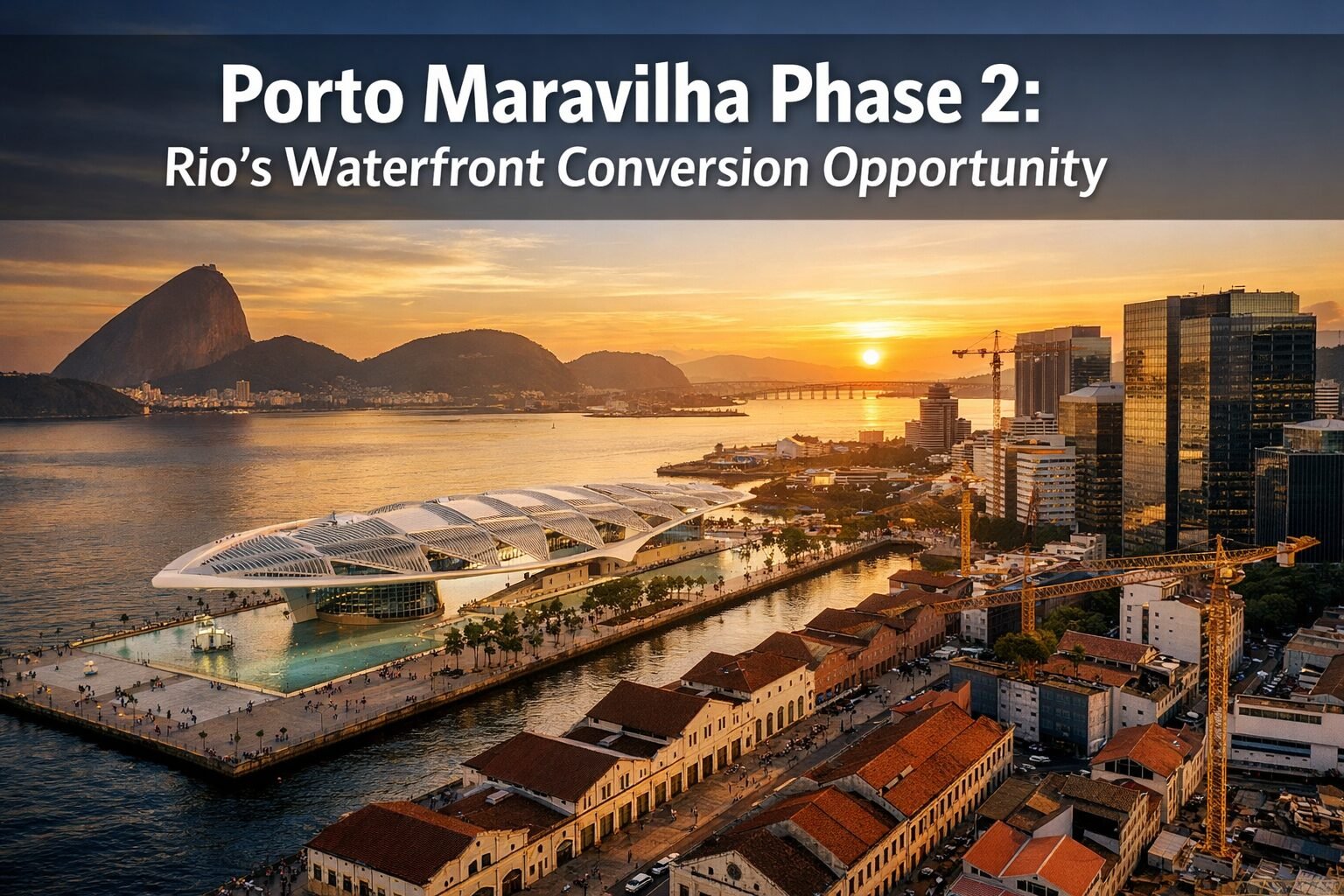
Less than 15% of Porto Maravilha’s original 5 million square meters of underutilized port land has been fully activated — which means the most lucrative wave of investment opportunity is still building. As Rio de Janeiro’s landmark urban renewal project enters its next chapter in 2026, a secondary market of commercial-to-residential conversions is emerging that savvy developers and investors cannot afford to overlook.
Porto Maravilha Regeneration Phase 2: Commercial-to-Residential Conversion Opportunities in Rio’s Waterfront Revival represents more than a real estate trend. It is a structural shift in how Rio’s historic port district is being reimagined — from a neglected industrial zone into a mixed-use, walkable waterfront community. With billions already committed to infrastructure and cultural anchors firmly in place, the conditions for adaptive reuse and residential conversion are maturing rapidly.
Key Takeaways 📌
- Porto Maravilha is a $4–5 billion urban revitalization project covering approximately 5 km² of Rio’s historic port zone [1][2]
- The project’s legal framework (Municipal Law 101/2009) creates a structured environment for commercial-to-residential adaptive reuse [1]
- Infrastructure upgrades — including an underground tunnel replacing a waterfront expressway — are unlocking premium residential land value [2]
- Cultural anchors like the Museum of Tomorrow and MAR are driving foot traffic and long-term demand for mixed-use living [1]
- Phase 2 conversion opportunities are concentrated in former warehouses, office buildings, and light-industrial structures within the OUC boundary
Understanding the Porto Maravilha Framework
The Scale and Legal Foundation of Rio’s Port Renewal
Porto Maravilha is not a speculative vision — it is a legally structured, government-backed urban operation. Established through Municipal Law 101 of 2009, the project operates as a Joint Urban Operation (OUC) and is administered by CDURP (the Urban Development Company of the Port Region of Rio de Janeiro) [1]. This governance model is critical for investors to understand because it defines the rules for density bonuses, land use changes, and the issuance of Urban Development Certificates (CEPACs) that fund public improvements.
The project covers roughly 5 million square meters — a district larger than many city centers — stretching along Guanabara Bay [2][3]. The investment commitment of $4 to $5 billion funds not just roads and utilities, but a wholesale reimagining of urban life in one of South America’s most historically significant neighborhoods.
💬 “The goal is not merely to renovate buildings — it is to triple the resident population and create a self-sustaining urban ecosystem.” — Porto Maravilha development framework [1]
Why Phase 2 Is Different from Phase 1
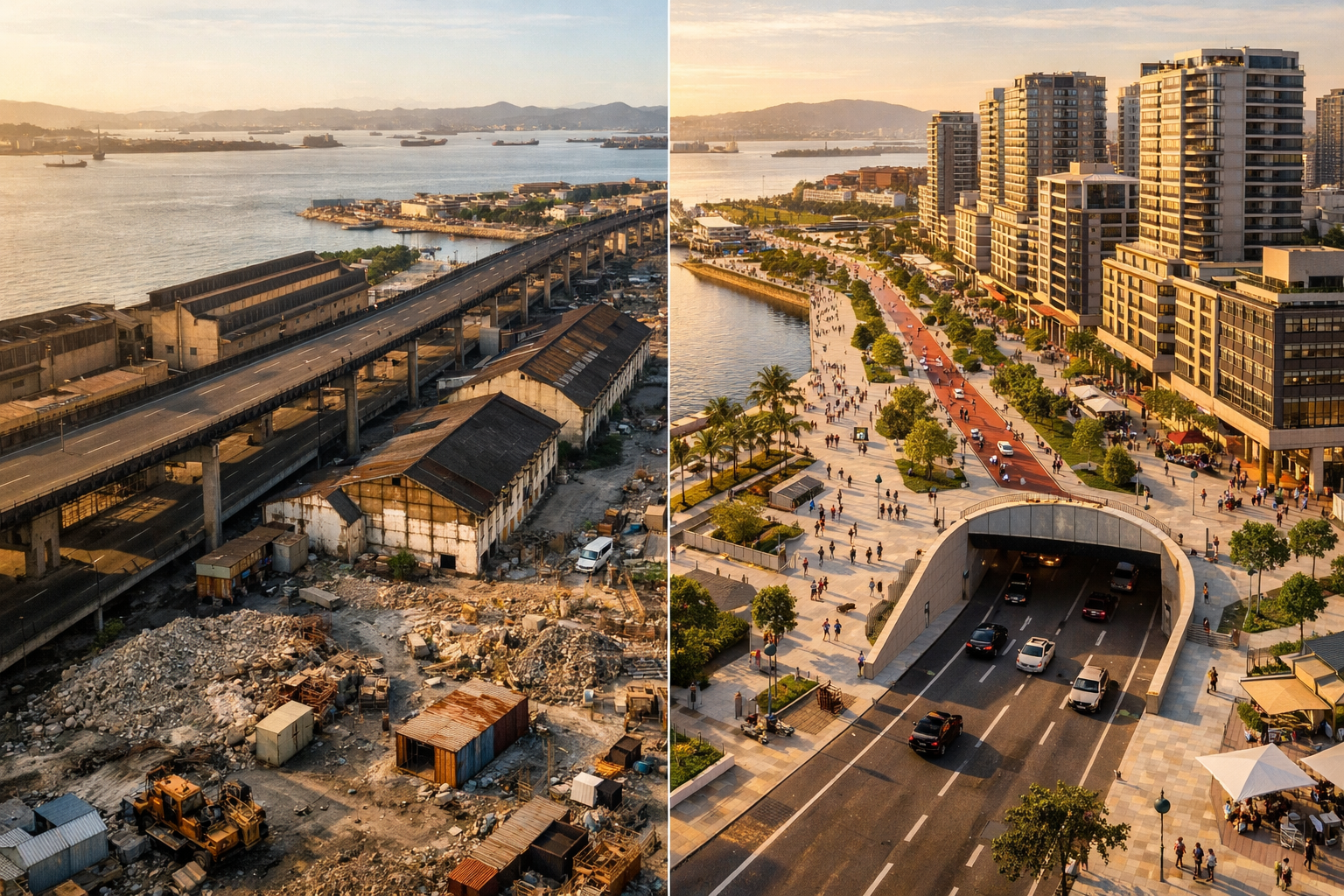
Phase 1 of Porto Maravilha focused on demolishing the Perimetral elevated expressway and replacing it with an underground tunnel, restoring direct pedestrian and visual access to the waterfront [2]. It also established the cultural infrastructure — the Museum of Tomorrow, the Rio Art Museum (MAR), and the VLT light rail system — that gives the district its identity and draws visitors and residents alike [1].
Phase 2 builds on that foundation. With infrastructure in place and cultural credibility established, the focus shifts toward activating the built environment: filling vacant lots, converting obsolete commercial and industrial buildings, and scaling up the residential population. This is where the commercial-to-residential conversion opportunity becomes most compelling.
For context on how infrastructure investment drives property appreciation, understanding how off-plan real estate purchases can amplify gains is directly relevant to the Porto Maravilha thesis.
The Commercial-to-Residential Conversion Opportunity in Porto Maravilha Phase 2
What Buildings Are Eligible for Conversion?
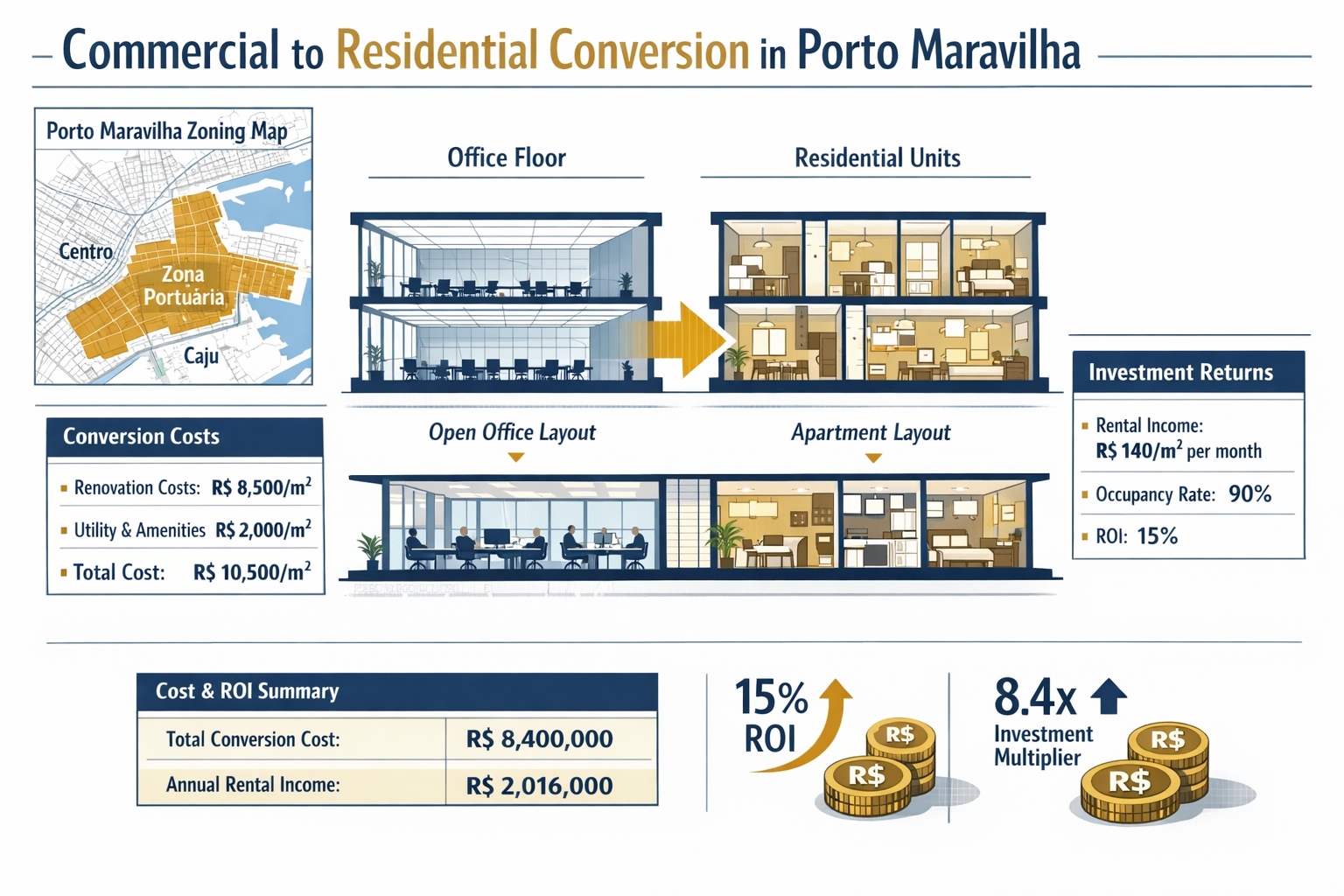
The port district contains a significant stock of underutilized or vacant structures that are prime candidates for adaptive reuse:
| Building Type | Typical Floor Plate | Conversion Potential | Key Challenge |
|---|---|---|---|
| Colonial warehouses (armazéns) | 800–2,500 m² | High — loft residential, boutique hotels | Heritage preservation rules |
| Mid-century office blocks | 500–1,500 m² | Medium-High — standard residential conversion | HVAC and plumbing retrofits |
| Light-industrial sheds | 1,000–4,000 m² | High — large-format mixed-use | Structural reinforcement |
| Ground-floor commercial strips | 200–600 m² | Medium — live/work units | Parking and access requirements |
The OUC framework allows developers to acquire additional construction rights through CEPACs, which means that converting a two-story warehouse into a five-story residential building is legally viable — provided the developer purchases the appropriate certificates [1][3].
Why Residential Demand Is Growing in the Port Zone
Several converging forces are driving residential demand in Porto Maravilha:
- Population tripling target: The official development plan explicitly aims to triple the resident population of the port district [1]. This is a policy commitment, not a projection.
- Waterfront access restored: The removal of the Perimetral expressway and the creation of pedestrian promenades along Guanabara Bay have transformed the quality of life calculus for potential residents [2].
- Cultural gravity: The Museum of Tomorrow and MAR are not just tourist attractions — they create the kind of neighborhood identity that sustains long-term residential demand [1].
- Tech ecosystem emergence: The POMAR initiative, which brings together academic institutions including IMPA and early-stage startups, is seeding a knowledge economy in the district [1]. Young professionals working in tech and innovation are natural renters and buyers.
- Green infrastructure: The Mata Maravilha project restores native Atlantic Forest vegetation throughout the district, adding environmental quality that commands residential premiums [1].
The Financial Logic of Conversion vs. New Build
In many waterfront regeneration contexts globally, conversion economics outperform ground-up development during the middle phases of a regeneration cycle. Here is why:
- Lower land acquisition cost: Existing structures in transitional zones are typically priced below replacement cost
- Faster delivery: Conversion timelines are often 30–40% shorter than new construction
- Heritage premium: Authentically converted historic buildings command rental and sale premiums from buyers seeking character
- Reduced regulatory risk: Adaptive reuse within an established OUC framework carries lower zoning uncertainty than greenfield development
This mirrors dynamics seen in other Brazilian markets where early-mover developers in revitalizing urban zones have captured outsized returns. Exploring the best places to invest in Brazilian property for high returns provides useful comparative context for evaluating Porto Maravilha against other Brazilian opportunities.
Infrastructure, Sustainability, and the Residential Value Proposition
How Infrastructure Upgrades Translate to Residential Value
The underground tunnel replacing the Perimetral expressway is arguably the single most important value-creation event in Porto Maravilha’s history [2]. In waterfront cities globally, removing elevated infrastructure and restoring shoreline access has produced property value increases of 20–40% in adjacent parcels within five years of completion.
In Porto Maravilha’s case, this infrastructure shift does several things simultaneously:
- Eliminates noise and pollution from heavy port traffic that historically suppressed residential values
- Creates a continuous pedestrian waterfront connecting the district to the broader city
- Enables new ground-floor activation — cafes, retail, cultural programming — that makes streets feel safe and vibrant
The VLT (Veículo Leve sobre Trilhos) light rail system connects the port district to Rio’s central business district and the main rail and bus terminals, making the area genuinely accessible without a car [1]. For residential conversion projects, proximity to the VLT network is a key marketing differentiator.
Sustainability as a Conversion Strategy
The Mata Maravilha green infrastructure program and the district’s explicit commitment to low-carbon mobility — including an extensive bike path network — align Porto Maravilha with the ESG criteria that institutional investors and international buyers increasingly require [1].
For developers undertaking commercial-to-residential conversions, embedding sustainability features is not just ethical — it is financially strategic:
- 🌿 Green certifications (LEED, AQUA-HQE) command rental premiums of 8–15% in Brazilian urban markets
- 🚲 Bike storage and EV charging are now baseline expectations for young professional tenants
- 🌳 Native vegetation integration (aligned with Mata Maravilha) differentiates projects in a crowded market
- ♻️ Adaptive reuse itself carries an inherent sustainability narrative — embodied carbon savings are measurable and marketable
The Technology and Innovation Multiplier
The POMAR initiative — a technology and innovation hub anchored by IMPA (Institute for Pure and Applied Mathematics) — is creating a knowledge district effect within Porto Maravilha [1]. This matters for residential conversion developers for a straightforward reason: tech workers are among the highest-income renters in Brazil’s urban markets, and they cluster in neighborhoods that offer walkability, cultural amenities, and connectivity.
Developers who position converted residential projects to appeal to this demographic — through co-working spaces on ground floors, high-speed fiber infrastructure, and proximity to POMAR institutions — can command premium rents and achieve faster lease-up.
Practical Considerations for Developers and Investors in 2026
Navigating the OUC and CEPAC System
The Joint Urban Operation framework means that development rights in Porto Maravilha are not automatically granted — they must be purchased through CEPACs (Certificados de Potencial Adicional de Construção). Developers need to:
- Assess the CEPAC requirement for their specific conversion project based on additional floor area and use change
- Engage CDURP early in the planning process to confirm zoning compatibility and heritage restrictions
- Model CEPAC costs into the project financial analysis — these can represent 8–15% of total development cost depending on location within the OUC
- Monitor CEPAC auctions for pricing signals about market confidence in the district
The structured nature of the OUC is actually a competitive advantage for serious developers: it filters out speculative actors and ensures that public infrastructure investment continues alongside private development.
Key Risk Factors to Monitor ⚠️
No regeneration project is without risk. Investors in Porto Maravilha Phase 2 should track:
- Political continuity: Municipal government transitions can affect OUC funding and enforcement
- Port operations: Active port activity adjacent to residential conversions creates noise and logistics conflicts that require careful site selection
- Heritage compliance: Conversions of listed buildings require IPHAN (federal heritage body) approval, which can extend timelines significantly
- Financing conditions: Brazil’s SELIC rate trajectory in 2026 directly affects mortgage availability and buyer purchasing power
Understanding how broader real estate market dynamics interact with specific project economics is essential. For developers active in Brazil’s property sector, staying current with real estate market performance trends helps contextualize Porto Maravilha within the national investment landscape.
Comparing Porto Maravilha to Other Brazilian Waterfront Opportunities
Porto Maravilha is not the only waterfront regeneration story in Brazil, but it is arguably the most structurally supported by public investment and legal framework. Compared to emerging coastal markets, the port district offers:
- A proven institutional framework (OUC/CEPAC)
- Completed anchor infrastructure (tunnel, VLT, cultural institutions)
- International visibility from the 2016 Olympic legacy
- Direct access to Rio’s CBD and international airport connections
For investors evaluating Brazilian real estate more broadly, the dynamics of studio and compact residential investment in revitalizing urban zones offer a useful parallel for understanding the compact-unit demand profile that will characterize Porto Maravilha’s early residential phase.
Additionally, developers looking at the intersection of technology and real estate financing should consider how cryptocurrency and real estate development are converging — a trend particularly relevant to Porto Maravilha’s tech-forward POMAR ecosystem.
Conclusion: Acting on the Porto Maravilha Phase 2 Conversion Window
Porto Maravilha Regeneration Phase 2: Commercial-to-Residential Conversion Opportunities in Rio’s Waterfront Revival represents a time-sensitive window that is open now but will not remain open indefinitely. The infrastructure is built. The cultural anchors are drawing visitors and residents. The legal framework is in place. What is still underway is the physical transformation of the building stock — and that is precisely where the conversion opportunity lives.
The developers and investors who move in 2026, while CEPAC prices are still reflecting transitional-zone risk rather than established-neighborhood premiums, will be positioned to capture the appreciation cycle that follows full residential activation.
Actionable Next Steps for Developers and Investors:
- ✅ Commission a site-specific feasibility study within the OUC boundary, focusing on buildings with clear title and no active heritage listing
- ✅ Engage a CDURP-registered architect familiar with the CEPAC calculation methodology before making acquisition decisions
- ✅ Model three scenarios: warehouse loft conversion, mid-rise office-to-residential, and mixed-use ground-floor activation
- ✅ Track CEPAC auction results quarterly as a leading indicator of institutional confidence
- ✅ Build sustainability credentials into the conversion brief from day one — ESG compliance is now a financing prerequisite for many institutional lenders
- ✅ Explore the full landscape of current Brazilian real estate development projects to benchmark Porto Maravilha returns against comparable opportunities
The waterfront revival is real, the demand drivers are structural, and the conversion opportunity is measurable. The question is not whether Porto Maravilha will succeed — it is whether your project will be part of the wave that defines it.
References
[1] Porto Maravilha – https://7wondersfc.com/participants/porto-maravilha [2] Porto Maravilha – https://www.scribd.com/document/227423714/Porto-Maravilha [3] 800b0a64 1a6b 4eac A7ea 2394907ece62 – https://archive.aesop-planning.eu/items/800b0a64-1a6b-4eac-a7ea-2394907ece62