

Brazil’s real estate technology sector generated R$4.2 billion in revenue in 2025 and is on track to reach R$6.8 billion by the end of 2026 — a 62% surge that signals one of the most consequential shifts in Latin American property markets in a generation [1]. The PropTech Boom 2026: AI Valuation and Cloud Tools Driving Efficiency in Brazil’s R$2.5B Market is not a distant projection; it is unfolding right now through Automated Valuation Models, cloud-native platforms, and a startup ecosystem that has crossed the 1,000-company threshold [2]. For developers, investors, and brokers operating in a high-Selic environment, understanding these tools is no longer optional — it is a competitive requirement.
Key Takeaways
- Brazil’s PropTech sector is projected to grow 62% in 2026, driven by AI valuation tools, cloud platforms, and rising venture capital confidence.
- Automated Valuation Models now deliver property estimates with a 5-10% margin of error, rivaling traditional appraisals in speed and cost.
- Cloud-based deployment accounts for 61% of PropTech solutions, lowering barriers for small and mid-size developers.
- Digital real estate transactions are expected to reach 42% of all deals in 2026, up from 31% in 2025.
- Tokenization, regulated by the CVM, has reduced minimum property investment thresholds from R$100,000 to as little as R$100, broadening the investor base significantly.

The Scale of Brazil’s PropTech Expansion in 2026
The numbers behind the PropTech Boom 2026: AI Valuation and Cloud Tools Driving Efficiency in Brazil’s R$2.5B Market are striking even by global standards. While the worldwide PropTech market is forecast to grow from USD 50.05 billion in 2026 to USD 115.04 billion by 2033 at a compound annual growth rate of 12.6% [5], Brazil is outpacing that trajectory by a significant margin.
Revenue and Investment Momentum
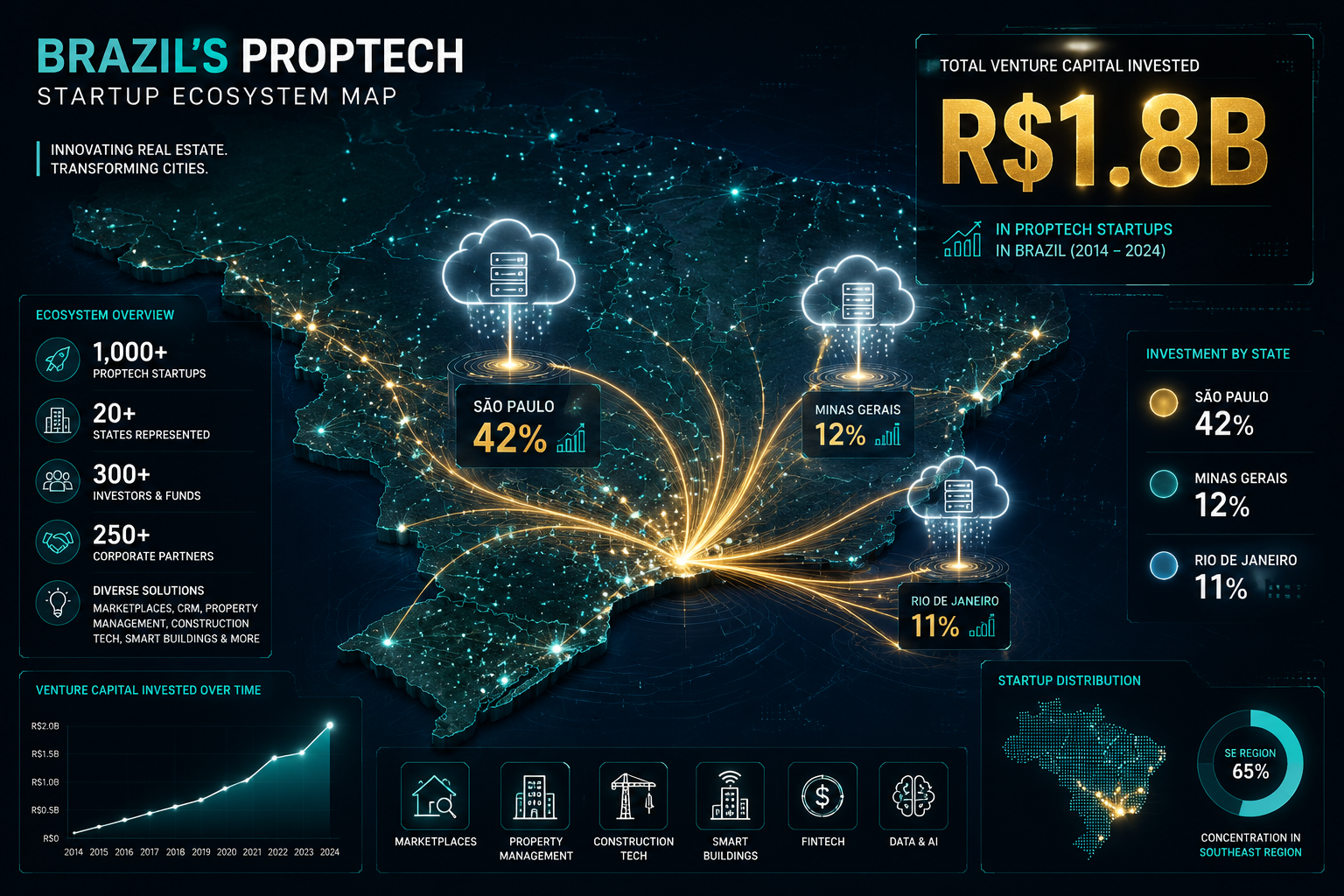
Venture capital flowing into Brazilian PropTechs is projected to reach R$1.8 billion in 2026, up from R$1.3 billion in 2025 [1]. That 38% year-over-year increase in investment reflects strong confidence from both domestic and international funds. The sector is also becoming a meaningful employer: direct employment is expected to reach approximately 32,000 individuals by the end of 2026, compared to 24,000 in 2025 [1].
| Metric | 2025 | 2026 (Projected) |
|---|---|---|
| Sector Revenue | R$4.2 billion | R$6.8 billion |
| VC Investment | R$1.3 billion | R$1.8 billion |
| Direct Employment | 24,000 | 32,000 |
| Digital Transaction Share | 31% | 42% |
| Active PropTech Startups | ~850 | 1,000+ |
Why the High-Selic Environment Accelerates Adoption
Brazil’s persistently elevated Selic rate creates a paradox for real estate developers. Financing costs rise, buyer affordability tightens, and launch cycles lengthen. Yet this same environment makes data-driven decision-making more valuable, not less. When margins compress, developers cannot afford to misprice a launch or misread demand. AI valuation tools and cloud-based market analytics give development teams the precision needed to sequence launches, calibrate pricing, and manage inventory in real time.
For buyers and investors evaluating the best places to invest in Brazilian property, these tools also provide clearer signals about which markets carry genuine appreciation potential versus speculative risk.
AI Valuation: How Automated Models Are Reshaping Property Pricing
Automated Valuation Models, commonly called AVMs, represent the most immediate and measurable impact of artificial intelligence on Brazil’s real estate sector. These systems process thousands of data points — comparable sales, neighborhood infrastructure scores, zoning data, proximity to transit, and macroeconomic indicators — to generate property value estimates in seconds rather than days [3].
Accuracy That Rivals Traditional Appraisals
A key concern when AVMs first entered the Brazilian market was accuracy. That concern has largely been addressed. In 2026, well-trained AVMs deliver estimates with a margin of error between 5% and 10%, which is comparable to the variance seen in traditional human appraisals [3]. For a developer pricing a 200-unit residential tower, a 5% pricing improvement across the portfolio can represent millions of reais in recovered margin.
“The shift from intuition-based pricing to model-driven valuation is not just a technology upgrade — it is a fundamental change in how risk is assessed and communicated to investors.”
Technology Adoption Breakdown in 2026
Brazilian PropTechs are not limiting themselves to a single technology. The adoption landscape in 2026 reflects a layered approach:
- Generative AI: 38% of PropTechs adopting for content, contract drafting, and client communication
- Big Data Analytics: 42% using for market trend analysis and demand forecasting
- Building Information Modeling (BIM): 35% integrating for construction management and cost control
- IoT sensors: 22% deploying for smart building management and energy monitoring
- Computer Vision: 25% using for property inspection, virtual tours, and defect detection
- Blockchain: 15% implementing for transaction security and asset tokenization [1]
This multi-technology approach means that AI valuation does not operate in isolation. It feeds into broader cloud platforms where developers, brokers, and investors access unified dashboards covering everything from construction progress to post-sale property management.
For developers exploring how off-plan purchases drive investment gains, AVM-backed pricing at the pre-launch stage offers a significant advantage in setting competitive yet profitable price points.
Cloud Infrastructure: The Engine Behind PropTech Scalability
Cloud deployment is not a trend within the PropTech Boom 2026: AI Valuation and Cloud Tools Driving Efficiency in Brazil’s R$2.5B Market — it is the foundation. As of 2024, cloud-based solutions already accounted for 61% of all PropTech deployments globally, driven by cost efficiency and ease of implementation [4]. In Brazil, this share is growing as smaller regional developers gain access to enterprise-grade tools without the capital expenditure of on-premise infrastructure.
What Cloud Platforms Enable for Brazilian Developers
Scalable CRM and lead management: Cloud-based customer relationship management systems allow sales teams to track buyer journeys across multiple developments simultaneously, with AI-powered lead scoring identifying the highest-probability conversions.
Real-time market intelligence: Instead of relying on quarterly market reports, cloud platforms aggregate listing data, transaction records, and economic indicators continuously, giving development teams a live view of market conditions.
Remote collaboration across construction sites: BIM integrated with cloud storage allows architects, engineers, and project managers to access updated building models from any device, reducing coordination errors and rework costs.
Compliance and documentation management: Brazil’s complex real estate regulatory environment — including CVM oversight of tokenized assets — demands meticulous documentation. Cloud platforms automate compliance workflows and maintain audit trails that satisfy regulatory requirements.
Regional Distribution of PropTech Activity
São Paulo dominates Brazil’s PropTech geography with 42% of all active startups, reflecting its role as the country’s financial and commercial capital [1]. Minas Gerais follows at 12%, and Rio de Janeiro at 11%. However, secondary markets are gaining ground. Cities like Florianópolis, with its strong technology sector and growing residential demand, are becoming important testing grounds for PropTech solutions.
The Florianópolis real estate market’s strong performance demonstrates how regional markets benefit directly from PropTech adoption, with digital sales tools accelerating transaction cycles in a city where inventory moves quickly.
Tokenization and Digital Transactions: Democratizing Property Investment
One of the most structurally significant developments within Brazil’s PropTech expansion is the tokenization of real estate assets. Regulated by the CVM under Resolução 88/2022, tokenization has reduced the minimum investment threshold from R$100,000 to as little as R$100 [1]. This is not a marginal change — it fundamentally expands the pool of potential real estate investors to include millions of Brazilians who were previously excluded by capital requirements.
The Digital Transaction Surge
The proportion of digital real estate transactions is projected to reach 42% in 2026, up from 31% in 2025 [1]. This shift encompasses:
- Digital contract signing with legally binding e-signatures
- Online property auctions with real-time bidding
- Tokenized fractional ownership traded on regulated platforms
- AI-powered mortgage pre-qualification integrated into developer websites
- Virtual reality property tours replacing or supplementing physical visits
For investors already exploring cryptocurrency and real estate development as converging investment frontiers, tokenization represents the most direct bridge between digital asset markets and traditional property investment.
Residential Segment Leads Adoption
The residential segment held the largest revenue share at 56.3% in 2025 [5], and this dominance is expected to continue through 2026. Residential PropTech applications — from AVM-powered pricing to digital buyer portals — are more standardized and scalable than commercial equivalents, making them natural early adopters of new technology.
Developers launching residential projects in high-demand coastal markets, such as those in the Ingleses region of Florianópolis, are finding that digital sales infrastructure — including virtual tours, online reservation systems, and AVM-validated pricing — shortens sales cycles and reduces the cost per acquisition significantly.

Practical Implications for Developers and Investors in 2026
Understanding the PropTech Boom 2026: AI Valuation and Cloud Tools Driving Efficiency in Brazil’s R$2.5B Market at a macro level is useful. Translating it into operational decisions is where the real value lies.
For Developers
Adopt AVM tools before launch, not after. Using AI valuation during the feasibility and pricing phase — rather than relying solely on broker opinion — reduces the risk of launching at a price point that stalls sales velocity. In a high-Selic environment, unsold inventory is expensive.
Integrate cloud-based construction management. BIM adoption at 35% among Brazilian PropTechs [1] reflects a growing recognition that construction cost overruns and delays are often information problems. Cloud-connected BIM reduces them.
Use digital sales infrastructure as a competitive differentiator. Buyers in 2026 expect to complete significant portions of the purchase journey online. Developers who provide seamless digital experiences — from virtual tours to digital contract signing — convert leads at higher rates.
For a concrete example of how modern development projects are progressing with technology-enabled construction management, the Tramonto development in Florianópolis illustrates how accelerated construction timelines and transparent progress reporting build buyer confidence.
For Investors
Evaluate PropTech adoption as a quality signal. Developers who use AI valuation, cloud platforms, and digital transaction infrastructure are demonstrating operational sophistication. In a market with over 1,000 active PropTech startups [2], the tools are accessible — the differentiator is whether a developer actually uses them effectively.
Consider tokenized real estate as a portfolio diversification tool. The CVM regulatory framework provides meaningful investor protection, and the dramatically lower minimum investment thresholds make fractional real estate ownership a viable complement to traditional property acquisition.
Monitor digital transaction volume as a market health indicator. The rise from 31% to 42% digital transaction share in a single year [1] signals accelerating market liquidity and buyer confidence — both positive indicators for property value appreciation.
Investors comparing opportunities across Brazil’s regional markets will find that current market conditions and projections for Greater Florianópolis provide a useful benchmark for evaluating where technology-enabled markets are outperforming national averages.
Challenges That Could Moderate Growth
No market expansion of this scale is without friction. Several factors could moderate the pace of Brazil’s PropTech growth:
Regulatory complexity: While the CVM’s tokenization framework is a positive development, Brazil’s broader regulatory environment for real estate technology remains fragmented. Compliance costs can be disproportionately burdensome for smaller startups.
Data quality and standardization: AVMs are only as accurate as the data they train on. Brazil’s property registry system has historically been inconsistent, and gaps in comparable sales data can reduce AVM reliability in secondary markets.
Digital literacy gaps: The shift to 42% digital transactions assumes that buyers, sellers, and brokers across Brazil have the digital literacy and infrastructure to participate. In smaller cities and lower-income segments, this assumption does not always hold.
Concentration risk: With 42% of PropTechs based in São Paulo [1], the ecosystem remains geographically concentrated. A localized economic shock could have outsized effects on the national sector.
These challenges are real but manageable. The trajectory of investment, employment, and transaction digitalization all point toward continued expansion, with the pace of growth likely to vary by region and market segment.
Conclusion
Brazil’s PropTech sector in 2026 is not waiting for the future — it is building it. The PropTech Boom 2026: AI Valuation and Cloud Tools Driving Efficiency in Brazil’s R$2.5B Market represents a convergence of AI precision, cloud scalability, and regulatory innovation that is reshaping how properties are valued, sold, financed, and managed across the country.
Actionable next steps for stakeholders:
- Developers should audit their current technology stack and identify gaps in AI valuation, cloud-based project management, and digital sales infrastructure before their next launch cycle.
- Investors should request AVM-backed pricing documentation from developers as a standard part of due diligence, and explore tokenized real estate platforms as a complement to direct property acquisition.
- Brokers and agents should prioritize training on digital transaction platforms and AI-assisted lead qualification tools, as these skills are becoming baseline expectations rather than differentiators.
- Market watchers should track the digital transaction share metric quarterly — its movement from 31% to 42% in a single year is one of the clearest real-time indicators of PropTech adoption velocity.
The R$2.5 billion figure in the market narrative is a milestone, not a ceiling. With venture capital accelerating, employment growing, and technology adoption broadening across residential and commercial segments, the Brazilian PropTech market in 2026 is building the infrastructure for a decade of structural transformation in Latin American real estate.
References
[1] Proptech Brasil Mercado Imobiliario – https://beanstech.com.br/blog/proptech-brasil-mercado-imobiliario?utm_source=openai
[2] Proptech Startups Brasileiras Mapeamento – https://beanstech.com.br/blog/proptech-startups-brasileiras-mapeamento?utm_source=openai
[3] Tecnologia Imobiliaria Proptech 2026 – https://proptechbr.com/blog/tecnologia-imobiliaria-proptech-2026?utm_source=openai
[4] Proptech Market Size Worth USD 185.31 Bn By 2034 Driven By Smart Cities And Digital Real Estate Adoption – https://www.globenewswire.com/news-release/2026/01/20/3221915/0/en/PropTech-Market-Size-Worth-USD-185-31-Bn-by-2034-Driven-by-Smart-Cities-and-Digital-Real-Estate-Adoption.html?utm_source=openai
[5] Proptech Market Report – https://www.grandviewresearch.com/industry-analysis/proptech-market-report?utm_source=openai
[6] Futuro Proptech Brasil 2026 – https://ventures.liveprint.com.br/insights/futuro-proptech-brasil-2026?utm_source=openai