
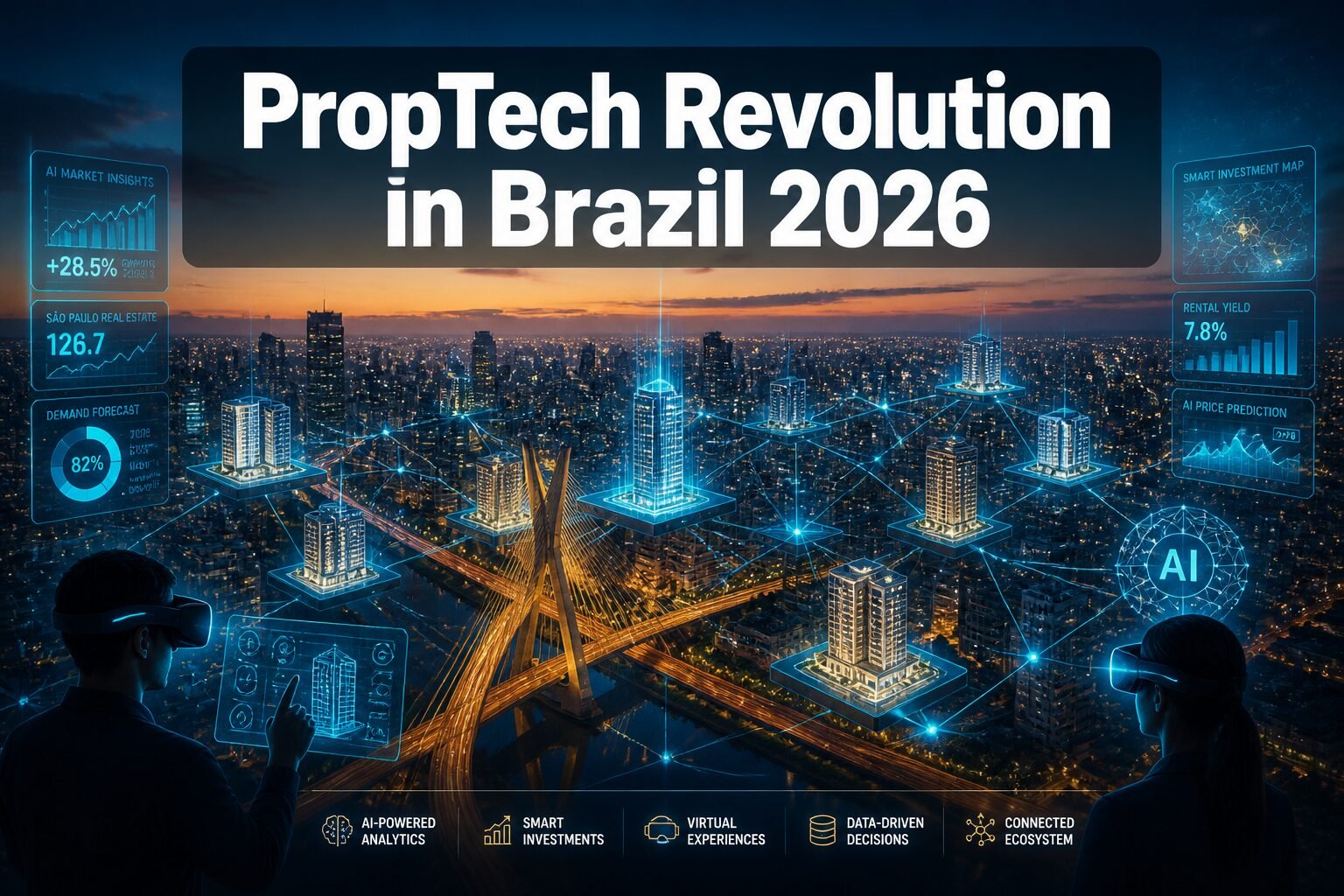
Brazil’s proptech market hit USD 866.49 million in 2025 — and analysts project it will surpass USD 2.5 billion by 2034, growing at a compound annual rate of 12.55% [1]. That trajectory is not driven by hype. It is powered by a fundamental shift in how developers, investors, and buyers interact with real estate — through artificial intelligence, virtual reality, and cloud-based platforms that are slashing transaction times by 30 to 50% [3]. The PropTech Revolution in Brazil 2026: AI Valuation Tools and VR Tours Driving Development Efficiency is no longer a future concept — it is the operating standard for competitive developers across the country.

Key Takeaways 📌
- 🚀 Brazil’s proptech market is projected to grow from USD 866M (2025) to USD 2.51B (2034), a CAGR of 12.55%
- 🤖 AI-driven valuation tools analyze massive datasets to deliver faster, more accurate property pricing and investment risk scores
- 🥽 Immersive VR and AR tours reduce marketing costs and accelerate deal closures by enabling remote property exploration
- 📱 Mobile platforms and cloud infrastructure are democratizing access to property transactions across Brazil’s growing urban centers
- 💰 Major players like Loft are committing R$ 100 million to AI and automation infrastructure in 2026, signaling industry-wide confidence
Why Brazil Is the Proptech Hotspot of Latin America
Several powerful forces are converging to make Brazil the region’s most dynamic proptech market in 2026.
Urban Growth Creating Massive Demand
Brazil’s cities are expanding rapidly. Millions of new urban residents need housing, and traditional real estate processes — paper-heavy, slow, and opaque — cannot keep pace. Digital solutions are filling that gap [1]. As more buyers and renters shift online to search, compare, and close property deals, the demand for efficient digital platforms grows exponentially.
“Brazil’s expanding urban population is not just a demographic trend — it is the engine driving the proptech market’s explosive growth.”
Government Programs Accelerating Digital Adoption
Substantial government investment in affordable housing programs is creating unprecedented demand for digital real estate solutions [1]. Programs targeting low-to-middle income housing require scalable, efficient transaction systems — exactly what proptech platforms deliver. This public-sector push is accelerating the adoption of AI tools, digital documentation, and online portals across the entire market.
Cloud Infrastructure and Data Privacy Foundations
The market is also being strengthened by robust cloud-based infrastructure and improving data privacy regulations [1]. Secure digital transactions are no longer a luxury — they are a baseline expectation. Brazilian developers and fintech companies are investing heavily in cloud architecture that supports everything from automated valuations to encrypted document verification.
For investors exploring where to place capital in this environment, understanding the best places to invest in Brazil property is an essential first step.
AI Valuation Tools: Redefining How Properties Are Priced
The PropTech Revolution in Brazil 2026: AI Valuation Tools and VR Tours Driving Development Efficiency is most visibly felt in the transformation of property valuation. What once took appraisers weeks now takes algorithms minutes.
How AI Valuation Works
AI-powered valuation tools process enormous datasets — including consumer behavior patterns, historical pricing, geographic information, infrastructure proximity, and macroeconomic indicators — to generate property valuations with remarkable precision [1]. Machine learning models improve with every transaction, becoming more accurate over time.
Key capabilities include:
| AI Valuation Feature | Business Impact |
|---|---|
| Real-time price prediction | Faster listing and offer decisions |
| Investment risk scoring | Reduced lender and buyer risk |
| Demand trend forecasting | Better development planning |
| Geographic hotspot identification | Higher-return site selection |
| Automated comparable analysis | Eliminated manual appraisal delays |
Personalized Recommendations at Scale
Beyond raw valuation, AI tools are functioning as intelligent matchmakers [2]. By analyzing a buyer’s past searches, behavioral cues, and stated preferences, platforms deliver property recommendations that improve in accuracy with every interaction. A buyer searching for a studio apartment near beaches in Florianópolis, for example, receives curated listings that match not just size and price — but lifestyle fit.
This personalization is transforming the buyer experience. Platforms are no longer passive search engines. They are active advisors.
Automated Risk Assessment Across the Pipeline
Lenders, insurers, and real estate agencies are deploying AI to automate risk assessments, streamline document verification, and simplify follow-up processes [2]. This reduces human error, compresses approval timelines, and makes the entire transaction pipeline more reliable. For developers, this means faster access to financing and smoother project launches.
The intersection of proptech and financial innovation is explored further in this analysis of cryptocurrencies and real estate development — another frontier reshaping how Brazilian property deals are structured.
Market Forecasting for Investors
AI systems are also processing vast volumes of market data to forecast price trends, identify emerging investment hotspots, and uncover high-return opportunities for both institutional and retail investors [2]. This capability is particularly valuable in a market as geographically diverse as Brazil, where regional dynamics can vary dramatically between São Paulo, Florianópolis, Recife, and Manaus.
VR Tours and AR Visualization: Selling Properties Before They Are Built
The second major pillar of the PropTech Revolution in Brazil 2026: AI Valuation Tools and VR Tours Driving Development Efficiency is immersive technology — and its impact on development marketing is profound.
Virtual Tours Eliminating Geographic Barriers 🥽
Real estate firms across Brazil are adopting immersive 3D virtual tours and virtual staging tools that allow prospective buyers and renters to explore properties remotely — without ever setting foot inside [1]. For a buyer in São Paulo considering a property in Florianópolis, or an international investor evaluating a Brazilian development from abroad, this capability is transformative.
Reported benefits include:
- ✅ Reduced marketing expenses — fewer physical showings required
- ✅ Faster deal closures — buyers arrive at decisions more confidently
- ✅ Broader buyer reach — geographic limitations disappear
- ✅ 24/7 property access — tours available at any hour
Developers launching projects in high-growth coastal regions are finding VR tours especially powerful. The Solis development exemplifies how modern Brazilian developers are leveraging digital presentation tools to attract buyers early in the development cycle.
Augmented Reality for Interior Visualization
Augmented reality is taking the experience one step further. Buyers can now use AR tools to visualize real-time interior design changes — seeing how different furniture arrangements, wall colors, or flooring options would look in an actual space [2]. This capability accelerates purchasing decisions by removing uncertainty about how a property will feel once personalized.
For off-plan purchases — where buyers commit before construction is complete — AR visualization is particularly powerful. It transforms abstract floor plans into tangible, personalized spaces.
“AR doesn’t just show buyers a property — it shows them their future home.”
Off-Plan Sales Powered by Digital Tools
The combination of VR tours and AI-driven personalization is supercharging off-plan property sales across Brazil. Buyers who invest in off-plan properties benefit from lower entry prices and significant appreciation potential — and digital tools are making it easier than ever to commit to a purchase before ground is broken.
Developers like those behind the Tramonto project are using digital progress updates and virtual site tours to keep buyers engaged and confident throughout the construction cycle, as seen in recent construction milestone reports.
Mobile Platforms and the Democratization of Property Transactions
The proptech revolution is not confined to enterprise software and developer tools. It is happening in the pockets of millions of Brazilian consumers.
Mobile-First Real Estate in 2026
Growing numbers of buyers, sellers, and tenants are using mobile apps and online portals to search, compare, and execute property transactions [1]. The smartphone has become the primary real estate tool for a generation of Brazilian consumers who expect the same digital fluency from property searches that they get from e-commerce or banking.
Key mobile platform capabilities driving adoption:
- 📍 GPS-integrated property search — find listings by precise location
- 📊 AI-powered price comparison — instant market context for any listing
- 📄 Digital document signing — complete transactions without physical meetings
- 🔔 Personalized alerts — notified instantly when matching properties list
- 💬 In-app agent communication — direct messaging with developers and brokers
Loft’s R$ 100 Million Commitment: A Market Signal
Perhaps the clearest signal of where Brazil’s proptech market is heading comes from Loft, one of the country’s leading real estate technology companies. In 2026, Loft announced a R$ 100 million technology investment, including expansion of its engineering team to 300 professionals, with a clear focus on AI and automation infrastructure [4].
This level of commitment from an established market player is not just a corporate announcement — it is a declaration that AI-driven real estate is the industry’s operating future, not a niche experiment.
Regional Growth Hotspots Attracting Proptech Investment
Cities like Florianópolis are emerging as particularly active proptech markets. The region’s combination of strong demand, quality-of-life appeal, and a sophisticated buyer base makes it an ideal environment for digital real estate tools. The growth of the Ingleses region in Florianópolis illustrates how technology-enabled development is reshaping even secondary markets.
For those considering the lifestyle and investment potential of Brazil’s southern coastal cities, the complete guide to life in Florianópolis provides essential context.
Challenges and Considerations for Developers
The proptech revolution brings significant opportunities — but also challenges that developers and investors must navigate carefully.
Digital Divide and Access Gaps
Not all regions of Brazil have equal access to high-speed internet or smartphone penetration. While urban centers are well-served, rural and semi-urban areas may lag in digital adoption, limiting the reach of proptech tools.
Data Security and Privacy Compliance
As more property transactions move online, data security becomes paramount. Brazil’s Lei Geral de Proteção de Dados (LGPD) — the country’s data protection law — sets strict standards for how personal and financial data must be handled [1]. Developers and platforms must invest in compliance infrastructure.
Integration with Legacy Systems
Many established developers and agencies still operate on legacy systems that do not easily integrate with modern AI platforms. The transition requires investment, training, and often cultural change within organizations.
Talent and Technology Investment
The expansion of engineering teams — as seen with Loft’s 300-person build-out — reflects a broader talent competition for AI and software professionals in Brazil’s real estate sector [4]. Smaller developers may find it challenging to compete for this talent.
What Developers and Investors Should Do Right Now
The window for early adoption advantage is narrowing. Here are actionable steps for stakeholders in Brazil’s real estate market:
For Developers:
- Audit current digital capabilities — identify gaps in valuation, marketing, and transaction tools
- Invest in VR/AR marketing assets — particularly for off-plan and pre-launch projects
- Partner with AI valuation platforms — integrate automated pricing into your development pipeline
- Prioritize mobile-first buyer experiences — ensure all digital touchpoints work seamlessly on smartphones
- Build data compliance into every system — LGPD compliance is non-negotiable
For Investors:
- Use AI-powered market forecasting — identify emerging hotspots before prices peak
- Evaluate developers by their digital maturity — proptech-enabled developers are lower risk
- Consider off-plan purchases in high-growth corridors — digital tools reduce the uncertainty traditionally associated with pre-construction investment
- Monitor regional infrastructure development — AI tools can flag areas where infrastructure investment is driving appreciation
Conclusion: The Digital Foundation of Brazil’s Real Estate Future
The PropTech Revolution in Brazil 2026: AI Valuation Tools and VR Tours Driving Development Efficiency is not a trend to watch — it is a transformation already underway. From AI systems that price properties with machine precision to VR tours that close deals across continents, the tools reshaping Brazilian real estate are delivering measurable results: faster transactions, lower costs, and better outcomes for buyers, developers, and investors alike.
With the market set to nearly triple in value by 2034, and with major players committing hundreds of millions to AI infrastructure, the question is no longer whether to embrace proptech — it is how fast to move.
Developers who integrate AI valuation, immersive digital marketing, and mobile-first platforms into their operations today will hold a decisive competitive advantage tomorrow. The foundation is being built right now — and those who build on it earliest will capture the greatest returns.
References
[1] Brazil Proptech Market – https://www.imarcgroup.com/brazil-proptech-market
[2] Proptech Transforming Real Estate 2025 – https://www.lodhagroup.com/blogs/homebuyers-handbook/proptech-transforming-real-estate-2025
[3] fiabci – https://fiabci.org/en/news-room/view/423
[4] Loft Ai Automation Fintech Real Estate – https://alabia.com.br/insights/economia/financas/loft-ai-automation-fintech-real-estate/
[5] Proptech Property Technology – https://bas-ip.com/articles/proptech-property-technology/