
Real Estate Opportunities in Brazil: A Comprehensive 2026 Investment Guide

Brazil’s real estate market is experiencing a remarkable transformation in 2026, creating unique investment windows that savvy investors cannot afford to ignore. With the Brazilian Real trading at historically favorable exchange rates, foreign investors are discovering effective discounts of 30-50% compared to similar properties in Miami or Lisbon, while domestic buyers navigate a landscape shaped by high interest rates, expanding government housing programs, and dramatic regional variations in property performance. Understanding real estate opportunities in Brazil requires looking beyond the headlines to identify where genuine value and growth potential intersect.
Key Takeaways
- Currency Advantage: Foreign investors enjoy 30-50% effective discounts on Brazilian properties due to the weak Real, making entry points historically attractive[1]
- Small Properties Outperform: Studios and small apartments are appreciating at 9% annually, significantly outpacing larger luxury properties amid affordability constraints[1]
- Secondary Cities Lead Growth: Salvador and João Pessoa show price increases exceeding 20%, while major metros like São Paulo and Rio lag behind[1]
- Government Support Expands: Brazil’s Minha Casa, Minha Vida program will invest $39.8 billion in 2026, with over 1 million units under construction nationwide[2]
- Interest Rate Trajectory: The Selic rate is expected to decline from 15% to approximately 12.25% by year-end 2026, potentially expanding the buyer pool and supporting price appreciation[1]
Understanding the Current Brazilian Real Estate Market Landscape
The Brazilian property market in 2026 presents a complex but navigable environment for investors seeking real estate opportunities in Brazil. The market is characterized by significant regional disparities, property type performance variations, and macroeconomic factors that create both challenges and opportunities.
Price Ranges and Market Segmentation
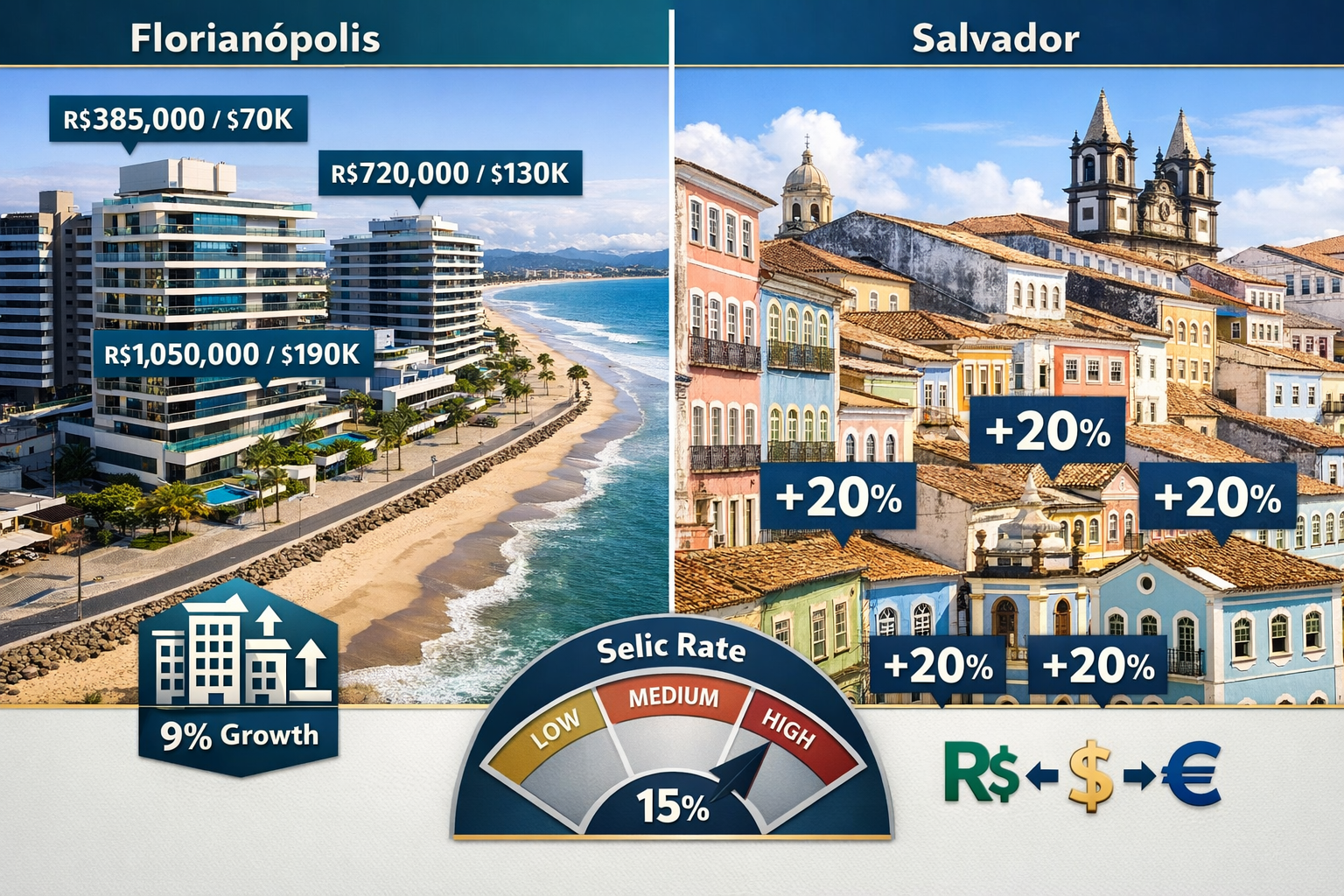
For the majority of residential properties—approximately 80% of the market—prices currently fall between R$385,000 and R$1,050,000 (approximately $69,000–$189,000 or €59,000–€162,000)[1]. This price band represents the sweet spot where transaction velocity remains healthy and financing accessibility supports steady demand.
However, nominal property prices increased only 7% over the past 12 months. When adjusted for Brazil’s inflation rate above 4%, real price growth was merely around 2%[1]. This modest real appreciation reflects the dampening effect of elevated interest rates on purchasing power and investor sentiment.
| Property Segment | Annual Appreciation | Market Dynamics |
|---|---|---|
| Small Apartments/Studios | ~9% | High demand, affordability-driven |
| Mid-Size Properties | ~2% (real) | Moderate growth, steady transactions |
| Large Luxury Apartments | Underperforming | Extended selling times, high financing costs |
| Secondary City Properties | 20%+ | Rapid urbanization, infrastructure investment |
The Interest Rate Environment and Its Impact
Brazil’s benchmark Selic interest rate stands at 15% in January 2026—the highest level since 2006[1]. This elevated rate environment has profound implications for real estate opportunities in Brazil:
🏦 Mortgage Accessibility: High borrowing costs have compressed the pool of qualified buyers, particularly for properties above the R$1 million threshold.
📉 Luxury Market Pressure: Large luxury apartments and trophy homes are expected to underperform throughout 2026 due to elevated financing costs and longer selling times[1].
📈 Rate Decline Forecast: Market forecasters expect the Selic rate to decline from 15% to approximately 12.25% by year-end 2026[1]. This anticipated reduction should gradually expand the buyer pool and provide tailwind support for price growth in the latter half of the year.
Regional Variations: Where to Find the Best Real Estate Opportunities in Brazil
Not all Brazilian markets are created equal in 2026. Understanding regional performance differences is critical for identifying the most promising real estate opportunities in Brazil.
Secondary Cities Outpacing Major Metros
A surprising trend has emerged: Salvador and João Pessoa are significantly outpacing traditional powerhouses like São Paulo and Rio de Janeiro, with price increases exceeding 20%[1]. This phenomenon reflects several converging factors:
✅ Infrastructure Investment: Government and private sector infrastructure projects are improving connectivity and livability in secondary markets.
✅ Affordability Migration: Buyers priced out of São Paulo and Rio are seeking value in emerging cities with lower entry points.
✅ Quality of Life: Coastal cities like Florianópolis offer superior lifestyle amenities, attracting remote workers and retirees.
✅ Development Pipeline: New construction in secondary markets often features modern amenities at competitive prices.
For investors exploring best places to invest in Brazil property, these secondary markets warrant serious consideration. The growth trajectory in cities like Florianópolis demonstrates how regional dynamics can create exceptional value propositions.
Florianópolis: A Case Study in Regional Growth
Florianópolis exemplifies the opportunity available in Brazil’s secondary markets. The growth of regions like Ingleses in Florianópolis showcases how quality of life, infrastructure development, and property appreciation converge to create compelling investment scenarios.
The city’s real estate market has demonstrated resilience even amid national headwinds, with Florianópolis’s real estate market performance continuing to attract both domestic and international capital.
Property Type Performance: Small is Beautiful in 2026
One of the most significant trends shaping real estate opportunities in Brazil in 2026 is the dramatic outperformance of smaller property formats.
The Studio and Small Apartment Advantage
Small apartments and studios are significantly outperforming larger properties with appreciation rates near 9% annually[1]. This performance gap is driven by several structural factors:
💰 Affordability Constraints: With interest rates at 15%, many buyers can only qualify for financing on smaller, less expensive units.
🎓 Student and Young Professional Demand: University cities experience consistent demand for compact, affordable housing.
🏢 Rental Yield Optimization: Smaller units typically generate higher rental yields on a per-square-meter basis.
📍 Urban Location Premium: Studios in prime urban locations remain accessible to middle-class buyers while larger properties in the same areas are prohibitively expensive.
Investors considering studio investments in Florianópolis can benefit from both appreciation potential and rental income generation in a market characterized by strong fundamentals.
Luxury Market Headwinds
Conversely, the luxury segment faces significant challenges in 2026. Large luxury apartments and trophy homes are expected to underperform due to:
⚠️ Extended Selling Times: Properties above R$2 million are experiencing market times 40-60% longer than in 2023.
⚠️ Financing Barriers: At 15% interest rates, even affluent buyers face substantial carrying costs.
⚠️ Limited Foreign Demand: Despite currency advantages, geopolitical uncertainty and economic volatility have moderated high-net-worth foreign buyer activity.
Government Housing Programs: Catalyzing Market Growth
Brazil’s government housing initiatives represent a critical driver of real estate opportunities in Brazil in 2026, particularly in the affordable and mid-market segments.
Minha Casa, Minha Vida Program Expansion
New financing requirements under the Minha Casa, Minha Vida (MCMV) program took effect January 2, 2026, significantly expanding access for lower-income families[2]. Key program parameters include:
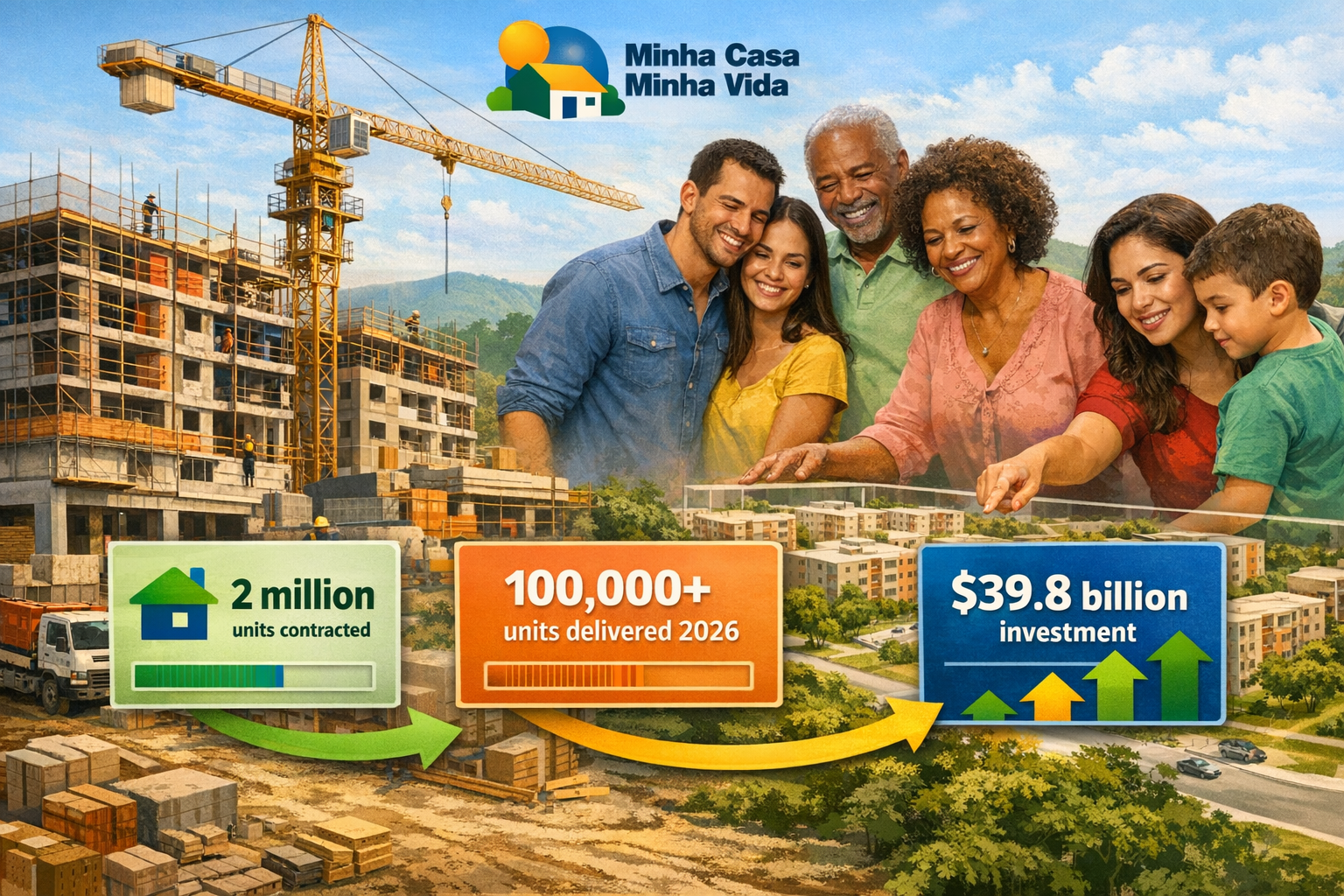
📊 Investment Scale: Combined government housing programs will invest approximately $39.8 billion in 2026[2].
📊 Historical Impact: The MCMV program has mobilized $140–145 billion since its inception in 2009[2].
📊 2026 Delivery Target: The government expects to deliver more than 100,000 housing units in 2026 under subsidized MCMV lines alone[2].
📊 Construction Pipeline: Over 1 million units are currently under construction nationwide[2].
📊 Contracting Goals: The administration has already contracted 2 million units in the first three years and aims to contract an additional 1 million units by year-end 2026[2].
Expanded Eligibility and Property Values
The 2026 MCMV reforms increased maximum property values to around R$255,000–R$270,000 in larger urban centers[2]. This expansion creates opportunities for developers and investors in several ways:
✅ Developer Demand: Construction companies benefit from guaranteed government purchases and financing support.
✅ Supplier Opportunities: Building materials, fixtures, and service providers experience sustained demand.
✅ Neighborhood Development: MCMV projects often catalyze broader neighborhood improvement and commercial development.
✅ Rental Market Expansion: MCMV units entering the resale market provide affordable rental inventory.
The Foreign Investor Advantage: Currency-Driven Opportunities
Perhaps the most compelling aspect of real estate opportunities in Brazil for international investors in 2026 is the currency arbitrage opportunity created by the weak Brazilian Real.
30-50% Effective Discount
Foreign investors enjoy an effective 30–50% discount on Brazilian real estate compared to similar properties in Miami or Lisbon due to the weak Brazilian Real[1]. This discount manifests in several ways:
💵 Purchasing Power: USD, EUR, and GBP holders can acquire significantly more square meters in Brazil than in comparable markets.
💵 Quality Differential: The discount often allows foreign buyers to access higher-quality properties with superior amenities than they could afford in their home markets.
💵 Diversification: Brazil offers geographic and currency diversification for portfolios concentrated in North American or European assets.
Considerations for Foreign Buyers
While the currency advantage is substantial, foreign investors should consider several factors:
⚖️ Legal Framework: Brazil has clear legal provisions for foreign property ownership, though bureaucratic processes can be complex.
⚖️ Tax Implications: Understanding Brazilian property taxes, capital gains treatment, and tax treaty provisions is essential.
⚖️ Repatriation: Currency controls and repatriation procedures should be understood before investing.
⚖️ Local Partnerships: Working with established local developers like Quadragon can streamline the acquisition process and provide valuable market insights.
Pre-Construction Opportunities: Maximizing Appreciation Potential
Buying properties during the pre-construction phase represents one of the most powerful strategies for capitalizing on real estate opportunities in Brazil.
The Pre-Construction Advantage
Pre-construction purchases from established developers offer several distinct advantages:
🏗️ Entry Price Discount: Pre-construction properties typically sell at 15-25% below completed market value.
🏗️ Payment Flexibility: Extended payment plans during construction reduce upfront capital requirements.
🏗️ Appreciation During Construction: Properties often appreciate significantly between contract signing and delivery.
🏗️ Customization Options: Early buyers may have opportunities to customize finishes and layouts.
Evaluating Developer Track Record
The success of pre-construction investments depends heavily on developer credibility and execution capability. Investors should evaluate:
✔️ Completion History: Review the developer’s track record of on-time, on-budget project delivery.
✔️ Financial Stability: Assess the developer’s balance sheet and access to construction financing.
✔️ Construction Progress: Monitor physical progress through site visits or photographic updates, such as those provided for Tramonto development projects.
✔️ Market Positioning: Evaluate whether the project’s location, pricing, and amenities align with market demand.
Emerging Trends Shaping Brazil’s Real Estate Future
Several emerging trends are reshaping real estate opportunities in Brazil and creating new investment paradigms.
Technology and Innovation in Real Estate Transactions
The Brazilian real estate sector is experiencing digital transformation:
🖥️ Virtual Tours: 3D property tours and virtual reality showings are becoming standard, particularly for international buyers.
🖥️ Blockchain and Cryptocurrency: Some developers are exploring cryptocurrency acceptance for real estate transactions, offering additional flexibility for international investors.
🖥️ PropTech Platforms: Digital platforms are streamlining property search, due diligence, and transaction management.
Sustainability and Green Building
Environmental consciousness is increasingly influencing buyer preferences and property values:
🌱 Energy Efficiency: Properties with solar panels, efficient HVAC systems, and LED lighting command premium prices.
🌱 Sustainable Materials: Developments using sustainable construction materials appeal to environmentally conscious buyers.
🌱 Green Certifications: LEED and similar certifications are becoming differentiators in competitive markets.
Remote Work and Lifestyle Migration
The normalization of remote work continues to reshape demand patterns:
🏖️ Coastal Migration: Professionals are relocating from São Paulo and Rio to coastal cities with superior quality of life.
🏖️ Second Home Demand: Remote work flexibility is driving second home purchases in resort markets.
🏖️ Co-working Amenities: New developments increasingly incorporate co-working spaces and high-speed internet infrastructure.
Risk Factors and Mitigation Strategies
While real estate opportunities in Brazil are compelling, prudent investors must understand and mitigate associated risks.
Economic and Political Volatility
Brazil’s economic and political environment can be unpredictable:
⚠️ Currency Risk: The Real’s value can fluctuate significantly, affecting returns when converted to foreign currencies.
⚠️ Policy Changes: Government housing policies, tax regulations, and foreign investment rules can change with new administrations.
⚠️ Inflation: Brazil’s history of inflation requires careful consideration of real versus nominal returns.
Mitigation: Diversify across multiple properties and regions, maintain adequate liquidity, and work with advisors who understand the Brazilian context.
Liquidity Considerations
Real estate is inherently illiquid, and Brazilian properties can take longer to sell than assets in more developed markets:
⚠️ Extended Selling Periods: Properties may take 6-18 months to sell, depending on market conditions and price point.
⚠️ Transaction Costs: Buying and selling costs (taxes, fees, commissions) can total 8-12% of property value.
Mitigation: Maintain a long-term investment horizon (5+ years), ensure adequate reserve funds, and price properties competitively when selling.
Legal and Bureaucratic Complexity
Brazil’s legal and bureaucratic systems can be challenging for foreign investors:
⚠️ Documentation Requirements: Property transactions require extensive documentation and notarization.
⚠️ Title Issues: Thorough title searches are essential to avoid encumbrances or ownership disputes.
⚠️ Regulatory Compliance: Understanding and complying with local regulations requires expert guidance.
Mitigation: Engage experienced local legal counsel, work with reputable developers and real estate agencies, and conduct comprehensive due diligence.
Practical Steps for Capitalizing on Real Estate Opportunities in Brazil
For investors ready to explore real estate opportunities in Brazil, a systematic approach increases the likelihood of success.
Step 1: Define Investment Objectives
Clarify your investment goals before beginning property search:
- Capital appreciation vs. rental income focus
- Investment timeline (short-term flip vs. long-term hold)
- Risk tolerance and liquidity requirements
- Geographic preferences and property type interests
Step 2: Research Markets and Properties
Conduct thorough market research:
- Study regional economic trends and demographic patterns
- Analyze historical price performance and appreciation trajectories
- Evaluate infrastructure development plans and their impact on property values
- Review available developments from established developers
Step 3: Assemble Your Advisory Team
Build a team of trusted professionals:
- Real estate attorney specializing in foreign investment
- Tax advisor familiar with cross-border implications
- Local real estate agent or developer representative
- Property management company (if pursuing rental income)
Step 4: Conduct Due Diligence
Perform comprehensive due diligence on target properties:
- Verify clear title and absence of liens or encumbrances
- Inspect physical condition (or review construction progress for pre-construction)
- Analyze comparable sales and rental rates
- Review all contracts, bylaws, and condominium regulations
Step 5: Structure the Transaction
Optimize transaction structure for tax efficiency and legal protection:
- Determine optimal ownership structure (individual, company, trust)
- Negotiate favorable payment terms and conditions
- Understand all costs (purchase price, taxes, fees, closing costs)
- Secure financing if applicable (though many foreign buyers pay cash)
Step 6: Manage the Asset
Implement effective property management:
- Engage professional property management if not residing locally
- Maintain adequate insurance coverage
- Monitor market conditions and property performance
- Plan exit strategy and timing based on market cycles
Conclusion: Seizing Brazil’s Real Estate Opportunities in 2026
The landscape of real estate opportunities in Brazil in 2026 presents a compelling but nuanced investment environment. The convergence of favorable currency exchange rates, government housing program expansion, and dramatic regional performance variations creates multiple pathways to attractive returns for informed investors.
The most promising opportunities lie in small apartments and studios in secondary markets like Salvador, João Pessoa, and Florianópolis, where appreciation rates significantly exceed national averages. The anticipated decline in interest rates from 15% to approximately 12.25% by year-end should provide additional tailwind support for property values and transaction volumes.
For foreign investors, the 30-50% effective discount created by the weak Real represents a historically attractive entry point, particularly when combined with pre-construction purchase strategies that maximize appreciation potential.
However, success requires navigating Brazil’s complex legal and bureaucratic environment, understanding regional market dynamics, and maintaining a long-term investment perspective that accounts for economic volatility and liquidity constraints.
Next Steps
Ready to explore real estate opportunities in Brazil? Consider these immediate actions:
- Connect with Local Experts: Contact experienced developers who understand regional markets and can guide your investment journey.
- Review Available Projects: Explore current development opportunities to understand pricing, locations, and amenities.
- Conduct Market Research: Study specific markets of interest, focusing on secondary cities with strong growth trajectories.
- Assemble Your Team: Begin building relationships with legal, tax, and real estate professionals who specialize in Brazilian property investment.
- Visit Properties: If possible, schedule site visits to experience neighborhoods, inspect properties, and meet with developers and agents.
The Brazilian real estate market in 2026 rewards preparation, patience, and partnership with knowledgeable local professionals. By understanding the market dynamics outlined in this guide and taking systematic action, investors can position themselves to capitalize on one of Latin America’s most compelling real estate opportunities.
References
[1] Brazil Price Forecasts – https://thelatinvestor.com/blogs/news/brazil-price-forecasts
[2] Brazils Construction Sector 2026 Housing Programs Support Rates High Risks Persist – https://www.fastmarkets.com/insights/brazils-construction-sector-2026-housing-programs-support-rates-high-risks-persist/