Remote Work Amenities in Brazil Urban Properties: Designing 2026 Developments for Post-Pandemic Hybrid Lifestyles

Remote Work Amenities in Brazil Urban Properties: Designing 2026 Developments for Post-Pandemic Hybrid Lifestyles

}

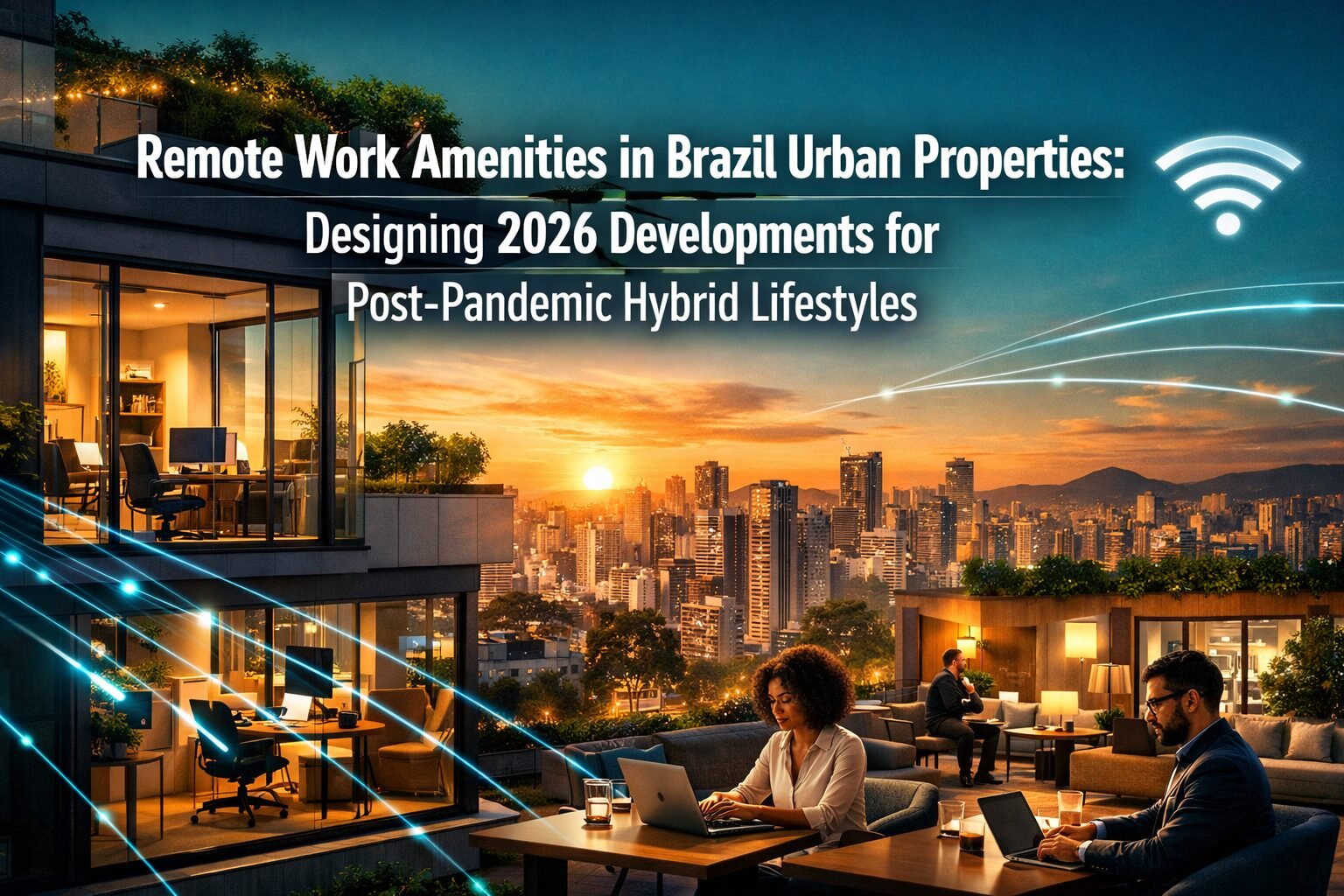
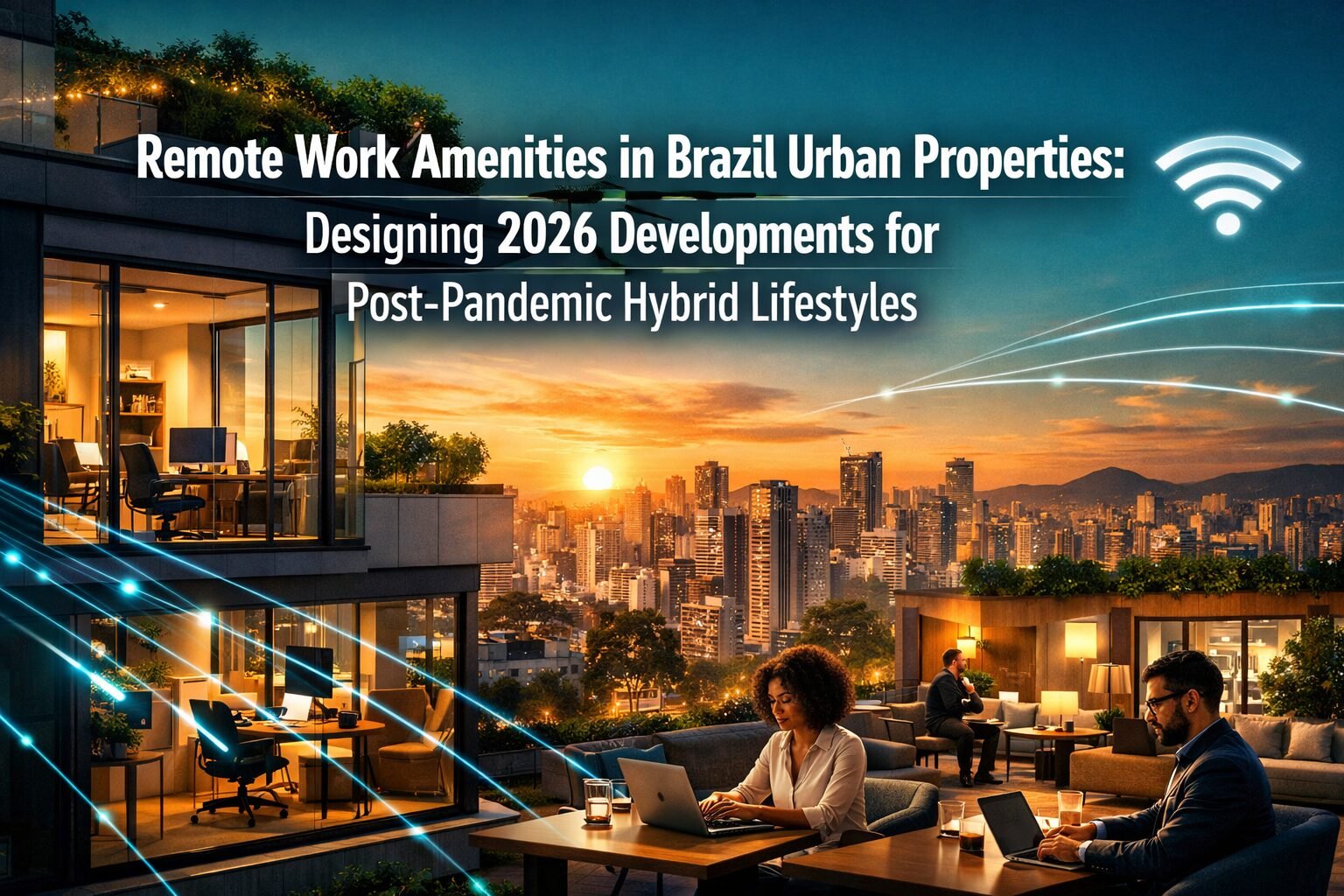
Professional landscape format (1536x1024) hero image featuring bold text overlay 'Remote Work Amenities in Brazil Urban Properties: Designin

The Brazilian real estate market is experiencing a fundamental transformation. In cities like Belo Horizonte, Niterói, and São Paulo, a new breed of urban property is emerging—one designed specifically for the remote worker. With dedicated home offices, fiber optic internet exceeding 300 Mbps, and integrated green spaces, these developments represent more than architectural evolution. They signal a complete reimagining of what urban living means in 2026. As professionals increasingly demand workspace functionality within their homes, developers are racing to meet this surge in demand, creating properties that blur the lines between residential comfort and professional productivity.

The numbers tell a compelling story. Niterói has recorded a 30% increase in demand for residential properties with dedicated home office spaces[4], while Brazil’s multifamily sector has expanded to 674,000 m² of built area comprising approximately 12,300 operational units as of Q1 2025[8]. This isn’t a temporary trend—it’s a permanent shift in how Brazilians live and work.

Key Takeaways

Demand Surge: Brazilian cities are experiencing 30%+ increases in demand for properties with dedicated home office infrastructure, particularly in secondary metros like Belo Horizonte and Curitiba[4]

Technical Standards Elevated: Properties with 300+ Mbps fiber optic connections, UPS backup systems, and mesh Wi-Fi coverage now command premium rental rates and are considered standard rather than luxury features[1]

Coliving Dominance: Managed coliving spaces with integrated coworking floors, ergonomic furniture, and all-inclusive flexible leases have become the primary delivery model for remote-work-ready housing[1][2]

Geographic Expansion: Coastal cities like Florianópolis and João Pessoa are attracting concentrated remote worker flows, while secondary metros are developing supporting infrastructure ecosystems[1][3]

Digital Nomad Infrastructure: Brazil’s Digital Nomad Visa ecosystem has matured with professionalized support services, driving international demand for hybrid-ready urban properties[1][5]

Understanding the Remote Work Revolution in Brazilian Urban Markets
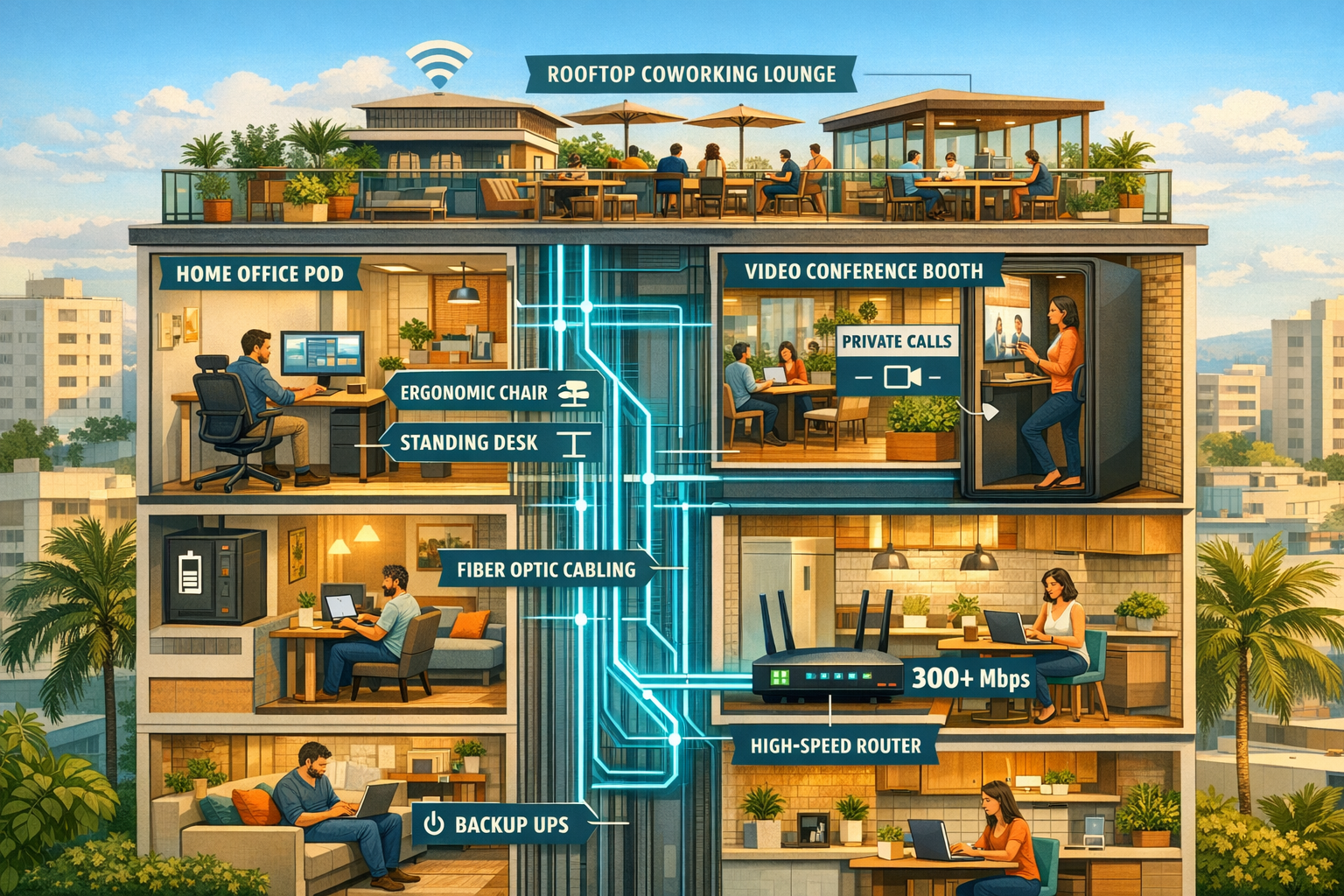
Detailed landscape format (1536x1024) architectural cutaway illustration showing modern Brazilian mid-rise condominium building with transpa

The Post-Pandemic Shift in Housing Priorities

The pandemic fundamentally altered what Brazilians expect from their homes. No longer just a place to sleep and relax, urban properties must now function as productive workspaces, meeting rooms, and creative studios. This transformation has created unprecedented opportunities for developers who understand the new priorities.

Traditional apartment features that once dominated marketing materials—proximity to shopping, number of bedrooms, parking spaces—now compete with workspace specifications: internet bandwidth, dedicated office layouts, soundproofing quality, and ergonomic design compatibility.

The shift is particularly pronounced in mid-tier condominium developments, where buyers represent a new demographic: young professionals, digital entrepreneurs, and remote employees who prioritize functionality over prestige. These buyers are willing to pay premiums for properties that enable productive work-from-home arrangements.

Market Data Driving Development Decisions

Real estate developers are responding to quantifiable market signals. The residential market in major Brazilian cities now breaks down as approximately 70% apartments/condos, 20% detached houses, and 10% other property types[4], with the apartment segment experiencing the most dramatic transformation in unit specifications.

Properties marketed with comprehensive remote work amenities are outperforming traditional units across multiple metrics:

  • Rental velocity: 40-60% faster occupancy rates
  • Price premiums: 15-25% higher rental rates in competitive neighborhoods
  • Tenant retention: Longer lease commitments and lower turnover
  • Investment returns: Enhanced ROI for developers focusing on hybrid-ready specifications

This data has prompted major developers to reconsider standard unit designs, incorporating workspace functionality as a core architectural element rather than an afterthought. For investors exploring opportunities in Brazil’s property market, understanding these shifting priorities is essential for identifying high-performing assets.

The Digital Nomad Catalyst

Brazil’s Digital Nomad Visa (VITEM XIV), introduced in January 2022, permits 1-year renewable stays with no taxation on foreign income[1][5]. This policy innovation has catalyzed demand for professionally-equipped urban housing, particularly in cities with established infrastructure and lifestyle appeal.

The visa ecosystem has matured significantly, with supporting services including:

  • 🌐 Digitized administrative platforms (MigranteWeb) streamlining visa acquisition
  • ⚖️ Legal support networks specializing in remote worker requirements
  • 📊 Tax compliance services navigating international income structures
  • 🏢 Corporate relocation consultancies facilitating company-sponsored moves

This professionalization has reduced friction for international remote workers, creating sustained demand for properties that meet global standards for connectivity, workspace design, and community integration.

Remote Work Amenities in Brazil Urban Properties: Designing 2026 Developments for Post-Pandemic Hybrid Lifestyles—Core Infrastructure Requirements

High-Speed Internet as Non-Negotiable Foundation

In 2026, internet connectivity isn’t an amenity—it’s essential infrastructure, comparable to electricity or water. Properties marketed with 300+ Mbps internet speeds, dedicated fiber optic connections, UPS/4G-5G backup systems, and meshed Wi-Fi coverage now command premium rental rates in competitive neighborhoods[1].

Technical specifications that differentiate premium properties include:

Feature Standard Offering Premium Offering
Download Speed 100-200 Mbps 300-1000 Mbps
Connection Type Shared cable Dedicated fiber optic
Backup Systems None UPS + 4G/5G failover
Coverage Single router Mesh network system
Network Management Resident-managed Professional monitoring
Service Level Agreement Best effort Guaranteed uptime

Developers partnering with telecommunications providers to pre-install enterprise-grade infrastructure are seeing measurable market advantages. Properties with documented connectivity specifications attract remote workers willing to pay 20-30% premiums over comparable units with standard internet service.

Dedicated Workspace Design Standards

The era of working from kitchen tables has ended. Modern Brazilian urban properties incorporate purpose-built home office spaces with specific design criteria:

🏗️ Architectural Elements:

  • Separate room or defined zone (minimum 6-8 m²)
  • Natural lighting with window access
  • Acoustic treatment reducing ambient noise
  • Electrical capacity supporting multiple devices
  • Climate control independent of living areas
  • Door or partition enabling privacy during calls

🪑 Ergonomic Infrastructure:

  • Adjustable desk mounting points or built-in workstations
  • Task lighting with adjustable color temperature
  • Multiple electrical outlets (minimum 6 per workspace)
  • Cable management systems integrated into walls
  • Ergonomic chair compatibility with appropriate floor space

These specifications have transitioned from luxury features to standard expectations, particularly in developments targeting professionals in technology, finance, and creative industries. Properties lacking dedicated workspace design face longer marketing periods and reduced pricing power.

Backup Power and Connectivity Resilience

Brazil’s electrical grid, while improving, still experiences periodic disruptions that can devastate remote workers on tight deadlines. Forward-thinking developments now incorporate uninterruptible power supply (UPS) systems and backup connectivity as standard infrastructure.

Resilience features include:

  • Building-level UPS systems providing 2-4 hours of backup power
  • Individual unit battery backup for critical equipment
  • Dual ISP connections from different providers
  • 4G/5G failover systems activating automatically during outages
  • Generator backup for common areas and critical systems

Properties advertising these resilience features attract remote workers whose income depends on consistent connectivity, particularly those serving international clients across time zones where downtime directly impacts revenue.

Coliving and Community-Integrated Models: The Future of Remote Work Amenities in Brazil Urban Properties

The Rise of Professionally Managed Coliving Spaces

Coliving spaces have emerged as the dominant solution for remote workers in Brazilian urban markets, offering dedicated desks, ergonomic chairs, quiet zones, and reserved coworking floors alongside high-speed internet and comprehensive technology integration[1]. This format represents a departure from traditional apartment rentals toward managed, amenity-inclusive models.

The coliving advantage centers on operational efficiency and community value:

📍 Physical Amenities:

  • Dedicated coworking floors with professional-grade furniture
  • Private phone booths for confidential calls
  • Conference rooms available for resident booking
  • Printing and office equipment access
  • Mail and package handling services
  • 24/7 access to workspace facilities

🤝 Community Programming:

  • Regular networking events and professional mixers
  • Skill-sharing workshops and educational sessions
  • Social activities reducing isolation
  • Professional matchmaking for collaboration opportunities
  • Mentorship programs connecting experienced and emerging professionals

Coliving operators structure regular events, networking activities, activity programming, and professional matchmaking as core amenities, addressing documented isolation concerns among remote workers and expatriates[1][2]. This ecosystem approach transforms housing from a transactional product into an integrated lifestyle service.

Flexible Lease Structures Reshaping Market Norms

Traditional Brazilian rental markets historically required long-term commitments, security deposits, and guarantor arrangements that created barriers for mobile professionals. The remote work revolution has normalized all-inclusive furnished offerings with 1-6 month lease flexibility[1], particularly in Rio de Janeiro and São Paulo where traditional long-term contracts previously dominated.

Modern lease structures include:

  • Furnished turnkey units eliminating setup friction
  • All-inclusive pricing covering utilities, internet, and amenities
  • Flexible terms from 1-month to 12-month options
  • Simplified documentation reducing bureaucratic barriers
  • Digital contracting enabling remote lease execution
  • Transparent pricing with no hidden fees or surprise charges

This flexibility particularly appeals to digital nomads, corporate relocations, and professionals testing new cities before committing to long-term residence. Developers offering these lease structures report occupancy rates 15-20% higher than comparable properties requiring traditional rental arrangements.

Technology Integration as Operational Infrastructure

Modern remote-work-focused developments deploy residential management applications, keyless access systems, usage-based billing, and community social networks as standard operational infrastructure[2]. These platforms facilitate both resident coordination and operator revenue optimization.

Digital infrastructure includes:

🔐 Access Management:

  • Smartphone-based entry systems
  • Temporary access codes for guests and services
  • Activity logging for security
  • Remote access management

💰 Financial Platforms:

  • Transparent billing dashboards
  • Usage-based amenity charges
  • Digital payment processing
  • Automated rent collection

👥 Community Coordination:

  • Resident social networks
  • Amenity booking systems
  • Maintenance request portals
  • Event registration and communication

These systems reduce operational friction while creating data streams that enable dynamic pricing, predictive maintenance, and personalized service delivery. Properties leveraging comprehensive technology platforms report 30-40% reductions in administrative overhead compared to traditionally managed buildings.

Developers in emerging markets like Florianópolis are particularly aggressive in deploying these technologies, recognizing that digital-native remote workers expect seamless technology integration as a baseline requirement.

Geographic Opportunities: Remote Work Amenities in Brazil Urban Properties Across Key Markets

Primary Metropolitan Markets: São Paulo and Rio de Janeiro

Brazil’s largest cities continue to attract the majority of remote work property development, but with evolving geographic concentration within these metros.

São Paulo developments cluster around established business districts that are transforming into hybrid work hubs:

  • Avenida Faria Lima: Premium properties targeting international remote workers and executives
  • Vila Olímpia: Mid-tier developments with strong coworking integration
  • Pinheiros: Creative professional focus with lifestyle amenities
  • Itaim Bibi: Corporate-oriented properties with conference facilities

Rio de Janeiro sees concentration in neighborhoods balancing professional infrastructure with lifestyle appeal:

  • Botafogo: Transit-connected properties with beach proximity
  • Flamengo: Established residential areas adding remote work amenities
  • Leblon/Ipanema: Premium segment targeting affluent remote workers
  • Barra da Tijuca: Newer developments with purpose-built workspace infrastructure

Rental prices exhibit upward pressure in well-connected neighborhoods near beaches, coworking poles, and transit hubs[1][2], with premium pricing supported by properties displaying work-ready specifications. This represents a documented secondary effect of digital nomad inflow, creating gentrification concerns in historically affordable neighborhoods.

Secondary Markets with Exceptional Growth Potential

Coastal cities Florianópolis and João Pessoa, plus secondary metros Curitiba, Belo Horizonte, Recife, and Salvador, are attracting concentrated remote worker flows due to infrastructure improvements and lifestyle positioning[1][3].

🏖️ Florianópolis has emerged as Brazil’s premier remote work destination, combining:

  • Exceptional quality of life with beach access
  • Growing technology sector ecosystem
  • Improving broadband infrastructure
  • International airport connectivity
  • Lower cost of living than São Paulo/Rio
  • Active digital nomad community

The city’s wellness-focused real estate developments integrate remote work amenities with lifestyle features, creating compelling value propositions for professionals prioritizing work-life balance.

🏙️ Belo Horizonte represents the archetypal mid-tier metro experiencing remote work transformation:

  • Strong educational institutions producing skilled workforce
  • Lower property costs enabling larger units with dedicated offices
  • Improving fiber optic coverage across residential neighborhoods
  • Growing coworking ecosystem supporting remote professionals
  • Central geographic location facilitating domestic travel

📊 Curitiba leverages urban planning excellence and quality infrastructure:

  • Established reputation for livability and sustainability
  • Comprehensive public transportation reducing car dependency
  • Tech sector growth creating professional community
  • European cultural influences appealing to international remote workers

These secondary cities remain dependent on expanding broadband reliability and supporting service ecosystems[1][3], but represent significant opportunities for developers willing to invest in comprehensive remote work infrastructure ahead of mainstream demand.

Investment Considerations Across Market Tiers

The residential market bifurcation creates distinct investment opportunities based on target demographics and risk tolerance.

Luxury Segment (Top 10% of market):

  • International digital nomads and executives
  • Premium pricing power (R$8,000-15,000+ monthly)
  • Full-service amenity packages
  • Prime locations with lifestyle appeal
  • Higher development costs but strong margins

Mid-Tier Segment (60-80% of market):

  • Domestic remote workers and young professionals
  • Moderate pricing (R$3,000-7,000 monthly)
  • Essential remote work infrastructure
  • Transit-connected locations
  • Volume-based returns on investment

Value Segment (Bottom 20% of market):

  • Entry-level remote workers and students
  • Budget pricing (R$1,500-3,000 monthly)
  • Basic connectivity and shared workspaces
  • Emerging neighborhoods
  • Higher vacancy risk but accessible entry points

Investors evaluating property investment opportunities in Brazil should align property specifications with target demographic expectations, recognizing that remote work amenities command premiums across all market segments but with varying feature requirements.

Design Principles for 2026 Hybrid-Ready Developments
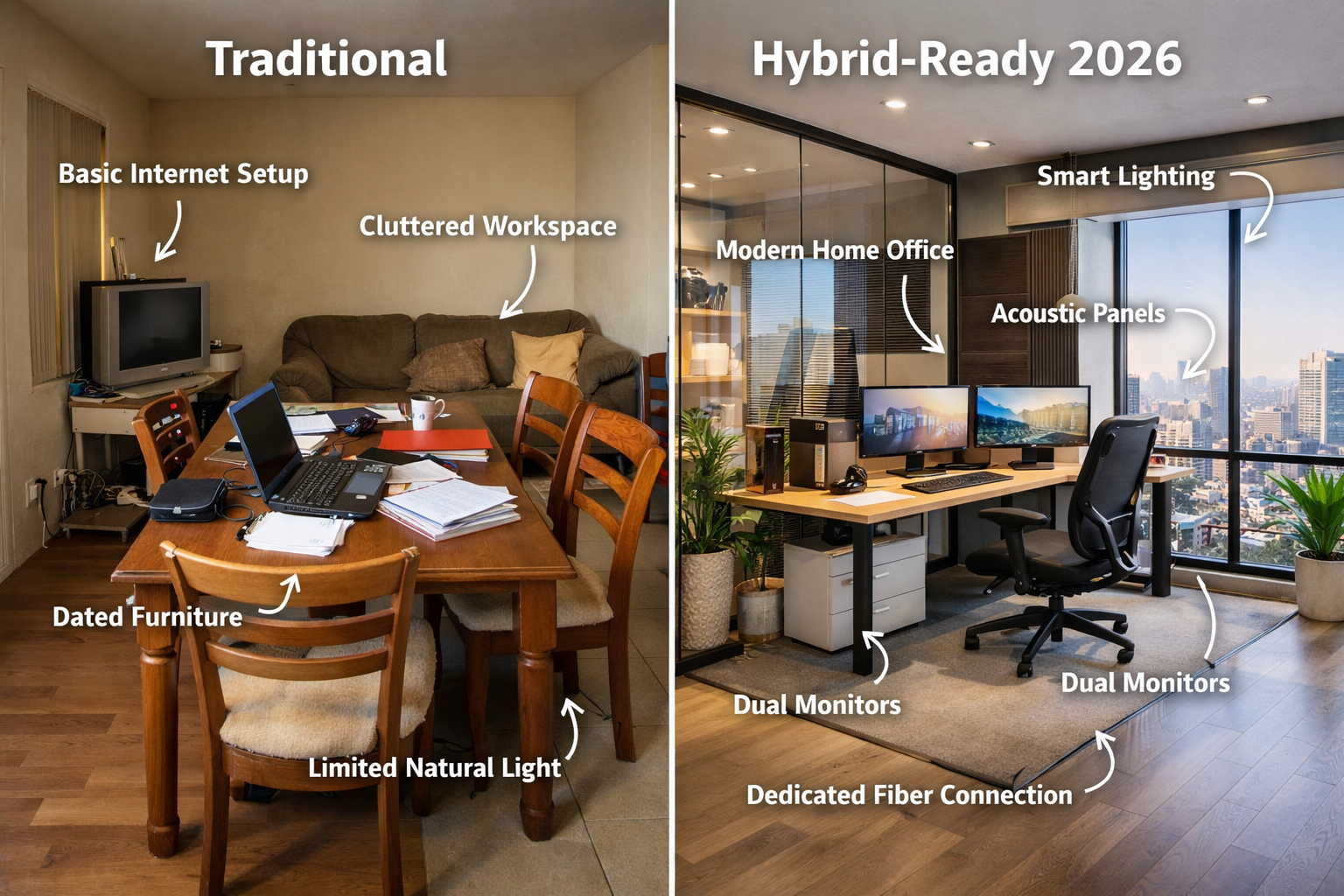
Detailed landscape format (1536x1024) split-screen comparison image showing traditional Brazilian apartment (left) versus 2026 hybrid-ready

Biophilic Design and Green Space Integration

Remote workers spending extended periods indoors increasingly prioritize access to nature and green spaces as essential amenities. Modern Brazilian developments integrate biophilic design principles throughout properties:

🌿 Building-Level Integration:

  • Rooftop gardens with workspace areas
  • Vertical gardens on facades and common areas
  • Indoor plants throughout coworking spaces
  • Natural materials (wood, stone) in finishes
  • Maximized natural light in all spaces

🌳 Neighborhood-Level Considerations:

  • Proximity to parks and green corridors
  • Walkable access to outdoor recreation
  • Bicycle infrastructure and storage
  • Outdoor meeting spaces and terraces
  • Connection to urban nature networks

Properties incorporating comprehensive green space strategies report higher tenant satisfaction, longer lease commitments, and premium pricing power, particularly among remote workers prioritizing mental health and work-life balance.

Acoustic Design and Noise Management

One of the most common complaints among remote workers involves noise interference during video calls and focused work sessions. Professional-grade developments address this through comprehensive acoustic strategies:

🔇 Structural Acoustic Solutions:

  • Enhanced wall insulation between units
  • Acoustic ceiling treatments in common areas
  • Soundproof phone booths for private calls
  • Floating floor systems reducing impact noise
  • Double-glazed windows blocking external noise

📞 Operational Noise Management:

  • Quiet hours policies in common workspaces
  • Designated zones for collaborative vs. focused work
  • White noise systems in shared areas
  • Acoustic monitoring and enforcement
  • Resident education on noise etiquette

These investments pay dividends in tenant retention, with properties demonstrating superior acoustic performance commanding 10-15% rental premiums in competitive markets.

Wellness Amenities Supporting Productivity

The boundary between work and wellness has blurred significantly, with remote workers recognizing that physical and mental health directly impact professional performance. Modern developments integrate wellness infrastructure:

💪 Physical Wellness:

  • Fitness centers with flexible hours (24/7 access)
  • Yoga and meditation spaces
  • Outdoor exercise areas
  • Bicycle storage and maintenance facilities
  • Walking/running paths in property grounds

🧘 Mental Wellness:

  • Quiet relaxation zones
  • Meditation rooms
  • Social spaces reducing isolation
  • Natural light exposure throughout buildings
  • Access to mental health resources

🍎 Nutritional Support:

  • Shared kitchens with professional equipment
  • Healthy food delivery partnerships
  • Community gardens for resident use
  • Nutrition education programming

Properties positioning wellness as integral to productivity rather than separate luxury amenities resonate strongly with remote workers, particularly those in high-stress industries like technology, finance, and consulting.

Financial Modeling and Investment Returns

Development Cost Premiums for Remote Work Infrastructure

Incorporating comprehensive remote work amenities increases development costs, but generates measurable returns through enhanced pricing power and reduced vacancy rates.

Typical cost premiums include:

Infrastructure Element Cost Increase ROI Timeline
Fiber Optic Pre-Installation 2-3% of construction 12-18 months
Dedicated Office Spaces 5-8% of unit cost 18-24 months
Coworking Floor Fit-Out R$1,500-2,500/m² 24-36 months
UPS/Backup Systems 1-2% of construction 12-18 months
Enhanced Acoustic Treatment 3-5% of construction 18-24 months
Technology Platforms R$50-100/unit/month 6-12 months

While these premiums increase initial capital requirements, properties delivering comprehensive remote work infrastructure achieve 15-25% rental premiums and 40-60% faster lease-up rates, significantly improving overall investment returns.

Rental Yield Optimization Strategies

Developers maximize returns through strategic amenity bundling and flexible pricing models:

📈 Revenue Enhancement:

  • Base rent premiums for work-ready units
  • Usage-based charges for premium amenities (conference rooms, event spaces)
  • Tiered service packages (basic, professional, executive)
  • Corporate housing contracts at premium rates
  • Short-term rental premiums during peak seasons

📉 Cost Management:

  • Shared infrastructure reducing per-unit costs
  • Technology platforms automating operations
  • Energy-efficient systems lowering utilities
  • Preventive maintenance reducing repairs
  • Community self-management reducing staffing

Properties implementing sophisticated revenue management achieve gross rental yields of 6-9% in primary markets and 8-12% in secondary markets, compared to 4-6% for traditional residential properties without remote work infrastructure.

Exit Strategies and Asset Appreciation

Remote work amenities enhance property values through multiple mechanisms:

🏗️ Physical Asset Enhancement:

  • Modern infrastructure extending building lifespan
  • Technology integration enabling future upgrades
  • Flexible spaces adapting to market evolution
  • Green certifications increasing marketability

💼 Operational Value Creation:

  • Established tenant communities reducing turnover
  • Proven revenue models demonstrating cash flow
  • Management systems transferable to new owners
  • Brand recognition in target demographics

Properties with comprehensive remote work infrastructure demonstrate 15-30% higher appreciation rates than comparable traditional properties, with particularly strong performance in secondary markets where remote work infrastructure remains scarce.

Investors considering early-stage property investments in markets like Florianópolis and Belo Horizonte can capture significant appreciation as remote work infrastructure becomes standard market expectation.

Regulatory Considerations and Compliance Requirements

Zoning and Mixed-Use Regulations

Brazilian municipal regulations are evolving to accommodate the blurring of residential and commercial use inherent in remote work properties. Developers must navigate complex zoning considerations:

🏛️ Regulatory Challenges:

  • Residential zoning restrictions on commercial activity
  • Coworking space classification (residential vs. commercial)
  • Parking requirements for mixed-use properties
  • Occupancy limits in shared living arrangements
  • Business licensing for amenity services

✅ Compliance Strategies:

  • Early engagement with municipal planning departments
  • Mixed-use zoning applications where appropriate
  • Clear documentation of residential primary use
  • Amenity positioning as resident services rather than commercial offerings
  • Legal counsel specializing in evolving remote work regulations

Cities like São Paulo and Rio de Janeiro are developing specific regulatory frameworks for coliving and remote work properties, while secondary markets often lack clear guidance, requiring case-by-case negotiation with authorities.

Building Code Requirements for Workspace Infrastructure

Incorporating professional workspace infrastructure triggers specific building code requirements:

⚡ Electrical Systems:

  • Enhanced electrical capacity for multiple devices
  • Dedicated circuits for workspace areas
  • Surge protection systems
  • Emergency power compliance
  • Energy efficiency certifications

🔥 Fire Safety:

  • Egress requirements for coworking areas
  • Fire suppression in common workspaces
  • Emergency lighting and signage
  • Occupancy load calculations
  • Regular safety inspections

♿ Accessibility:

  • ADA-equivalent accessibility in common workspaces
  • Elevator capacity for increased daytime occupancy
  • Accessible workspace furniture and equipment
  • Parking accommodations for disabled residents

Developers working with experienced architects familiar with remote work property requirements avoid costly redesigns and approval delays.

Tax Implications and Incentive Programs

Some Brazilian municipalities offer incentives for developments incorporating sustainability and technology infrastructure that align with remote work property features:

💰 Potential Incentives:

  • Property tax reductions for green building certifications
  • Development fee waivers for affordable housing components
  • Accelerated permitting for technology infrastructure
  • Grants for fiber optic installation in underserved areas

Developers should investigate municipal and state programs that may offset costs of remote work infrastructure installation.

Future Trends Shaping Remote Work Amenities in Brazil Urban Properties Beyond 2026

Artificial Intelligence and Smart Building Integration

The next evolution of remote work properties will leverage artificial intelligence and machine learning to optimize building operations and enhance resident experiences:

🤖 AI-Powered Features:

  • Predictive maintenance reducing equipment failures
  • Dynamic climate control based on occupancy patterns
  • Intelligent lighting adjusting to natural light and usage
  • Automated amenity scheduling optimizing utilization
  • Personalized recommendations for workspace and community resources

📊 Data-Driven Operations:

  • Occupancy analytics informing space allocation
  • Energy consumption optimization
  • Resident behavior insights guiding amenity development
  • Predictive pricing models maximizing revenue
  • Community engagement metrics driving programming

Properties implementing comprehensive AI systems will achieve operational efficiencies enabling 20-30% reductions in operating costs while simultaneously enhancing resident satisfaction through personalized experiences.

Virtual and Augmented Reality Workspace Enhancement

Emerging technologies will transform how remote workers utilize physical spaces:

🥽 VR/AR Applications:

  • Virtual meeting rooms enabling immersive collaboration
  • Augmented reality workspace customization
  • Virtual property tours for prospective residents
  • Digital twins for building management
  • Mixed reality training and education spaces

While currently nascent in Brazilian markets, these technologies will become increasingly accessible, with forward-thinking developers incorporating infrastructure (high-bandwidth networks, dedicated VR spaces) enabling future deployment.

Sustainability and Carbon Neutrality

Environmental considerations are transitioning from marketing differentiators to baseline expectations:

🌍 Sustainability Infrastructure:

  • Solar panel installations with battery storage
  • Rainwater harvesting and greywater recycling
  • Electric vehicle charging infrastructure
  • Zero-waste programs and composting facilities
  • Carbon offset programs for resident activities

🏅 Certification Targets:

  • LEED certification for new developments
  • AQUA-HQE Brazilian green building standards
  • Carbon neutrality commitments
  • Energy efficiency certifications
  • Sustainable materials sourcing documentation

Properties achieving comprehensive sustainability certifications command 10-20% rental premiums among environmentally conscious remote workers, particularly international residents from markets with strong sustainability cultures.

Demographic Shifts and Multigenerational Living

Brazil’s evolving demographics will reshape remote work property design:

👨‍👩‍👧‍👦 Multigenerational Considerations:

  • Flexible unit configurations accommodating extended families
  • Multiple workspace zones for simultaneous remote work
  • Childcare facilities and educational spaces
  • Elder care amenities and accessibility features
  • Community programming spanning age groups

👶 Family-Friendly Remote Work Features:

  • Soundproofed home offices separating work from family noise
  • Flexible spaces transitioning between work and family use
  • Outdoor play areas visible from home workspaces
  • Educational programming and tutoring services
  • Parent networking and support groups

Developers recognizing that remote work extends beyond young professionals to encompass families and multigenerational households will capture broader market segments.

Case Studies: Successful Remote Work Property Implementations
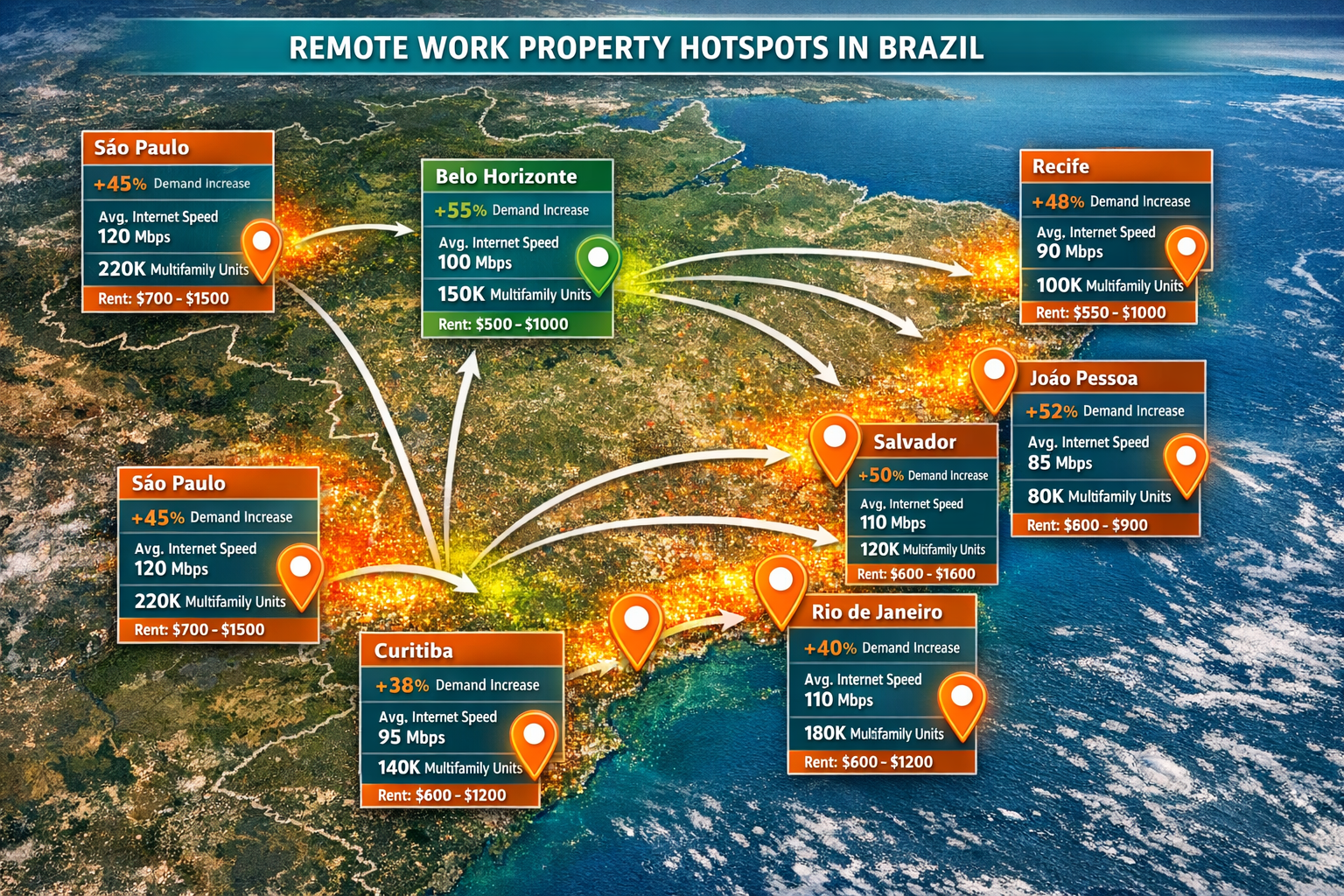
Detailed landscape format (1536x1024) aerial view infographic map of Brazil highlighting key cities for remote work property development: Sã

Premium Coliving Development – São Paulo

A 180-unit development in Vila Olímpia demonstrates the premium coliving model:

📋 Project Specifications:

  • Dedicated coworking floor with 40 workstations
  • Private phone booths (8 units)
  • Conference rooms (3 spaces, 6-12 person capacity)
  • 500 Mbps fiber optic with 4G backup
  • All-inclusive pricing including utilities and amenities
  • Flexible 1-12 month leases
  • Monthly community events and networking

💵 Financial Performance:

  • Average occupancy: 94%
  • Rental premium vs. comparable traditional units: 22%
  • Average lease length: 7.3 months
  • Tenant renewal rate: 68%
  • Gross rental yield: 8.2%

🎯 Target Demographics:

  • 45% Brazilian remote workers (technology, finance)
  • 35% International digital nomads
  • 20% Corporate relocations and consultants

This development demonstrates the viability of premium coliving models in primary markets, with strong financial performance driven by comprehensive amenity packages and flexible lease structures.

Mid-Tier Hybrid Development – Belo Horizonte

A 240-unit mid-rise development targeting domestic remote workers:

📋 Project Specifications:

  • Dedicated home office space in 85% of units
  • Shared coworking lounge (150 m²)
  • 300 Mbps fiber optic standard installation
  • Rooftop garden with outdoor workspace
  • Fitness center and yoga studio
  • 6-12 month standard leases with furnished options

💵 Financial Performance:

  • Average occupancy: 89%
  • Rental premium vs. traditional units: 15%
  • Average lease length: 11 months
  • Tenant renewal rate: 72%
  • Gross rental yield: 9.1%

🎯 Target Demographics:

  • 70% Domestic remote workers (education, marketing, design)
  • 20% Hybrid workers (2-3 days office)
  • 10% Small business owners and entrepreneurs

This case demonstrates strong performance in secondary markets where lower development costs enable attractive yields despite more moderate rental premiums.

Adaptive Reuse Project – Rio de Janeiro

Conversion of a 1980s office building in Botafogo into 96 remote work-optimized residential units:

📋 Project Specifications:

  • Existing infrastructure enabling cost-effective conversion
  • Floor plates subdivided into studio and 1-bedroom units
  • Preserved open floor coworking space (200 m²)
  • Upgraded fiber optic and electrical systems
  • Rooftop terrace with workspace and leisure areas
  • Transit-connected location near metro station

💵 Financial Performance:

  • Development cost 30% below new construction
  • Average occupancy: 91%
  • Rental rates comparable to new construction
  • Lease-up period: 4 months (60% faster than comparable new builds)
  • Gross rental yield: 10.3%

🎯 Target Demographics:

  • 50% Young professionals (25-35 years)
  • 30% Digital nomads and international remote workers
  • 20% Established professionals downsizing from larger units

This project demonstrates the viability of adaptive reuse strategies, particularly in established neighborhoods where new construction opportunities are limited.

Conclusion: Positioning for Success in Brazil’s Remote Work Property Market

The transformation of Brazilian urban properties to accommodate remote work represents one of the most significant real estate shifts in decades. Properties incorporating dedicated home offices, enterprise-grade connectivity, flexible community spaces, and integrated wellness amenities are not simply responding to temporary pandemic-era trends—they’re aligning with fundamental changes in how Brazilians live and work.

The data is unambiguous: 30% demand increases for work-ready properties, 300+ Mbps connectivity as standard, and 674,000 m² of purpose-built multifamily space demonstrate that Remote Work Amenities in Brazil Urban Properties: Designing 2026 Developments for Post-Pandemic Hybrid Lifestyles has transitioned from niche to mainstream[1][4][8].

Key Success Factors for Developers and Investors

🎯 Infrastructure First: Prioritize connectivity, power resilience, and workspace functionality as core architectural elements, not afterthought amenities.

🤝 Community Integration: Recognize that remote workers value social connection and professional networking as highly as physical amenities.

📍 Strategic Location Selection: Focus on neighborhoods balancing professional infrastructure with lifestyle appeal, particularly in secondary markets with growth potential.

💡 Flexibility and Adaptability: Design spaces and lease structures that accommodate evolving work patterns and diverse resident needs.

🌱 Sustainability Alignment: Integrate environmental considerations that resonate with remote worker values while reducing operating costs.

Actionable Next Steps

For Developers:

  1. Conduct Market Research: Survey target demographics to understand specific remote work needs in your market segment
  2. Partner with Technology Providers: Establish relationships with ISPs and technology vendors to pre-install superior infrastructure
  3. Engage Specialized Architects: Work with design professionals experienced in remote work property requirements
  4. Develop Operational Capabilities: Build or partner for community management, technology platforms, and flexible lease administration
  5. Explore Emerging Markets: Investigate opportunities in secondary cities like Belo Horizonte, Curitiba, and Florianópolis where remote work infrastructure remains undersupplied

For Investors:

  1. Prioritize Work-Ready Properties: Evaluate properties based on connectivity specifications, workspace design, and amenity packages
  2. Assess Management Quality: Investigate operator experience with remote work demographics and technology platforms
  3. Consider Geographic Diversification: Balance primary market stability with secondary market growth potential
  4. Evaluate Lease Flexibility: Understand how flexible lease structures impact cash flow stability and returns
  5. Monitor Regulatory Evolution: Stay informed about zoning and regulatory changes affecting remote work properties

For Property Managers:

  1. Invest in Technology Platforms: Implement comprehensive resident management systems enabling seamless operations
  2. Develop Community Programming: Create regular events and networking opportunities addressing isolation concerns
  3. Maintain Infrastructure Excellence: Prioritize connectivity and workspace amenity maintenance as critical operational functions
  4. Gather Resident Feedback: Systematically collect and act on resident input regarding workspace and amenity needs
  5. Build Service Ecosystems: Partner with local businesses providing services remote workers value (meal delivery, fitness, coworking day passes)

The remote work revolution has permanently altered Brazilian urban real estate. Properties designed for hybrid lifestyles will command premiums, achieve superior occupancy, and deliver enhanced returns for decades to come. Success requires understanding that these developments represent not just buildings, but integrated ecosystems supporting productive, connected, and balanced lives.

For developers, investors, and property managers willing to embrace this transformation, the opportunities are substantial. The question is no longer whether to incorporate remote work amenities, but how comprehensively and strategically to position properties for the hybrid work era that defines 2026 and beyond.


References

[1] Digital Nomads Brazil Rental Market Impact – https://www.jarniascyril.com/international-real-estate/investing-brazil-real-estate/digital-nomads-brazil-rental-market-impact/

[2] Brazil Real Estate Boom Co Living Spaces – https://www.jarniascyril.com/international-real-estate/investing-brazil-real-estate/brazil-real-estate-boom-co-living-spaces/

[3] Brazil Property Market Predictions For 2026 – https://esalesinternational.com/2025/11/20/brazil-property-market-predictions-for-2026/

[4] Brazil Real Estate Market – https://thelatinvestor.com/blogs/news/brazil-real-estate-market

[5] Rio De Janeiro Expat Guide – https://thelatinvestor.com/blogs/news/rio-de-janeiro-expat-guide

[6] Best Cities To Invest In Brazilian Real Estate 2026 Edition – https://www.brazilbeachhouse.com/blogg/2025/12/1/best-cities-to-invest-in-brazilian-real-estate-2026-edition

[7] Wellness Real Estate Florianopolis – https://www.elisainvestimentos.com.br/en/wellness-real-estate-florianopolis/

[8] siila – https://siila.com/news/multifamily-conceots-674-000-m2-brazil/7684/lang/en
Remote Work Amenities in Brazil Urban Properties: Designing 2026 Developments for Post-Pandemic Hybrid Lifestyles

Remote Work Amenities in Brazil Urban Properties: Designing 2026 Developments for Post-Pandemic Hybrid Lifestyles

}

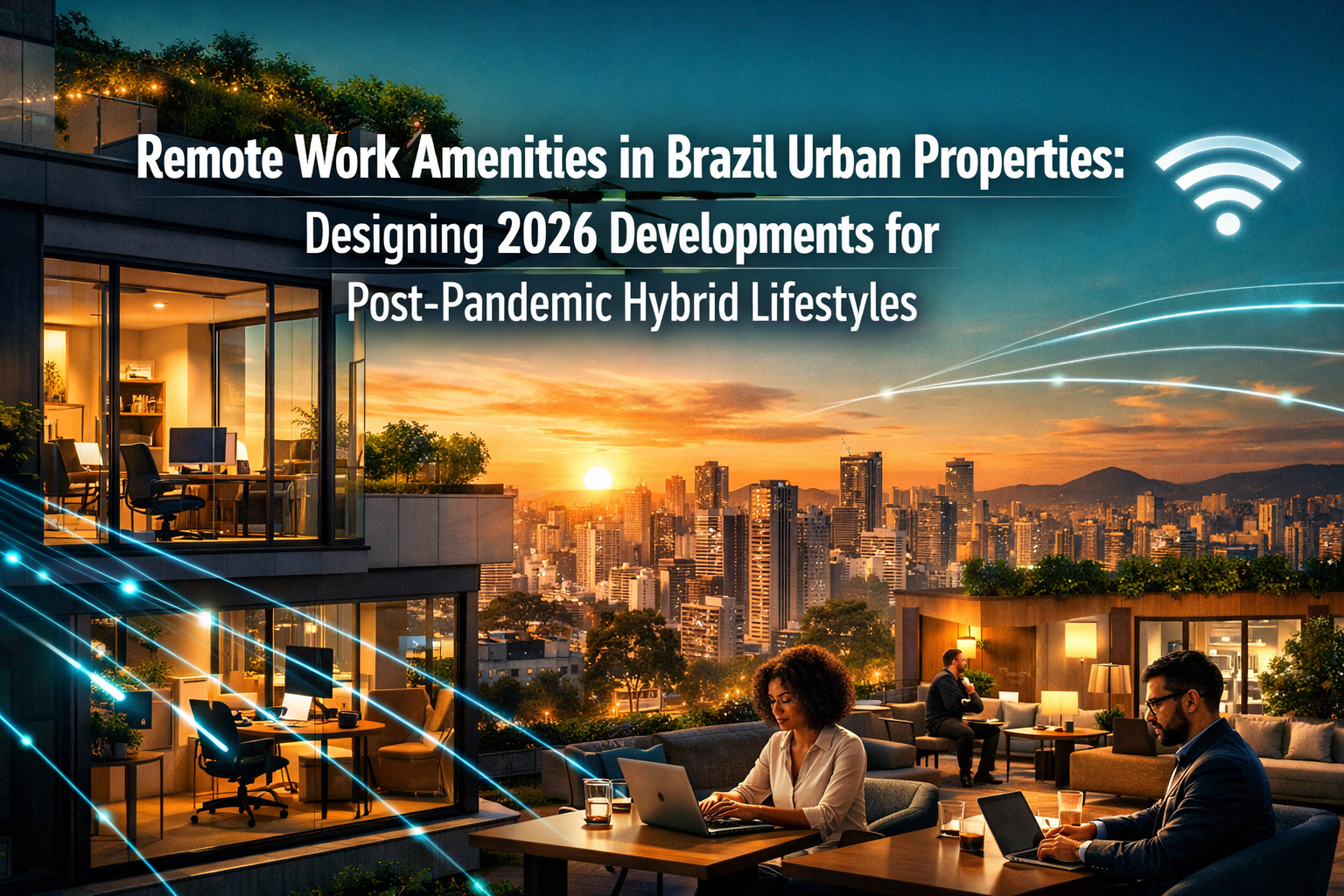
Professional landscape format (1536x1024) hero image featuring bold text overlay 'Remote Work Amenities in Brazil Urban Properties: Designin

The Brazilian real estate market is experiencing a fundamental transformation. In cities like Belo Horizonte, Niterói, and São Paulo, a new breed of urban property is emerging—one designed specifically for the remote worker. With dedicated home offices, fiber optic internet exceeding 300 Mbps, and integrated green spaces, these developments represent more than architectural evolution. They signal a complete reimagining of what urban living means in 2026. As professionals increasingly demand workspace functionality within their homes, developers are racing to meet this surge in demand, creating properties that blur the lines between residential comfort and professional productivity.

The numbers tell a compelling story. Niterói has recorded a 30% increase in demand for residential properties with dedicated home office spaces[4], while Brazil’s multifamily sector has expanded to 674,000 m² of built area comprising approximately 12,300 operational units as of Q1 2025[8]. This isn’t a temporary trend—it’s a permanent shift in how Brazilians live and work.

Key Takeaways

Demand Surge: Brazilian cities are experiencing 30%+ increases in demand for properties with dedicated home office infrastructure, particularly in secondary metros like Belo Horizonte and Curitiba[4]

Technical Standards Elevated: Properties with 300+ Mbps fiber optic connections, UPS backup systems, and mesh Wi-Fi coverage now command premium rental rates and are considered standard rather than luxury features[1]

Coliving Dominance: Managed coliving spaces with integrated coworking floors, ergonomic furniture, and all-inclusive flexible leases have become the primary delivery model for remote-work-ready housing[1][2]

Geographic Expansion: Coastal cities like Florianópolis and João Pessoa are attracting concentrated remote worker flows, while secondary metros are developing supporting infrastructure ecosystems[1][3]

Digital Nomad Infrastructure: Brazil’s Digital Nomad Visa ecosystem has matured with professionalized support services, driving international demand for hybrid-ready urban properties[1][5]

Understanding the Remote Work Revolution in Brazilian Urban Markets

Detailed landscape format (1536x1024) architectural cutaway illustration showing modern Brazilian mid-rise condominium building with transpa

The Post-Pandemic Shift in Housing Priorities

The pandemic fundamentally altered what Brazilians expect from their homes. No longer just a place to sleep and relax, urban properties must now function as productive workspaces, meeting rooms, and creative studios. This transformation has created unprecedented opportunities for developers who understand the new priorities.

Traditional apartment features that once dominated marketing materials—proximity to shopping, number of bedrooms, parking spaces—now compete with workspace specifications: internet bandwidth, dedicated office layouts, soundproofing quality, and ergonomic design compatibility.

The shift is particularly pronounced in mid-tier condominium developments, where buyers represent a new demographic: young professionals, digital entrepreneurs, and remote employees who prioritize functionality over prestige. These buyers are willing to pay premiums for properties that enable productive work-from-home arrangements.

Market Data Driving Development Decisions

Real estate developers are responding to quantifiable market signals. The residential market in major Brazilian cities now breaks down as approximately 70% apartments/condos, 20% detached houses, and 10% other property types[4], with the apartment segment experiencing the most dramatic transformation in unit specifications.

Properties marketed with comprehensive remote work amenities are outperforming traditional units across multiple metrics:

  • Rental velocity: 40-60% faster occupancy rates
  • Price premiums: 15-25% higher rental rates in competitive neighborhoods
  • Tenant retention: Longer lease commitments and lower turnover
  • Investment returns: Enhanced ROI for developers focusing on hybrid-ready specifications

This data has prompted major developers to reconsider standard unit designs, incorporating workspace functionality as a core architectural element rather than an afterthought. For investors exploring opportunities in Brazil’s property market, understanding these shifting priorities is essential for identifying high-performing assets.

The Digital Nomad Catalyst

Brazil’s Digital Nomad Visa (VITEM XIV), introduced in January 2022, permits 1-year renewable stays with no taxation on foreign income[1][5]. This policy innovation has catalyzed demand for professionally-equipped urban housing, particularly in cities with established infrastructure and lifestyle appeal.

The visa ecosystem has matured significantly, with supporting services including:

  • 🌐 Digitized administrative platforms (MigranteWeb) streamlining visa acquisition
  • ⚖️ Legal support networks specializing in remote worker requirements
  • 📊 Tax compliance services navigating international income structures
  • 🏢 Corporate relocation consultancies facilitating company-sponsored moves

This professionalization has reduced friction for international remote workers, creating sustained demand for properties that meet global standards for connectivity, workspace design, and community integration.

Remote Work Amenities in Brazil Urban Properties: Designing 2026 Developments for Post-Pandemic Hybrid Lifestyles—Core Infrastructure Requirements

High-Speed Internet as Non-Negotiable Foundation

In 2026, internet connectivity isn’t an amenity—it’s essential infrastructure, comparable to electricity or water. Properties marketed with 300+ Mbps internet speeds, dedicated fiber optic connections, UPS/4G-5G backup systems, and meshed Wi-Fi coverage now command premium rental rates in competitive neighborhoods[1].

Technical specifications that differentiate premium properties include:

Feature Standard Offering Premium Offering
Download Speed 100-200 Mbps 300-1000 Mbps
Connection Type Shared cable Dedicated fiber optic
Backup Systems None UPS + 4G/5G failover
Coverage Single router Mesh network system
Network Management Resident-managed Professional monitoring
Service Level Agreement Best effort Guaranteed uptime

Developers partnering with telecommunications providers to pre-install enterprise-grade infrastructure are seeing measurable market advantages. Properties with documented connectivity specifications attract remote workers willing to pay 20-30% premiums over comparable units with standard internet service.

Dedicated Workspace Design Standards

The era of working from kitchen tables has ended. Modern Brazilian urban properties incorporate purpose-built home office spaces with specific design criteria:

🏗️ Architectural Elements:

  • Separate room or defined zone (minimum 6-8 m²)
  • Natural lighting with window access
  • Acoustic treatment reducing ambient noise
  • Electrical capacity supporting multiple devices
  • Climate control independent of living areas
  • Door or partition enabling privacy during calls

🪑 Ergonomic Infrastructure:

  • Adjustable desk mounting points or built-in workstations
  • Task lighting with adjustable color temperature
  • Multiple electrical outlets (minimum 6 per workspace)
  • Cable management systems integrated into walls
  • Ergonomic chair compatibility with appropriate floor space

These specifications have transitioned from luxury features to standard expectations, particularly in developments targeting professionals in technology, finance, and creative industries. Properties lacking dedicated workspace design face longer marketing periods and reduced pricing power.

Backup Power and Connectivity Resilience

Brazil’s electrical grid, while improving, still experiences periodic disruptions that can devastate remote workers on tight deadlines. Forward-thinking developments now incorporate uninterruptible power supply (UPS) systems and backup connectivity as standard infrastructure.

Resilience features include:

  • Building-level UPS systems providing 2-4 hours of backup power
  • Individual unit battery backup for critical equipment
  • Dual ISP connections from different providers
  • 4G/5G failover systems activating automatically during outages
  • Generator backup for common areas and critical systems

Properties advertising these resilience features attract remote workers whose income depends on consistent connectivity, particularly those serving international clients across time zones where downtime directly impacts revenue.

Coliving and Community-Integrated Models: The Future of Remote Work Amenities in Brazil Urban Properties

The Rise of Professionally Managed Coliving Spaces

Coliving spaces have emerged as the dominant solution for remote workers in Brazilian urban markets, offering dedicated desks, ergonomic chairs, quiet zones, and reserved coworking floors alongside high-speed internet and comprehensive technology integration[1]. This format represents a departure from traditional apartment rentals toward managed, amenity-inclusive models.

The coliving advantage centers on operational efficiency and community value:

📍 Physical Amenities:

  • Dedicated coworking floors with professional-grade furniture
  • Private phone booths for confidential calls
  • Conference rooms available for resident booking
  • Printing and office equipment access
  • Mail and package handling services
  • 24/7 access to workspace facilities

🤝 Community Programming:

  • Regular networking events and professional mixers
  • Skill-sharing workshops and educational sessions
  • Social activities reducing isolation
  • Professional matchmaking for collaboration opportunities
  • Mentorship programs connecting experienced and emerging professionals

Coliving operators structure regular events, networking activities, activity programming, and professional matchmaking as core amenities, addressing documented isolation concerns among remote workers and expatriates[1][2]. This ecosystem approach transforms housing from a transactional product into an integrated lifestyle service.

Flexible Lease Structures Reshaping Market Norms

Traditional Brazilian rental markets historically required long-term commitments, security deposits, and guarantor arrangements that created barriers for mobile professionals. The remote work revolution has normalized all-inclusive furnished offerings with 1-6 month lease flexibility[1], particularly in Rio de Janeiro and São Paulo where traditional long-term contracts previously dominated.

Modern lease structures include:

  • Furnished turnkey units eliminating setup friction
  • All-inclusive pricing covering utilities, internet, and amenities
  • Flexible terms from 1-month to 12-month options
  • Simplified documentation reducing bureaucratic barriers
  • Digital contracting enabling remote lease execution
  • Transparent pricing with no hidden fees or surprise charges

This flexibility particularly appeals to digital nomads, corporate relocations, and professionals testing new cities before committing to long-term residence. Developers offering these lease structures report occupancy rates 15-20% higher than comparable properties requiring traditional rental arrangements.

Technology Integration as Operational Infrastructure

Modern remote-work-focused developments deploy residential management applications, keyless access systems, usage-based billing, and community social networks as standard operational infrastructure[2]. These platforms facilitate both resident coordination and operator revenue optimization.

Digital infrastructure includes:

🔐 Access Management:

  • Smartphone-based entry systems
  • Temporary access codes for guests and services
  • Activity logging for security
  • Remote access management

💰 Financial Platforms:

  • Transparent billing dashboards
  • Usage-based amenity charges
  • Digital payment processing
  • Automated rent collection

👥 Community Coordination:

  • Resident social networks
  • Amenity booking systems
  • Maintenance request portals
  • Event registration and communication

These systems reduce operational friction while creating data streams that enable dynamic pricing, predictive maintenance, and personalized service delivery. Properties leveraging comprehensive technology platforms report 30-40% reductions in administrative overhead compared to traditionally managed buildings.

Developers in emerging markets like Florianópolis are particularly aggressive in deploying these technologies, recognizing that digital-native remote workers expect seamless technology integration as a baseline requirement.

Geographic Opportunities: Remote Work Amenities in Brazil Urban Properties Across Key Markets

Primary Metropolitan Markets: São Paulo and Rio de Janeiro

Brazil’s largest cities continue to attract the majority of remote work property development, but with evolving geographic concentration within these metros.

São Paulo developments cluster around established business districts that are transforming into hybrid work hubs:

  • Avenida Faria Lima: Premium properties targeting international remote workers and executives
  • Vila Olímpia: Mid-tier developments with strong coworking integration
  • Pinheiros: Creative professional focus with lifestyle amenities
  • Itaim Bibi: Corporate-oriented properties with conference facilities

Rio de Janeiro sees concentration in neighborhoods balancing professional infrastructure with lifestyle appeal:

  • Botafogo: Transit-connected properties with beach proximity
  • Flamengo: Established residential areas adding remote work amenities
  • Leblon/Ipanema: Premium segment targeting affluent remote workers
  • Barra da Tijuca: Newer developments with purpose-built workspace infrastructure

Rental prices exhibit upward pressure in well-connected neighborhoods near beaches, coworking poles, and transit hubs[1][2], with premium pricing supported by properties displaying work-ready specifications. This represents a documented secondary effect of digital nomad inflow, creating gentrification concerns in historically affordable neighborhoods.

Secondary Markets with Exceptional Growth Potential

Coastal cities Florianópolis and João Pessoa, plus secondary metros Curitiba, Belo Horizonte, Recife, and Salvador, are attracting concentrated remote worker flows due to infrastructure improvements and lifestyle positioning[1][3].

🏖️ Florianópolis has emerged as Brazil’s premier remote work destination, combining:

  • Exceptional quality of life with beach access
  • Growing technology sector ecosystem
  • Improving broadband infrastructure
  • International airport connectivity
  • Lower cost of living than São Paulo/Rio
  • Active digital nomad community

The city’s wellness-focused real estate developments integrate remote work amenities with lifestyle features, creating compelling value propositions for professionals prioritizing work-life balance.

🏙️ Belo Horizonte represents the archetypal mid-tier metro experiencing remote work transformation:

  • Strong educational institutions producing skilled workforce
  • Lower property costs enabling larger units with dedicated offices
  • Improving fiber optic coverage across residential neighborhoods
  • Growing coworking ecosystem supporting remote professionals
  • Central geographic location facilitating domestic travel

📊 Curitiba leverages urban planning excellence and quality infrastructure:

  • Established reputation for livability and sustainability
  • Comprehensive public transportation reducing car dependency
  • Tech sector growth creating professional community
  • European cultural influences appealing to international remote workers

These secondary cities remain dependent on expanding broadband reliability and supporting service ecosystems[1][3], but represent significant opportunities for developers willing to invest in comprehensive remote work infrastructure ahead of mainstream demand.

Investment Considerations Across Market Tiers

The residential market bifurcation creates distinct investment opportunities based on target demographics and risk tolerance.

Luxury Segment (Top 10% of market):

  • International digital nomads and executives
  • Premium pricing power (R$8,000-15,000+ monthly)
  • Full-service amenity packages
  • Prime locations with lifestyle appeal
  • Higher development costs but strong margins

Mid-Tier Segment (60-80% of market):

  • Domestic remote workers and young professionals
  • Moderate pricing (R$3,000-7,000 monthly)
  • Essential remote work infrastructure
  • Transit-connected locations
  • Volume-based returns on investment

Value Segment (Bottom 20% of market):

  • Entry-level remote workers and students
  • Budget pricing (R$1,500-3,000 monthly)
  • Basic connectivity and shared workspaces
  • Emerging neighborhoods
  • Higher vacancy risk but accessible entry points

Investors evaluating property investment opportunities in Brazil should align property specifications with target demographic expectations, recognizing that remote work amenities command premiums across all market segments but with varying feature requirements.

Design Principles for 2026 Hybrid-Ready Developments

Detailed landscape format (1536x1024) split-screen comparison image showing traditional Brazilian apartment (left) versus 2026 hybrid-ready

Biophilic Design and Green Space Integration

Remote workers spending extended periods indoors increasingly prioritize access to nature and green spaces as essential amenities. Modern Brazilian developments integrate biophilic design principles throughout properties:

🌿 Building-Level Integration:

  • Rooftop gardens with workspace areas
  • Vertical gardens on facades and common areas
  • Indoor plants throughout coworking spaces
  • Natural materials (wood, stone) in finishes
  • Maximized natural light in all spaces

🌳 Neighborhood-Level Considerations:

  • Proximity to parks and green corridors
  • Walkable access to outdoor recreation
  • Bicycle infrastructure and storage
  • Outdoor meeting spaces and terraces
  • Connection to urban nature networks

Properties incorporating comprehensive green space strategies report higher tenant satisfaction, longer lease commitments, and premium pricing power, particularly among remote workers prioritizing mental health and work-life balance.

Acoustic Design and Noise Management

One of the most common complaints among remote workers involves noise interference during video calls and focused work sessions. Professional-grade developments address this through comprehensive acoustic strategies:

🔇 Structural Acoustic Solutions:

  • Enhanced wall insulation between units
  • Acoustic ceiling treatments in common areas
  • Soundproof phone booths for private calls
  • Floating floor systems reducing impact noise
  • Double-glazed windows blocking external noise

📞 Operational Noise Management:

  • Quiet hours policies in common workspaces
  • Designated zones for collaborative vs. focused work
  • White noise systems in shared areas
  • Acoustic monitoring and enforcement
  • Resident education on noise etiquette

These investments pay dividends in tenant retention, with properties demonstrating superior acoustic performance commanding 10-15% rental premiums in competitive markets.

Wellness Amenities Supporting Productivity

The boundary between work and wellness has blurred significantly, with remote workers recognizing that physical and mental health directly impact professional performance. Modern developments integrate wellness infrastructure:

💪 Physical Wellness:

  • Fitness centers with flexible hours (24/7 access)
  • Yoga and meditation spaces
  • Outdoor exercise areas
  • Bicycle storage and maintenance facilities
  • Walking/running paths in property grounds

🧘 Mental Wellness:

  • Quiet relaxation zones
  • Meditation rooms
  • Social spaces reducing isolation
  • Natural light exposure throughout buildings
  • Access to mental health resources

🍎 Nutritional Support:

  • Shared kitchens with professional equipment
  • Healthy food delivery partnerships
  • Community gardens for resident use
  • Nutrition education programming

Properties positioning wellness as integral to productivity rather than separate luxury amenities resonate strongly with remote workers, particularly those in high-stress industries like technology, finance, and consulting.

Financial Modeling and Investment Returns

Development Cost Premiums for Remote Work Infrastructure

Incorporating comprehensive remote work amenities increases development costs, but generates measurable returns through enhanced pricing power and reduced vacancy rates.

Typical cost premiums include:

Infrastructure Element Cost Increase ROI Timeline
Fiber Optic Pre-Installation 2-3% of construction 12-18 months
Dedicated Office Spaces 5-8% of unit cost 18-24 months
Coworking Floor Fit-Out R$1,500-2,500/m² 24-36 months
UPS/Backup Systems 1-2% of construction 12-18 months
Enhanced Acoustic Treatment 3-5% of construction 18-24 months
Technology Platforms R$50-100/unit/month 6-12 months

While these premiums increase initial capital requirements, properties delivering comprehensive remote work infrastructure achieve 15-25% rental premiums and 40-60% faster lease-up rates, significantly improving overall investment returns.

Rental Yield Optimization Strategies

Developers maximize returns through strategic amenity bundling and flexible pricing models:

📈 Revenue Enhancement:

  • Base rent premiums for work-ready units
  • Usage-based charges for premium amenities (conference rooms, event spaces)
  • Tiered service packages (basic, professional, executive)
  • Corporate housing contracts at premium rates
  • Short-term rental premiums during peak seasons

📉 Cost Management:

  • Shared infrastructure reducing per-unit costs
  • Technology platforms automating operations
  • Energy-efficient systems lowering utilities
  • Preventive maintenance reducing repairs
  • Community self-management reducing staffing

Properties implementing sophisticated revenue management achieve gross rental yields of 6-9% in primary markets and 8-12% in secondary markets, compared to 4-6% for traditional residential properties without remote work infrastructure.

Exit Strategies and Asset Appreciation

Remote work amenities enhance property values through multiple mechanisms:

🏗️ Physical Asset Enhancement:

  • Modern infrastructure extending building lifespan
  • Technology integration enabling future upgrades
  • Flexible spaces adapting to market evolution
  • Green certifications increasing marketability

💼 Operational Value Creation:

  • Established tenant communities reducing turnover
  • Proven revenue models demonstrating cash flow
  • Management systems transferable to new owners
  • Brand recognition in target demographics

Properties with comprehensive remote work infrastructure demonstrate 15-30% higher appreciation rates than comparable traditional properties, with particularly strong performance in secondary markets where remote work infrastructure remains scarce.

Investors considering early-stage property investments in markets like Florianópolis and Belo Horizonte can capture significant appreciation as remote work infrastructure becomes standard market expectation.

Regulatory Considerations and Compliance Requirements

Zoning and Mixed-Use Regulations

Brazilian municipal regulations are evolving to accommodate the blurring of residential and commercial use inherent in remote work properties. Developers must navigate complex zoning considerations:

🏛️ Regulatory Challenges:

  • Residential zoning restrictions on commercial activity
  • Coworking space classification (residential vs. commercial)
  • Parking requirements for mixed-use properties
  • Occupancy limits in shared living arrangements
  • Business licensing for amenity services

✅ Compliance Strategies:

  • Early engagement with municipal planning departments
  • Mixed-use zoning applications where appropriate
  • Clear documentation of residential primary use
  • Amenity positioning as resident services rather than commercial offerings
  • Legal counsel specializing in evolving remote work regulations

Cities like São Paulo and Rio de Janeiro are developing specific regulatory frameworks for coliving and remote work properties, while secondary markets often lack clear guidance, requiring case-by-case negotiation with authorities.

Building Code Requirements for Workspace Infrastructure

Incorporating professional workspace infrastructure triggers specific building code requirements:

⚡ Electrical Systems:

  • Enhanced electrical capacity for multiple devices
  • Dedicated circuits for workspace areas
  • Surge protection systems
  • Emergency power compliance
  • Energy efficiency certifications

🔥 Fire Safety:

  • Egress requirements for coworking areas
  • Fire suppression in common workspaces
  • Emergency lighting and signage
  • Occupancy load calculations
  • Regular safety inspections

♿ Accessibility:

  • ADA-equivalent accessibility in common workspaces
  • Elevator capacity for increased daytime occupancy
  • Accessible workspace furniture and equipment
  • Parking accommodations for disabled residents

Developers working with experienced architects familiar with remote work property requirements avoid costly redesigns and approval delays.

Tax Implications and Incentive Programs

Some Brazilian municipalities offer incentives for developments incorporating sustainability and technology infrastructure that align with remote work property features:

💰 Potential Incentives:

  • Property tax reductions for green building certifications
  • Development fee waivers for affordable housing components
  • Accelerated permitting for technology infrastructure
  • Grants for fiber optic installation in underserved areas

Developers should investigate municipal and state programs that may offset costs of remote work infrastructure installation.

Future Trends Shaping Remote Work Amenities in Brazil Urban Properties Beyond 2026

Artificial Intelligence and Smart Building Integration

The next evolution of remote work properties will leverage artificial intelligence and machine learning to optimize building operations and enhance resident experiences:

🤖 AI-Powered Features:

  • Predictive maintenance reducing equipment failures
  • Dynamic climate control based on occupancy patterns
  • Intelligent lighting adjusting to natural light and usage
  • Automated amenity scheduling optimizing utilization
  • Personalized recommendations for workspace and community resources

📊 Data-Driven Operations:

  • Occupancy analytics informing space allocation
  • Energy consumption optimization
  • Resident behavior insights guiding amenity development
  • Predictive pricing models maximizing revenue
  • Community engagement metrics driving programming

Properties implementing comprehensive AI systems will achieve operational efficiencies enabling 20-30% reductions in operating costs while simultaneously enhancing resident satisfaction through personalized experiences.

Virtual and Augmented Reality Workspace Enhancement

Emerging technologies will transform how remote workers utilize physical spaces:

🥽 VR/AR Applications:

  • Virtual meeting rooms enabling immersive collaboration
  • Augmented reality workspace customization
  • Virtual property tours for prospective residents
  • Digital twins for building management
  • Mixed reality training and education spaces

While currently nascent in Brazilian markets, these technologies will become increasingly accessible, with forward-thinking developers incorporating infrastructure (high-bandwidth networks, dedicated VR spaces) enabling future deployment.

Sustainability and Carbon Neutrality

Environmental considerations are transitioning from marketing differentiators to baseline expectations:

🌍 Sustainability Infrastructure:

  • Solar panel installations with battery storage
  • Rainwater harvesting and greywater recycling
  • Electric vehicle charging infrastructure
  • Zero-waste programs and composting facilities
  • Carbon offset programs for resident activities

🏅 Certification Targets:

  • LEED certification for new developments
  • AQUA-HQE Brazilian green building standards
  • Carbon neutrality commitments
  • Energy efficiency certifications
  • Sustainable materials sourcing documentation

Properties achieving comprehensive sustainability certifications command 10-20% rental premiums among environmentally conscious remote workers, particularly international residents from markets with strong sustainability cultures.

Demographic Shifts and Multigenerational Living

Brazil’s evolving demographics will reshape remote work property design:

👨‍👩‍👧‍👦 Multigenerational Considerations:

  • Flexible unit configurations accommodating extended families
  • Multiple workspace zones for simultaneous remote work
  • Childcare facilities and educational spaces
  • Elder care amenities and accessibility features
  • Community programming spanning age groups

👶 Family-Friendly Remote Work Features:

  • Soundproofed home offices separating work from family noise
  • Flexible spaces transitioning between work and family use
  • Outdoor play areas visible from home workspaces
  • Educational programming and tutoring services
  • Parent networking and support groups

Developers recognizing that remote work extends beyond young professionals to encompass families and multigenerational households will capture broader market segments.

Case Studies: Successful Remote Work Property Implementations

Detailed landscape format (1536x1024) aerial view infographic map of Brazil highlighting key cities for remote work property development: Sã

Premium Coliving Development – São Paulo

A 180-unit development in Vila Olímpia demonstrates the premium coliving model:

📋 Project Specifications:

  • Dedicated coworking floor with 40 workstations
  • Private phone booths (8 units)
  • Conference rooms (3 spaces, 6-12 person capacity)
  • 500 Mbps fiber optic with 4G backup
  • All-inclusive pricing including utilities and amenities
  • Flexible 1-12 month leases
  • Monthly community events and networking

💵 Financial Performance:

  • Average occupancy: 94%
  • Rental premium vs. comparable traditional units: 22%
  • Average lease length: 7.3 months
  • Tenant renewal rate: 68%
  • Gross rental yield: 8.2%

🎯 Target Demographics:

  • 45% Brazilian remote workers (technology, finance)
  • 35% International digital nomads
  • 20% Corporate relocations and consultants

This development demonstrates the viability of premium coliving models in primary markets, with strong financial performance driven by comprehensive amenity packages and flexible lease structures.

Mid-Tier Hybrid Development – Belo Horizonte

A 240-unit mid-rise development targeting domestic remote workers:

📋 Project Specifications:

  • Dedicated home office space in 85% of units
  • Shared coworking lounge (150 m²)
  • 300 Mbps fiber optic standard installation
  • Rooftop garden with outdoor workspace
  • Fitness center and yoga studio
  • 6-12 month standard leases with furnished options

💵 Financial Performance:

  • Average occupancy: 89%
  • Rental premium vs. traditional units: 15%
  • Average lease length: 11 months
  • Tenant renewal rate: 72%
  • Gross rental yield: 9.1%

🎯 Target Demographics:

  • 70% Domestic remote workers (education, marketing, design)
  • 20% Hybrid workers (2-3 days office)
  • 10% Small business owners and entrepreneurs

This case demonstrates strong performance in secondary markets where lower development costs enable attractive yields despite more moderate rental premiums.

Adaptive Reuse Project – Rio de Janeiro

Conversion of a 1980s office building in Botafogo into 96 remote work-optimized residential units:

📋 Project Specifications:

  • Existing infrastructure enabling cost-effective conversion
  • Floor plates subdivided into studio and 1-bedroom units
  • Preserved open floor coworking space (200 m²)
  • Upgraded fiber optic and electrical systems
  • Rooftop terrace with workspace and leisure areas
  • Transit-connected location near metro station

💵 Financial Performance:

  • Development cost 30% below new construction
  • Average occupancy: 91%
  • Rental rates comparable to new construction
  • Lease-up period: 4 months (60% faster than comparable new builds)
  • Gross rental yield: 10.3%

🎯 Target Demographics:

  • 50% Young professionals (25-35 years)
  • 30% Digital nomads and international remote workers
  • 20% Established professionals downsizing from larger units

This project demonstrates the viability of adaptive reuse strategies, particularly in established neighborhoods where new construction opportunities are limited.

Conclusion: Positioning for Success in Brazil’s Remote Work Property Market

The transformation of Brazilian urban properties to accommodate remote work represents one of the most significant real estate shifts in decades. Properties incorporating dedicated home offices, enterprise-grade connectivity, flexible community spaces, and integrated wellness amenities are not simply responding to temporary pandemic-era trends—they’re aligning with fundamental changes in how Brazilians live and work.

The data is unambiguous: 30% demand increases for work-ready properties, 300+ Mbps connectivity as standard, and 674,000 m² of purpose-built multifamily space demonstrate that Remote Work Amenities in Brazil Urban Properties: Designing 2026 Developments for Post-Pandemic Hybrid Lifestyles has transitioned from niche to mainstream[1][4][8].

Key Success Factors for Developers and Investors

🎯 Infrastructure First: Prioritize connectivity, power resilience, and workspace functionality as core architectural elements, not afterthought amenities.

🤝 Community Integration: Recognize that remote workers value social connection and professional networking as highly as physical amenities.

📍 Strategic Location Selection: Focus on neighborhoods balancing professional infrastructure with lifestyle appeal, particularly in secondary markets with growth potential.

💡 Flexibility and Adaptability: Design spaces and lease structures that accommodate evolving work patterns and diverse resident needs.

🌱 Sustainability Alignment: Integrate environmental considerations that resonate with remote worker values while reducing operating costs.

Actionable Next Steps

For Developers:

  1. Conduct Market Research: Survey target demographics to understand specific remote work needs in your market segment
  2. Partner with Technology Providers: Establish relationships with ISPs and technology vendors to pre-install superior infrastructure
  3. Engage Specialized Architects: Work with design professionals experienced in remote work property requirements
  4. Develop Operational Capabilities: Build or partner for community management, technology platforms, and flexible lease administration
  5. Explore Emerging Markets: Investigate opportunities in secondary cities like Belo Horizonte, Curitiba, and Florianópolis where remote work infrastructure remains undersupplied

For Investors:

  1. Prioritize Work-Ready Properties: Evaluate properties based on connectivity specifications, workspace design, and amenity packages
  2. Assess Management Quality: Investigate operator experience with remote work demographics and technology platforms
  3. Consider Geographic Diversification: Balance primary market stability with secondary market growth potential
  4. Evaluate Lease Flexibility: Understand how flexible lease structures impact cash flow stability and returns
  5. Monitor Regulatory Evolution: Stay informed about zoning and regulatory changes affecting remote work properties

For Property Managers:

  1. Invest in Technology Platforms: Implement comprehensive resident management systems enabling seamless operations
  2. Develop Community Programming: Create regular events and networking opportunities addressing isolation concerns
  3. Maintain Infrastructure Excellence: Prioritize connectivity and workspace amenity maintenance as critical operational functions
  4. Gather Resident Feedback: Systematically collect and act on resident input regarding workspace and amenity needs
  5. Build Service Ecosystems: Partner with local businesses providing services remote workers value (meal delivery, fitness, coworking day passes)

The remote work revolution has permanently altered Brazilian urban real estate. Properties designed for hybrid lifestyles will command premiums, achieve superior occupancy, and deliver enhanced returns for decades to come. Success requires understanding that these developments represent not just buildings, but integrated ecosystems supporting productive, connected, and balanced lives.

For developers, investors, and property managers willing to embrace this transformation, the opportunities are substantial. The question is no longer whether to incorporate remote work amenities, but how comprehensively and strategically to position properties for the hybrid work era that defines 2026 and beyond.


References

[1] Digital Nomads Brazil Rental Market Impact – https://www.jarniascyril.com/international-real-estate/investing-brazil-real-estate/digital-nomads-brazil-rental-market-impact/

[2] Brazil Real Estate Boom Co Living Spaces – https://www.jarniascyril.com/international-real-estate/investing-brazil-real-estate/brazil-real-estate-boom-co-living-spaces/

[3] Brazil Property Market Predictions For 2026 – https://esalesinternational.com/2025/11/20/brazil-property-market-predictions-for-2026/

[4] Brazil Real Estate Market – https://thelatinvestor.com/blogs/news/brazil-real-estate-market

[5] Rio De Janeiro Expat Guide – https://thelatinvestor.com/blogs/news/rio-de-janeiro-expat-guide

[6] Best Cities To Invest In Brazilian Real Estate 2026 Edition – https://www.brazilbeachhouse.com/blogg/2025/12/1/best-cities-to-invest-in-brazilian-real-estate-2026-edition

[7] Wellness Real Estate Florianopolis – https://www.elisainvestimentos.com.br/en/wellness-real-estate-florianopolis/

[8] siila – https://siila.com/news/multifamily-conceots-674-000-m2-brazil/7684/lang/en