
The global workforce revolution is reshaping Brazil’s real estate landscape in unexpected ways. While coastal cities like Florianópolis grab international headlines as digital nomad destinations, a quieter transformation is unfolding in Brazil’s interior cities—where Remote Work Havens in Brazil’s Interior: Designing Flexible Condos for 2026 Digital Nomad Influx represents a strategic opportunity for developers and investors alike. Cities such as Uberlândia, Goiânia, and Brasília are emerging as powerhouse alternatives, offering high-speed connectivity, lower costs, and impressive 8-12% investment yields without the coastal premium.
This shift reflects broader post-pandemic realities. With 40 million professionals currently living as digital nomads globally—projected to reach 60 million by 2030[1]—and Brazil’s digital nomad visa enabling two-year residencies[1], the demand for purpose-built remote work housing has never been stronger. Smart developers are responding with flexible condo designs that integrate coworking spaces, green amenities, and cutting-edge infrastructure tailored to this lifestyle-driven market.
Key Takeaways
🏙️ Interior cities like Uberlândia and Goiânia offer 8-12% yields with lower entry costs compared to coastal markets, attracting both digital nomads and investors
💼 Brazil’s digital nomad visa allows two-year residencies, with Embratur targeting 30% annual growth in visa issuance through 2026[1]
🌐 High-speed fiber infrastructure in mid-tier cities now rivals major metros, making interior locations viable for remote professionals
🏗️ Flexible condo designs incorporating modular workspaces, coworking integration, and biophilic elements are commanding premium rents
📈 60 million global digital nomads expected by 2030[1], creating sustained demand for purpose-built remote work housing
Understanding the Digital Nomad Opportunity in Brazil’s Interior
The Global Digital Nomad Boom
The remote work revolution has fundamentally altered how professionals choose where to live. Currently, 40 million people worldwide embrace the digital nomad lifestyle, with projections indicating this number will surge to 60 million by 2030[1]. The average digital nomad profile reveals a lucrative target market: 36 years old, predominantly male (84%), highly educated (90% hold higher education degrees), and financially stable with 69% earning between $50,000-$250,000 annually[1].
Brazil has positioned itself aggressively to capture this market. Through Embratur’s unprecedented campaign titled “Brazil, your dream office. Come work and live intensely,” the country aims to increase digital nomad visa issuance by 30% annually and climb global digital nomad rankings[1]. The digital nomad visa, established via Regulatory Resolution No. 45/2021, allows foreigners to legally reside for up to two years[1]—a competitive offering in the global landscape.
Why Interior Cities Are Gaining Ground
While coastal destinations like Florianópolis (named by Remote Year as the best city globally for remote work)[1] and Pipa (Brazil’s first digital nomad village)[1] attract attention, interior cities present compelling advantages for both nomads and real estate investors:
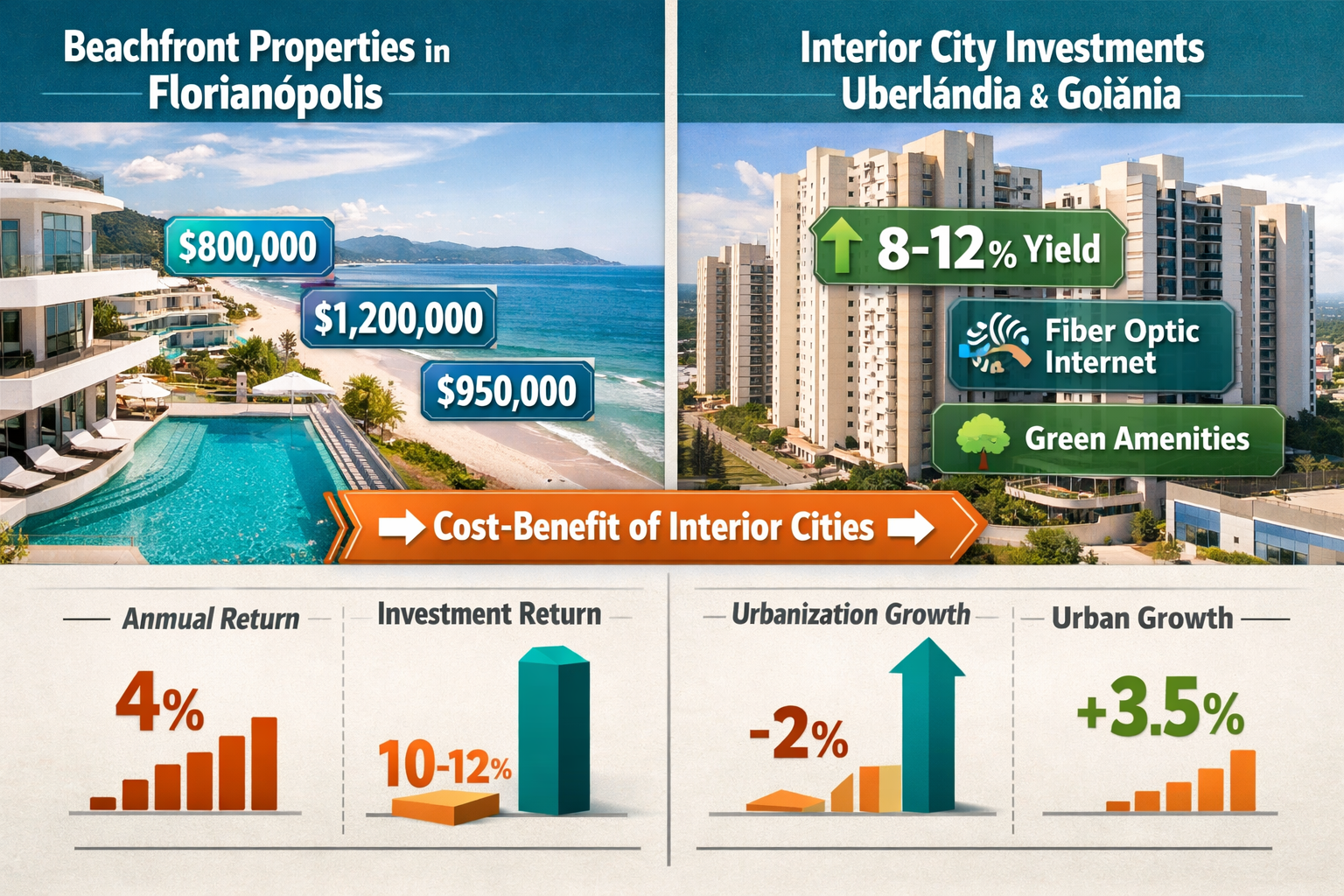
Cost Efficiency: Interior markets offer 30-40% lower property prices compared to coastal equivalents, translating to superior yields for investors and affordable living for remote workers.
Infrastructure Maturity: Cities like Brasília—recently named by InsureMyTrip as the world’s best city for digital nomads[1]—offer balanced infrastructure, connectivity, and quality of life. Uberlândia and Goiânia have invested heavily in fiber optic networks, achieving connectivity speeds that rival São Paulo.
Urbanization Momentum: Brazil’s interior cities are experiencing accelerated urbanization without the saturation pressures of coastal metros, creating growth opportunities for strategic property investments.
Quality of Life Balance: Lower crime rates, reduced congestion, and proximity to natural landscapes (Cerrado biome) appeal to remote workers seeking work-life integration.
The Investment Case: 8-12% Yields Without Coastal Premiums
Interior Brazilian cities are delivering exceptional returns for developers focused on the digital nomad segment. Current market data indicates:
| City | Average Yield | Entry Price (1BR) | Fiber Coverage | Digital Nomad Amenities |
|---|---|---|---|---|
| Uberlândia | 10-12% | R$250,000-350,000 | 85%+ | Growing coworking, international airport |
| Goiânia | 8-11% | R$220,000-320,000 | 80%+ | Tech hub development, cultural scene |
| Brasília | 9-11% | R$300,000-450,000 | 95%+ | Top global ranking, government stability |
| Campo Grande | 9-10% | R$200,000-280,000 | 75%+ | Emerging market, nature access |
These yields significantly outperform coastal markets while offering lower volatility. Developers who understand how to maximize returns through strategic timing can achieve even stronger performance by targeting pre-construction opportunities in these growing markets.
Designing Flexible Condos for Remote Work Havens in Brazil’s Interior: 2026 Specifications
Essential Infrastructure: High-Speed Connectivity as Foundation
Fiber optic infrastructure is non-negotiable for digital nomad housing. In 2026, successful developments in Brazil’s interior must guarantee:
✅ Minimum 500 Mbps symmetrical connections with options for 1 Gbps+ for power users
✅ Redundant internet service providers to ensure 99.9% uptime
✅ Building-wide mesh Wi-Fi systems with seamless roaming
✅ Backup power systems for internet equipment during outages
✅ 5G readiness with infrastructure for emerging wireless technologies
Cities like Uberlândia and Goiânia have made significant infrastructure investments, with fiber coverage exceeding 80% in urban areas. Developers should partner with multiple ISPs to offer residents choice and reliability—a key differentiator in the digital nomad market.
Workspace Integration: Beyond the Home Office
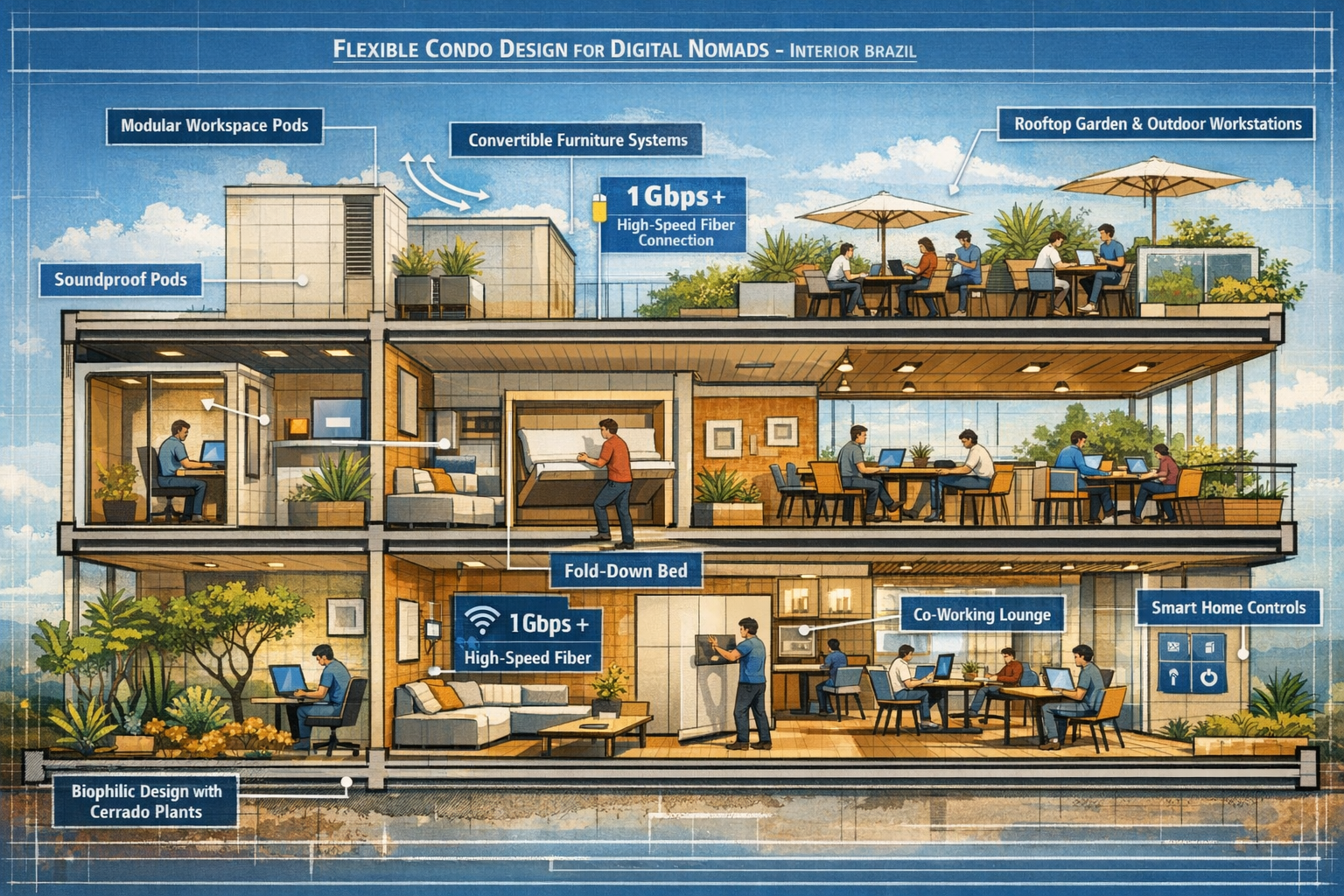
Traditional residential design assumes work happens elsewhere. Remote work havens must integrate professional-grade workspace directly into the living environment:
Individual Unit Features:
- Dedicated workspace zones with ergonomic design, natural lighting, and acoustic treatment
- Modular furniture systems allowing configuration changes as work needs evolve
- Smart home integration for lighting, climate, and privacy control during video calls
- Soundproofing standards exceeding typical residential specifications (STC 55+ ratings)
Building-Level Amenities:
- Integrated coworking lounges with hot desks, meeting pods, and presentation equipment
- Podcast/content creation studios with professional lighting and acoustic treatment
- Outdoor workstations leveraging Brazil’s climate with shaded, connected spaces
- 24/7 access protocols accommodating global time zones and flexible schedules
These features transform condos from simple housing into productivity ecosystems that justify premium rents and attract quality tenants. The evolving real estate market increasingly rewards developments that anticipate lifestyle needs rather than simply providing shelter.
Biophilic Design and Green Amenities
Digital nomads prioritize wellness and environmental quality when selecting accommodations. Incorporating biophilic design principles creates competitive advantage:
🌿 Native Cerrado landscaping connecting residents to Brazil’s unique interior ecosystem
🌿 Green walls and rooftop gardens improving air quality and providing relaxation spaces
🌿 Natural ventilation systems reducing energy costs while enhancing comfort
🌿 Abundant natural light through strategic window placement and light wells
🌿 Water features creating ambient sound and cooling effects
Sustainability features also appeal to the environmentally conscious digital nomad demographic while reducing operating costs—a win-win for owners and residents.
Flexible Floor Plans and Modular Spaces
The most successful Remote Work Havens in Brazil’s Interior: Designing Flexible Condos for 2026 Digital Nomad Influx embrace adaptability as a core principle:
Convertible Spaces: Rooms that transform from bedroom to office to studio based on resident needs, using sliding partitions, Murphy beds, and multi-function furniture.
Multiple Configuration Options: Offering 1-bedroom units that can convert to studios with larger workspace, or 2-bedroom units where one room serves as dedicated office.
Furniture Packages: Providing optional fully-furnished configurations specifically designed for remote work, reducing friction for international arrivals.
Storage Solutions: Generous built-in storage compensating for smaller square footage, acknowledging that digital nomads accumulate less but value organization.
This flexibility extends the appeal beyond digital nomads to local remote workers, hybrid professionals, and traditional residents—diversifying tenant pools and reducing vacancy risk.
Community and Social Infrastructure
Remote work can be isolating. Successful developments counter this by engineering community connection:
- Common areas designed for spontaneous interaction: coffee bars, communal kitchens, game rooms
- Regular resident events: networking mixers, skill-sharing workshops, cultural exchanges
- Digital community platforms: apps connecting residents for collaboration, social activities, and local recommendations
- Partnerships with local coworking spaces: providing membership discounts and expanding workspace options
- Language exchange programs: connecting international nomads with Brazilian residents
These community features create stickiness—encouraging longer stays and positive reviews that drive referrals in the tight-knit digital nomad community.
Case Studies: Adaptation Playbooks for Interior Brazil’s Remote Work Market
Uberlândia: The Agricultural Hub’s Tech Transformation
Uberlândia, traditionally known for agribusiness, has emerged as an unexpected remote work destination. With a population of 700,000+, the city offers urban amenities without metropolitan chaos.
Development Strategy: A local developer converted a mid-rise commercial building near Shopping Uberlândia into 42 flexible residential units specifically targeting remote workers. The project incorporated:
- Ground-floor coworking space with 20 desks (free for residents, paid for public)
- Rooftop terrace with covered workstations and Cerrado garden
- Partnership with three fiber ISPs offering residents choice
- Furnished options with ergonomic chairs and standing desks
- Monthly networking events with local entrepreneurs
Results:
- 95% occupancy within 3 months of launch
- 40% of tenants international digital nomads, 60% Brazilian remote workers
- Average stay duration: 8 months (vs. 3-4 months typical for short-term rentals)
- Rental premiums of 25% above comparable unfurnished units
- 11% net yield for investors
Key Lesson: Hybrid targeting (international + local remote workers) provides stability while building critical mass for community features.
Goiânia: Leveraging Cultural Assets
Goiânia, Goiás state capital with 1.5 million metro population, combines art deco architecture with emerging tech scene. The city’s lower costs and cultural vibrancy attract creative professionals.
Development Strategy: A boutique development near Setor Marista created 28 units in a renovated 1950s building, emphasizing:
- Preservation of art deco architectural elements for Instagram-worthy aesthetics
- Individual units averaging 45m² with 15m² dedicated workspace zones
- Building-level podcast studio and photography space
- Partnership with local cultural institutions (museums, theaters) for resident discounts
- Bike-sharing program and walkable neighborhood emphasis
Results:
- Target demographic shift toward creative professionals (designers, writers, content creators)
- 30% premium over new construction due to character and location
- Strong social media presence driving organic inquiries
- 9.5% yield with appreciation potential in gentrifying neighborhood
Key Lesson: Authentic local character and cultural integration can differentiate developments in competitive markets.
Brasília: Premium Positioning for Top-Tier Nomads
As the world’s best city for digital nomads according to InsureMyTrip[1], Brasília attracts higher-income remote workers. The city’s iconic Oscar Niemeyer architecture and government stability create unique appeal.
Development Strategy: A high-end development in Asa Sul targeted senior professionals and executives with:
- Larger units (65-85m²) with separate office rooms
- Concierge services including visa assistance and local orientation
- Partnership with private clubs providing networking opportunities
- Premium finishes and smart home technology throughout
- Electric vehicle charging stations and sustainability certifications
Results:
- Average tenant income 40% higher than typical digital nomad
- Longer average stays (12+ months) with many extending visas
- Lower price sensitivity allowing premium positioning
- 10% yield despite higher acquisition costs
- Strong referral network among executive remote workers
Key Lesson: Premium positioning works in cities with established digital nomad reputations, attracting quality tenants willing to pay for excellence.
Implementation Roadmap: From Concept to Occupancy
Phase 1: Market Research and Site Selection (Months 1-3)
Identify Target Cities: Evaluate interior cities based on:
- Fiber infrastructure coverage and quality
- Airport connectivity (international and domestic)
- Cost of living relative to coastal alternatives
- Existing coworking spaces and remote work community
- Local government support for digital nomad initiatives
- Safety and quality of life metrics
Site Analysis: Prioritize locations with:
- Walkability scores above 70
- Proximity to amenities (cafes, restaurants, gyms, cultural venues)
- Access to nature (parks, trails, green spaces)
- Good public transportation or bike-friendly infrastructure
- Neighborhood character appealing to target demographic
Competitive Analysis: Study existing developments, identifying gaps in the market and opportunities for differentiation.
Phase 2: Design and Development (Months 4-18)
Architectural Planning: Engage architects experienced in flexible residential design, emphasizing:
- Workspace integration at unit and building levels
- Acoustic engineering for sound isolation
- Natural light maximization
- Biophilic design principles
- Modular construction where feasible to reduce costs
Technology Infrastructure: Design redundant, high-performance systems:
- Multiple fiber providers with automatic failover
- Enterprise-grade Wi-Fi throughout common areas
- Smart building systems for energy efficiency
- Security systems balancing safety with privacy
Amenity Programming: Design spaces that encourage community:
- Right-sized coworking areas (avoid over-building)
- Outdoor spaces leveraging climate advantages
- Flexible event spaces supporting various uses
- Fitness and wellness facilities
Sustainability Integration: Incorporate features that reduce operating costs while appealing to environmentally conscious tenants:
- Solar panels for common area electricity
- Rainwater harvesting for landscaping
- Energy-efficient HVAC and appliances
- Native landscaping requiring minimal irrigation
Understanding how real estate development performance is transforming markets can inform timeline and sales strategies.
Phase 3: Marketing and Lease-Up (Months 15-24)
Digital-First Marketing: Reach remote workers where they live—online:
- Professional photography and 3D virtual tours
- Presence on digital nomad platforms (Nomad List, Remote Year, etc.)
- Social media campaigns targeting remote work communities
- SEO-optimized content about living and working in the city
- Partnerships with remote work influencers and bloggers
Flexible Leasing Terms: Accommodate digital nomad preferences:
- 3, 6, and 12-month lease options
- Furnished and unfurnished configurations
- International payment options (credit cards, wire transfers)
- Simplified documentation for foreigners
- Visa support services
Community Building: Start before full occupancy:
- Welcome packages with local guides and recommendations
- Resident Slack/WhatsApp groups for connection
- Launch events introducing early residents
- Partnerships with local businesses for resident discounts
Pricing Strategy: Balance yield optimization with occupancy:
- Premium pricing for furnished, short-term leases
- Discounts for longer commitments (12+ months)
- Dynamic pricing adjusting to seasonal demand
- Early-bird incentives during lease-up phase
Phase 4: Operations and Optimization (Ongoing)
Property Management: Deliver service levels exceeding traditional residential:
- 24/7 emergency response for connectivity issues
- Proactive maintenance preventing disruptions
- Community manager fostering resident engagement
- Regular feedback collection and rapid iteration
Performance Monitoring: Track metrics specific to remote work housing:
- Occupancy rates by lease term length
- Tenant satisfaction with workspace and connectivity
- Referral rates and online reviews
- Yield compared to traditional residential
- Tenant demographic mix and evolution
Continuous Improvement: Evolve based on resident feedback:
- Amenity usage patterns informing future investments
- Technology upgrades maintaining competitive edge
- Programming adjustments based on community preferences
- Physical improvements addressing pain points
Financial Projections and Investment Returns
Development Economics
A typical 40-unit flexible condo development in a mid-tier interior city might show the following economics:
Development Costs (Uberlândia example):
- Land acquisition: R$800,000
- Construction (R$3,500/m² × 2,000m²): R$7,000,000
- Technology infrastructure: R$400,000
- Amenity fit-out: R$600,000
- Professional fees and permits: R$500,000
- Marketing and lease-up: R$300,000
- Total Development Cost: R$9,600,000
Revenue Projections (stabilized year):
- Average unit size: 50m²
- Average rent: R$2,800/month (furnished, utilities included)
- Occupancy: 92%
- Annual gross revenue: R$1,235,520
- Operating expenses (30%): R$370,656
- Net Operating Income: R$864,864
Returns:
- Net Yield: 9.0%
- Cash-on-Cash (with 40% leverage): 14.2%
- Appreciation potential: 5-7% annually in growing markets
- Total return potential: 14-16% annually
These returns significantly exceed traditional residential developments while offering diversification benefits for investors exploring strategic property investment locations.
Risk Mitigation Strategies
Demand Risk: Diversify tenant base beyond pure digital nomads:
- Target local remote workers (growing segment in Brazil)[2]
- Attract hybrid workers needing occasional local workspace
- Appeal to traditional renters valuing quality and amenities
Technology Obsolescence: Build flexibility into infrastructure:
- Conduit systems allowing easy cable upgrades
- Modular technology rooms for equipment swaps
- Partnership agreements with ISPs including upgrade clauses
Market Saturation: Focus on differentiation and quality:
- Unique design elements creating brand identity
- Superior service levels building loyalty
- Community strength creating network effects
- Location selection in under-served neighborhoods
Regulatory Changes: Stay informed and adaptable:
- Monitor digital nomad visa policy evolution
- Maintain compliance with all local regulations
- Build relationships with government stakeholders
- Design flexibility allowing pivots if market shifts
The Future of Remote Work Havens in Brazil’s Interior
Emerging Trends Shaping 2026 and Beyond
Hybrid Work Normalization: Remote work has become a permanent feature of corporate life in Brazil[2], with companies increasingly offering flexible arrangements. This expands the addressable market beyond pure digital nomads to include:
- Corporate employees working remotely from lower-cost cities
- Entrepreneurs building businesses outside traditional hubs
- Retirees and semi-retirees seeking affordable, connected lifestyles
- Students and young professionals prioritizing flexibility
Technology Evolution: Advancing technologies will enable new development features:
- AI-powered building management optimizing energy use and predicting maintenance needs
- Virtual reality amenities allowing remote collaboration and social connection
- IoT integration creating seamless smart home experiences
- Blockchain-based property management streamlining payments and contracts
For developers interested in emerging technologies, understanding cryptocurrency and real estate development intersections may provide additional opportunities.
Sustainability Imperatives: Environmental consciousness will drive design:
- Net-zero energy buildings becoming standard
- Circular economy principles in construction and operations
- Wellness certifications (WELL, Fitwel) commanding premiums
- Climate resilience features protecting long-term value
Community as Amenity: The most successful developments will prioritize human connection:
- Curated resident experiences beyond physical amenities
- Skill-sharing and collaboration platforms
- Integration with local communities reducing isolation
- Purpose-built spaces for events, workshops, and networking
Policy and Infrastructure Developments
Brazil’s commitment to attracting digital nomads continues strengthening. Embratur’s goal of 30% annual growth in visa issuance[1] signals sustained government support. Interior cities are responding with:
- Fiber infrastructure expansion: National broadband initiatives targeting 95% coverage in urban areas by 2027
- Airport improvements: Regional airports adding international routes and improving facilities
- Coworking incentives: Municipal programs supporting coworking space development
- Tax advantages: Some cities offering property tax breaks for developments meeting remote work criteria
Developers who align with these policy directions can access incentives while riding demographic and technological tailwinds.
Competitive Positioning for Long-Term Success
As the market matures, differentiation becomes critical. Successful Remote Work Havens in Brazil’s Interior: Designing Flexible Condos for 2026 Digital Nomad Influx will distinguish themselves through:
- Authentic local integration: Celebrating regional culture rather than creating generic international spaces
- Service excellence: Delivering hospitality-level service in residential contexts
- Community strength: Building resident networks that create loyalty and referrals
- Technological leadership: Maintaining infrastructure advantages as standards rise
- Sustainability credentials: Meeting growing environmental expectations
- Flexibility and adaptation: Continuously evolving based on resident needs and market shifts
Conclusion
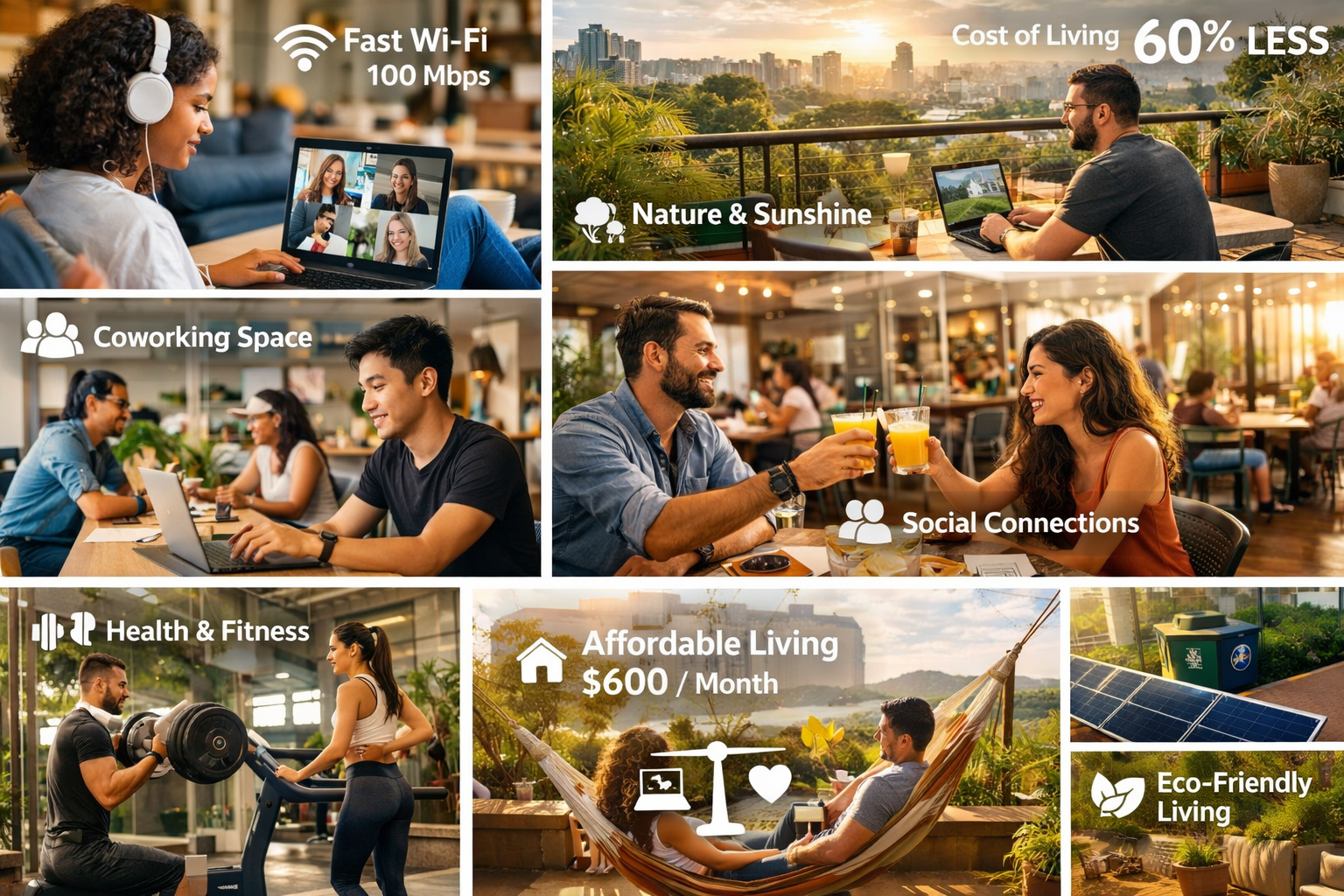
The convergence of global remote work trends, Brazil’s digital nomad visa program, and infrastructure improvements in interior cities creates a compelling opportunity for forward-thinking real estate developers. Remote Work Havens in Brazil’s Interior: Designing Flexible Condos for 2026 Digital Nomad Influx represents more than a niche market—it’s a fundamental shift in how people live and work that will reshape Brazilian real estate for decades.
Cities like Uberlândia, Goiânia, and Brasília offer exceptional value propositions: lower costs than coastal markets, strong infrastructure, quality of life advantages, and investment yields of 8-12% that significantly outperform traditional residential developments. By designing flexible condos that integrate professional workspace, high-speed connectivity, biophilic elements, and community-building features, developers can capture this growing market while delivering superior returns.
Actionable Next Steps
For developers and investors ready to capitalize on this opportunity:
✅ Conduct market research in target interior cities, evaluating infrastructure, demographics, and competition
✅ Visit successful developments in Brasília, Uberlândia, and Goiânia to understand best practices and resident preferences
✅ Engage specialized architects experienced in flexible residential design and remote work integration
✅ Build partnerships with ISPs, coworking operators, and digital nomad platforms before breaking ground
✅ Develop financial models incorporating both digital nomad and local remote worker demand for conservative projections
✅ Create pilot projects starting with smaller developments to test concepts before scaling
✅ Join industry networks connecting with other developers, property managers, and service providers in this emerging sector
The digital nomad influx is not a temporary phenomenon—it’s a permanent restructuring of work and lifestyle that savvy developers can leverage for sustained competitive advantage. By focusing on Brazil’s interior cities and designing purpose-built flexible condos, forward-thinking investors can achieve superior returns while meeting genuine market needs.
The future of Brazilian real estate is being written today in the interior cities that embrace remote work. Those who act decisively with well-designed, thoughtfully positioned developments will reap the rewards as 60 million global digital nomads[1] seek their ideal work-life destinations in the years ahead.
References
[1] News 104112 Brazil Encourages The Recruitment Of Digital Nomads – https://en.travel2latam.com/news-104112-brazil-encourages-the-recruitment-of-digital-nomads
[2] Labor Work Models In Brazil Home Office On Site And Hybrid Arrangements In 2026remote Work Has Become A Permanent Feature Of Corporate Life In Brazil – https://www.feijolopes.com.br/en/2025/12/29/labor-work-models-in-brazil-home-office-on-site-and-hybrid-arrangements-in-2026remote-work-has-become-a-permanent-feature-of-corporate-life-in-brazil/
[3] Digital Nomad Visa Index 2026 – https://immigrantinvest.com/reports/digital-nomad-visa-index-2026/
[4] How Much Income Brazilians Need For 2026 Digital Nomad Visas Around The World – https://www.visahq.com/news/2026-02-25/br/how-much-income-brazilians-need-for-2026-digital-nomad-visas-around-the-world/
[5] Remote Work Statistics – https://join.virtuallatinos.com/blog/remote-work-statistics/
[6] Brasil Lidera Ranking Global De Intencao De Contratacao Para Inicio De 2026 – https://tiinside.com.br/en/12/01/2026/brasil-lidera-ranking-global-de-intencao-de-contratacao-para-inicio-de-2026/
[7] Salaries In Brazil For Us Remote Teams 2026 – https://kaptasglobal.io/blog/salaries-in-brazil-for-us-remote-teams-2026/