
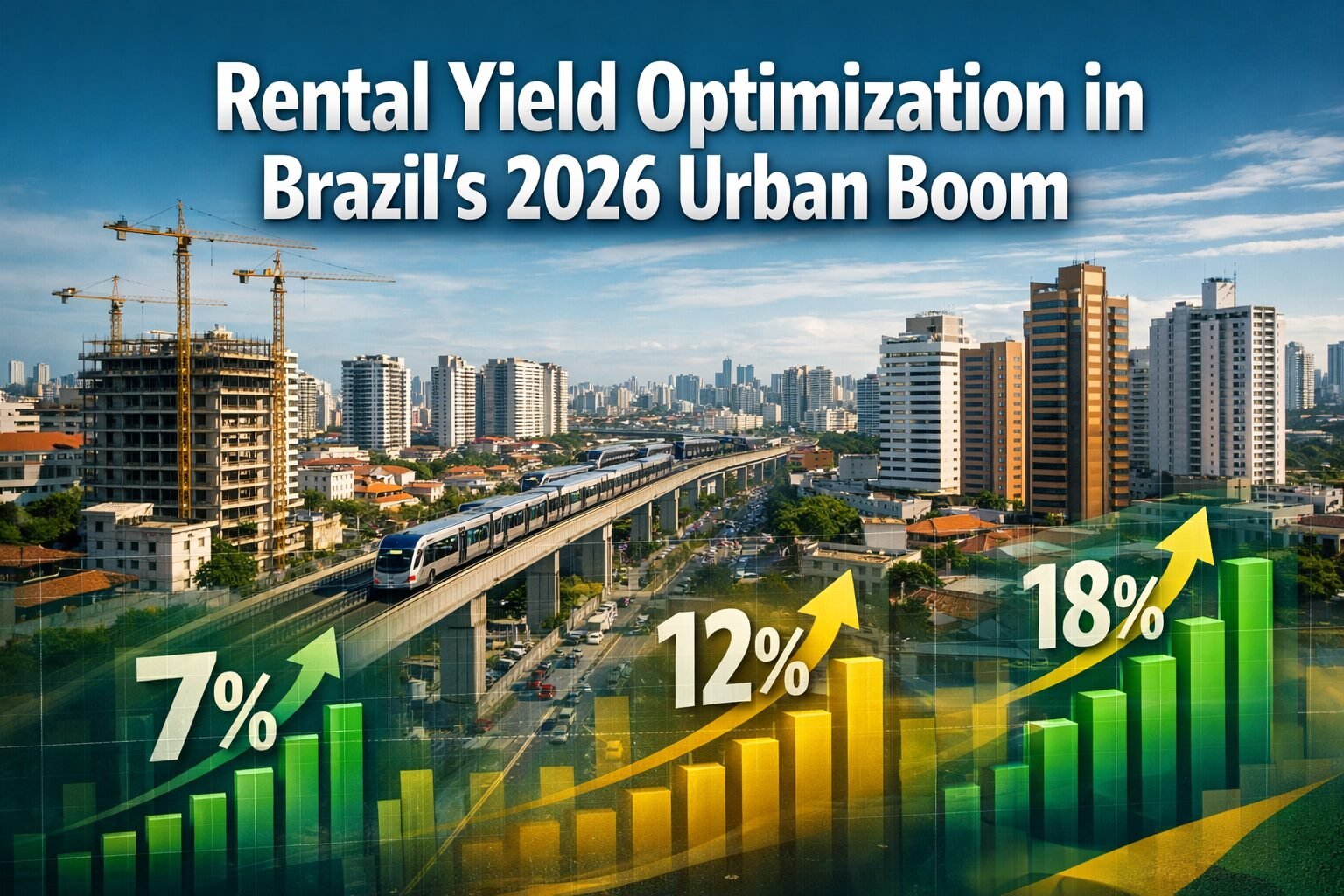
Brazil’s urban landscape is transforming at an unprecedented pace in 2026, creating exceptional opportunities for savvy real estate investors. As urbanization accelerates and rental demand surges across major metropolitan areas, Rental Yield Optimization in Brazil’s 2026 Urban Boom: Strategies for High-Return Buy-to-Let Developments Outside MCMV has become the critical focus for investors seeking returns that outpace traditional government-subsidized housing programs. With strategic positioning in secondary cities and innovative approaches to property management, investors are now achieving gross yields of 12-18% through mixed-use integrations and short-term rental strategies targeting digital nomads and young professionals.
The traditional buy-to-let model is evolving rapidly. Brazil’s high-interest environment—with the Selic rate at 15%—has fundamentally reset investor expectations, requiring minimum gross yields of 6% just to compete with risk-free fixed-income alternatives.[2] This shift has pushed sophisticated investors to look beyond conventional long-term residential rentals and explore best places to invest in Brazil property that offer superior risk-adjusted returns.
Key Takeaways
✅ Regional yield variance is substantial: Salvador delivers 7% gross yields compared to São Paulo’s 6% and Rio’s sub-5% returns, representing a 200+ basis point advantage.[1][2]
✅ Property type matters significantly: Studios and one-bedroom apartments achieve 6.5-8% gross yields, outperforming larger units at 5-6% due to higher rent density per square meter.[1]
✅ Net yields reveal the true picture: Operating costs consume 25-33% of rental income, dropping São Paulo’s net yields to 4.2% and Salvador’s to approximately 5%.[1][2]
✅ Short-term rentals unlock premium returns: Properties positioned for digital nomads and tourists achieve net yields of 6-10% annually, with peak season performance reaching 18% in strategic locations.[3]
✅ Transit-oriented developments outperform: Neighborhoods near metro stations and employment hubs like São Paulo’s República achieve 6.5-8% gross yields despite central locations.[1]
Understanding Brazil’s 2026 Rental Yield Landscape
The High-Interest Reality Reshaping Investment Thresholds
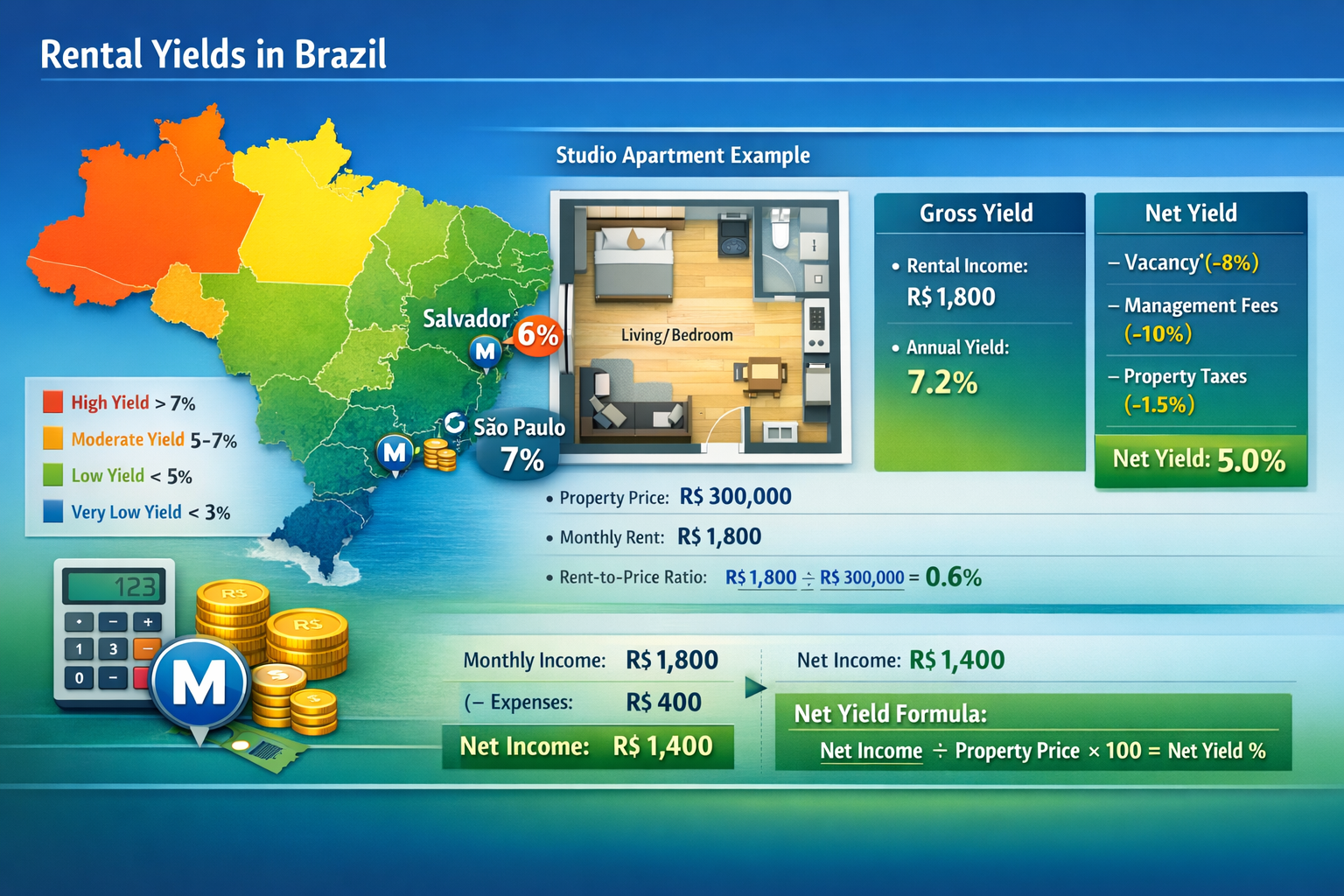
The Brazilian rental market in 2026 operates under dramatically different conditions than previous years. With the Selic rate positioned at 15%, the opportunity cost of real estate investment has never been higher. Landlords and developers must now target minimum gross yields of 6% simply to justify choosing property over government bonds.[2]
This high-interest environment has created a natural filter, separating sophisticated investors who understand yield optimization strategies from those relying on outdated models. The math is straightforward: if risk-free fixed-income instruments deliver 15% annually, real estate investments must offer compelling advantages—whether through capital appreciation potential, inflation hedging, or superior net yields after tax optimization.
Regional Yield Variance: The Salvador Advantage
One of the most striking features of Brazil’s 2026 rental market is the substantial regional yield variance across major metropolitan areas. Salvador emerges as the clear leader, delivering gross rental yields of approximately 7%, while São Paulo hovers around 6%, and Rio de Janeiro frequently falls below 5%.[1][2]
| City | Gross Yield | Net Yield | Monthly Rent-to-Price Ratio |
|---|---|---|---|
| Salvador 🏆 | 7.0% | ~5.0% | 0.59% |
| São Paulo | 6.0% | 4.2% | 0.50% |
| Rio de Janeiro | <5.0% | ~3.5% | 0.42% |
This 200+ basis point advantage positions Salvador as particularly attractive for yield-focused investors willing to accept the perceived higher risk of secondary markets. The city’s favorable rent-to-price dynamics reflect a market where property values haven’t inflated as aggressively as rental demand, creating the ideal conditions for buy-to-let strategies.
The Net Yield Reality: Where Returns Actually Land
While gross yields capture headlines, net yields tell the true story of rental property performance. The gap between gross and net returns typically ranges from 1.5 to 2 percentage points, with operating costs consuming roughly one-quarter to one-third of rental income.[1][2]
Key deductions that compress yields include:
- Vacancy periods: Salvador averages 6-8% annually (3-4 weeks empty per year), while São Paulo experiences different patterns due to deeper market liquidity[1][2]
- Property management fees: Typically 8-10% of monthly rent
- Maintenance and repairs: 5-8% of rental income annually
- Property taxes (IPTU): Varies by municipality and property value
- Condominium fees: Significant in multi-unit developments
- Insurance: Essential but often overlooked cost
For investors pursuing valorizacao para quem compra na planta, understanding these operating costs from the development phase allows for more accurate pro forma projections.
Rental Yield Optimization Strategies for Brazil’s 2026 Urban Markets
Property Type Selection: The Studio and One-Bedroom Advantage
Property type dramatically influences returns in Brazil’s competitive rental market. Studios and one-bedroom apartments consistently outperform larger units, delivering gross yields of 6.5% to 8% in well-located neighborhoods compared to 5% to 6% for two and three-bedroom properties.[1]
The mathematics behind this performance advantage is compelling:
Rent density per square meter drives the differential. A 35-square-meter studio renting for R$2,500 monthly generates R$71 per square meter, while a 90-square-meter three-bedroom unit renting for R$4,500 produces only R$50 per square meter. This 42% difference in rent efficiency translates directly to superior yields.
The demand drivers supporting smaller units include:
- 📱 Young professionals seeking affordable, well-located housing near employment centers
- 🎓 University students requiring independent accommodation
- 💼 Digital nomads preferring flexible, furnished options in urban cores
- 👥 Single-person households, Brazil’s fastest-growing demographic segment
Investors focusing on vantagens de investir em estudios em Florianopolis can leverage these demographic trends for sustained occupancy and yield performance.
Location Strategy: Transit-Oriented Development vs. Ultra-Prime Compression
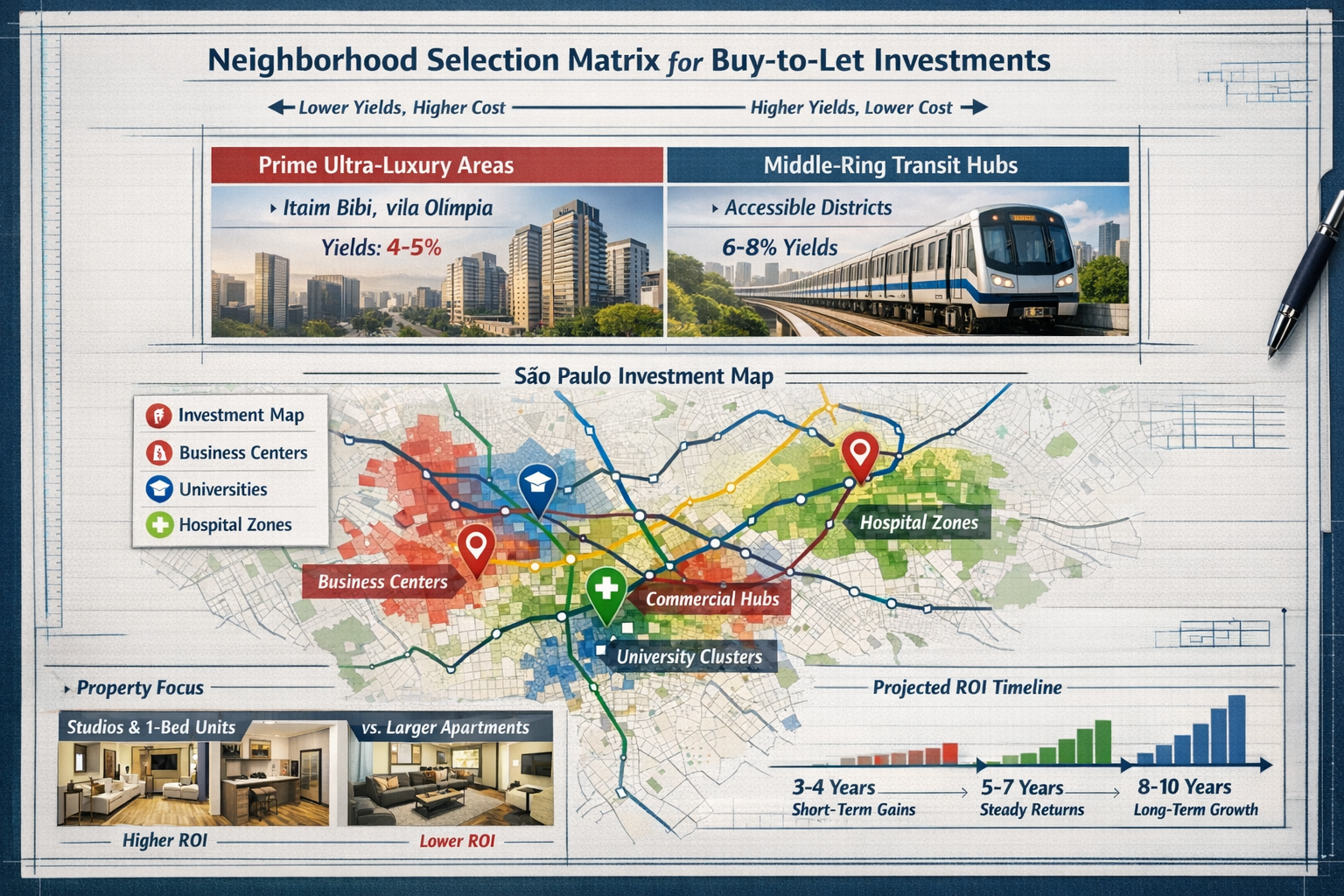
Neighborhood location serves as the primary yield compressor or amplifier in Brazil’s major markets. Counter-intuitively, ultra-prime neighborhoods often deliver the lowest yields, while middle-ring districts with excellent transit access offer superior returns.
Ultra-prime yield compression affects prestigious areas like:
- São Paulo: Itaim Bibi, Vila Olímpia, Jardim Paulista (4-5.5% gross yields)[1][2]
- Salvador: Barra, Graça (similar compression patterns)[2]
These neighborhoods suffer from lifestyle premiums where land values have inflated faster than rents can grow. Wealthy buyers pay substantial premiums for prestige addresses, but tenants show less willingness to pay proportionally higher rents.
Transit-oriented opportunities deliver superior performance:
- São Paulo’s República and Santa Cecília: 6.5-8% gross yields[1]
- Neighborhoods within 500 meters of metro stations
- Areas with concentrated employment hubs (hospitals, universities, commercial centers)
“Proximity to employment hubs and metro stations justifies rent growth that outpaces purchase price appreciation, creating the ideal conditions for yield optimization.”
The structural rental demand created by job concentration and institutional presence supports occupancy rates above 92%, making these areas stable despite lower per-square-meter property values.
Short-Term Rental Integration: The 12-18% Yield Pathway
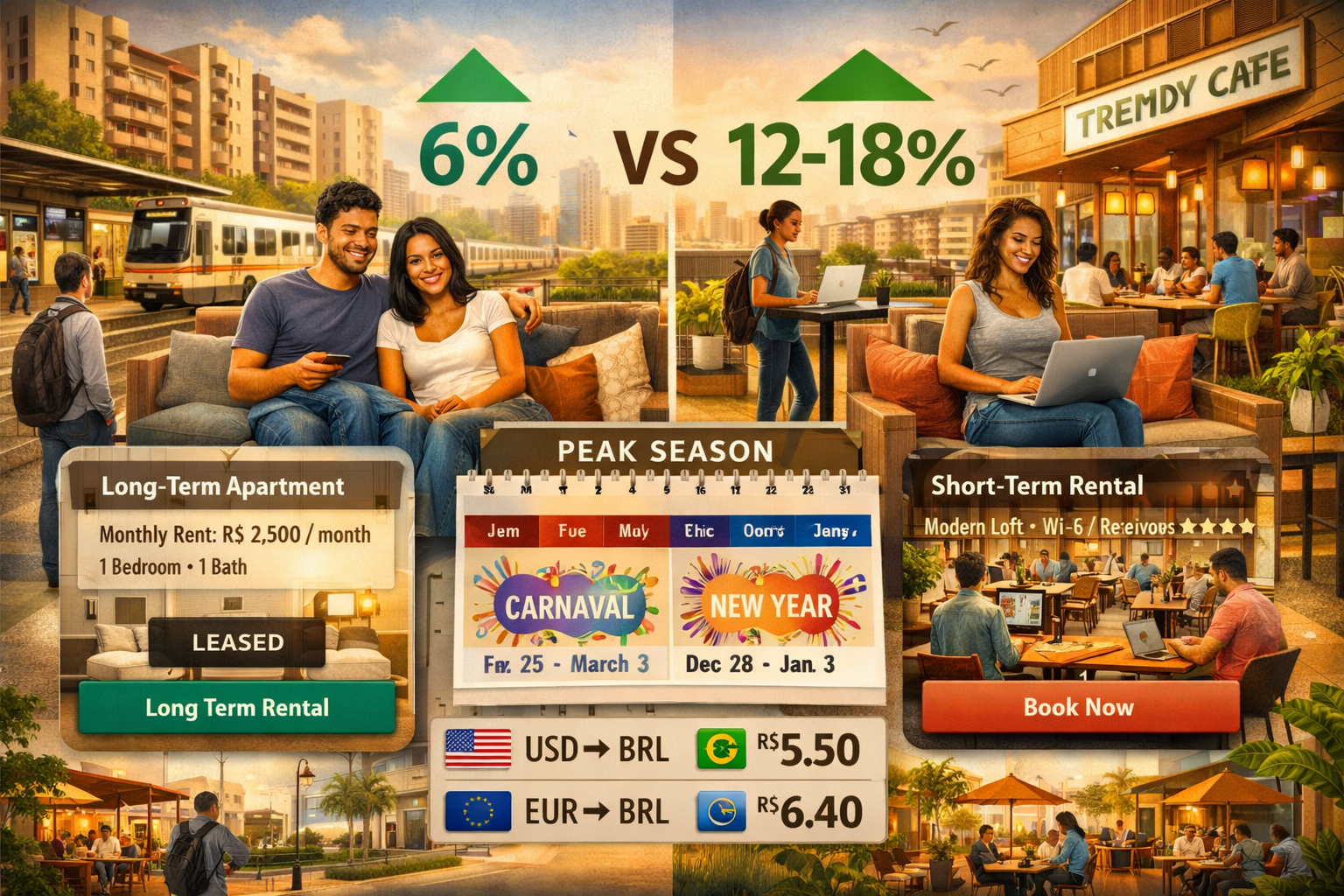
The most transformative strategy for Rental Yield Optimization in Brazil’s 2026 Urban Boom involves integrating short-term rental capabilities into buy-to-let developments. Properties positioned for platforms like Airbnb and Booking.com achieve net yields of 6% to 10% annually, with peak season performance reaching 12-18% in strategic locations.[3]
Key success factors for short-term rental optimization:
Strategic timing around Brazilian peak seasons:
- New Year (December 28 – January 5)
- Carnival (February/March, varies annually)
- Major holidays and long weekends
- Business conference seasons
Target market segmentation:
- 🌍 International digital nomads benefiting from favorable BRL exchange rates
- 💻 Remote workers seeking monthly stays
- 🎉 Leisure tourists during festivals
- 👔 Business travelers near commercial districts
Property configuration requirements:
- Furnished to international standards
- High-speed internet (minimum 100 Mbps)
- Flexible check-in/check-out systems
- Professional photography and listing optimization
- Responsive property management
Regulatory compliance:
- Municipal registration for short-term rentals
- Tax compliance (ISS and income tax)
- Condominium approval where required
- Insurance coverage for short-term guests
International investors particularly benefit from BRL exchange rate advantages, as rental income in Brazilian Reais converts favorably when the currency weakens, effectively boosting dollar-denominated returns.[3]
Mixed-Use Integration and Secondary City Opportunities
The Mixed-Use Development Advantage
Mixed-use integrations represent the frontier of yield optimization in Brazil’s 2026 urban boom. Developments combining residential units with ground-floor commercial spaces, co-working facilities, or hospitality services create multiple revenue streams while enhancing property values.
Benefits of mixed-use configurations:
- Diversified income sources reducing dependency on residential occupancy alone
- Higher overall property valuations from commercial rent premiums
- Enhanced tenant experience with on-site amenities
- Stronger neighborhood effects attracting quality tenants
- Resilience during economic cycles through varied tenant bases
Successful mixed-use developments in 2026 typically feature:
- Ground floor: Cafés, restaurants, co-working spaces, or retail
- Floors 2-3: Short-term rental units for digital nomads and tourists
- Upper floors: Traditional long-term residential rentals
- Rooftop: Shared amenity spaces (gym, lounge, event space)
This vertical integration strategy allows developers to capture different market segments within a single asset, optimizing overall returns while spreading risk.
Secondary City Strategies: Beyond São Paulo and Rio
While São Paulo and Rio de Janeiro dominate headlines, Brazil’s secondary cities offer compelling yield opportunities with lower entry costs and faster-growing rental markets. Cities experiencing rapid urbanization and economic development in 2026 include:
🏙️ Florianópolis: Tech hub attracting digital workers and remote professionals, with mercado imobiliario da Grande Florianopolis em alta showing sustained momentum
🏙️ Curitiba: Strong educational institutions and quality of life metrics
🏙️ Belo Horizonte: Diversified economy and growing professional class
🏙️ Recife: Coastal appeal with emerging tech sector
These markets share common advantages:
- Lower acquisition costs per square meter (30-50% below São Paulo)
- Faster rental growth rates as urbanization accelerates
- Less competitive investor landscape with fewer institutional players
- Strong demographic tailwinds from internal migration
- Infrastructure investment improving connectivity and livability
The rent-to-price ratio in secondary cities often exceeds 0.6% monthly (7.2% annualized), compared to 0.5% in São Paulo, providing immediate cash flow advantages.[1][4]
Advanced Yield Optimization Tactics for 2026
Rent Indexation and Lease Structuring
Brazil’s FipeZAP rent index shows annual rent increases of approximately 12% as of early 2026, creating favorable conditions for buy-to-let investors willing to hold through market cycles.[7] Strategic lease structuring can capture this growth:
Indexation strategies:
- IGP-M (General Market Price Index) indexation clauses
- Annual adjustment timing aligned with market peak seasons
- Graduated rent increases for longer-term leases
- Performance-based adjustments tied to property improvements
Lease term optimization:
- 12-month contracts with renewal incentives
- Seasonal pricing for short-term rentals
- Corporate lease premiums (15-25% above market)
- Furnished vs. unfurnished pricing differentials
Technology-Enabled Property Management
Modern yield optimization requires sophisticated property management systems that minimize vacancy, reduce operating costs, and maximize rental rates:
- Dynamic pricing algorithms for short-term rentals
- Automated tenant screening reducing bad debt
- Predictive maintenance lowering emergency repair costs
- Digital payment systems improving collection rates
- Virtual tours and online leasing expanding tenant pools
These technologies reduce the traditional management fee burden from 10% to as low as 6-7% while improving occupancy rates by 2-3 percentage points—directly impacting net yields.
Tax Optimization Structures
Brazilian tax law offers several structures for optimizing rental income taxation:
- Individual ownership (Pessoa Física): Progressive rates up to 27.5%
- Corporate ownership (Pessoa Jurídica): Potentially lower effective rates
- Real Estate Investment Funds (FIIs): Tax-advantaged for qualifying structures
- Holding company structures: For portfolio investors
Professional tax planning can improve after-tax yields by 1-2 percentage points, representing a 20-30% improvement in net returns for high-yield properties.
Portfolio Diversification Across Property Types and Locations
Rather than concentrating capital in a single property or market, sophisticated investors in 2026 build diversified portfolios that balance:
- Geographic diversity: Primary and secondary cities
- Property type mix: Studios, one-bedrooms, and select larger units
- Rental strategy blend: Long-term, short-term, and corporate leases
- Development stage: Existing properties and compra na planta opportunities
This approach reduces portfolio volatility while maintaining target yield levels, as different segments perform differently across economic cycles.
Risk Management in High-Yield Strategies
Understanding the Yield-Risk Tradeoff
Higher yields invariably come with elevated risks. Properties delivering 12-18% returns through short-term rental strategies face:
- Regulatory risk: Municipal governments may restrict short-term rentals
- Market saturation: Oversupply in popular tourist areas
- Seasonal volatility: Income concentration in peak periods
- Management intensity: Higher operational complexity
- Property wear: Accelerated maintenance requirements
Successful investors price these risks appropriately and implement mitigation strategies:
✅ Regulatory monitoring: Stay informed on municipal legislation ✅ Dual-use capability: Design properties that can pivot to long-term rentals ✅ Reserve funds: Maintain 6-12 months of operating expenses ✅ Professional management: Invest in quality property management ✅ Insurance coverage: Comprehensive policies for short-term operations
Vacancy Management and Tenant Quality
Vacancy represents the single largest yield killer in rental property portfolios. A property vacant for one month loses 8.3% of annual income—more than most operating cost reductions can recover.
Proven vacancy reduction strategies:
- Competitive pricing: Use market data, not wishful thinking
- Professional presentation: Quality photos, staging, descriptions
- Tenant retention programs: Renewal incentives, responsive maintenance
- Pre-leasing: Market properties 60-90 days before vacancy
- Flexible terms: Consider shorter initial terms for quality tenants
Tenant quality directly impacts net yields through reduced turnover, lower maintenance costs, and consistent payment. Screening criteria should include:
- Credit history and income verification (rent ≤ 30% of gross income)
- Employment stability and references
- Rental history with previous landlords
- Background checks where legally permitted
Implementation Roadmap for Investors
Phase 1: Market Research and Property Selection (Months 1-3)
Begin with comprehensive market analysis focusing on:
- Identify target markets using rent-to-price ratios above 0.5% monthly
- Analyze neighborhood dynamics: employment centers, transit, demographics
- Study competitive supply: Inventory levels and absorption rates
- Evaluate regulatory environment: Zoning, short-term rental rules
- Calculate pro forma yields: Conservative assumptions on all variables
Resources like best places to invest in Brazil property provide valuable market intelligence for this phase.
Phase 2: Acquisition and Positioning (Months 4-6)
Execute the investment strategy with attention to:
- Negotiate purchase price targeting 10-15% below asking in normal markets
- Conduct thorough due diligence: Title, physical condition, legal compliance
- Optimize financing structure: Balance leverage with cash flow requirements
- Plan renovation/configuration: Align with target tenant profile
- Establish management systems: Technology platforms, service providers
Phase 3: Launch and Optimization (Months 7-12)
Activate the property with professional execution:
- Professional staging and photography: Essential for short-term rentals
- Multi-platform listing: Airbnb, Booking.com, local portals, corporate channels
- Dynamic pricing implementation: Adjust daily based on demand signals
- Performance monitoring: Track occupancy, ADR, RevPAR, net yield
- Continuous optimization: Refine pricing, amenities, marketing based on data
Phase 4: Scale and Portfolio Growth (Year 2+)
Leverage learnings to expand the portfolio:
- Reinvest cash flow into additional properties
- Replicate successful models in similar markets
- Diversify across strategies to balance risk and return
- Build operational efficiency through systems and partnerships
- Consider institutional partnerships for larger developments
Conclusion
Rental Yield Optimization in Brazil’s 2026 Urban Boom: Strategies for High-Return Buy-to-Let Developments Outside MCMV represents a compelling opportunity for investors who understand the nuanced dynamics of Brazil’s evolving real estate market. The combination of accelerating urbanization, shifting demographics, and innovative rental strategies creates pathways to 12-18% returns in secondary cities and mixed-use developments.
The key insights driving successful yield optimization include:
🎯 Strategic property selection: Studios and one-bedroom units in transit-oriented locations deliver superior rent density and yields of 6.5-8% gross.
🎯 Regional arbitrage: Salvador’s 7% gross yields and secondary cities’ favorable rent-to-price ratios offer 200+ basis point advantages over compressed primary markets.
🎯 Rental strategy innovation: Short-term rental integration targeting digital nomads and peak season tourists unlocks 12-18% returns with proper execution.
🎯 Mixed-use development: Vertical integration of residential, commercial, and hospitality uses diversifies income and enhances overall property performance.
🎯 Operational excellence: Technology-enabled property management, dynamic pricing, and tenant quality focus convert gross yields into sustainable net returns.
The high-interest environment of 2026, with Selic at 15%, has raised the bar for real estate investments. Only properties and strategies delivering compelling risk-adjusted returns will attract sophisticated capital. This creates both challenge and opportunity—separating passive investors from those willing to implement advanced yield optimization tactics.
Actionable Next Steps
For investors ready to capitalize on Brazil’s urban boom:
- Conduct detailed market analysis of secondary cities with strong demographic and employment growth
- Model pro forma yields conservatively, accounting for all operating costs and realistic vacancy assumptions
- Visit target markets personally to understand neighborhood dynamics and competitive positioning
- Build professional networks with local property managers, real estate agents, and legal advisors
- Start with a pilot property to test strategies before scaling the portfolio
- Monitor regulatory developments affecting short-term rentals and property taxation
- Explore empreendimentos that align with yield optimization strategies
The Brazilian rental market in 2026 rewards preparation, strategic thinking, and professional execution. Investors who master the tactics outlined in this guide position themselves to achieve exceptional returns while building resilient, cash-flowing portfolios that outperform both traditional real estate and fixed-income alternatives.
The urban boom is here. The strategies are proven. The opportunity awaits those ready to act with knowledge and conviction.
References
[1] Sao Paulo Rental Yields – https://thelatinvestor.com/blogs/news/sao-paulo-rental-yields
[2] Salvador Brazil Rental Yields – https://thelatinvestor.com/blogs/news/salvador-brazil-rental-yields
[3] Brazil Property Market Predictions For 2026 – https://esalesinternational.com/2025/11/20/brazil-property-market-predictions-for-2026/
[4] Invest In Real Estate Salvador Complete Guide Market Returns Neighborhoods – https://www.jarniascyril.com/international-real-estate/investing-brazil-real-estate/invest-in-real-estate-salvador-complete-guide-market-returns-neighborhoods/
[7] Brazil Real Estate Market – https://thelatinvestor.com/blogs/news/brazil-real-estate-market