
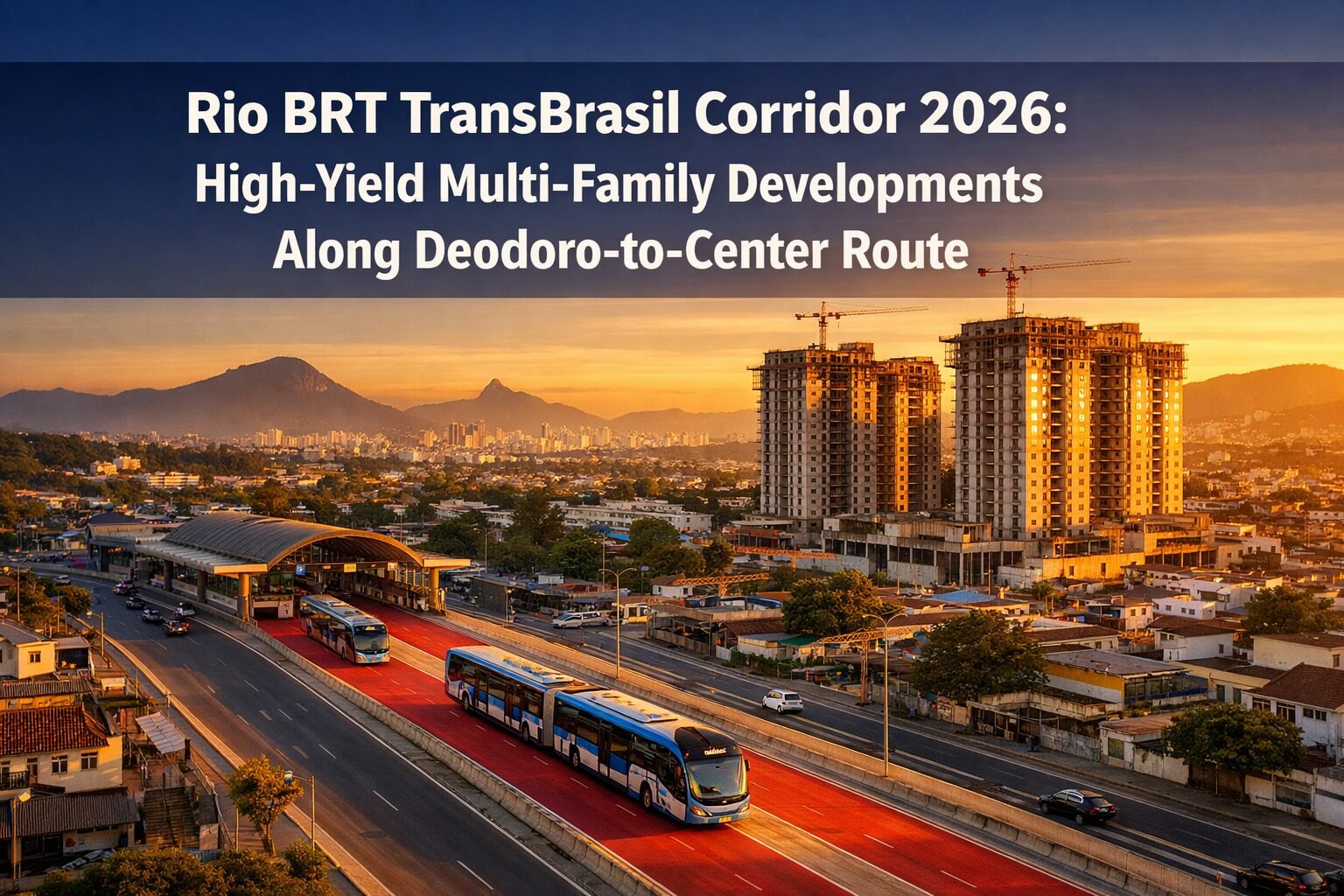
Rental yields of 15 to 20 percent are rare in any major Latin American city — yet that is precisely the range that analysts are projecting for well-positioned multi-family units near the BRT TransBrasil stations in Rio de Janeiro’s West Zone in 2026. The catalyst is straightforward: a R$1.9 billion transit infrastructure investment has permanently cut commute times between Deodoro and the city center, and land prices in the corridor have not yet caught up with the new reality. The Rio BRT TransBrasil Corridor 2026: High-Yield Multi-Family Developments Along Deodoro-to-Center Route represents one of the most compelling transit-oriented investment windows in Brazil right now, and the window is narrowing fast.
Key Takeaways
- The BRT TransBrasil corridor is fully operational, carrying approximately 250,000 passengers daily across 25 kilometers and 17 stations, with a growth target of 700,000 daily riders by 2030.
- The Deodoro Terminal, inaugurated in September 2023, connects BRT, Supervia rail, and the Transolímpica corridor, cutting travel times by up to 30 minutes.
- Express Line 61, launched in May 2024, links Deodoro Terminal to Gentileza Intermodal Terminal in roughly 35 to 40 minutes during peak hours.
- Multi-family developments within 400 to 600 meters of BRT stations are attracting the strongest demand, particularly compact units targeting young professionals.
- Minha Casa Minha Vida (MCMV) subsidy alignment in lower-income West Zone micro-markets can amplify net rental yields significantly, making early-stage land acquisition especially attractive.
Why the TransBrasil Corridor Is Reshaping Rio’s Investment Map
For decades, Rio’s West Zone was considered a dormitory region — affordable to live in, but punishing to commute from. The completion of the BRT TransBrasil corridor changed that equation permanently. The system spans 25 kilometers, serves 17 stations, and has been in full operation since May 2024, carrying approximately 250,000 passengers every day [1]. Projections place that figure at 700,000 daily riders by 2030, a number that signals sustained and growing demand for housing near every station along the route [1].
The Deodoro Terminal, inaugurated in September 2023 at a cost of approximately R$1.9 billion financed by BNDES and Caixa Econômica Federal, is the anchor of the entire system [2][5]. It serves as the primary interchange between the TransBrasil and Transolímpica BRT corridors, and it also integrates directly with Supervia commuter rail services [5]. For residents of neighborhoods like Deodoro, Magalhães Bastos, and Ricardo de Albuquerque, the terminal reduced travel times to downtown Rio by up to 30 minutes compared to pre-BRT conditions [2].
“Transit infrastructure does not just move people — it moves capital. Every minute shaved off a commute translates directly into a premium that renters and buyers will pay for proximity.”
The express service (Line 61), introduced in May 2024, sharpened the corridor’s value proposition even further. Running between Deodoro Terminal and the Gentileza Intermodal Terminal, Line 61 completes the journey in approximately 35 to 40 minutes during peak hours [3]. That puts the West Zone within a commute window that was previously reserved for Barra da Tijuca or Tijuca residents paying far higher rents.
The MCMV Subsidy Layer: Amplifying Returns in the West Zone
What separates the Deodoro-to-Center corridor from other transit-oriented investment plays in Rio is the overlap with Minha Casa Minha Vida (MCMV) subsidy eligibility zones. Large portions of the West Zone near the BRT stations fall within income brackets that qualify for federal housing subsidies, which effectively subsidizes construction costs for developers and reduces the financial barrier for end-buyers and tenants.
For investors, this creates a dual-yield mechanism:
- Subsidized construction costs lower the break-even threshold for new multi-family projects.
- Below-market acquisition prices in neighborhoods still priced as pre-transit areas create built-in appreciation upside.
When these two factors combine with the transit premium now delivered by the operational BRT system, analysts tracking the corridor are projecting net rental yields in the 15 to 20 percent range for well-located compact units — a figure that is exceptional by any Brazilian urban standard [4].
Investors interested in understanding how transit infrastructure drives property premiums across Brazil’s major cities can explore best places to invest in Brazil property for a broader national comparison.
Investment Hotspots Along the Rio BRT TransBrasil Corridor 2026: High-Yield Multi-Family Developments Along Deodoro-to-Center Route
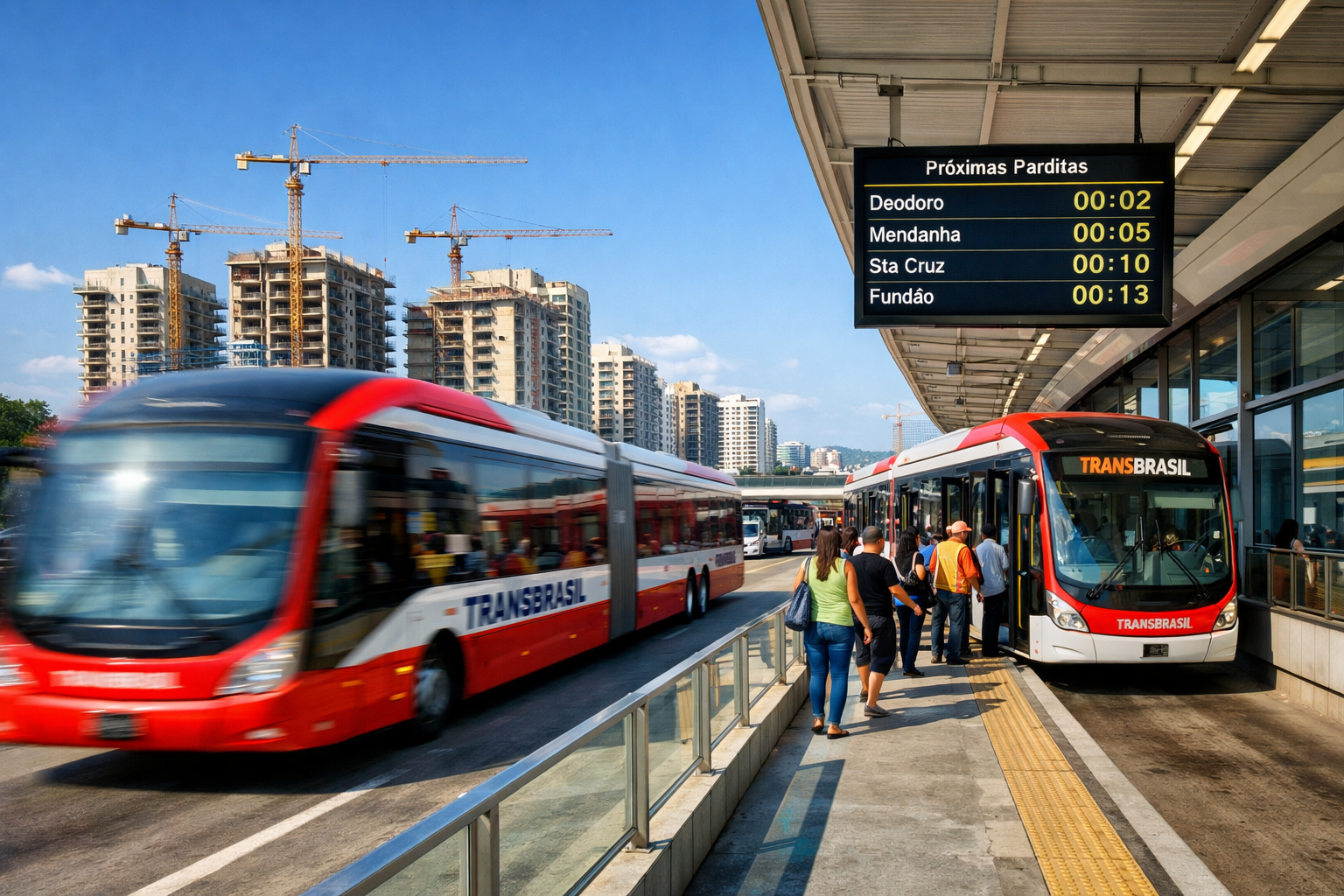
Not all 17 stations along the TransBrasil corridor carry equal investment weight. The most attractive opportunities cluster around three distinct zone types: interchange nodes, mid-corridor growth zones, and the downtown approach.
Tier 1: Interchange Nodes (Highest Demand, Fastest Appreciation)
Deodoro Terminal sits at the top of this tier. As the western anchor of the BRT system and the connection point to Supervia rail and the Transolímpica corridor, Deodoro generates the highest foot traffic and the broadest catchment area of any single station [2][5]. Multi-family developments within 400 meters of the terminal are already attracting developer attention, and land prices — while rising — remain well below comparable transit-adjacent parcels in the Zona Sul or Barra.
Gentileza Intermodal Terminal at the eastern end of Line 61 represents the downtown gateway. Its intermodal function — connecting BRT to metro, rail, and ferry services — makes it a natural attractor for young professional renters who prioritize car-free mobility.
Tier 2: Mid-Corridor Growth Zones (Best Risk-Adjusted Returns)
The stations between Deodoro and the downtown approach — including areas along Avenida Brasil — represent the corridor’s sweet spot for risk-adjusted returns. Land prices in these zones have not yet fully priced in the transit premium, but ridership data confirms consistent daily usage that underpins rental demand [1].
Key characteristics of Tier 2 stations that make them attractive for multi-family development:
| Factor | Tier 2 Mid-Corridor Profile |
|---|---|
| Land cost vs. Zona Sul | 60 to 75% lower |
| Average commute to Centro | 40 to 55 minutes |
| MCMV eligibility overlap | High |
| New development pipeline | Early-stage, limited competition |
| Projected yield range | 14 to 18% net |
Tier 3: Downtown Approach (Lower Yield, Lower Risk)
Stations closer to the city center carry lower yield potential but offer greater liquidity and a more established rental market. These are better suited to capital-preservation strategies than high-yield plays.
The 400 to 600 Meter Rule
Industry analysis consistently identifies a 400 to 600 meter radius from BRT stations as the optimal development zone [4]. Beyond 600 meters, the transit premium begins to decay. Within 400 meters, land scarcity and higher competition from commercial uses can compress residential margins. The 400 to 600 meter band offers the best balance of accessibility premium and land cost efficiency.
For developers and investors evaluating off-plan opportunities, understanding how pre-construction pricing works is essential. The concept of buying property off-plan to maximize gains applies directly to early-stage TransBrasil corridor projects, where entry prices are still reflective of pre-operational land values.
What Developers and Investors Are Building Along the Corridor in 2026
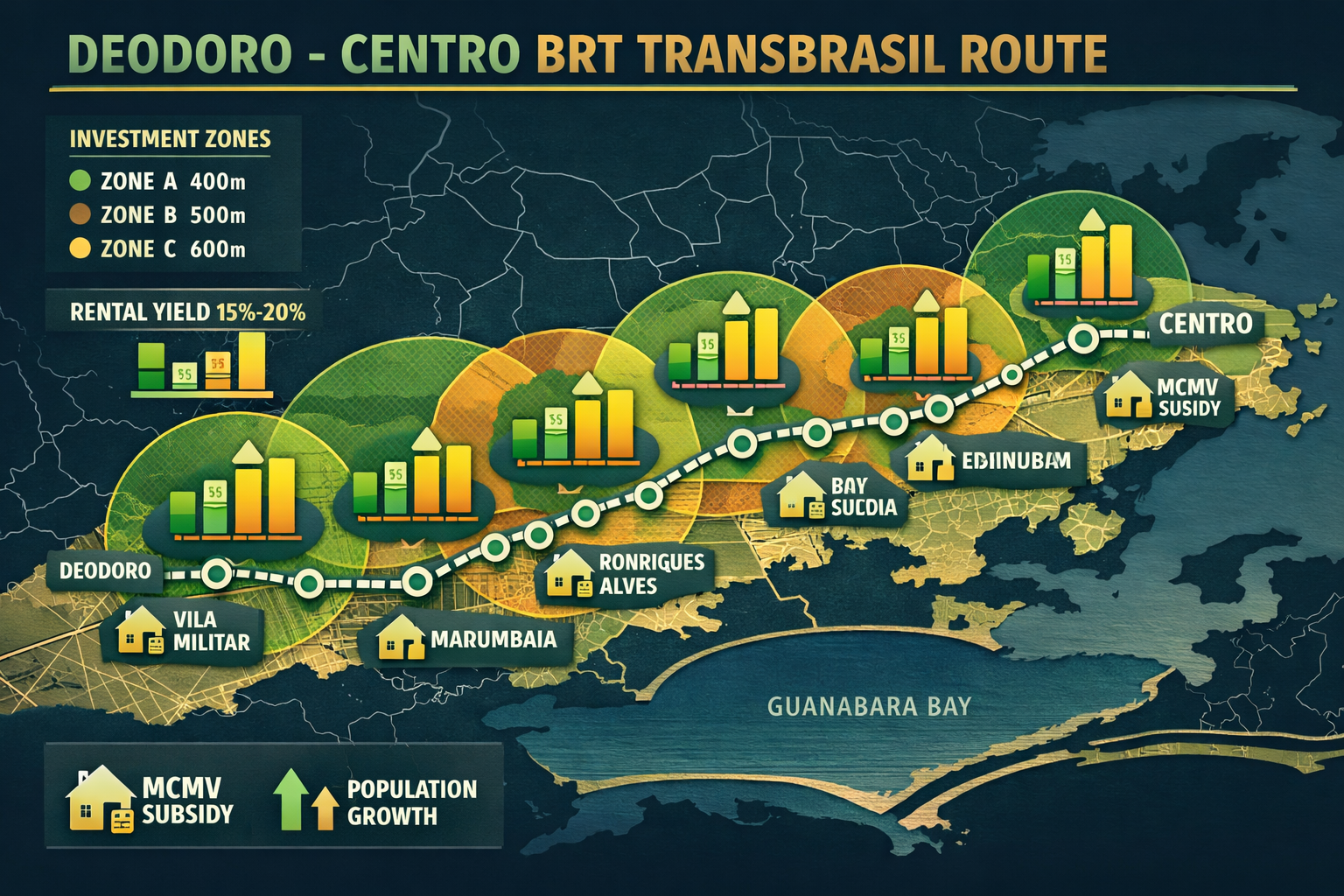
The Rio BRT TransBrasil Corridor 2026: High-Yield Multi-Family Developments Along Deodoro-to-Center Route is not a theoretical investment thesis — it is an active construction story. The improved connectivity has already attracted a measurable surge in transit-oriented residential development, with projects catering specifically to young professionals who prioritize commute efficiency over unit size [4].
The Compact Unit Model
The dominant product type emerging along the corridor is the compact studio or one-bedroom unit — typically 25 to 45 square meters — with a strong amenity package that compensates for smaller floor plates. These units target renters who spend minimal time at home and maximum time commuting, working, or socializing. The model mirrors successful transit-adjacent development patterns seen in Curitiba and São Paulo’s BRT corridors.
Core amenities driving demand in this segment include:
- Co-working spaces within the building
- High-speed internet infrastructure
- Secure bicycle storage and maintenance stations
- Rooftop social areas
- Proximity to convenience retail at the ground floor
Sustainability as a Value Driver
New residential developments along the corridor are incorporating sustainable design elements — solar panels, rainwater harvesting, and energy-efficient facades — that serve two purposes [4]. First, they reduce operating costs, which improves net yield for investors. Second, they align with Rio’s municipal environmental targets, which can accelerate permitting timelines for compliant projects.
Urban Renewal as a Co-Investment Catalyst
The TransBrasil corridor’s completion has triggered broader urban renewal investment from the city government, including public space revitalization, street lighting upgrades, and sidewalk improvements along key station corridors [4]. This public investment functions as a co-catalyst for private development, reducing the infrastructure risk that often deters developers from West Zone projects.
Investors tracking similar urban renewal dynamics in other Brazilian markets can find useful context in analyses of how the real estate market in Greater Florianopolis is performing, where infrastructure-led appreciation has followed a comparable pattern.
Phase 2 Expansion: The Santa Cruz Extension and Early-Mover Advantage
The current 25-kilometer operational corridor is not the final form of the TransBrasil system. Planned Phase 2 expansion extends the corridor westward from Deodoro toward Santa Cruz, a move that would open an entirely new band of underpriced residential land to the transit premium effect [4].
For investors, the Phase 2 announcement creates a classic early-mover opportunity. Land prices along the Santa Cruz extension route are currently priced without any transit premium baked in. Developers who secure sites along the planned extension before construction begins — or even before final alignment is confirmed — stand to capture the largest appreciation gains.
The Phase 2 opportunity profile:
- Current land pricing: Pre-transit, reflecting existing bus-dependent connectivity
- Projected timeline: Extension planning underway as of 2026
- Upside scenario: 30 to 50% land value appreciation upon route confirmation
- Risk factor: Timeline uncertainty typical of municipal infrastructure projects
The strategic parallel here is clear: investors who entered the Deodoro-to-Center corridor before the May 2024 operational launch captured the largest gains. Phase 2 offers a comparable entry point for those who missed the first wave.
Financial Modeling: What the Numbers Look Like in 2026
Understanding the yield mechanics requires a clear-eyed look at the numbers. The following model reflects a typical compact unit development in a Tier 2 mid-corridor location as of 2026.
Sample Investment Scenario
| Metric | Estimated Value |
|---|---|
| Land acquisition cost (per unit) | R$35,000 to R$55,000 |
| Construction cost (per unit, MCMV-eligible) | R$120,000 to R$160,000 |
| Total all-in cost per unit | R$155,000 to R$215,000 |
| Monthly rental income per unit | R$1,800 to R$2,800 |
| Gross annual yield | 13 to 21% |
| Net yield (after vacancy, maintenance, taxes) | 10 to 17% |
These figures are consistent with analyst projections for the corridor [4]. The wide range reflects the variation between Tier 1 interchange nodes (higher cost, higher rent) and Tier 2 mid-corridor sites (lower cost, lower rent but better margin).
Key Risk Factors to Price In
No investment thesis is complete without an honest risk assessment. The primary risks for TransBrasil corridor multi-family investments include:
- Ridership growth lag: If the projected 700,000 daily riders by 2030 materializes slower than expected, rental demand growth may be more gradual [1].
- Construction cost inflation: Brazil’s construction input costs have been volatile. MCMV cost caps can create margin pressure if input prices rise.
- Phase 2 timeline risk: The Santa Cruz extension is planned but not yet under construction. Delays are possible.
- Regulatory changes: MCMV subsidy structures are subject to federal policy adjustments.
Investors who have navigated similar risk profiles in other Brazilian transit-adjacent markets — such as those who tracked studio apartment investment advantages in Florianopolis — will recognize that the risk-reward balance here is favorable for patient capital with a 5 to 10 year horizon.
Who Is Buying and Who Is Renting Along the Corridor
The demand profile for TransBrasil corridor housing is well-defined. On the rental side, the primary tenant profile is the young professional — aged 22 to 35 — who works in the city center or in commercial districts accessible via the BRT system and prioritizes commute time over unit size. This demographic is growing in Rio as the city’s service sector expands and remote-work hybrid models make transit-adjacent living more valuable, not less.
On the buyer side, the corridor is attracting two distinct investor profiles:
- Individual investors purchasing one to three units for rental income, often leveraging MCMV financing structures to reduce equity requirements.
- Institutional and semi-institutional developers acquiring land parcels for 50 to 200 unit multi-family projects, targeting the compact unit model described above.
Both profiles are responding to the same fundamental signal: the BRT system has made the West Zone commutable, and the market has not yet fully repriced that fact.
For those exploring development opportunities across Brazil’s emerging urban corridors, reviewing current real estate development projects in high-growth markets provides useful benchmarks for product design and pricing strategy.
Conclusion: Actionable Steps for Investors in 2026
The operational BRT TransBrasil corridor has permanently altered the accessibility calculus for Rio’s West Zone. The Deodoro Terminal is functioning, Line 61 is running, and 250,000 passengers per day are proving the system’s utility with their feet [1][2][3]. The Rio BRT TransBrasil Corridor 2026: High-Yield Multi-Family Developments Along Deodoro-to-Center Route represents a genuine, data-supported opportunity — but the window for pre-appreciation entry is closing as more capital recognizes the transit premium.
Actionable next steps for investors and developers:
- Conduct site-specific due diligence within the 400 to 600 meter radius of Tier 1 and Tier 2 stations, prioritizing parcels with MCMV eligibility confirmation.
- Model MCMV subsidy scenarios carefully, accounting for current federal program parameters and potential policy adjustments.
- Monitor Phase 2 Santa Cruz extension announcements for early land acquisition opportunities along the planned alignment.
- Engage local developers already active in the corridor to explore joint venture or co-investment structures that reduce individual project risk.
- Set a 5 to 10 year investment horizon that captures both the near-term rental yield and the medium-term appreciation as ridership grows toward the 700,000 daily rider target.
The transit infrastructure is built. The riders are coming. The question is whether investors move before or after the market reprices the West Zone accordingly. For those ready to act, connecting with specialists in Brazil’s high-growth real estate markets — such as the team at Quadragon — is a logical first step toward identifying the right entry point along this corridor.
References
[1] Brt Transbrasil Esta Em Pleno Funcionamento Na Cidade – https://prefeitura.rio/transportes/brt-transbrasil-esta-em-pleno-funcionamento-na-cidade/?utm_source=openai
[2] Prefeitura Inaugura O Terminal Deodoro – https://prefeitura.rio/cidade/prefeitura-inaugura-o-terminal-deodoro/?utm_source=openai
[3] Brt Transbrasil Novo Servico Expresso Deodoro X Gentileza Oferece Viagem Mais Rapida Em Horarios De Pico – https://prefeitura.rio/transportes/brt-transbrasil-novo-servico-expresso-deodoro-x-gentileza-oferece-viagem-mais-rapida-em-horarios-de-pico/?utm_source=openai
[4] Brt Transbrasil Corridor Boom 2026 Transit Oriented Residential Developments In Rios Deodoro To Downtown Zones – https://quadragon.com.br/brt-transbrasil-corridor-boom-2026-transit-oriented-residential-developments-in-rios-deodoro-to-downtown-zones/?utm_source=openai
[5] Prefeitura Inaugura O Terminal Deodoro – https://en.prefeitura.rio/cidade/prefeitura-inaugura-o-terminal-deodoro/?utm_source=openai