
The heart of Rio de Janeiro once pulsed with business activity during working hours, only to fall silent after dark. Empty office towers cast shadows over historic streets, while the city struggled with housing shortages in other districts. But a bold legislative initiative is rewriting this story. Rio’s Reviver Centro Program: Converting Commercial Buildings to Residential with Tax Incentives in 2026 represents one of Brazil’s most ambitious urban transformation projects, offering developers substantial tax breaks to convert underutilized commercial spaces into much-needed housing units.
This adaptive reuse strategy addresses two critical challenges simultaneously: breathing new life into Rio’s historic downtown while tackling the city’s persistent housing crisis. For developers, investors, and urban planners, the program presents a unique opportunity to participate in reshaping one of South America’s most iconic cities.
Key Takeaways
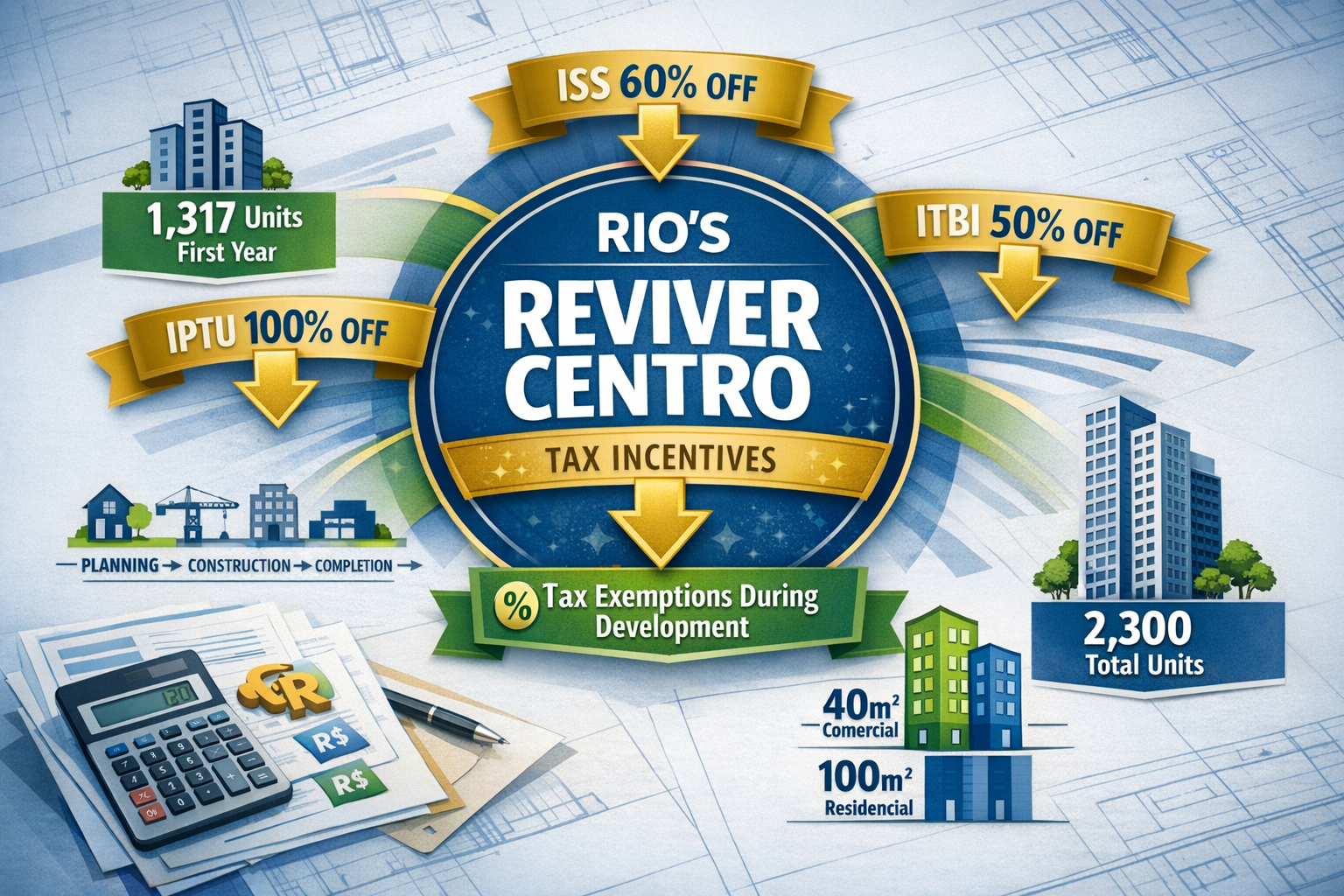
- Proven Track Record: The program licensed 1,317 housing units in its first year and has facilitated 2,300 residential units total through tax incentives and strategic support[1][2]
- Attractive Tax Benefits: Developers receive tax exemptions during the development phase, plus priority access to commercial space ratios (40sqm commercial per 100sqm residential)[1]
- Strategic Coverage: The initiative encompasses five key neighborhoods—Santo Cristo, Gamboa, Saúde, Centro, and Lapa—targeting areas most affected by commercial abandonment[1]
- International Recognition: Rio received a 2024 Special Mention in the Lee Kuan Yew World City Prize for innovative urban solutions, highlighting Reviver Centro’s global significance[2]
- Sustainable Revenue Model: Program revenues fund bike trails, pocket parks, and subsidized housing, creating a self-sustaining urban regeneration cycle[1]
Understanding Rio’s Reviver Centro Program: Converting Commercial Buildings to Residential with Tax Incentives in 2026
The Problem: A Hollow Downtown Core
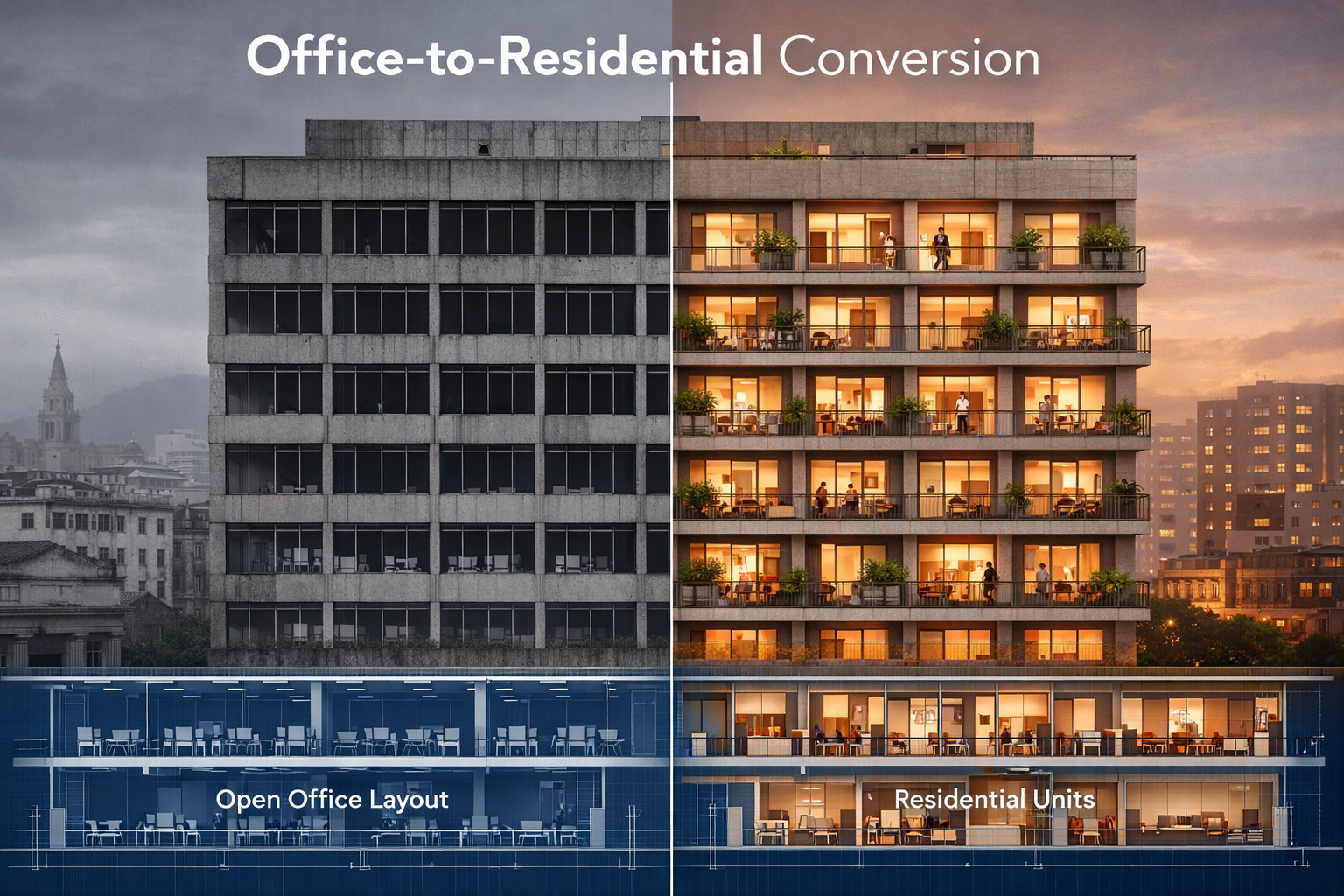
Rio de Janeiro’s downtown district exemplifies a common urban planning challenge that accelerated during the COVID-19 pandemic. The city pursued a Central Business District (CBD) model for decades, concentrating commercial activity while neglecting residential development. This mono-functional approach created the lowest housing density in Rio’s urban core[3].
When the pandemic forced businesses to adopt remote work policies, the fragility of this model became painfully apparent. Office vacancy rates soared, foot traffic disappeared, and the historic center—home to architectural treasures and cultural landmarks—faced unprecedented abandonment.
The statistics painted a concerning picture:
- Minimal residential population in the downtown core
- High commercial vacancy rates post-pandemic
- Underutilized infrastructure and public services
- Safety concerns due to reduced street activity
- Economic decline affecting local businesses
The Solution: Adaptive Reuse Through Tax Incentives
The Reviver Centro program launched as Rio’s legislative response to this urban crisis. Rather than allowing valuable real estate to deteriorate, city officials created a comprehensive framework to incentivize office-to-residential conversions through strategic tax breaks and regulatory support.
The program’s genius lies in its simplicity: make residential conversion financially attractive enough to overcome the traditional barriers that discourage adaptive reuse projects. By removing tax burdens during the development phase and offering additional commercial development rights, Rio created a win-win scenario for both developers and the city.
How the Tax Incentive Structure Works
Core Tax Benefits for Developers
The Reviver Centro tax incentive package includes several components designed to reduce development costs and improve project economics:
1. Development Phase Tax Exemptions
Participating developers receive comprehensive tax exemptions during the construction and conversion period[1]. This eliminates significant carrying costs that typically burden adaptive reuse projects, which often take longer than new construction due to structural complexities.
2. Commercial Space Priority Access
For every 100 square meters of residential space created, developers gain priority rights to develop 40 square meters of commercial space[1]. This ratio allows mixed-use projects that can generate ongoing revenue streams while maintaining the program’s residential focus.
3. Streamlined Licensing Process
Beyond direct tax benefits, the program offers expedited permitting and licensing procedures. The city licensed 1,317 housing units in the program’s first year alone[1], demonstrating the efficiency of these streamlined processes.
Financial Advantages for Investors
The tax incentive structure creates compelling investment opportunities:
| Benefit Category | Traditional Development | Reviver Centro Program |
|---|---|---|
| Property Taxes During Development | Full rate | Exempt |
| Licensing Timeline | Standard process | Priority/expedited |
| Commercial Development Rights | Standard allocation | Enhanced (40:100 ratio) |
| Infrastructure Support | Self-funded | City-supported improvements |
| Market Positioning | Competitive | Preferred status |
These advantages significantly improve project internal rate of return (IRR) calculations, making previously marginal projects financially viable. For developers experienced in adaptive reuse and urban regeneration, the program offers exceptional opportunities.
Revenue Allocation and Sustainability
The program demonstrates fiscal innovation by channeling generated revenues back into neighborhood improvements. Funds support:
- 🚴 Bike trails and cycling infrastructure
- 🌳 Pocket parks and green spaces
- 🏘️ Subsidized housing programs
- 🚶 Pedestrian improvements
This reinvestment strategy creates a positive feedback loop: as the neighborhood improves, property values increase, attracting more development, which generates additional revenue for further improvements[1].
Geographic Scope: Five Neighborhoods Transforming Rio’s Reviver Centro Program
Target Areas for Conversion
The program strategically focuses on five interconnected neighborhoods in Rio’s historic center[1]:
Santo Cristo 🏭
- Former industrial and port district
- Significant warehouse and commercial building stock
- Strong potential for loft-style conversions
- Proximity to cultural attractions
Gamboa 🎵
- Rich cultural heritage and samba history
- Mix of commercial and underutilized structures
- Community-oriented development potential
- Historic preservation opportunities
Saúde ⚓
- Port-adjacent location
- Large-scale commercial buildings suitable for conversion
- Transportation connectivity advantages
- Emerging creative district characteristics
Centro 🏛️
- Traditional CBD core
- Highest concentration of office towers
- Historic architectural significance
- Maximum conversion potential
Lapa 🎭
- Famous for nightlife and cultural venues
- Mix of commercial and entertainment spaces
- Strong existing foot traffic
- Opportunity for live-work-play integration
The 15-Minute Neighborhood Vision
Municipal officials position Reviver Centro within a broader “15-minute neighborhood” framework[2]. This urban planning concept, gaining global traction, envisions communities where residents can access essential services, employment, recreation, and culture within a 15-minute walk or bike ride.
For Rio’s centro district, this means transforming from a 9-to-5 business zone into a vibrant, mixed-use community where people live, work, shop, and socialize throughout the day and evening. The conversion of commercial buildings to residential use provides the critical missing ingredient: a resident population to support this vision.
Investors interested in emerging Brazilian property markets should recognize that the 15-minute neighborhood model significantly enhances long-term property values by creating more livable, sustainable communities.
Performance Metrics: Measuring Success
First-Year Results Exceed Expectations
The program’s initial performance demonstrated strong market appetite for incentivized residential conversions:
- 1,317 housing units licensed in year one[1]
- Multiple developer participation across various project scales
- Diverse architectural approaches from full conversions to mixed-use renovations
- Rapid permitting turnaround validating streamlined processes
Cumulative Impact Through 2024
By 2024, the program’s cumulative achievements included:
- 2,300 new residential units facilitated through subsidies and land transfers[2]
- Significant private investment attracted to previously declining areas
- Infrastructure improvements funded by program revenues
- Growing residential population in target neighborhoods
These numbers represent substantial progress toward reversing decades of residential decline in Rio’s downtown core. For context, adding over 2,000 residential units creates a population base capable of supporting retail, services, and cultural amenities that make neighborhoods truly livable.
International Recognition
Rio’s innovative approach earned 2024 Special Mention in the prestigious Lee Kuan Yew World City Prize under the Innovative Climate Solutions category[2]. This international recognition validates the program’s design and positions Rio as a model for other cities facing similar challenges.
The award committee specifically noted Reviver Centro’s role in “redefining urban development paradigms”—praise that reflects the program’s potential to influence urban policy globally.
Complementary Initiatives Enhancing Program Success
Low Emission District Pilot
Running parallel to Reviver Centro, the Low Emission District initiative promotes active mobility and reduces vehicular dependence[2]. This complementary program:
- Creates safer pedestrian environments
- Reduces air pollution in residential areas
- Supports the 15-minute neighborhood concept
- Enhances quality of life for new residents
For residential conversion projects, the Low Emission District designation increases property appeal by prioritizing walkability and environmental quality.
Porto Maravalley Technology Hub
The Porto Maravalley project leverages a former warehouse district to attract technology companies, startups, and innovation talent[2]. This economic development initiative complements residential conversions by:
- Creating employment opportunities near new housing
- Attracting young professionals seeking urban living
- Generating demand for housing in converted buildings
- Establishing Rio’s centro as a technology and innovation hub
The synergy between residential conversion and technology sector growth creates a powerful revitalization dynamic. Similar patterns have driven urban renewal in cities worldwide, from Brooklyn’s DUMBO district to Barcelona’s 22@ innovation district.
Cultural Regeneration and Heritage Preservation
The program strategically positions Rio’s existing cultural assets as transformation catalysts[2]. Notable initiatives include:
Valongo Wharf Restoration 🏛️
- UNESCO World Heritage Site
- Emphasizes African heritage and inclusivity
- Creates cultural tourism anchor
- Enhances neighborhood identity and pride
By integrating cultural preservation with residential development, the program ensures that revitalization respects and celebrates the centro’s historic character rather than erasing it.
Financing Mechanisms and Development Rights
Innovative Public-Private Partnership Model
Rio developed sophisticated financing mechanisms through the public company CCPAR (Companhia de Desenvolvimento Urbano da Região do Porto do Rio de Janeiro)[2]. This model enables:
Bonus Floor Area Acquisition
- Developers can purchase additional development rights
- City sells these rights to generate infrastructure funding
- Revenue directly supports neighborhood improvements
- Creates market-based funding for public goods
Strategic Land Transfers
- City facilitates land assembly for larger projects
- Reduces fragmented ownership barriers
- Enables comprehensive redevelopment
- Accelerates project timelines
This approach represents a significant evolution from traditional urban renewal models that relied primarily on public funding or purely private development. By creating a self-funding mechanism, Rio ensures the program’s sustainability beyond initial political support.
For developers familiar with innovative real estate financing approaches, the CCPAR model offers valuable lessons in structuring public-private partnerships.
Practical Considerations for Developers and Investors
Project Feasibility Assessment
Developers considering participation in Rio’s Reviver Centro Program should evaluate several key factors:
Building Suitability 🏢
- Structural integrity for residential conversion
- Floor plate dimensions (residential units typically require different layouts than offices)
- Window placement and natural light access
- Mechanical systems adaptability
- Historic preservation requirements
Market Demand Analysis 📊
- Target demographic identification
- Pricing strategy relative to other Rio neighborhoods
- Amenity expectations
- Competition from new construction
Financial Modeling 💰
- Tax incentive value quantification
- Conversion costs versus new construction
- Timeline projections
- Exit strategy options
Regulatory Navigation 📋
- Licensing requirements specific to conversions
- Building code compliance for residential use
- Historic preservation approvals if applicable
- Ongoing tax obligations post-completion
Risk Factors to Consider
While the program offers substantial incentives, developers should carefully evaluate potential risks:
- Construction complexity: Adaptive reuse often encounters unexpected structural issues
- Market absorption: New residential supply must find buyers/renters in evolving neighborhoods
- Regulatory changes: Future administrations might modify incentive structures
- Infrastructure timing: Neighborhood improvements may lag behind individual projects
Experienced developers who understand market dynamics and valuation trends will be best positioned to navigate these considerations.
Comparison with Other Brazilian Markets
Investors should consider how Rio’s Reviver Centro Program compares with opportunities in other Brazilian cities:
Rio Centro vs. São Paulo Downtown
- Rio offers more generous tax incentives
- São Paulo has larger existing residential market
- Rio provides stronger cultural/tourism appeal
- Both face similar post-pandemic office vacancy challenges
Rio Centro vs. Florianópolis Growth Areas
- Florianópolis offers new construction opportunities with different risk profiles
- Rio provides established infrastructure and urban amenities
- Florianópolis attracts different demographic (lifestyle/beach focus)
- Rio’s program specifically targets adaptive reuse specialists
Understanding these market distinctions helps investors allocate capital according to their expertise and risk tolerance.
Future Outlook: Rio’s Reviver Centro Program Beyond 2026
Scaling and Expansion Potential
As the program matures, several expansion scenarios appear likely:
Geographic Extension 🗺️ The success in the initial five neighborhoods may prompt expansion to adjacent areas facing similar challenges. Candidates include additional port-district neighborhoods and secondary commercial corridors.
Incentive Evolution 📈 Tax incentive structures may evolve based on performance data. The city might introduce tiered benefits to encourage specific outcomes like affordable housing inclusion or sustainable building practices.
Replication in Other Brazilian Cities 🇧🇷 Other Brazilian municipalities facing downtown decline and housing shortages are closely watching Rio’s results. Successful models often spread rapidly across Brazil’s urban policy landscape.
Long-Term Urban Impact
The program’s ultimate success will be measured not just in units converted, but in comprehensive neighborhood transformation:
- Population growth creating 24-hour activity patterns
- Retail and service sector development supporting residents
- Property value appreciation benefiting existing owners
- Cultural vitality with residential community supporting arts and entertainment
- Reduced crime through increased street presence
- Environmental benefits from reduced commuting and improved density
These outcomes align with global urban sustainability goals and position Rio as a leader in climate-responsive urban development.
Lessons for Global Urban Planning
Rio’s Reviver Centro Program offers valuable insights for cities worldwide:
✅ Tax incentives can effectively drive private investment in public policy priorities ✅ Adaptive reuse addresses multiple challenges simultaneously (housing, sustainability, heritage preservation) ✅ Revenue recycling creates sustainable funding for ongoing improvements ✅ Mixed-use conversion proves more resilient than mono-functional districts ✅ Cultural assets enhance rather than hinder urban transformation
These principles transcend Rio’s specific context and apply broadly to post-pandemic urban recovery strategies.
Actionable Steps for Stakeholders
For Developers and Investors
- Conduct market research on the five target neighborhoods to identify optimal locations
- Engage local architects experienced in adaptive reuse and Brazilian building codes
- Consult with CCPAR regarding available properties and development rights
- Model financial scenarios incorporating tax incentives and commercial space ratios
- Visit completed conversions to understand market reception and design approaches
- Connect with established development companies familiar with Brazilian regulatory environments
For Property Owners
- Assess building suitability for residential conversion
- Understand tax benefit eligibility for your specific property
- Consider partnership opportunities with experienced developers
- Evaluate timing relative to market conditions and incentive availability
- Explore financing options through CCPAR and traditional lenders
For Prospective Residents
- Monitor new conversion projects coming to market
- Visit neighborhoods at different times to assess livability
- Understand amenity development timelines in your target area
- Compare pricing with established residential neighborhoods
- Consider early adoption advantages as neighborhoods transform
For Urban Planning Professionals
- Study program documentation and performance metrics
- Analyze applicability to your city’s specific challenges
- Engage Rio officials to understand implementation lessons
- Adapt incentive structures to local regulatory and market conditions
- Build stakeholder coalitions to support similar initiatives
Conclusion
Rio’s Reviver Centro Program: Converting Commercial Buildings to Residential with Tax Incentives in 2026 represents a bold reimagining of urban development in one of the world’s most iconic cities. By strategically deploying tax incentives to drive office-to-residential conversions, Rio addresses housing shortages while revitalizing its historic downtown core—a dual benefit that creates compelling opportunities for adaptive reuse specialists.
The program’s impressive track record—1,317 units in year one, 2,300 units cumulatively—demonstrates strong market response to well-designed incentives[1][2]. International recognition through the Lee Kuan Yew World City Prize validates the approach and positions Rio as a model for cities worldwide facing similar post-pandemic challenges[2].
For developers and investors, the combination of tax exemptions, enhanced development rights, and strategic city support creates favorable project economics in neighborhoods rich with architectural heritage and cultural significance. The complementary initiatives—Low Emission Districts, Porto Maravalley technology hub, cultural preservation efforts—amplify the program’s impact and enhance long-term investment prospects.
As Rio’s centro transforms from a hollow business district into a vibrant 15-minute neighborhood, early participants in the Reviver Centro Program position themselves at the forefront of Brazilian urban renewal. The opportunity to shape one of South America’s most important cities while generating attractive returns makes this program worthy of serious consideration for any developer or investor focused on adaptive reuse and urban regeneration.
The question for 2026 and beyond isn’t whether Rio’s downtown will transform—the data confirms transformation is already underway. The question is who will participate in writing this next chapter of Rio’s urban story.
For more information about investment opportunities in Brazil’s evolving real estate market, explore our latest market insights or contact our team to discuss specific project opportunities.
References
[1] Rio De Janeiro Rj Incentivizes Residential Development In Business District With Reviver Centro – https://govlaunch.com/it/projects/rio-de-janeiro-rj-incentivizes-residential-development-in-business-district-with-reviver-centro
[2] Rio De Janeiro – https://leekuanyewworldcityprize.gov.sg/rio-de-janeiro/
[3] Aia International Brazil Rios Reviver Centro Plan – https://www.aiainternational.org/online-lectures-calendar/2023/3/11/aia-international-brazil-rios-reviver-centro-plan