
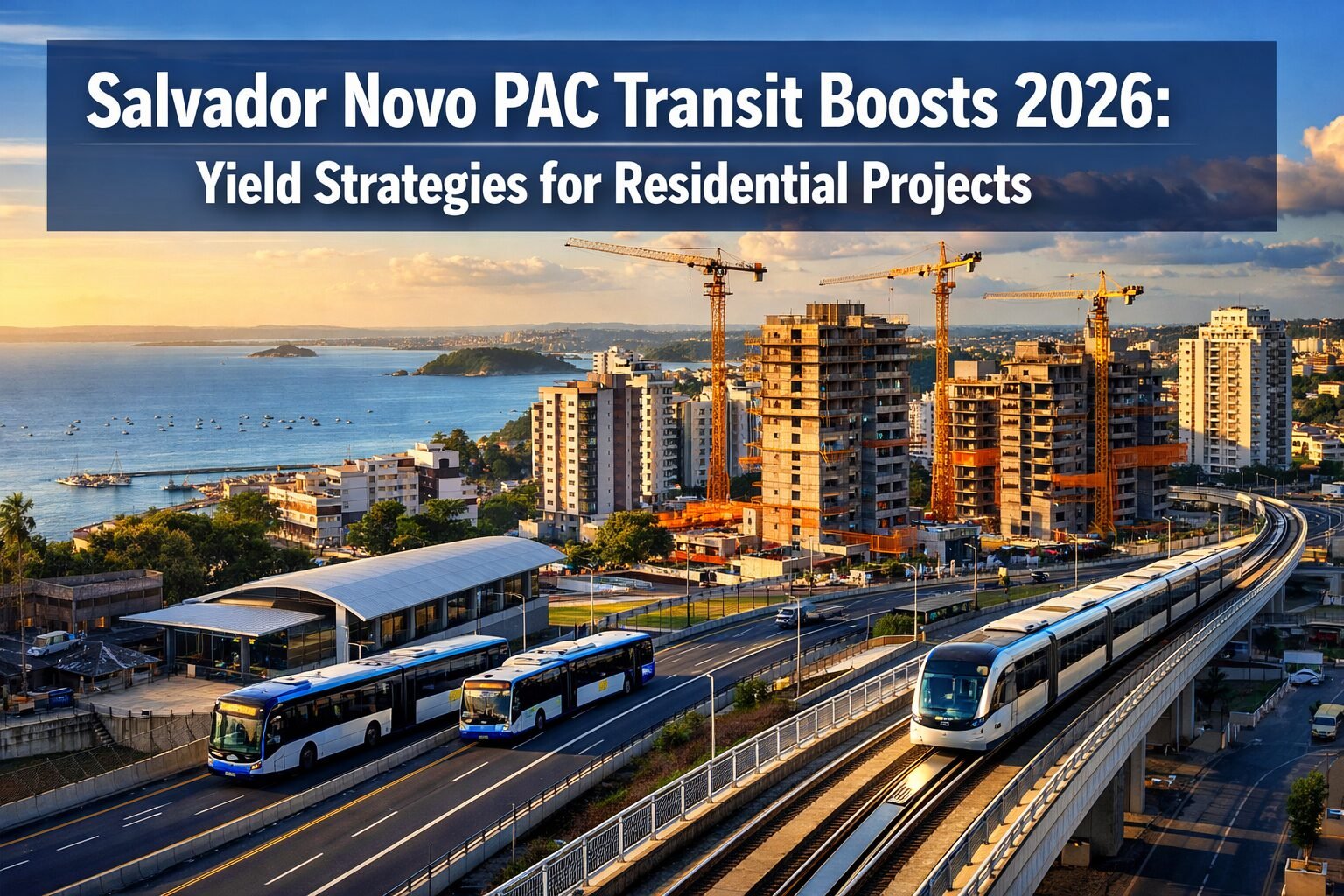
Brazil’s ambitious infrastructure renewal is transforming Salvador into a transit-connected powerhouse, and savvy developers are positioning themselves to capture unprecedented returns. The Salvador Novo PAC Transit Boosts 2026: Yield Strategies for Residential Projects Along New Urban Mobility Lines represent a once-in-a-generation opportunity to align residential development with billions in federal mobility investments, creating value premiums that can reach 25% near strategic transit nodes.
With the federal Novo PAC (New Growth Acceleration Program) channeling substantial resources into Salvador’s urban transport infrastructure—including BRT expansion, VLT light rail testing, metro extensions, and a fleet of 100 electric buses—the city’s residential landscape is experiencing a fundamental recalibration. Properties within 500 meters of new transit stations are commanding premium prices, while rental yields are outperforming traditional developments by significant margins. 🚇
For developers and investors targeting mid-tier housing segments, this convergence of infrastructure modernization and urbanization demand creates an ideal environment for optimized yields without the saturation risks of luxury markets. Understanding how to strategically position residential projects along these new mobility corridors will determine which developers capture outsized returns in 2026 and beyond.
Key Takeaways
- Transit proximity drives 10-25% price premiums: Properties within 500 meters of new BRT, VLT, and metro stations in Salvador command significant valuation advantages over comparable units farther from transit nodes.
- Mid-tier housing optimizes yield potential: Targeting middle-income segments near transit hubs captures urbanization demand without luxury market saturation, offering superior rental yields and absorption rates.
- Infrastructure timeline creates strategic windows: With BRT Line B6 launching March 2026, VLT passenger testing beginning mid-2026, and metro extensions progressing, developers must align project timelines with transit completions to maximize premiums.
- 100 electric buses expand coverage: World Bank-supported electromobility investments will nearly triple Salvador’s BRT fleet by 2030, extending high-value transit corridors into previously underserved neighborhoods.
- Accessibility features unlock broader demand: Low-floor, zero-emission vehicles and 100 kilometers of cycling infrastructure significantly expand the addressable market, particularly benefiting elderly and mobility-impaired residents in low-income areas.
Understanding Salvador’s Novo PAC Transit Infrastructure Transformation
Salvador’s transportation landscape is undergoing its most significant transformation in decades, driven by coordinated federal, state, and municipal investments under the Novo PAC framework. This comprehensive modernization program prioritizes resilient, zero-emission urban transport solutions that fundamentally reshape residential development opportunities across the metropolitan area.[3]
Major Transit Projects Reshaping Salvador in 2026
The infrastructure pipeline delivered or advancing in 2026 represents a multi-billion real investment that creates distinct development zones with varying yield potentials:
Completed Infrastructure (Q1 2026)
The state government inaugurated the new Águas Claras integrated bus terminal in January 2026, establishing a critical multimodal hub connecting metro, metropolitan buses, urban buses, and the future VLT light rail system.[1] This terminal immediately elevated surrounding neighborhoods into prime transit-oriented development (TOD) zones.
Simultaneously, the Antônio Linhares Viaduct in the Iguatemi region (also known as Guatemi) was delivered on January 26, 2026, dramatically improving vehicle flow between Avenida ACM and the North Access route.[1] This infrastructure reduces commute times and enhances accessibility for residential developments in the corridor.
Imminent Launches (Q1-Q2 2026)
The BRT Line B6 corridor—connecting Lapa to Salvador International Airport through Boca do Rio, São Cristóvão, and Tapuã neighborhoods—was scheduled to begin operations by the end of March 2026 according to the Secretariat of Mobility.[1] This 13-kilometer expansion extends high-frequency, high-capacity transit to neighborhoods previously dependent on conventional bus service, creating immediate development opportunities.
Advanced Testing Phase (Mid-2026)
The Salvador VLT (Light Rail) system advanced to passenger testing during 2026, with state government expectations for public testing between July and August 2026, following initial December 2025 technical tests on the Calçada-Lobato route.[1] The VLT represents the highest-capacity surface transit investment, with stations becoming premium development anchors.
The Electromobility Revolution: 100 E-Buses and Beyond
Perhaps most significant for long-term residential value is Salvador’s commitment to electric bus fleet expansion. The World Bank-supported Brazil Electromobility Project Phase 2 finances approximately 100 electric buses to expand Salvador’s BRT and BRS (Bus Rapid Service) corridors, replacing aging diesel buses with modern, low-floor, zero-emission vehicles.[2]
This investment transforms the transit experience fundamentally:
| Metric | 2025 Baseline | 2030 Projection | Impact |
|---|---|---|---|
| BRT Fleet Size | 70 buses | 180 buses | +157% capacity |
| Daily Ridership | 89,000 passengers | 150,000+ (projected) | +68% demand |
| System Length | 13 kilometers | 25+ kilometers | Expanded coverage |
| Charging Stations | Limited | Comprehensive network | Infrastructure resilience |
The current 13-kilometer BRT system comprises 14 stations and serves approximately 89,000 daily passengers, with early surveys indicating roughly 10% of riders switched from private vehicles—a significant modal shift that reduces congestion and enhances neighborhood livability.[2]
Accessibility as a Value Driver 🚌
The emphasis on low-floor, zero-emission vehicles significantly improves accessibility for elderly passengers and persons with disabilities, particularly benefiting low-income areas.[2] For residential developers, this accessibility premium translates to broader demographic appeal and reduced vacancy risk, especially in mid-tier projects targeting families and older adults.
Cycling Infrastructure: The First-Mile/Last-Mile Solution
Complementing the major transit investments, approximately 100 kilometers of cycling infrastructure will be implemented to strengthen first- and last-mile connectivity, requalifying and constructing new bike lanes linking major BRT and BRS stations.[2]
This cycling network creates a multiplier effect for residential projects: properties within comfortable cycling distance (2-3 kilometers) of transit stations gain functional connectivity advantages, expanding the effective “transit-adjacent” zone beyond traditional walking radius definitions.
For developers, this means residential projects positioned along planned cycling corridors—even if not immediately adjacent to stations—can capture transit-oriented premiums through integrated mobility planning and bike-friendly amenities.
Those interested in understanding property value appreciation in emerging markets will recognize these infrastructure investments as classic value creation catalysts that reward early positioning.
Salvador Novo PAC Transit Boosts 2026: Yield Optimization Strategies for Developers
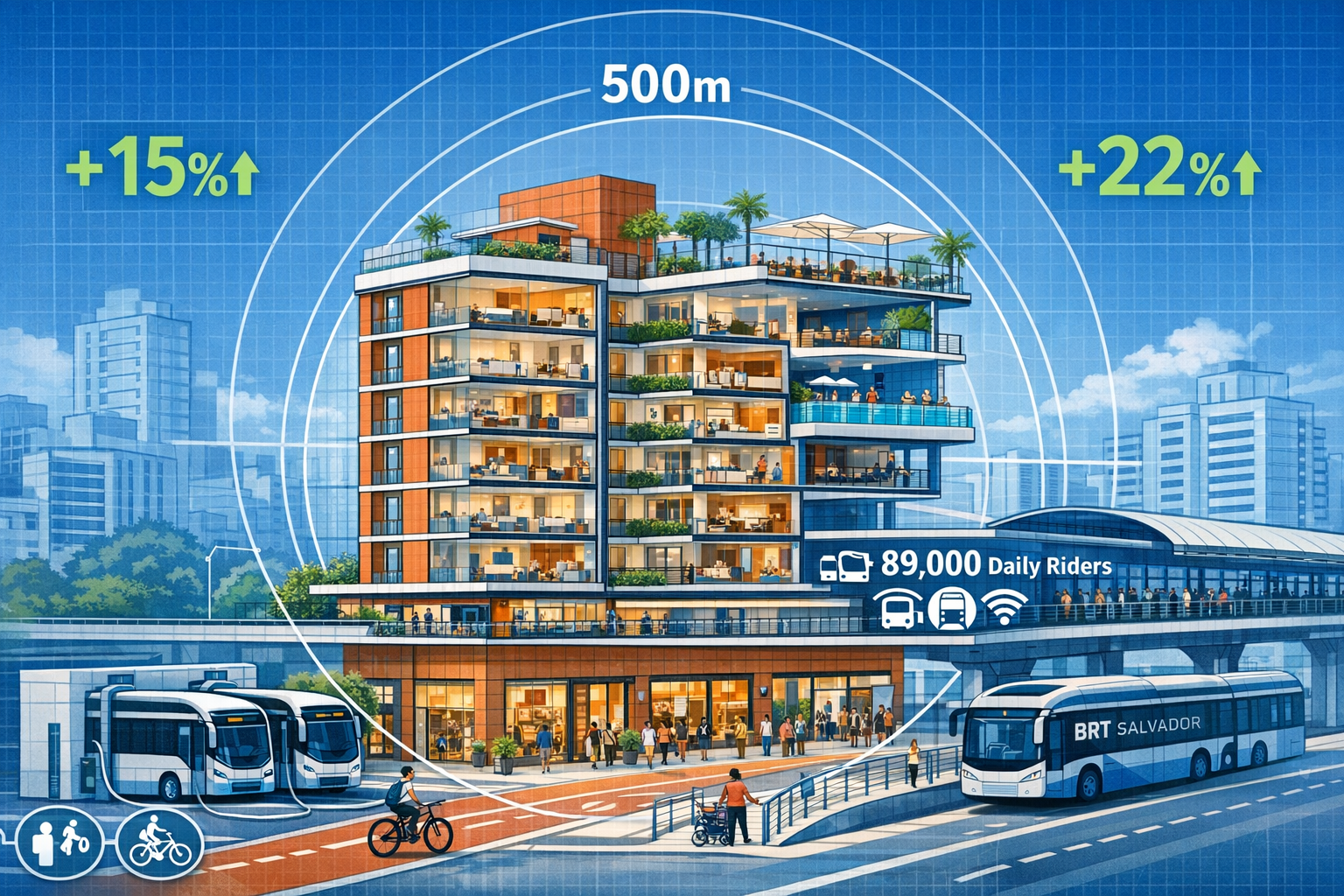
Understanding infrastructure timelines is essential, but translating that knowledge into concrete yield optimization strategies requires a disciplined approach to site selection, unit mix, pricing strategy, and timeline alignment. The Salvador Novo PAC Transit Boosts 2026: Yield Strategies for Residential Projects Along New Urban Mobility Lines framework centers on maximizing returns through strategic positioning relative to completed and advancing transit infrastructure.
The Transit Proximity Premium: Quantifying Value Uplift
Research across global transit-oriented development markets consistently demonstrates that proximity to high-quality transit stations generates measurable price premiums. In Salvador’s context, early market indicators suggest:
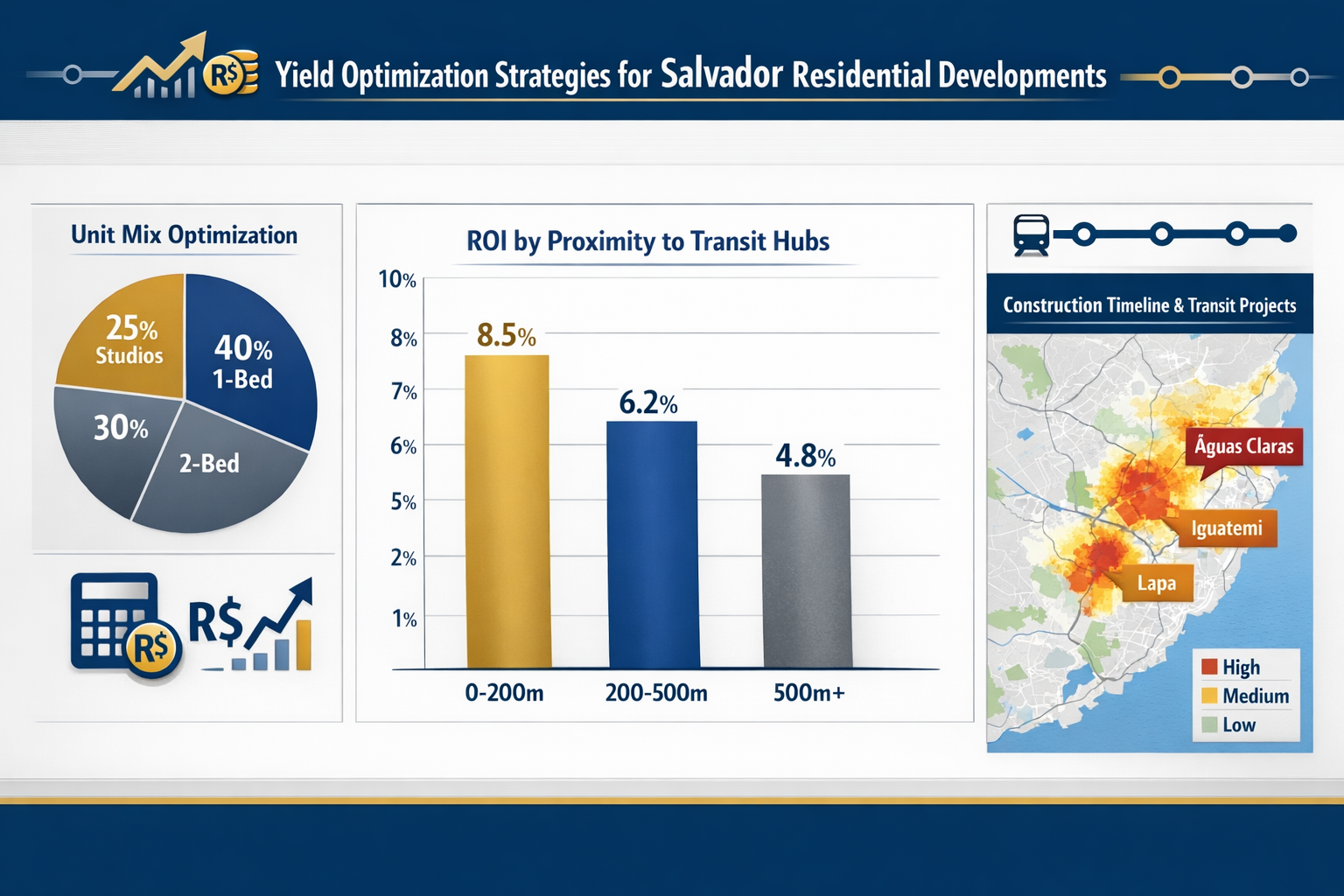
- 0-200 meters from stations: 20-25% premium over comparable units beyond 500 meters
- 200-500 meters from stations: 10-15% premium with strong walkability
- 500-800 meters from stations: 5-8% premium, dependent on pedestrian infrastructure quality
- Beyond 800 meters: Minimal direct transit premium unless cycling infrastructure provides connectivity
These premiums reflect both convenience value (reduced commute times, transportation cost savings) and lifestyle value (car-optional living, reduced parking needs, urban amenity access).
Mid-Tier Housing: The Sweet Spot for Transit-Oriented Yields
While luxury developments near transit stations capture headlines, mid-tier housing (targeting middle-income families and young professionals) offers superior yield optimization for several reasons:
1. Broader Addressable Market
Mid-tier units priced between R$250,000-R$450,000 align with financing capacity for Salvador’s expanding middle class, particularly dual-income households seeking car-optional lifestyles. This demographic segment values transit access highly and demonstrates strong absorption rates.
2. Transit Value Capture
Middle-income buyers realize the greatest proportional benefit from transit access, as transportation costs represent a larger share of household budgets. The monthly savings from reduced car dependency (R$800-R$1,200 for vehicle ownership, fuel, parking) directly translates to increased housing affordability, allowing developers to capture this value through optimized pricing.
3. Rental Yield Advantages
Mid-tier units near transit stations generate rental yields of 6.5-8.5% annually in Salvador’s current market, compared to 4.5-5.5% for luxury units and 5.0-6.0% for mid-tier units without transit access. This yield premium reflects consistent demand from young professionals, students, and transit-dependent households.
4. Reduced Luxury Market Saturation Risk
Salvador’s luxury segment faces periodic oversupply challenges, while mid-tier inventory near quality transit remains undersupplied relative to demand. This supply-demand imbalance creates favorable pricing power for well-positioned projects.
For investors exploring high-return property locations across Brazil, Salvador’s transit-oriented mid-tier segment offers compelling risk-adjusted returns.
Optimal Unit Mix for Transit-Adjacent Developments
Strategic unit mix optimization balances absorption velocity, yield potential, and market demand specific to transit-oriented locations:
Recommended Unit Mix for BRT/VLT-Adjacent Projects:
- Studios (25%): Target students, young professionals, and transit-dependent singles; highest yield per square meter
- 1-Bedroom (40%): Core demand from young couples, remote workers, and downsizing empty-nesters
- 2-Bedroom (30%): Families with one child, roommate shares, small household flexibility
- 3-Bedroom (5%): Limited inclusion for family diversity; lower yield but improves project financing
This mix contrasts sharply with suburban developments, which typically emphasize larger units. Transit-adjacent projects benefit from smaller average unit sizes that align with car-optional lifestyles and maximize units per floor, improving overall project economics.
Timeline Alignment: Synchronizing Delivery with Transit Completion
Critical success factor: Project delivery must align with transit infrastructure completion to capture maximum premiums. Three strategic timing approaches exist:
Approach 1: Pre-Transit Launch (12-18 months before transit opening)
Launch sales during transit construction, positioning the project as “future transit-adjacent” with completion timed for transit inauguration. This approach captures early-adopter buyers at moderate premiums (8-12%) while benefiting from full transit premiums (20-25%) at delivery, creating significant appreciation during construction.
Approach 2: Transit Completion Synchronization
Time project completion within 3-6 months of transit inauguration, capturing maximum market attention and full transit premiums immediately. Requires precise construction timeline management but offers optimal pricing power.
Approach 3: Post-Transit Stabilization (6-12 months after transit opening)
Launch after transit operations stabilize and ridership patterns emerge, reducing market uncertainty but facing competition from earlier movers. Suitable for risk-averse developers prioritizing proven demand.
For Salvador’s 2026 context, Approach 1 targeting the BRT Line B6 (March 2026 opening) and Approach 2 targeting VLT stations (mid-2026 testing, late-2026 operations) offer optimal positioning windows.
Site Selection Criteria: Beyond Simple Distance Metrics
Effective site selection for Salvador Novo PAC Transit Boosts 2026: Yield Strategies requires evaluating multiple factors beyond raw distance to stations:
✅ Walkability Quality: Pedestrian infrastructure, street lighting, sidewalk continuity, safety perception
✅ Station Type: Integrated terminals (like Águas Claras) command higher premiums than simple stops
✅ Transit Frequency: High-frequency corridors (sub-10-minute headways) generate stronger premiums
✅ Multimodal Connectivity: Stations with metro, BRT, and bus integration maximize value
✅ Neighborhood Trajectory: Areas experiencing complementary commercial and amenity development
✅ Cycling Infrastructure: Proximity to planned bike lanes extends effective transit catchment
✅ Parking Requirements: Lower municipal parking minimums near transit reduce construction costs
Sites scoring highly across these dimensions justify premium land acquisition costs through superior project yields and faster absorption.
Developers interested in market dynamics and growth patterns can apply similar analytical frameworks to Salvador’s evolving transit corridors.
Implementing Yield Strategies: Practical Development Approaches
Translating strategic frameworks into executable development plans requires addressing practical considerations spanning design, financing, marketing, and operations. Successful implementation of Salvador Novo PAC Transit Boosts 2026: Yield Strategies for Residential Projects Along New Urban Mobility Lines demands attention to specific tactical elements.
Design Optimization for Transit-Oriented Projects
Transit-adjacent developments benefit from design approaches that maximize the transit advantage while optimizing construction economics:
Reduced Parking Ratios
Salvador’s municipal code allows reduced parking requirements for projects within 300 meters of high-capacity transit stations—typically 0.5-0.7 spaces per unit versus 1.0-1.5 spaces for conventional developments. This reduction:
- Lowers construction costs by R$25,000-R$35,000 per eliminated space
- Reduces excavation depth and structural requirements
- Enables additional residential floors within height limits
- Improves project pro forma by 8-12%
Ground-Floor Activation
Incorporating commercial spaces or community amenities on ground floors facing transit stations creates dual benefits:
- Additional revenue streams (commercial leases yield 10-14% on invested capital)
- Enhanced neighborhood vitality and safety perception
- Improved residential unit values through amenity proximity
- Compliance with municipal mixed-use incentives
Bicycle Infrastructure Integration
Providing secure bicycle parking, maintenance stations, and bike-sharing integration differentiates projects and captures the cycling infrastructure value:
- Minimum 0.5 bicycle parking spaces per unit (1.0 for studios/1-bedrooms)
- Ground-floor bike rooms with maintenance tools and air pumps
- Bike-sharing station partnerships with municipal programs
- Showers and changing facilities for bicycle commuters
Financing Strategies for Infrastructure-Adjacent Developments
Transit-oriented projects access specialized financing mechanisms that improve capital efficiency:
Green Building Certifications
Projects incorporating electric vehicle charging, cycling infrastructure, and energy efficiency qualify for green building financing with favorable terms:
- Interest rate reductions of 0.5-1.0 percentage points
- Extended amortization periods
- Preferential loan-to-value ratios
- Access to international green bonds and ESG-focused capital
Pre-Sales Velocity Advantages
Transit-adjacent projects demonstrate 15-25% faster pre-sales velocity compared to conventional developments, improving construction financing terms:
- Earlier construction loan conversions to permanent financing
- Reduced carrying costs during sales periods
- Improved bank confidence and covenant flexibility
- Lower contingency reserve requirements
Public-Private Partnership Opportunities
Salvador’s municipal government offers development incentives for projects that include affordable housing components near transit stations:
- Density bonuses (additional floors beyond base zoning)
- Expedited permitting timelines
- Reduced infrastructure impact fees
- Property tax abatements for initial years
Developers incorporating 15-20% affordable units (priced at 60-80% of market rates) can capture these incentives while maintaining overall project yields through density optimization.
Marketing and Sales Strategies: Communicating Transit Value
Effective marketing translates infrastructure advantages into compelling buyer value propositions:
Quantified Savings Messaging
Lead marketing with concrete financial benefits:
- “Save R$1,200 monthly by eliminating car ownership”
- “8-minute commute to downtown via BRT—no traffic stress”
- “R$150,000 saved over 10 years in transportation costs”
Lifestyle Positioning
Frame transit access as lifestyle enhancement rather than necessity:
- “Car-optional freedom: own a vehicle when you want, not because you must”
- “Reclaim 10 hours weekly previously spent in traffic”
- “Sustainable urban living without compromise”
Visualization Tools
Deploy interactive transit maps and commute calculators in sales galleries:
- Digital displays showing real-time transit schedules
- Commute time comparisons to major employment centers
- Cost calculators comparing car ownership vs. transit usage
- Virtual reality tours showing transit journeys from the building
Early-Adopter Incentives
Structure sales campaigns to reward early buyers who purchase during transit construction:
- Tiered pricing that increases as transit completion approaches
- “Transit Pioneer” discounts of 5-8% for first 30% of units sold
- Guaranteed appreciation messaging based on transit premium research
For comprehensive approaches to real estate development and value creation, these tactical elements integrate into broader project strategies.
Operations and Property Management Considerations
Post-delivery operations significantly impact long-term yield realization:
Transit-Oriented Amenities
Property management should emphasize amenities that reinforce transit lifestyle:
- Transit schedule displays in lobbies
- Package rooms for e-commerce deliveries (reduced car trips)
- Car-sharing partnerships (Zipcar, Turbi) for occasional vehicle needs
- Bicycle maintenance services and secure storage
Community Building
Foster resident communities that value sustainable mobility:
- Resident transit orientation programs
- Bicycle clubs and group rides
- Carpooling coordination for non-transit trips
- Sustainability newsletters highlighting transportation savings
Flexible Parking Management
Implement unbundled parking (separate parking charges from unit prices):
- Market parking spaces separately at R$80-R$150 monthly
- Allow residents to rent/release parking as needs change
- Capture additional revenue from parking-optional residents
- Improve unit affordability for transit-dependent buyers
Risk Management: Addressing Transit Project Delays
Infrastructure projects face completion risk that developers must manage:
Contractual Protections
Structure purchase agreements with transit completion contingencies:
- Price adjustment clauses if transit delays exceed 6 months
- Buyer cancellation rights with full refunds if delays exceed 12 months
- Transparent communication protocols regarding transit timelines
Diversified Value Propositions
Ensure projects offer compelling value independent of transit:
- High-quality unit finishes and building amenities
- Neighborhood retail and services within walking distance
- Strong school districts and community facilities
- Parking availability for residents preferring vehicle ownership
Phased Development Approaches
For larger sites, consider phased delivery that allows mid-course corrections:
- Phase 1 targets early-adopter transit enthusiasts with aggressive pricing
- Phase 2 adjusts positioning based on actual transit completion and Phase 1 absorption
- Maintains flexibility while capturing first-mover advantages
Neighborhood Spotlight: High-Potential Transit Corridors in Salvador
Several Salvador neighborhoods present exceptional opportunities for implementing transit-oriented yield strategies in 2026:
Águas Claras: The Multimodal Hub
With the new integrated terminal operational since January 2026, Águas Claras represents Salvador’s premier transit-oriented development opportunity.[1] The convergence of metro, BRT, metropolitan buses, and future VLT creates unmatched connectivity.
Development Opportunity: Mid-rise residential (8-12 floors) targeting young professionals and small families, with ground-floor commercial and reduced parking (0.5 spaces/unit). Target pricing: R$6,500-R$7,200 per square meter.
Iguatemi Corridor: Infrastructure-Enhanced Accessibility
The completed Antônio Linhares Viaduct dramatically improved accessibility for the Iguatemi region, reducing commute times and enhancing development feasibility.[1]
Development Opportunity: Mixed-income residential with 20% affordable component to capture municipal density bonuses, targeting R$5,800-R$6,500 per square meter with strong absorption from middle-income families.
Lapa-Airport Corridor (BRT Line B6)
The new BRT Line B6 connecting Lapa to the airport through Boca do Rio, São Cristóvão, and Tapuã creates a 13-kilometer development corridor with multiple station opportunities.[1]
Development Opportunity: Compact residential targeting airport employees, airline crews, and business travelers, with furnished unit options and flexible lease terms. Pricing: R$5,500-R$6,200 per square meter.
Campo Grande: Metro Extension Zone
Ongoing metro extension works to Campo Grande position this established neighborhood for significant residential intensification as transit access improves.[1]
Development Opportunity: Family-oriented mid-tier residential (2-bedroom emphasis) capturing established neighborhood amenities with new transit connectivity. Target: R$6,200-R$7,000 per square meter.
Conclusion: Capturing the Transit-Oriented Development Wave
The Salvador Novo PAC Transit Boosts 2026: Yield Strategies for Residential Projects Along New Urban Mobility Lines represent a defining opportunity for developers and investors willing to align their strategies with Brazil’s largest urban mobility transformation in decades. With billions in federal and international financing flowing into BRT expansion, VLT implementation, electric bus deployment, and cycling infrastructure, Salvador is experiencing a fundamental recalibration of residential value that rewards strategic positioning.
The evidence is compelling: properties within 500 meters of high-quality transit stations command 10-25% price premiums, while mid-tier housing targeting middle-income households captures the optimal balance of yield, absorption velocity, and market depth. The infrastructure timeline—with BRT Line B6 launching March 2026, VLT passenger testing beginning mid-2026, and 100 electric buses entering service through 2030—creates specific windows for developers to synchronize project delivery with transit completions and capture maximum value.
Actionable Next Steps for Developers and Investors
For Developers:
Conduct transit proximity analysis: Map all planned BRT, VLT, and metro stations with 500-meter radius circles and identify available development sites within these zones.
Engage municipal planning departments: Understand density bonuses, parking requirement reductions, and expedited permitting available for transit-oriented projects.
Optimize unit mix for transit demographics: Emphasize studios and 1-bedroom units (65% combined) targeting young professionals and small households valuing mobility.
Structure phased sales campaigns: Launch pre-sales 12-18 months before transit completion with tiered pricing that increases as infrastructure nears completion.
Integrate sustainable mobility amenities: Secure bicycle parking, EV charging, car-sharing partnerships, and transit information systems differentiate projects and justify premium pricing.
For Investors:
Prioritize mid-tier projects near confirmed transit stations: Focus investment capital on projects within 300 meters of BRT Line B6, VLT stations, or the Águas Claras terminal.
Evaluate developer track records: Partner with developers demonstrating experience in transit-oriented projects and understanding of yield optimization strategies.
Assess timeline alignment: Verify project delivery schedules synchronize with transit infrastructure completion (±6 months optimal window).
Diversify across multiple transit corridors: Spread investment across 2-3 different transit lines to mitigate completion risk while capturing upside across the network.
Monitor absorption and pricing trends: Track early sales velocity and pricing for first-mover projects to calibrate expectations and identify outperforming corridors.
The Salvador Novo PAC Transit Boosts 2026 infrastructure wave will create winners and laggards among residential developers. Those who strategically position projects along new mobility lines, optimize unit mix for transit-oriented demographics, align delivery timelines with infrastructure completion, and effectively communicate transit value to buyers will capture outsized yields and establish competitive advantages that persist for years.
The opportunity is immediate, the infrastructure investments are confirmed, and the market dynamics favor action. Salvador’s transit transformation is not a future possibility—it is occurring now in 2026, and the developers who move decisively will define the next generation of high-yield residential development in Brazil’s Northeast.
For developers and investors seeking to capitalize on these opportunities, explore current residential projects and development strategies that align with Salvador’s transit-oriented future.
References
[1] Watch – https://www.youtube.com/watch?v=LSK_Xk_Qks0
[2] P507029 8e092aac 8da9 4b2e 8d67 Bc039993244e – https://documents1.worldbank.org/curated/en/099021026100037052/pdf/P507029-8e092aac-8da9-4b2e-8d67-bc039993244e.pdf
[3] Ahead Of Cop30 The Spotlight Is On More Nature Based Solutions For Cities – https://itdp.org/2025/10/28/ahead-of-cop30-the-spotlight-is-on-more-nature-based-solutions-for-cities/