
A 73% reduction in commute time — from 90 minutes by bus to just 23 minutes by metro — is the kind of infrastructure shock that rewrites property valuations overnight. That is precisely what São Paulo Metro Line 6-Orange is delivering to the north-center corridor in 2026, and developers who move now are positioning themselves ahead of one of the most significant transit-driven appreciation cycles in Brazilian real estate history.
With construction surpassing 77% completion as of January 2026 and the first operational phase between Brasilândia and Perdizes targeted for late 2026, the window for pre-opening investment is narrowing fast [1]. The São Paulo Metro Line 6 Impact 2026: Developer Plays for North-Center Connectivity Premiums story is not speculative — it is backed by a BRL 19 billion public-private partnership, 630,000 projected daily riders, and hard construction data that signals delivery is imminent [1][3].
This article breaks down the project’s current status, the property value mechanics at play, and the specific developer strategies that are capturing connectivity premiums before the ribbon is cut.
Key Takeaways 🚇
- Line 6-Orange is 77%+ complete with the first phase (Brasilândia–Perdizes) targeting a late 2026 opening.
- Travel time drops 73%, from ~90 minutes by bus to ~23 minutes by metro, fundamentally reshaping north-center commuter demand.
- 14 of 15 stations have surpassed 50% construction completion, with leading stations above 89%.
- 630,000 daily riders are projected once fully operational, creating sustained demand pressure along the corridor.
- Developers who acquire land or launch projects near stations now can capture both pre-opening appreciation and post-opening rental yield premiums.
Understanding the São Paulo Metro Line 6 Impact 2026: Developer Plays for North-Center Connectivity Premiums
The Scale of the Project
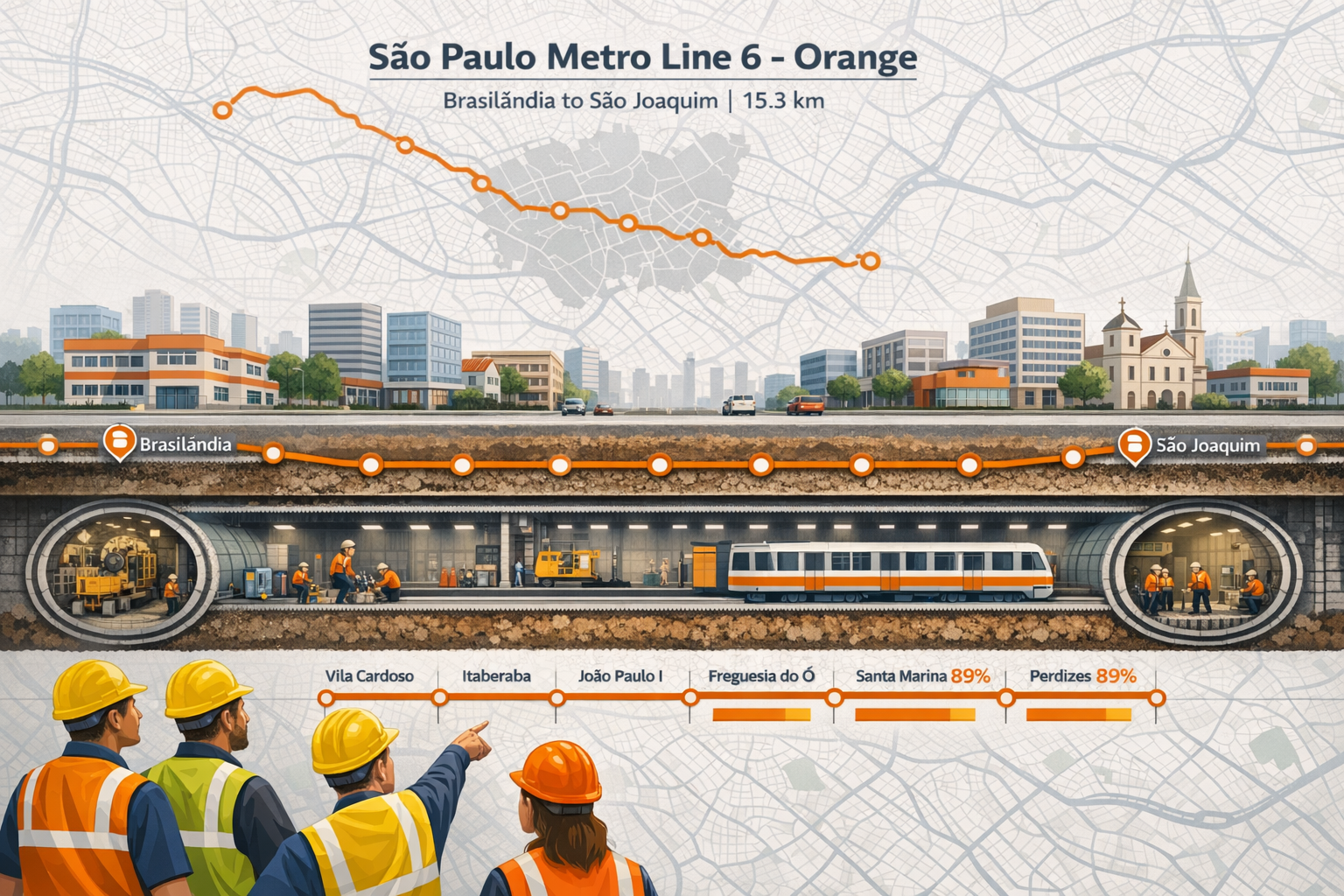
Line 6-Orange is not a minor transit upgrade. It is the largest infrastructure project currently underway in Latin America, backed by a BRL 19 billion investment (approximately US$3.8 billion) through a public-private partnership between the Government of the State of São Paulo and the Linha Universidade Concessionaire [1]. The primary construction contractor is ACCIONA, and the project has generated over 10,000 jobs during its build phase [1].
The line stretches 15.3 kilometers, connecting Brasilândia in the far north to São Joaquim near the city center, with 15 stations threading through some of São Paulo’s most densely populated and historically underserved neighborhoods [3]. Upon completion, Alstom will operate 22 Metropolis trains with 6 cars each, purpose-built for this line [7].
Construction Milestones as of January 2026
The numbers tell a compelling story of near-completion:
| Station | Completion % |
|---|---|
| Morro Grande Yard (Operations Center) | 93.79% |
| Água Branca | 92.41% |
| Perdizes | 89.56% |
| Santa Marina | 89.34% |
| Brasilândia | In final fit-out |
| Sesc Pompeia | In final fit-out |
| Freguesia do Ó | In final fit-out |
14 of 15 stations have surpassed 50% construction completion, and the 15.3-kilometer tunnel excavation is fully finished [1].
Platform screen door installation is actively underway at six stations — Brasilândia, Santa Marina, Água Branca, Sesc Pompeia, Perdizes, and Freguesia do Ó — with 720 devices (48 per station) being installed [1]. Escalator and elevator installations have also begun at multiple stations, signaling the project is firmly in its systems integration phase [1].
The Two-Phase Opening Timeline
- Phase 1 (Late 2026): Brasilândia → Perdizes — the critical north-center link [1][2]
- Phase 2 (Late 2027): Extension to São Joaquim, completing the full corridor [1]
For developers, Phase 1 is the catalyst event. The neighborhoods along the initial segment — Brasilândia, Freguesia do Ó, Água Branca, and Perdizes — are the primary zones where connectivity premiums will be captured first.
How Transit Infrastructure Drives Property Value Premiums
The Transit-Oriented Appreciation Mechanism
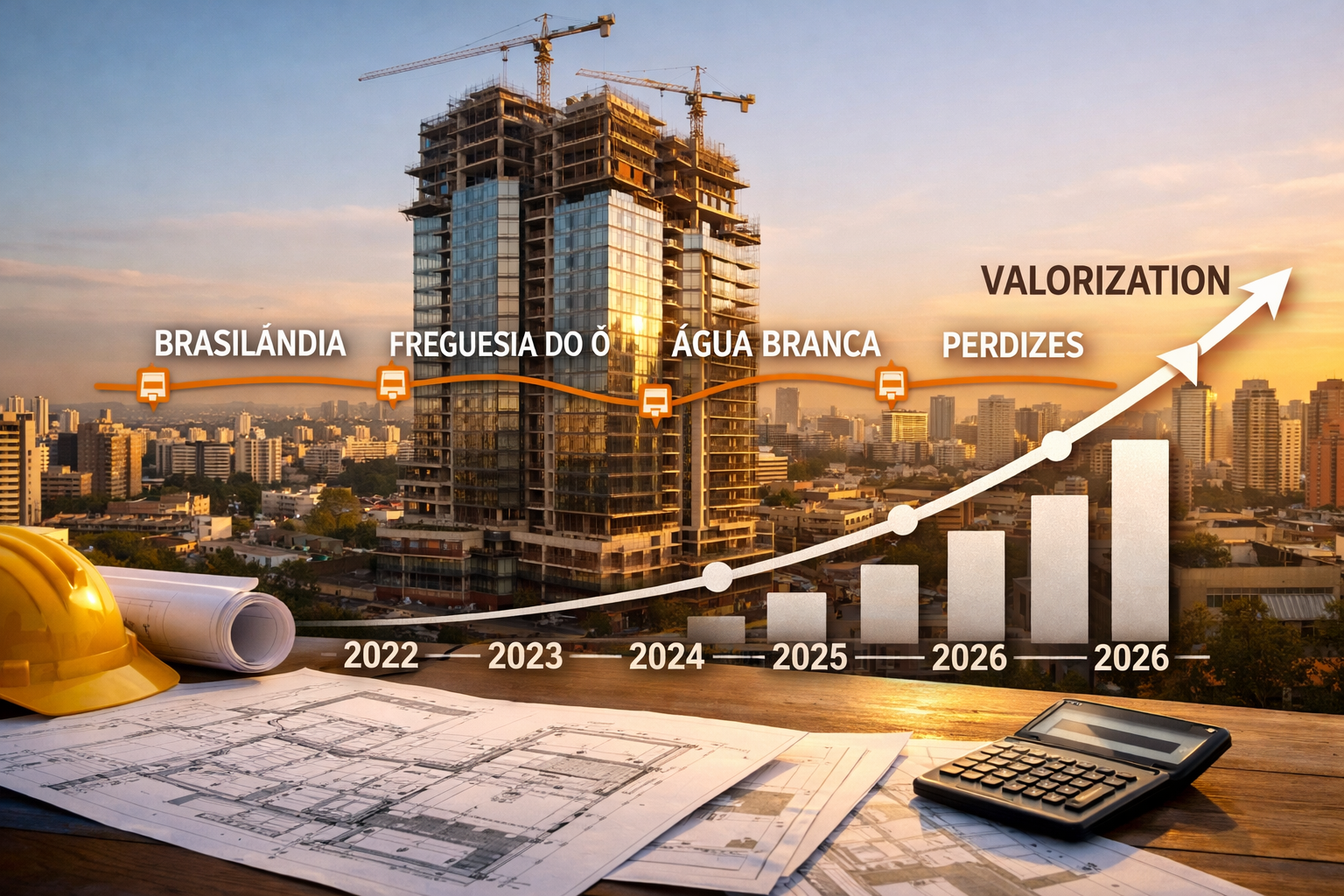
Transit infrastructure creates property value through a well-documented mechanism: accessibility capitalization. When a new metro line reduces travel time to employment centers, retail hubs, and services, the neighborhoods served become more desirable. That desirability is priced into real estate.
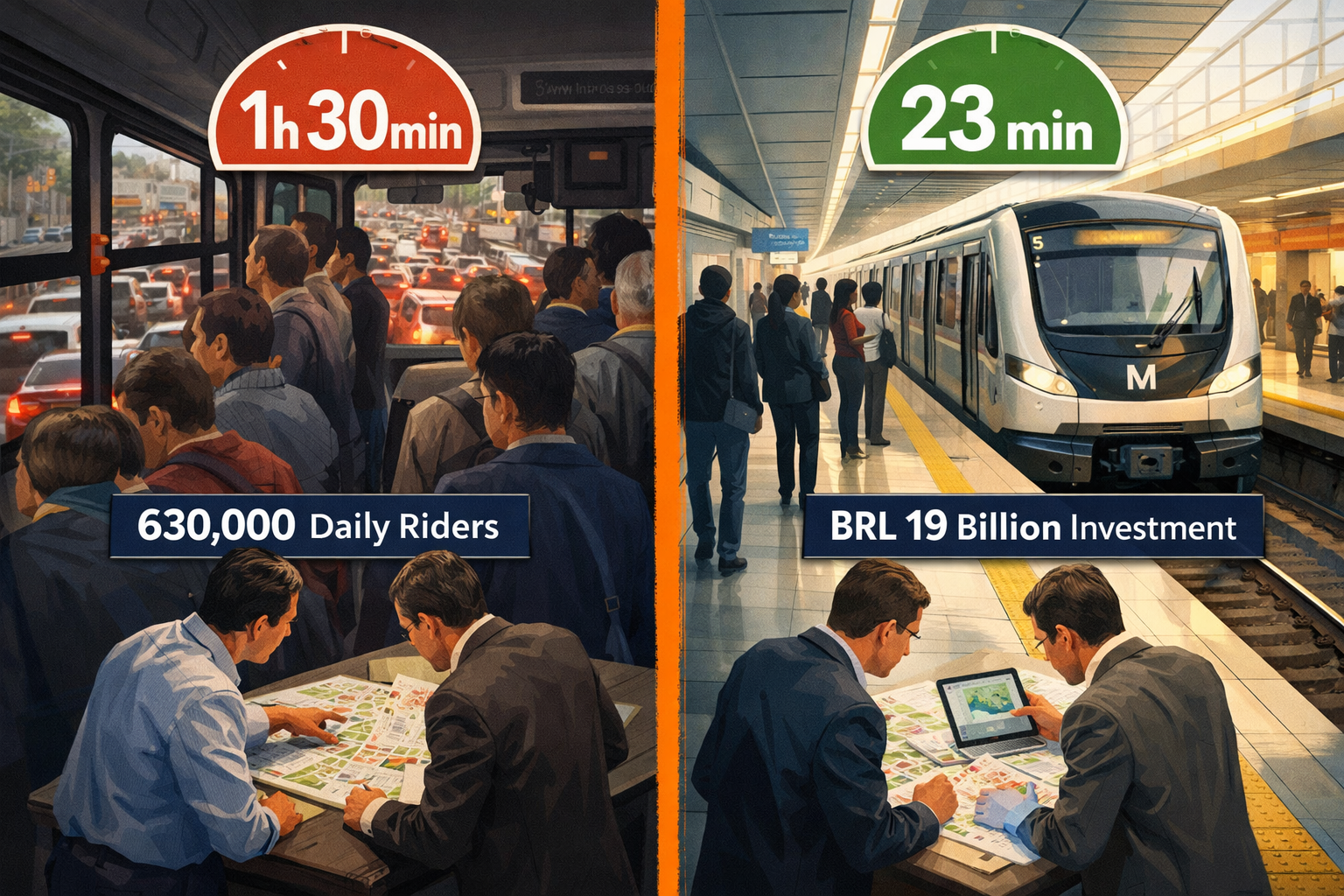
The 73% travel time reduction on Line 6-Orange is extraordinary by any standard. A commuter traveling from Brasilândia to the city center currently faces roughly 90 minutes by bus. After Line 6 opens, that same journey takes approximately 23 minutes [1][3]. This is not incremental improvement — it is a fundamental restructuring of urban accessibility.
Three value drivers are at work simultaneously:
- 🏗️ Pre-opening land appreciation — Developers and investors who acquire near confirmed station locations before opening capture speculative and fundamental appreciation.
- 🏢 Post-opening rental yield compression — As demand for residential units near stations rises, rents increase and yields compress, rewarding early buyers.
- 📈 Long-term neighborhood upgrading — Transit investment attracts retail, services, and further development, creating compounding value over years.
Which Neighborhoods Are in Play?
The Line 6-Orange corridor passes through neighborhoods with very different baseline valuations, creating asymmetric opportunities:
- Brasilândia (North): A historically working-class district with low baseline property prices. The connectivity shock here will be the most dramatic, as residents gain direct metro access to the city center for the first time.
- Freguesia do Ó: A mid-tier residential neighborhood with established infrastructure. Transit access will accelerate gentrification already underway.
- Água Branca & Santa Marina: Near the Lapa district, these areas already have commercial activity. Metro access adds a premium layer to an already improving market.
- Perdizes: An upper-middle-class neighborhood near Higienópolis. The station here reinforces existing high valuations and attracts premium residential launches.
💡 Developer insight: The highest absolute price gains will likely occur in Brasilândia and Freguesia do Ó, where baseline prices are lowest. The highest premium-per-square-meter gains will likely occur in Perdizes and Água Branca, where buyers have more purchasing power.
Brazil’s Broader Property Market Context
São Paulo’s real estate market is operating within a favorable macro environment for transit-adjacent investments. Infrastructure investment across Brazil is accelerating, with major players planning approximately US$10 billion in infrastructure investment in 2026 alone [6]. São Paulo specifically has confirmed record rail budgets to support its expanding metro network [8].
For investors evaluating Brazil’s property landscape, understanding which cities and corridors offer the strongest return potential is essential. A thorough analysis of the best places to invest in Brazil property shows that transit-adjacent urban real estate consistently outperforms broader market benchmarks over 5–10 year horizons.
Developer Strategies for Capturing North-Center Connectivity Premiums
Strategy 1: Station-Adjacent Residential Launches
The most direct play is launching residential developments within 500–800 meters of confirmed Line 6 stations. This radius is the “transit premium zone” — close enough to benefit from walkable station access, but not so close as to face noise or density challenges.
Key considerations for this strategy:
- Compact units (studios and 1-bedroom) near stations in Brasilândia and Freguesia do Ó target first-time buyers and young professionals who will use the metro daily.
- Mid-to-large units near Perdizes and Água Branca target established professionals seeking premium connectivity without sacrificing neighborhood quality.
- Launch timing matters: Projects launched 12–18 months before opening capture the maximum pre-opening appreciation curve.
Understanding why buying off-plan can amplify investment gains is especially relevant here — off-plan purchases near Line 6 stations in 2026 lock in prices before post-opening demand fully reprices the market.
Strategy 2: Mixed-Use Development Along the Corridor
The 630,000 projected daily riders [3] create enormous demand for ground-floor retail, food and beverage, and service businesses near stations. Developers who build mixed-use projects — residential above, commercial below — capture both the residential premium and the commercial rental income from transit-driven foot traffic.
Optimal mixed-use zones along Line 6:
| Zone | Opportunity Type |
|---|---|
| Brasilândia Station | Affordable retail, convenience services |
| Freguesia do Ó | Food & beverage, personal services |
| Água Branca | Premium retail, co-working spaces |
| Perdizes | Boutique retail, healthcare, professional services |
Strategy 3: Buy-to-Rent for Commuter Demand
With 630,000 daily riders projected [3] and a 19-year operational concession ensuring long-term line stability [1], the buy-to-rent model near Line 6 stations is structurally sound. Investors purchasing units now — before the line opens — can expect:
- Rental demand surge from workers relocating to be closer to metro access
- Yield compression as capital values rise faster than rents post-opening
- Liquidity improvement as the neighborhood’s profile rises and secondary market transaction volumes increase
For investors interested in how studio and compact unit investments perform in transit-connected markets, the advantages of investing in studio apartments from a real estate development perspective offer a useful analytical framework applicable to São Paulo’s corridor plays.
Strategy 4: Land Banking in the Second Ring
As station-adjacent land prices rise with construction progress, savvy developers are looking 500–1,500 meters from stations — the “second ring” — where prices have not yet fully reflected the connectivity premium but will once the line opens and commuter patterns shift.
This is a medium-term play (2–4 years) that requires patience but offers stronger margin potential than competing for already-priced station-adjacent parcels.
Strategy 5: Leveraging the Infrastructure Completion Signal
The 77% completion milestone is itself a market signal [1]. Each percentage point of completion reduces project risk and accelerates the timeline for buyers and developers to act. Developers tracking construction progress through official updates can time launches and acquisitions to coincide with high-visibility milestones — such as the first test train runs or the official opening announcement — which generate media coverage and buyer attention.
Staying current with real estate market news and development updates is essential for developers and investors who want to time their moves with infrastructure milestones.
Risk Factors and Due Diligence Considerations
No investment thesis is complete without a clear-eyed look at risks. For Line 6-adjacent plays, the key risks include:
⚠️ Timeline Risk
Large infrastructure projects in Brazil have historically faced delays. While the 77% completion figure and Phase 1 late-2026 target are encouraging, developers should build buffer into financial models. A 6–12 month delay in opening would defer — but not eliminate — the appreciation catalyst.
⚠️ Pricing-In Risk
In high-profile station zones like Perdizes and Água Branca, some of the connectivity premium may already be priced into land values. Thorough comparable analysis is essential before acquisition.
⚠️ Macro Rate Risk
Brazil’s interest rate environment affects mortgage affordability and developer financing costs. Developers should stress-test projects against rate scenarios before committing to corridor plays.
⚠️ Neighborhood Transition Risk
In lower-income areas like Brasilândia, the pace of neighborhood upgrading post-opening may be slower than models assume. Phased development approaches reduce exposure here.
For investors comparing urban transit-adjacent plays with other high-growth Brazilian markets, it is worth understanding what to expect from Brazil’s real estate market in the current cycle, as macro conditions affect all segments.
The Long-Term Vision: A Transformed North-Center Corridor
The São Paulo Metro Line 6 Impact 2026: Developer Plays for North-Center Connectivity Premiums story extends well beyond the opening date. The 19-year operational concession [1] means this infrastructure will anchor north-center connectivity for a generation. The compounding effects — neighborhood upgrading, retail development, further transit investment — will continue to create value long after the initial premium is captured.
São Paulo’s metropolitan government has confirmed record rail budgets [8], signaling that Line 6 is part of a broader network expansion that will further integrate the city’s north zone. Developers who establish a presence along the Line 6 corridor now are not just capturing a single infrastructure event — they are positioning in a district undergoing structural, multi-decade transformation.
For developers and investors seeking to understand how infrastructure-driven appreciation works in practice, reviewing active real estate developments that are already capitalizing on connectivity and urban growth trends provides valuable real-world benchmarks.
Conclusion: Act Before the Orange Line Opens
The data is unambiguous: São Paulo Metro Line 6-Orange is delivering. With 77%+ construction complete, 14 of 15 stations past the halfway mark, and a Phase 1 opening targeted for late 2026, the window for pre-opening positioning is measured in months, not years [1][2].
The 73% travel time reduction and 630,000 projected daily riders [1][3] create the demand fundamentals that drive sustained property value appreciation. Developers and investors who act on these fundamentals now — before the ribbon is cut and prices fully adjust — stand to capture the most significant connectivity premiums.
Actionable Next Steps for Developers and Investors:
- Map your acquisition targets within 800 meters of the six most advanced stations: Água Branca, Perdizes, Santa Marina, Brasilândia, Sesc Pompeia, and Freguesia do Ó.
- Run comparable analysis to determine how much of the premium is already priced in versus what remains to be captured.
- Time your launch to coincide with high-visibility construction milestones — test runs, official opening announcements — to maximize buyer attention.
- Prioritize compact and mid-size residential units for the buy-to-rent segment, targeting the commuter demographic that will rely on Line 6 daily.
- Monitor official construction updates and integrate timeline scenarios into financial models to manage delay risk.
- Explore off-plan purchase strategies to lock in pre-opening pricing before the market fully adjusts.
The north-center corridor is being rewired. The developers who move with the infrastructure — not after it — will write the most compelling return stories of 2026 and beyond.
References
[1] Sao Paulo Metro Line 6 Project Reaches Key Milestones – https://www.acciona.com/updates/articles/sao-paulo-metro-line-6-project-reaches-key-milestones
[2] Changes Sao Paulo 2026 Metro Fare – https://saopaulosecreto.com/en/changes-sao-paulo-2026-metro-fare/
[3] Glo Metro Line 6 Sao Paulo Brazil – https://gcc.sika.com/dam/dms/corporate/s/glo-metro-line-6-sao-paulo-brazil.pdf
[6] Infrastructure Giants Plan To Invest Around Us10 Billion In Brazil In 2026 – https://www.bnamericas.com/en/analysis/infrastructure-giants-plan-to-invest-around-us10-billion-in-brazil-in-2026
[7] Alstom Celebrates 70 Years Brazil And Launches Its First Impact Report – https://www.alstom.com/press-releases-news/2025/11/alstom-celebrates-70-years-brazil-and-launches-its-first-impact-report
[8] Sao Paulo Confirms Record Rail Budget – https://www.railjournal.com/financial/sao-paulo-confirms-record-rail-budget/