
For decades, international property investors focused almost exclusively on Brazil’s major metropolitan areas—São Paulo, Rio de Janeiro, and Brasília. However, 2026 marks a transformative moment as Secondary City Shifts for Foreign Investors: Low-Cost, High-Yield Opportunities Beyond São Paulo 2026 are reshaping the investment landscape. With the Brazilian Real trading at approximately 4.85 BRL per USD and secondary cities delivering rental yields that substantially outpace traditional metros, savvy international buyers—particularly from Portugal, Germany, and the United States—are discovering extraordinary value in Brazil’s emerging markets.
This strategic pivot isn’t merely about cost savings. Secondary cities like Salvador, Fortaleza, and Florianópolis are experiencing double-digit price appreciation while offering lifestyle amenities that appeal to retirement-focused European buyers and yield-hungry institutional investors alike[1]. The convergence of favorable currency dynamics, government housing programs, and massive infrastructure investment creates a unique window of opportunity that sophisticated foreign investors cannot afford to ignore.
Key Takeaways
- Salvador leads secondary city growth with 20.63% nominal price appreciation and 14.31% real growth, substantially outperforming São Paulo and Rio de Janeiro[1]
- Foreign acquisitions surging 40% year-over-year as American and European buyers capitalize on the Brazilian Real trading at 4.85 per USD[1]
- Rental yields average 5.28% nationally with higher returns available in coastal secondary markets through short-term rental strategies[1]
- R$300 billion infrastructure investment in 2026 supports long-term property appreciation in emerging cities, with sanitation upgrades benefiting 49.2% of projects[1][3]
- Lifestyle-oriented coastal markets attract Portuguese and German retirees seeking affordable, high-quality living with strong rental income potential[2][4]
Understanding Secondary City Shifts for Foreign Investors Beyond São Paulo in 2026
The Changing Geography of Brazilian Real Estate Investment
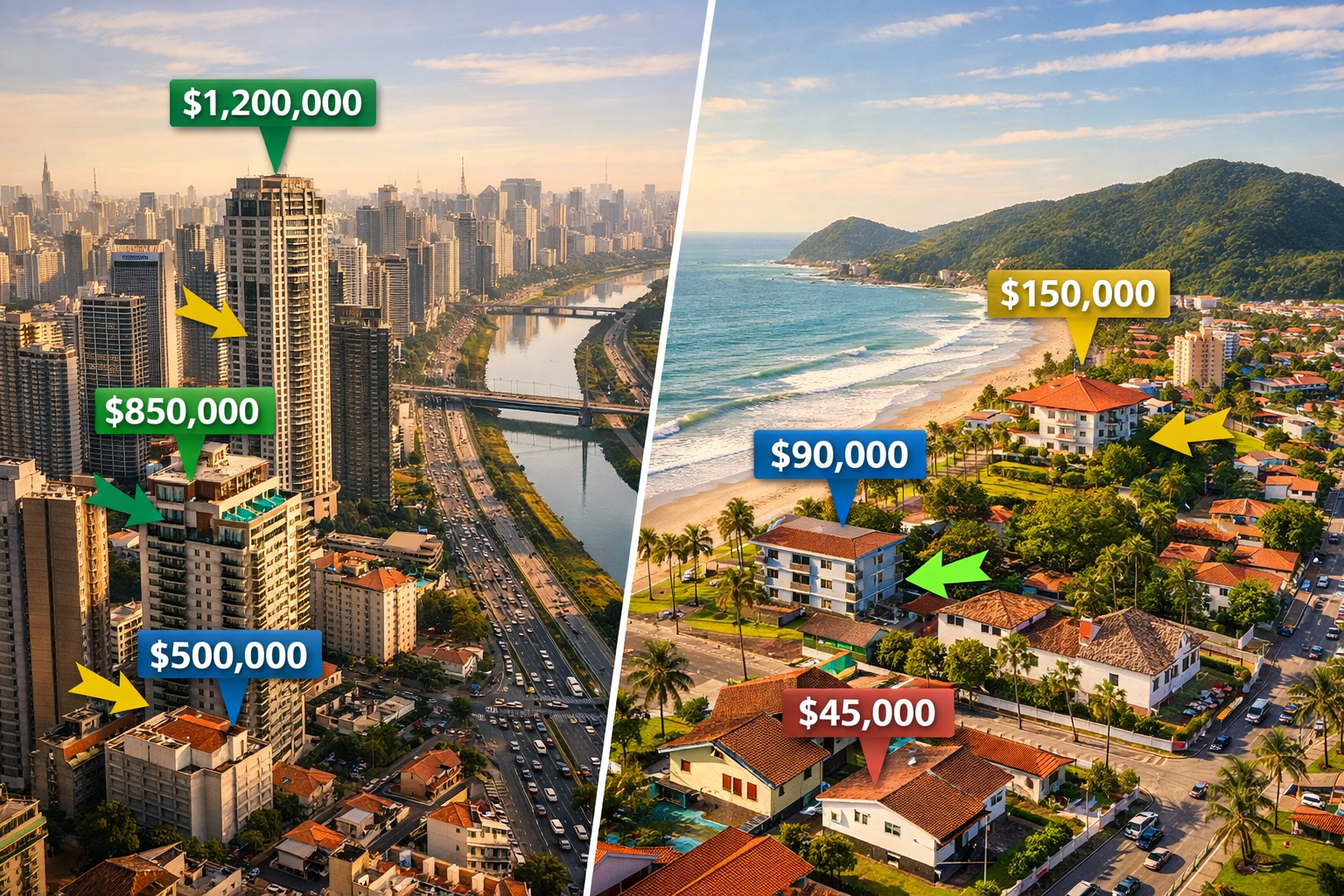
The traditional concentration of foreign capital in São Paulo and Rio de Janeiro is undergoing a fundamental transformation. While these major metros continue to serve as economic powerhouses, secondary cities are delivering superior investment performance across virtually every metric that matters to international buyers.
Salvador, the capital of Bahia state, exemplifies this trend with 20.63% nominal price growth in recent periods—nearly triple the appreciation rates seen in traditional investment hubs[1]. Fortaleza in the northeast achieved 12.33% nominal growth, demonstrating that this phenomenon extends beyond a single market anomaly.
Several structural factors drive this geographic rebalancing:
🏗️ Infrastructure Investment Concentration: Brazil’s R$300 billion infrastructure budget for 2026 prioritizes secondary cities requiring modernization, with sanitation projects accounting for 49.2% of investment intentions[3]. This targeted spending directly enhances property values in emerging markets.
💰 Affordability Gap Arbitrage: Acquisition costs in secondary cities remain 40-60% lower than comparable properties in São Paulo, while rental yields often exceed metro averages by 150-200 basis points.
🌊 Lifestyle Migration Patterns: Wealthy Brazilians and international buyers increasingly prioritize quality of life, coastal access, and lower cost of living—attributes where secondary cities excel[2][4].
📊 Government Housing Program Impact: Subsidized financing initiatives like “Minha Casa, Minha Vida” and “Casa Verde e Amarela” create structural demand fundamentals particularly strong in emerging markets[1].
For foreign investors exploring best places to invest in Brazil property, understanding these dynamics provides critical context for portfolio allocation decisions.
Currency Advantage: The BRL Weakness Opportunity
The Brazilian Real’s weakness represents perhaps the single most compelling factor driving Secondary City Shifts for Foreign Investors: Low-Cost, High-Yield Opportunities Beyond São Paulo 2026. Trading at approximately 4.85 BRL per USD—and projected to reach 5.50 by year-end 2026—the currency creates substantial purchasing power for international buyers[1][3].
Consider this practical example:
| Metric | Secondary City (Florianópolis) | São Paulo |
|---|---|---|
| Property Cost | R$500,000 (≈$103,000 USD) | R$1,200,000 (≈$247,000 USD) |
| Annual Rental Income | R$30,000 (≈$6,200 USD) | R$60,000 (≈$12,400 USD) |
| Rental Yield | 6.0% | 5.0% |
| Appreciation (2025) | 14.3% real growth | 6.8% real growth |
For European investors earning in euros or American buyers with USD income, the currency discount effectively provides a 15-20% acquisition advantage compared to historical exchange rate norms. This advantage compounds when combined with lower absolute property prices in secondary markets.
However, investors must balance currency opportunity against macroeconomic headwinds. The Selic rate projected at 12.25% increases financing costs for leveraged purchases[3]. Cash buyers or those with access to foreign currency financing gain disproportionate advantages in this environment.
The European Retiree Phenomenon: Portuguese and German Buyer Trends
A particularly noteworthy dimension of Secondary City Shifts for Foreign Investors involves the growing cohort of European retirees—especially Portuguese and German nationals—establishing residence in Brazil’s coastal secondary cities.
Why Portuguese Buyers Choose Brazilian Secondary Cities:
🗣️ Language Continuity: Native Portuguese speakers face zero language barriers, enabling seamless integration into local communities
🏖️ Coastal Lifestyle Quality: Cities like Florianópolis offer Mediterranean-style coastal living at a fraction of European costs
💶 Pension Purchasing Power: European pensions provide substantial purchasing power when converted to Brazilian Real
🏥 Healthcare Access: Major secondary cities offer quality private healthcare at costs 60-70% below European equivalents
German Retiree Preferences:
German buyers typically prioritize different attributes:
- Environmental quality and sustainable development practices
- Organized infrastructure and reliable public services
- Cultural amenities including museums, theaters, and international cuisine
- Safety and security in gated communities or secure neighborhoods
Cities like Florianópolis have responded by developing German-language services, European-style bakeries, and community organizations catering specifically to this demographic. The growth of regions like Ingleses in Florianópolis demonstrates how secondary cities are adapting to international buyer preferences.
These retirees often purchase properties not merely as vacation homes but as income-generating assets during months when they return to Europe. Short-term rental platforms enable them to capture seasonal rental premiums while enjoying personal use during peak travel periods.
High-Yield Investment Strategies in Secondary Brazilian Markets
Rental Yield Optimization: Long-Term vs. Short-Term Strategies
National average rental yields of 5.28% provide attractive baseline returns, but sophisticated investors in secondary cities can substantially exceed these benchmarks through strategic property selection and management approaches[1].
Long-Term Rental Strategy:
Traditional long-term leases offer stability and predictable cash flow:
- Typical yields: 4.5-6.5% in secondary cities
- Tenant profile: Local professionals, relocated workers, students
- Management intensity: Low—annual lease renewals, minimal turnover
- Regulatory considerations: Tenant protection laws favor long-term occupants
Short-Term Rental Strategy:
Airbnb and similar platforms represent the single most powerful driver of foreign investment in Brazilian residential property, with yields in specific micro-markets substantially exceeding traditional returns[2]:
- Typical yields: 8-14% in prime coastal locations
- Seasonal variation: Premium rates during Brazilian summer (December-March)
- Management intensity: High—requires local management or professional services
- Regulatory landscape: Varies by municipality; some cities implementing restrictions
Hybrid Approach:
Many foreign investors adopt a hybrid strategy:
- Personal use during preferred travel periods (2-3 months annually)
- Short-term rentals during peak season (December-March)
- Long-term lease during off-season months (April-November)
This approach maximizes both personal enjoyment and financial returns while reducing vacancy risk. Properties near Florianópolis developments particularly suit this strategy due to year-round appeal.
Target Cities: Where Secondary City Shifts Create Maximum Value
Not all secondary cities offer equal investment potential. Foreign investors should focus on markets combining multiple favorable characteristics:
🏆 Top-Tier Secondary Cities for 2026:
1. Salvador (Bahia)
- Price appreciation: 20.63% nominal, 14.31% real growth[1]
- Foreign buyer appeal: Afro-Brazilian culture, UNESCO heritage sites, coastal access
- Infrastructure investment: Major port expansion, airport modernization
- Rental market: Strong demand from domestic tourism, business travelers
- Considerations: Higher crime rates in certain neighborhoods require careful location selection
2. Fortaleza (Ceará)
- Price appreciation: 12.33% nominal, 6.44% real growth[1]
- Foreign buyer appeal: Pristine beaches, consistent sunshine, lower cost of living
- Infrastructure investment: Renewable energy hub development
- Rental market: Excellent short-term rental performance during peak season
- Considerations: Seasonal demand variation requires strategic pricing
3. Florianópolis (Santa Catarina)
- Price appreciation: Consistent mid-single-digit real growth
- Foreign buyer appeal: European-style infrastructure, high quality of life, natural beauty
- Infrastructure investment: Technology sector growth, sustainable development initiatives
- Rental market: Year-round demand from tech workers, seasonal tourism premium
- Considerations: Higher entry prices than northeastern alternatives but superior infrastructure
4. Curitiba (Paraná)
- Price appreciation: Steady appreciation with lower volatility
- Foreign buyer appeal: Urban planning excellence, European cultural influence, safety
- Infrastructure investment: Transportation infrastructure, smart city initiatives
- Rental market: Strong long-term rental demand from corporate relocations
- Considerations: Less tourism appeal but superior stability for risk-averse investors
5. Natal (Rio Grande do Norte)
- Price appreciation: Strong growth in coastal zones
- Foreign buyer appeal: Year-round warm weather, beach access, affordable pricing
- Infrastructure investment: Tourism infrastructure expansion
- Rental market: Excellent short-term rental potential
- Considerations: Smaller market with less liquidity for eventual exit
Investors can explore specific investment opportunities in these emerging markets through established development companies with local expertise.
Property Types and Investment Vehicles
Secondary City Shifts for Foreign Investors: Low-Cost, High-Yield Opportunities Beyond São Paulo 2026 encompass diverse property types, each offering distinct advantages:
Studio and One-Bedroom Units:
- Acquisition cost: R$250,000-500,000 (≈$51,500-103,000 USD)
- Target market: Young professionals, short-term renters, students
- Yield potential: 6-9% with proper management
- Liquidity: Highest among property types due to affordability
- Best locations: University districts, beach zones, city centers
The advantages of investing in studios in Florianópolis demonstrate how smaller units can deliver outsized returns.
Two-Three Bedroom Condominiums:
- Acquisition cost: R$500,000-1,000,000 (≈$103,000-206,000 USD)
- Target market: Families, retirees, medium-term corporate rentals
- Yield potential: 5-7% with stable occupancy
- Liquidity: Moderate—larger buyer pool than luxury segment
- Best locations: Residential neighborhoods with schools, amenities
Beachfront Properties:
- Acquisition cost: R$800,000-2,500,000 (≈$165,000-515,000 USD)
- Target market: Affluent domestic tourists, international vacationers
- Yield potential: 8-14% through short-term rentals
- Liquidity: Lower due to higher price points but strong appreciation
- Best locations: Established beach towns with tourism infrastructure
Pre-Construction Opportunities:
Purchasing during construction phases offers additional advantages:
✅ Payment flexibility: Installment payments during construction period
✅ Appreciation capture: Valuation gains for buyers purchasing off-plan
✅ Unit selection: First choice of floor plans, views, orientations
✅ Developer incentives: Early-buyer discounts, upgrade packages
However, pre-construction investments require thorough due diligence on developer reputation, construction timelines, and market absorption rates.
Navigating Risks and Maximizing Returns in Secondary City Investments
Macroeconomic Considerations for 2026
While Secondary City Shifts for Foreign Investors present compelling opportunities, prudent investors must understand the macroeconomic context shaping Brazilian markets in 2026.
Interest Rate Environment:
The Selic rate projected at 12.25% creates both challenges and opportunities[3]:
Challenges:
- Higher mortgage costs for leveraged purchases
- Increased competition from fixed-income investments
- Potential cooling of domestic buyer demand
Opportunities:
- Reduced competition from leveraged domestic buyers
- Advantage for cash-rich foreign investors
- Higher rental yields become more competitive with bonds
Exchange Rate Dynamics:
Projections indicating the Real reaching R$5.50 per USD by year-end 2026 suggest continued currency advantage for foreign buyers[3]. However, investors should consider:
- Entry timing: Current rates (4.85) offer better value than projected year-end levels
- Repatriation planning: Future currency strengthening could reduce USD-denominated returns
- Hedging strategies: Sophisticated investors may employ currency hedging for large positions
Infrastructure Investment Impact:
Brazil’s R$300 billion infrastructure investment for 2026—plus R$372.3 billion planned through 2029—provides fundamental support for secondary city appreciation[1][3]. Notably:
- Private sector dominance: 72.2% of infrastructure spending comes from private capital, reducing government budget dependency[3]
- Sanitation priority: 49.2% of investment targets sanitation infrastructure, directly benefiting secondary cities[3]
- Regulatory stability: Consolidated frameworks provide predictability for long-term planning
Understanding macroeconomic conditions affecting infrastructure investment helps investors time entry points and select cities benefiting most from public spending.
Legal and Tax Considerations for Foreign Buyers
International investors must navigate Brazil’s regulatory framework:
Property Acquisition Process:
- CPF registration: Obtain Brazilian tax identification number (Cadastro de Pessoas Físicas)
- Legal representation: Engage qualified Brazilian attorney for due diligence
- Title verification: Confirm clean title, absence of liens, proper zoning
- Purchase contract: Formalize terms, payment schedule, possession timeline
- Registration: Record ownership with local property registry (Cartório)
Taxation Framework:
Acquisition Phase:
- ITBI tax: 2-4% of property value (varies by municipality)
- Registration fees: Approximately 1% of purchase price
Ownership Phase:
- IPTU (property tax): 0.3-1.5% annually based on assessed value
- Condominium fees: Variable based on building amenities
Rental Income:
- Income tax: 15-27.5% on net rental income for non-residents
- Withholding: Property managers typically withhold taxes monthly
Disposition Phase:
- Capital gains tax: 15% on appreciation (with exemptions for primary residences)
- Withholding: 15% withheld at closing for non-resident sellers
Repatriation Considerations:
Foreign investors can freely repatriate rental income and sale proceeds, subject to:
- Proper tax compliance and documentation
- Central Bank registration for amounts exceeding $50,000 USD annually
- Exchange rate risk during conversion to foreign currency
Risk Mitigation Strategies
Successful foreign investors in secondary Brazilian cities employ multiple risk mitigation approaches:
🛡️ Diversification Tactics:
- Geographic spread: Invest across multiple secondary cities rather than concentrating in one market
- Property type mix: Combine studio units (high yield) with larger properties (stability)
- Rental strategy variety: Balance long-term leases with short-term rental opportunities
🔍 Due Diligence Essentials:
- Developer verification: Research track record, financial stability, completed projects
- Location analysis: Assess proximity to amenities, transportation, employment centers
- Market absorption: Evaluate supply pipeline relative to demand fundamentals
- Legal review: Engage qualified attorneys for title, zoning, regulatory compliance
👥 Local Partnership:
Foreign investors benefit enormously from local expertise:
- Property management: Professional managers handle tenant relations, maintenance, compliance
- Market intelligence: Local partners provide insights on emerging neighborhoods, pricing trends
- Regulatory navigation: Expertise in municipal regulations, tax optimization, legal requirements
Partnering with established development companies with proven track records reduces execution risk significantly.
📱 Technology Integration:
Modern property management platforms enable remote oversight:
- Real-time financial reporting and occupancy tracking
- Automated rental collection and expense management
- Digital communication with tenants and service providers
- Market analytics for pricing optimization
Emerging Trends Shaping 2026 and Beyond
Several emerging trends will influence Secondary City Shifts for Foreign Investors through 2026 and subsequent years:
Remote Work Migration:
The permanent shift toward remote work enables Brazilian professionals to relocate from expensive metros to affordable secondary cities with superior quality of life. This trend creates sustained rental demand in markets offering:
- Reliable high-speed internet infrastructure
- Coworking spaces and professional amenities
- Lifestyle attractions (beaches, nature, cultural activities)
- Lower cost of living relative to São Paulo/Rio
Sustainability Focus:
International buyers—particularly Europeans—increasingly prioritize environmental sustainability:
- Energy-efficient construction and renewable energy systems
- Water conservation and waste management infrastructure
- Proximity to public transportation and walkable neighborhoods
- Green building certifications and eco-friendly materials
Secondary cities implementing sustainable development practices gain competitive advantages in attracting foreign capital.
Cryptocurrency Integration:
Brazil’s progressive stance on cryptocurrency and real estate development creates innovative financing options for international investors seeking to deploy digital assets into tangible property holdings.
Demographic Shifts:
Brazil’s aging population and growing middle class create structural demand for:
- Retirement communities in coastal secondary cities
- Healthcare-adjacent residential properties
- Multigenerational housing configurations
- Accessible design and senior-friendly amenities
Foreign investors positioning for these demographic trends can capture long-term appreciation as demand intensifies.
Practical Implementation: Your Secondary City Investment Roadmap
Phase 1: Research and Market Selection (Months 1-2)
Objective: Identify target cities and property types aligned with investment goals.
Action Steps:
Define investment criteria:
- Target rental yield (e.g., 6%+ net)
- Acceptable price range (e.g., $100,000-250,000 USD)
- Preferred property type (studio, 2BR, beachfront)
- Management approach (self-managed vs. professional)
Conduct market research:
- Review appreciation trends in target cities
- Analyze rental market dynamics and seasonal patterns
- Assess infrastructure investment plans
- Evaluate foreign buyer communities and support services
Engage local expertise:
- Connect with reputable developers and real estate agencies
- Consult with attorneys specializing in foreign investment
- Interview property management companies
- Join online communities of foreign investors in Brazil
Resources like the Florianópolis real estate market analysis provide valuable market intelligence for decision-making.
Phase 2: Property Identification and Due Diligence (Months 2-4)
Objective: Identify specific properties meeting investment criteria and complete thorough verification.
Action Steps:
Property search:
- Review listings from multiple sources (developers, agencies, platforms)
- Conduct virtual tours and video walkthroughs
- Request detailed financial projections and rental histories
- Evaluate comparable properties for pricing validation
Site visits:
- Schedule concentrated visit to tour multiple properties
- Assess neighborhood quality, amenities, transportation
- Meet with property managers and local service providers
- Experience the city as a potential resident/renter would
Legal due diligence:
- Verify clean title and ownership documentation
- Confirm zoning compliance and permitted uses
- Review condominium bylaws and financial health
- Assess any liens, encumbrances, or legal disputes
Financial analysis:
- Model projected returns under various scenarios
- Calculate all-in acquisition costs including taxes and fees
- Project operating expenses and management costs
- Evaluate financing options if applicable
Phase 3: Acquisition and Setup (Months 4-6)
Objective: Complete purchase transaction and establish operational infrastructure.
Action Steps:
Purchase execution:
- Negotiate final terms and pricing
- Arrange currency conversion and fund transfer
- Execute purchase contract and payment schedule
- Complete property registration and title transfer
Property preparation:
- Conduct any necessary renovations or improvements
- Furnish and equip for target rental market
- Install technology systems (smart locks, WiFi, security)
- Photograph professionally for marketing materials
Operational setup:
- Engage property management company
- Establish banking and payment processing
- List property on rental platforms (Airbnb, Booking.com, local sites)
- Create pricing strategy and availability calendar
Compliance and administration:
- Register for tax obligations
- Obtain necessary permits and licenses
- Set up accounting and financial reporting systems
- Establish communication protocols with management team
Phase 4: Ongoing Management and Optimization (Ongoing)
Objective: Maximize returns through active management and continuous improvement.
Action Steps:
Performance monitoring:
- Review monthly financial statements and occupancy rates
- Track market trends and competitive positioning
- Analyze guest feedback and satisfaction scores
- Benchmark performance against projections
Revenue optimization:
- Adjust pricing based on seasonal demand and market conditions
- Implement dynamic pricing tools for short-term rentals
- Expand marketing reach through additional platforms
- Enhance property amenities based on guest preferences
Relationship management:
- Maintain regular communication with property managers
- Build relationships with local service providers
- Network with other foreign investors for knowledge sharing
- Stay informed on regulatory changes and market developments
Portfolio evolution:
- Evaluate opportunities for additional acquisitions
- Consider property improvements to increase value
- Assess optimal holding period and exit timing
- Rebalance portfolio based on changing market conditions
Staying informed through resources like Florianópolis market performance updates enables proactive portfolio management.
Conclusion

Secondary City Shifts for Foreign Investors: Low-Cost, High-Yield Opportunities Beyond São Paulo 2026 represent one of the most compelling real estate investment opportunities in the Americas today. The convergence of favorable currency dynamics (4.85 BRL per USD), superior price appreciation in cities like Salvador (20.63% nominal growth) and Fortaleza (12.33% nominal growth), attractive rental yields averaging 5.28% nationally, and massive infrastructure investment totaling R$300 billion creates a unique window for international capital deployment[1][3].
For Portuguese and German retirees seeking affordable coastal lifestyle combined with income generation, Brazilian secondary cities offer unmatched value propositions. American investors capitalizing on currency advantages can acquire quality properties at 40-60% discounts compared to historical norms while capturing rental yields that substantially exceed developed market alternatives.
However, success requires strategic execution: careful city and property selection, thorough due diligence, local partnership with experienced developers and managers, and realistic understanding of macroeconomic factors including the 12.25% Selic rate and projected currency movements.
The foreign investment surge—growing at 40% year-over-year—demonstrates that sophisticated international buyers recognize this opportunity[1]. Those who act decisively in 2026, while currency advantages remain favorable and secondary city appreciation accelerates, position themselves to capture both immediate cash flow and long-term capital appreciation.
Next Steps
Ready to explore Secondary City Shifts for Foreign Investors in Brazil’s emerging markets?
- Research target cities using the framework provided in this guide
- Connect with local expertise through established development companies with proven track records
- Schedule exploratory visits to experience markets firsthand and build local relationships
- Engage qualified professionals including attorneys, accountants, and property managers
- Start with manageable exposure through a single property before expanding your portfolio
For personalized guidance on investment opportunities in Florianópolis and other high-potential secondary cities, contact experienced local developers who understand both international investor needs and local market dynamics.
The secondary city revolution in Brazilian real estate is underway. The question isn’t whether to participate—it’s whether you’ll position yourself early enough to capture maximum value.
References
[1] Brazil Good Time – https://thelatinvestor.com/blogs/news/brazil-good-time
[2] Brazil Property Market Predictions For 2026 – https://esalesinternational.com/2025/11/20/brazil-property-market-predictions-for-2026/
[3] Condicoes Macroeconomicas Investimentos Infraestrutura Brasil 2025 2026 – https://news.griinstitute.org/en/infrastructure/condicoes-macroeconomicas-investimentos-infraestrutura-brasil-2025-2026
[4] Best Cities To Invest In Brazilian Real Estate 2026 Edition – https://www.brazilbeachhouse.com/blogg/2025/12/1/best-cities-to-invest-in-brazilian-real-estate-2026-edition