

Brazil’s real estate market stands at a pivotal moment in 2026. After enduring one of the most restrictive monetary environments in emerging markets, developers and investors are witnessing the beginning of a transformative shift. The Brazilian central bank’s decision to cut the Selic benchmark rate—with projections pointing toward 12.25% by year-end—is not merely a statistical adjustment. It represents a fundamental recalibration of opportunity, particularly for mid-sized apartment developments that have long been overshadowed by smaller studio units in high-interest conditions. This Selic Rate Drop to 12.25% by End-2026: Unlocking Mid-Sized Apartment Developments in High-Interest Brazil creates a strategic window for developers to expand buyer pools, optimize launch timing, and capture yield uplifts of 10-15% by shifting from small apartment dominance to family-oriented 2-3 bedroom units.

Key Takeaways
- 🏦 Brazil’s central bank cut the Selic rate to 14.75% in March 2026, with markets forecasting it will reach approximately 12.25% by year-end, representing 275 basis points of total reductions[1][3]
- 🏢 Declining borrowing costs expand buyer pools for mid-sized 2-3 bedroom apartments, shifting market dynamics away from studio and 1-bedroom unit dominance
- 📊 Strategic launch timing aligned with rate cuts can deliver 10-15% yield uplifts for developers who position projects to capture the expanding mortgage-qualified buyer segment
- ⚠️ Geopolitical risks and energy price volatility create uncertainty around the pace of future cuts, requiring flexible development strategies
- 💰 Mortgage cost relief is gradual but significant—each 25-basis-point reduction improves affordability for family-sized units, unlocking previously priced-out demographics
Understanding the Selic Rate Cut and Its Market Context
The March 2026 Turning Point
On March 18, 2026, Brazil’s Monetary Policy Committee (Copom) unanimously voted to reduce the Selic benchmark rate by 0.25 percentage points to 14.75%, marking the first reduction since May 2024[1][4]. This decision formally launched an easing cycle after rates remained frozen at 15% for nine consecutive months—a period that severely constrained real estate financing and pushed developers toward smaller, more affordable unit types.
The cut, while smaller than the 0.50-point reduction markets had anticipated, signals a cautious but definitive shift in monetary policy. The central bank’s restraint stems primarily from geopolitical tensions in the Middle East that pushed oil prices above $100 per barrel, creating inflationary pressures that demanded careful calibration[1].
The Path to 12.25%: Projections and Uncertainties
Market consensus projects the Selic will reach approximately 12.25% by the end of 2026, representing roughly 275 basis points of total cuts from current levels[1]. Alternative forecasts, such as those from BBVA Research, suggest an even more aggressive trajectory, with rates potentially falling to 11.75% in 2026 and 10.00% in 2027[3].
However, these projections come with significant caveats:
| Factor | Impact on Rate Cuts | Current Status (2026) |
|---|---|---|
| Oil Prices | Higher prices slow cuts | Above $100/barrel due to Middle East tensions[1] |
| Inflation Expectations | Must stabilize for faster cuts | Near upper bound of 1.5%-4.5% target range[3] |
| Economic Growth | Slower growth supports cuts | 1.7% forecast (down from 2.3% in 2025)[3] |
| Currency Stability | Real weakness may limit cuts | Expected modest depreciation[3] |
| Global Conditions | External volatility creates uncertainty | Pre-election uncertainty in Brazil[3] |
The Copom has explicitly stated that future adjustments will depend entirely on new information regarding Middle East conflict impacts on global commodity prices and Brazil’s inflation outlook[1]. If oil prices retreat and inflation expectations stabilize, a 0.50-point cut becomes the base case for future meetings[1].
Why This Matters for Real Estate Development
Capital Economics notes that Brazil’s current monetary stance remains “sheer restrictively,” meaning there is more room for interest rates to come down in Brazil than in most other emerging economies[5]. This creates a unique opportunity window for real estate developers who can anticipate and position for the transition.
For context on Brazil’s property investment landscape, understanding regional dynamics becomes crucial as monetary easing unfolds differently across markets.
How the Selic Rate Drop to 12.25% by End-2026 Transforms Mid-Sized Apartment Viability
The High-Interest Constraint on Family Units
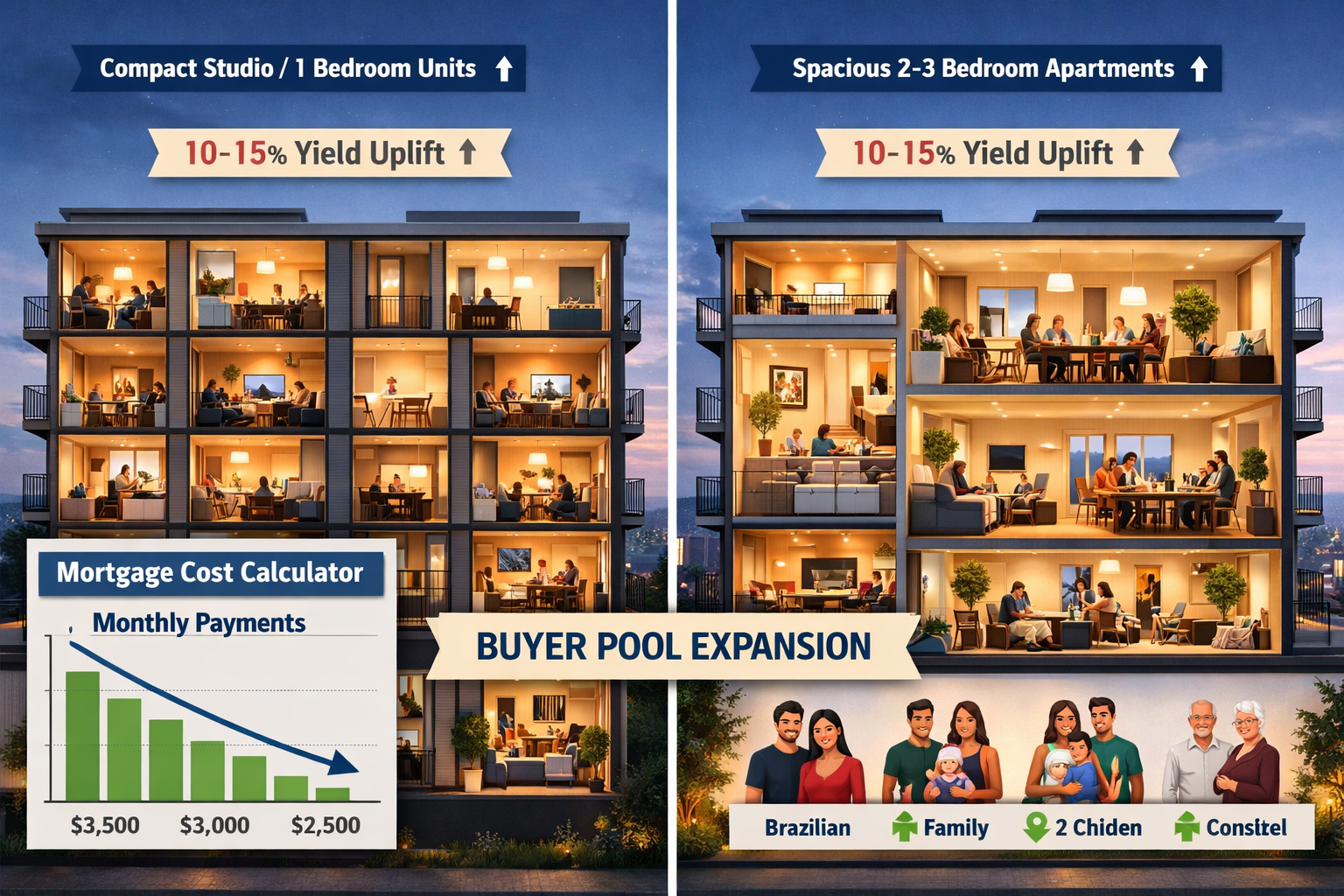
During the prolonged period of 15% Selic rates, Brazil’s real estate market experienced a pronounced shift toward smaller unit types—particularly studios and compact 1-bedroom apartments. This wasn’t a preference-driven trend but rather a financing-driven necessity. High borrowing costs dramatically reduced the pool of buyers who could qualify for mortgages on larger, more expensive 2-3 bedroom units.
Consider the mathematics: At 15% interest rates, a R$500,000 mortgage (typical for a mid-sized 2-bedroom apartment in quality locations) carries monthly payments that price out substantial portions of middle-class buyers. Developers responded rationally by focusing on R$250,000-350,000 studio and 1-bedroom units that remained accessible to young professionals and investors.
The Mortgage Cost Relief Equation
The projected decline from 14.75% to 12.25% represents a 250-basis-point reduction in borrowing costs by year-end. While this may seem modest, the impact on monthly mortgage payments is substantial:
Example Calculation for R$500,000 30-Year Mortgage:
- At 14.75%: Monthly payment ≈ R$6,200
- At 12.25%: Monthly payment ≈ R$5,350
- Monthly savings: R$850 (13.7% reduction)
- Annual savings: R$10,200
This R$850 monthly reduction brings previously unaffordable mid-sized apartments within reach for families earning R$12,000-18,000 monthly—a demographic segment that represents significant untapped demand in Brazil’s growing middle class.
Expanding Buyer Pools: The Demographic Shift
The easing of mortgage costs triggers a cascading expansion of qualified buyers for mid-sized units:
- Young Families: Couples with children who were forced into cramped 1-bedroom units can now afford proper 2-3 bedroom apartments
- Upgraders: Current studio/1-bedroom owners gain equity and qualification capacity to move up
- Remote Workers: Professionals requiring home office space can justify the additional bedroom
- Multi-Generational Households: Extended families seeking shared living arrangements become viable buyers
For developers tracking market performance trends in Florianópolis, this demographic expansion represents a fundamental shift in product-market fit.
The 10-15% Yield Uplift Opportunity
Strategic developers who time their launches to coincide with rate cuts can capture yield uplifts of 10-15% through several mechanisms:
Mechanism 1: Premium Pricing Power Mid-sized units command higher per-square-meter prices than studios when demand exists. As financing improves, buyers willingly pay premiums for family-appropriate layouts.
Mechanism 2: Reduced Inventory Risk Faster absorption rates for properly sized units reduce carrying costs and improve IRR (Internal Rate of Return).
Mechanism 3: Lower Marketing Costs Organic demand from expanded buyer pools reduces customer acquisition costs compared to heavily marketed studio projects.
Mechanism 4: Appreciation Potential Family units in quality locations demonstrate stronger long-term appreciation as demographic demand remains stable.
Strategic Launch Timing: Capturing the Selic Rate Drop to 12.25% by End-2026

The Quarterly Rate Cut Calendar
The Copom meets every 45 days to assess monetary policy, creating a predictable rhythm for rate adjustments throughout 2026. The next scheduled meeting occurs April 28-29, with subsequent meetings following a regular cadence[1].
Projected Rate Cut Timeline (Base Case Scenario):
- Q2 2026: 14.75% → 13.75% (two 0.50-point cuts if conditions permit)
- Q3 2026: 13.75% → 13.00% (one or two 0.50-point cuts)
- Q4 2026: 13.00% → 12.25% (final adjustments to year-end target)
Each rate reduction creates a discrete improvement in buyer qualification capacity, making launch timing a critical strategic variable.
Optimal Launch Windows for Mid-Sized Developments
Based on the rate cut trajectory and typical buyer decision cycles, developers should consider these strategic timing approaches:
Strategy 1: Pre-Announcement Positioning (Q2 2026) Launch projects immediately before anticipated rate cuts to capture buyers who are monitoring rates and preparing to enter the market. This approach benefits from:
- First-mover advantage in the expanding mid-sized segment
- Ability to adjust pricing upward as rates fall
- Building sales momentum before competitors react
Strategy 2: Post-Cut Acceleration (Q3 2026) Launch 30-60 days after confirmed rate reductions when buyer confidence peaks and mortgage pre-approvals surge. Benefits include:
- Maximum buyer pool expansion
- Reduced need for aggressive incentives
- Strong comparative positioning against older inventory
Strategy 3: Year-End Capture (Q4 2026) Position launches for late Q4 2026 when rates approach the 12.25% target and buyer psychology shifts from “waiting for lower rates” to “securing before prices rise.” This timing offers:
- Peak affordability conditions
- Tax-year planning motivations for buyers
- Reduced competition from projects launched earlier
For developers exploring opportunities in high-growth regions, aligning launch timing with rate cuts amplifies location-based advantages.
Project Staging and Phased Releases
Rather than launching entire developments at once, sophisticated developers can stage releases to optimize pricing across the rate cut cycle:
Phase 1 (Early 2026): Release 20-30% of units at current rates to establish baseline pricing and generate early cash flow
Phase 2 (Mid-2026): Release 40-50% of units as rates decline, capturing expanded buyer pools at premium pricing
Phase 3 (Late 2026): Release remaining inventory at peak affordability, maximizing absorption velocity
This phased approach allows developers to capture price appreciation as financing conditions improve while managing construction cash flow requirements.
Risk Mitigation: Preparing for Alternative Scenarios
While the base case projects steady rate cuts to 12.25%, developers must prepare for alternative scenarios:
Scenario A: Accelerated Cuts (Rates fall faster than expected)
- Risk: Launching too late means missing peak buyer enthusiasm
- Mitigation: Maintain flexible launch capabilities with pre-approved permits and marketing materials
Scenario B: Stalled Cuts (Geopolitical escalation pauses easing)
- Risk: Projects sized for expanded buyer pools face limited demand
- Mitigation: Design flexible unit configurations that can convert 3-bedroom units to 2-bedroom + office layouts
Scenario C: Partial Reversal (Inflation forces rate increases)
- Risk: Mid-sized inventory becomes difficult to move
- Mitigation: Secure fixed-rate construction financing and maintain conservative leverage ratios
Understanding market dynamics in Florianópolis provides valuable context for regional risk assessment.
Designing Mid-Sized Units for the Expanding Market
Optimal Unit Configurations for 2026-2027
As buyer pools expand with declining rates, unit design becomes a critical differentiator. Successful mid-sized developments in the 12.25% Selic environment will feature:
2-Bedroom Units (65-75 m²)
- Open-concept living/dining areas maximizing perceived space
- Master suite with en-suite bathroom
- Second bedroom suitable for children or home office
- Compact but functional kitchen with modern appliances
- Balcony or outdoor space (minimum 6-8 m²)
- Target price point: R$400,000-550,000
3-Bedroom Units (85-95 m²)
- Separated social and private zones
- Two full bathrooms (one en-suite)
- Dedicated home office or flex space
- Larger kitchen with dining area
- Service area for laundry
- Balcony with sufficient space for family use
- Target price point: R$550,000-750,000
Amenities That Justify Premium Pricing
Mid-sized developments targeting family buyers require amenity packages that differentiate from studio-focused buildings:
Essential Amenities:
- Children’s play area (indoor and outdoor)
- Fitness center with family-friendly hours
- Coworking space with private meeting rooms
- Secure parking (minimum 1.5 spaces per unit)
- Package receiving and storage
Premium Differentiators:
- Rooftop leisure area with grilling facilities
- Pet-friendly spaces and services
- Guest suites for visiting family
- Bicycle storage and maintenance area
- Electric vehicle charging infrastructure
Projects like Tramonto demonstrate how thoughtful amenity design enhances family-oriented developments.
Location Selection for Maximum Impact
The Selic Rate Drop to 12.25% by End-2026: Unlocking Mid-Sized Apartment Developments in High-Interest Brazil creates opportunities in specific location types:
Emerging Neighborhoods with Infrastructure Growth Areas experiencing transportation, school, and commercial development benefit most from expanded family buyer pools. These locations offer:
- Lower land costs enabling competitive pricing
- Strong appreciation potential as infrastructure completes
- Less competition from established luxury developments
Established Family Districts Mature neighborhoods with schools, parks, and services attract upgrading families seeking stability. Benefits include:
- Proven demand for family-sized units
- Lower marketing costs due to location recognition
- Premium pricing justified by convenience
Transit-Oriented Developments Locations near metro, bus rapid transit, or major employment centers appeal to dual-income families. Advantages include:
- Reduced transportation costs improve housing affordability
- Strong rental demand if buyers need to relocate
- Government incentives may be available
Exploring life in Florianópolis reveals how lifestyle factors influence location selection for family-oriented developments.
Financial Modeling and Investment Returns
Pro Forma Analysis: Studio vs. Mid-Sized Development
Comparing financial returns between studio-focused and mid-sized developments under 12.25% Selic conditions reveals the strategic advantage:
Studio-Focused Development (Traditional High-Rate Strategy):
- Average unit size: 35 m²
- Average unit price: R$280,000
- Total units: 80
- Gross revenue: R$22.4 million
- Construction cost: R$14.5 million
- Sales cycle: 18 months
- Projected IRR: 18-22%
Mid-Sized Development (12.25% Rate Environment Strategy):
- Average unit size: 70 m²
- Average unit price: R$525,000
- Total units: 50
- Gross revenue: R$26.25 million
- Construction cost: R$16.8 million
- Sales cycle: 14 months (faster due to expanded buyer pool)
- Projected IRR: 24-28%
The 6-point IRR advantage stems from higher per-unit margins, faster absorption, and reduced marketing costs per square meter sold.
Sensitivity Analysis: Rate Scenarios
Understanding how different rate outcomes affect returns enables robust decision-making:
| Year-End 2026 Rate | Buyer Pool Expansion | Absorption Rate | Projected IRR |
|---|---|---|---|
| 13.50% (Conservative) | +25% vs. 15% rate environment | 16 months | 20-23% |
| 12.25% (Base Case) | +45% vs. 15% rate environment | 14 months | 24-28% |
| 11.00% (Optimistic) | +65% vs. 15% rate environment | 12 months | 28-32% |
Even in conservative scenarios, mid-sized developments outperform studio-focused strategies when rates decline below 13.5%.
Financing Strategies for Developers
Developers can optimize returns by aligning their own construction financing with the rate decline trajectory:
Strategy 1: Fixed-Rate Construction Loans Lock in current construction financing rates (typically Selic + 3-5%) to benefit from the spread as market rates decline. This approach:
- Protects against unexpected rate increases
- Improves predictability for financial modeling
- May cost slightly more initially but provides certainty
Strategy 2: Floating-Rate with Hedges Use floating-rate construction financing with partial interest rate hedges to capture declining rates while limiting downside. Benefits include:
- Lower initial borrowing costs
- Flexibility to refinance as rates fall
- Partial protection against reversal scenarios
Strategy 3: Equity-Heavy Capitalization Minimize debt financing in favor of equity partnerships to maximize flexibility and returns in declining rate environments. This approach:
- Eliminates interest rate risk entirely
- Allows aggressive pricing to capture market share
- Requires strong investor relationships and track record
Developers interested in buying off-plan advantages can apply similar strategic thinking to buyer financing options.
Regional Considerations Across Brazil
São Paulo and Rio de Janeiro: Established Markets
Brazil’s largest metropolitan areas present unique dynamics under the Selic Rate Drop to 12.25% by End-2026:
Advantages:
- Massive pent-up demand from families priced out during high-rate period
- Extensive infrastructure supports family living
- Deep buyer pools across income segments
- Established financing ecosystem
Challenges:
- High land costs require premium pricing
- Intense competition from established developers
- Regulatory complexity and lengthy approval processes
- Market saturation in prime family neighborhoods
Optimal Strategy: Focus on emerging transit corridors and redevelopment zones where land costs remain manageable while infrastructure investment creates appreciation potential.
Florianópolis and Secondary Cities: High-Growth Opportunities
Secondary markets, particularly coastal and quality-of-life destinations like Florianópolis, offer compelling advantages:
Advantages:
- Lower land costs enable competitive pricing
- Strong migration from primary cities (remote work trend)
- Less competition in mid-sized segment
- Lifestyle appeal attracts family buyers
- Municipal governments often more development-friendly
Challenges:
- Smaller absolute buyer pools require precise targeting
- Financing infrastructure less developed
- Economic volatility affects secondary markets first
- Seasonal demand fluctuations (coastal markets)
Optimal Strategy: Position developments as lifestyle upgrades for families relocating from larger cities, emphasizing quality of life, safety, and value compared to São Paulo/Rio pricing.
Exploring current development opportunities provides insight into successful regional strategies.
Border and Interior Markets: Emerging Potential
As rates decline, previously overlooked interior and border markets gain viability:
Advantages:
- Exceptionally low land costs
- Underserved family housing demand
- Government incentives for regional development
- Less sophisticated competition
Challenges:
- Limited buyer financing options
- Smaller economic base
- Infrastructure gaps
- Higher perceived risk for investors
Optimal Strategy: Partner with local developers who understand regional dynamics while bringing capital and expertise from larger markets. Focus on government-backed housing programs that provide financing support.
Marketing and Sales Strategies for the Transition Period
Messaging That Resonates with Expanding Buyer Pools
As mortgage costs decline, marketing messaging must evolve from affordability-focused (studio era) to lifestyle and value-focused (mid-sized era):
Effective Messaging Themes:
- 💼 “Finally Affordable Family Living”: Emphasize how rate declines make proper family apartments accessible
- 📈 “Invest in Space, Not Compromise”: Position against cramped studio living
- 🏡 “Room to Grow with Your Family”: Appeal to life-stage planning
- 💰 “Lock in Low Rates Before They’re Gone”: Create urgency around rate environment
- 🌟 “Premium Living at Mid-Market Prices”: Highlight value proposition
Sales Team Training and Incentives
Sales teams accustomed to selling studios require retraining to effectively sell mid-sized units:
Key Training Elements:
- Understanding mortgage qualification under declining rates
- Articulating long-term value vs. short-term cost
- Addressing buyer concerns about timing (wait for lower rates?)
- Demonstrating unit flexibility for changing family needs
- Presenting comparative value vs. rental costs
Incentive Alignment: Structure commission plans that reward faster absorption rather than maximum unit count, as mid-sized units generate higher per-sale revenue but lower volume.
Digital Marketing in the Rate Decline Environment
Online marketing strategies should anticipate search behavior shifts as rates decline:
SEO Focus Areas:
- “2-bedroom apartments [city] affordable”
- “Family apartments low mortgage rates Brazil”
- “Best neighborhoods for families [city]”
- “Mortgage calculator 12% interest Brazil”
Content Marketing:
- Mortgage affordability calculators with rate decline scenarios
- Neighborhood guides emphasizing family amenities
- Video tours showcasing space and functionality
- Testimonials from young families who upgraded
Paid Advertising:
- Retarget studio/1-bedroom browsers with mid-sized options
- Geographic targeting of family-dense neighborhoods
- Lookalike audiences based on family demographic profiles
- Mortgage-focused ad creative highlighting monthly payment savings
For insights on sales performance trends, examining successful campaigns provides valuable benchmarks.
Risk Factors and Mitigation Strategies
Geopolitical and Economic Uncertainties
The Selic Rate Drop to 12.25% by End-2026: Unlocking Mid-Sized Apartment Developments in High-Interest Brazil faces several external risk factors:
Middle East Conflict Escalation Oil prices above $100/barrel create inflationary pressures that could slow or reverse rate cuts[1]. Mitigation:
- Maintain flexible project timelines
- Secure fixed-price construction contracts
- Build contingency reserves for extended sales cycles
Global Economic Slowdown Brazil’s growth forecast of just 1.7% in 2026 indicates economic fragility[3]. Mitigation:
- Focus on essential housing (mid-sized family units) rather than luxury
- Target stable-income buyers (government employees, established professionals)
- Maintain conservative leverage ratios
Currency Volatility Expected real weakness could affect imported construction materials and foreign investor appetite[3]. Mitigation:
- Source materials domestically where possible
- Price in reais rather than dollar-indexed contracts
- Hedge currency exposure for international investors
Regulatory and Policy Risks
Brazilian real estate operates within a complex regulatory environment that can shift:
Zoning Changes Municipal governments may alter density or use regulations. Mitigation:
- Secure all approvals before land acquisition
- Maintain relationships with municipal planning departments
- Join industry associations that advocate for developer interests
Tax Policy Shifts Property taxes, transfer fees, or capital gains treatment could change. Mitigation:
- Model scenarios with 20-30% higher tax burdens
- Structure projects to optimize tax efficiency under current rules
- Diversify across municipalities with different tax regimes
Housing Program Modifications Government-backed mortgage programs (Casa Verde e Amarela, etc.) could be expanded or restricted. Mitigation:
- Design units that qualify for multiple program types
- Maintain direct relationships with private lenders
- Don’t rely exclusively on subsidized financing
Construction and Execution Risks
Mid-sized developments face operational challenges distinct from studio projects:
Higher Construction Complexity Larger units require more sophisticated MEP (mechanical, electrical, plumbing) systems. Mitigation:
- Partner with experienced contractors
- Build contingency buffers (15-20%) into budgets
- Implement rigorous quality control processes
Extended Sales Cycles Family buyers typically have longer decision processes than investors. Mitigation:
- Begin marketing 6-9 months before construction completion
- Offer flexible payment plans that accommodate family budgeting
- Create model units early to facilitate decision-making
Market Timing Misalignment Rate cuts may occur slower or faster than projected. Mitigation:
- Maintain 6-month cash reserves to weather delays
- Design units with flexible configurations
- Establish relationships with multiple financing partners
Conclusion: Seizing the Mid-Sized Opportunity
The Selic Rate Drop to 12.25% by End-2026: Unlocking Mid-Sized Apartment Developments in High-Interest Brazil represents more than a monetary policy adjustment—it signals a fundamental transformation in Brazil’s real estate landscape. After years of high-interest constraints that pushed the market toward small, affordable studios, the easing cycle creates a strategic window for developers to capture significant value by shifting toward family-oriented 2-3 bedroom units.
The mathematics are compelling: a 250-basis-point decline in borrowing costs expands buyer pools by 45% or more, reduces monthly mortgage payments by 13-15%, and enables developers who time launches strategically to capture yield uplifts of 10-15% compared to studio-focused strategies. Projects positioned in emerging family neighborhoods, designed with thoughtful amenities, and marketed to the expanding middle-class demographic stand to benefit most dramatically.
However, success requires more than simply building larger units. Developers must:
✅ Monitor rate cut timing closely and maintain flexible launch capabilities to capture optimal market windows
✅ Design units specifically for family needs, not simply scaled-up studios, with appropriate amenities and configurations
✅ Model multiple rate scenarios and build financial resilience to weather potential delays or reversals in the easing cycle
✅ Align financing strategies to benefit from declining rates while protecting against downside risks
✅ Retrain sales and marketing teams to effectively reach and convert family buyers rather than investor-focused approaches
✅ Select locations strategically, focusing on areas with infrastructure growth and family-oriented services
The next 12-18 months will define Brazil’s real estate landscape for the remainder of the decade. Developers who recognize the shift from small apartment dominance to mid-sized opportunity—and execute with precision—will capture disproportionate returns as the Selic rate declines toward 12.25% and beyond.
For developers ready to capitalize on this transition, exploring current development projects and understanding regional market dynamics provides essential context for strategic planning.
The opportunity is clear. The timing is now. The question is whether developers will adapt quickly enough to capture the full potential of Brazil’s evolving interest rate environment and the mid-sized apartment renaissance it enables.
References
[1] Brazil Interest Rate Cut Selic Copom March 2026 – https://www.riotimesonline.com/brazil-interest-rate-cut-selic-copom-march-2026/
[3] Brazil Economic Outlook March 2026 – https://www.bbvaresearch.com/en/publicaciones/brazil-economic-outlook-march-2026/
[4] Brazil S Central Bank Starts Easing Cycle Cuts Selic Rate To 14 – https://en.mercopress.com/2026/03/18/brazil-s-central-bank-starts-easing-cycle-cuts-selic-rate-to-14.75
[5] Brazil Interest Rate Announcement Mar 2026 – https://www.capitaleconomics.com/publications/latin-america-rapid-response/brazil-interest-rate-announcement-mar-2026