
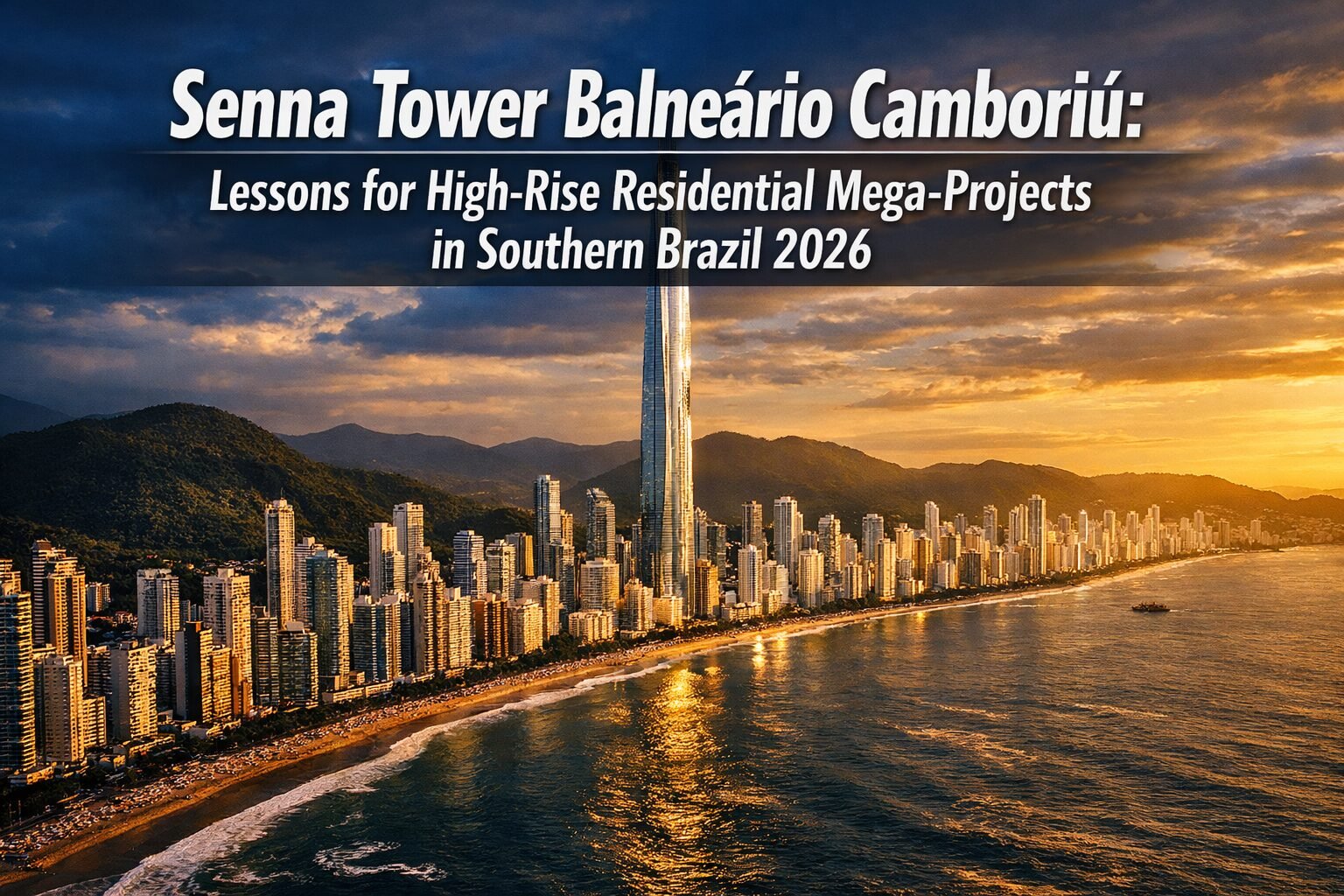
At 509 to 544 meters tall across 154 floors, a single residential building in a mid-sized Brazilian beach city is about to redefine what “luxury living” means on a global scale. Senna Tower Balneário Camboriú: Lessons for High-Rise Residential Mega-Projects in Southern Brazil 2026 is not just a story about record-breaking height — it is a masterclass in how developers can fuse cultural iconography, engineering innovation, and ultra-premium positioning to dominate an emerging market. For developers, investors, and urban planners watching Southern Brazil’s skyline evolve, the tactics behind this project offer a replicable blueprint worth studying closely.
Key Takeaways 🏗️
- Senna Tower will be the world’s tallest all-residential building, surpassing New York’s Central Park Tower upon completion, with 228 units ranging from luxury apartments to 900+ sq m penthouses.
- Engineering firsts matter for marketing: The tower’s tuned mass damper — a Latin American first — and its LEED Platinum pursuit signal how technical innovation becomes a competitive sales advantage.
- Cultural branding drives international demand: Anchoring the project to Ayrton Senna’s legacy transforms a real estate product into a globally recognized lifestyle statement.
- FG Empreendimentos’ 40-year track record — including responsibility for eight of Brazil’s ten tallest buildings — demonstrates that developer credibility is a non-negotiable asset in mega-project financing.
- Southern Brazilian hubs like Florianópolis are positioned to replicate Balneário Camboriú’s skyline-defining strategies as regional demand for premium vertical living accelerates in 2026.
The Anatomy of a World Record: Engineering and Design Choices That Define the Senna Tower
Understanding the Senna Tower Balneário Camboriú: Lessons for High-Rise Residential Mega-Projects in Southern Brazil 2026 begins underground — literally. Before a single floor rises above the coastal skyline, the engineering foundation sets the tone for everything that follows.
Foundation Engineering: Going 40 Meters Deep
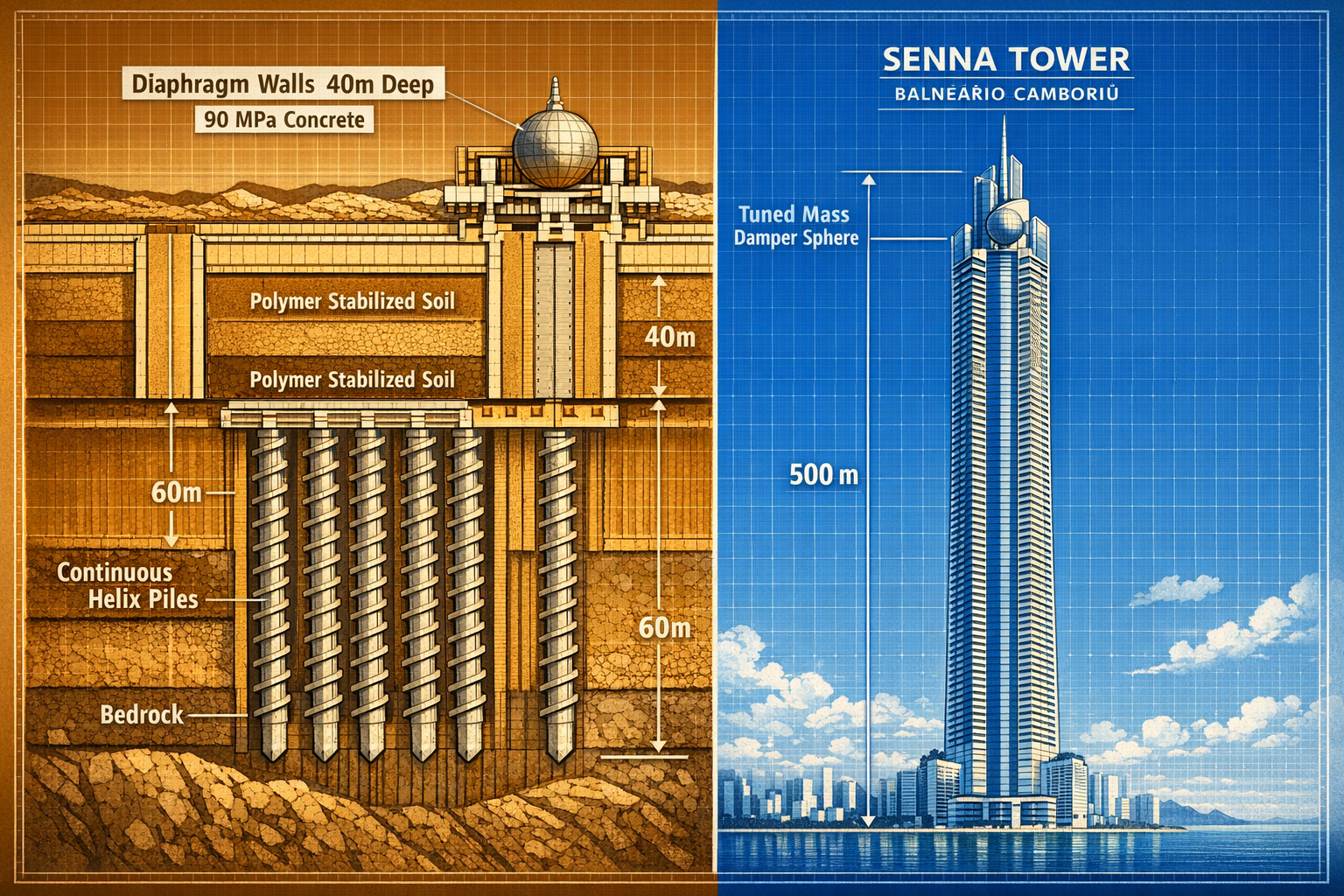
The tower’s construction employs a 40-meter deep diaphragm wall using concrete with a compressive strength of 90 MPa — among the highest used in Brazilian residential construction. Each wall panel measures 1 meter wide by 2 meters long, reinforced through polymer soil stabilization and continuous helix piles. [2] This is not simply a technical requirement; it is a statement of ambition that filters through to the project’s entire marketing narrative.
💡 Pull Quote: “The foundation of a supertall is its first marketing asset — it signals to buyers, financiers, and regulators that the developer is operating at a different level entirely.”
The Tuned Mass Damper Advantage
Perhaps the most commercially significant engineering feature is the tuned mass damper (TMD), which will make Senna Tower the first building in Latin America to deploy this technology. [1] A TMD is a large counterweight system — typically a massive pendulum or sliding mass — installed near a skyscraper’s crown to absorb wind-induced sway and seismic vibration. In practical terms, residents on the 130th floor will experience measurably less movement during storms than in comparable towers without the system.
For sales teams, this translates directly into a comfort guarantee that competitors cannot match. For engineers, it opens the door to greater structural slenderness, enabling the tower’s dramatic silhouette.
Stepped Terraces and the LEED Platinum Target
The architectural design features ascending rows of terraces with integrated pools and landscaping, reducing the building’s visual mass while creating private outdoor spaces at multiple levels. [3] More strategically, the project is pursuing LEED Platinum certification — which, if achieved, would make it the world’s first supertall residential building to reach this sustainability standard. [4]
| Feature | Senna Tower | Typical Brazilian High-Rise |
|---|---|---|
| Height | 509–544 m | 100–200 m |
| Sustainability Target | LEED Platinum | None or LEED Certified |
| Wind Mitigation | Tuned Mass Damper | Standard structural bracing |
| Foundation Depth | 40 m | 15–25 m |
| Concrete Strength | 90 MPa | 40–60 MPa |
This combination of structural innovation and sustainability positioning creates a dual narrative — one that appeals to environmentally conscious international buyers and to buyers seeking the most technologically advanced address in South America.
Cultural Iconography as a Sales Strategy: The Ayrton Senna Branding Model
The most replicable lesson from Senna Tower Balneário Camboriú: Lessons for High-Rise Residential Mega-Projects in Southern Brazil 2026 may have nothing to do with concrete or steel. It is the decision to build a real estate product around one of the most universally recognized names in global sports history.
How the Senna Family Partnership Works
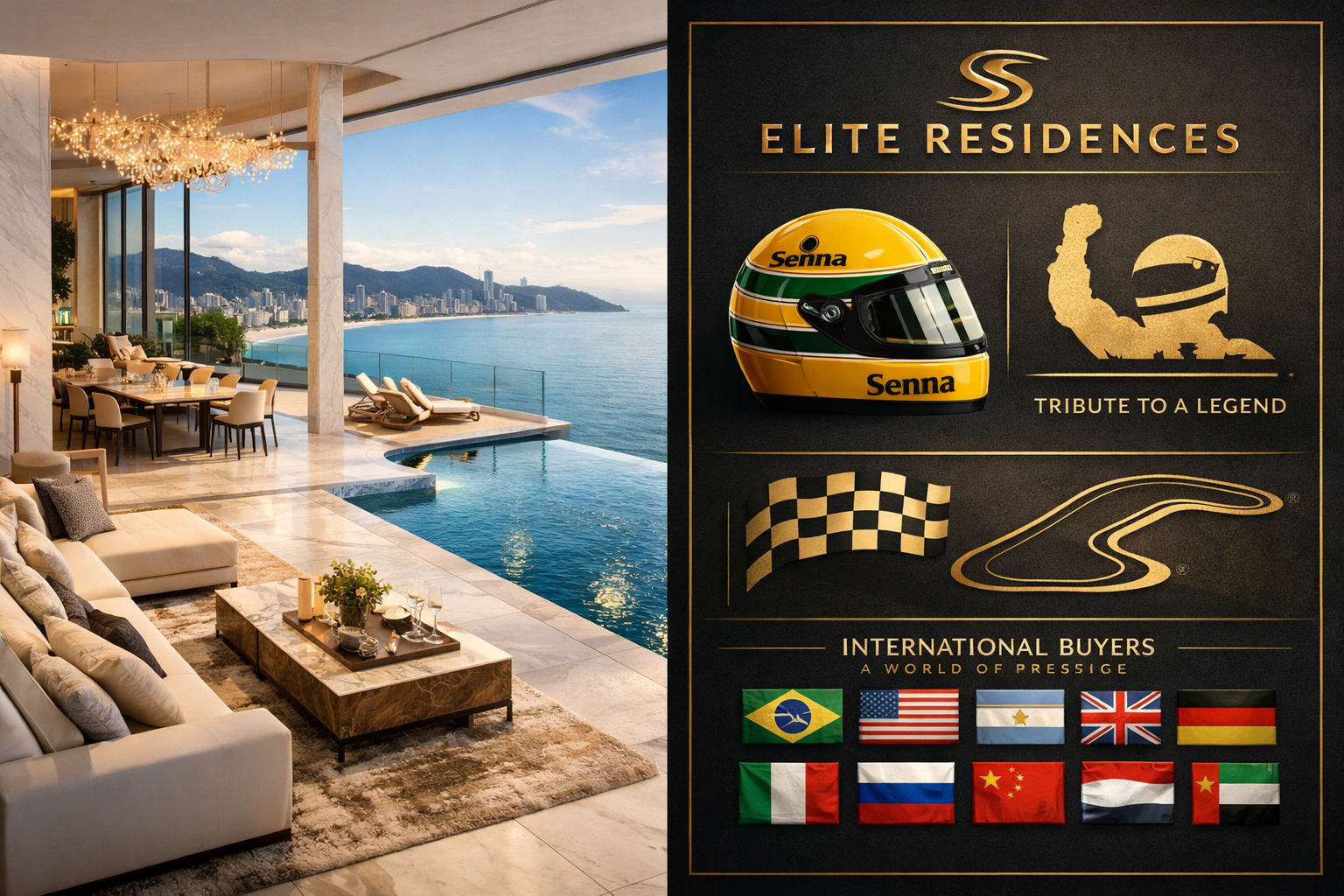
Announced on September 17, 2024, by FG Empreendimentos in partnership with the Senna family, the project was conceptualized by Lalalli Senna, Ayrton Senna’s niece. [1] [4] The podium level includes an immersive space dedicated to the late Formula One champion, complete with a tribute race track experience. [4] This is not a licensing arrangement slapped onto a generic luxury tower — it is a foundational design concept that shapes the building’s identity from the ground floor to the penthouse.
The strategic implications are significant:
- 🏎️ Global brand recognition: Ayrton Senna’s name resonates in Europe, Asia, and the Americas, extending the project’s marketing reach far beyond Brazilian borders.
- 🎯 Emotional differentiation: Buyers are not purchasing square meters — they are purchasing a connection to a cultural legend.
- 🌍 International media coverage: The Senna name generated editorial coverage in architecture, motorsport, and lifestyle publications worldwide, providing organic marketing that no advertising budget could replicate.
Translating Cultural Branding to Other Southern Brazilian Projects
Developers working in Florianópolis and the greater Santa Catarina region can draw a direct lesson here. Southern Brazil has its own rich cultural assets — from German and Italian immigrant heritage in the Serra Gaúcha to the surf culture of Florianópolis — that remain largely untapped as residential branding tools. The real estate market in greater Florianópolis is already in a high-growth phase; cultural differentiation could be the factor that elevates premium projects above the competition.
For investors evaluating the best places to invest in Brazilian property for high returns, the Senna Tower model demonstrates that brand equity is as important as location in determining long-term asset value.
Unit Mix, Pricing Architecture, and the Luxury Residential Market
A 228-Unit Tower Designed for Scarcity
The Senna Tower will contain just 228 residential units across 154 floors. [1] [3] This is a remarkably low density for a building of this height, and the math is intentional. The unit breakdown includes:
- Standard luxury apartments: Maximum 400 sq m each
- 18 elevated mansions: Mid-tower sky homes with expanded floor plans
- 6 penthouses: The largest exceeding 900 sq m in area [3]
Scarcity at this scale — fewer than 230 units in the world’s tallest residential building — creates an artificial exclusivity that supports premium pricing. Comparable supertall residential towers in New York and Dubai typically house 400 to 800 units. The Senna Tower’s restraint is a deliberate commercial strategy.
Amenity Stacking: The Full Lifestyle Package
The tower’s amenity program is designed to justify the price point at every level: [3] [4]
- 🏊 Heated pools (multiple levels)
- 💪 Gyms and spas
- 🎾 Tennis courts
- 🍽️ Restaurants and shops
- 🚗 Private garage club
- 🔭 Observatory at the tower’s crown with panoramic Atlantic Ocean views
This “vertical city” model — where residents never need to leave the building for daily needs — is increasingly standard in ultra-luxury towers globally, but it remains a differentiator in the Brazilian market. Developers building premium projects in Southern Brazil should note that amenity stacking directly supports price-per-square-meter premiums of 20–40% over comparable units without such offerings.
For context, projects like Tramonto and Solis in the Florianópolis region are already incorporating elevated amenity concepts — a clear signal that the market is moving in this direction. Understanding why buying off-plan can maximize investment gains is especially relevant when evaluating entry points into these premium developments.
Developer Credibility: Why FG Empreendimentos Could Pull This Off
40 Years, 63 Developments, 5,500 Units
Not every developer can announce the world’s tallest residential building and be taken seriously by buyers, financiers, and regulators. FG Empreendimentos brings over 40 years of construction experience, having delivered 63 major developments and approximately 5,500 units. [5] Critically, the company holds responsibility for eight of Brazil’s ten tallest buildings. [5]
This track record performs a specific function in the sales process: it converts skepticism into confidence. When a buyer is committing to a unit in a tower that will take years to complete, the developer’s history is the primary risk mitigation tool.
💡 Pull Quote: “In mega-project sales, the developer’s résumé IS the product — especially when the building exists only as renderings and engineering plans.”
Construction Timeline and Current Status
Construction was scheduled to begin in late 2025, with active construction underway in 2026. [4] [7] The foundation work — including the 40-meter diaphragm walls — represents the most technically complex phase of the entire project, and its successful execution validates the developer’s engineering claims to prospective buyers.
For developers in Southern Brazil watching this process, the lesson is clear: invest in visible, documentable construction milestones early. Progress updates, engineering certifications, and foundation completion announcements function as marketing assets. This mirrors the approach seen in foundation and construction progress updates for regional projects, where transparency builds buyer confidence throughout the development cycle.
Lessons for High-Rise Residential Mega-Projects in Southern Brazil 2026
The Senna Tower Balneário Camboriú: Lessons for High-Rise Residential Mega-Projects in Southern Brazil 2026 framework distills into five actionable strategies for developers operating in the region’s emerging premium markets.
1. 🏗️ Lead with Engineering Firsts
Technical innovations — TMD systems, ultra-high-strength concrete, LEED Platinum targets — are not just construction decisions. They are marketing differentiators that justify premium pricing and generate media coverage. Every mega-project should identify at least one engineering “first” to anchor its narrative.
2. 🎨 Anchor Identity in Cultural Storytelling
The Senna name transformed a luxury tower into a global cultural event. Southern Brazilian developers have access to rich regional heritage — from Florianópolis’ surf and technology identity to the wine country of Serra Gaúcha — that can perform a similar function at a regional or national scale.
3. 🔢 Use Scarcity as a Pricing Tool
228 units across 154 floors is a deliberate choice. Limiting unit count while maximizing floor-to-ceiling heights and private terrace space creates the conditions for premium pricing. Developers should resist the temptation to maximize unit density at the expense of exclusivity.
4. 📋 Build Developer Credibility Before You Build the Tower
FG Empreendimentos’ track record was a prerequisite for this project’s commercial viability. Developers in Florianópolis and the broader Southern Brazil market should systematically document and communicate their delivery history, engineering capabilities, and regulatory relationships. The sales performance transformation happening in Florianópolis real estate shows that buyers are increasingly sophisticated — credibility signals matter more than ever.
5. 🌿 Pursue Sustainability Certifications Proactively
LEED Platinum pursuit is not just an environmental commitment — it is an international marketing credential that opens doors to ESG-focused institutional investors and high-net-worth international buyers who prioritize sustainability in their real estate decisions.
The Florianópolis Opportunity: Replicating the Balneário Camboriú Model
Balneário Camboriú did not become Brazil’s vertical capital by accident. It combined permissive zoning, a desirable coastal location, and a culture of developer ambition over several decades. Florianópolis in 2026 presents a comparable inflection point — a growing technology hub, an internationally recognized quality of life, and a real estate market that is attracting both domestic and foreign capital.
The lifestyle advantages of living in Florianópolis — from beaches and nature to a thriving startup ecosystem — create the demand-side conditions that mega-projects require. What the city needs now is the supply-side ambition to match: developers willing to apply the engineering innovation, cultural branding, and scarcity-based pricing strategies that the Senna Tower has demonstrated at the world stage.
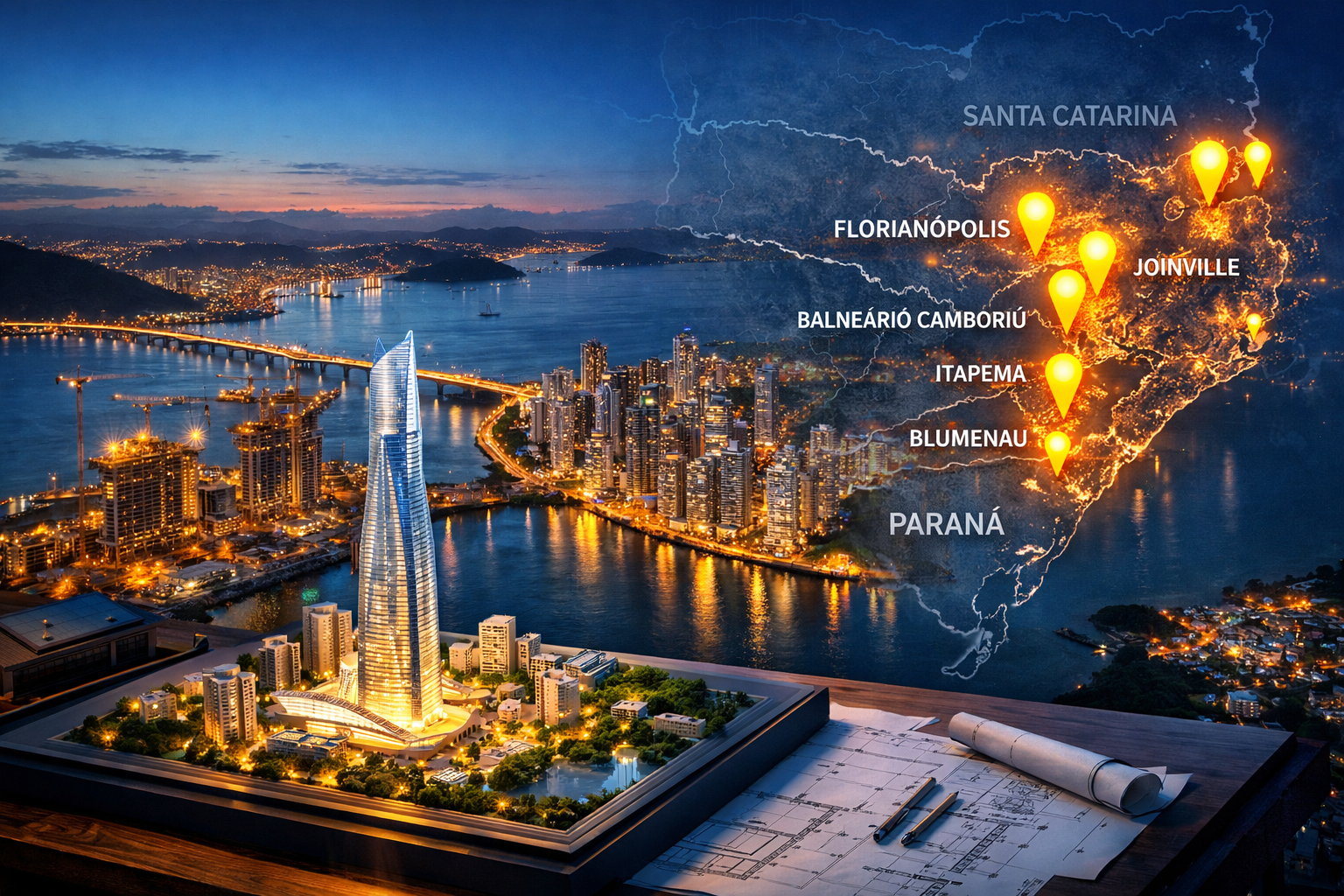
For investors, the window to enter Southern Brazilian premium real estate at pre-appreciation prices is narrowing. The Senna Tower effect — where a single landmark project elevates the entire city’s profile and property values — is a well-documented phenomenon in global real estate markets. Balneário Camboriú experienced it with each successive height record. Florianópolis is positioned for a similar trajectory.
Conclusion: Actionable Next Steps for Developers and Investors
The Senna Tower is more than a record-breaking skyscraper. It is a strategic document written in concrete and glass, demonstrating exactly how a developer can transform an emerging coastal city into a globally recognized luxury residential destination.
For developers planning high-rise projects in Southern Brazil in 2026, the immediate priorities are:
- ✅ Identify one engineering innovation that can serve as a marketing anchor
- ✅ Commission cultural or heritage research to find authentic brand narratives for the project
- ✅ Limit unit counts deliberately to support premium pricing architecture
- ✅ Begin LEED or equivalent sustainability certification processes at the design stage, not as an afterthought
- ✅ Document and publish construction milestones aggressively to build buyer confidence
For investors, the Senna Tower signals that Southern Brazil’s premium residential market has reached global-stage credibility. Early positions in comparable projects — particularly those in Florianópolis, where infrastructure investment and lifestyle demand are converging — offer the strongest risk-adjusted return potential.
The world’s tallest residential building is rising from a Brazilian beach city. The developers and investors who study its blueprint carefully will be the ones building — and profiting from — the next generation of Southern Brazil’s skyline.
References
[1] Senna Tower – https://en.wikipedia.org/wiki/Senna_Tower
[2] Cena Tower Veja Como Esta Nascendo O Predio Residencial Mais Alto Do Mundo Em Balneario Camboriu Com Fundacao De 40 Metros De Profundidade Mhbb01 – https://en.clickpetroleoegas.com.br/cena-tower-veja-como-esta-nascendo-o-predio-residencial-mais-alto-do-mundo-em-balneario-camboriu-com-fundacao-de-40-metros-de-profundidade-mhbb01/
[3] The Worlds Tallest Residential Skyscraper Senna Tower In Brazil – https://www.whitemad.pl/en/the-worlds-tallest-residential-skyscraper-senna-tower-in-brazil/
[4] Senna Tower Lalalli Balneario Camboriu Brazil Worlds Tallest Residential Skyscraper 09 20 2024 – https://www.designboom.com/architecture/senna-tower-lalalli-balneario-camboriu-brazil-worlds-tallest-residential-skyscraper-09-20-2024/
[5] sennatower – https://www.sennatower.com/en
[7] Cikbabvazvg – https://www.youtube.com/shorts/cIkbaBVAzvg