
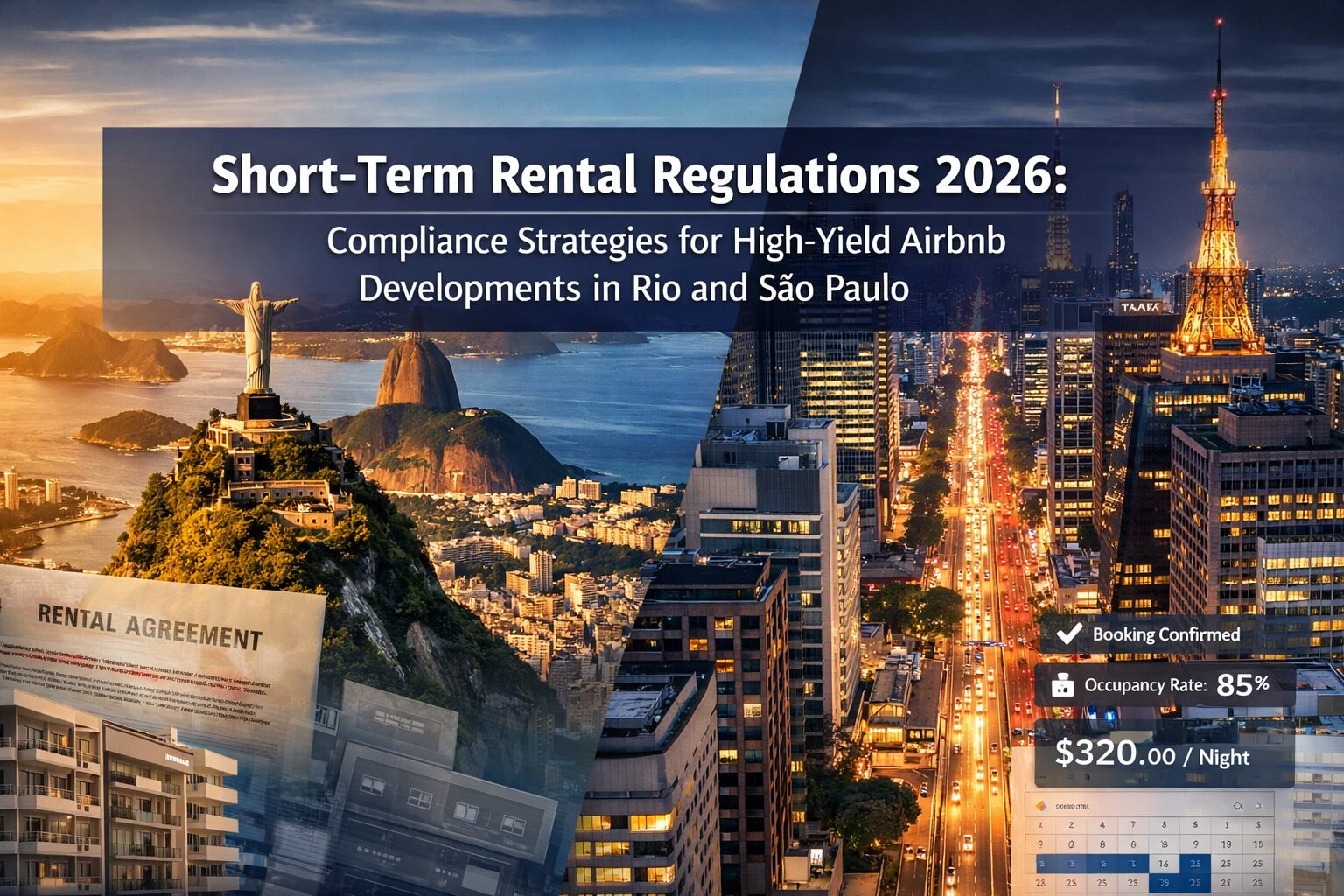
The Brazilian short-term rental market has entered a new era of regulatory scrutiny. As 2026 unfolds, developers and investors targeting high-yield Airbnb developments in Rio de Janeiro and São Paulo face an increasingly complex compliance landscape that demands strategic planning from the ground up. With stricter zoning classifications, taxation requirements, and registration proposals emerging across both cities, the days of purchasing any property and immediately listing it on Airbnb are definitively over. Yet opportunities for 20-30% annual returns remain robust for those who integrate compliant designs and partner with professional management from day one.
Understanding Short-Term Rental Regulations 2026: Compliance Strategies for High-Yield Airbnb Developments in Rio and São Paulo is no longer optional—it’s the foundation of sustainable investment success. The regulatory environment has matured significantly, with condominium-level restrictions, housing classification bans, and proposed municipal registration systems creating multiple compliance checkpoints that can make or break an investment’s profitability.
Key Takeaways
- Condominium approval is the single most critical compliance requirement in both cities, with Brazil’s Superior Court confirming buildings can prohibit short-term rentals through internal rules [9]
- São Paulo’s HIS/HMP housing ban prohibits entire categories of affordable housing developments from short-term rental use in premium neighborhoods including Vila Mariana, Pinheiros, and Butantã [1]
- Professional operators must register for business taxation with Municipal ISS rates of 2-5% in São Paulo, while Rio debates mandatory city-wide registration systems [1][4]
- Rio operates in a legal gray area with pending legislation (PL 372/2025) that would require explicit registration and condominium approval, potentially transforming the current permissive environment [4][5]
- Non-compliance penalties exceed R$10,000 in fines, injunctions, and legal costs, making pre-purchase verification essential before acquisition [1]
The Legal Foundation: Understanding Short-Term Rental Regulations 2026 in Brazil’s Major Cities

São Paulo’s Regulatory Framework: Permissive but Conditional
Short-term renting through Airbnb remains generally legal in São Paulo as of 2026, with no blanket citywide ban in place [1]. Operations are governed by federal Tenancy Law (Lei 8.245/1991), which explicitly allows seasonal rentals for stays up to 90 days [1]. This federal framework provides the baseline legal authorization that makes short-term rentals possible across Brazil.
However, São Paulo’s regulatory environment operates on a multi-layered compliance model where federal permission represents only the starting point. Three additional regulatory layers determine whether any specific property can legally operate as a short-term rental:
1. Condominium-Level Authorization
Brazil’s Superior Court of Justice (STJ) confirmed in a landmark 2021 ruling that residential buildings possess the legal authority to prohibit Airbnb-style rentals through their internal conventions and rules [9]. This decision elevated condominium approval to the single most important legal requirement for compliance in both São Paulo and Rio de Janeiro.
The ruling means that even if federal law permits short-term rentals and no municipal ban exists, a condominium’s internal rules can completely prohibit the practice. Violations of these rules can result in:
- Fines escalating with each infraction
- Court injunctions forcing immediate cessation of operations
- Legal costs exceeding R$10,000 [1]
- Permanent damage to investor reputation within the building
2. Housing Classification Restrictions
São Paulo implemented a 2025 municipal decree that prohibits all units classified as Habitação de Interesse Social (HIS) or Habitação de Mercado Popular (HMP) from short-term rental use [1]. These classifications were originally created to incentivize affordable housing development through construction benefits and tax advantages.
The ban creates a significant compliance challenge because many newer compact developments in high-potential neighborhoods fall under these classifications. Affected areas include:
- Vila Mariana
- Butantã
- Pinheiros
- Vila Clementino
- Perdizes
These neighborhoods represent some of São Paulo’s most desirable short-term rental markets, creating a paradox where premium locations contain properties permanently prohibited from the most profitable rental strategies. Developers who used HIS/HMP classifications to access construction incentives inadvertently locked their units out of short-term rental eligibility [1].
3. Absence of Additional Municipal Restrictions
Unlike many global cities, São Paulo does not impose citywide minimum-stay requirements, maximum nights-per-year caps, or primary residence requirements as of 2026 [1]. Owners of secondary homes can legally operate short-term rentals provided their condominium permits it and the property isn’t classified as restricted housing [1].
This absence of additional municipal restrictions means that properly classified, condominium-approved properties enjoy relatively permissive operating conditions compared to cities like New York, Paris, or Barcelona.
Rio de Janeiro’s Evolving Regulatory Landscape
Rio de Janeiro presents a markedly different regulatory picture. As of 2026, short-term rentals operate in a legal gray area with municipal authorities actively debating formalization through registration and taxation systems [4].
Current Operating Environment
Three core regulatory discussions dominate Rio’s short-term rental landscape:
ISS Collection Through Platforms: Municipal authorities are exploring mechanisms to collect Service Tax (ISS) directly through rental platforms like Airbnb, similar to hotel accommodation taxes [4]
Accommodation Fee Debates: Proposals for mandatory fees similar to Taxa de Estadia (tourism tax) would create new revenue streams while formalizing the sector [4]
Mandatory Unit Registration: The most significant proposal involves requiring all short-term rental units to register with municipal authorities before operating [4]
Pending Legislation: PL 372/2025
Rio lawmakers are actively debating Bill PL 372/2025, which would fundamentally transform the city’s short-term rental environment by requiring [4][5]:
- Mandatory city registration for all short-term rental properties
- Explicit condominium approval documented through official channels
- Simple online property registration processes
- Compliance verification before platform listing authorization
If enacted, PL 372/2025 would move Rio from its current permissive gray area to a formalized regulatory framework similar to São Paulo’s multi-layered model. The legislation focuses on traceability and safety rather than prohibition, suggesting Rio’s regulatory evolution aims to formalize rather than restrict the sector [4].
For investors and developers, this pending legislation creates planning uncertainty but also opportunity. Properties designed with compliance in mind will face minimal disruption if registration becomes mandatory, while existing non-compliant operations may face costly retrofitting or prohibition.
Critical Compliance Strategies for High-Yield Airbnb Developments
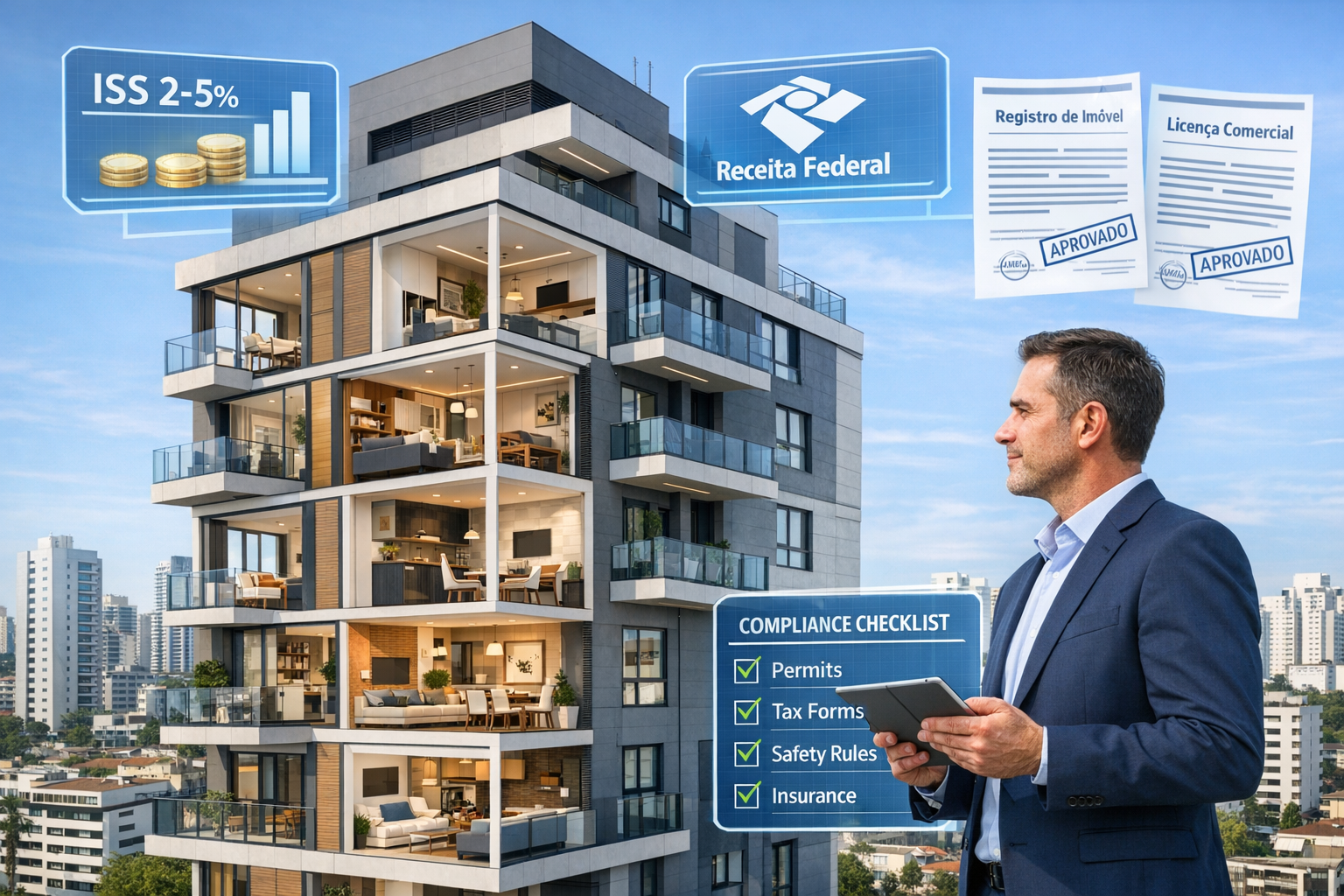
Pre-Acquisition Due Diligence: The Foundation of Compliance
Successful compliance begins before purchase, not after. Developers and investors must verify three critical factors during property evaluation:
1. Housing Classification Verification
Request official documentation showing the property’s classification status. In São Paulo, confirm the unit is not designated as HIS or HMP housing [1]. This single factor can determine whether a property in a premium neighborhood like Pinheiros can ever operate as a short-term rental.
Classification verification requires:
- Review of original construction permits
- Confirmation with the municipal planning department
- Written certification from the developer or seller
- Legal opinion from a Brazilian real estate attorney
2. Condominium Convention Analysis
Obtain and thoroughly review the building’s convention (convenção de condomínio) and internal rules (regimento interno). These documents govern all aspects of building operations and may contain explicit prohibitions on short-term rentals [9].
Key provisions to identify:
| Provision Type | Compliance Impact | Mitigation Options |
|---|---|---|
| Explicit STR prohibition | Complete barrier | None—avoid property |
| Minimum rental period (e.g., 30 days) | Operational constraint | Adjust rental strategy |
| Guest registration requirements | Administrative burden | Implement compliance systems |
| Silent on short-term rentals | Generally permissive | Document current practice |
| Explicit STR permission | Ideal scenario | Verify cannot be changed easily |
3. Neighborhood Regulatory Research
Research pending municipal legislation that might affect the target neighborhood. Rio’s PL 372/2025 demonstrates how quickly regulatory environments can shift [4][5]. Subscribe to municipal legislative updates and maintain relationships with local real estate attorneys who monitor regulatory changes.
Taxation and Business Registration Requirements
Professional short-term rental operations in São Paulo trigger specific taxation and registration obligations that differ significantly from traditional long-term rentals.
Municipal Service Tax (ISS)
Professional operators must pay Municipal ISS ranging from 2 to 5 percent of rental income in São Paulo [1]. The rate varies based on:
- Total annual revenue
- Business structure (individual vs. corporate)
- Specific municipal district
- Nature of services provided
All rental income must be declared to Receita Federal (Brazil’s federal tax authority) regardless of operation scale [1]. Failure to declare creates significant legal exposure including:
- Back taxes with penalties and interest
- Criminal tax evasion charges for systematic non-declaration
- Platform account suspension
- Difficulty selling the property due to tax liens
Business Registration Thresholds
São Paulo does not require a specific short-term rental license for individual hosts, but professional operators running recurring rentals with profit intent may need business registration [1]. Registration requires:
- Proof of address (comprovante de residência)
- Valid identification (CPF for individuals, CNPJ for companies)
- Declaration of business activity (rental services)
- Municipal registration for ISS collection
The threshold between “casual host” and “professional operator” remains somewhat ambiguous, but operating multiple properties or generating substantial income (generally above R$50,000 annually) clearly triggers professional obligations.
Condominium Relations and Approval Strategies
Given that condominium approval represents the most critical compliance factor, developers must prioritize building-level authorization strategies.
For New Developments
Developers creating purpose-built short-term rental properties should:
✅ Draft STR-Permissive Conventions: Include explicit language permitting short-term rentals in the original condominium convention
✅ Create Dedicated STR Buildings: Design entire buildings for short-term rental use, eliminating resident conflicts
✅ Implement Professional Management: Require professional management companies to maintain quality standards
✅ Establish Guest Protocols: Create clear guest registration, access, and behavior policies
✅ Design for Compliance: Include features like separate guest entrances, soundproofing, and adequate parking
For Existing Buildings
Investors purchasing in existing condominiums must:
🔍 Verify Current Practice: Document whether other units currently operate as short-term rentals
🔍 Review Meeting Minutes: Examine past condominium meeting records for STR discussions or complaints
🔍 Engage Building Management: Establish positive relationships with building administrators before launching operations
🔍 Propose Rule Amendments: If rules are silent or ambiguous, propose formal amendments explicitly permitting STR with appropriate safeguards
🔍 Offer Compromise Solutions: Suggest guest registration systems, noise monitoring, or revenue sharing with the condominium
Professional Management: The Compliance Multiplier
Professional property management has evolved from a luxury to a compliance necessity in 2026. High-yield operations increasingly depend on management companies that handle:
Regulatory Compliance Functions
- Tax declaration and ISS payment
- Guest registration and documentation
- Condominium rule adherence
- Municipal registration (in Rio if PL 372/2025 passes)
- Insurance and liability management
Operational Excellence Functions
- Dynamic pricing optimization
- 24/7 guest communication
- Professional cleaning and maintenance
- Quality control and inspection
- Review management and reputation building
The cost of professional management (typically 20-30% of gross revenue) is increasingly viewed as a compliance investment rather than an expense. Properties managed professionally demonstrate significantly lower violation rates and higher guest satisfaction scores, both critical for sustained high yields.
For developers targeting institutional investors or international buyers, professional management integration from day one has become a mandatory selling point. Many sophisticated investors now refuse to purchase properties without established management agreements already in place.
Maximizing Returns Within the Compliance Framework

Design Strategies for Compliant High-Yield Properties
The regulatory environment of 2026 rewards properties specifically designed for compliant short-term rental operations. Key design elements include:
Location Selection
- Prioritize neighborhoods with established short-term rental markets
- Verify absence of HIS/HMP classifications in target buildings
- Select areas with strong tourism or business travel demand
- Consider proximity to metro stations, beaches, or business districts
- Research condominium attitudes toward short-term rentals in the area
Unit Configuration
- Studio and one-bedroom units generate highest per-square-meter returns
- Include dedicated workspace for business travelers
- Maximize natural light and views
- Design flexible spaces that photograph well
- Include high-quality finishes that justify premium pricing
Amenity Integration
- Building amenities (pools, gyms, coworking spaces) significantly increase booking rates
- Smart home technology (keyless entry, climate control) reduces operational costs
- High-speed internet (minimum 100 Mbps) is non-negotiable for business travelers
- In-unit laundry increases guest satisfaction and nightly rates
- Quality kitchen equipment enables longer stays and higher ratings
Compliance-Friendly Features
- Soundproofing exceeding building code minimums
- Separate guest entrance where possible
- Video doorbell systems for security and guest verification
- Noise monitoring devices (non-recording) to prevent violations
- Clear signage and guest instruction materials
Financial Modeling for Compliant Operations
Accurate financial modeling must incorporate all compliance costs to project realistic returns. A comprehensive pro forma for a compliant São Paulo or Rio short-term rental includes:
Revenue Assumptions
- Average Daily Rate (ADR): R$250-600 depending on location and quality
- Occupancy Rate: 65-75% for well-managed properties
- Seasonal Variation: 20-30% rate premium during high season
- Cleaning Fees: R$150-300 per turnover
Operating Expenses
- Professional Management: 20-30% of gross revenue
- Cleaning and Laundry: R$150-300 per turnover
- Utilities: R$300-600 monthly
- Platform Fees: 3% (Airbnb host service fee)
- Maintenance Reserve: 5-8% of gross revenue
- Insurance: R$1,500-3,000 annually
- Condominium Fees: R$400-1,200 monthly
- Property Tax (IPTU): 0.5-1.5% of property value annually
Compliance Costs
- ISS Tax: 2-5% of gross revenue [1]
- Business Registration: R$500-2,000 annually
- Legal and Accounting: R$3,000-8,000 annually
- Municipal Registration (Rio, if enacted): R$500-1,500 initially
Capital Expenditure
- Initial Furnishing: R$30,000-80,000 depending on quality
- Refresh Cycle: R$5,000-15,000 every 2-3 years
- Technology Upgrades: R$2,000-5,000 every 3-4 years
When properly modeled with all compliance costs included, well-located and professionally managed properties in Rio and São Paulo continue to generate net returns of 20-30% annually on invested capital, significantly outperforming traditional long-term rentals (typically 4-6% net yields).
Market Positioning for Premium Pricing
Compliance-focused properties can command premium pricing by positioning themselves as legitimate, professional accommodations rather than informal rentals. Effective positioning strategies include:
🏆 Professional Branding
- Create dedicated property websites beyond platform listings
- Develop consistent visual identity across all marketing materials
- Highlight compliance credentials (registered business, professional management)
- Showcase building amenities and neighborhood advantages
⭐ Quality Differentiation
- Target 4.8+ average rating through consistent quality delivery
- Respond to all guest inquiries within 1 hour
- Provide welcome packages and local recommendations
- Maintain hotel-quality cleanliness standards
- Offer flexible check-in/check-out when possible
💼 Business Traveler Focus
- Emphasize workspace, high-speed internet, and quiet environment
- Offer monthly discounts for extended business stays
- Provide invoices and documentation for corporate reimbursement
- Create relationships with corporate relocation services
- Position near business districts and conference venues
🌍 International Guest Appeal
- Provide multilingual support (English, Spanish, Portuguese minimum)
- Include international power adapters and voltage converters
- Offer airport transfer coordination
- Create detailed neighborhood guides in multiple languages
- Accept international payment methods beyond platform standards
Risk Management and Insurance
Comprehensive insurance coverage has evolved from optional to essential as regulatory scrutiny increases. Required coverage includes:
Property Insurance
- Standard homeowner’s coverage (often excludes short-term rental activity)
- Short-term rental endorsement or specialized STR policy
- Coverage minimums of R$500,000 for property damage
- Loss of income coverage for 6-12 months
Liability Insurance
- General liability coverage minimum R$1,000,000
- Coverage for guest injuries on property
- Protection against third-party property damage claims
- Legal defense cost coverage
Host Protection Programs
- Airbnb’s Host Protection Insurance (R$1,000,000 coverage)
- VRBO’s liability insurance programs
- Supplemental coverage for gaps in platform protection
- Verification that platform coverage applies in Brazil
Many traditional Brazilian insurance companies now offer specialized short-term rental policies that address the unique risk profile of these operations, with annual premiums typically ranging from 0.5-1.5% of property value.
Future-Proofing Your Investment Strategy
Anticipating Regulatory Evolution
The regulatory landscape will continue evolving through 2026 and beyond. Successful investors anticipate changes rather than react to them. Key trends to monitor:
📋 Registration Requirements
Rio’s PL 372/2025 represents a likely template for future Brazilian regulation [4][5]. Even if not enacted in its current form, some version of mandatory registration will probably emerge. Investors should:
- Design operations that can easily comply with registration systems
- Maintain detailed records of all guests, income, and expenses
- Establish relationships with legal counsel monitoring regulatory changes
- Participate in industry associations advocating for balanced regulation
🏛️ Condominium Rule Evolution
As short-term rentals become more common, condominium rules will continue evolving. Buildings may:
- Impose percentage caps on STR units (e.g., maximum 20% of units)
- Require professional management as a condition of approval
- Mandate guest registration and screening systems
- Establish noise monitoring or complaint resolution procedures
- Create special assessment fees for STR units
Proactive investors should participate in condominium governance, serve on boards, and help shape reasonable rules rather than opposing all regulation.
💰 Taxation Expansion
Tax collection will likely intensify as municipalities recognize short-term rentals as significant revenue sources. Anticipated developments include:
- Platform-collected accommodation taxes similar to hotel taxes
- Increased ISS rates for professional operators
- Enhanced reporting requirements and tax authority data sharing
- Penalties for non-compliance becoming more severe
Maintaining impeccable tax compliance from day one protects against future enforcement actions and positions properties as legitimate businesses.
Building Portfolio Resilience
Sophisticated investors are building portfolio resilience through diversification strategies that reduce regulatory risk:
Geographic Diversification
- Spread investments across multiple neighborhoods and cities
- Include properties in areas with different regulatory environments
- Consider emerging markets like Florianópolis and other high-return Brazilian locations
Product Diversification
- Mix short-term and long-term rental properties
- Include properties suitable for corporate housing (30+ day stays)
- Develop flexible properties that can pivot between rental strategies
- Consider mixed-use developments with retail or office components
Operational Diversification
- Work with multiple management companies to reduce dependency
- List on multiple platforms (Airbnb, VRBO, Booking.com)
- Develop direct booking channels to reduce platform dependency
- Create corporate client relationships for guaranteed occupancy
Legal Structure Optimization
- Consult with Brazilian tax attorneys on optimal ownership structures
- Consider holding properties through properly structured companies
- Evaluate family office structures for larger portfolios
- Implement estate planning strategies for long-term holdings
Conclusion: Thriving Through Strategic Compliance
Short-Term Rental Regulations 2026: Compliance Strategies for High-Yield Airbnb Developments in Rio and São Paulo demand a fundamentally different approach than the freewheeling early days of platform-based rentals. The regulatory environment has matured into a multi-layered compliance framework where success requires strategic planning from property selection through daily operations.
The core compliance requirements are clear: condominium approval stands as the single most critical factor, while housing classification verification, professional tax compliance, and operational excellence through professional management complete the foundation for sustainable high yields. São Paulo’s explicit HIS/HMP ban and Rio’s pending registration legislation demonstrate that regulatory evolution continues accelerating.
Yet these challenges create opportunity. Properties designed specifically for compliant short-term rental operations—with appropriate classifications, condominium approval, professional management integration, and guest-focused amenities—continue generating exceptional returns of 20-30% annually while less sophisticated competitors face increasing operational barriers.
Actionable Next Steps
For developers and investors targeting high-yield Airbnb developments in Rio and São Paulo:
Conduct Comprehensive Due Diligence: Verify housing classifications, review condominium conventions, and research neighborhood regulatory trends before any acquisition
Integrate Professional Management: Partner with established management companies from day one rather than attempting self-management in an increasingly complex regulatory environment
Design for Compliance: Incorporate soundproofing, separate entrances, smart home technology, and other features that facilitate compliant operations while enhancing guest experience
Establish Proper Business Structure: Register appropriate business entities, implement tax compliance systems, and maintain detailed financial records from the first booking
Build Condominium Relationships: Engage positively with building management, participate in governance, and demonstrate that professional short-term rentals benefit the entire community
Monitor Regulatory Evolution: Subscribe to legislative updates, maintain legal counsel relationships, and participate in industry associations shaping future regulation
Invest in Quality: Target 4.8+ ratings through consistent quality delivery, positioning properties as premium professional accommodations rather than informal rentals
The Brazilian short-term rental market remains extraordinarily attractive for investors who approach it strategically. By embracing compliance as a competitive advantage rather than viewing it as a burden, developers can build sustainable high-yield portfolios that thrive regardless of regulatory evolution.
The opportunity is substantial, but the window for establishing compliant operations before enforcement intensifies is narrowing. Investors who act now with proper compliance strategies will dominate the next decade of Brazilian short-term rental markets.
For more insights on Brazilian real estate investment opportunities, explore Quadragon’s comprehensive market analysis and discover why buying pre-construction properties can maximize your returns.
References
[1] Sao Paulo Airbnb – https://thelatinvestor.com/blogs/news/sao-paulo-airbnb
[2] Brazil Airbnb – https://thelatinvestor.com/blogs/news/brazil-airbnb
[3] Airbnb Rules Brazil – https://www.hostaway.com/blog/airbnb-rules-brazil/
[4] Rio Airbnb Regulation Outlook – https://www.oabitat.com/en/rio-airbnb-regulation-outlook/
[5] Watch – https://www.youtube.com/watch?v=UDp32QxWqoU
[6] airbnb – https://www.airbnb.com/help/article/4071
[7] airbnb – https://www.airbnb.com/help/article/2588
[8] Starting An Airbnb Brazil – https://airbtics.com/starting-an-airbnb-brazil/
[9] Brazilian Court Confirms Restrictions On Airbnb Rentals In Condominiums – https://www.riotimesonline.com/brazilian-court-confirms-restrictions-on-airbnb-rentals-in-condominiums/
[10] Sao Paulo Airbnb – https://thelatinvestor.com/blogs/news/sao-paulo-airbnb