
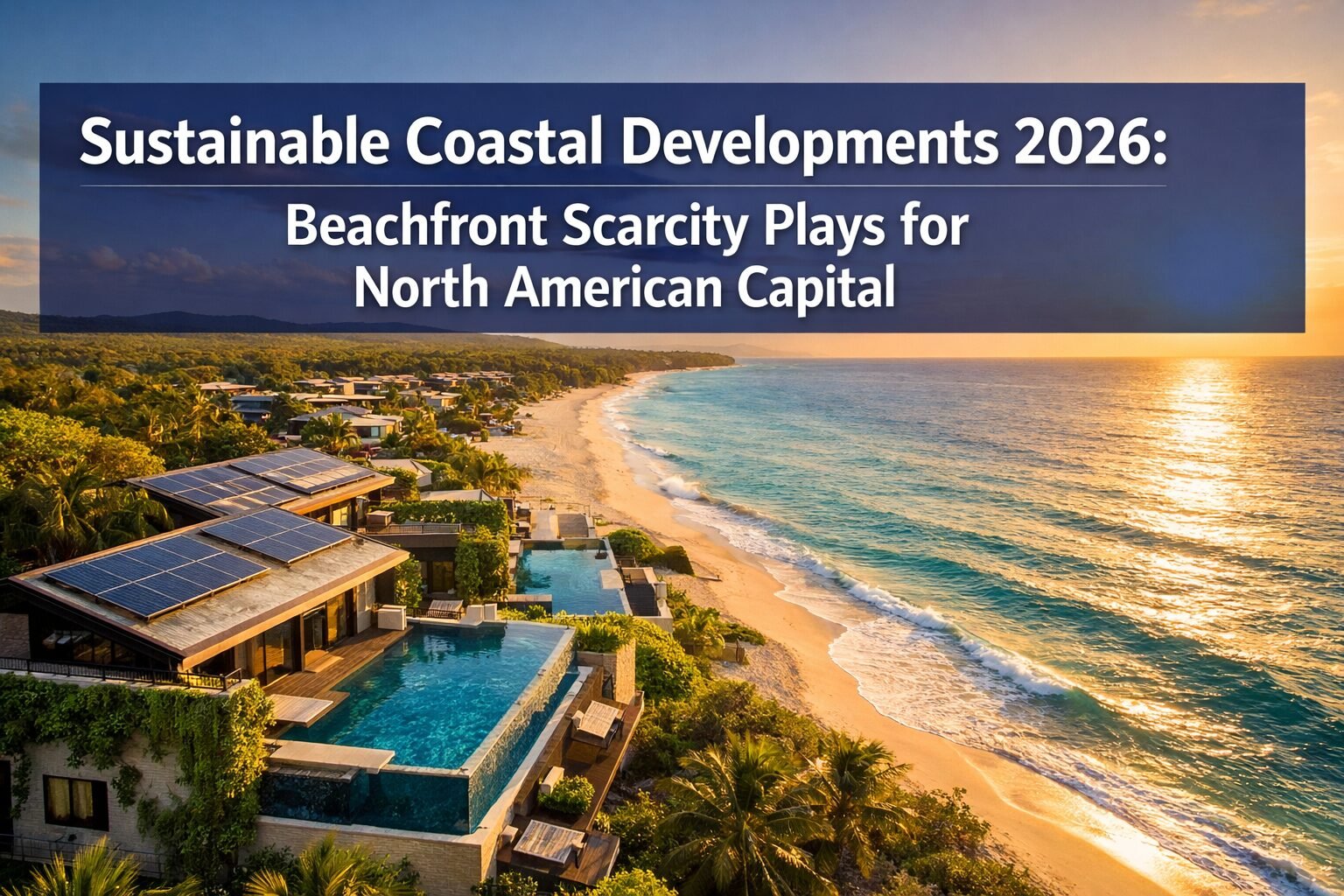
Foreign demand for North American beachfront real estate has surged 40% year-over-year — yet the supply of developable, regulation-compliant coastal land keeps shrinking. That gap between demand and supply is exactly where the most compelling capital opportunity of 2026 sits. Sustainable Coastal Developments 2026: Beachfront Scarcity Plays for North American Capital is not simply a trend story; it is an urgent strategic window for developers and investors who understand that eco-luxury beachfront assets are becoming the scarcest, most defensible real estate class on the continent.
Water constraints, climate resilience mandates, and tightening coastal zoning are converging to permanently limit new beachfront supply. Meanwhile, sustainability-focused foreign capital is actively hunting for shovel-ready projects that meet ESG criteria. The developers who move now — before the 2026 appreciation wave fully crests — will capture the most asymmetric returns.
Key Takeaways 🏖️
- Beachfront land supply is structurally constrained by water scarcity, coastal zoning, and climate regulations — creating durable scarcity premiums.
- Foreign demand for North American coastal real estate has grown 40% year-over-year, driven by ESG mandates and lifestyle migration.
- Water availability has become the #1 site-selection factor for new developments across North America, displacing labor costs and tax incentives. [2]
- Sustainability credentials are no longer optional — they are the gating requirement for premium pricing, financing, and regulatory approval.
- Early-mover developers who secure coastal sites with verified water access and green certifications in 2026 are positioned for outsized appreciation.
Why Beachfront Scarcity Is the Defining Investment Theme of 2026
The phrase “they’re not making more beachfront” has been a real estate cliché for decades. In 2026, it has become a quantifiable investment thesis backed by regulatory data, climate science, and capital flows.
The Water Constraint Is Reshaping Every Market
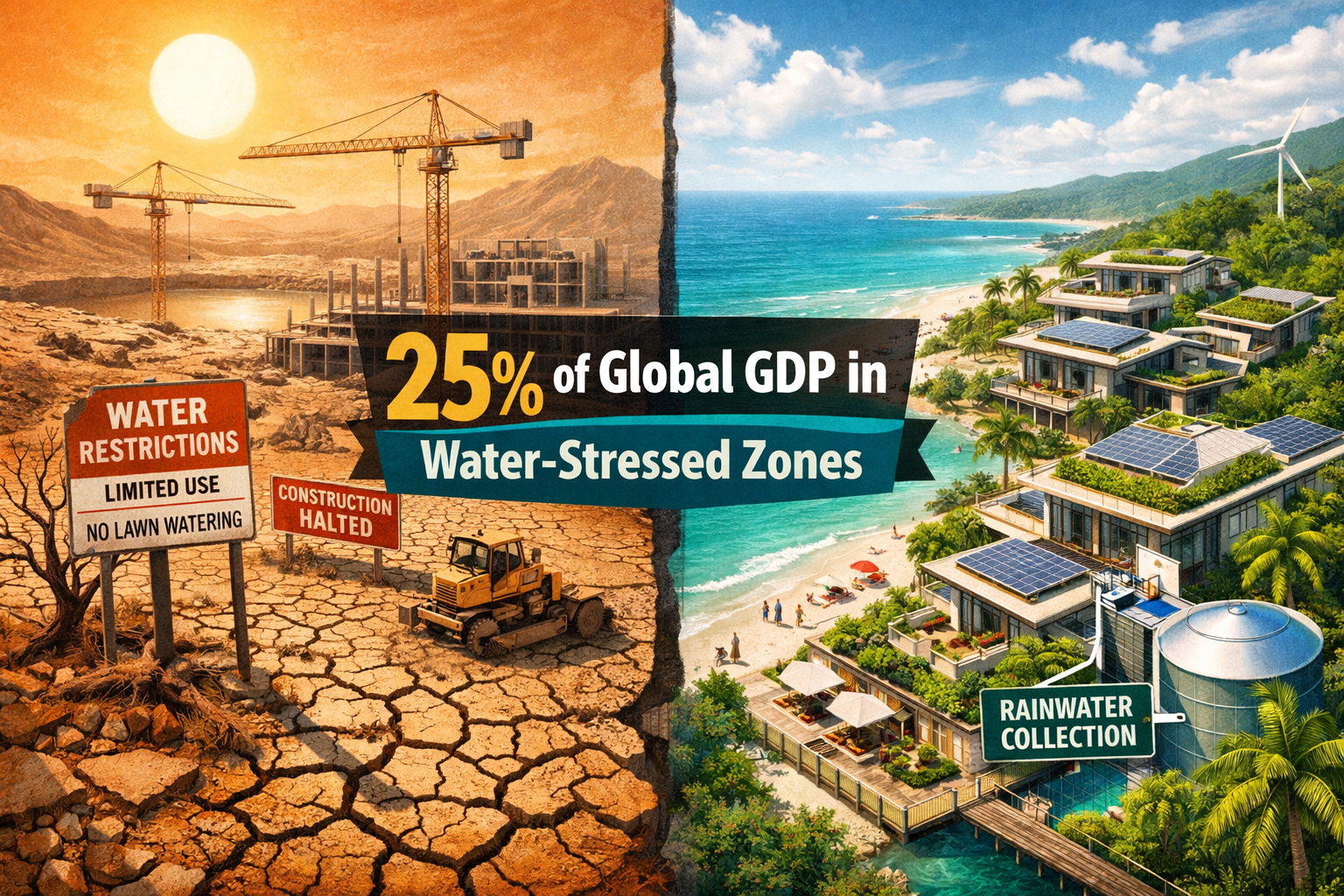
Water availability has moved from a background utility to the primary gating factor in site selection decisions across North America [2]. This shift has profound implications for coastal developers: inland alternatives are closing off, funneling capital toward coastal locations where freshwater access, desalination potential, and rainwater harvesting systems make projects viable.
💧 “Water has displaced labor costs, tax incentives, and logistics as the number-one site selection driver in 2026.” — Environment & Energy Leader [2]
The numbers are stark. The World Resources Institute estimates that more than 25% of global GDP operates in areas of high or extremely high water stress — including Texas, Arizona, and California [2]. These are precisely the states where the most aggressive coastal and industrial development has been concentrated.
- Arizona has already restricted groundwater access for new developments in the Phoenix metro area, citing insufficient long-term supply [2].
- Texas industrial users face rising water costs and tighter regulatory scrutiny as aquifer levels decline across multiple basins [2].
- California faces persistent drought across the Southwest and Southern Plains, compounding pressure on any new development that cannot demonstrate a sustainable water strategy [2].
The practical result: developers who can demonstrate closed-loop water systems, rainwater harvesting, and greywater recycling in their coastal projects are not just being responsible — they are unlocking approvals and financing that water-stressed inland competitors cannot access.
Coastal Zoning Is Permanently Shrinking the Buildable Supply
Beyond water, coastal zoning regulations are tightening in every major North American market. Setback requirements, flood-zone restrictions, and sea-level-rise projections are removing parcels from the developable inventory at a pace that will not reverse. This is structural scarcity, not cyclical.
For investors, this means that every permitted, shovel-ready coastal site is rarer today than it was 12 months ago — and will be rarer still in 12 months. The appreciation premium for compliant beachfront assets is not speculative; it is a direct function of shrinking supply meeting growing demand.
Explore current coastal development opportunities that are already navigating these regulatory realities with sustainability-first design.
The Eco-Luxury Demand Wave: Foreign Capital and Sustainability Mandates

Sustainable Coastal Developments 2026: Beachfront Scarcity Plays for North American Capital are attracting a specific and highly motivated buyer profile: internationally mobile capital seeking assets that satisfy both financial return requirements and ESG mandates.
Who Is Buying and Why
The 40% year-over-year growth in foreign demand for North American beachfront assets is not random. It reflects three converging forces:
| Driver | Detail |
|---|---|
| 🌍 ESG Mandates | Institutional and family office capital must demonstrate sustainable asset allocation |
| 🏖️ Lifestyle Migration | Post-pandemic preference for coastal living with natural amenity access |
| 💱 Currency Arbitrage | Dollar-denominated hard assets remain attractive to Latin American and European buyers |
| 🔒 Scarcity Premium | Investors understand that compliant coastal supply is permanently shrinking |
This demand profile is particularly relevant for markets like Florianópolis, Brazil — a coastal destination that has seen remarkable growth in both lifestyle appeal and investment returns. The real estate market of Greater Florianópolis has demonstrated how sustainable coastal development, when executed correctly, generates premium valuations that outperform inland alternatives.
Sustainability Is Now the Admission Ticket
The era of greenwashing is over. Sophisticated buyers in 2026 require verifiable sustainability credentials — third-party certifications, measurable energy performance, documented water management plans, and biodiversity impact assessments.
California has put its institutional weight behind this standard, approving over $6 million in funding for nine science and restoration projects supporting ocean health and conservation [5]. The state’s explicit goal is to conserve 30% of coastal waters by 2030 [5] — a policy trajectory that will continue to tighten what can be built, where, and how.
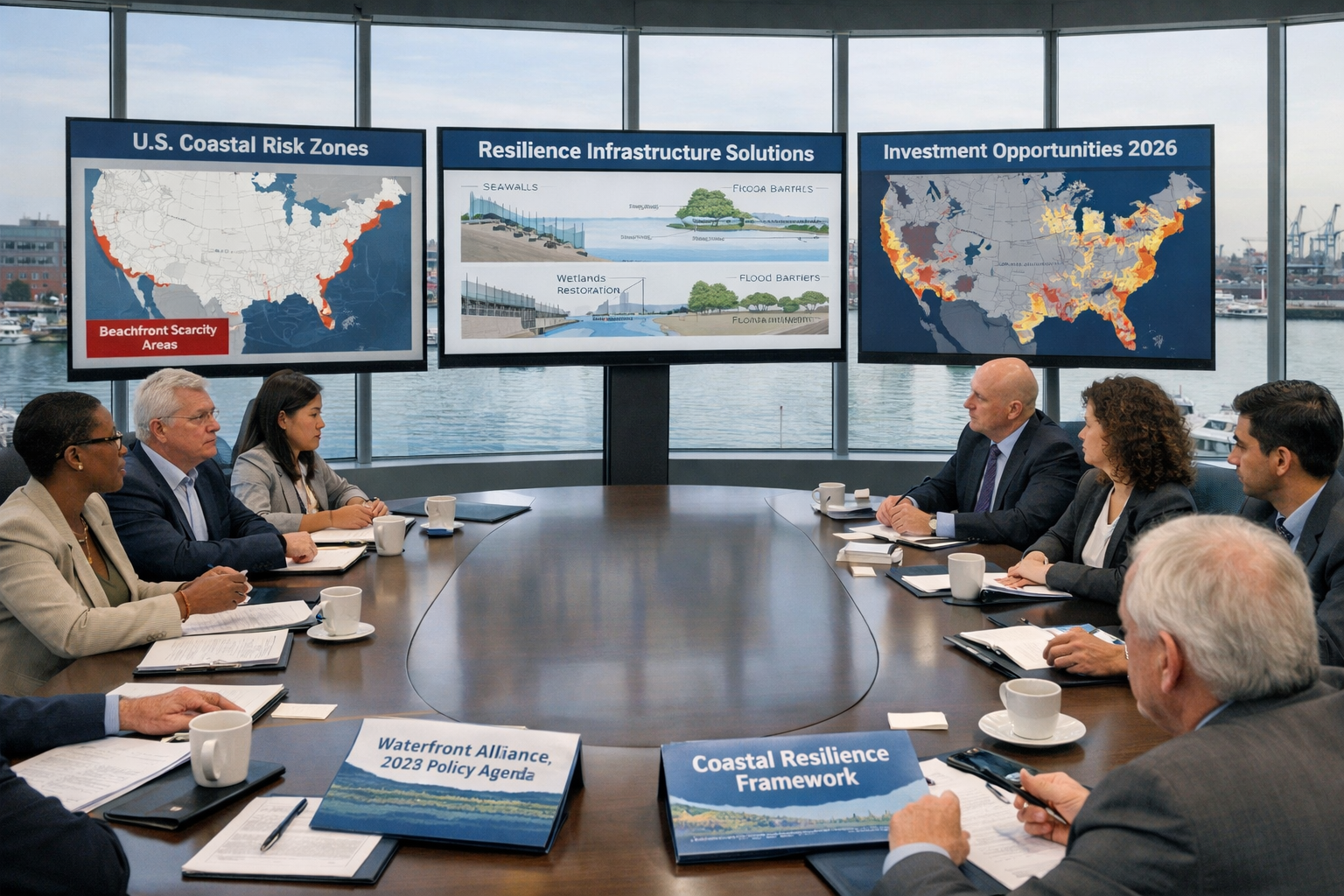
The Waterfront Alliance’s 2026 policy agenda for the New York/New Jersey region (released February 26, 2026) prioritizes innovative funding strategies for climate resilience and expanding maritime services across the harbor region [3]. This signals that even the densest, most established coastal markets are pivoting toward resilience infrastructure as the organizing principle for future development.
For developers, this creates a clear mandate: build sustainability in from the foundation, not as an afterthought. Projects like Tramonto represent what this looks like in practice — coastal development designed with long-term environmental and financial resilience as core principles.
Strategic Playbook: Positioning Capital for 2026 Coastal Appreciation
Sustainable Coastal Developments 2026: Beachfront Scarcity Plays for North American Capital requires a specific strategic framework. Not all coastal assets will benefit equally from the scarcity dynamic — the premium will concentrate in projects that meet a defined set of criteria.
The Four Pillars of a Scarcity-Proof Coastal Asset
1. 🌊 Verified Water Security Any coastal development that cannot demonstrate a sustainable, long-term water supply strategy is a liability, not an asset. This means closed-loop systems, rainwater harvesting, greywater recycling, or access to desalination infrastructure. Given that hyperscale facilities alone can consume 3–5 million gallons of water per day for cooling [2], municipal water systems in coastal cities are under unprecedented pressure. Residential and mixed-use coastal developments that reduce their draw on public supply will earn both regulatory favor and premium buyer interest.
2. 🏗️ Resilience Infrastructure Coastal summit leaders convened in March 2026 specifically to address policy strategies for shoreline protection and coastal resilience [1]. The policy direction is clear: new coastal developments must demonstrate resilience to sea-level rise, storm surge, and increased hurricane intensity. Elevated foundations, permeable surfaces, living shorelines, and native landscaping are no longer optional design features — they are underwriting requirements.
3. 📋 Regulatory Compliance and Beach Water Quality Congress protected FY26 funding for EPA BEACH Act water quality testing programs nationwide [6], despite attempts to eliminate the program. This means beach water quality standards will be enforced and publicly reported. Developments adjacent to consistently high-quality, tested beaches carry measurable premium over those near degraded or untested shorelines. Developers should actively engage with local water quality monitoring programs as a marketing and valuation asset.
4. 💰 Pre-Appreciation Entry Timing The appreciation wave is building, not cresting. Investors who enter during the construction phase of certified sustainable coastal projects capture the maximum valuation uplift. The advantages of investing in off-plan coastal properties are well-documented: pre-launch pricing, construction-phase appreciation, and delivery-day valuation gaps that can represent 20–40% returns before the first tenant or owner takes possession.
Market Selection: Where to Deploy Capital in 2026
Not every coastal market offers equal scarcity dynamics. The most attractive plays combine:
- Tight existing zoning that prevents new supply from entering the market
- Strong foreign buyer demand with ESG-aligned capital
- Proven infrastructure investment in resilience and water management
- Lifestyle appeal that sustains demand across economic cycles
Markets like Florianópolis stand out in this analysis. The growth of the Ingleses region in Florianópolis illustrates how a coastal market with strong lifestyle fundamentals, improving infrastructure, and constrained supply generates consistent appreciation. For North American capital seeking international coastal diversification, Brazil’s top coastal investment locations offer compelling risk-adjusted returns alongside the scarcity dynamics playing out domestically.
Financing Innovation: Crypto and Alternative Capital Structures
One emerging dimension of the 2026 coastal investment landscape is the role of alternative capital structures. The intersection of cryptocurrency and real estate development is opening new channels for foreign capital to access coastal development projects — bypassing traditional banking friction and enabling faster deal execution. Tokenized coastal real estate, in particular, aligns well with the ESG-focused buyer profile: transparent, traceable, and auditable.
Risk Factors and Mitigation Strategies
Coastal development in 2026 is not without risk. Informed capital deployment requires clear-eyed assessment of the headwinds:
⚠️ Key Risks
- Regulatory acceleration: Coastal zoning restrictions can tighten faster than project timelines allow. Mitigation: secure all permits before capital commitment.
- Climate event exposure: A single major hurricane season can reset valuations in exposed markets. Mitigation: prioritize resilience-certified projects with appropriate insurance structures.
- Water cost escalation: Even coastal projects face rising costs for freshwater supply. Mitigation: design for maximum water independence from day one.
- Greenwashing liability: Buyers and regulators are increasingly sophisticated. Mitigation: pursue third-party certification (LEED, EDGE, AQUA) rather than self-declared sustainability claims.
✅ Mitigation Through Project Selection
The most effective risk mitigation is rigorous project selection. Developments that have already completed foundation work — demonstrating execution capability and regulatory compliance — offer significantly de-risked entry points. The construction progress at Tramonto, with foundations completed and accelerated build pace confirmed, exemplifies the type of execution-stage project that balances appreciation potential with reduced development risk.
Conclusion: The Window Is Open — But Not Indefinitely
The convergence of structural beachfront scarcity, 40% year-over-year foreign demand growth, tightening water and climate regulations, and accelerating sustainability mandates has created a rare and time-sensitive capital opportunity. Sustainable Coastal Developments 2026: Beachfront Scarcity Plays for North American Capital is the defining theme for sophisticated real estate investors this year — but the window for pre-appreciation entry is measured in months, not years.
Actionable Next Steps for Investors and Developers
- Audit your water strategy first — no coastal project in 2026 should proceed without a verified, long-term water management plan.
- Prioritize markets with tight zoning and proven foreign demand — scarcity without demand is storage; scarcity with demand is appreciation.
- Seek third-party sustainability certification — LEED, EDGE, or equivalent credentials are now financing prerequisites, not marketing extras.
- Enter at construction phase — pre-delivery pricing gaps in certified coastal projects represent the highest risk-adjusted return window.
- Explore international coastal diversification — North American capital has compelling options in markets like Florianópolis that combine lifestyle fundamentals with structural scarcity.
For developers and investors ready to act on these dynamics, connect with a coastal development specialist to assess current project availability and entry strategies before the 2026 appreciation wave fully materializes.
The beachfront is finite. The capital chasing it is not. That asymmetry is the entire thesis — and 2026 is the year to act on it.
References
[1] Folly Goes To Washington – https://www.follycurrent.com/2026/04/folly-goes-to-washington/
[2] How Water Scarcity Is Reshaping Site Selection In 2026 – https://www.environmentenergyleader.com/stories/how-water-scarcity-is-reshaping-site-selection-in-2026,121545
[3] From Vision To Action Waterfront Alliances 2026 Policy Agenda – https://waterfrontalliance.org/2026/02/26/from-vision-to-action-waterfront-alliances-2026-policy-agenda/
[5] California Doubles Down On Ocean Health – https://opc.ca.gov/2026/03/california-doubles-down-on-ocean-health/
[6] Coastal Funding Protected Fy26 – https://www.surfrider.org/news/coastal-funding-protected-fy26