

Brazil’s sweeping tax overhaul — the most significant restructuring of its fiscal system in over three decades — has already begun reshaping the economics of real estate development and property flipping. With Complementary Law No. 214/2025 now in force and a wave of new withholding rules effective January 1, 2026, developers and flip investors who fail to adapt their exit strategies risk watching a substantial portion of their gains disappear at settlement.
Understanding the Tax Reform Impacts on Capital Gains: 2026 Strategies for Brazil Property Developers and Flip Investors is no longer optional — it is the difference between a profitable project and a costly miscalculation. This guide breaks down every critical change, explains how each rule interacts with real-world development cycles, and delivers a practical playbook for structuring, holding, and exiting Brazilian real estate in 2026 and beyond.

Key Takeaways 📌
- Progressive capital gains brackets now range from 15% to 22.5%, directly affecting how flip investors time their exits and how developers structure profit realization.
- LCI and LCA instruments lost their tax-exempt status for new 2026 issuances, but grandfathered holdings retain exemption — creating a short-term planning window.
- Real estate leasing is now subject to IBS and CBS for the first time, fundamentally changing the economics of rental holding companies.
- Dividend withholding of 10% kicks in above R$50,000/month, reshaping how developers extract profits from corporate structures.
- IOF-FX on foreign investment returns dropped to 0%, making Brazil more attractive for international capital and simplifying repatriation for foreign developers.
Understanding the New Capital Gains Tax Landscape in Brazil
Progressive Brackets: The Core Change
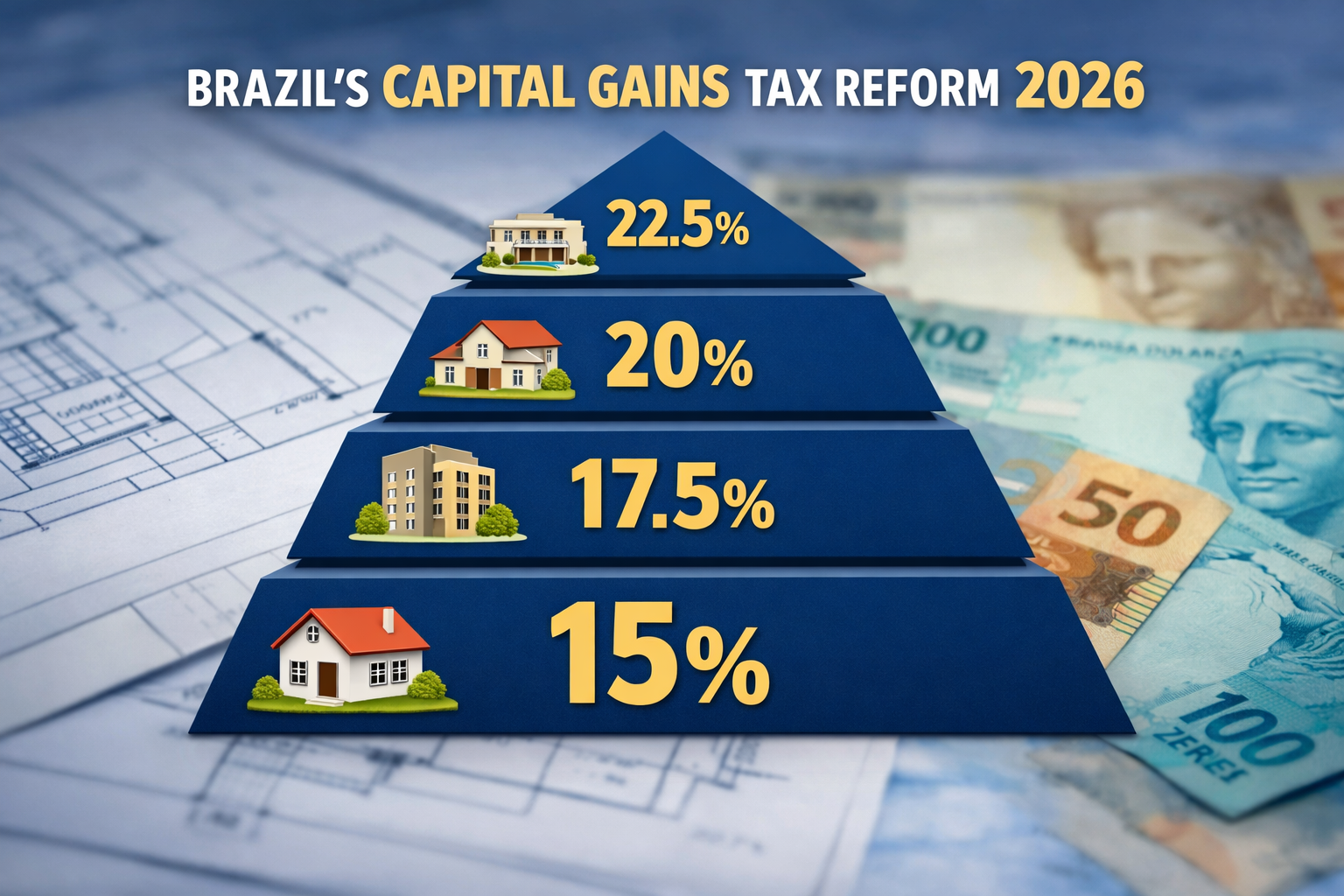
The foundation of the Tax Reform Impacts on Capital Gains: 2026 Strategies for Brazil Property Developers and Flip Investors is the tiered capital gains structure. As of early 2026, gains from property sales are taxed at progressive rates [2]:
| Gain Amount (BRL) | Tax Rate |
|---|---|
| Up to R$5 million | 15% |
| R$5M – R$10 million | 17.5% |
| R$10M – R$30 million | 20% |
| Above R$30 million | 22.5% |
💡 Pull Quote: “A developer selling a R$35M project faces a blended effective rate well above 15% — making pre-sale cost basis documentation worth tens of thousands of reais.”
For most residential flip investors operating in the R$500K–R$3M range, the 15% bracket will apply. However, developers working on mid-to-large residential complexes or logistics assets in high-growth corridors must plan for the upper brackets from day one of project feasibility.
Calculating Your Taxable Gain Correctly
Capital gains are calculated as sale price minus original purchase cost, with adjustments permitted for documented capital improvements [2]. This sounds straightforward, but the details matter enormously:
- ✅ Documented construction costs, architect fees, and permitted improvements reduce taxable gain
- ✅ Legal acquisition costs (ITBI, notary fees, registration) may be added to the cost basis
- ❌ Undocumented “informal” costs cannot be deducted and expose developers to audit risk
- ⚠️ Rules vary based on acquisition timing, so older land parcels may require specialized basis reconstruction
Action item: Every developer should maintain a dedicated capital improvements ledger from acquisition through sale, with receipts, invoices, and notarized contracts supporting every line item.
Exemptions Worth Knowing
Two important exemptions remain available in 2026, though eligibility conditions are strict [2]:
- Primary residence exemption — Selling your only residential property below a certain value threshold may qualify for capital gains exemption
- Reinvestment rollover — Proceeds reinvested in another residential property within a defined timeframe may defer or eliminate the gain
Developer-investors who personally occupy a unit within a project should verify whether that unit qualifies as a principal residence under current rules before structuring the sale.
How New Tax Rules Reshape Holding Structures and Financing
LCI and LCA: The Grandfathering Opportunity Closes
One of the most time-sensitive changes under the 2026 reform is the elimination of tax-exempt status for Real Estate Credit Letters (LCI) and Agribusiness Credit Letters (LCA) issued on or after January 1, 2026. These instruments now carry a 5% withholding tax [1].
The critical nuance: existing holdings retain their tax-exempt status. This creates a genuine planning window for developers who:
- Hold LCI/LCA positions acquired before the cutoff
- Are evaluating whether to roll over maturing instruments into new issuances
- Are comparing after-tax yields against alternative financing vehicles
For developers using LCI instruments to fund construction phases, the 5% withholding on new issuances meaningfully increases the effective cost of capital. Factoring this into project pro formas from the outset is essential.
Flat Withholding on Financial Applications: A Hidden Cost
The shift from a regressive 22.5%–15% schedule to a flat 17.5% withholding tax on financial applications — effective January 1, 2026 — may appear minor, but it has a real impact on interim cash management [1].
Developers routinely park capital between project phases in fixed-income instruments. Under the old regressive system, holding funds for longer periods reduced the effective tax rate. Under the flat 17.5% regime, this benefit disappears. Short-term and medium-term holdings are now taxed identically, removing the incentive to extend holding periods purely for tax efficiency.
Interest on Net Equity: Still Useful, But More Expensive
Interest on Net Equity (INE) — a mechanism allowing companies to remunerate shareholders with a deductible corporate expense — saw its withholding tax rise from 15% to 20% effective January 1, 2026 [1]. Despite the rate increase, INE remains a deductible shareholder compensation tool and continues to offer structural advantages over pure dividend distributions in certain corporate configurations.
Developers using INE as their primary profit extraction mechanism should recalculate the net benefit against the new 20% rate and compare it against the dividend withholding threshold described below.
The Dividend Threshold: R$50,000/Month Is the New Dividing Line
Starting in 2026, dividends and profits above R$50,000 per month are subject to a 10% withholding tax (IRRF) [4]. Below this threshold, income tax exemption applies up to R$5,000/month for individuals.
For corporate rental structures and developer holding companies, this creates a clear optimization target:
- Distributions structured to remain below R$50,000/month avoid the 10% hit
- Larger distributions above the threshold should be evaluated against INE, salary, or other compensation mechanisms
- Multi-shareholder structures may allow threshold benefits to be distributed across multiple individuals
This is one of the most impactful changes for real estate holding companies — a structure widely used by Brazilian property investors to manage rental income. For a deeper look at how the Florianópolis real estate market is evolving alongside these fiscal changes, the dynamics of supply, demand, and tax efficiency are increasingly intertwined.
Real Estate Leasing Now Subject to IBS and CBS
Complementary Law No. 214/2025 brought a landmark change: real estate leasing is now included in the scope of IBS (Imposto sobre Bens e Serviços) and CBS (Contribuição sobre Bens e Serviços) [4]. This is the first time rental income has faced these consumption-based taxes, fundamentally altering the economics of rental property holding companies.
Developers who planned to hold completed units as rental assets — a common strategy in high-demand urban markets — must now recalculate net operating income projections to account for IBS/CBS exposure. The total effective tax burden on rental income has increased meaningfully, and in some configurations may tip the balance toward outright sale rather than hold-and-rent strategies.
Developer Playbooks: Structuring, Timing, and Exiting in 2026
The Compliance Playbook for Residential Developers
Residential developers — particularly those active in high-growth markets like Florianópolis and the Ingleses region — should implement the following compliance framework:
Phase 1: Pre-Acquisition
- Conduct full tax due diligence on land cost basis and ITBI documentation
- Model capital gains exposure under all four tax brackets at projected sale prices
- Evaluate corporate structure options: SPE (Sociedade de Propósito Específico) vs. holding company vs. individual ownership
Phase 2: Construction & Development
- Maintain a real-time capital improvements ledger with full documentation
- Evaluate LCI financing against new 5% withholding costs
- Benchmark interim cash management against flat 17.5% withholding on financial applications
Phase 3: Pre-Sale Planning
- Determine optimal sale timing relative to project completion milestones
- Assess whether unit-by-unit sales vs. bulk portfolio sales optimize bracket exposure
- Verify reinvestment rollover eligibility for any units held as personal residences
Phase 4: Exit & Distribution
- Structure profit distributions to respect the R$50,000/month dividend threshold
- Compare INE at 20% withholding vs. dividend distribution at 10% above threshold
- Document all capital improvements for final basis calculation before notarization
The Flip Investor Playbook
For individual flip investors operating in the residential market — buying, renovating, and reselling properties — the 2026 reform introduces both risks and opportunities:
Key risks:
- Undocumented renovation costs that cannot reduce the taxable gain
- Misclassifying a property as a primary residence to claim exemption without meeting strict eligibility criteria
- Ignoring IBS/CBS exposure if holding a property as a short-term rental between purchase and resale
Key opportunities:
- Loss harvesting — Losses on financial investments from January 1, 2026 may now be offset against gains from other financial investments [1], enabling cross-portfolio tax management within investment vehicles
- Grandfathered LCI/LCA positions — Existing tax-exempt instruments can continue to provide efficient interim capital storage
- IOF-FX at 0% — Foreign flip investors face zero IOF on capital repatriation, dramatically improving net returns for international buyers [1]
For investors exploring off-plan property purchases as a flip strategy, the appreciation window between launch price and delivery creates gains that may still fall within the 15% bracket — but only with proper cost basis documentation from day one.
Foreign Developers: The IOF-FX Advantage
The reduction of the IOF-FX rate on foreign investment returns to 0% is one of the most developer-friendly changes in the 2026 reform [1]. For international capital entering the Brazilian real estate market:
- Repatriation of investment returns no longer carries an IOF cost
- Exit costs for foreign developers are meaningfully reduced
- Brazil becomes more competitive against other Latin American real estate markets for cross-border capital allocation
Non-resident sellers do not automatically face higher capital gains rates, but may encounter different withholding and reporting requirements [2]. Engaging a qualified Brazilian tax advisor before structuring any cross-border transaction remains essential.
Equity Restructuring: A Hidden Tax Trigger
One frequently overlooked provision: converting foreign investment registrations from private to publicly listed shares — or similar modality changes — now triggers capital gains taxation at progressive rates from 15% to 22.5% [1]. Developers considering equity restructuring, SPE conversions, or registration changes must model the capital gains exposure before proceeding. What appears to be an administrative change can generate a material tax event.
Logistics and Commercial Sectors
While this guide focuses primarily on residential real estate, developers active in logistics and commercial sectors should note that the IBS/CBS expansion and the new rental income tax treatment apply equally to commercial leasing structures. The latest developments in Brazil’s property investment landscape highlight how location selection and asset class now carry significant tax implications alongside traditional return metrics.
Investors considering alternative structures — including cryptocurrency-linked real estate financing — should be aware that the 2026 reform’s broader financial investment rules may apply to token-based instruments as well, requiring careful legal review.
Quick Reference: 2026 Brazil Real Estate Tax Changes at a Glance
| Rule | Pre-2026 | 2026 Onward | Impact |
|---|---|---|---|
| Capital gains brackets | 15%–22.5% progressive | Same, now actively enforced | Exit timing critical |
| LCI/LCA withholding | 0% (exempt) | 5% on new issuances | Higher financing costs |
| Financial application withholding | 22.5%–15% regressive | Flat 17.5% | No benefit to longer holds |
| INE withholding | 15% | 20% | Reduced shareholder returns |
| Dividend withholding | Exempt | 10% above R$50K/month | Restructure distributions |
| Real estate leasing (IBS/CBS) | Not applicable | Now in scope | Hold-to-rent less attractive |
| IOF-FX on foreign returns | Variable | 0% | Better for foreign investors |
| Loss harvesting (financial) | Limited | Cross-portfolio allowed | New planning tool |
Conclusion: Actionable Next Steps for 2026
The Tax Reform Impacts on Capital Gains: 2026 Strategies for Brazil Property Developers and Flip Investors represent a genuine inflection point for the Brazilian real estate sector. The changes are not merely technical — they alter the fundamental economics of how projects are financed, held, and exited.
Immediate actions every developer and flip investor should take in 2026:
- 🗂️ Audit your cost basis documentation — Every capital improvement, acquisition cost, and legal fee should be organized and verified before any sale transaction
- 📊 Model your exit under all four capital gains brackets — Understand your blended effective rate at different sale price scenarios
- 🏦 Review LCI/LCA positions — Grandfathered exempt holdings are a finite asset; evaluate rollover decisions carefully
- 💼 Restructure dividend distributions — Align profit extraction with the R$50,000/month threshold to minimize IRRF exposure
- 🌐 Foreign investors: register your IOF-FX benefit — Ensure repatriation structures are properly documented to capture the 0% rate
- ⚖️ Consult a qualified Brazilian tax advisor — The interaction between IBS, CBS, IRRF, INE, and capital gains rules requires professional coordination
For developers actively building in high-appreciation markets, exploring current development opportunities with tax-efficient structures built in from the ground up is the most powerful strategy available in 2026. The reform creates complexity — but for the prepared investor, it also creates competitive advantage over those who adapt too slowly.
References
[1] Brazilian Government Announces Substantial Tax Changes Affecting Interest On Net Equity Financial Investments Betting Operations And Iof Regulations – https://www.ey.com/en_gl/technical/tax-alerts/brazilian-government-announces-substantial-tax-changes-affecting-interest-on-net-equity-financial-investments-betting-operations-and-iof-regulations
[2] Brazil Property Taxes Fees – https://thelatinvestor.com/blogs/news/brazil-property-taxes-fees
[3] Brazilian Tax System Reform – https://www.barbieriadvogados.com/brazilian-tax-system-reform/
[4] Real Estate Holding Companies In Brazil For Rental Income – https://tersi.adv.br/en/real-estate-holding-companies-in-brazil-for-rental-income/
[5] Brazils 2026 Tax Reform Preparing For Transition – https://letstalkglobaltax.forvismazars.com/2025/12/08/brazils-2026-tax-reform-preparing-for-transition/
[6] Brazil – https://cms.law/en/int/expert-guides/cross-border-tax-forecast-2026/brazil
[7] Brazil – https://practiceguides.chambers.com/practice-guides/investing-in-2026/brazil
[8] Brazil Tax Reform Expected To Push Brazilian Wealthy To Invest More Abroad – https://www.ifcreview.com/news/2025/december/brazil-tax-reform-expected-to-push-brazilian-wealthy-to-invest-more-abroad/