
Brazil’s real estate development sector faces a critical inflection point as the country approaches its October 2026 general election. While construction cranes dot the skylines of cities like Florianópolis and São Paulo, developers must navigate an increasingly complex landscape where The 2026 Election Year Uncertainty: Stress-Testing Your Brazil Development Pipeline Against Fiscal Risk and Political Transitions has become essential for protecting investments and ensuring project viability.
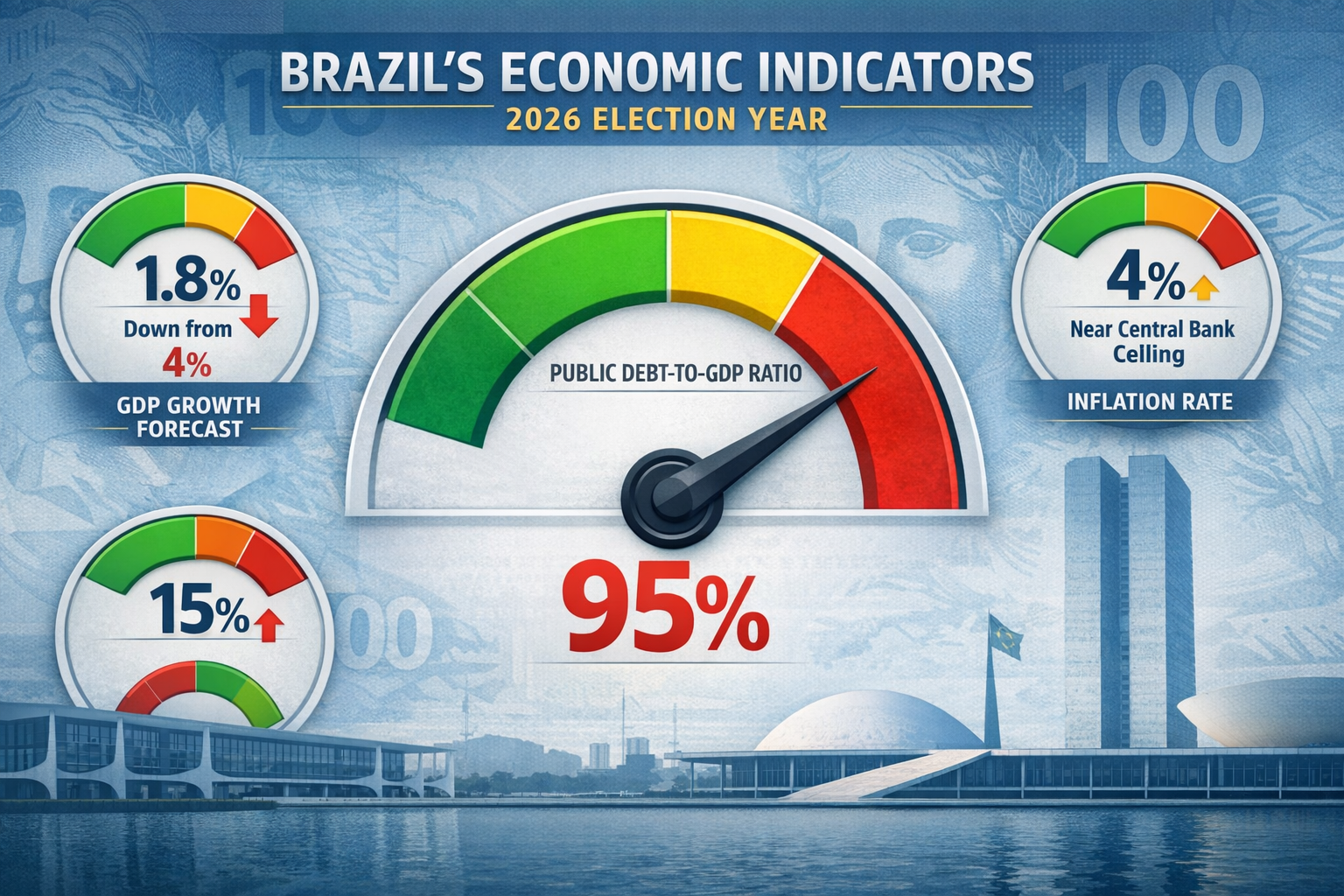
With public debt projected to reach 95% of GDP[1], inflation hovering near the central bank’s ceiling, and a highly polarized political race creating market volatility, the development pipeline that looked promising six months ago now requires rigorous stress-testing against multiple risk scenarios.
Key Takeaways
- 📉 Economic slowdown ahead: Brazil’s GDP growth is forecast to decelerate sharply to 1.8% in 2026 from 4% in early 2025, creating headwinds for absorption rates and pricing power[1][2]
- 💰 Fiscal crisis looming: Public debt reaching 95% of GDP combined with persistent deficits threatens government housing programs and infrastructure support critical to development projects[1]
- 🗳️ Election volatility: The October 2026 general election represents Brazil’s most polarized race in recent history, with market-moving candidates creating significant policy uncertainty[1][3]
- 📊 Interest rate pressure: The 15% policy rate maintained since June 2025 creates challenging financing conditions that compress margins and limit buyer affordability[2]
- ✅ Strategic positioning wins: Developers who stress-test pipelines, build liquidity buffers, and position projects for multiple political scenarios will emerge stronger regardless of election outcomes
Understanding the 2026 Election Year Uncertainty: Economic Fundamentals Deteriorating
The Growth Deceleration Reality
Brazil’s economic momentum is rapidly fading. After posting 4% growth in Q1 2025, the economy has decelerated sharply, with forecasts showing just 1.8% growth by Q3 2025 and through 2026[1][2]. This dramatic slowdown reflects fundamental structural issues that directly impact real estate development.
The deceleration stems from procyclical fiscal policy that stimulated short-term growth while creating long-term imbalances, combined with weak consumer demand despite historically strong employment numbers[2]. For developers, this creates a dangerous divergence: employment data suggests healthy demand, but actual consumer spending—particularly on durables and major purchases like housing—remains constrained.
“Markets are watching whether Brazil will move towards or away from more market-friendly policies, and that uncertainty will continue to drive asset prices in the months ahead.”[1]
Inflation’s Persistent Pressure
Inflation is forecast at approximately 4% in 2026, having recently slipped just below the central bank’s 4.5% upper bound in January[1][2]. However, this headline figure masks concerning underlying dynamics.
Services inflation remains persistently elevated at 6% year-over-year as of December 2025, driven by strong wage growth that reached 5% year-over-year—the strongest rate since June 2024[2]. This wage-price spiral creates a challenging environment where:
- Construction costs continue rising faster than headline inflation
- Labor expenses accelerate beyond revenue growth projections
- Central bank rate cuts remain limited despite economic slowdown
- Buyer purchasing power erodes even as employment remains strong
For developers with projects in high-growth markets like Florianópolis, understanding this inflation dynamic is critical for accurate pro forma modeling.
The Public Debt Crisis
The International Monetary Fund’s forecast that public debt will reach 95% of gross domestic product in 2026 represents a rapid escalation driven by procyclical spending policies[1]. This debt trajectory creates multiple risks for development pipelines:
Direct fiscal risks:
- Government housing programs like Minha Casa Minha Vida face potential funding cuts
- Infrastructure investments supporting new developments may be delayed or canceled
- Tax incentives for real estate investment could be reduced or eliminated
- Municipal finances deteriorate, affecting permitting and public services
Indirect market risks:
- Credit spreads widen, increasing financing costs
- Foreign investment flows become more volatile
- Currency depreciation pressures increase input costs
- Sovereign rating downgrades trigger institutional selling
The government’s stated target of a 0.25% primary budget surplus in 2026 is viewed as unlikely given election year pressures and structural imbalances[2]. In reality, Brazil’s primary deficit (excluding exemptions and interest payments) amounted to just over 1% of GDP in the first three quarters of 2025[2], highlighting the gap between fiscal rhetoric and reality.
Interest Rate Environment: The 15% Reality
The policy rate has remained at 15% since June 2025, creating very high real interest rates that restrain capital investment and consumer spending[2]. For real estate developers, this rate environment creates multiple challenges:
Financing constraints:
- Construction loans carry prohibitive interest expenses
- Buyer mortgage rates limit affordability and demand
- Equity returns face higher hurdle rates from alternative investments
- Pre-sale velocity slows as buyers delay decisions
While the central bank is expected to begin gradual rate cuts, progress will be limited by wage growth and loose fiscal policy[2]. Developers cannot count on significant monetary easing to rescue projects with weak fundamentals.
Stress-Testing Your Brazil Development Pipeline Against Fiscal Risk and Political Transitions
The October 2026 Election: Key Dynamics
Brazil’s October 2026 general election dominates political and market dynamics, with the race described as highly polarized and “open”[1][3]. The electoral landscape features several critical elements that developers must monitor:
Leading candidates and market implications:
São Paulo Governor Tarcísio de Freitas has emerged as the leading challenger to President Luiz Inácio Lula da Silva, representing a more market-friendly alternative that could shift fiscal and regulatory policies[1]. His background in infrastructure and business-oriented governance suggests potential support for development-friendly policies.
Senator Flávio Bolsonaro (son of former President Jair Bolsonaro) entered the race in late February, significantly increasing political tension and unsettling markets[1]. According to an AtlasIntel survey released February 25, Flávio Bolsonaro held 46.3% of voting intentions, demonstrating substantial support for right-wing opposition[3].
This three-way dynamic creates maximum uncertainty, as each candidate represents fundamentally different approaches to:
- Fiscal policy and government spending
- Housing programs and real estate incentives
- Environmental regulations affecting development
- Foreign investment frameworks
- Infrastructure priorities
International Political Dimensions
The 2026 election doesn’t occur in isolation. President Trump shifted to a constructive relationship with President Lula beginning around September 2025, driven by concerns about inflation impacts of Brazilian exports (coffee and meat) and strategic interests in critical minerals amid China competition[5].
However, experts warn that “President Trump will likely seek to weigh in and influence the outcome [of the 2026 election] through public statements or symbolic gestures” and potentially meetings with opposition figures at Mar-a-Lago or the White House[5]. This international dimension adds another layer of uncertainty to market dynamics.
Additionally, seven countries representing 52% of Latin America and the Caribbean’s population will undergo presidential transitions in 2026, creating overlapping uncertainty driven by shifting geopolitical alliances, changing trade rules, and U.S. policy shifts[4]. Regional instability can spill over into Brazilian markets through capital flows and investor sentiment.
Building Your Stress-Testing Framework
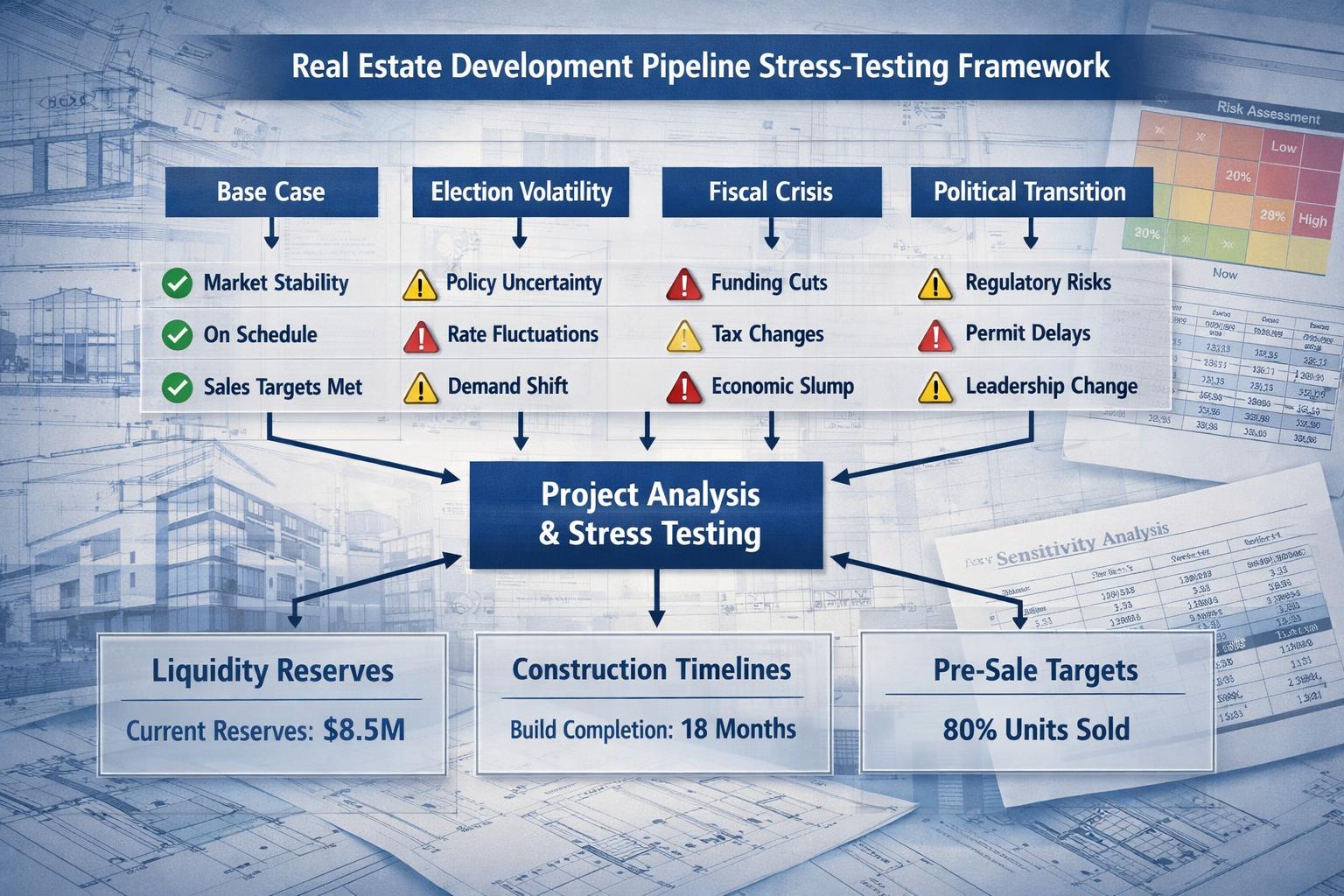
Effective stress-testing requires modeling multiple scenarios across your development pipeline. Here’s a practical framework:
Scenario 1: Base Case (40% probability)
- Lula or moderate successor wins with coalition government
- Gradual fiscal adjustment with housing program continuity
- Interest rates decline slowly to 12% by end-2026
- GDP growth at 1.8% with gradual recovery in 2027
- Real estate fundamentals remain stable with selective opportunities
Scenario 2: Market-Friendly Transition (30% probability)
- Tarcísio de Freitas or similar candidate wins
- Accelerated fiscal reforms and market-oriented policies
- Interest rate cuts accelerate to 10% by end-2026
- Confidence boost drives GDP growth to 2.5%+ in 2027
- Real estate sector benefits from improved financing and demand
Scenario 3: Political Gridlock (20% probability)
- Contested election or weak coalition government
- Fiscal reforms stall, debt trajectory worsens
- Interest rates remain elevated at 14%+
- GDP growth stagnates below 1.5%
- Real estate market bifurcates: prime locations hold, secondary markets struggle
Scenario 4: Crisis Scenario (10% probability)
- Severe political instability or fiscal crisis
- Government programs suspended, credit markets freeze
- Interest rates spike above 16%, currency depreciates sharply
- GDP contracts, unemployment rises
- Real estate development largely halts except distressed opportunities
Quantifying Risk Across Your Pipeline
For each project in your development pipeline, assess exposure across these dimensions:
| Risk Factor | Low Exposure | Medium Exposure | High Exposure |
|---|---|---|---|
| Government program dependency | <10% of revenue from subsidized buyers | 10-30% government-backed sales | >30% dependent on Minha Casa Minha Vida |
| Construction timeline | Completion before Q3 2026 | Completion Q4 2026-Q1 2027 | Completion after Q1 2027 |
| Pre-sale status | >60% sold | 30-60% sold | <30% sold |
| Financing structure | Equity-heavy, low leverage | Moderate construction debt | High leverage, refinancing needed |
| Location resilience | Prime markets with diverse demand | Growing secondary markets | Emerging areas dependent on infrastructure |
Projects with multiple high-exposure factors require immediate mitigation strategies, while low-exposure projects provide portfolio stability during uncertainty.
Employment Paradox: Reading the Mixed Signals
Brazil’s unemployment rate fell to 5.3% in December 2025, the lowest level since at least 2012, with real wages accelerating at 5% year-over-year growth[2]. Surface-level analysis suggests robust housing demand should follow.
However, deeper examination reveals concerning trends:
Decelerating momentum: Year-over-year job growth pace in December fell to half of July’s pace, and employment declined for three consecutive months before recovering in November and December[2]. This deceleration suggests the employment boom may be peaking.
Public sector distortion: Public sector employment growth of 3.9% year-over-year is outpacing private sector growth, raising sustainability concerns if the government must consolidate spending post-election[2]. Government jobs may prove less stable than private sector employment for underwriting buyer capacity.
Consumption disconnect: Despite strong employment and wage growth, consumer spending on durables remains weak due to high interest rates and inflation uncertainty[2]. This disconnect means employment data overstates actual housing demand.
For developers, this requires sophisticated buyer qualification that looks beyond employment status to debt service capacity, savings rates, and income stability.
Positioning Your Development Projects for Multiple Political Outcomes
Liquidity and Timing Strategies
The most critical risk mitigation tool is liquidity management. Projects entering the market in 2026 face maximum uncertainty, while those completing before Q3 2026 or delayed until post-election clarity have natural hedges.
Acceleration strategies:
- Fast-track permitting for projects 80%+ sold to capture pre-election demand
- Increase construction crews to compress timelines where economically viable
- Offer aggressive pre-sale incentives to lock in buyers before election volatility
- Secure construction financing now before potential credit tightening
Strategic delay tactics:
- Postpone launches of marginal projects until Q4 2026 after election clarity
- Maintain land bank optionality rather than committing to construction
- Extend due diligence periods on new acquisitions with election contingencies
- Build cash reserves to weather 6-12 month demand disruption
Geographic and Product Diversification
Not all Brazilian markets face equal election risk. Strategic location selection becomes critical for portfolio resilience.
Lower-risk markets:
- Established prime locations with international demand (select São Paulo neighborhoods, Rio beachfront)
- Growing quality-of-life destinations like Florianópolis with diverse buyer profiles
- University towns with stable institutional demand
- Corporate relocation hubs with employment diversity
Higher-risk markets:
- Government-dependent peripheral developments
- Single-industry cities vulnerable to economic cycles
- Emerging areas requiring infrastructure investment
- Markets with oversupply and speculative inventory
Product positioning:
- Studio apartments in Florianópolis and similar markets offer lower price points and investor demand resilience
- Mid-market family housing faces maximum uncertainty from financing costs and confidence
- Luxury segments serve cash buyers less affected by interest rates but vulnerable to wealth effects
Financing Structure Optimization
Capital structure determines survival capacity during market disruption. The 2026 election year uncertainty demands conservative financing approaches:
Equity preservation:
- Maintain minimum 40% equity in projects launching in 2026
- Build 15-20% contingency reserves beyond standard buffers
- Avoid aggressive mezzanine financing with near-term refinancing requirements
- Partner with institutional capital sources offering patient capital
Debt management:
- Lock in construction financing now at fixed rates despite current high costs
- Negotiate covenant flexibility for absorption timeline extensions
- Diversify lender relationships to avoid single-source dependency
- Structure buyer financing assistance programs to support sales velocity
Alternative capital:
- Explore cryptocurrency and blockchain-based financing for international capital access
- Consider joint ventures with foreign partners seeking dollar-denominated returns
- Evaluate sale-leaseback arrangements for completed inventory
- Maintain relationships with distressed debt buyers as contingency exit
Buyer Engagement and Sales Strategies
Election uncertainty affects buyer psychology as much as economics. Proactive engagement strategies can maintain velocity:
Confidence-building measures:
- Transparent construction progress reporting to demonstrate commitment
- Financial guarantees and completion insurance to reduce buyer risk
- Flexible payment terms that accommodate election-period cash flow concerns
- Educational content explaining market fundamentals beyond election noise
Pricing strategies:
- Lock in current pricing for pre-election commitments to create urgency
- Build election-contingent price adjustment clauses for post-October sales
- Offer inflation-indexed payment plans that share risk with buyers
- Create VIP early-bird programs that reward pre-election decisions
Target audience shifts:
- Emphasize international buyers less affected by domestic politics
- Focus on corporate relocation demand driven by business fundamentals
- Target cash-heavy investors seeking election-discounted opportunities
- Cultivate relationships with family offices making long-term allocations
Regulatory and Compliance Preparation
Political transitions often bring regulatory changes. Proactive compliance positioning reduces transition risk:
Documentation excellence:
- Ensure all permits and approvals are fully executed before election period
- Resolve any outstanding municipal issues that could become leverage points
- Document compliance with environmental and social requirements
- Maintain transparent beneficial ownership records
Relationship management:
- Build relationships across political spectrum, not single-party dependency
- Engage industry associations for collective advocacy
- Participate in policy discussions to shape post-election frameworks
- Maintain professional relationships with regulatory agencies
Contingency planning:
- Model impact of potential policy changes (tax reforms, housing program modifications)
- Prepare alternative project configurations if regulations shift
- Identify legal strategies for grandfathering existing projects
- Budget for potential compliance cost increases
Opportunities Within the 2026 Election Year Uncertainty
Counter-Cyclical Positioning
While most developers adopt defensive postures during election uncertainty, sophisticated players identify opportunities:
Distressed acquisition targets:
- Overleveraged competitors forced to sell projects at discounts
- Land sellers accepting lower prices due to financing constraints
- Completed inventory available below replacement cost
- Partnership opportunities with developers needing capital infusions
Talent acquisition:
- Skilled construction labor available as weaker competitors scale back
- Experienced sales professionals seeking stable employers
- Technical specialists (engineers, architects) with capacity
- Management talent from consolidating competitors
Supply-demand rebalancing:
- Construction slowdown in 2026 creates 2027-2028 supply shortage
- Projects launched post-election face less competition
- Buyers who delayed decisions create pent-up demand
- Recovery phase offers premium pricing power for positioned developers
The Pre-Construction Purchase Advantage
Election uncertainty creates unique value for pre-construction buyers willing to commit during volatility:
Pricing discounts: Developers offer election-period incentives that disappear post-clarity Payment flexibility: Extended payment terms accommodate election-period caution Appreciation potential: Post-election recovery drives values above pre-construction pricing Selection advantages: Best units and locations available before post-election rush
Developers can market these advantages to sophisticated buyers who understand cyclical dynamics and have financial capacity to act counter-cyclically.
Regional Growth Stories Transcending Politics
Certain Brazilian markets have fundamental growth drivers that transcend election outcomes. The growth of regions like Ingleses in Florianópolis demonstrates how quality of life, infrastructure development, and demographic trends create resilient demand regardless of political transitions.
Structural growth drivers:
- Remote work enabling migration to quality-of-life locations
- Middle-class expansion creating first-time buyer demand
- Infrastructure improvements (airports, highways) opening new markets
- Educational and healthcare institution growth anchoring demand
Projects aligned with these structural trends maintain fundamentals through political cycles, offering portfolio stability during the 2026 uncertainty.
Conclusion: Navigating The 2026 Election Year Uncertainty Successfully
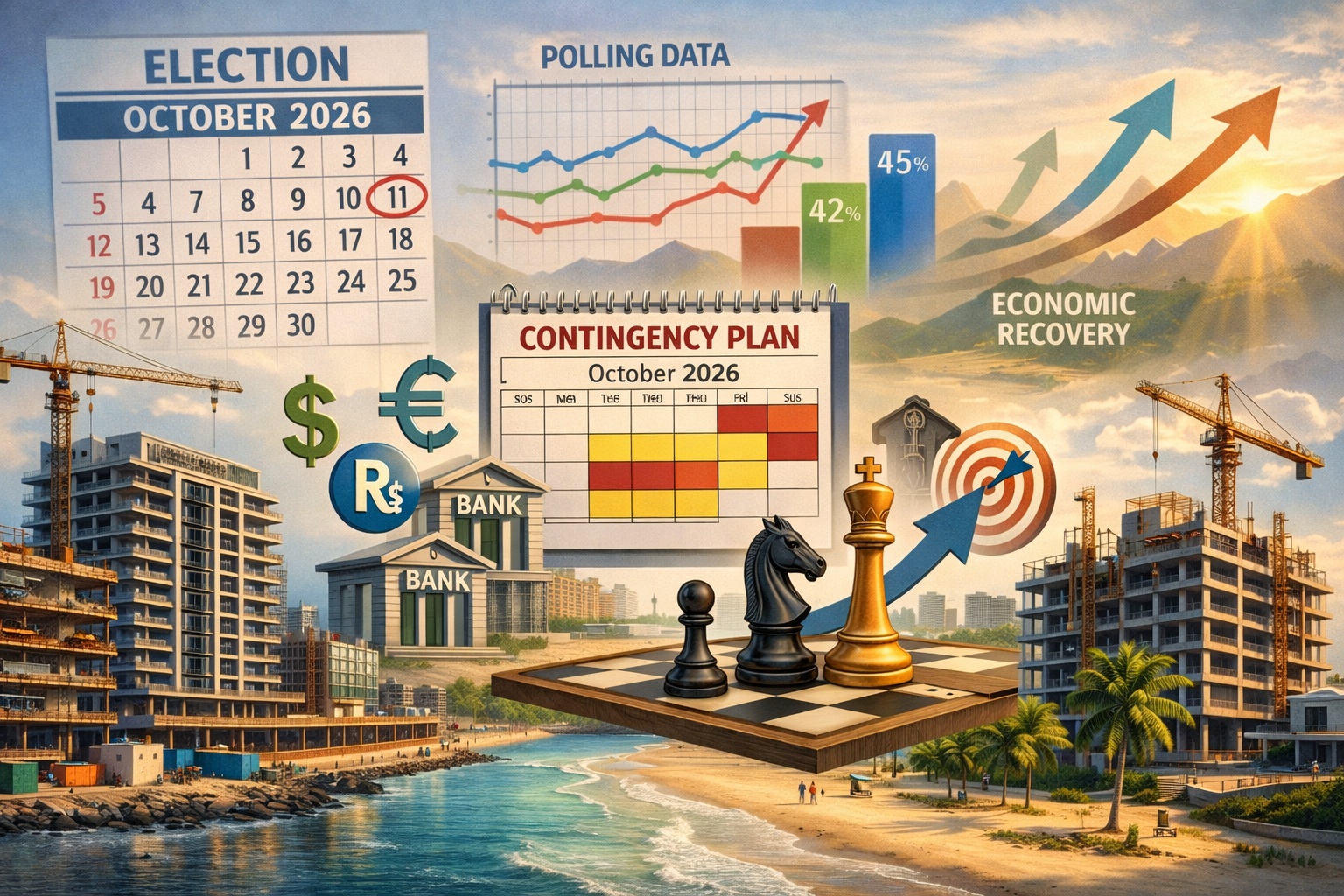
The 2026 Election Year Uncertainty: Stress-Testing Your Brazil Development Pipeline Against Fiscal Risk and Political Transitions isn’t just a risk management exercise—it’s a strategic imperative that separates successful developers from casualties of political and economic volatility.
The fundamentals are clear: Brazil faces 95% public debt, 1.8% GDP growth, 15% interest rates, and a highly polarized October election that could shift policy dramatically[1][2][3]. Development pipelines built on optimistic assumptions from 2024-2025 require rigorous stress-testing against multiple scenarios.
Actionable Next Steps
Immediate actions (next 30 days):
- Conduct portfolio stress-test using the four-scenario framework outlined above
- Assess liquidity position and build 15-20% contingency reserves beyond standard buffers
- Review construction timelines and identify acceleration or delay opportunities
- Evaluate financing structures and lock in construction debt before potential credit tightening
- Strengthen buyer engagement with confidence-building measures and flexible terms
Strategic positioning (Q2-Q3 2026):
- Diversify geographic exposure toward markets with structural growth drivers beyond politics
- Optimize product mix for resilient buyer segments (investors, international, cash buyers)
- Build regulatory compliance excellence to navigate potential policy transitions
- Cultivate relationships across political spectrum for post-election adaptability
- Identify counter-cyclical opportunities in distressed assets and talent acquisition
Post-election preparation (Q4 2026):
- Rapid response protocols for different election outcomes
- Launch strategies for projects delayed pending clarity
- Pricing adjustments based on new policy environment
- Partnership opportunities with international capital seeking entry points
- Market communication positioning your company as election-resilient
The developers who emerge strongest from the 2026 election year uncertainty will be those who stress-tested rigorously, positioned conservatively, and maintained capacity to act opportunistically when others retreated. Political transitions create both risks and opportunities—success requires preparing for both.
Brazil’s real estate fundamentals remain strong in select markets, demographic trends support long-term demand, and quality developments in growing regions will thrive regardless of election outcomes. The key is ensuring your pipeline survives the transition period and positions for the recovery that follows.
For developers committed to the Brazilian market, understanding regional dynamics, building financial resilience, and maintaining strategic flexibility will transform election year uncertainty from existential threat into competitive advantage.
References
[1] Election And Trade Risks Weigh On Brazil And Mexico Outlook – https://sebgroup.com/press/news/2026/election-and-trade-risks-weigh-on-brazil-and-mexico-outlook
[2] Brazil Economic Outlook – https://www.deloitte.com/us/en/insights/topics/economy/americas/brazil-economic-outlook.html
[3] Extreme Polarization Marks Brazils Election Race – https://www.bnamericas.com/en/analysis/extreme-polarization-marks-brazils-election-race
[4] What To Expect For Development In Latin America And The Caribbean In 2026 – https://social.desa.un.org/world-summit-2025/blog/what-to-expect-for-development-in-latin-america-and-the-caribbean-in-2026
[5] President Trump Is Currently Interested In A More Constructive Relationship With President Lula And With Brazil – https://cebri.org/revista/en/artigo/242/president-trump-is-currently-interested-in-a-more-constructive-relationship-with-president-lula-and-with-brazil