

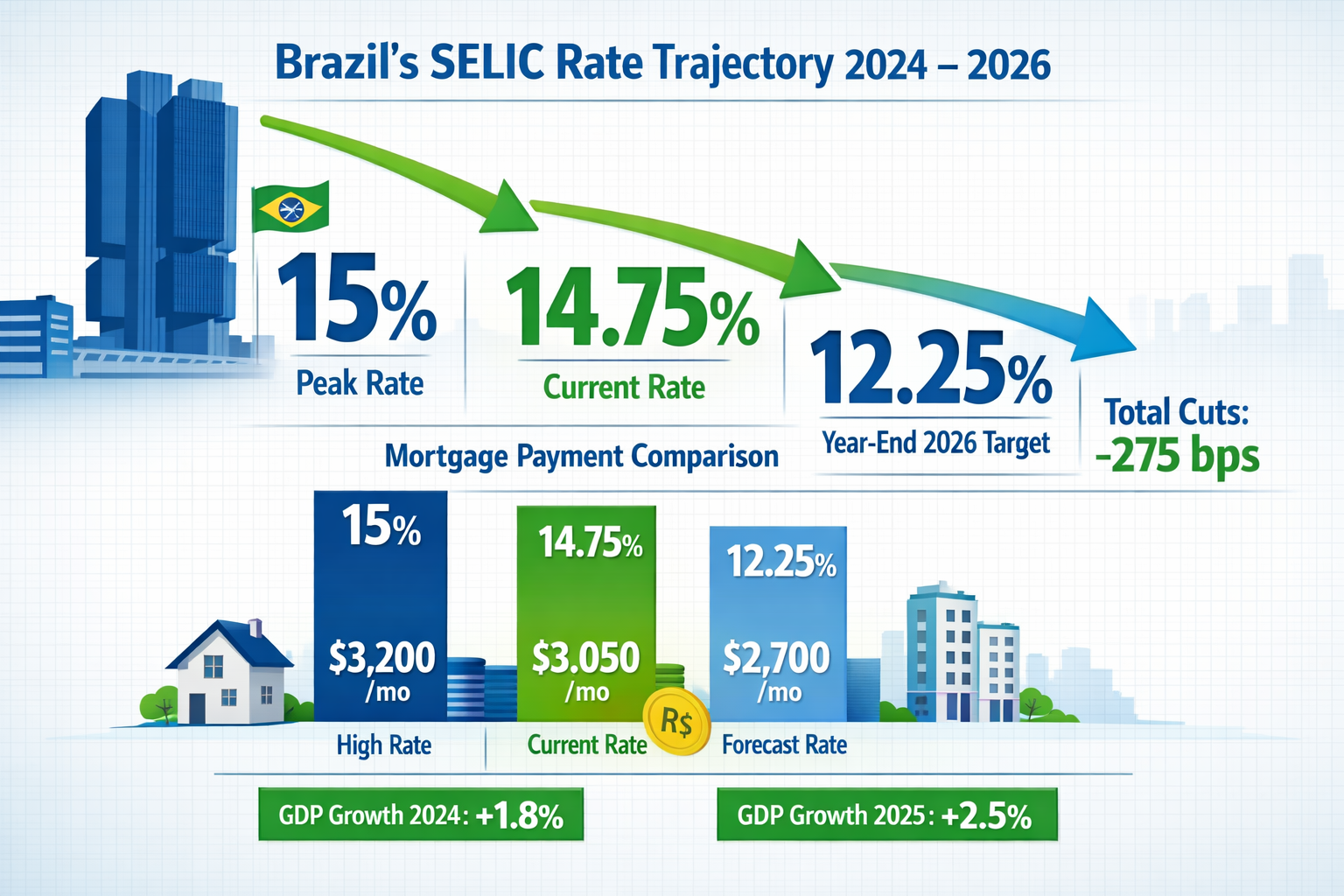
Brazil’s real estate market stands at a pivotal turning point in 2026. After enduring one of the most aggressive monetary tightening cycles in recent history, developers now face an unprecedented opportunity as the Central Bank begins cutting the SELIC benchmark rate. On March 18, 2026, Brazil’s central bank reduced the SELIC rate from 15% to 14.75%, marking the first reduction since May 2024[1][2]. This shift signals the beginning of a new era for The SELIC Rate Decline Strategy: How Developers Should Reposition Inventory as Brazil’s Mortgage Affordability Window Opens in 2026—a critical moment when strategic repositioning can unlock dormant demand and accelerate sales velocity across residential segments.
The implications extend far beyond a simple quarter-point rate cut. Market projections suggest the SELIC could reach approximately 12.25% by year-end 2026, representing roughly 275 basis points of total cuts[2]. This monetary easing cycle creates a fundamental transformation in mortgage affordability, shifting the financing landscape from floating-rate products that penalized borrowers during the high-rate environment to fixed-rate opportunities that make homeownership accessible again.
Key Takeaways
- 🏦 Rate Decline Momentum: Brazil’s SELIC rate dropped to 14.75% in March 2026, with projections suggesting further cuts to approximately 12.25% by year-end, creating a 275 basis point improvement window[2]
- 💰 Affordability Transformation: The rate decline enables a shift from floating-rate to fixed-rate mortgages, dramatically improving payment affordability and unlocking previously priced-out buyer segments
- 📊 Strategic Repositioning Window: Developers must act now to reposition inventory pricing, payment structures, and marketing messaging to capitalize on the narrow affordability window before competition intensifies
- 🎯 Segment-Specific Opportunities: Different market segments (luxury, mid-market, affordable) require distinct repositioning strategies aligned with buyer financing profiles and payment sensitivity
- ⚡ Velocity Over Margin: The optimal strategy prioritizes sales velocity and inventory turnover during the affordability window rather than holding for maximum pricing appreciation
Understanding the SELIC Rate Decline and Its Impact on Mortgage Markets
The Monetary Policy Shift Driving Market Transformation
Brazil’s economic landscape has undergone significant changes that prompted the Central Bank’s pivot toward monetary easing. GDP growth slowed to 2.3% in 2025, down from 3.4% in 2024, with Q4 2025 showing annualized growth of just 0.1%[1][2]. This economic deceleration, combined with inflation falling to 3.81% in February 2026—the first time below 4% since May 2024[2]—created the conditions necessary for rate cuts.
The Central Bank’s decision to begin the easing cycle reflects a careful balance between stimulating economic growth and maintaining inflation control. While the initial cut was smaller than market expectations (0.25% instead of 0.50%), this cautious approach stems from geopolitical uncertainty, particularly the Iran conflict pushing oil prices above $100 per barrel[2]. Despite these headwinds, the trajectory remains clear: interest rates are declining, and this creates opportunities for developers who understand how to leverage the shift.
From Floating to Fixed: The Mortgage Product Revolution
The high-SELIC environment of 2024-2025 forced most Brazilian homebuyers into floating-rate mortgage products tied to the CDI (Certificado de Depósito Interbancário) or IPCA inflation index. These products carried significant payment uncertainty, deterring many potential buyers from entering the market. As one industry analyst noted:
“When SELIC reached 15%, monthly mortgage payments on a R$500,000 property increased by nearly 40% compared to the 10% rate environment. This wasn’t just expensive—it was prohibitive for middle-class families.”
The declining SELIC rate fundamentally changes this equation. Financial institutions can now offer fixed-rate mortgage products with predictable payments that align with household budgets. For a R$500,000 property with 20% down payment:
| SELIC Rate | Estimated Mortgage Rate | Monthly Payment (30-year) | Affordability Improvement |
|---|---|---|---|
| 15.0% | ~16.5% | R$5,640 | Baseline |
| 14.75% | ~16.2% | R$5,540 | 1.8% reduction |
| 12.25% (projected) | ~13.7% | R$4,820 | 14.5% reduction |
| 9.25% (optimistic) | ~10.7% | R$3,980 | 29.4% reduction |
This payment reduction translates directly into expanded buyer pools. Families previously unable to qualify for financing at 15% rates suddenly become viable buyers at 12-13% rates. This is the affordability window that developers must capture.
For developers seeking to understand best places to invest in Brazil property, the rate decline creates geographic opportunities as well, with secondary markets becoming newly accessible to financed buyers.
The SELIC Rate Decline Strategy: Repositioning Inventory Across Market Segments
Luxury Segment: Converting Cash Buyers to Leveraged Investors
The luxury residential segment (properties above R$1.5 million) traditionally attracts cash buyers or high-net-worth individuals with substantial down payments. However, The SELIC Rate Decline Strategy creates a counterintuitive opportunity in this segment: converting would-be cash buyers into leveraged purchasers.
During the 15% SELIC environment, wealthy buyers had little incentive to finance property purchases when risk-free government bonds offered similar returns. As SELIC declines toward 12% and potentially lower, the opportunity cost of cash purchases increases. Savvy investors recognize they can finance properties at 13-14% while deploying cash into higher-return opportunities.
Repositioning strategies for luxury inventory:
- Introduce financing incentives: Partner with banks to offer preferential fixed-rate products for luxury buyers, emphasizing the leverage advantage
- Adjust pricing psychology: Rather than reducing headline prices, restructure payment plans to highlight monthly payment affordability with financing
- Target investor profiles: Shift marketing from owner-occupiers to investment buyers who understand leverage arbitrage
- Emphasize rental yields: Position luxury properties as income-generating assets that can service mortgage payments through rental income
Mid-Market Segment: Capturing the Expanding Qualified Buyer Pool
The mid-market segment (R$400,000 – R$1.5 million) represents the largest opportunity for developers implementing The SELIC Rate Decline Strategy. This segment contains the greatest concentration of financing-dependent buyers who were priced out during the high-rate cycle.
Private economists’ Focus survey projects only 1.83% GDP growth for 2026, well below the 3.2% average of the prior three years[2]. This subdued economic growth means income growth remains constrained, making payment affordability—not just price—the critical purchase factor.
Repositioning tactics for mid-market inventory:
✅ Payment-centric marketing: Lead all marketing materials with monthly payment figures rather than total prices
✅ Extended amortization options: Offer 30-35 year terms to maximize payment reduction benefits
✅ Graduated payment structures: Create payment plans that start below market rate and gradually increase, capturing buyers anticipating income growth
✅ Financing partnerships: Establish exclusive relationships with banks offering competitive fixed-rate products for your developments
✅ Buyer education programs: Host seminars explaining the financing landscape shift and how fixed-rate products provide security
The real estate market performance in Florianópolis demonstrates how markets with strong fundamentals can capitalize on improved financing conditions to accelerate sales velocity.
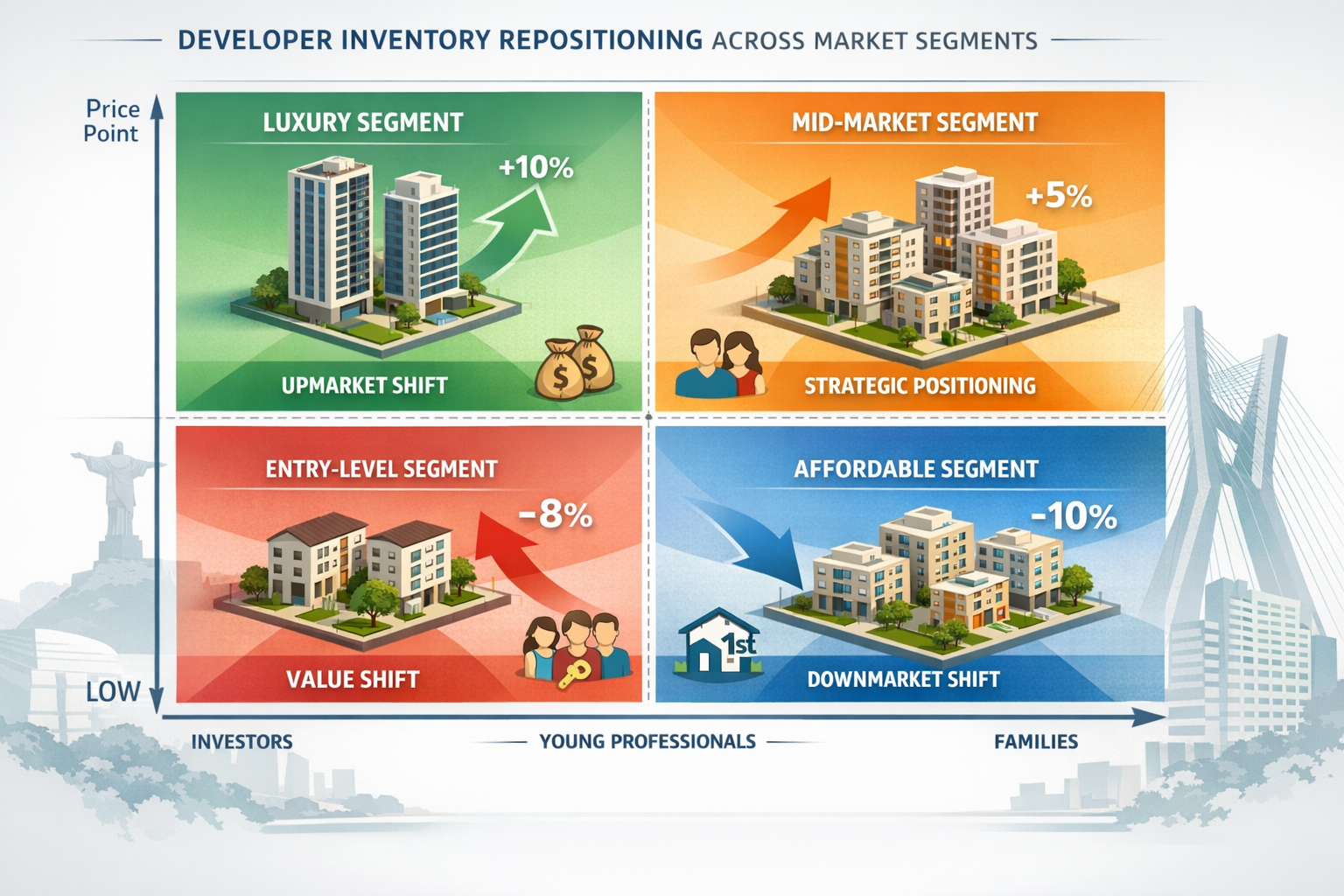
Affordable and Entry-Level Segment: Unlocking First-Time Buyer Demand
The affordable segment (below R$400,000) contains the most payment-sensitive buyers—first-time purchasers, young families, and households with limited savings. For this group, even small payment reductions create qualification opportunities.
The SELIC decline strategy for this segment focuses on maximum accessibility:
- Minimum down payment programs: Reduce required down payments to 10-15% to lower entry barriers
- Government program integration: Align inventory with Casa Verde e Amarela and other subsidized financing programs that benefit from lower base rates
- Flexible qualification criteria: Work with lenders to develop qualification models that account for alternative income sources and gig economy workers
- Payment guarantor options: Introduce co-signer and guarantor programs that enable buyers with limited credit history to qualify
For developers considering advantages of investing in studios in Florianópolis, the entry-level segment presents particular opportunities as compact units align perfectly with first-time buyer budgets and financing capacity.
Tactical Implementation: Pricing, Marketing, and Sales Process Adjustments
Dynamic Pricing Models for the Transition Period
The SELIC rate decline creates a transitional pricing challenge: how to adjust prices and payment structures as financing conditions improve without leaving money on the table or confusing buyers with frequent changes.
Recommended pricing framework:
Establish rate-indexed pricing tiers: Create pricing structures that automatically adjust based on prevailing mortgage rates, with clear communication about how improvements benefit buyers
Time-limited incentives: Offer temporary financing subsidies (developer pays points to buy down rates) with explicit expiration dates to create urgency
Graduated release pricing: For multi-phase developments, increase prices for later phases as financing conditions improve, rewarding early buyers
Payment caps with price adjustments: Guarantee maximum monthly payments while retaining flexibility to adjust total price based on market conditions
The key principle: optimize for velocity, not maximum price. During the affordability window, capturing market share and converting inventory to cash provides greater value than holding for incremental price appreciation.
Marketing Message Transformation
Traditional Brazilian real estate marketing emphasizes location, amenities, and lifestyle benefits. While these remain important, The SELIC Rate Decline Strategy requires message prioritization that leads with affordability.
Marketing message hierarchy for 2026:
1️⃣ Monthly payment affordability (primary headline) 2️⃣ Fixed-rate security (payment predictability message) 3️⃣ Limited-time opportunity (urgency around rate window) 4️⃣ Location and lifestyle benefits (traditional value proposition) 5️⃣ Investment appreciation potential (future value message)
Example headline transformation:
- ❌ Old: “Luxury 3-Bedroom Apartments in Prime Location – R$850,000”
- ✅ New: “Own Your Dream Home for R$4,200/Month – Fixed Rate Locked – 3BR Luxury Apartments”
This message shift acknowledges that most buyers think in terms of monthly budget impact, not total price. The declining SELIC rate makes this affordability story compelling for the first time in two years.
Sales Process and Team Training
Sales teams require retraining to capitalize on the financing transformation. Many Brazilian real estate sales professionals lack deep understanding of mortgage products and qualification processes, limiting their ability to convert financing-dependent buyers.
Essential sales process updates:
📋 Pre-qualification partnerships: Integrate mortgage pre-qualification into the initial sales consultation, enabling immediate feedback on buyer capacity
📋 Payment scenario modeling: Equip sales teams with tools to demonstrate payment impacts across different rate scenarios and financing structures
📋 Objection handling for financing concerns: Train teams to address common financing fears (payment increases, qualification challenges, documentation requirements)
📋 Lender relationship management: Assign dedicated team members to maintain relationships with financing partners and expedite approval processes
📋 Alternative financing education: Ensure teams understand FGTS (Fundo de Garantia do Tempo de Serviço) usage, government programs, and creative financing structures
The growth of regions like Ingleses in Florianópolis demonstrates how emerging markets benefit most from improved financing access, as buyers can now afford properties in appreciating locations previously beyond reach.

Risk Factors and Contingency Planning
Inflation Resurgence and Rate Reversal Risk
While the SELIC decline trajectory appears established, developers must acknowledge reversal risks. The Central Bank raised its 2026 inflation projection from 3.4% to 3.9%, and the weekly Focus survey jumped to 4.1%[2]. If inflation accelerates beyond expectations, the easing cycle could pause or reverse.
Contingency strategies:
- Avoid long-term rate guarantees: Limit developer-subsidized rate buy-downs to 12-24 month periods rather than full loan terms
- Maintain pricing flexibility: Use variable pricing models that can adjust if market conditions shift
- Diversify buyer profiles: Balance financing-dependent buyers with cash purchasers to reduce vulnerability to rate changes
- Accelerate sales velocity: Prioritize rapid inventory conversion while favorable conditions persist
Competition Intensification
As all developers recognize the affordability window, competition for qualified buyers will intensify. The market will shift from supply-constrained (high rates limiting buyers) to demand-competitive (multiple developers pursuing the same expanded buyer pool).
Competitive positioning strategies:
- First-mover advantage: Launch repositioned inventory and financing programs ahead of competitors
- Exclusive financing partnerships: Secure preferential terms with lenders that competitors cannot match
- Differentiated product positioning: Emphasize unique features and value propositions beyond price and payment
- Customer experience excellence: Invest in sales process efficiency and buyer support to win competitive situations
Developers can learn from sales performance trends transforming the Florianópolis market to understand how operational excellence creates competitive advantages during market transitions.
Strategic Timing: When to Execute Repositioning Initiatives
The Narrow Window of Maximum Opportunity
The affordability window created by SELIC decline follows a predictable lifecycle:
Phase 1: Early Recognition (Current – Q2 2026)
- Few developers have repositioned inventory
- Buyer awareness of improved financing remains limited
- Competition for qualified buyers stays moderate
- Optimal time for aggressive repositioning
Phase 2: Market Awakening (Q3-Q4 2026)
- Multiple developers launch financing-focused campaigns
- Buyer awareness increases through marketing saturation
- Competition intensifies for qualified buyer pool
- Focus shifts to differentiation and execution excellence
Phase 3: New Equilibrium (2027+)
- Market fully prices in improved financing conditions
- Property prices adjust upward to reflect affordability gains
- Competitive advantages diminish as all players adapt
- Returns to normal market dynamics
Developers who execute repositioning strategies during Phase 1 capture disproportionate benefits. Those who wait until Phase 2 face intensified competition and compressed margins. Phase 3 represents missed opportunity, as market prices will have adjusted to reflect the new financing reality.
Coordinating Repositioning with Development Timelines
For developers with projects at different completion stages, timing coordination becomes critical:
- Completed inventory: Immediate aggressive repositioning with financing incentives and payment-focused marketing
- Near-completion projects (3-6 months): Launch pre-sales campaigns emphasizing guaranteed financing rates at closing
- Under construction (6-18 months): Moderate repositioning with flexible pricing structures that can adjust as market evolves
- Planning stage projects: Redesign product mix and pricing strategies to align with projected financing landscape at delivery
The progress on developments like Tramonto demonstrates how construction momentum combined with favorable financing conditions creates powerful sales catalysts.
Implementation Roadmap: 90-Day Action Plan
Month 1: Assessment and Planning
Week 1-2: Market Analysis
- Analyze current inventory by segment, pricing, and sales velocity
- Model payment affordability at various SELIC scenarios
- Identify buyer segments most impacted by rate decline
- Assess competitive positioning and repositioning activities
Week 3-4: Strategy Development
- Develop segment-specific repositioning strategies
- Create new pricing and payment structures
- Design financing partnership requirements
- Establish sales velocity targets and success metrics
Month 2: Partnership Development and Team Preparation
Week 5-6: Financing Partnerships
- Negotiate exclusive or preferential financing terms with banks
- Develop co-branded financing products
- Create buyer pre-qualification processes
- Establish expedited approval workflows
Week 7-8: Internal Preparation
- Train sales teams on new financing landscape
- Develop payment modeling tools and sales materials
- Create buyer education content
- Implement CRM and tracking systems for financing-dependent buyers
Month 3: Launch and Optimization
Week 9-10: Market Launch
- Launch repositioned inventory with new pricing and messaging
- Execute payment-focused marketing campaigns
- Host buyer education events and financing seminars
- Activate sales team with new processes and tools
Week 11-12: Monitoring and Adjustment
- Track sales velocity and buyer response
- Gather feedback from sales teams and buyers
- Adjust pricing, messaging, and processes based on results
- Scale successful approaches across additional inventory
For developers seeking to understand broader market dynamics, exploring investment opportunities across Brazil’s property markets provides context for how regional variations in financing access create differentiated opportunities.
Conclusion
The SELIC Rate Decline Strategy: How Developers Should Reposition Inventory as Brazil’s Mortgage Affordability Window Opens in 2026 represents more than a tactical response to monetary policy changes—it’s a fundamental repositioning opportunity that will separate market leaders from laggards. The decline from 15% to 14.75%, with projections suggesting further cuts to approximately 12.25% by year-end[2], creates a narrow but powerful window when mortgage affordability improves faster than property prices adjust.
Developers who act decisively during this transition period will capture disproportionate benefits:
✨ Accelerated inventory turnover as financing-dependent buyers return to the market
✨ Improved cash flow from converting stagnant inventory to sales
✨ Competitive positioning as first-movers in the financing-focused market approach
✨ Customer relationships built during the affordability window that generate referrals and repeat business
The strategy requires coordinated action across multiple dimensions: pricing restructuring, marketing message transformation, sales process optimization, and financing partnership development. Most critically, it demands speed of execution. The affordability window will close as market prices adjust to reflect improved financing conditions and as competition intensifies for the expanded buyer pool.
Actionable Next Steps
For developers ready to implement The SELIC Rate Decline Strategy:
- Conduct immediate inventory analysis to identify which units and segments offer greatest repositioning opportunity
- Initiate financing partnership discussions with banks to secure preferential terms before competitors
- Develop payment-focused marketing materials that lead with monthly affordability messages
- Train sales teams on financing landscape changes and new buyer qualification processes
- Launch pilot repositioning program with selected inventory to test and refine approach
- Monitor results closely and scale successful tactics across broader inventory base
The Brazilian real estate market stands at an inflection point. Economic headwinds persist, with GDP growth projected at just 1.83% for 2026[2], but the SELIC decline creates a powerful countervailing force that unlocks latent demand. Developers who recognize this dynamic and reposition inventory strategically will thrive during 2026 and beyond.
The window is open. The question is whether developers will move quickly enough to capture the opportunity before it closes.
References
[1] Brazil S Central Bank Starts Easing Cycle Cuts Selic Rate To 14 – https://en.mercopress.com/2026/03/18/brazil-s-central-bank-starts-easing-cycle-cuts-selic-rate-to-14.75
[2] Brazil Interest Rate Cut Selic Copom March 2026 – https://www.riotimesonline.com/brazil-interest-rate-cut-selic-copom-march-2026/