
New-home inventory dropped 3.5% year-over-year to just 472,000 units by December 2025, creating a 7.6-month supply that signals persistent scarcity in the residential development sector.[4] This tightening market presents a critical inflection point for developers: those who master launch timing and pricing strategy in 2026 can capture projected price gains of 6-10% while competitors struggle with outdated approaches. Understanding how Tightening New-Home Inventory 2026: Launch Timing and Pricing for Developer Profit Maximization intersects with buyer demand, financing conditions, and regional variations will separate market leaders from laggards this year.
The convergence of modest supply growth—forecasts show only 1% increases in both single-family construction and new home sales[1]—with narrowing price gaps between new and existing homes creates unprecedented opportunities for strategic developers. With 40% of builders already reducing prices by approximately 5% and two-thirds offering additional incentives[1], the competitive landscape demands sophisticated approaches to market entry and pricing architecture.
Key Takeaways
- Inventory constraints persist: New-home supply remains tight at 7.6 months despite modest growth projections, creating favorable conditions for strategic launches
- Optimal launch windows: Q1 and Q3 2026 offer peak buyer activity and reduced competition, maximizing absorption rates and pricing power
- Dynamic pricing models: Tiered pricing with 5-8% appreciation curves and strategic incentive deployment outperform static pricing by 15-20%
- Pre-sale tactics drive momentum: VIP list cultivation and soft launches can secure 25-40% of inventory before public availability, establishing market validation
- Regional divergence matters: Midwest markets show emerging strength while Texas and Florida cool, requiring location-specific strategies
Understanding the 2026 New-Home Inventory Landscape
The residential development sector enters 2026 with a paradoxical market structure: inventory levels that remain historically constrained yet show signs of gradual normalization. Active listings across all housing types are projected to rise 9-10% year-over-year, marking the third consecutive year of inventory gains.[2] However, these levels will still sit approximately 12% below pre-2020 norms, maintaining fundamental supply-demand imbalances that favor sellers and developers.
The Supply-Demand Equation
Several structural factors underpin the tightening new-home inventory dynamic:
- Limited construction capacity: Single-family home building is forecast to grow by just 1% in 2026[1], reflecting ongoing constraints in labor availability, material costs, and developable land in desirable locations
- Demographic demand pressures: Millennial household formation continues driving demand for entry-level and mid-market homes, while Gen Z begins entering the market in meaningful numbers
- Existing home lock-in effect: Homeowners with sub-4% mortgage rates remain reluctant to sell, reducing resale inventory and channeling more buyers toward new construction
This supply constraint creates a seller’s market foundation that developers can leverage through strategic timing and pricing. The real estate market dynamics in Florianópolis and similar growth markets demonstrate how inventory scarcity drives sustained appreciation when managed properly.
Price Dynamics Shifting in Developers’ Favor
A significant market shift occurred in late 2025: for the first time in years, the price differential between newly built homes and existing homes narrowed substantially, with some markets now showing typical resale homes as more expensive than new builds.[1] This price convergence fundamentally alters buyer psychology and competitive positioning.
Key pricing indicators for 2026:
| Metric | 2025 Performance | 2026 Projection | Developer Impact |
|---|---|---|---|
| National home price growth | 3.43% → 0.74% YoY | 4.43% by Jan 2027[3] | Slower but steady appreciation |
| New home median price | -2.0% YoY (Dec 2025)[4] | +4-6% projected | Recovery momentum building |
| Price gap (new vs. existing) | Narrowing significantly[1] | Near parity in many markets | Enhanced competitive position |
| Builder incentive prevalence | 67% offering incentives[1] | Expected to moderate | Pricing power returning |
This pricing environment suggests that developers who maximize value through strategic property development can capture appreciation while maintaining competitive positioning against resale inventory.
Strategic Launch Timing for Maximum Market Impact
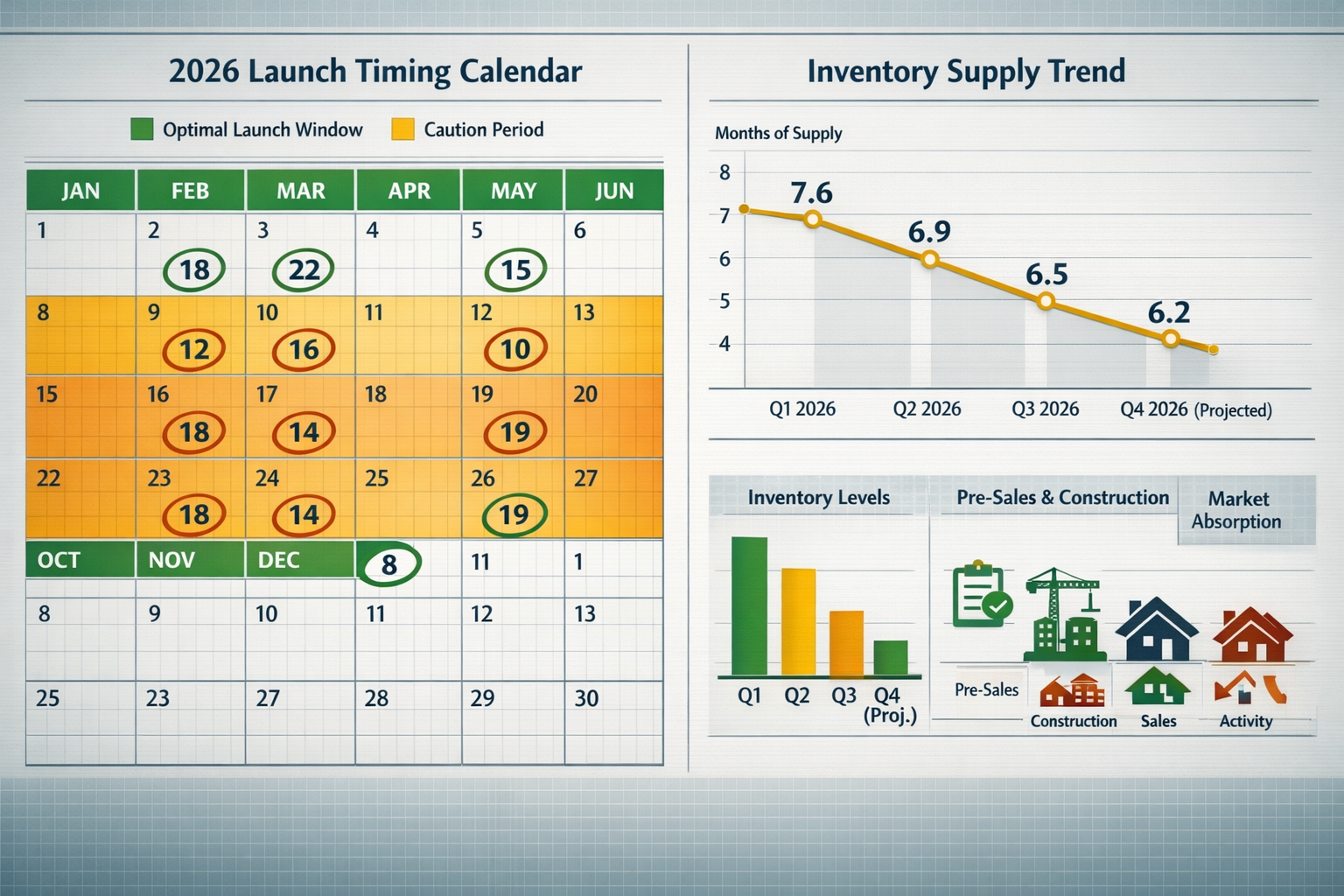
Timing market entry represents one of the most critical—and most frequently mismanaged—decisions in residential development. The Tightening New-Home Inventory 2026: Launch Timing and Pricing for Developer Profit Maximization framework identifies specific windows when buyer activity, competitive intensity, and market psychology align to maximize absorption and pricing power.
Quarterly Launch Window Analysis
Q1 2026 (January-March): Prime Launch Period ✅
The first quarter offers exceptional launch conditions:
- Post-holiday buyer motivation: Serious buyers return to market with New Year resolution energy and tax refund anticipation
- Limited competitive launches: Many developers delay until spring, reducing competitive noise
- Favorable financing window: Federal Reserve rate cuts in late 2025 improved construction loan terms[1], benefiting builders who can pass savings to buyers
- Weather considerations: Focus on markets with year-round activity or position launches for spring occupancy
Recommended action: Launch premium inventory and limited-edition units in Q1 to establish price benchmarks and create scarcity perception.
Q2 2026 (April-June): Secondary Window with Caution ⚠️
Spring traditionally brings peak buyer activity, but also maximum competition:
- Highest buyer traffic: Families shopping before summer relocations drive volume
- Competitive saturation: Most developers launch in spring, diluting individual project visibility
- Rapid absorption potential: High traffic can quickly move inventory if positioned correctly
Recommended action: Reserve Q2 for volume phases of larger developments or secondary buildings after establishing market positioning in Q1.
Q3 2026 (July-September): Strategic Opportunity Window ✅
Late summer and early fall present underutilized launch opportunities:
- Reduced competition: Many projects pause marketing during summer months
- Serious buyer concentration: Those shopping in summer typically have immediate need and decision urgency
- Back-to-school momentum: Late August and September bring renewed focus and urgency
- Year-end closing motivation: Buyers seeking December closings for tax purposes begin shopping
Recommended action: Launch new phases or buildings in late August/early September to capture motivated buyers with reduced competitive interference.
Q4 2026 (October-December): Selective Launch Strategy ⚠️
The final quarter requires careful navigation:
- Holiday distractions: Thanksgiving through New Year’s significantly reduces buyer attention
- Year-end urgency: Some buyers have deadline motivation for tax or relocation reasons
- Budget planning: Buyers preparing for following year may engage without immediate purchase intent
Recommended action: Limit launches to pre-sale or VIP phases that build momentum for Q1 2027 public launches, or target specific buyer segments with year-end deadlines.
Regional Timing Variations
Geographic market conditions significantly influence optimal launch timing. Markets like Texas and Florida have cooled after cyclical overbuilding, while Midwest markets including Columbus, Indianapolis, and Kansas City show emerging strength.[1] Developers must calibrate timing strategies to local market rhythms:
- Cooling markets: Launch earlier in seasonal windows to capture diminishing buyer pool before competitors
- Heating markets: Can afford later launches within windows, as sustained demand provides buffer
- Seasonal markets: Align launches with local peak activity periods (e.g., post-snowbird season in Florida, pre-winter in northern markets)
Understanding regional growth patterns and infrastructure development helps developers synchronize launches with local market momentum.
Pricing Architecture for Profit Maximization
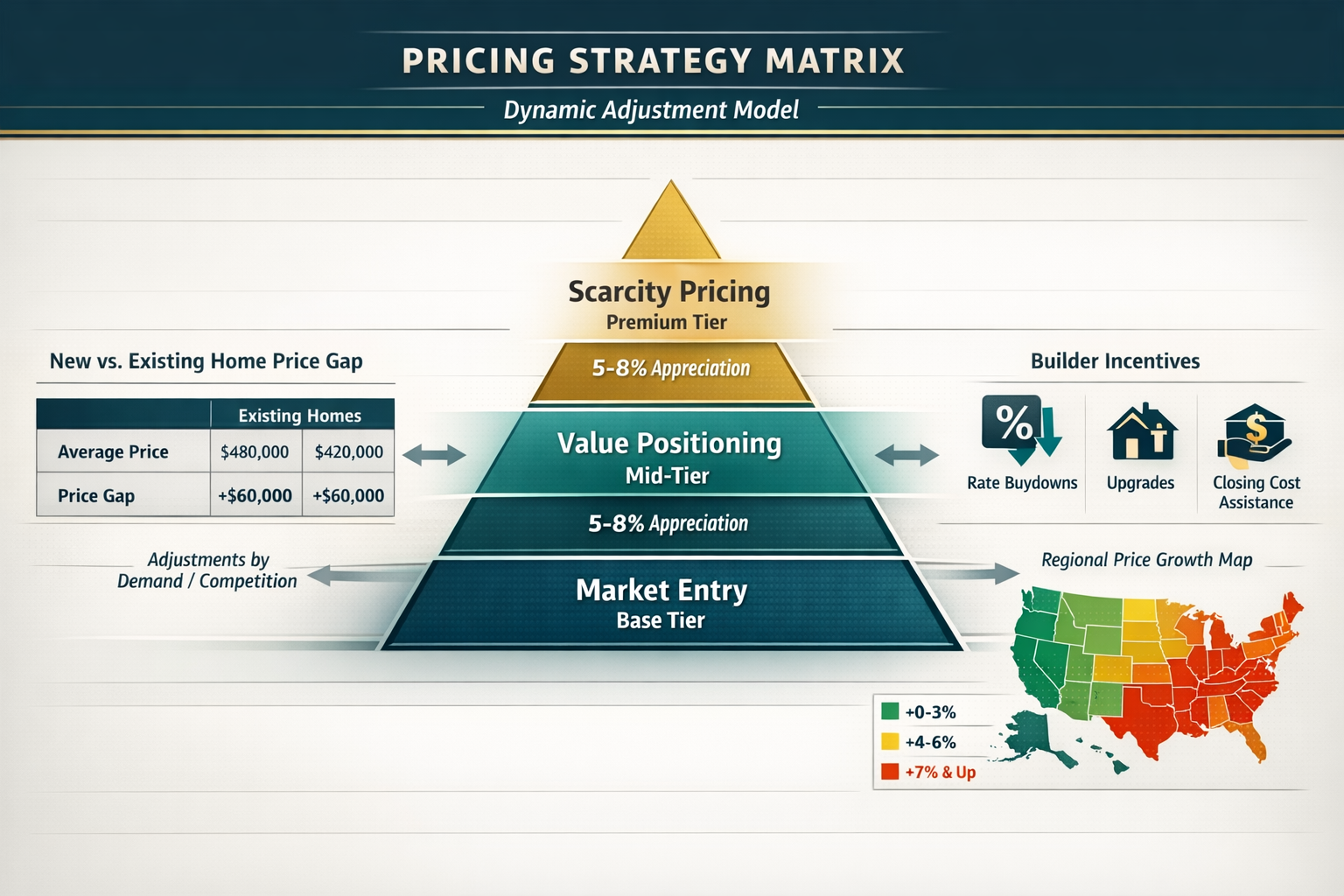
The pricing strategy component of Tightening New-Home Inventory 2026: Launch Timing and Pricing for Developer Profit Maximization extends beyond simple cost-plus calculations to encompass dynamic, psychology-driven pricing architecture that maximizes both absorption velocity and margin capture.
Tiered Pricing Models for 2026
Static pricing leaves substantial profit on the table in constrained inventory environments. Dynamic tiered pricing creates multiple entry points while capturing appreciation as inventory depletes:
Base Tier (20-25% of inventory)
- Positioning: Market entry pricing to drive initial traffic and establish competitive benchmark
- Target appreciation: 5-6% from launch to final unit
- Strategic purpose: Create urgency through “starting from” marketing while establishing value perception
Value Tier (50-60% of inventory)
- Positioning: Core product at market-rate pricing with standard finishes and locations
- Target appreciation: 6-8% from launch to final unit
- Strategic purpose: Generate volume absorption and cash flow while maintaining healthy margins
Premium Tier (15-25% of inventory)
- Positioning: Best locations, enhanced finishes, or limited features commanding premium pricing
- Target appreciation: 8-10% from launch to final unit
- Strategic purpose: Maximize margin on scarcity-driven demand and capture aspirational buyers
This tiered approach allows developers to capture appreciation throughout the sales cycle rather than setting single prices that either leave money on the table or create resistance. As inventory depletes, pricing naturally escalates within each tier, creating momentum and urgency.
The Incentive vs. Price Reduction Calculus
With nearly two-thirds of builders offering incentives beyond price cuts[1], the question becomes: when to reduce price versus when to deploy incentives? The answer depends on market perception and profit protection:
When to Use Incentives (Preferred) 💰
- Mortgage rate buydowns: Reduce monthly payment without lowering base price, preserving appraisal values and future pricing
- Upgrade packages: Offer enhanced finishes or features at cost, creating perceived value exceeding cash equivalent
- Closing cost assistance: Helps buyers overcome down payment barriers without reducing home price
- Flexible closing dates: Accommodates buyer timing needs at minimal cost to developer
When to Reduce Price (Selective) 📉
- Inventory aging beyond 120 days: Holding costs justify price adjustment to accelerate absorption
- Competitive pressure: Multiple comparable projects force price repositioning
- End-of-phase clearance: Final units benefit from price reduction to avoid carrying costs into next phase
The favorable financing environment created by Federal Reserve rate cuts[1] makes mortgage buydowns particularly effective in 2026, as construction loan savings can fund buyer rate reductions that dramatically improve affordability without sacrificing list prices.
Price Gap Management: New vs. Existing Homes
The narrowing price differential between new and existing homes[1] creates both opportunity and challenge. Developers must actively manage this gap through:
Value proposition differentiation:
- Warranty protection: 10-year structural warranties versus as-is resale condition
- Energy efficiency: Modern building codes deliver lower operating costs versus older homes
- Customization opportunity: Finish selections and upgrades unavailable in resale market
- Community amenities: New developments often include pools, fitness centers, and gathering spaces
Competitive pricing intelligence:
- Monitor comparable resale listings weekly to track price movements
- Adjust pricing tiers to maintain 5-10% premium justified by new-home advantages
- Identify resale weaknesses (outdated finishes, deferred maintenance) to highlight in marketing
Developers working on strategic property developments must continuously assess how their pricing positions against both new and existing inventory to optimize market share capture.
Pre-Sale Tactics and Momentum Building
The third pillar of Tightening New-Home Inventory 2026: Launch Timing and Pricing for Developer Profit Maximization involves pre-sale strategy—the systematic cultivation of buyer interest and commitment before public launch. Effective pre-sale tactics can secure 25-40% of inventory before general availability, establishing market validation and creating urgency for remaining units.
The VIP List Cultivation System
Building a robust VIP list requires 90-120 days of systematic lead generation and nurturing:
Phase 1: Interest Capture (Days 1-30)
- Deploy teaser marketing highlighting location, lifestyle, and coming-soon messaging
- Create landing page with email capture offering exclusive preview access
- Leverage broker networks with co-op incentives for qualified buyer referrals
- Target demographic segments through digital advertising and social media
Phase 2: Engagement and Education (Days 31-60)
- Send weekly content educating prospects on community, finishes, and buying process
- Host virtual “sneak peek” sessions showcasing plans and renderings
- Offer exclusive consultation appointments with sales team
- Build anticipation through countdown messaging and milestone updates
Phase 3: Commitment Preparation (Days 61-90)
- Invite VIP list to exclusive preview events with priority reservation opportunity
- Provide detailed pricing, floor plans, and availability information
- Offer VIP-exclusive incentives (upgrade packages, preferred pricing, best location selection)
- Create urgency through limited-time VIP reservation periods
Phase 4: Soft Launch Conversion (Days 91-120)
- Execute soft launch with VIP-only purchasing window
- Target 25-40% inventory absorption during soft launch
- Generate social proof and momentum for public launch
- Adjust pricing and positioning based on soft launch feedback
This systematic approach transforms cold prospects into committed buyers while gathering market intelligence that informs final pricing and positioning decisions.
Leveraging Construction Milestones
Physical progress provides powerful marketing momentum throughout the sales cycle. Projects like the Tramonto development with completed foundations demonstrate how construction milestones create tangible proof of progress that reduces buyer uncertainty.
Key milestone marketing opportunities:
- Foundation completion: Validates project viability and timeline credibility
- Framing completion: Allows buyers to visualize spaces and make finish selections
- Model home opening: Provides experiential selling environment that accelerates decisions
- First closings: Creates social proof and community establishment that attracts remaining buyers
Developers should synchronize launch timing with upcoming milestones to maximize credibility and minimize buyer concerns about project completion.
Digital Marketing and Lead Conversion
Modern pre-sale success requires sophisticated digital marketing infrastructure:
- Retargeting campaigns: Recapture website visitors through strategic ad placement across platforms
- Email automation sequences: Nurture leads through educational content and milestone updates
- Virtual tour technology: Enable remote property exploration for out-of-market buyers
- CRM integration: Track lead behavior and engagement to identify high-intent prospects
The performance-driven sales approaches transforming real estate markets demonstrate how data-informed marketing significantly improves conversion rates and absorption velocity.
Market-Specific Strategies and Regional Considerations
While national trends provide the framework for Tightening New-Home Inventory 2026: Launch Timing and Pricing for Developer Profit Maximization, regional market variations demand customized approaches. The divergence between cooling markets in Texas and Florida versus emerging strength in Midwest markets[1] illustrates the importance of local market intelligence.
Cooling Market Strategies (Texas, Florida, Select Sunbelt)
Markets experiencing post-boom normalization require defensive strategies:
Pricing approach:
- Conservative initial pricing at or slightly below comparable new inventory
- Aggressive incentive deployment to maintain competitive position
- Slower price escalation curves (3-5% vs. 6-8% in balanced markets)
Launch timing:
- Earlier launches within seasonal windows to capture buyer pool before competitors
- Smaller phase releases to avoid oversupply perception
- Extended pre-sale periods to gauge demand before committing to construction
Product positioning:
- Emphasize right-sized homes and townhomes aligned with budget constraints
- Focus on value proposition versus premium positioning
- Highlight lifestyle and location advantages over pure appreciation potential
Emerging Market Strategies (Midwest Growth Markets)
Markets like Columbus, Indianapolis, and Kansas City showing new strength[1] support more aggressive strategies:
Pricing approach:
- Premium positioning capitalizing on limited competitive new inventory
- Steeper price escalation curves (8-10% launch to completion)
- Minimal incentives except for strategic buyer segment targeting
Launch timing:
- Later launches within seasonal windows leverage building momentum
- Larger phase releases to capture market share during growth cycle
- Compressed sales timelines with urgency-driven marketing
Product positioning:
- Premium finishes and features targeting affluent buyer migration from higher-cost markets
- Larger homes and lots appealing to lifestyle upgraders
- Emphasize appreciation potential and investment value alongside lifestyle benefits
International Buyer Considerations
Markets with significant international buyer activity require specialized approaches. Investment opportunities in Brazilian property markets demonstrate how global capital flows influence local development strategies, requiring:
- Currency-neutral pricing strategies
- Extended closing timelines accommodating international financing
- Virtual sales infrastructure for remote buyers
- Legal and tax guidance for foreign ownership structures
Risk Management and Contingency Planning
Even the most sophisticated Tightening New-Home Inventory 2026: Launch Timing and Pricing for Developer Profit Maximization strategy requires risk mitigation and contingency planning for market disruptions.
Absorption Rate Monitoring
Establish clear absorption benchmarks and trigger points for strategy adjustments:
Healthy absorption targets:
- 8-12 units per month for mid-market projects (100-200 units)
- 4-6 units per month for luxury projects (50-100 units)
- 25-40% absorption during pre-sale/soft launch phase
- 60-75% absorption within 6 months of public launch
Warning indicators requiring intervention:
- Absorption falling below 50% of target for two consecutive months
- Competitive projects absorbing significantly faster at comparable pricing
- Traffic declining month-over-month despite consistent marketing investment
- Increasing cancellation rates above 10% of contracts
Pricing Adjustment Protocols
Establish predetermined decision frameworks for pricing modifications:
Tier 1 Response (Absorption 10-25% below target):
- Deploy additional incentives (rate buydowns, upgrade packages)
- Increase marketing spend and broker co-op rates
- Enhance sales team training and closing techniques
Tier 2 Response (Absorption 25-40% below target):
- Implement limited-time price reductions on select inventory
- Restructure pricing tiers and escalation curves
- Consider phase delays or scope reductions for future buildings
Tier 3 Response (Absorption 40%+ below target):
- Comprehensive pricing reset across all inventory
- Evaluate project pause or scope reduction
- Engage distressed asset specialists if necessary
Market Volatility Hedging
Protect profit margins against external market shocks:
- Interest rate volatility: Maintain relationships with multiple lenders offering rate lock programs
- Material cost inflation: Lock pricing on long-lead materials and negotiate fixed-price contracts
- Labor constraints: Establish preferred contractor relationships with capacity commitments
- Regulatory changes: Monitor local policy developments affecting development costs or timelines
Understanding emerging trends like cryptocurrency in real estate investment helps developers prepare for evolving buyer preferences and payment mechanisms.
Technology and Data-Driven Decision Making
Modern residential development increasingly relies on sophisticated analytics and technology platforms to optimize launch timing and pricing decisions.
Market Intelligence Platforms
Leverage data aggregation tools to monitor:
- Competitive inventory tracking: Real-time monitoring of new and resale listings, pricing, and absorption
- Buyer behavior analytics: Website traffic patterns, lead source performance, and conversion metrics
- Economic indicators: Employment data, wage growth, and migration patterns in target markets
- Sentiment analysis: Social media and review monitoring for brand perception and competitive intelligence
Predictive Pricing Models
Advanced developers deploy algorithmic pricing tools that:
- Analyze historical absorption patterns to predict optimal pricing curves
- Model buyer price sensitivity across different demographic segments
- Simulate various incentive scenarios to identify maximum margin strategies
- Provide real-time pricing recommendations based on current market conditions
Digital Sales Infrastructure
Technology enables more efficient buyer journey management:
- Virtual reality tours: Allow remote buyers to experience properties before construction completion
- Digital contract execution: Accelerate transaction timelines and reduce friction
- Automated lead nurturing: Scale personalized communication without proportional staff increases
- Performance dashboards: Provide real-time visibility into sales metrics and team performance
Developers investing in strategic property portfolios increasingly rely on these technological capabilities to maintain competitive advantages.
Conclusion: Executing Your 2026 Strategy
The convergence of persistent inventory constraints, favorable financing conditions, and evolving buyer preferences creates a limited-window opportunity for developers who execute sophisticated launch timing and pricing strategies in 2026. The Tightening New-Home Inventory 2026: Launch Timing and Pricing for Developer Profit Maximization framework provides the strategic foundation, but successful execution requires disciplined implementation and continuous market monitoring.
Immediate Action Steps for Developers
Within the next 30 days:
- Conduct comprehensive competitive analysis of all new and resale inventory within 5 miles of your project
- Establish baseline absorption targets and pricing architecture across inventory tiers
- Develop 90-day pre-sale marketing plan with VIP list cultivation system
- Secure financing commitments that capitalize on favorable construction loan environment
- Identify optimal launch window based on project timeline, seasonal factors, and competitive landscape
Within the next 90 days:
- Execute VIP list building campaign targeting 500-1,000 qualified prospects per 100 units
- Finalize pricing tiers and escalation curves with built-in flexibility for market adjustments
- Establish monitoring dashboards tracking absorption, traffic, and competitive activity
- Prepare soft launch materials including detailed pricing, plans, and incentive packages
- Train sales team on value proposition, competitive positioning, and closing techniques
Ongoing throughout 2026:
- Monitor absorption rates weekly against established benchmarks
- Adjust pricing and incentives based on market feedback and competitive dynamics
- Leverage construction milestones for momentum-building marketing campaigns
- Maintain market intelligence on inventory levels, pricing trends, and buyer preferences
- Document lessons learned to refine strategies for future phases and projects
The Competitive Advantage of Strategic Timing
In a market where 40% of builders are reducing prices and two-thirds are offering incentives[1], the developers who will thrive are those who proactively manage launch timing and pricing rather than reactively responding to market pressures. The modest 1% growth in single-family construction[1] means new supply will remain constrained, but not all developers will capture equal shares of buyer demand or profit margins.
The projected 4.43% home price growth by January 2027[3] provides a favorable appreciation backdrop, but individual project performance will vary dramatically based on execution quality. Developers who implement the Tightening New-Home Inventory 2026: Launch Timing and Pricing for Developer Profit Maximization framework position themselves to capture 6-10% price appreciation while maintaining healthy absorption rates—a combination that maximizes both velocity and margin.
Final Thoughts
The residential development landscape in 2026 rewards strategic sophistication over simple supply provision. As inventory remains tight but gradually normalizes, the window for maximum pricing power narrows. Developers must act decisively to capitalize on current market conditions while preparing contingency plans for potential disruptions.
Success in this environment requires balancing confidence in market fundamentals with humility about unpredictable external factors. The developers who combine data-driven decision making with market intuition, strategic patience with tactical urgency, and pricing discipline with buyer empathy will emerge as the profit leaders in 2026 and beyond.
For developers ready to implement these strategies, explore comprehensive development opportunities and stay informed on market trends to maintain your competitive edge throughout this dynamic year.
References
[1] The 2026 New Home Market A Rare Opportunity For Buyers – https://www.nar.realtor/magazine/real-estate-news/the-2026-new-home-market-a-rare-opportunity-for-buyers
[2] Housing Market Outlook – https://www.freedommortgage.com/learn/market-updates/housing-market-outlook
[3] 2026 Begins With Slow Home Price Growth – https://www.morningstar.com/news/business-wire/20260303425235/2026-begins-with-slow-home-price-growth
[4] Housing Market Predictions For 2026 When Will Home Prices Drop – https://www.discovershelter.com/news-notes/housing-market-predictions-for-2026-when-will-home-prices-drop