
nn

The Brazilian residential real estate landscape is undergoing a quiet revolution. While high-rise apartment towers continue to dominate urban skylines and transaction volumes, a powerful counter-trend is reshaping suburban markets across the country. The Villa and Landed House Resurgence in Suburban Brazil: Countering Apartment Dominance for 2026 Family Buyers represents more than just a shift in architectural preference—it signals a fundamental transformation in how Brazilian families envision their ideal living environment in the post-pandemic era.
For decades, apartments and condominiums have reigned supreme in Brazil’s major metropolitan areas, offering convenience, security, and proximity to urban amenities. Yet as 2026 unfolds, an increasing number of family buyers are looking beyond the vertical concrete jungle toward spacious villas and landed houses in suburban districts. This migration is fueled by evolving lifestyle priorities: dedicated home office spaces, private outdoor areas, and flexible floor plans that accommodate multi-generational living and remote work arrangements.
The Villa and Landed House Resurgence in Suburban Brazil: Countering Apartment Dominance for 2026 Family Buyers is not merely a temporary trend but a structural market shift supported by favorable financing conditions, government policy initiatives, and strategic developer positioning. Understanding this transformation is essential for buyers, investors, and industry stakeholders navigating Brazil’s dynamic property market.
Key Takeaways
🏡 Accelerated Growth Trajectory: Villas and landed houses are projected to grow at 6.31% annually through 2031, significantly outpacing overall market expansion and challenging apartment dominance.[1]
💰 Enhanced Financing Access: The April 2025 expansion of Minha Casa, Minha Vida to include Faixa 4 and October 2025 federal credit modernization (raising property ceilings to R$ 2.25 million and loan-to-value ratios to 80%) have unlocked middle-income buyer access to suburban landed properties.[1]
🌳 Lifestyle-Driven Demand: Post-pandemic preferences for larger living spaces, private yards, home offices, and proximity to green areas are driving family buyers toward suburban villa developments rather than urban apartments.[2][4]
📊 Market Share Reality: Despite rapid growth, apartments still command 77.17% of transactions, creating substantial runway for villa and landed house market penetration among family buyers.[1]
🏗️ Developer Innovation: Builders employing off-site construction methods, phased master plans, and sustainability features (solar energy, water conservation, eco-materials) are best positioned to capture the suburban villa opportunity.[1][4]
Understanding the Current Market Landscape: Apartment Dominance Meets Villa Growth
The Numbers Behind Apartment Supremacy
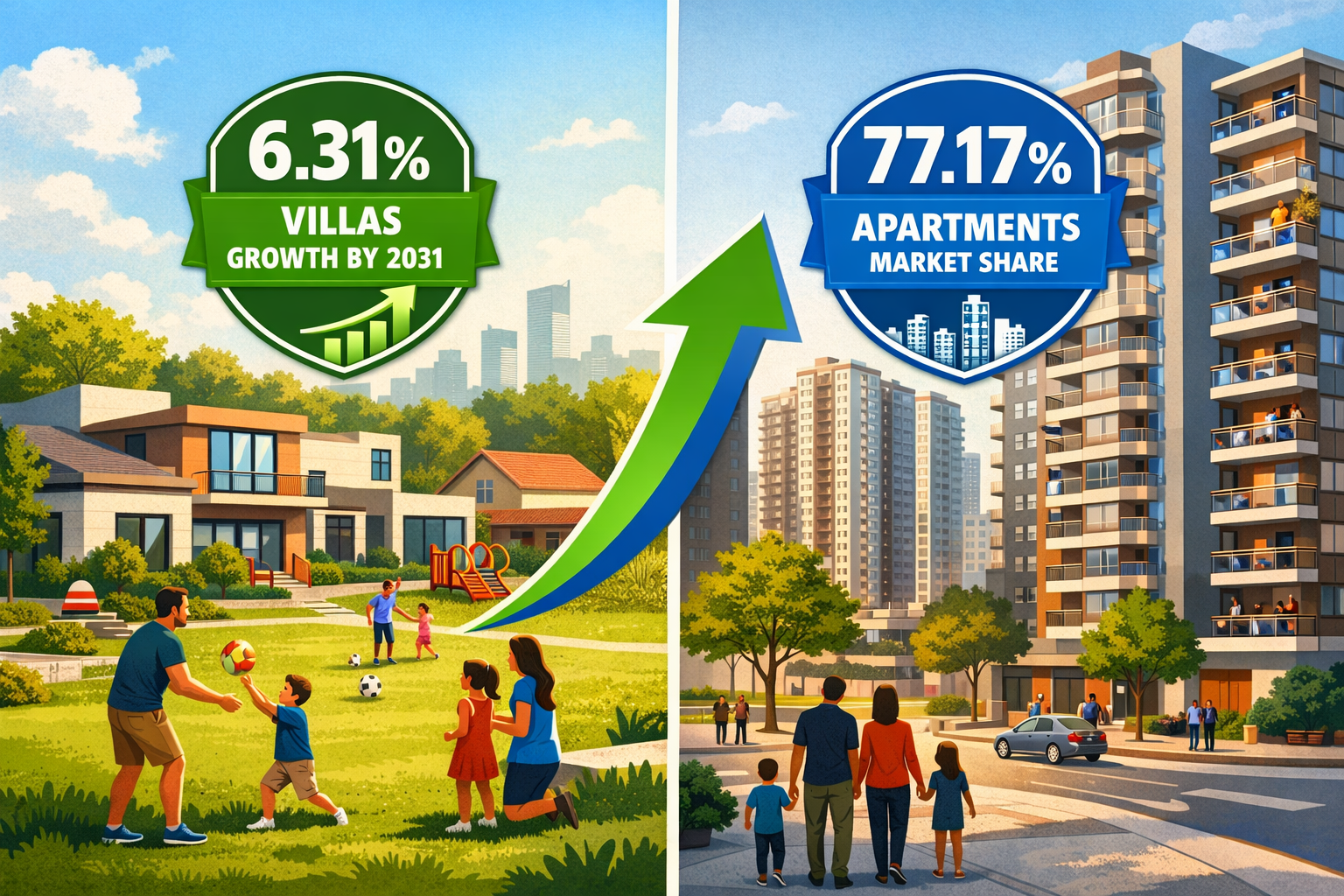
Brazil’s residential real estate market has long been synonymous with vertical living. As of 2025, apartments and condominiums represented 77.17% of all residential transactions across the country, establishing an overwhelming market dominance that has shaped urban development patterns for generations.[1] This concentration reflects historical factors including:
- Land scarcity in desirable urban cores
- Infrastructure efficiency of high-density development
- Security concerns favoring gated vertical communities
- Cultural acceptance of condominium living among Brazilian families
Major metropolitan areas like São Paulo, Rio de Janeiro, and Belo Horizonte have built their residential fabric around apartment towers, creating ecosystems where vertical living is not just common but expected. For developers, the economics of apartment construction—maximizing units per square meter of land—have driven decades of investment decisions.
The Emerging Villa and Landed House Opportunity
Yet beneath this apartment dominance, a powerful counter-trend is gaining momentum. Villas and landed houses are projected to achieve a compound annual growth rate of 6.31% through 2031, substantially outperforming the broader residential market.[1] Even more striking, one market analyst forecasts growth rates of 14% or higher for villas and landed estates, despite their currently limited market share.[8]
This growth trajectory for the Villa and Landed House Resurgence in Suburban Brazil: Countering Apartment Dominance for 2026 Family Buyers is not occurring in isolation. It reflects fundamental shifts in:
| Market Driver | Impact on Villa Demand | Timeframe |
|---|---|---|
| Lifestyle Migration | Families relocating to suburban and secondary-city districts seeking space and amenities | Ongoing through 2026+ |
| Financing Expansion | Minha Casa, Minha Vida Faixa 4 addition (April 2025) expanding middle-income access | Immediate impact |
| Credit Modernization | Federal policy raising property ceiling to R$ 2.25M and LTV to 80% (October 2025) | R$ 40B injection over two years[1] |
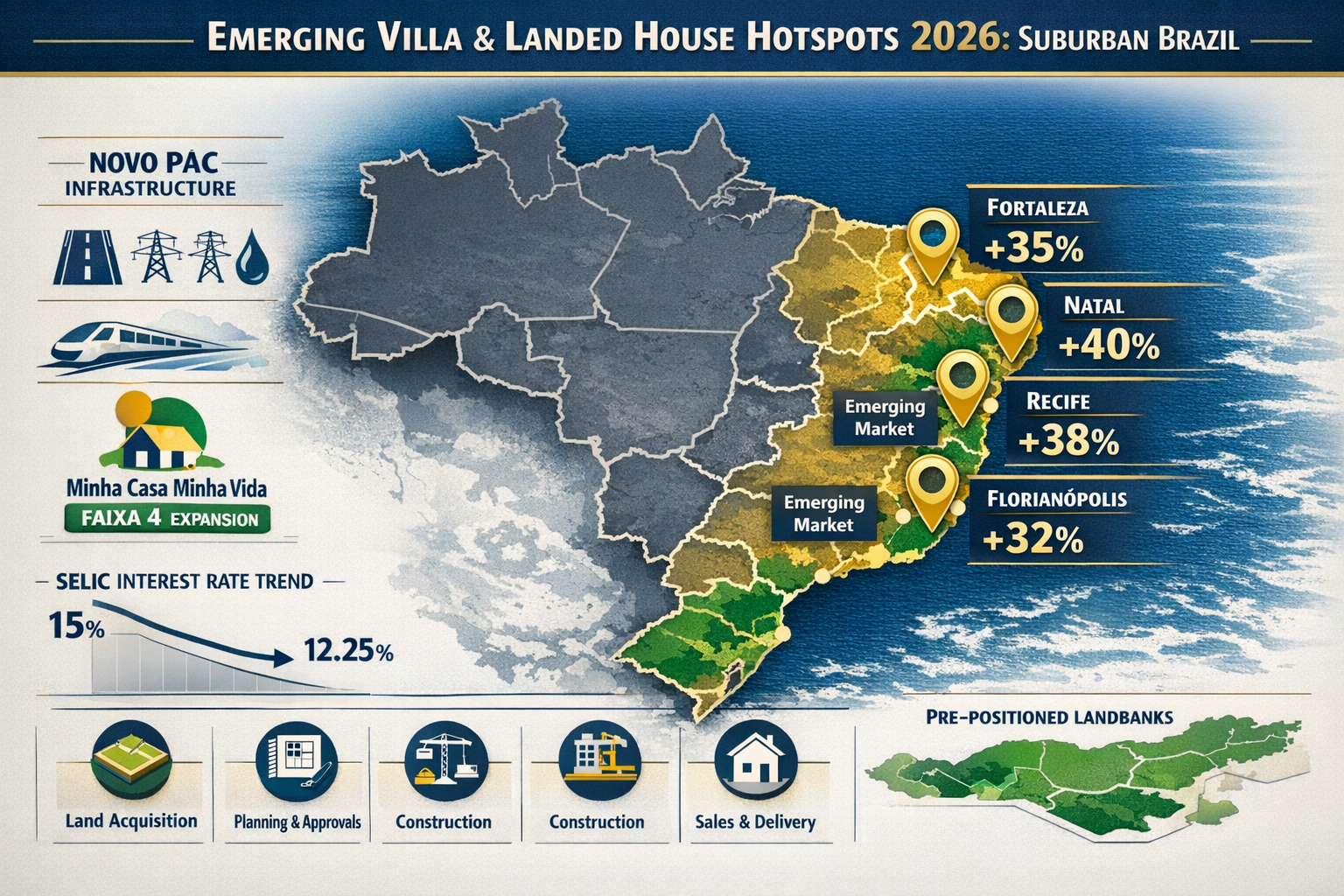
| Interest Rate Decline | Selic projected to fall from 15% to ~12.25% by end of 2026 | Gradual affordability improvement[5] |
| Sustainability Demand | Growing preference for eco-residences with solar, water conservation, green materials | Accelerating through 2026[4] |
Geographic Patterns: Where Villas Are Gaining Ground
The Villa and Landed House Resurgence in Suburban Brazil: Countering Apartment Dominance for 2026 Family Buyers is not uniformly distributed across the country. Growth is concentrated in specific geographic contexts where land availability, infrastructure development, and lifestyle amenities converge:
Suburban Rings Around Major Metros: Municipalities surrounding São Paulo, Rio de Janeiro, and other state capitals are experiencing the strongest villa demand. These areas offer proximity to urban employment centers while providing the space and amenities that apartments cannot match.
Secondary Cities with Infrastructure Investment: Cities benefiting from Novo PAC infrastructure projects—improved roads, utilities, transit connections—are becoming increasingly attractive for landed house developments. The combination of lower land costs and improving connectivity creates compelling value propositions for family buyers.[4]
Coastal and Eco-Tourism Regions: Areas like the interior of Bahia, coastal Santa Catarina (including the growing region of Ingleses in Florianópolis), and ecological tourism destinations are commanding premium valuations for properties offering genuine connection to nature.[4]
Master-Planned Communities: Developers creating comprehensive suburban communities with integrated schools, parks, commercial areas, and recreational facilities are successfully attracting family buyers away from traditional apartment-centric neighborhoods.
Demographic and Lifestyle Drivers: Why Families Are Choosing Villas Over Apartments
The Post-Pandemic Lifestyle Transformation
The COVID-19 pandemic fundamentally altered how Brazilian families evaluate residential spaces. What began as temporary adaptations during lockdowns has evolved into permanent lifestyle preferences that favor villas and landed houses over apartments:
🏠 Space as a Premium Commodity: Families discovered that apartment living, while convenient, often lacks the square footage necessary for comfortable multi-functional use. The Villa and Landed House Resurgence in Suburban Brazil: Countering Apartment Dominance for 2026 Family Buyers is directly tied to demand for larger living spaces and outdoor amenities that support diverse household activities.[2]
💻 Dedicated Home Office Requirements: Remote and hybrid work arrangements have become permanent fixtures for many Brazilian professionals. Landed houses offer the ability to create proper home offices with adequate space, natural light, and separation from family living areas—features difficult to achieve in typical apartment layouts.[4]
🌳 Private Outdoor Space: Perhaps no single factor drives villa demand more powerfully than the desire for private yards and outdoor living areas. Families want spaces where children can play safely, where outdoor dining and entertainment are possible, and where connection to nature is immediate rather than mediated through shared condominium amenities.[1]
🧘 Mental Health and Well-being: The psychological benefits of access to green spaces, natural light, and reduced density have become central considerations for family buyers. Suburban villas offer improved living conditions that directly support mental and physical health.[4]
Consumer Segment Profile: Who Is Buying Villas?
The Villa and Landed House Resurgence in Suburban Brazil: Countering Apartment Dominance for 2026 Family Buyers is driven by specific consumer segments with distinct characteristics and priorities:
Middle-Income Families with Children: The April 2025 addition of Faixa 4 to Minha Casa, Minha Vida expanded financing eligibility to middle-income cohorts, enabling families previously priced out of landed house ownership to enter the market.[1] These buyers prioritize:
- School proximity and quality
- Safe outdoor play spaces
- Room for family expansion
- Long-term value appreciation
Multi-Generational Households: Brazilian culture often includes extended family living arrangements. Villas with flexible floor plans can accommodate grandparents, adult children, and multiple generations under one roof more comfortably than apartments.[1]
Remote Workers and Digital Professionals: Professionals no longer tethered to daily office commutes are willing to trade urban proximity for suburban space. This segment values:
- High-quality internet infrastructure
- Dedicated workspace
- Quieter environments for video calls
- Work-life balance through outdoor access
Eco-Conscious Buyers: A growing segment actively seeks eco-residences and sustainable features including solar panels, rainwater harvesting, native landscaping, and energy-efficient construction. These buyers often target properties near protected areas or in developments with genuine environmental commitments.[4]
Lifestyle Migrants: Both domestic migrants (moving from smaller towns to regional centers) and international buyers (attracted by Brazil’s favorable currency exchange) are increasingly targeting lifestyle-oriented markets offering high rental yields and low acquisition costs beyond traditional São Paulo and Rio de Janeiro concentration.[4]
Flexibility and Customization Advantages
Unlike apartments constrained by structural columns, shared walls, and condominium regulations, landed houses offer unparalleled flexibility:
- Renovation Freedom: Homeowners can modify layouts, add rooms, create outdoor structures, and personalize spaces without navigating complex condominium approval processes
- Expansion Potential: Many suburban plots allow for future additions as family needs evolve
- Lifestyle Customization: From home gyms to workshops, from vegetable gardens to pet areas, villas accommodate diverse lifestyle choices
- Reduced Regulatory Constraints: While still subject to municipal codes, single-family homes face fewer restrictions than multi-unit condominiums
This flexibility is particularly valuable for the consumer segments seeking yards and flexible layouts that characterize villa demand growth.[1]
Financial Accessibility and Policy Support Enabling the Villa Resurgence
Game-Changing Financing Reforms of 2025
The Villa and Landed House Resurgence in Suburban Brazil: Countering Apartment Dominance for 2026 Family Buyers has been significantly accelerated by landmark policy changes implemented in 2025:
Minha Casa, Minha Vida Faixa 4 Expansion (April 2025)
The addition of Faixa 4 to Brazil’s flagship housing program represented a watershed moment for middle-income villa buyers. This expansion:
- Extended financing eligibility to middle-income cohorts previously excluded from subsidy programs
- Offered longer repayment tenors that improved affordability metrics
- Pulled forward demand from credit-constrained segments who could now qualify for landed house mortgages[1]
The impact has been immediate and substantial, with developers reporting accelerated sales velocity in suburban villa projects targeting Faixa 4-eligible buyers.
Federal Credit Modernization (October 2025)
In October 2025, the federal government announced comprehensive modernization of real estate credit rules with profound implications for villa buyers:
📈 Property Value Ceiling Increase: The maximum property value eligible for standard financing rose from R$ 1.5 million to R$ 2.25 million, bringing many suburban villa developments within reach of conventional mortgage products.[1]
💰 Enhanced Loan-to-Value Ratios: Maximum LTV ratios increased to 80%, reducing down payment requirements and making landed houses accessible to buyers with limited cash reserves.[1]
🏦 Credit Injection Projection: These reforms are projected to inject R$ 40 billion in housing credit over two years and finance 80,000 incremental units through 2026—a significant portion targeting suburban villa and landed house segments.[1]
Interest Rate Environment and Affordability Dynamics
Beyond direct policy interventions, the macroeconomic interest rate trajectory is creating favorable conditions for villa buyers. Market forecasters expect the Selic rate to decline from 15% to approximately 12.25% by the end of 2026, which should:
- Expand the buyer pool as mortgage rates compress
- Improve installment-to-income ratios most significantly for middle-income buyers
- Support continued price growth across residential segments including landed houses
- Enable developers to broaden product offerings beyond subsidy thresholds[1][5]
For family buyers evaluating villa purchases in 2026, this interest rate environment represents a multi-year window of improved affordability that may not persist indefinitely.
Investment Returns and Value Appreciation
The Villa and Landed House Resurgence in Suburban Brazil: Countering Apartment Dominance for 2026 Family Buyers is not solely a lifestyle story—it’s also an investment opportunity. Several factors support strong value appreciation potential:
Limited Supply in High-Demand Locations: Unlike apartments where developers can add vertical density, suburban villa supply is constrained by land availability and municipal approval processes, creating scarcity value.
Infrastructure Investment Multiplier: Properties located near Novo PAC infrastructure projects benefit from improved connectivity and amenities that drive appreciation. Buyers who identify these corridors early can capture substantial value gains.
Pre-Positioned Landbanks: Developers with pre-positioned land inventory and off-plan sales funnels in landed house segments are positioned to monetize demand faster than secondary resales, creating opportunities for early buyers in new developments.[1]
Rental Yield Potential: Suburban villas in well-located communities can generate attractive rental yields, particularly for families and corporate relocations seeking longer-term leases. For insights on maximizing returns, explore best places to invest in Brazil property.
Currency Advantage: International buyers benefit from Brazil’s relatively weak currency, making villa purchases attractive on a comparative basis to similar properties in other markets.[5]
Developer Strategies and Product Innovation for the Villa Market
Off-Site Construction and Phased Master Plans
Developers successfully capturing the Villa and Landed House Resurgence in Suburban Brazil: Countering Apartment Dominance for 2026 Family Buyers are employing innovative construction and planning methodologies:
🏗️ Off-Site Construction Methods: Modular and prefabricated construction techniques offer several advantages for villa developments:
- Faster build schedules that align with sales velocity
- Quality control through factory production environments
- Cost efficiency through standardization and scale
- Reduced on-site disruption in suburban neighborhoods
Developers using these methods are better positioned to serve landed house demand where serviced plots and municipal approvals are available.[1]
📋 Phased Master Plans: Rather than attempting to build entire villa communities simultaneously, successful developers are implementing phased rollouts that:
- Match construction timelines to sales absorption
- Allow infrastructure investment to be distributed over time
- Enable refinement of product offerings based on market feedback
- Reduce capital requirements and financial risk
🤝 Structured Partnership Models: Receivables-backed funding and structured partnerships for off-plan velocity are emerging as key competitive advantages, allowing developers to align construction timelines with sales schedules without excessive balance sheet strain.[1]
Product Segmentation: Corridor Densification vs. Planned-Community Depth
The Brazil residential real estate industry is increasingly segmenting product strategies around distinct formats:
Apartment Strategy: Corridor Densification
- Focus on urban corridors with transit access
- Maximize unit count per land parcel
- Target single professionals and small households
- Emphasize convenience and urban amenities
Villa Strategy: Planned-Community Depth
- Create comprehensive suburban neighborhoods
- Integrate residential, commercial, educational, and recreational uses
- Target families seeking space and lifestyle amenities
- Build long-term community value beyond individual units
This segmentation reflects market maturation where different formats serve distinct buyer needs and geographic contexts.[1] Developers attempting to apply apartment-style density economics to villa projects typically struggle, while those embracing the unique value proposition of suburban landed houses succeed.
Sustainability as Competitive Differentiation
Eco-residences and sustainability represent a key growth driver for villa developments in 2026 and beyond.[4] Family buyers increasingly demand:
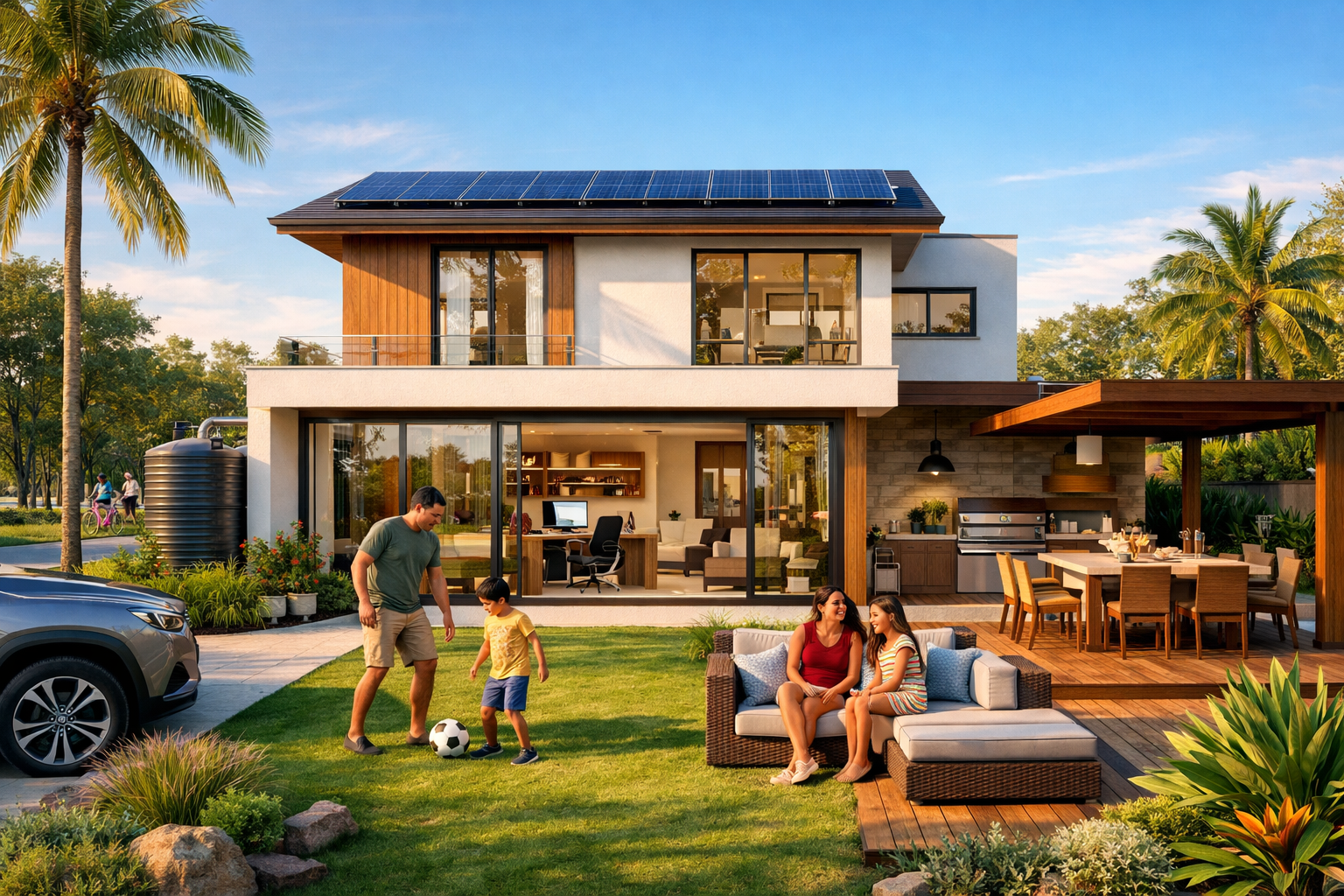
☀️ Solar Energy Systems: Rooftop solar installations that reduce electricity costs and provide energy independence are becoming standard features in premium villa developments.
💧 Water Conservation Infrastructure: Rainwater harvesting systems, greywater recycling, and drought-resistant native landscaping appeal to eco-conscious buyers and reduce operating costs.
🌱 Sustainable Building Materials: Use of responsibly sourced wood, recycled materials, low-VOC finishes, and energy-efficient insulation systems differentiates developments in competitive markets.
🌳 Connection to Nature: Properties located near protected areas or offering genuine connection to nature (not just landscaping but access to trails, waterways, or ecological preserves) command premium valuations.[4]
Developers incorporating these features are not only capturing current demand but also future-proofing their projects against evolving environmental regulations and buyer expectations.
Hybrid Designs: Blending Urban Access with Outdoor Living
The most successful villa developments in the Villa and Landed House Resurgence in Suburban Brazil: Countering Apartment Dominance for 2026 Family Buyers are those that bridge the gap between urban convenience and suburban lifestyle:
🚗 Proximity to Transit and Employment Centers: While buyers seek space, they don’t want complete isolation. Developments within 30-45 minutes of major employment centers via quality roads or transit connections attract the broadest buyer pool.
🛒 Integrated Commercial Amenities: Master-planned communities that include retail, dining, and services reduce the need for constant trips to urban centers.
🏫 Educational Infrastructure: Proximity to quality schools—or inclusion of educational facilities within the development—is a top priority for family buyers.
🎾 Recreational and Social Spaces: Community centers, sports facilities, parks, and gathering spaces create the social fabric that makes suburban living attractive rather than isolating.
📡 Digital Infrastructure: High-speed internet and mobile connectivity are non-negotiable for remote workers and digital-native families.
Developers who successfully integrate these elements create hybrid environments that offer the best of both worlds—the space and nature of suburban living with the convenience and connectivity of urban life. For examples of developments achieving this balance, explore current projects that exemplify modern Brazilian residential innovation.
Geographic Hotspots and Investment Opportunities for 2026
Identifying High-Potential Suburban Markets
The Villa and Landed House Resurgence in Suburban Brazil: Countering Apartment Dominance for 2026 Family Buyers is creating differentiated investment opportunities across Brazil’s diverse geography. Success requires understanding which markets offer the strongest fundamentals:
🎯 Growth with Infrastructure Balance: Villa demand is concentrated in municipalities that balance growth with adequate infrastructure provision.[1] Markets experiencing rapid population growth without corresponding infrastructure investment face congestion and quality-of-life challenges that undermine villa value propositions.
🌊 Coastal Secondary Cities: Beyond the traditional São Paulo-Rio axis, coastal cities like Florianópolis, Vitória, and Natal are attracting both domestic and international buyers seeking lifestyle-oriented markets with beach access, natural amenities, and strong rental yields.[4] The life in Florianópolis exemplifies the appeal of these secondary coastal markets.
🏞️ Ecological Tourism Destinations: The interior of Bahia, Minas Gerais mountain regions, and Amazonian gateway cities are emerging as niche villa markets where properties offering authentic nature experiences command premium pricing.[4]
🏭 Industrial Corridor Suburbs: Areas surrounding major industrial and logistics hubs benefit from employment growth and corporate relocation demand, creating stable rental markets for suburban villas.
📊 Pre-Positioned Developer Landbanks: Markets where developers have already secured pre-positioned landbanks and obtained municipal approvals offer faster time-to-market and reduced execution risk for buyers seeking new construction.[1]
Regional Variations in Villa Product Types
Villa and landed house preferences vary significantly across Brazil’s regions, requiring localized product strategies:
| Region | Preferred Villa Characteristics | Key Buyer Priorities |
|---|---|---|
| Southeast (SP, RJ, MG) | Contemporary architecture, security features, proximity to metros | Commute times, school quality, property appreciation |
| South (SC, PR, RS) | European-influenced designs, sustainability features, larger plots | Climate comfort, nature access, community quality |
| Northeast (BA, PE, CE) | Beach proximity, indoor-outdoor living, resort-style amenities | Lifestyle quality, rental income potential, second-home appeal |
| Central-West (DF, GO, MT) | Modern minimalist designs, agricultural integration, space | Land value, expansion potential, agribusiness connections |
| North (AM, PA) | Eco-conscious designs, climate adaptation, nature integration | Environmental authenticity, unique location value |
Novo PAC Infrastructure Projects: The Hidden Multiplier
One of the most significant yet underappreciated factors in the Villa and Landed House Resurgence in Suburban Brazil: Countering Apartment Dominance for 2026 Family Buyers is the Novo PAC (Programa de Aceleração do Crescimento) infrastructure investment program.
Suburban villa developments located near Novo PAC projects benefit from:
🛣️ Transportation Improvements: New highways, road expansions, and transit connections reduce commute times and improve access to urban employment centers.
💡 Utility Upgrades: Electrical grid improvements, water system expansions, and sewage infrastructure make previously marginal areas viable for quality residential development.
🏥 Public Service Expansion: Investment in schools, healthcare facilities, and public services improves quality of life and attracts family buyers.
💰 Value Appreciation Catalyst: Infrastructure investment typically precedes property value appreciation by 12-24 months, creating opportunities for early buyers and developers who can identify Novo PAC corridors before they’re widely recognized.
Savvy investors and family buyers in 2026 are mapping Novo PAC project locations and targeting villa developments within these infrastructure improvement zones to maximize both lifestyle quality and investment returns.
Practical Guidance for 2026 Family Buyers
Evaluating Villa vs. Apartment: A Decision Framework
For families navigating the Villa and Landed House Resurgence in Suburban Brazil: Countering Apartment Dominance for 2026 Family Buyers, the choice between villa and apartment should be systematic rather than emotional:
✅ Choose a Villa When:
- Family size requires 3+ bedrooms and multiple living areas
- Remote or hybrid work necessitates dedicated home office space
- Children need safe outdoor play areas
- Pets require yard access
- Multi-generational living is current or anticipated
- Long-term residence (7+ years) is planned
- Customization and renovation flexibility are valued
- Commute tolerance is 30-45+ minutes
- Sustainability features are priorities
✅ Choose an Apartment When:
- Urban location and walkability are essential
- Minimal maintenance responsibility is preferred
- Building amenities (gym, pool, concierge) are heavily used
- Short-term flexibility or relocation likelihood is high
- Commute must be under 30 minutes
- Security concerns favor gated vertical communities
- Budget constraints favor lower entry prices
- Single professional or small household without space needs
Financial Preparation and Qualification
Successfully purchasing a villa in 2026’s favorable financing environment requires strategic financial preparation:
📋 Documentation Requirements: Gather employment verification, income statements, tax returns, and credit history documentation well before beginning property search.
💳 Credit Score Optimization: Brazilian lenders increasingly use credit scoring in mortgage decisions. Pay down existing debts, correct credit report errors, and avoid new credit applications in the months before mortgage application.
💰 Down Payment Strategy: While LTV ratios now reach 80%, larger down payments (30-40%) secure better interest rates and terms. Consider:
- FGTS (Fundo de Garantia do Tempo de Serviço) withdrawal for property purchase
- Family loan or gift arrangements
- Sale of existing property or assets
- Systematic savings programs over 12-24 months
🏦 Lender Comparison: Don’t accept the first mortgage offer. Compare terms from:
- Major commercial banks (Banco do Brasil, Caixa Econômica Federal, Itaú, Bradesco)
- Regional banks with competitive niche products
- Developer-affiliated financing programs
- Credit unions and cooperative banks
📊 Total Cost Analysis: Beyond purchase price, budget for:
- Property transfer taxes (ITBI)
- Registration and notary fees
- Legal review and representation
- Property inspection
- Initial renovations or improvements
- Moving costs
- Ongoing property taxes (IPTU)
- Utilities and maintenance
- Homeowners association fees (if applicable)
Due Diligence Essentials for Villa Purchases
The Villa and Landed House Resurgence in Suburban Brazil: Countering Apartment Dominance for 2026 Family Buyers includes both established properties and new developments, each requiring specific due diligence approaches:
For Resale Villas:
- Title Verification: Engage a real estate attorney to confirm clean title, absence of liens, and proper registration
- Structural Inspection: Hire qualified engineers to assess foundation, roof, electrical, plumbing, and structural integrity
- Zoning Compliance: Verify all structures and improvements comply with municipal codes
- Boundary Survey: Confirm property boundaries match legal description and no encroachments exist
- Neighborhood Research: Visit at different times/days, speak with neighbors, assess noise and traffic patterns
- Infrastructure Assessment: Test water pressure, electrical capacity, internet speeds, mobile coverage
For New Construction/Off-Plan Villas:
- Developer Track Record: Research completion history, financial stability, and buyer satisfaction with previous projects
- Project Approvals: Verify all municipal permits, environmental licenses, and utility commitments are in place
- Construction Timeline: Understand realistic completion dates and penalties for delays
- Payment Structure: Negotiate payment milestones tied to construction progress rather than calendar dates
- Warranty Coverage: Clarify structural warranties, defect remediation processes, and post-delivery support
- Community Completion: Understand phasing plans and what amenities/infrastructure will be delivered when
For buyers interested in new developments with strong track records, reviewing construction progress updates can provide confidence in developer execution capabilities.
Maximizing Long-Term Value
🌱 Sustainable Improvements: Invest in solar panels, water conservation systems, and energy-efficient upgrades that reduce operating costs and increase resale appeal.
🏡 Landscaping and Curb Appeal: Professional landscaping with native plants creates immediate visual impact and long-term value with minimal maintenance.
🔧 Quality Over Trends: Choose classic architectural elements and quality materials over trendy designs that may date quickly.
📈 Market Timing: While trying to perfectly time markets is difficult, understanding market cycles and performance trends can inform purchase timing decisions.
🏘️ Community Engagement: Active participation in neighborhood associations and community development enhances both lifestyle quality and property values.
Challenges and Considerations in the Villa Market
Infrastructure Gaps in Emerging Suburban Areas
While the Villa and Landed House Resurgence in Suburban Brazil: Countering Apartment Dominance for 2026 Family Buyers offers tremendous opportunities, buyers must be realistic about infrastructure challenges in developing suburban markets:
🚗 Transportation Dependency: Suburban villa living typically requires vehicle ownership and tolerance for longer commutes. Public transit may be limited or nonexistent.
🏫 Educational Options: While urban centers offer diverse school choices, suburban areas may have limited options, requiring long commutes or boarding arrangements for quality education.
🏥 Healthcare Access: Proximity to quality healthcare facilities varies significantly. Families with medical needs should prioritize locations with adequate healthcare infrastructure.
🛒 Commercial Services: Daily conveniences like grocery stores, pharmacies, and services may require longer trips than in dense urban areas.
📡 Digital Connectivity: While improving, some suburban areas still lack high-speed internet infrastructure essential for remote work.
💧 Utility Reliability: Water, electricity, and sewage systems in rapidly developing suburban areas may experience growing pains and service interruptions.
Successful villa buyers in 2026 thoroughly assess infrastructure adequacy before committing, prioritizing locations where current infrastructure supports their lifestyle needs or where Novo PAC investments are committed.
Maintenance Responsibilities and Costs
Unlike apartment living where condominium fees cover building maintenance, villa owners bear full responsibility for property upkeep:
Regular Maintenance Requirements:
- Roof inspection and repair
- Exterior painting and weatherproofing
- Yard and landscape maintenance
- Pool and outdoor feature upkeep
- HVAC system servicing
- Pest control
- Security system maintenance
- Fence and gate repair
Budget Considerations: Financial planning should allocate 2-3% of property value annually for maintenance and repairs, with additional reserves for major systems replacement (roof, HVAC, water heater).
Time Investment: Villa ownership requires time for maintenance coordination, contractor management, and hands-on upkeep—or budget for property management services.
Security Considerations in Suburban Settings
Security remains a significant concern for Brazilian property buyers. While gated apartment communities offer 24/7 security, suburban villas require different security approaches:
🏘️ Master-Planned Community Advantage: Developments with perimeter security, controlled access, and professional security staff offer apartment-like security in villa settings.
🔒 Individual Property Security: Standalone villas require investment in:
- Perimeter fencing and gates
- Security cameras and monitoring systems
- Alarm systems with professional monitoring
- Lighting and motion sensors
- Secure windows and doors
- Safe rooms for valuables
👥 Community Watch Programs: Active neighborhood watch and community engagement enhance security through collective vigilance.
📍 Location Selection: Research crime statistics and security reputation of specific neighborhoods before purchasing.
The Future Trajectory: Where the Villa Market Is Heading
Sustained Growth Through 2031
The Villa and Landed House Resurgence in Suburban Brazil: Countering Apartment Dominance for 2026 Family Buyers is not a short-term phenomenon but a structural market shift with sustained momentum. The projected 6.31% annual growth through 2031 reflects fundamental drivers that will persist:[1]
Demographic Tailwinds: Brazil’s continued urbanization and household formation will generate residential demand across all formats. While apartments will continue serving single professionals and small households, growing family segments will increasingly opt for suburban villas.[5]
Lifestyle Permanence: Post-pandemic preferences for space, outdoor access, and home offices have proven durable rather than temporary. Remote and hybrid work arrangements are permanent features of Brazil’s employment landscape.
Policy Support Continuation: Government commitment to expanding homeownership access through financing programs and credit modernization appears bipartisan and sustained.
Developer Sophistication: As developers refine product offerings, construction methods, and community planning for villa segments, execution quality will improve and buyer confidence will strengthen.
Technology Integration and Smart Homes
The next generation of suburban villas will be digitally native, incorporating:
🏠 Smart Home Systems: Integrated lighting, climate, security, and entertainment systems controlled via smartphone apps.
⚡ Energy Management: Solar panels combined with battery storage and smart grid integration for energy independence and cost optimization.
💧 Water Intelligence: Automated irrigation systems, leak detection, and consumption monitoring.
🔐 Advanced Security: AI-powered cameras, facial recognition access, and integrated alarm systems.
🌐 Connectivity Infrastructure: Whole-home mesh Wi-Fi, wired Ethernet backbone, and 5G integration for seamless remote work and entertainment.
Developers incorporating these technologies from the design phase will command premium pricing and attract tech-savvy family buyers.
Sustainability as Standard Rather Than Premium
By 2031, sustainability features will transition from luxury differentiators to baseline expectations:
- Solar energy systems will be standard in new villa construction
- Water conservation will be mandatory in drought-prone regions
- Sustainable materials will achieve cost parity with conventional alternatives
- Energy efficiency certifications will become standard in financing and valuation
- Climate resilience (flood protection, heat mitigation, storm resistance) will be essential in vulnerable areas
Early adopters of sustainable villa development will establish market leadership and brand strength that compounds over time.
The Apartment-Villa Equilibrium
Rather than villas completely displacing apartments, the market is evolving toward equilibrium where each format serves distinct needs:
Apartments: Will continue dominating in dense urban cores, serving young professionals, small households, and buyers prioritizing convenience and urban amenities.
Villas: Will capture growing share in suburban rings and secondary cities, serving families, remote workers, and buyers prioritizing space and lifestyle quality.
This dual-track growth means both segments can expand simultaneously, driven by different demographic cohorts and geographic markets. The Villa and Landed House Resurgence in Suburban Brazil: Countering Apartment Dominance for 2026 Family Buyers represents market rebalancing rather than displacement.
Conclusion: Seizing the Villa Opportunity in 2026
The Villa and Landed House Resurgence in Suburban Brazil: Countering Apartment Dominance for 2026 Family Buyers represents one of the most significant structural shifts in Brazilian residential real estate in decades. While apartments maintain overwhelming market share at 77.17% of transactions, the accelerating 6.31% annual growth trajectory for villas and landed houses signals a fundamental rebalancing driven by lifestyle evolution, policy support, and developer innovation.[1]
For family buyers in 2026, the opportunity is exceptional:
✅ Financing conditions are the most favorable in years, with expanded program eligibility, higher property ceilings, enhanced LTV ratios, and declining interest rates creating a multi-year affordability window.
✅ Product quality is improving as developers refine villa offerings, incorporate sustainability features, and create master-planned communities that blend suburban space with urban convenience.
✅ Infrastructure investment through Novo PAC projects is transforming previously marginal suburban areas into viable, high-quality residential locations with strong appreciation potential.
✅ Lifestyle alignment between villa living and post-pandemic family priorities creates genuine demand sustainability rather than speculative bubbles.
Actionable Next Steps for 2026 Family Buyers
1. Define Your Priorities: Create a written list of must-have features, nice-to-have amenities, and deal-breaker constraints. Include considerations like commute tolerance, school requirements, space needs, and budget limits.
2. Financial Preparation: Begin credit optimization, down payment accumulation, and lender research 6-12 months before you plan to purchase. Understand your qualification limits and monthly payment capacity.
3. Market Research: Identify 3-5 target markets or developments that align with your priorities. Visit multiple times, speak with current residents, and assess infrastructure adequacy. Explore current developments to understand available options.
4. Professional Team Assembly: Engage qualified professionals early:
- Real estate attorney for legal review
- Buyer’s agent familiar with suburban villa markets
- Structural engineer for property inspection
- Financial advisor for mortgage optimization
5. Infrastructure Mapping: Research Novo PAC project locations and prioritize villa developments within infrastructure improvement corridors for maximum appreciation potential.
6. Sustainability Assessment: Evaluate eco-features and calculate long-term operating cost savings from solar, water conservation, and energy efficiency systems.
7. Community Evaluation: Assess not just the individual property but the broader community, developer track record, and long-term master plan completion likelihood.
8. Flexible Timeline: While 2026 offers favorable conditions, avoid rushed decisions. The villa market will continue growing through 2031, so prioritize finding the right property over timing the market perfectly.
The Villa and Landed House Resurgence in Suburban Brazil: Countering Apartment Dominance for 2026 Family Buyers is creating a generational opportunity for families to achieve homeownership in spacious, amenity-rich environments at accessible price points. By combining strategic financial preparation, thorough due diligence, and alignment with personal lifestyle priorities, family buyers can successfully navigate this transformation and secure properties that deliver both immediate quality-of-life improvements and long-term value appreciation.
The suburban villa market in Brazil is no longer a niche alternative to apartment dominance—it’s an ascending segment with sustained growth drivers, policy support, and genuine demand. For families willing to embrace suburban living’s trade-offs while capturing its substantial benefits, 2026 represents an optimal entry point into this dynamic market transformation.
References
[1] Residential Real Estate Market In Brazil – https://www.mordorintelligence.com/industry-reports/residential-real-estate-market-in-brazil
[2] Brazil Residential Real Estate Industry 17321 – https://www.datainsightsmarket.com/reports/brazil-residential-real-estate-industry-17321
[3] Brazil Real Estate Market – https://thelatinvestor.com/blogs/news/brazil-real-estate-market
[4] Brazil Property Market Predictions For 2026 – https://esalesinternational.com/2025/11/20/brazil-property-market-predictions-for-2026/
[5] Brazil Price Forecasts – https://thelatinvestor.com/blogs/news/brazil-price-forecasts
[6] Brazil Residential Real Estate Market – https://www.imarcgroup.com/brazil-residential-real-estate-market
[7] Best Cities To Invest In Brazilian Real Estate 2026 Edition – https://www.brazilbeachhouse.com/blogg/2025/12/1/best-cities-to-invest-in-brazilian-real-estate-2026-edition
[8] New Real Estate Investment Frontiers In 2026 – https://www.luxuo.com/properties/new-real-estate-investment-frontiers-in-2026.html