
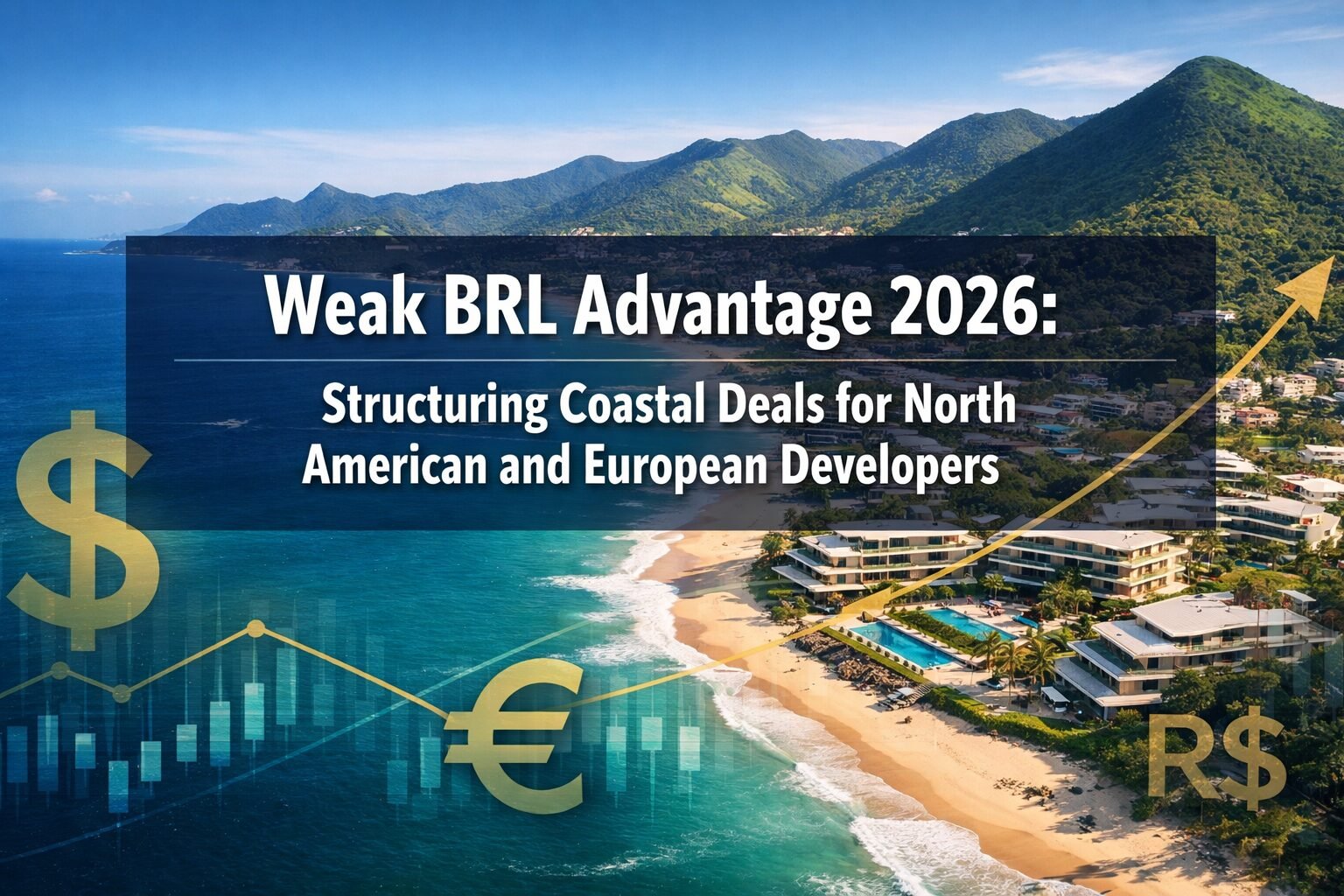
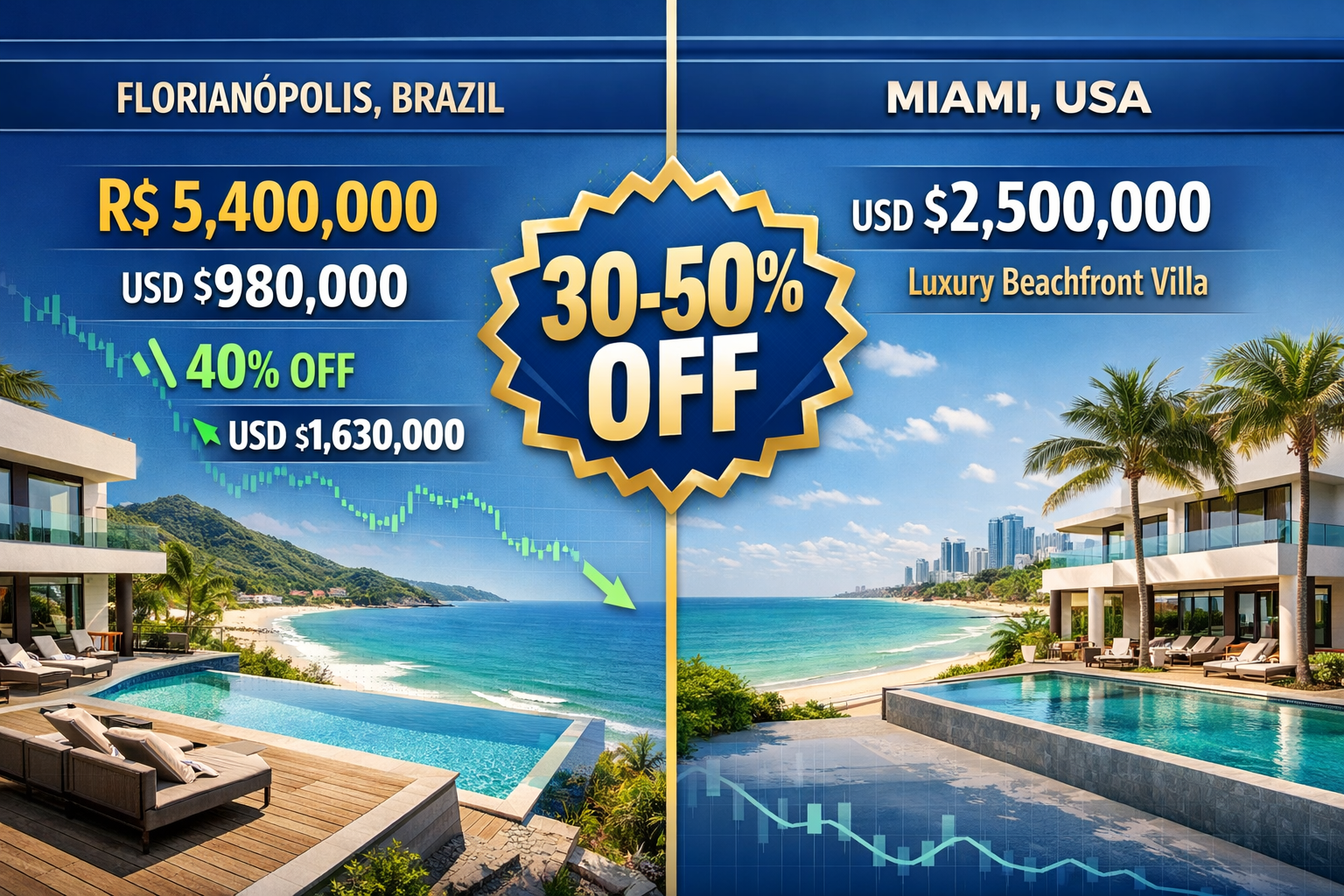
The Brazilian Real has plummeted to historic lows against the US Dollar and Euro, creating an unprecedented 30% to 50% effective discount on coastal properties compared to equivalent assets in Miami, Lisbon, or the French Riviera.[1] This currency-driven arbitrage opportunity is reshaping how savvy international developers approach the Weak BRL Advantage 2026: Structuring Coastal Deals for North American and European Developers market, with foreign capital becoming the primary engine driving value appreciation in Brazil’s luxury coastal segments.
The convergence of exchange rate dynamics, shifting investment geography, and evolving buyer profiles has created a unique window for structured coastal real estate transactions. Understanding how to navigate currency hedging, legal frameworks, and regional market nuances separates successful international ventures from costly missteps in Brazil’s complex property landscape.
Key Takeaways
- Currency Arbitrage Opportunity: The weakened BRL provides 30-50% effective discounts on Brazilian coastal properties versus comparable North American and European markets[1]
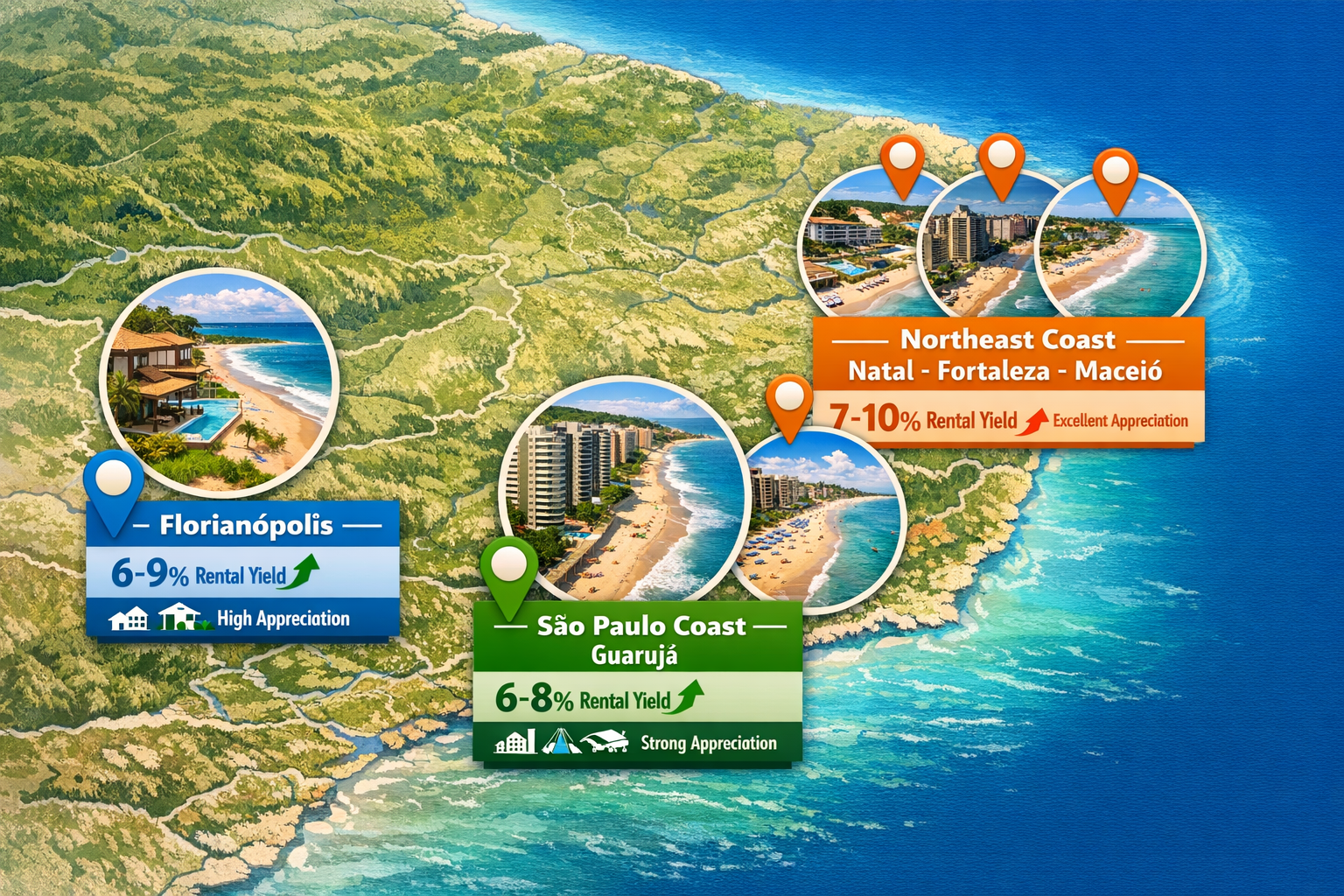
- Yield Performance: Optimized short-term rental properties in tourism zones achieve 6-10% annual net yields, highly competitive by international standards[1]
- Market Shift: 2026 trends favor niche coastal and secondary markets over major capitals, with international buyers driving luxury segment appreciation[1]
- Geographic Hotspots: Florianópolis, Northeast Coast (Natal, Fortaleza), and São Paulo Coast offer distinct risk-return profiles for different investor strategies
- Structural Requirements: Proper legal entity formation, currency hedging strategies, and local partnership structures are critical for maximizing returns and minimizing regulatory friction
Understanding the Weak BRL Advantage 2026: Currency Dynamics and Market Fundamentals
The Exchange Rate Foundation
The Brazilian Real’s weakness against major currencies represents the dominant factor enticing foreign capital to Brazilian property in 2026.[1] When a luxury beachfront apartment in Florianópolis costs R$2 million but translates to approximately $400,000 USD at current exchange rates, the same property would cost $800,000 to $1.2 million in comparable Miami locations.
This currency-driven discount creates multiple strategic advantages:
💰 Immediate Value Capture: Purchase price discounts of 30-50% versus comparable international coastal markets[1]
📈 Dual Appreciation Potential: Property value increases in BRL terms plus potential currency recovery gains
🏖️ Rental Yield Enhancement: Strong tourism demand generates USD/EUR rental income against lower BRL acquisition costs
🛡️ Portfolio Diversification: Geographic and currency diversification for North American and European portfolios
The best places to invest in Brazil property have become increasingly attractive as the Real’s weakness amplifies purchasing power for foreign investors holding hard currencies.
International Buyer Impact and Market Dynamics
International buyers are predicted to be the primary engine of value appreciation in Brazil’s luxury and coastal markets throughout 2026.[1] This influx of foreign capital operates with fundamentally different sensitivity factors than domestic buyers—less influenced by Brazil’s Selic interest rate and more responsive to exchange rates and global portfolio diversification strategies.
The buyer profile diversity includes:
- European Retirees: Particularly Portuguese, German, and Italian nationals drawn to cultural affinity, favorable climate, and lifestyle value[1]
- North American Investors: Seeking high rental returns and geographic diversification from saturated US coastal markets
- Chinese Capital: Targeting diversification and safe-haven assets with strong capital preservation characteristics[1]
- Digital Nomads: Remote workers from developed economies leveraging currency arbitrage for lifestyle upgrades
This demographic shift has profound implications for developers structuring coastal projects. Properties must accommodate international expectations for quality, amenities, property management, and legal transparency while capitalizing on the price advantage that attracts these buyers initially.
Strategic Geographic Positioning: Where to Structure Coastal Deals
Florianópolis: The Balanced Play
Florianópolis represents the goldilocks zone for international developers seeking balance between established infrastructure, tourism appeal, and growth potential. The island’s 42 beaches, strong European expat community, and robust tech sector create multiple demand drivers beyond pure tourism.
Key Advantages:
- Established international airport with direct European connections
- Strong year-round occupancy potential (not purely seasonal)
- Growing digital nomad and remote worker community
- Existing international school and healthcare infrastructure
- Cultural affinity for European buyers (particularly Portuguese and German)
The real estate market in Greater Florianópolis continues showing strength, with international buyers increasingly recognizing the region’s value proposition. Properties in prime beach neighborhoods like Jurerê Internacional, Campeche, and Ingleses offer developers opportunities to create projects specifically targeting foreign buyers.
Developers should focus on studio and one-bedroom configurations optimized for rental yields, as well as larger units targeting European retirees seeking permanent or extended-stay residences. The advantages of investing in studios in Florianópolis include lower entry points for investors and higher rental yield percentages.
Northeast Coast: High-Yield Opportunity Markets
The Northeast Coast (Natal, Fortaleza, Maceió) is predicted to see increased demand in 2026, with particular strength in Natal and surrounding beach towns like Pipa.[1] These markets offer excellent value, steady capital appreciation potential, and robust rental markets catering to European tourists seeking extended stays.
Natal and Rio Grande do Norte:
- Direct flights from Lisbon and other European hubs
- Lower acquisition costs than southern markets (30-40% below Florianópolis)
- Strong European tourist demand (particularly Italian and Portuguese)
- Emerging infrastructure development in beach corridors
- Year-round warm climate with consistent tourism
Fortaleza and Ceará:
- Largest city in Northeast with substantial infrastructure
- Established tourism industry with international appeal
- Kite-surfing and beach sports tourism niche
- Growing domestic middle-class demand alongside international buyers
Master-planned residential resort communities in the Northeast are specifically forecast to see increased demand in 2026.[1] These developments offer international buyers the security, amenities, and property management infrastructure they expect, making them attractive structures for North American and European developers entering the Brazilian market.
The Northeast’s combination of lower entry costs, higher rental yields (often 8-10% net), and strong appreciation potential creates compelling risk-adjusted returns for developers willing to navigate slightly less mature markets than Florianópolis or São Paulo coast.
São Paulo Coast: Premium Safe-Haven Assets
The São Paulo Coast (Guarujá, Riviera de São Lourenço) positions differently—as a “safe haven” asset offering high-specification properties with strong capital preservation.[1] These markets insulate better from macroeconomic shocks and offer premium seasonal rental rates, though acquisition costs are notably higher.
Strategic Positioning:
- Proximity to São Paulo’s wealthy domestic market (1-2 hours)
- Established luxury infrastructure and high-end amenities
- Strong capital preservation characteristics during volatility
- Premium rental rates during peak seasons (December-March)
- Mature property management and legal frameworks
Developers targeting the São Paulo coast should focus on ultra-high-net-worth international buyers seeking Brazilian exposure with minimal friction. These buyers prioritize quality, security, and turnkey property management over maximum yield optimization.
The trade-off is clear: higher acquisition costs but lower execution risk, more stable capital preservation, and access to both international and wealthy domestic demand.
Structuring Deals: Legal Frameworks and Transaction Architecture
Entity Formation and Ownership Structures
Proper legal structuring is non-negotiable for international developers entering Brazilian coastal markets. The right entity formation protects assets, optimizes tax treatment, and facilitates eventual exit strategies.
Primary Structure Options:
| Structure Type | Best For | Key Advantages | Considerations |
|---|---|---|---|
| Direct Individual Ownership | Small single-property investments | Simplest structure, lower setup costs | Higher tax exposure, limited liability protection |
| Brazilian LLC (Sociedade Limitada) | Multiple property portfolios | Liability protection, operational flexibility | Requires local accounting, ongoing compliance |
| SPE (Sociedade de Propósito Específico) | Single large developments | Project-specific liability isolation | Common for development projects, clear exit path |
| Offshore Holding Company | Large portfolio investors | Tax optimization, asset protection | Complex setup, higher costs, enhanced scrutiny |
Most North American and European developers structuring significant coastal deals benefit from a Brazilian SPE owned by an offshore holding company (typically in favorable jurisdictions). This structure provides:
✅ Liability isolation for specific development projects
✅ Tax optimization through proper jurisdiction selection
✅ Clean exit mechanisms when selling completed projects
✅ Asset protection from personal liability exposure
✅ Financing flexibility for construction and development capital
Working with experienced Brazilian real estate attorneys who understand international structures is essential. The upfront legal investment (typically $15,000-$40,000 for proper structuring) pays dividends through tax savings, liability protection, and smoother transactions.
Currency Hedging and Financial Structuring
The Weak BRL Advantage 2026: Structuring Coastal Deals for North American and European Developers opportunity comes with inherent currency risk. While the weak Real creates the initial purchase advantage, developers must consider currency exposure throughout the project lifecycle.
Currency Risk Scenarios:
🔴 Downside Risk: If the Real strengthens significantly against USD/EUR during the holding period, rental income and sale proceeds convert to fewer hard currency units
🟢 Upside Opportunity: If the Real remains weak or weakens further, rental income and appreciation gains amplify when converted to USD/EUR
Hedging Strategies:
Natural Hedging: Price rental units in USD/EUR for international tourists (common in Brazilian coastal markets), creating revenue in hard currency while costs remain in BRL
Forward Contracts: Lock in exchange rates for planned repatriation of funds, eliminating conversion uncertainty for specific transactions
Currency Options: Purchase downside protection while maintaining upside potential if Real continues weakening
Staggered Conversion: Systematically convert rental income at regular intervals, averaging exchange rate fluctuations over time
Local Reinvestment: Keep proceeds in BRL for additional Brazilian acquisitions, avoiding conversion entirely while building portfolio
Most sophisticated developers employ natural hedging as the foundation (USD/EUR pricing for rentals) combined with selective forward contracts for large planned repatriations. This balances protection with flexibility and cost-effectiveness.
Partnership and Local Expertise Requirements
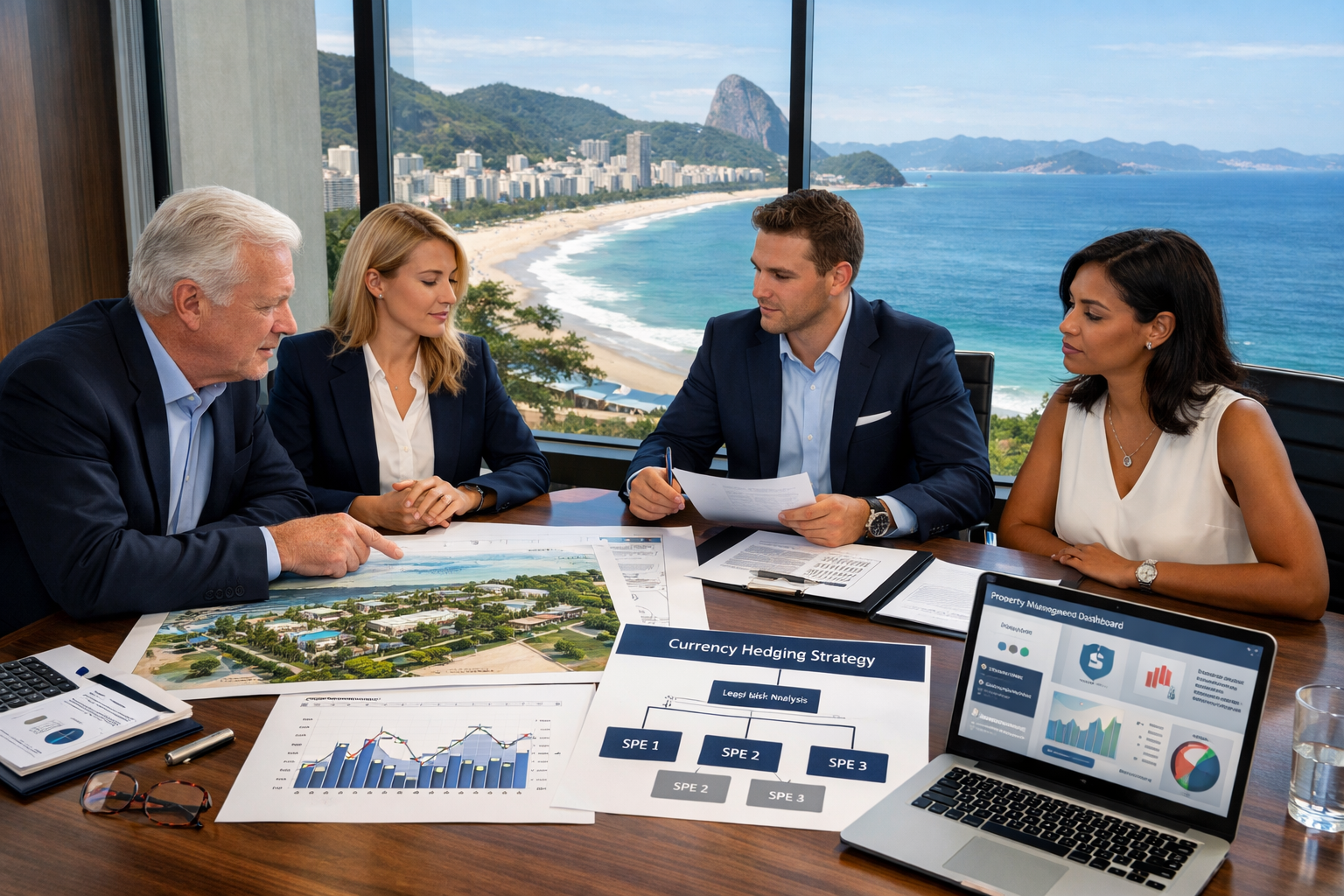
Successful international developers never operate in isolation in Brazilian markets. Local partnerships provide essential advantages:
Critical Local Partner Functions:
- Market Intelligence: Understanding micro-market dynamics, neighborhood trajectories, and emerging opportunities
- Regulatory Navigation: Managing permits, approvals, and compliance requirements across municipal, state, and federal levels
- Construction Management: Overseeing contractors, quality control, and timeline adherence with local expertise
- Property Management: Operating rental programs, maintenance, and guest services for tourism-focused properties
- Political Relationships: Navigating local government relationships and community integration
The Quadragon approach to development demonstrates how local expertise combined with international quality standards creates successful coastal projects. Developers should seek partners with:
✅ Proven track record in coastal development
✅ Existing property management infrastructure
✅ Transparent financial reporting and governance
✅ English/Spanish language capabilities for international clients
✅ Understanding of international buyer expectations
Partnership structures typically involve joint ventures (50-50 or 60-40 splits) or development management agreements where the international developer provides capital and the local partner provides expertise and execution capability.
Optimizing Returns: Rental Strategies and Revenue Management
Short-Term Rental Optimization
Properties suitable for short-term rentals in key tourism zones can achieve net yields of 6% to 10% annually—highly competitive by international standards—when optimized for Airbnb and holiday rental markets.[1]
Peak Season Revenue Maximization:
Brazilian coastal markets generate highest returns during:
- New Year’s (December 20 – January 10): Premium rates, often 3-5x standard pricing
- Carnival (February/March): Second major peak, 2-4x standard rates
- Major Holidays: Easter, July school holidays, extended weekends
- Summer Season (December-March): Consistent elevated pricing throughout
Properties optimized for short-term rentals require specific characteristics:
🏠 Property Features:
- Turnkey furnished condition with quality finishes
- Air conditioning (essential for Northeast, valuable in South)
- Modern kitchen and appliances
- Strong WiFi infrastructure (digital nomad appeal)
- Proximity to beach (walking distance strongly preferred)
- Parking availability (important for domestic tourists)
📊 Management Requirements:
- Professional property management with 24/7 guest support
- Dynamic pricing optimization responding to demand
- Multi-platform listing (Airbnb, Booking.com, VRBO)
- Professional photography and listing optimization
- Guest screening and quality control
- Maintenance and cleaning coordination
The growth in Florianópolis regions like Ingleses demonstrates how infrastructure development and tourism growth drive rental demand, creating opportunities for developers who position properties correctly.
Long-Term Rental and Hybrid Strategies
While short-term rentals maximize revenue potential, hybrid strategies often optimize risk-adjusted returns:
Hybrid Approach Benefits:
- Guaranteed base income from long-term tenant (9-10 months)
- Short-term rental during peak season (2-3 months at premium rates)
- Reduced vacancy risk and property management intensity
- Lower wear-and-tear than year-round short-term rentals
This strategy works particularly well for European retirees who occupy properties 3-4 months annually and generate rental income the remainder of the year.
Target Tenant Profiles for Long-Term:
- Digital nomads seeking 6-12 month stays
- Corporate relocations and business travelers
- International students at local universities
- Seasonal workers in tourism industry
- Local professionals in growing markets
Long-term rentals typically yield 4-6% net annually in prime coastal locations—lower than optimized short-term strategies but with significantly reduced management complexity and more stable cash flow.
Risk Factors and Mitigation Strategies for the Weak BRL Advantage 2026
Political and Macroeconomic Risks
Political stability remains the single largest risk factor for 2026 projections.[1] Should Brazil’s reform agenda stall or fiscal uncertainty rise, investor confidence from both domestic and international sources could quickly retreat.
Key Political Risk Factors:
- Fiscal policy uncertainty and government spending trajectory
- Tax reform implementation and potential changes to property taxation
- Regulatory changes affecting foreign ownership or capital repatriation
- Political instability affecting economic confidence
- Infrastructure investment commitment and execution
Brazil’s economic challenges, including fiscal pressures and political uncertainty, create an environment where policy shifts can rapidly impact property markets.[2] International developers must maintain scenario planning for various political and economic outcomes.
Mitigation Strategies:
- Conservative Leverage: Limit debt financing to 50-60% LTV, maintaining equity cushion for volatility
- Diversified Holdings: Spread investments across multiple coastal regions rather than concentrating risk
- Flexible Exit Timing: Structure deals allowing 3-5 year hold periods, avoiding forced sales during downturns
- Currency Diversification: Maintain some assets in hard currencies as portfolio ballast
- Political Risk Insurance: Consider coverage for expropriation or currency transfer restrictions on large investments
Interest Rate and Financing Considerations
A sustained decrease in the Selic rate is predicted as fundamental for 2026 market conditions.[1] The Selic directly impacts local mortgage affordability and developer financing costs, stimulating domestic demand particularly in middle-income segments.
However, international developers should not rely exclusively on Brazilian domestic financing:
Financing Strategy Recommendations:
- Primary Capital: Use hard currency (USD/EUR) financing from international banks or private capital
- Supplemental Local Financing: Utilize Brazilian construction loans for specific project phases when rates are favorable
- Mezzanine Structures: Consider mezzanine debt for development projects, balancing cost and flexibility
- Equity Partnerships: Joint ventures with local developers reduce capital requirements and share risk
Global economic conditions, including potential slowdowns in North American and Latin American housing markets, may create headwinds for international investment flows.[4] Developers should maintain financial flexibility to navigate changing capital availability.
Legal and Regulatory Compliance
Brazilian property regulations, while generally favorable to foreign ownership, require careful navigation:
Critical Compliance Areas:
📋 Foreign Ownership Limits: Certain coastal and border areas have restrictions on foreign ownership—verify specific property eligibility
💵 Capital Registration: Foreign capital must be registered with Brazilian Central Bank (Banco Central) for future repatriation
🏛️ Tax Obligations: Property transfer taxes (ITBI), annual property taxes (IPTU), and capital gains taxes on sale require proper planning
🏗️ Development Permits: Construction permits, environmental licenses, and municipal approvals require local expertise and timeline planning
📄 Title Insurance: While less common in Brazil than US/Europe, title insurance is increasingly available and recommended for large transactions
Working with qualified legal counsel familiar with international transactions is essential. The complexity of Brazilian bureaucracy makes local expertise invaluable for avoiding costly delays or compliance failures.
Building Value Through Pre-Construction and Development Timing
The Pre-Construction Advantage
Purchasing properties during pre-construction phases offers significant value appreciation potential for developers and investors willing to accept construction timeline risk.[1] The appreciation potential for those buying pre-construction can substantially enhance returns.
Pre-Construction Benefits:
- 20-40% below completed property pricing in same location
- Phased payment structures reducing upfront capital requirements
- Customization opportunities to optimize for target market
- Appreciation during construction as project de-risks and market evolves
- First selection of premium units with best views/locations
Pre-Construction Risks:
- Construction delays extending timeline and capital lock-up period
- Developer financial distress potentially halting projects
- Market changes during construction affecting ultimate value
- Quality control issues requiring post-completion remediation
Developers structuring coastal deals should conduct thorough due diligence on construction partners, including:
✅ Financial stability and balance sheet strength
✅ Track record of on-time, on-budget project completion
✅ Quality of previous developments and buyer satisfaction
✅ Permit and approval status for specific projects
✅ Construction methodology and timeline realism
Projects like Tramonto and Solis demonstrate how quality coastal developments progress through construction phases, with regular construction updates providing transparency for international investors.
Market Timing and Entry Strategies
The Weak BRL Advantage 2026: Structuring Coastal Deals for North American and European Developers opportunity exists within a specific market window. Currency advantages can shift rapidly based on macroeconomic factors beyond individual control.
Strategic Timing Considerations:
🟢 Favorable Entry Signals:
- BRL at or near historic lows against USD/EUR
- Political stability with reform-oriented government
- Declining Selic rates improving domestic demand outlook
- Infrastructure investment announcements in target regions
- Increasing international flight connectivity to coastal cities
🔴 Caution Signals:
- Rapid BRL appreciation reducing currency advantage
- Political instability or fiscal crisis scenarios
- Rising Selic rates constraining domestic demand
- Oversupply in specific micro-markets
- Declining tourism metrics or international visitor numbers
The current 2026 environment presents favorable conditions across most indicators, with the weakened Real creating the foundation for attractive entry pricing. However, developers should maintain disciplined underwriting and avoid overpaying even in favorable currency environments.
Phased entry strategies—acquiring multiple properties or development sites over 12-24 months rather than concentrating purchases—can average currency timing risk while building market knowledge and local relationships.
Conclusion: Capitalizing on the Weak BRL Advantage 2026
The convergence of a historically weak Brazilian Real, shifting international investment patterns, and Brazil’s world-class coastal assets creates a compelling opportunity for North American and European developers in 2026. The 30-50% effective discount on coastal properties compared to equivalent markets in Miami, Lisbon, or the French Riviera represents a currency-driven arbitrage that sophisticated developers can structure into sustainable, high-yielding investments.[1]
Success requires more than simply recognizing the currency advantage. Effective execution demands:
✅ Strategic geographic selection matching risk tolerance and return objectives—whether Florianópolis’s balanced growth, the Northeast’s high-yield opportunities, or São Paulo coast’s premium positioning
✅ Proper legal and financial structuring through appropriate entity formation, currency hedging strategies, and local partnerships that navigate regulatory complexity
✅ Optimized property positioning for target markets, whether short-term vacation rentals, long-term digital nomad tenants, or European retiree buyers
✅ Disciplined risk management addressing political uncertainty, interest rate dynamics, and market timing considerations
✅ Quality local partnerships providing essential market intelligence, construction management, and property operations expertise
The international buyers driving luxury coastal market appreciation in 2026 seek turnkey opportunities that deliver both lifestyle value and financial returns.[1] Developers who structure deals meeting these expectations while capitalizing on the weak Real advantage position themselves for exceptional risk-adjusted returns.
Actionable Next Steps
For developers ready to explore Brazilian coastal opportunities:
Conduct market reconnaissance in 2-3 target coastal regions, evaluating micro-market dynamics, tourism metrics, and infrastructure trajectories
Establish legal and financial infrastructure through qualified Brazilian real estate attorneys and international tax advisors familiar with cross-border structures
Identify and vet local partners with proven development track records, property management capabilities, and alignment with quality standards
Analyze specific opportunities using conservative underwriting that accounts for currency risk, construction timelines, and realistic rental projections
Structure pilot transactions to build market knowledge and operational capabilities before scaling to larger portfolio commitments
The Quadragon developments demonstrate how quality coastal projects combine international standards with local market expertise. Developers seeking to capitalize on the Weak BRL Advantage 2026 should prioritize partnerships with established local players who understand both Brazilian market dynamics and international investor expectations.
The currency window creating today’s opportunity will not remain open indefinitely. Developers who move decisively while maintaining disciplined underwriting and proper structural foundations will capture the most significant value from this unique market moment in Brazilian coastal real estate.
References
[1] Brazil Property Market Predictions For 2026 – https://esalesinternational.com/2025/11/20/brazil-property-market-predictions-for-2026/
[2] Brazil Playing With Fire – https://www.realinstitutoelcano.org/en/analyses/brazil-playing-with-fire/
[4] North America Latin America Housing Markets Slowing In 2026 08 12 2025 – https://www.fitchratings.com/research/structured-finance/north-america-latin-america-housing-markets-slowing-in-2026-08-12-2025