
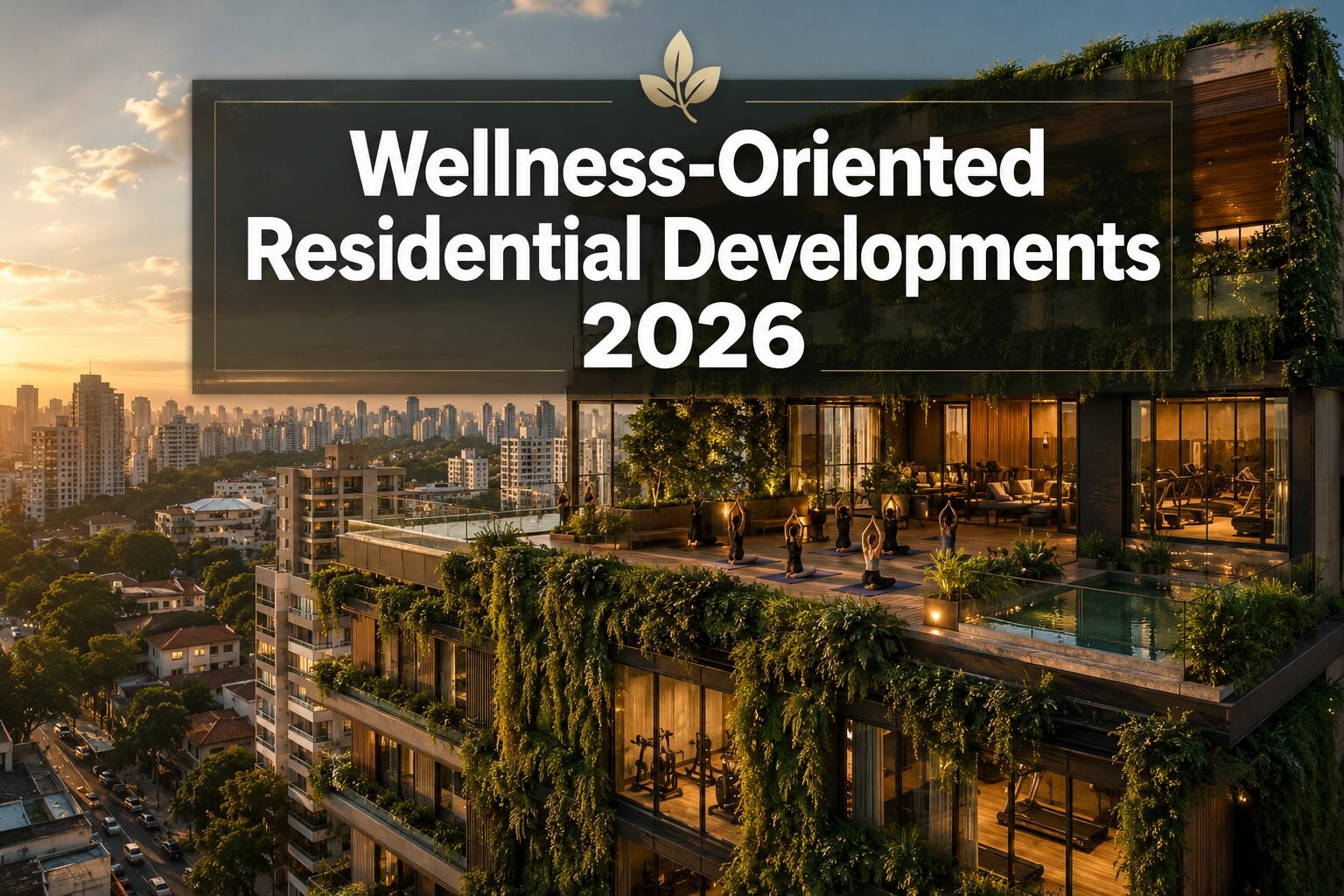
A mid-market condominium in São Paulo’s Zona Sul now sells for up to R$9,800 per square meter — roughly 17% above the neighborhood baseline — simply because it has a yoga studio, a rooftop garden, and a full-service gym on site. That gap is not a luxury outlier. It is a structural shift reshaping how developers, buyers, and investors think about residential real estate in Brazil’s two largest metros in 2026. [1]
Wellness-Oriented Residential Developments 2026: Gyms, Yoga Spaces and Green Amenities Boosting Mid-Market Demand in SP and RJ represent one of the most consequential trends in Brazilian property today. Post-pandemic priorities — physical health, mental recovery, and remote-work flexibility — have permanently altered what buyers consider non-negotiable in a home. Developers who recognized this early are now commanding measurable premiums; those who ignored it are competing on price alone.
Key Takeaways
- Mid-market properties in SP with wellness amenities command a 10–15% price premium over standard condominiums, with Zona Sul benchmarks reaching R$9,500–R$9,800 per sqm. [1]
- The global wellness real estate sector reached $584 billion in 2024 and is projected to reach $1.1 trillion by 2029, with mid-market segments driving the bulk of that growth. [2]
- Full-service gyms add approximately 6–8% to perceived property value; dedicated yoga/pilates studios add 3–5%; rooftop green spaces add 4–6%. [1]
- Rio de Janeiro is producing landmark wellness projects — from Botafogo to Gávea — that blend ecological preservation with high-specification fitness and spa facilities. [4][6]
- Investors targeting properties that combine wellness amenities with remote-work infrastructure are best positioned to capture both capital appreciation and rental premiums in 2026.
The Economics of Wellness: Why Gyms, Yoga Spaces and Green Amenities Are Driving Mid-Market Demand in SP and RJ
A Market Measured in Square Meters and Wellbeing
The numbers behind wellness real estate are no longer speculative. Globally, the sector reached $584 billion in 2024 and is on track to double to $1.1 trillion by 2029. [2] Brazil sits at the intersection of this global wave and a domestic post-pandemic reckoning with urban quality of life. In São Paulo and Rio de Janeiro, the evidence is visible in launch prices, absorption rates, and buyer surveys alike.
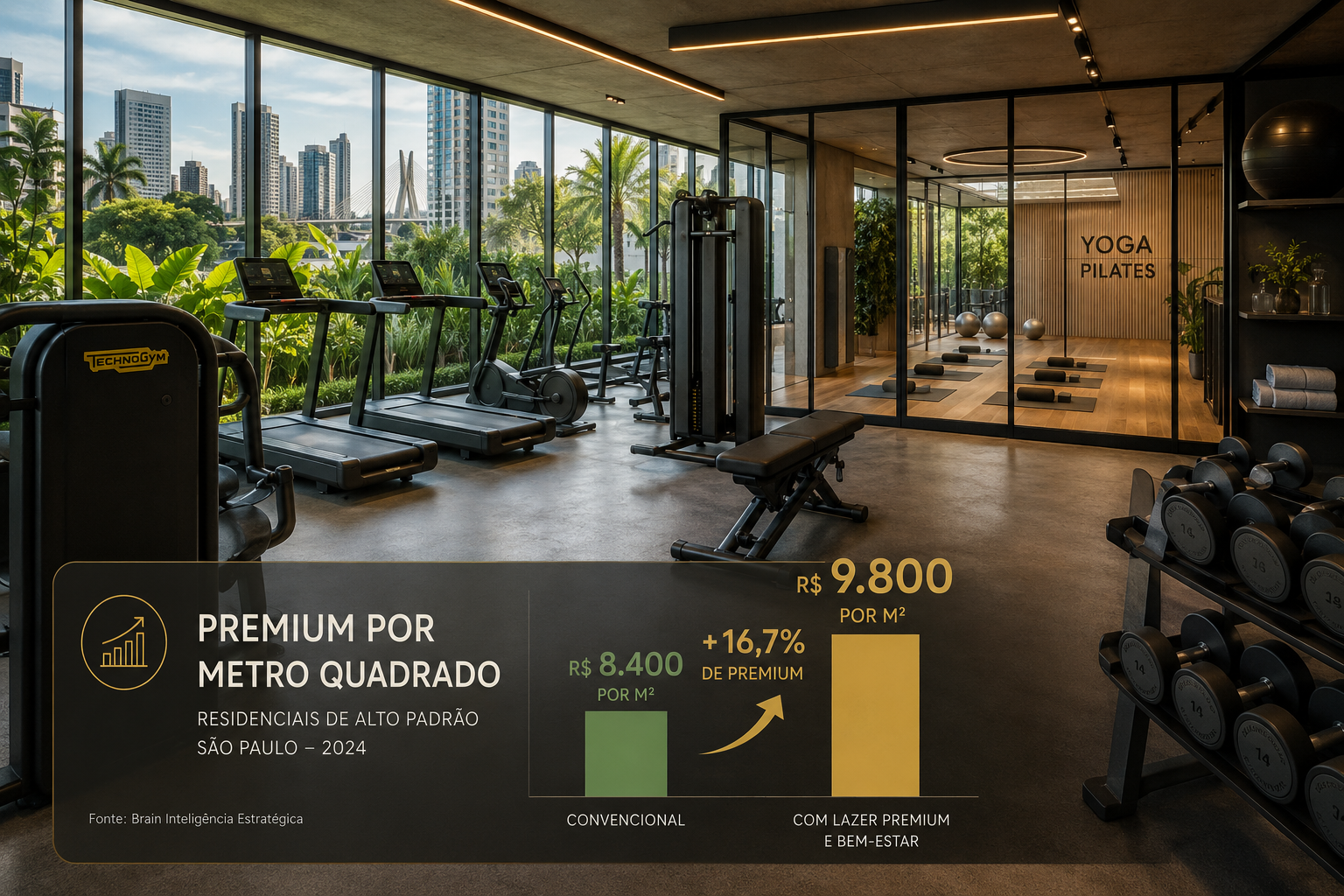
Standard condominiums in São Paulo’s Zona Sul average R$8,400 per square meter. Wellness-integrated condos in the same area range from R$9,500 to R$9,800 per square meter — a premium of 10–15% that buyers are consistently willing to pay. [1] This is not a niche luxury phenomenon. It is happening in the mid-market segment, where developers are discovering that a well-designed yoga studio or a rooftop garden can move units faster and at higher margins than an extra parking space ever could.
The Amenity Value Ladder
Not all wellness features deliver equal returns. Research across SP and RJ developments in 2026 points to a clear hierarchy of value-added amenities:
| Amenity | Estimated Value Add |
|---|---|
| Full-service gym | 6–8% |
| Rooftop garden / green terrace | 4–6% |
| Dedicated yoga / pilates studio | 3–5% |
| Sauna or recovery spa | 2–4% |
| On-site organic market or partnership | 2–3% |
[1]
Full-service gyms remain the single highest-impact amenity. Buyers in urban metros increasingly factor out gym membership costs when calculating total cost of living, making an in-building facility a tangible financial benefit. When Technogym partnered with REM Luxury Properties to equip the gym and pilates studio at Altitude Jardins by Artefacto in São Paulo in February 2026, the project underscored that equipment quality — not just square footage — signals value to discerning buyers. [3]
Green amenities are the fastest-rising category. Rooftop gardens, vertical green walls, and preserved native forest areas address a psychological need that became acute during pandemic lockdowns: access to nature within an urban setting. The Living Wellness development in Aclimação, São Paulo, dedicates 30% of its 9,000+ sqm footprint to green areas, drawing explicit inspiration from the Six Senses The Palm in Dubai. [7] That comparison to a globally recognized wellness hospitality brand is deliberate — it signals to buyers that the residential experience has been elevated to a hospitality standard.
Yoga and pilates studios have moved from luxury differentiator to mid-market expectation. Their relatively low construction cost relative to their perceived value makes them a high-ROI investment for developers targeting health-conscious professionals.
The Remote Work Multiplier
One factor amplifying wellness demand in 2026 is the consolidation of hybrid and remote work. When residents spend more hours at home, the quality of that home environment matters more. A building with a gym, a quiet yoga space, and a coworking lounge does not just serve physical health — it replaces the entire ecosystem of a corporate office campus. Developers who bundle wellness amenities with high-speed connectivity infrastructure and dedicated work-from-home lounges are capturing a rental premium that neither category could achieve alone.
For investors evaluating off-plan opportunities, this bundled value proposition is worth careful attention. Understanding how buying off-plan can amplify investment gains is especially relevant when the development in question is positioned around a wellness concept that will only become more desirable as the building ages and the neighborhood matures.
Landmark Wellness Developments Reshaping SP and RJ in 2026
São Paulo: From Compact Studios to Resort-Scale Concepts
São Paulo’s wellness development landscape in 2026 spans a striking range of scales and typologies.
At the compact end, Alameda 45 challenges the assumption that wellness living requires large floor plates. Units range from 39 m² to 94 m², yet the development delivers high-specification amenities that redefine what sophistication means at a mid-market price point. [9] The project reflects a broader industry insight: buyers are increasingly willing to trade private square footage for shared wellness infrastructure of exceptional quality.
At the opposite scale, Jardim da Hípica in Santo Amaro, launched in April 2026, occupies approximately 50,000 sqm and centers on a 10,000 sqm private plaza anchored by centennial trees. The resort residential concept positions the development as a sanctuary within the city — a response to buyer demand for green space that goes beyond a token garden. [8]
The Living Wellness development in Aclimação represents perhaps the most explicit wellness branding in São Paulo’s mid-to-upper market. By referencing Six Senses — a brand synonymous with holistic health — the developer signals that the amenity package is curated around a coherent wellness philosophy, not simply a list of features. [7]
Rio de Janeiro: Ecology, Water, and Urban Recovery
Rio de Janeiro’s wellness residential market in 2026 is defined by its relationship with the city’s extraordinary natural assets — the bay, the mountains, and the Atlantic Forest fragments that survive within its urban boundaries.
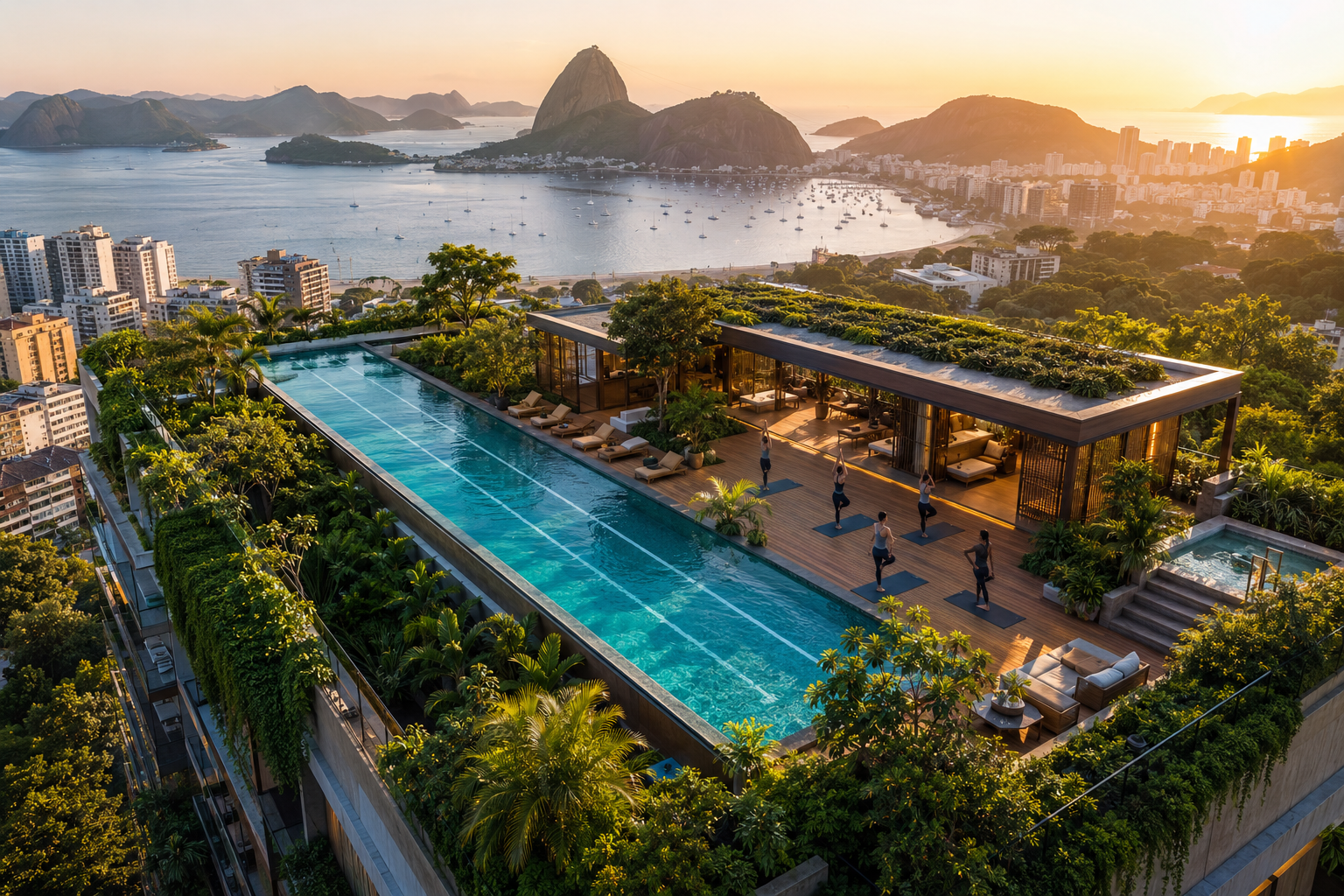
ICONYC by Yoo in Botafogo delivers a comprehensive wellness ecosystem: a 25-meter lap pool, spa, solarium, fitness center with a multipurpose room, coworking space, and a gourmet lounge. [4] The development’s location in Botafogo — a neighborhood undergoing significant cultural and commercial revitalization — adds a locational wellness dimension: walkability, access to parks, and proximity to the waterfront.
First Life Friendly in Humaitá, scheduled for delivery in September 2026, packages a panoramic pool, pool bar, gym, functional training area, spa with indoor and outdoor hot tubs, steam sauna, and massage room into a development that reads more like a boutique hotel than a traditional condominium. [5] The delivery timeline makes it a live opportunity for investors tracking the RJ mid-market.
Parque Sustentável da Gávea takes the most ecologically ambitious approach of any 2026 development in either city. The project integrates over 17,000 sqm of preserved native forest, offering ecological trails and scenic viewpoints alongside a private club with a fully equipped gym, gourmet lounges, a mini sports court, and children’s playgrounds. [6] The preserved forest is not landscaping — it is a permanent ecological asset that cannot be replicated or depreciated, making it a unique value driver for long-term holders.
What These Projects Share
Across both cities, the most successful wellness-oriented residential developments in 2026 share three structural characteristics:
- Coherent identity: The wellness concept is embedded in the development’s name, marketing, and physical design — not bolted on as an afterthought.
- Layered amenity stacks: No single feature defines the offering. Gyms, green spaces, water features, and social-wellness spaces (coworking, gourmet lounges) are combined to serve residents at different times of day and stages of life.
- Location alignment: The best projects are sited in neighborhoods where the surrounding urban fabric reinforces the wellness proposition — walkable streets, parks, cultural amenities, and good air quality.
Investors and buyers who understand these characteristics are better equipped to identify which projects will sustain their premiums over time and which will fade as novelty wears off. Reviewing current residential and commercial developments across the Brazilian market provides useful context for benchmarking any single project against the broader competitive landscape.
Investment Strategy: Capturing Wellness Premiums in the Mid-Market Segment
Who Is Buying and Why It Matters for Investors
The buyer profile driving wellness-oriented residential demand in SP and RJ in 2026 is relatively well-defined: urban professionals aged 28–45, many working hybrid or fully remote schedules, with household incomes in the upper-middle range. They are health-literate, time-poor, and willing to pay for convenience that supports their lifestyle. They are also increasingly sophisticated about the long-term value of their purchase — they understand that a wellness-branded building in a strong location is likely to appreciate faster than a comparable standard condominium.
This buyer profile overlaps significantly with the renter profile in both cities. Young professionals who cannot yet afford to purchase are renting in wellness-oriented buildings, creating a rental demand base that supports strong yields for investors who buy early in a project’s lifecycle.
Off-Plan Entry Points and Value Capture
The most effective strategy for capturing wellness premiums is entry at the off-plan stage, before the amenity package is fully priced into the market. Developments like those profiled above typically launch at prices that reflect the developer’s cost structure plus a margin — not the full market value that will be realized once the building is complete, occupied, and generating social proof.
The mechanics of this value capture are well-documented in the Brazilian market. Understanding how off-plan real estate investment amplifies returns is foundational knowledge for any investor targeting the wellness segment. Construction milestones — foundation completion, structural topping-out, interior fit-out — each represent inflection points at which market pricing adjusts upward.
For a concrete example of how construction progress translates to value visibility, the foundation completion and accelerated construction pace at Tramonto illustrates how physical progress de-risks an investment and signals to the broader market that delivery is on track.
Diversification and Emerging Markets
Investors focused exclusively on SP and RJ may be overlooking markets where wellness-oriented residential development is growing rapidly with less competition and lower entry prices. Florianópolis, for example, has seen significant demand growth driven by remote workers and lifestyle migrants who prioritize quality of life — exactly the buyer profile that wellness developments target. Exploring the best places to invest in Brazilian property provides a framework for evaluating these secondary markets alongside the primary metros.
Risk Factors to Monitor
Wellness-oriented developments are not without risk. Three factors deserve particular attention:
- Amenity maintenance costs: High-specification gyms, pools, and green spaces carry ongoing maintenance costs that translate into condominium fees. Buyers and renters have a ceiling on what they will tolerate, and developments that underestimate this can face resident dissatisfaction and value erosion.
- Oversupply in specific submarkets: As wellness branding becomes mainstream, some submarkets may see an oversupply of similarly positioned projects, compressing the premium. Careful submarket analysis is essential.
- Greenwashing risk: Developments that use wellness language without delivering substantive amenities will face reputational damage as buyers become more sophisticated. Due diligence on the actual amenity package — not just the marketing materials — is non-negotiable.
Conclusion
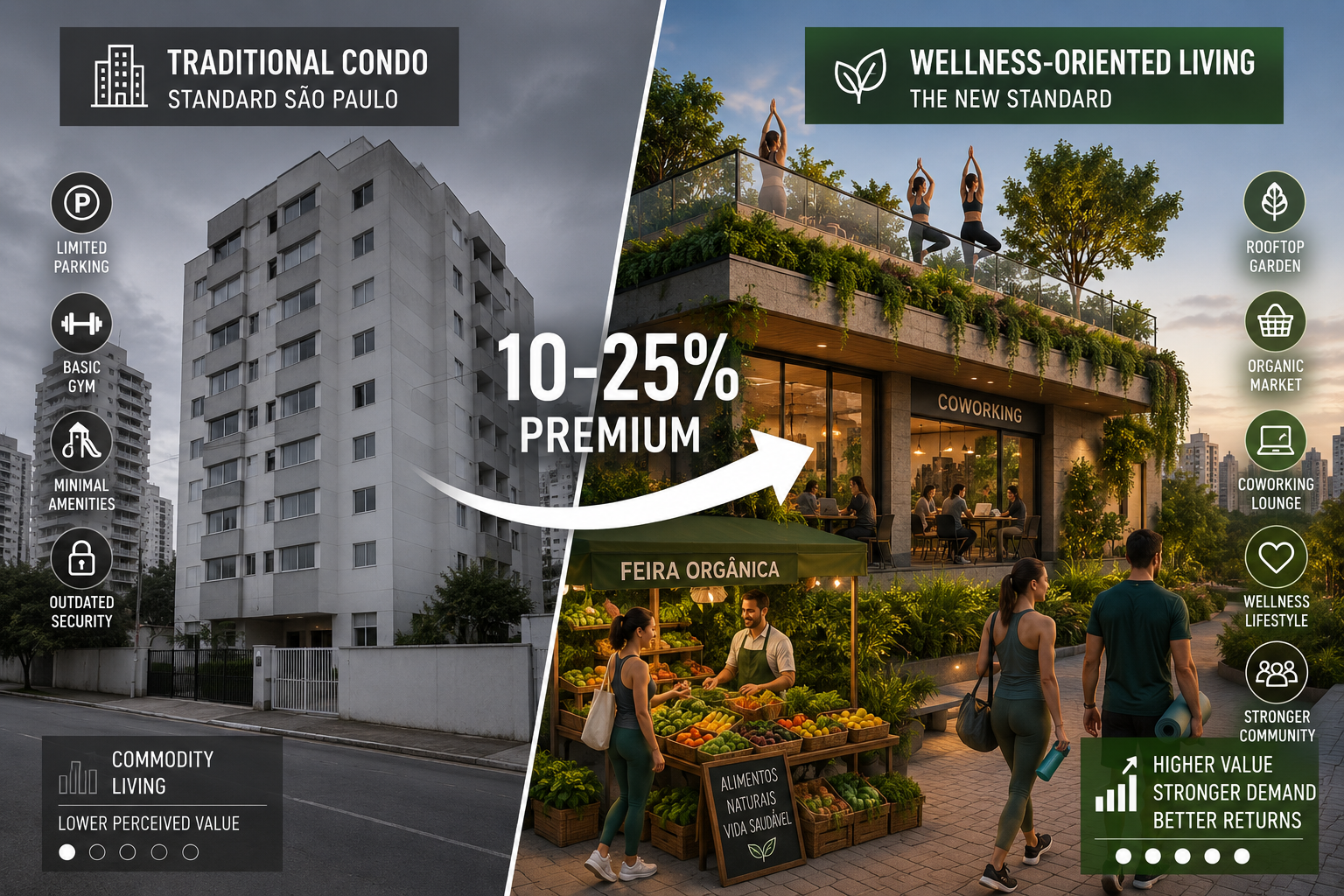
Wellness-Oriented Residential Developments 2026: Gyms, Yoga Spaces and Green Amenities Boosting Mid-Market Demand in SP and RJ are not a passing trend. They represent a permanent recalibration of what urban buyers and renters expect from a home — and what developers must deliver to compete. The data is clear: wellness-integrated properties command 10–15% price premiums in São Paulo’s Zona Sul, mid-market developments with post-pandemic amenity stacks are pricing 10–25% above traditional peers, and the global wellness real estate market is on a trajectory toward $1.1 trillion by 2029. [1][2]
Actionable next steps for buyers and investors:
- Prioritize developments with coherent wellness identities — not just feature lists — and verify that the amenity package is contractually guaranteed, not aspirational.
- Enter at the off-plan stage in projects where construction progress is verifiable and the developer has a track record of delivery.
- Evaluate the surrounding neighborhood as part of the wellness proposition: walkability, green space access, and air quality matter as much as in-building amenities.
- Consider secondary markets like Florianópolis alongside SP and RJ to diversify exposure and access lower entry prices with comparable lifestyle demand drivers.
- Monitor condominium fee projections carefully — the maintenance cost of wellness amenities is a real variable that affects net yield.
The shift toward health-centered living is structural. The developers, buyers, and investors who act on that reality in 2026 — rather than waiting for further confirmation — are best positioned to benefit from the decade ahead.
For a broader view of current residential opportunities aligned with these trends, explore the full portfolio of developments at Quadragon or stay current with market analysis and industry news as the sector continues to evolve.
References
[1] Wellness Focused Developments In Sao Paulo 2026 Gyms Yoga Spaces And Healthy Amenities Driving Premium Pricing – https://quadragon.com.br/wellness-focused-developments-in-sao-paulo-2026-gyms-yoga-spaces-and-healthy-amenities-driving-premium-pricing/?utm_source=openai
[2] Wellness Amenities In Mid Market Developments 2026 Integrating Gyms Yoga Spaces And Healthy Markets For Post Pandemic Buyer Premiums – https://quadragon.com.br/wellness-amenities-in-mid-market-developments-2026-integrating-gyms-yoga-spaces-and-healthy-markets-for-post-pandemic-buyer-premiums/?utm_source=openai
[3] Parceria De Sucesso Entre Technogym E Rem Luxury Properties Traz Academia De Luxo Para O Altitude Jardins Em Parceria Com Artefacto – https://minutosp.com.br/2026/02/10/parceria-de-sucesso-entre-technogym-e-rem-luxury-properties-traz-academia-de-luxo-para-o-altitude-jardins-em-parceria-com-artefacto/?utm_source=openai
[4] Iconyc By Yoo – https://www.jmrioestate.com/en/iconyc-by-yoo?utm_source=openai
[5] First – https://www.jmrioestate.com/en/first?utm_source=openai
[6] Parque Sustentavel Da Gavea – https://www.jmrioestate.com/en/parque-sustentavel-da-gavea?utm_source=openai
[7] Aclimacao Living Wellness – https://levilee.com.br/imoveis/aclimacao-living-wellness/?utm_source=openai
[8] Projeto Na Hipica Inclui Resort Residencial Com Bosque – https://www.terra.com.br/noticias/projeto-na-hipica-inclui-resort-residencial-com-bosque%2Cad306e8d2464d568883e1bab793de4d7jaa4d714.html?utm_source=openai
[9] Brandvoice Alameda 45 Padrao Em Escala Compacta – https://forbes.com.br/forbes-life/2026/05/brandvoice-alameda-45-padrao-em-escala-compacta/?utm_source=openai