
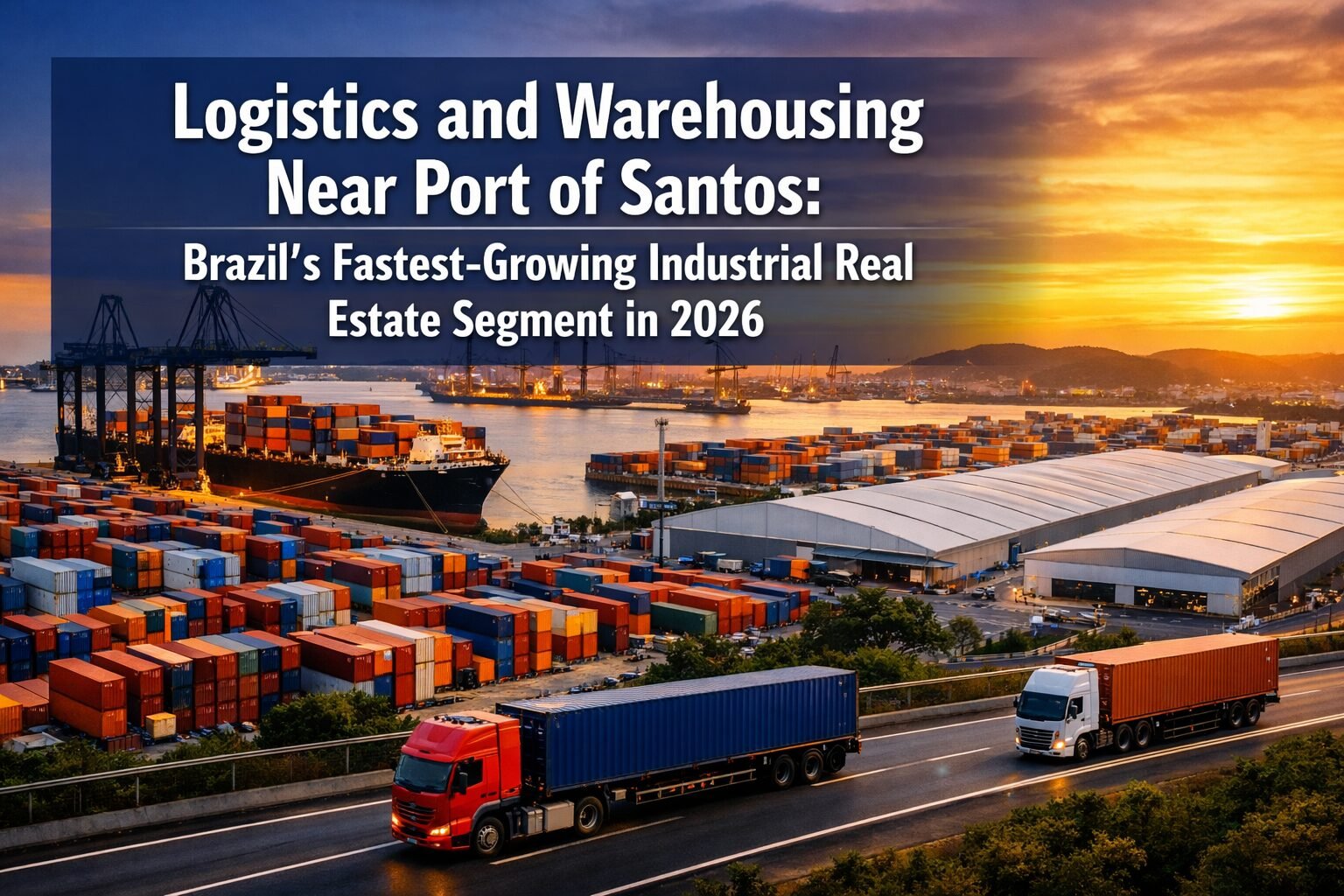
Brazil’s industrial real estate market is experiencing an unprecedented transformation in 2026, with logistics and warehousing near Port of Santos emerging as the nation’s most dynamic development segment. While residential developers have traditionally dominated Brazil’s real estate landscape, a fundamental shift is underway—driven by record-low vacancy rates, explosive e-commerce growth, and massive port infrastructure investments. Logistics and Warehousing Near Port of Santos: Why Industrial Real Estate Is Brazil’s Fastest-Growing Development Segment in 2026 represents more than just a market trend; it signals a structural change in how investors view Brazilian real estate opportunities.
The numbers tell a compelling story. DP World’s recent R$1.6 billion investment announcement in December 2025, combined with the Port of Santos polygon expansion that increases the organized port’s active area by 162%, has created an investment environment that rivals—and in many cases surpasses—traditional residential development returns[1][2]. For developers accustomed to residential property markets, the industrial logistics sector presents a different risk-reward profile with unique infrastructure requirements and regulatory considerations.
Key Takeaways
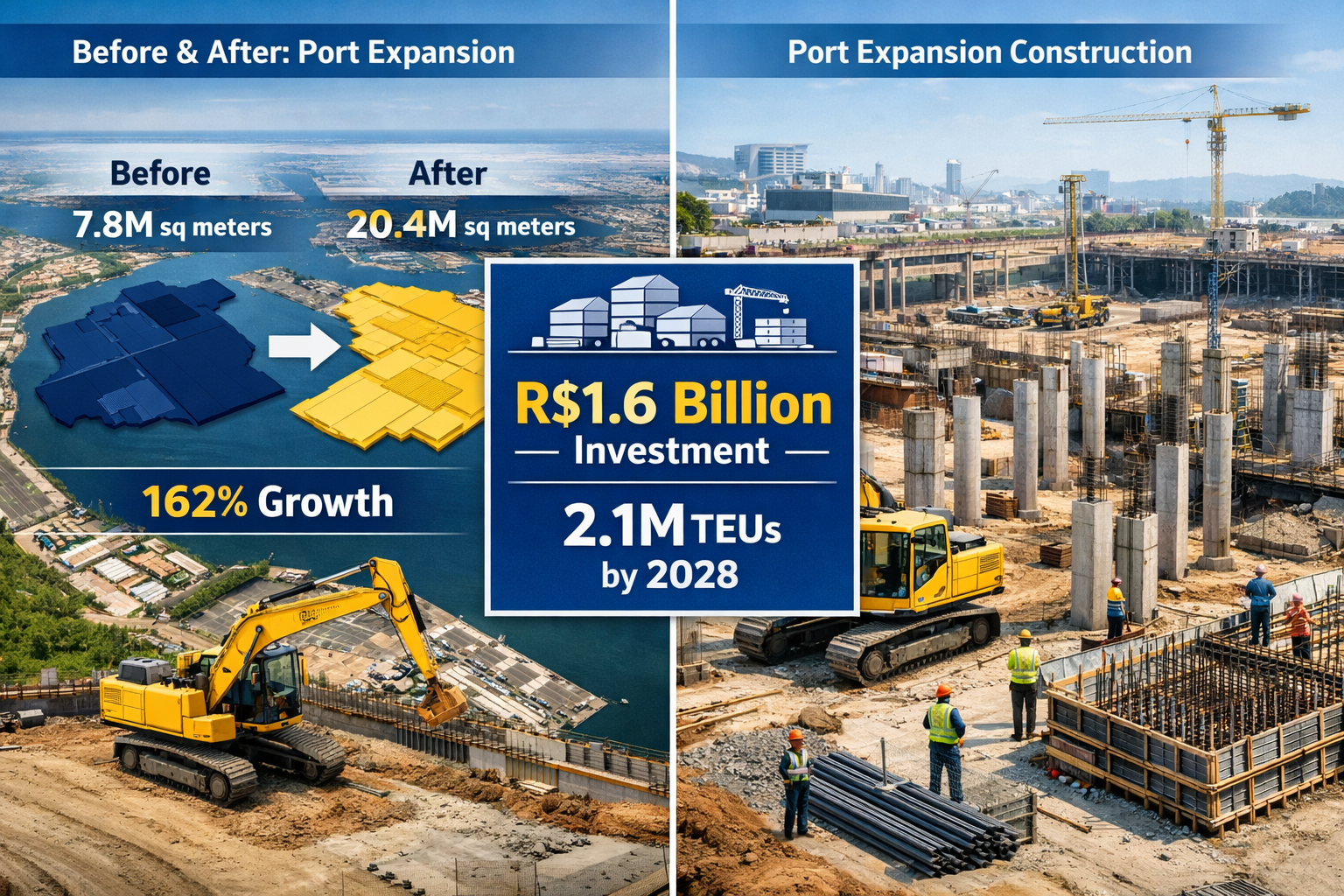
- 🚢 Port of Santos is expanding its active area from 7.8 million to 20.4 million square meters, representing a 162% increase that enables large-scale logistics infrastructure development
- 💰 DP World’s R$1.6 billion investment will increase terminal capacity by 25% to 2.1 million TEUs by 2028, signaling strong institutional confidence in the region’s logistics potential
- 📦 E-commerce-driven demand has created record-low vacancy rates in modern warehouse facilities, making industrial real estate more attractive than residential for many developers
- 🏗️ New logistics infrastructure requirements include specialized facilities for cargo consolidation, customs operations, and last-mile distribution networks
- ⚡ Green infrastructure and decarbonization strategies are becoming mandatory considerations for competitive logistics developments near Santos
The Port of Santos Expansion: Creating a New Logistics Ecosystem
The Port of Santos polygon expansion represents the most significant infrastructure transformation in Latin America’s largest port in decades. The expansion increases the organized port’s active area from 7.8 million to approximately 20.4 million square meters—a staggering 162% increase that incorporates 12.6 million square meters of new territory[1]. This isn’t simply about adding space; it’s about fundamentally reimagining the port’s logistics capabilities.
What the Expansion Enables
The expanded polygon creates opportunities for construction of large logistical back areas that were previously impossible due to space constraints. These include:
- Truck yards and staging areas for improved traffic flow management
- Cargo consolidation and deconsolidation facilities for efficient container handling
- Inspection facilities and customs operations integrated directly into port operations
- Modern warehouses with advanced technology for real-time inventory management
- Port maintenance workshops and equipment storage for operational efficiency
The federal approval timeline, expected in January 2026, includes specific areas such as Vila dos Criadores in the Alemoa district, areas in São Vicente, and the Ecopátio area in Cubatão[3]. These locations will become prime real estate for logistics developers seeking proximity to port operations.
Infrastructure Investment Driving Development
DP World’s investment cycle, announced December 2, 2025, demonstrates the scale of institutional capital flowing into Santos logistics infrastructure. The R$1.6 billion (US$296 million) investment will expand terminal capacity by 25% to 2.1 million TEUs by 2028[2]. This follows the company’s cumulative investment of more than R$3 billion since launching operations in Brazil in 2013.
The investment includes acquisition of:
- Four quay cranes for enhanced container handling capacity
- 15 rubber-tired gantry cranes (RTGs) for yard operations
- 40 internal transfer vehicles for efficient cargo movement
These equipment investments align with decarbonization strategies and support the higher cargo volumes that will flow through expanded logistics facilities. The DP World terminal recorded 1.25 million TEUs in 2024, representing a 14% increase and establishing a new annual record[2].
E-Commerce Growth and Record-Low Vacancy Rates: Why Logistics Beats Residential
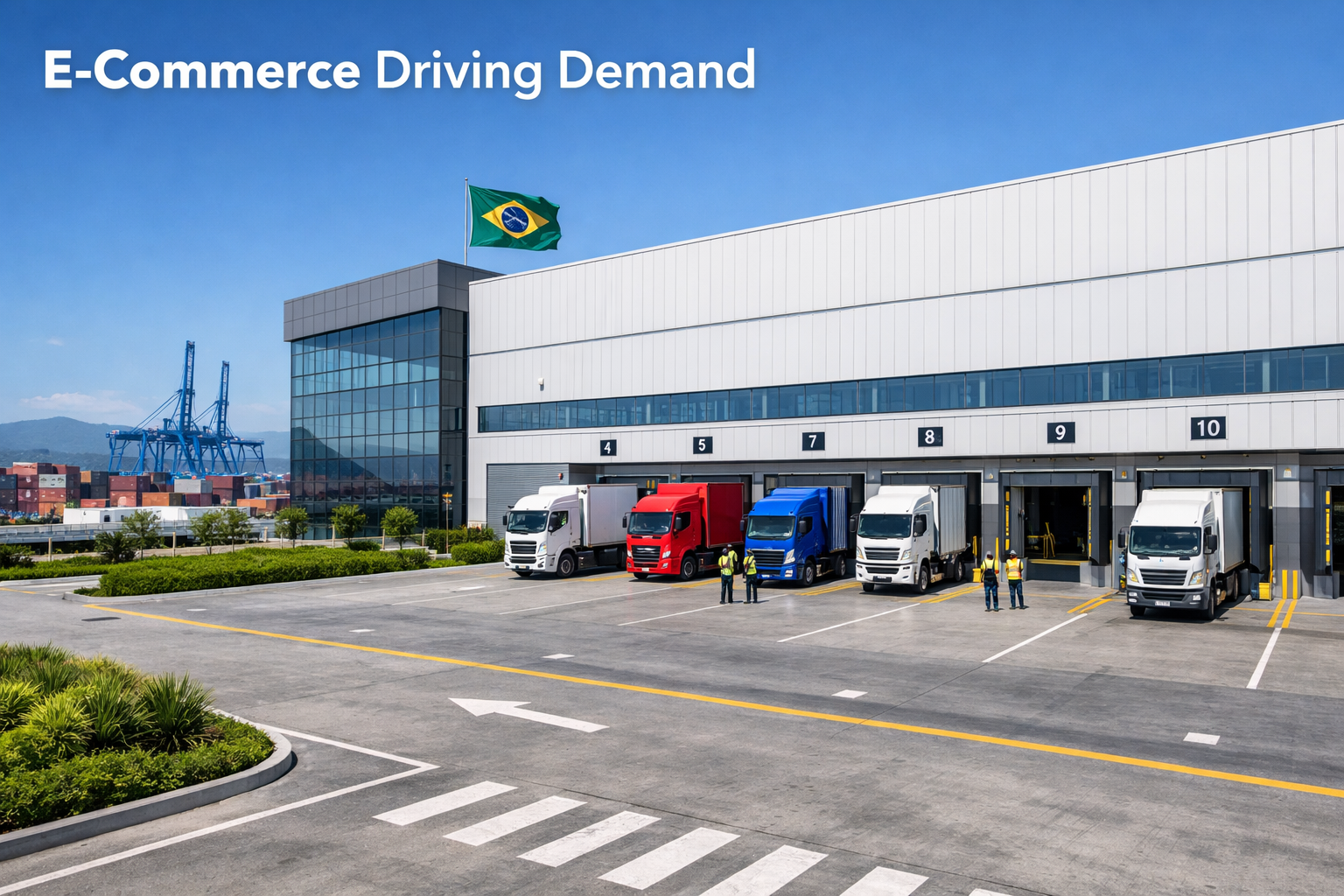
The fundamental driver behind Logistics and Warehousing Near Port of Santos: Why Industrial Real Estate Is Brazil’s Fastest-Growing Development Segment in 2026 is the explosive growth of e-commerce in Brazil. This digital transformation has created unprecedented demand for modern warehouse space, particularly facilities offering:
Class A Warehouse Characteristics
Modern logistics facilities near Santos command premium rents due to specific features that traditional warehouse space cannot provide:
| Feature | Traditional Warehouse | Class A Logistics Facility |
|---|---|---|
| Ceiling Height | 6-8 meters | 12+ meters |
| Floor Load Capacity | 3-5 tons/m² | 6+ tons/m² |
| Loading Docks | Limited, non-standardized | Multiple dock-high doors |
| Technology Integration | Minimal | WMS, automation-ready |
| Energy Efficiency | Standard | LED lighting, solar panels |
| Fire Suppression | Basic sprinklers | Advanced ESFR systems |
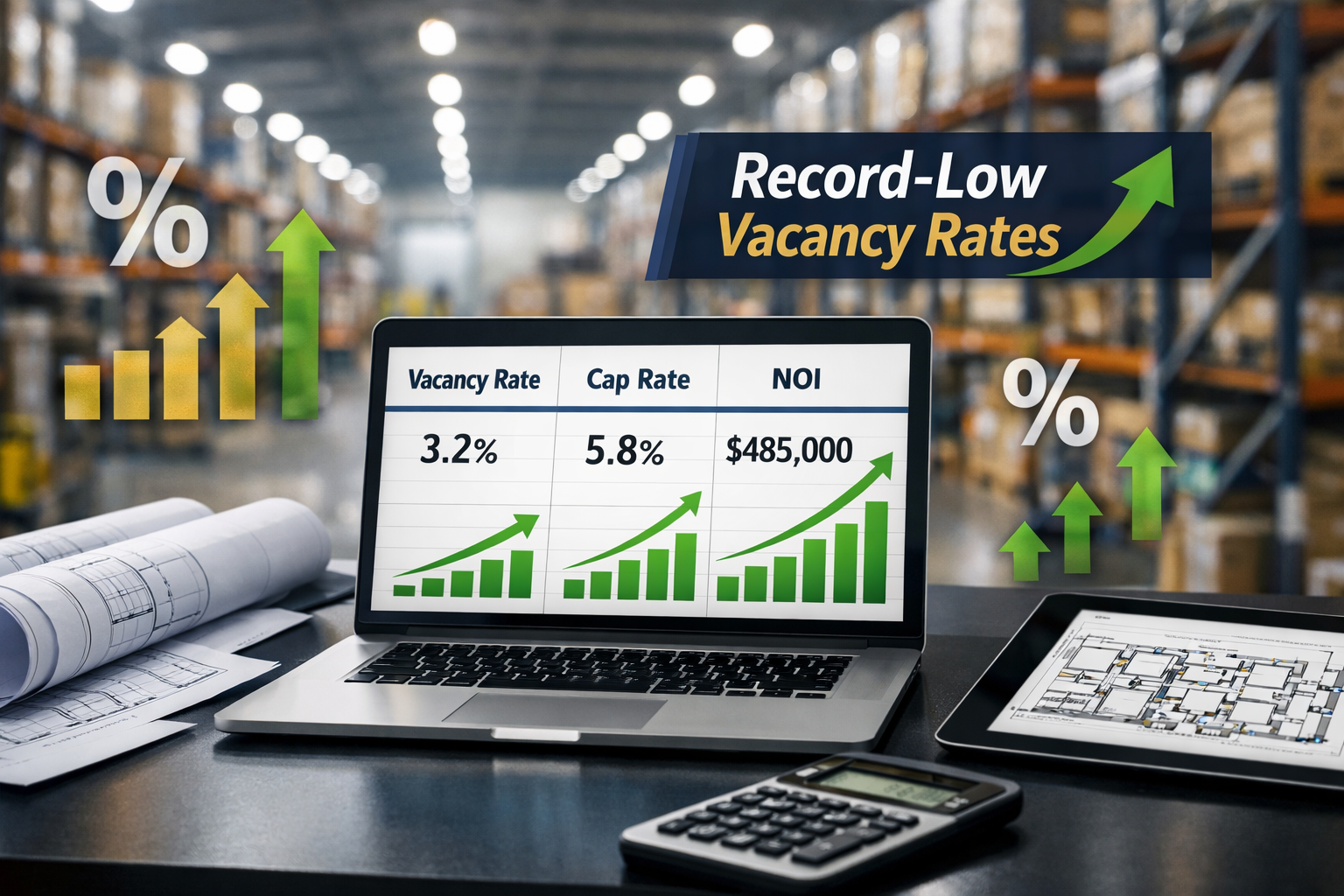
The vacancy rates for Class A facilities in the Santos region have reached historic lows, with some submarkets reporting less than 3% availability. This contrasts sharply with residential markets, where oversupply concerns persist in certain segments.
The E-Commerce Logistics Chain
Brazil’s e-commerce market continues expanding rapidly, creating demand at every node of the logistics chain:
- Import consolidation facilities near the port for international shipments
- Regional distribution centers serving São Paulo metropolitan area
- Last-mile delivery hubs for rapid urban fulfillment
- Reverse logistics facilities for returns processing
Each node requires specialized infrastructure with different location requirements. Proximity to Port of Santos provides competitive advantages for import-dependent e-commerce operations, while access to São Paulo’s consumer base drives demand for distribution facilities along key highway corridors.
Comparing ROI: Industrial vs. Residential Development
For developers evaluating investment opportunities in Brazil, the financial metrics for logistics facilities present compelling advantages:
Industrial Logistics Facilities:
- ✅ Cap rates: 8-10% for stabilized assets
- ✅ Lease terms: 5-10 years with built-in escalations
- ✅ Tenant quality: Large corporations with strong credit
- ✅ Vacancy risk: Low due to limited Class A supply
- ✅ Exit liquidity: Strong institutional buyer demand
Residential Development:
- ⚠️ Cap rates: 6-8% for rental properties
- ⚠️ Lease terms: 1-2 years with higher turnover
- ⚠️ Tenant quality: Variable individual credit profiles
- ⚠️ Vacancy risk: Higher in oversupplied markets
- ⚠️ Exit liquidity: Dependent on retail buyer sentiment
The longer lease terms and institutional tenant base of logistics facilities provide more predictable cash flows, making them attractive for developers seeking stable returns. Additionally, the construction timeline for warehouse facilities (12-18 months) is often shorter than residential towers, accelerating capital deployment and returns.
Infrastructure Requirements and Regulatory Landscape for Industrial Developers
Developing Logistics and Warehousing Near Port of Santos: Why Industrial Real Estate Is Brazil’s Fastest-Growing Development Segment in 2026 requires navigating a complex infrastructure and regulatory environment distinct from residential development. Understanding these requirements is essential for developers entering this market segment.
Critical Infrastructure Components
Successful logistics developments near Santos require integration with multiple infrastructure systems:
Transportation Infrastructure
- Highway access: Direct connections to Anchieta-Imigrantes highway system
- Rail connectivity: Access to Santos-Jundiaí railway for bulk cargo
- Port proximity: Location within 30-60 minute drive time to terminals
- Last-mile networks: Secondary road access for urban distribution
The planned Santos-Guarujá immersed tunnel project, representing a $1.2 billion P3 investment, will significantly improve connectivity between port facilities and mainland logistics zones[4][5]. This infrastructure enhancement will reduce travel times and improve reliability for time-sensitive cargo operations.
Utility Infrastructure
Modern logistics facilities require substantial utility capacity:
- Electrical capacity: 500-2000 kVA for automated facilities
- Water supply: Fire suppression systems require significant capacity
- Telecommunications: Fiber optic connectivity for WMS integration
- Waste management: Specialized handling for packaging materials
Developers must coordinate with local utilities early in the planning process to ensure adequate capacity. In some cases, private investment in utility infrastructure becomes necessary to support large-scale developments.
Regulatory and Zoning Considerations
The regulatory landscape for industrial logistics development involves multiple approval layers:
Federal Port Authority Regulations
The Port of Santos polygon expansion gained expected federal authorization in January 2026, but specific area approvals involve coordination with:
- National Waterway Transportation Agency (ANTAQ) for port-adjacent developments
- Brazilian Institute of Environment (IBAMA) for environmental licensing
- Federal Revenue Service for customs facility certifications
The Tecon 10 container terminal auction, scheduled for March 2026, demonstrates the federal government’s active role in port infrastructure development[7]. Private developers must understand these federal processes when planning facilities that integrate with port operations.
State and Municipal Approvals
São Paulo state and local municipalities maintain jurisdiction over:
- Land use zoning designations for industrial development
- Environmental impact assessments (EIA/RIMA) for large projects
- Building permits and construction approvals
- Traffic impact studies for developments generating significant truck traffic
The approval timeline for logistics facilities typically ranges from 12-24 months depending on project complexity and environmental sensitivity. Developers should engage with regulatory authorities early to identify potential obstacles.
Environmental and Sustainability Requirements
Green infrastructure has transitioned from optional to mandatory for competitive logistics developments. DP World’s electrification of its fleet of 22 RTGs, which achieved a reduction of over 1,000 metric tons of CO₂ as of June 2025, sets the standard for port-adjacent facilities[2].
Sustainability features increasingly required by institutional tenants:
- 🌱 LEED or similar certification for building design
- ⚡ Solar panel installations for energy independence
- 💧 Rainwater harvesting systems for non-potable uses
- ♻️ EV charging infrastructure for electric truck fleets
- 🌳 Green space requirements for environmental mitigation
These features add 8-15% to construction costs but generate higher rents and attract premium tenants committed to corporate sustainability goals.
ROI Potential and Investment Strategies for Industrial Developers
Understanding the return on investment potential for logistics and warehousing developments near Port of Santos requires analyzing multiple value creation strategies. The market dynamics in 2026 favor developers who can execute efficiently and secure institutional-grade tenants.
Development Cost Structure
Typical cost breakdown for a 20,000 square meter Class A warehouse facility:
| Cost Component | Percentage | R$ per m² |
|---|---|---|
| Land Acquisition | 15-20% | R$300-400 |
| Site Preparation | 5-8% | R$100-150 |
| Building Construction | 45-50% | R$900-1,000 |
| Infrastructure/Utilities | 8-12% | R$150-200 |
| Professional Fees | 5-7% | R$100-140 |
| Financing Costs | 8-10% | R$150-180 |
| Contingency | 5% | R$100 |
| Total Development Cost | 100% | R$1,800-2,200 |
These costs vary significantly based on location, with sites closer to port terminals commanding premium land prices but offering superior tenant demand.
Revenue and Return Projections
Modern Class A warehouse facilities near Santos achieve rental rates of R$25-35 per square meter per month, depending on specific location and facility features. For a stabilized 20,000 square meter facility:
Annual Revenue Calculation:
- Gross rental income: R$6.0-8.4 million annually
- Operating expenses (15-20%): R$0.9-1.7 million
- Net operating income (NOI): R$5.1-6.7 million
Return Metrics:
- Cap rate on cost: 12-15% (NOI ÷ Total Development Cost)
- Cash-on-cash return: 18-25% with leverage
- Stabilized value: R$51-84 million at 8-10% cap rate
- Development profit: R$15-30 million (30-40% margin)
These returns significantly exceed typical residential development margins of 15-25%, making industrial logistics an attractive alternative for developers with appropriate expertise.
Tenant Acquisition Strategies
Securing institutional-grade tenants before construction completion reduces risk and improves financing terms. Target tenant categories include:
- Third-party logistics providers (3PLs) serving multiple e-commerce clients
- Major retailers with direct distribution operations
- Import/export trading companies requiring port proximity
- Manufacturing companies with just-in-time inventory needs
Pre-leasing 60-80% of space before construction completion enables favorable construction financing and reduces stabilization risk. Developers should engage tenant representatives 18-24 months before projected delivery to capture tenant demand cycles.
Exit Strategy Considerations
The industrial logistics sector has attracted significant institutional capital from REITs, pension funds, and international investors seeking stable income streams. Exit strategies include:
- Portfolio sale to institutional investors at stabilized cap rates
- REIT contribution for tax-efficient liquidity
- Joint venture recapitalization retaining partial ownership
- Hold for long-term income with refinancing to extract equity
The strong buyer demand for stabilized logistics assets near Port of Santos provides developers with multiple exit pathways, enhancing overall risk-adjusted returns.
Future Outlook: South America’s Largest Container Terminal Development
The development of what is described as South America’s largest box terminal at Santos will boost the port’s annual container capacity by almost 60%[6]. This transformational project represents the culmination of infrastructure investments that position the Santos region as Latin America’s premier logistics hub.
Capacity Expansion Timeline
The phased expansion of Santos port capacity creates predictable demand for logistics real estate:
| Year | Terminal Capacity (TEUs) | Implied Warehouse Demand |
|---|---|---|
| 2024 | 1.25 million (actual) | Baseline |
| 2026 | 1.7 million | +36% increase |
| 2028 | 2.1 million | +68% increase |
| 2030+ | 3.0+ million (projected) | +140% increase |
Each incremental TEU of capacity generates demand for approximately 3-5 square meters of warehouse space in the surrounding logistics corridor, translating to millions of square meters of development opportunity over the next decade.
Competitive Positioning
Santos’ expansion positions the port to compete more effectively with other major South American gateways. The combination of deep-water berths, modern equipment, and extensive hinterland connectivity creates competitive advantages that attract shipping lines and cargo owners.
For logistics developers, this competitive positioning translates to sustainable long-term demand rather than cyclical volatility. The port’s role as São Paulo’s primary gateway ensures consistent cargo volumes that drive warehouse utilization.
Technology Integration and Automation
Future logistics facilities near Santos will increasingly incorporate automation and technology to remain competitive:
- Automated storage and retrieval systems (AS/RS) for high-density storage
- Autonomous mobile robots (AMRs) for internal material handling
- Artificial intelligence for inventory optimization and demand forecasting
- IoT sensors for real-time visibility and predictive maintenance
Developers planning facilities today should design for automation readiness even if initial tenants don’t require full automation. This future-proofing protects asset value as technology adoption accelerates.
Strategic Considerations for Developers Entering the Market
For developers considering entry into Logistics and Warehousing Near Port of Santos: Why Industrial Real Estate Is Brazil’s Fastest-Growing Development Segment in 2026, several strategic considerations warrant careful evaluation:
Market Entry Timing
The current market environment in 2026 presents both opportunities and challenges:
Favorable Factors:
- ✅ Record-low vacancy rates creating pricing power
- ✅ Institutional capital seeking deployment opportunities
- ✅ Major infrastructure investments de-risking the market
- ✅ E-commerce growth providing sustained demand
Risk Factors:
- ⚠️ Construction cost inflation reducing margins
- ⚠️ Competition from established industrial developers
- ⚠️ Regulatory approval timelines creating uncertainty
- ⚠️ Interest rate environment affecting financing costs
Developers with experience in Brazilian real estate markets possess advantages in navigating local regulatory environments and establishing contractor relationships.
Partnership and Joint Venture Strategies
Given the specialized nature of logistics development, strategic partnerships can accelerate market entry:
- Land owners with entitled industrial sites seeking development partners
- Logistics operators providing tenant relationships and operational expertise
- Financial partners contributing capital for land acquisition and construction
- International developers seeking local market knowledge and execution capabilities
Joint ventures allow developers to share risk while accessing complementary capabilities essential for successful project execution.
Geographic Submarket Selection
Not all locations near Port of Santos offer equal opportunity. Key submarket considerations include:
Port-Adjacent Locations:
- Highest land costs (R$400+ per m²)
- Shortest approval timelines for port-related uses
- Premium rents from import/export tenants
- Limited expansion opportunities
Highway Corridor Locations:
- Moderate land costs (R$250-350 per m²)
- Balanced access to port and São Paulo market
- Diverse tenant mix possibilities
- Better expansion and assemblage opportunities
Interior Logistics Parks:
- Lower land costs (R$150-250 per m²)
- Longer approval timelines
- Focus on distribution rather than port operations
- Larger site opportunities for campus developments
Submarket selection should align with target tenant profiles and risk tolerance for development timelines.
Conclusion
Logistics and Warehousing Near Port of Santos: Why Industrial Real Estate Is Brazil’s Fastest-Growing Development Segment in 2026 represents a fundamental shift in Brazil’s real estate investment landscape. The convergence of massive port infrastructure expansion, explosive e-commerce growth, and record-low vacancy rates has created an investment environment where industrial logistics facilities often outperform traditional residential developments on risk-adjusted return metrics.
The Port of Santos polygon expansion, increasing active area by 162% to 20.4 million square meters, combined with DP World’s R$1.6 billion investment to expand terminal capacity to 2.1 million TEUs by 2028, demonstrates the scale of institutional capital commitment to this market[1][2]. These infrastructure investments create predictable demand for millions of square meters of modern warehouse space over the coming decade.
For developers accustomed to residential projects, the transition to industrial logistics requires understanding specialized infrastructure requirements, navigating complex regulatory landscapes, and adapting to longer lease terms with institutional tenants. However, the financial rewards—with development margins of 30-40% and stabilized cap rates of 8-10%—justify the learning curve for developers willing to invest in market expertise.
Actionable Next Steps
Developers considering entry into the Santos logistics market should:
- Conduct detailed submarket analysis to identify locations balancing land costs, approval timelines, and tenant demand
- Engage regulatory consultants early to understand approval processes and timeline expectations for target sites
- Build relationships with 3PL operators and major retailers to understand tenant requirements and secure pre-leasing commitments
- Evaluate partnership opportunities with land owners, logistics operators, or financial partners to share risk and access complementary expertise
- Design for sustainability and automation readiness to ensure facilities remain competitive as tenant requirements evolve
- Develop detailed financial models incorporating realistic construction costs, lease-up timelines, and exit strategy assumptions
The industrial logistics sector near Port of Santos offers compelling opportunities for developers seeking to diversify beyond residential markets. As Brazil’s e-commerce economy continues expanding and port infrastructure investments materialize, the region’s position as Latin America’s premier logistics hub will only strengthen. Developers who enter this market in 2026 with appropriate expertise and execution capabilities will be well-positioned to capture value from one of Brazil’s most dynamic real estate segments.
For more insights on Brazilian real estate investment opportunities and market trends, explore additional resources on strategic property development and market analysis.
References
[1] Watch – https://www.youtube.com/watch?v=ahRUn6Kp4cw
[2] Dpw Invests Over 1 Billion Reais To Expand Santos Terminal By 25 Percent – https://www.dpworld.com/en/news/usa/dpw-invests-over-1-billion-reais-to-expand-santos-terminal-by-25-percent
[3] Brazils Port Of Santos Expansion Remains Pending As Federal Approval Slips To 2026 – https://datamarnews.com/noticias/brazils-port-of-santos-expansion-remains-pending-as-federal-approval-slips-to-2026/
[4] 62441 Sao Paulo Signs 12b P3 For Brazils First Immersed Tunnel – https://www.enr.com/articles/62441-sao-paulo-signs-12b-p3-for-brazils-first-immersed-tunnel
[5] Concessao Tunel Santos Guaruja – https://www.mota-engil.com/en/concessao-tunel-santos-guaruja/
[6] Brazils Santos Readies Development Of South Americas Largest Box Terminal 6082796 – https://www.joc.com/article/brazils-santos-readies-development-of-south-americas-largest-box-terminal-6082796
[7] Brazil Sets March 2026 Auction Date For Santos Port Terminal – https://www.bairdmaritime.com/shipping/ports/brazil-sets-march-2026-auction-date-for-santos-port-terminal