

Rental households in Curitiba’s Rebouças neighborhood have grown by an estimated 25% over the past three years — and the engine behind that surge is not a coincidence. It is a deliberate, policy-driven transformation anchored by one of Latin America’s most ambitious urban innovation ecosystems. The Curitiba Rebouças Boom 2026: Vale do Pinhão Innovation District Driving Multi-Family Demand is reshaping who lives in this neighborhood, how they live, and what developers should build next.
Key Takeaways 📌
- Vale do Pinhão, established in 2017, has transformed Rebouças from an industrial zone into Curitiba’s leading innovation hub, attracting thousands of tech workers and students.
- Rental demand is surging, with an estimated 25% growth in rental households driven by young tech professionals seeking proximity to the innovation district.
- Multi-family and rent-sharing developments optimized for co-living are the highest-demand product type in the area as of 2026.
- Strategic partnerships — including BMW do Brasil’s battery recycling initiative and a MIT-accredited Fab Lab — signal long-term institutional commitment to the district.
- Investors who act early on pre-construction opportunities in Rebouças stand to benefit from significant appreciation as the ecosystem matures.
What Is Vale do Pinhão and Why Does Rebouças Matter?
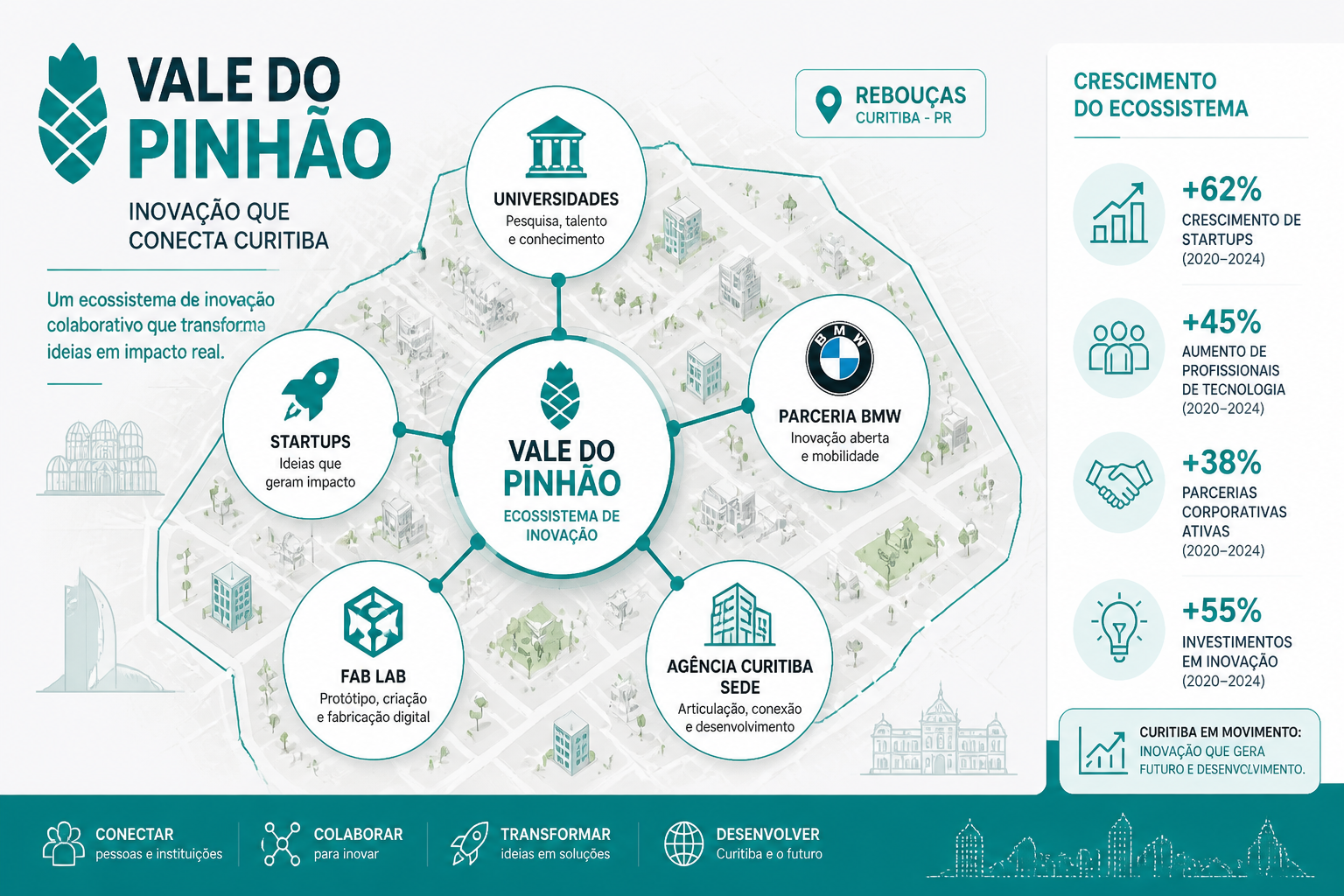
The Vale do Pinhão is not a startup incubator or a co-working space. It is a full-scale urban innovation policy. Curitiba City Hall and Agência Curitiba formalized it through Decree No. 857/17 in 2017, backed by initial funding of over USD 2.8 million, with alignment to the United Nations Sustainable Development Goals [1].
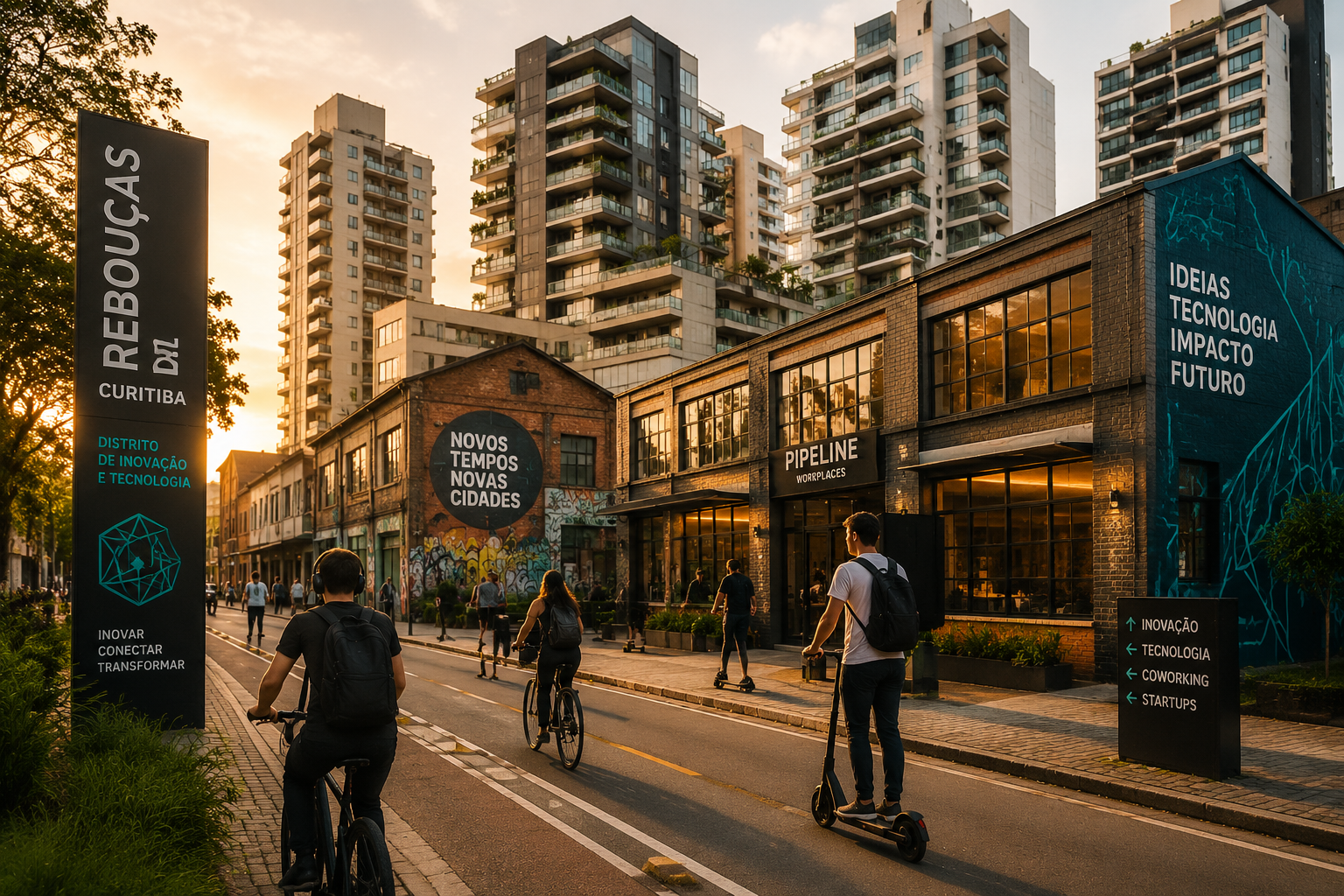
The geographic anchor of this ecosystem is the Rebouças neighborhood — a former industrial corridor that has been steadily converted into an urban living lab. The Innovation Mill (Fábrica do Futuro) and the headquarters of Agência Curitiba are both located here, making Rebouças the literal and symbolic heart of the district [2].
💡 Pull Quote: “Rebouças is no longer defined by its industrial past. It is being redefined by the talent, technology, and capital that Vale do Pinhão continues to attract.”
The ecosystem brings together multiple innovation pillars: universities, class entities, public institutions, and private-sector players. Ongoing forums, seminars, congresses, and events create a constant flow of knowledge workers, entrepreneurs, and investors through the neighborhood [2].
The Gentrification Effect: Who Is Moving to Rebouças?
The profile of the new Rebouças resident is clear: young, tech-adjacent, renting, and mobile. These are software developers, UX designers, data analysts, and startup founders — people who prioritize proximity to their professional ecosystem over square footage.
This demographic shift is driving a very specific type of real estate demand:
| Renter Profile | Key Preference | Ideal Unit Type |
|---|---|---|
| Tech professionals (25–35) | Walkability to innovation hub | Studio or 1BR compact |
| Graduate students | Affordability + community | Rent-sharing / co-living |
| Remote workers | High-speed connectivity | Flexible multi-family |
| Startup founders | Networking proximity | Mixed-use residential |
The result is a gentrification wave that is creating both opportunity and urgency for developers and investors. Those who understand the demand curve early will capture the highest returns. For a broader look at how Brazilian cities are experiencing similar dynamics, the analysis of the Grande Florianópolis real estate market offers useful parallel context.
The Innovation Infrastructure Fueling the Curitiba Rebouças Boom 2026
Understanding the Curitiba Rebouças Boom 2026: Vale do Pinhão Innovation District Driving Multi-Family Demand requires a close look at the physical and institutional infrastructure being built — because real estate demand follows infrastructure investment.
The Fab Lab: Digital Fabrication for the Masses
In March 2019, Vale do Pinhão opened a MIT-accredited Fab Lab at Rua da Cidadania do Cajuru. This facility provides digital fabrication and prototyping capabilities to students, companies, and community members [1]. A Fab Lab of this caliber is a talent magnet — it attracts the kind of skilled, mobile professionals who become long-term renters in surrounding neighborhoods.
BMW do Brasil and the Battery Recycling Breakthrough
One of the most telling indicators of Vale do Pinhão’s institutional credibility is the BMW do Brasil and Senai Institute partnership for electric vehicle battery recycling. Described as an unprecedented development, this collaboration emerged directly from Vale do Pinhão’s mobilization efforts [1]. When global automotive brands are anchoring R&D partnerships in your neighborhood, real estate values follow.
Smart City 2026: Curitiba on the Global Stage
In late March 2026, Curitiba hosted Smart City 2026, one of Latin America’s major technology and urban innovation conferences [8]. The event featured discussions on urban solutions across energy, mobility, housing, and digital infrastructure. Events like this do not just generate press — they generate talent migration. Professionals who attend, present, or exhibit at Smart City 2026 often become the next wave of Rebouças renters.
The Innovation Fair: A Startup Ecosystem Made Visible
The Feira de Inovação (Innovation Fair) brought together startups, established companies, universities, and creative projects with solutions in creative economy, urban agriculture, environmental remediation, and smart city technologies [4]. This annual showcase reinforces Rebouças as a destination for innovation talent — and by extension, a destination for multi-family real estate investment.
COVID-19 Resilience: A Stress Test Passed
Perhaps the most compelling data point for long-term investors: Vale do Pinhão demonstrated economic resilience during the COVID-19 pandemic, maintaining job creation, investment levels, and business opportunity generation even during global economic contraction [1]. An innovation district that grows through a pandemic is one worth betting on.
Multi-Family Demand: What the Curitiba Rebouças Boom 2026 Means for Investors
The Curitiba Rebouças Boom 2026: Vale do Pinhão Innovation District Driving Multi-Family Demand is not just a headline — it is an investment thesis. Here is how to think about it.
The Rent-Sharing Opportunity 🏢
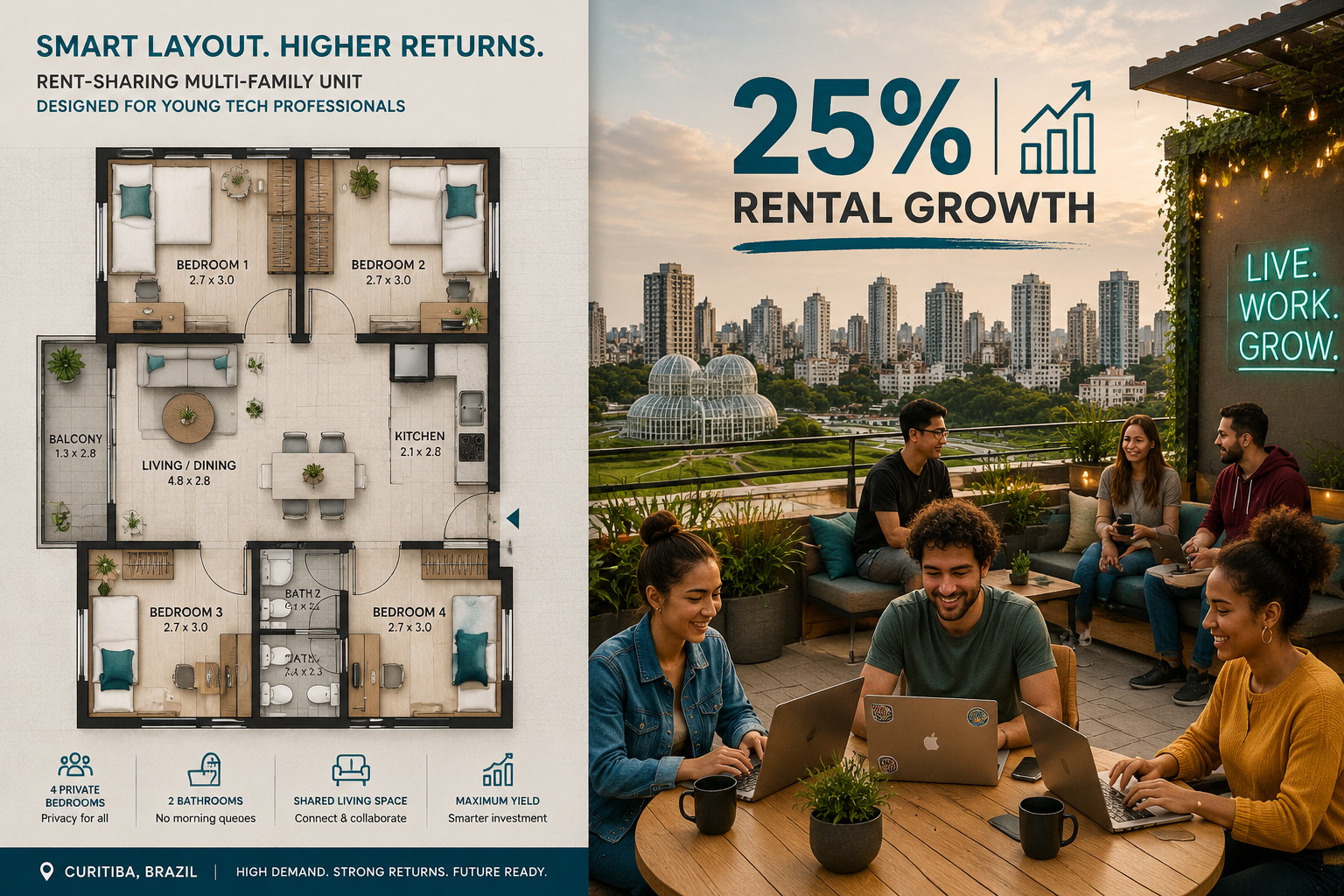
Traditional multi-family development focuses on individual units. But the rent-sharing model — where two or three young professionals share a purpose-designed apartment with private bedrooms and shared common areas — is the highest-yield product for this market. Why?
- Higher gross rent per square meter compared to single-tenant units
- Lower vacancy risk because the unit serves multiple renters
- Demographic alignment with the tech professional renter profile
- Lower per-person cost for tenants, increasing affordability and demand
Developers who design specifically for rent-sharing — with soundproofed bedrooms, multiple bathrooms, and high-speed infrastructure baked in — will command premium rents and lower vacancy rates in Rebouças.
For investors evaluating pre-construction opportunities, understanding how buying off-plan can amplify returns is essential context for the Rebouças market.
Why Proximity to Vale do Pinhão Commands a Rent Premium
Location within walking or cycling distance of the Innovation Mill, Agência Curitiba, and the broader Vale do Pinhão campus creates a location premium that is measurable and growing. Tech professionals — especially those working in hybrid or fully in-person environments — will pay more to avoid commuting.
This is the same dynamic that drove rent premiums around innovation districts in São Paulo’s Faria Lima corridor and in Florianópolis’s tech cluster. The growth of innovation-adjacent neighborhoods in Florianópolis provides a useful benchmark for what Rebouças can expect over the next five years.
Studio Units vs. Rent-Sharing: A Comparison
| Metric | Studio Unit | Rent-Sharing 3BR |
|---|---|---|
| Monthly rent (est.) | R$ 2,200 | R$ 5,400 (R$ 1,800/person) |
| Gross yield potential | Moderate | High |
| Vacancy risk | Medium | Low |
| Target renter | Solo professional | Group of 2–3 tech workers |
| Design complexity | Low | Medium |
The numbers favor purpose-built rent-sharing units in a market where the dominant renter is a young tech professional earning a competitive salary but still prioritizing cost efficiency.
Investors interested in the studio model in comparable Brazilian markets can also review the advantages of investing in studio units in Florianópolis for additional insight on compact unit performance.
The C40 Reinventing Cities Connection
The Vale do Pinhão area has also attracted attention from the C40 Reinventing Cities competition [3], which challenges developers and cities to reimagine underutilized urban sites as sustainable, mixed-use communities. This international recognition adds another layer of credibility — and another signal that Rebouças is on the radar of global capital.
Emerging Technologies and Real Estate Finance
The Rebouças boom is also intersecting with new frontiers in real estate finance. Tokenization and blockchain-based investment structures are beginning to appear in Brazilian real estate, offering new entry points for investors. For those exploring these models, how cryptocurrencies are intersecting with real estate development is a relevant emerging topic.
Key Risks and Considerations ⚠️
No investment thesis is complete without an honest look at risks. The Rebouças market is compelling, but investors should be aware of:
- Gentrification displacement pressure: Rapid rent increases can trigger regulatory responses, including rent control discussions at the municipal level.
- Construction pipeline risk: As more developers enter the market, oversupply in specific unit types is possible within 3–5 years.
- Infrastructure gaps: While Vale do Pinhão is well-funded, some public infrastructure in Rebouças (transit, green space) is still catching up to demand.
- Interest rate sensitivity: Brazilian real estate investment is sensitive to Selic rate movements, which affect financing costs and buyer appetite.
Balancing these risks against the structural demand drivers — a government-backed innovation district, 25% rental household growth, and a young professional demographic — still produces a net-positive investment case for well-positioned multi-family assets.
For investors comparing Brazilian cities for portfolio allocation, the guide to the best places to invest in Brazilian property provides a useful macro framework.
Conclusion: Actionable Next Steps for 2026 🚀
The Curitiba Rebouças Boom 2026: Vale do Pinhão Innovation District Driving Multi-Family Demand is not a speculative narrative — it is a documented, policy-backed, demographically driven real estate opportunity. The convergence of institutional infrastructure (Vale do Pinhão, Fab Lab, BMW partnership), talent migration (tech professionals, graduate students, startup founders), and a 25% rental household growth rate creates a rare alignment of demand signals.
Here is what to do next:
- Evaluate pre-construction opportunities in Rebouças and adjacent neighborhoods now, before the pipeline matures and prices reflect full market awareness.
- Prioritize rent-sharing unit designs over traditional single-tenant layouts to maximize gross yield per square meter.
- Monitor Vale do Pinhão’s event calendar — Smart City conferences, Innovation Fairs, and new institutional partnerships are leading indicators of the next demand wave.
- Stress-test your financing structure against Selic rate scenarios to ensure the investment remains viable across rate environments.
- Engage with a developer who understands the local ecosystem — execution quality and market knowledge matter enormously in a fast-moving neighborhood like Rebouças.
To explore current development opportunities aligned with this market thesis, visit the Quadragon developments portfolio or get in touch directly to discuss investment positioning in 2026’s most dynamic Brazilian urban markets.
The window for early-mover advantage in Rebouças is open. The data says it will not stay open for long.
References
[1] Pinhao Valley Innovation Ecosystem – https://www.urbanagendaplatform.org/best-practice/pinhao-valley-innovation-ecosystem
[2] Home – http://www.valedopinhao.com.br/en/home
[3] Vale Do Pinhao Pinhao Valley 1833 – https://www.c40reinventingcities.org/en/students/previous-winning-projects/vale-do-pinhao-pinhao-valley-1833.html
[4] curitiba.pr.gov.br – https://www.curitiba.pr.gov.br/noticias/feira-de-inovacao-do-vale-do-pinhao-leva-tecnologia-criatividade-e-novos-negocios-ao-centro-de-curitiba/82161
[8] Watch – https://www.youtube.com/watch?v=1hsqeGhe8g0