

Brazil’s residential real estate market is experiencing a remarkable shift in 2026. While high interest rates challenge traditional property investment, studios and one-bedroom apartments are outperforming larger properties with impressive 9% annual appreciation rates. The Small Apartment Boom in Brazil 2026: Capturing 9% Appreciation with Affordable Units Amid 15% Selic Constraints represents a strategic opportunity for developers and investors navigating the country’s complex economic landscape. This surge in compact housing isn’t just a trend—it’s a fundamental market response to affordability pressures, massive housing deficits, and changing urban demographics.

Key Takeaways
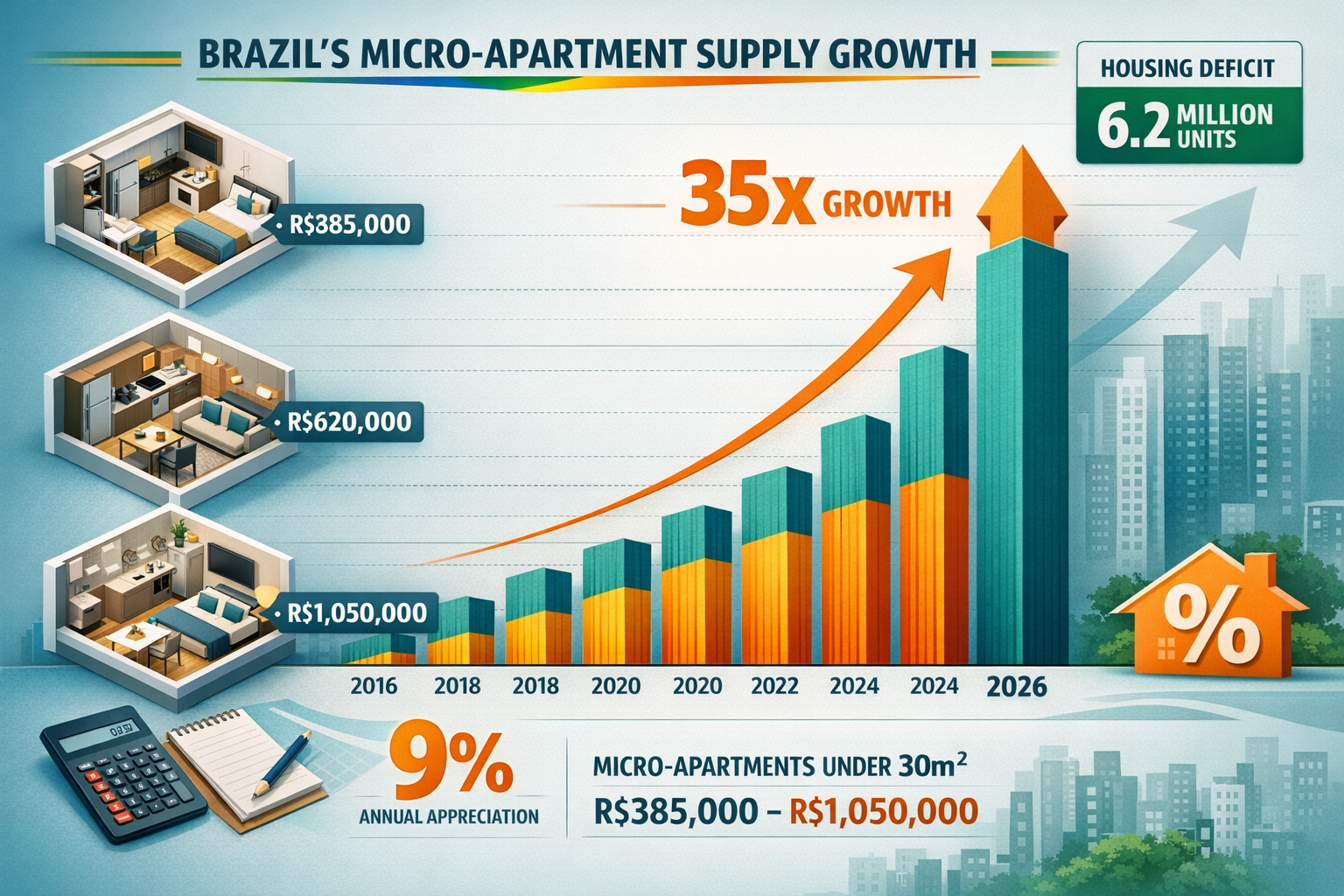
✅ Micro-apartments under 30 m² multiplied by 35 times between 2016 and 2022 in São Paulo, with momentum accelerating into 2026[3]
✅ Studios command the highest price per square meter in Brazilian cities, offering better land-cost efficiency than larger units[4]
✅ Brazil’s residential market is projected to grow from USD 63.2 billion in 2025 to USD 102.6 billion by 2034, with small units leading growth[6]
✅ Government programs allocated R$15 billion for 500,000 new affordable housing units in 2026, supporting compact housing demand[1]
✅ Small units deliver superior rental yields due to lower entry costs and higher occupancy rates in major urban centers[3]
Understanding the Small Apartment Boom in Brazil’s 2026 Market
The Perfect Storm: Why Compact Units Are Thriving
The Small Apartment Boom in Brazil 2026 didn’t emerge in a vacuum. Several converging factors have created ideal conditions for compact residential units to dominate market growth:
Housing Deficit Crisis 🏘️
Brazil faces a staggering national housing deficit of 6.2 million units, with São Paulo alone requiring approximately 230,000 additional homes[3]. This structural shortage has fundamentally shifted buyer expectations and increased acceptance of smaller living spaces as viable long-term solutions.
Selic Rate Constraints at 15%
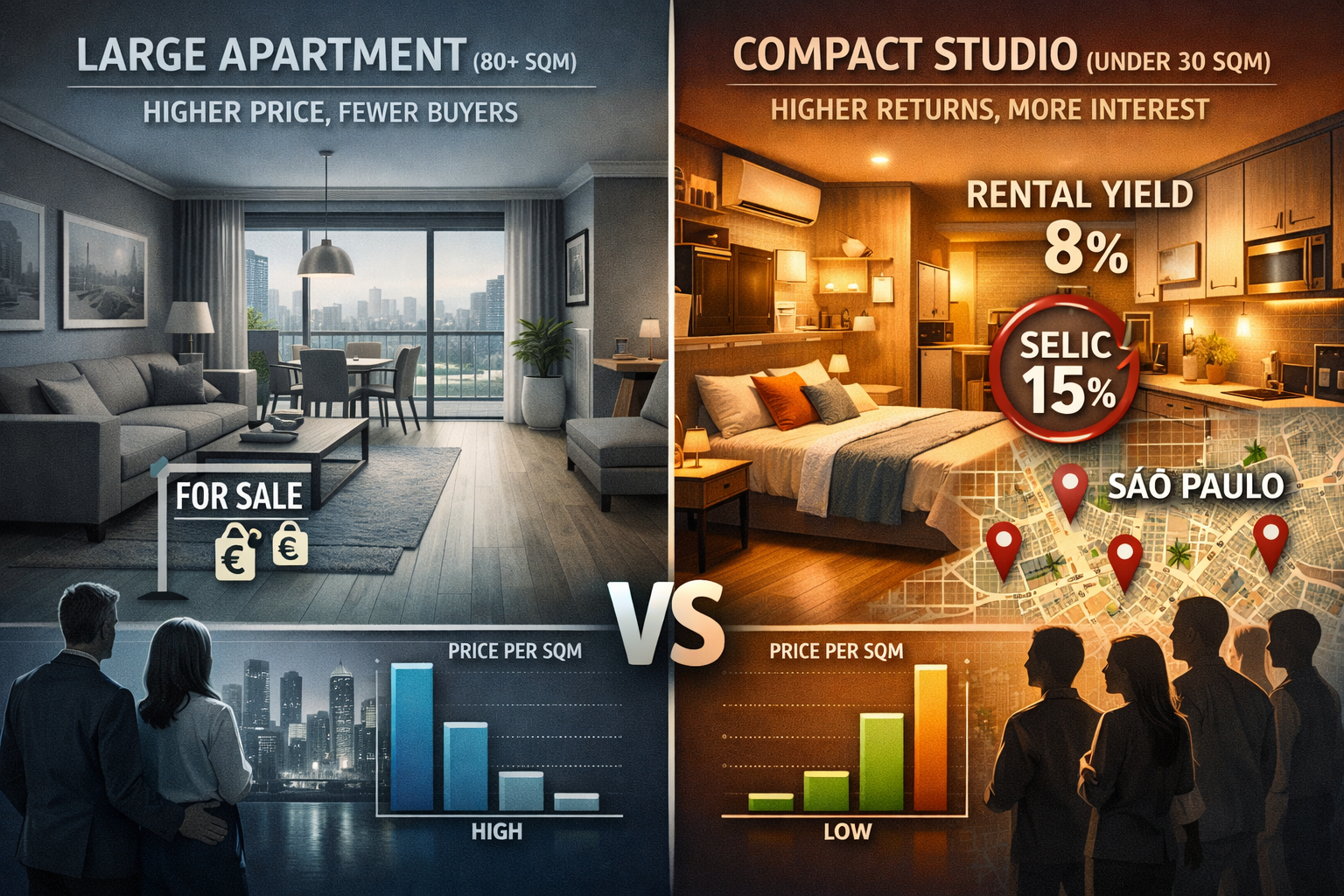
Brazil’s benchmark Selic interest rate remains elevated at approximately 15% in 2026, making mortgage financing expensive for average buyers. This constraint has pushed demand toward more affordable entry points—precisely what studios and one-bedroom apartments provide. When monthly payments matter more than total square footage, compact units become the logical choice.
Price Range Accessibility
For 80% of residential properties in Brazil’s 2026 market, prices fall between R$385,000 and R$1,050,000 (approximately $69,000 to $189,000)[4]. Small apartments cluster at the lower end of this spectrum, making homeownership accessible to first-time buyers, young professionals, and investors seeking multiple properties rather than single large holdings.
Supply Growth: A 35-Fold Explosion
Perhaps the most striking evidence of this boom comes from supply data. In São Paulo, the supply of housing units under 30 m² multiplied by 35 between 2016 and 2022[3]. This explosive growth demonstrates that developers recognized market demand early and responded aggressively. By 2026, this trend has matured into a stable market segment with proven performance metrics.
For developers exploring opportunities in Brazil’s evolving market, understanding best places to invest in Brazil property becomes essential for maximizing returns on compact unit developments.
Capturing 9% Appreciation: The Economics of Small Units
Why Small Apartments Command Premium Pricing
Studios and one-bedroom apartments achieve the highest price per square meter in Brazilian cities in 2026[4]. This counterintuitive pricing structure reflects fundamental real estate economics:
Land Cost Distribution
Urban land represents a fixed cost regardless of building size. When developers construct compact units, they spread land acquisition costs across fewer square meters per unit, but they create more individual units per plot. Each unit commands market pricing based on its utility as a complete residence, not merely its size.
Location Premium
Small apartments typically occupy prime urban locations where land costs are highest. Buyers pay for proximity to employment centers, public transportation, dining, and entertainment. A 25 m² studio in São Paulo’s Jardins neighborhood offers far more lifestyle value than a 100 m² apartment in a distant suburb—and pricing reflects this reality.
Lower Absolute Price, Higher Unit Economics
While a studio might list for R$450,000 and a three-bedroom for R$900,000, the studio’s price per square meter often exceeds the larger unit’s by 20-30%. This creates favorable economics for developers who can maximize unit count per project.
The 9% Appreciation Advantage
Small apartments are experiencing approximately 9% annual appreciation in Brazil’s major markets in 2026, outpacing larger residential properties. Several factors drive this outperformance:
- Demand Concentration: More buyers can afford R$400,000 than R$800,000, creating deeper buyer pools
- Rental Market Strength: Small units rent faster and maintain higher occupancy rates
- Investment Diversification: Investors prefer owning three studios over one large apartment
- Government Support: Affordable housing programs specifically target this segment
The typical 6% gap between listing and closing prices[4] means a studio listed at R$700,000 typically sells for R$658,000. However, annual appreciation of 9% quickly recovers this negotiation discount and generates positive equity growth.
Investors interested in maximizing returns through pre-construction purchases should explore strategies for buying off-plan to amplify gains in Brazil’s expanding small-unit market.
Rental Yield Performance
Small-unit studios and one-bedrooms outperform in rental yield due to lower entry costs and higher rental liquidity[3]. Consider these comparative metrics:
| Property Type | Average Purchase Price | Monthly Rent | Annual Yield |
|---|---|---|---|
| Studio (25 m²) | R$420,000 | R$2,800 | 8.0% |
| 1-Bedroom (40 m²) | R$580,000 | R$3,600 | 7.4% |
| 2-Bedroom (70 m²) | R$850,000 | R$4,500 | 6.4% |
| 3-Bedroom (100 m²) | R$1,200,000 | R$6,000 | 6.0% |
Note: Yields calculated before expenses; actual returns vary by location and property condition
The yield advantage for compact units becomes even more pronounced when considering occupancy rates. Studios in major Brazilian cities maintain 90-95% occupancy versus 75-85% for larger family apartments, as smaller units appeal to a broader tenant base including students, young professionals, and short-term renters.
Government Programs Fueling Affordable Housing Demand
Minha Casa Minha Vida: R$15 Billion Catalyst
The Brazilian government allocated approximately R$15 billion to the Minha Casa Minha Vida program in 2026, targeting delivery of 500,000 new housing units nationwide[1]. This massive investment directly supports the small apartment boom by:
- Subsidizing eligible buyers in lower income brackets
- Reducing financing costs through preferential interest rates
- Incentivizing developers to build affordable compact units
- Creating predictable demand for specific property types
The restructured program now incorporates enhanced environmental and urban planning standards, which increase the market value of properties over time[1]. Developers building to these elevated standards benefit from both government support and premium positioning in the resale market.
Casa Verde e Amarela: Expanding Access
Additional housing programs like Casa Verde e Amarela provide subsidies and low-interest loans to eligible families, increasing homeownership among lower-income groups[6]. These programs specifically target properties in the R$200,000-R$500,000 range—exactly where most studios and one-bedroom apartments are priced.
For developers, these programs represent demand guarantees. When government subsidies reduce effective buyer costs by 20-30%, previously unaffordable units become accessible to millions of additional households. This expanded buyer pool supports both initial sales velocity and long-term appreciation.
Developers focusing on regions with strong infrastructure growth can maximize program benefits. The growth of Ingleses region in Florianópolis exemplifies how infrastructure improvements amplify small-unit appreciation in emerging markets.
Navigating the 15% Selic Constraint Environment
How High Interest Rates Shape Buyer Behavior
Brazil’s 15% Selic rate in 2026 creates significant headwinds for traditional property financing. Monthly mortgage payments on a R$700,000 property can exceed R$8,000, placing homeownership out of reach for many middle-class families.
This constraint fundamentally reshapes buyer priorities:
Affordability Trumps Space
When interest rates are high, buyers optimize for monthly payment affordability rather than total living space. A R$400,000 studio with R$4,500 monthly payments becomes more attractive than a R$800,000 two-bedroom with R$9,000 payments.
Shorter Financing Terms
High interest rates incentivize shorter loan terms to minimize total interest paid. Smaller loan amounts on compact units make 10-15 year mortgages feasible, whereas larger properties often require 20-30 year terms.
Investment Strategy Shifts
Investors increasingly prefer multiple small units over single large properties. Three studios totaling R$1,200,000 in value offer diversification, higher aggregate rental yield, and more flexible exit strategies than one R$1,200,000 apartment.
Developer Advantages in High-Rate Environments
For developers, the Small Apartment Boom in Brazil 2026: Capturing 9% Appreciation with Affordable Units Amid 15% Selic Constraints creates specific strategic advantages:
✨ Faster Sales Velocity: Lower-priced units sell faster, improving cash flow and reducing carrying costs
✨ Broader Buyer Base: More qualified buyers exist at R$400,000 than R$800,000 price points
✨ Government Program Eligibility: Small units align with subsidy program requirements
✨ Pre-Sale Success: Affordable units achieve higher pre-sale percentages, reducing construction financing risk
Developers can also leverage pre-construction pricing strategies to offset interest rate impacts. By offering early-bird discounts and flexible payment plans during construction, developers maintain sales momentum even as financing costs rise for end buyers.
The real estate market performance in Florianópolis demonstrates how strategic pricing and product positioning can overcome interest rate challenges in competitive markets.
Short-Term Rental Market: The Hidden Yield Multiplier
Airbnb and Platform-Driven Demand
The short-term rental market, spearheaded by platforms like Airbnb, is identified as the single most powerful driver of foreign investment in Brazilian residential property[5]. This trend particularly benefits small apartment owners because:
Higher Nightly Rates per Square Meter
A 25 m² studio can command R$200-300 per night in prime locations, generating R$6,000-9,000 monthly at 80% occupancy—double or triple long-term rental rates.
Tourism and Business Travel
Brazil’s growing tourism sector and business travel to major cities create consistent demand for short-term accommodations. Small units perfectly suit solo travelers and couples who represent the majority of short-term guests.
Lower Guest Expectations
Short-term guests prioritize location and amenities over space. A well-appointed 30 m² studio near Copacabana or Avenida Paulista satisfies guest needs while maximizing owner returns per square meter.
Foreign Investor Appeal
International investors particularly favor small units for short-term rental strategies because they offer:
- Lower capital requirements
- Easier property management
- Higher cash-on-cash returns
- Portfolio diversification across multiple properties
Regulatory Landscape in 2026
Cities like Rio de Janeiro and São Paulo are expected to introduce stricter regulations regarding zoning, taxation, and registration of short-term rental properties in 2026[5]. However, these regulations typically include exemptions or reduced requirements for:
- Properties under certain size thresholds
- Owner-occupied units with occasional rentals
- Properties in designated tourism zones
Meanwhile, smaller resort communities offer more operational leniency, creating opportunities for developers to position small-unit projects in emerging coastal and mountain destinations where regulatory burdens remain light.
Investors exploring short-term rental strategies should consider investment advantages in studio apartments in emerging markets like Florianópolis, where tourism growth supports strong rental performance.
Market Projections: Brazil’s Residential Growth Through 2034
USD 102.6 Billion Market by 2034
Brazil’s residential real estate market is projected to grow from USD 63.2 billion in 2025 to USD 102.6 billion by 2034, exhibiting a compound annual growth rate (CAGR) of 5.52% during 2026-2034[6]. This substantial growth reflects:
- Urbanization trends continuing to concentrate population in major cities
- Middle-class expansion creating new homebuyer cohorts
- Infrastructure investments improving connectivity and livability
- Foreign investment attracted by relative value compared to developed markets
Within this broader growth trajectory, small apartments are positioned to capture disproportionate market share because they align with affordability constraints, demographic shifts toward smaller households, and investor preferences for yield-focused properties.
Demographic Tailwinds
Several demographic trends specifically support small apartment demand:
Single-Person Households 👤
Brazil’s single-person household rate continues rising, particularly in major cities. These households prioritize location and affordability over space, making studios and one-bedrooms ideal.
Delayed Family Formation
Brazilians are marrying later and having fewer children, extending the period when compact living arrangements suit lifestyle needs.
Student and Young Professional Migration
Universities and employment opportunities concentrate in major cities, creating steady demand for affordable urban housing near campuses and business districts.
Retiree Downsizing
Aging Brazilians increasingly sell family homes and purchase smaller urban apartments to access healthcare, cultural amenities, and reduce maintenance burdens.
Regional Hotspots for Small Unit Development
While São Paulo and Rio de Janeiro dominate headlines, several secondary markets offer exceptional opportunities for small apartment development:
Florianópolis 🏖️
This coastal city combines tourism appeal with growing tech sector employment, creating demand for both long-term rentals and short-term vacation properties. The Florianópolis real estate market outlook for 2025 extends into 2026 with continued strength in compact unit segments.
Belo Horizonte
Strong university presence and lower cost of living compared to São Paulo attract young professionals seeking affordable homeownership.
Curitiba
Excellent urban planning and quality of life metrics support premium pricing for well-located small units.
Porto Alegre
Southern Brazil’s largest city offers stable demand and less speculative pricing volatility.
Developers can explore Quadragon’s development projects for examples of successful small-unit positioning in emerging Brazilian markets.
Strategic Considerations for Developers and Investors
Low-Risk Entry Strategy
The Small Apartment Boom in Brazil 2026: Capturing 9% Appreciation with Affordable Units Amid 15% Selic Constraints offers developers a relatively low-risk entry point into urban condo markets:
Reduced Capital Requirements
Developing 50 studios requires less total capital than 25 two-bedroom apartments, even with similar aggregate square footage, because infrastructure costs scale more favorably.
Faster Construction Timelines
Smaller unit sizes often mean simpler layouts and faster construction completion, reducing financing costs and accelerating revenue recognition.
Diversified Buyer Risk
Selling to 50 different buyers distributes default risk compared to selling 25 larger units. If several buyers face financing challenges, the project remains viable.
Flexible Exit Strategies
Developers can more easily pivot between retail sales, bulk sales to investors, or rental operation with small units due to their broader market appeal.
Design Optimization for Maximum Value
Successful small apartment projects in 2026 incorporate specific design elements that maximize perceived value:
Efficient Layouts 📐
Open floor plans, multi-functional furniture, and clever storage solutions make 25-30 m² feel spacious and livable.
Premium Finishes
High-quality materials and modern appliances justify premium pricing per square meter and attract discerning buyers.
Amenity Packages
Shared amenities (fitness centers, coworking spaces, rooftop terraces) compensate for limited private space and create community value.
Technology Integration
Smart home features, high-speed internet infrastructure, and app-based building management appeal to young, tech-savvy buyers.
Natural Light and Views
Floor-to-ceiling windows and balconies (even small ones) dramatically improve livability perception in compact spaces.
Financing and Partnership Structures
Given the 15% Selic environment, developers must structure projects carefully:
Pre-Sales Financing
Achieving 30-40% pre-sales before construction starts reduces reliance on expensive construction financing and demonstrates market validation to lenders.
Government Program Partnerships
Structuring projects to qualify for Minha Casa Minha Vida or Casa Verde e Amarela programs provides demand certainty and may unlock preferential financing terms.
Joint Ventures
Partnering with established developers or institutional investors can provide capital at better terms than traditional construction loans.
Phased Development
Breaking larger projects into phases allows developers to use early-phase profits to finance later phases, reducing external financing needs.
For insights into how construction progress impacts investment returns, review foundation completion and accelerated development timelines in successful Brazilian projects.
Challenges and Risk Mitigation
Regulatory Complexity
Brazil’s real estate regulatory environment varies significantly by municipality. Developers must navigate:
- Zoning restrictions limiting unit sizes or building heights
- Environmental compliance requirements for new construction
- Short-term rental regulations affecting investment appeal
- Tax structures varying by property type and location
Mitigation Strategy: Engage local legal counsel early in project planning and build regulatory compliance costs into pro formas.
Market Saturation Risk
As more developers recognize small apartment opportunities, certain markets risk oversupply. Warning signs include:
- Rapidly increasing inventory without corresponding absorption
- Declining price per square meter trends
- Extended listing times for similar properties
- Increasing developer incentives and concessions
Mitigation Strategy: Focus on underserved neighborhoods with strong fundamentals rather than chasing established hotspots. Conduct thorough supply-demand analysis before site acquisition.
Construction Cost Inflation
Brazil’s construction costs have risen significantly in recent years. Small margins on affordable units mean cost overruns can eliminate profitability.
Mitigation Strategy:
- Lock in fixed-price contracts with reputable contractors
- Include contingency reserves of 10-15% in budgets
- Use standardized designs that contractors can execute efficiently
- Consider prefabricated or modular construction methods
Interest Rate Volatility
While the Selic rate stands at 15% in 2026, future changes could impact buyer affordability and investment returns.
Mitigation Strategy: Structure projects with flexible pricing that can adjust to market conditions. Maintain relationships with multiple lenders to access best available financing terms.
Conclusion: Seizing the Small Apartment Opportunity
The Small Apartment Boom in Brazil 2026: Capturing 9% Appreciation with Affordable Units Amid 15% Selic Constraints represents a compelling opportunity for developers and investors who understand the market’s structural drivers. With a national housing deficit of 6.2 million units, government programs allocating R$15 billion for affordable housing, and demographic shifts favoring compact urban living, small apartments are positioned for sustained outperformance.
Studios and one-bedroom units deliver superior economics through:
- Highest price per square meter in urban markets
- Strong 9% annual appreciation rates
- Excellent rental yields exceeding larger properties
- Lower entry barriers attracting broader buyer pools
- Government subsidy program eligibility
The 15% Selic constraint that challenges traditional property investment actually strengthens the small apartment thesis by pushing buyers toward affordable entry points and investors toward yield-focused assets. Meanwhile, Brazil’s residential market growth trajectory toward USD 102.6 billion by 2034 provides a rising tide that will lift well-positioned projects.
Actionable Next Steps
For developers and investors ready to capitalize on this opportunity:
- Conduct Market Analysis: Identify underserved neighborhoods in major cities with strong employment growth and infrastructure development
- Evaluate Government Programs: Determine project eligibility for Minha Casa Minha Vida or Casa Verde e Amarela to access subsidized demand
- Optimize Unit Mix: Design projects with 25-40 m² units that maximize land utilization while maintaining livability
- Secure Strategic Partnerships: Establish relationships with local developers, contractors, and property managers with small-unit expertise
- Plan Exit Strategies: Determine whether retail sales, bulk investor sales, or rental operation best aligns with your investment objectives
- Monitor Regulatory Changes: Stay informed about zoning, taxation, and short-term rental regulations in target markets
The small apartment boom isn’t a speculative bubble—it’s a fundamental market response to Brazil’s housing crisis, affordability constraints, and evolving demographics. Developers who act strategically in 2026 can establish strong positions in this growing segment and capture attractive returns even amid challenging interest rate conditions.
For personalized guidance on entering Brazil’s small apartment market, contact Quadragon’s development team to explore opportunities aligned with your investment goals.
References
[1] Brazil Real Estate Market Trends 2026 – https://www.riotimesonline.com/brazil-real-estate-market-trends-2026/
[3] Micro Apartments Brazil Solution Small Budgets – https://www.jarniascyril.com/international-real-estate/investing-brazil-real-estate/micro-apartments-brazil-solution-small-budgets/
[4] Brazil Housing Prices – https://thelatinvestor.com/blogs/news/brazil-housing-prices
[5] Brazil Property Market Predictions For 2026 – https://esalesinternational.com/2025/11/20/brazil-property-market-predictions-for-2026/
[6] Brazil Residential Real Estate Market – https://www.imarcgroup.com/brazil-residential-real-estate-market