
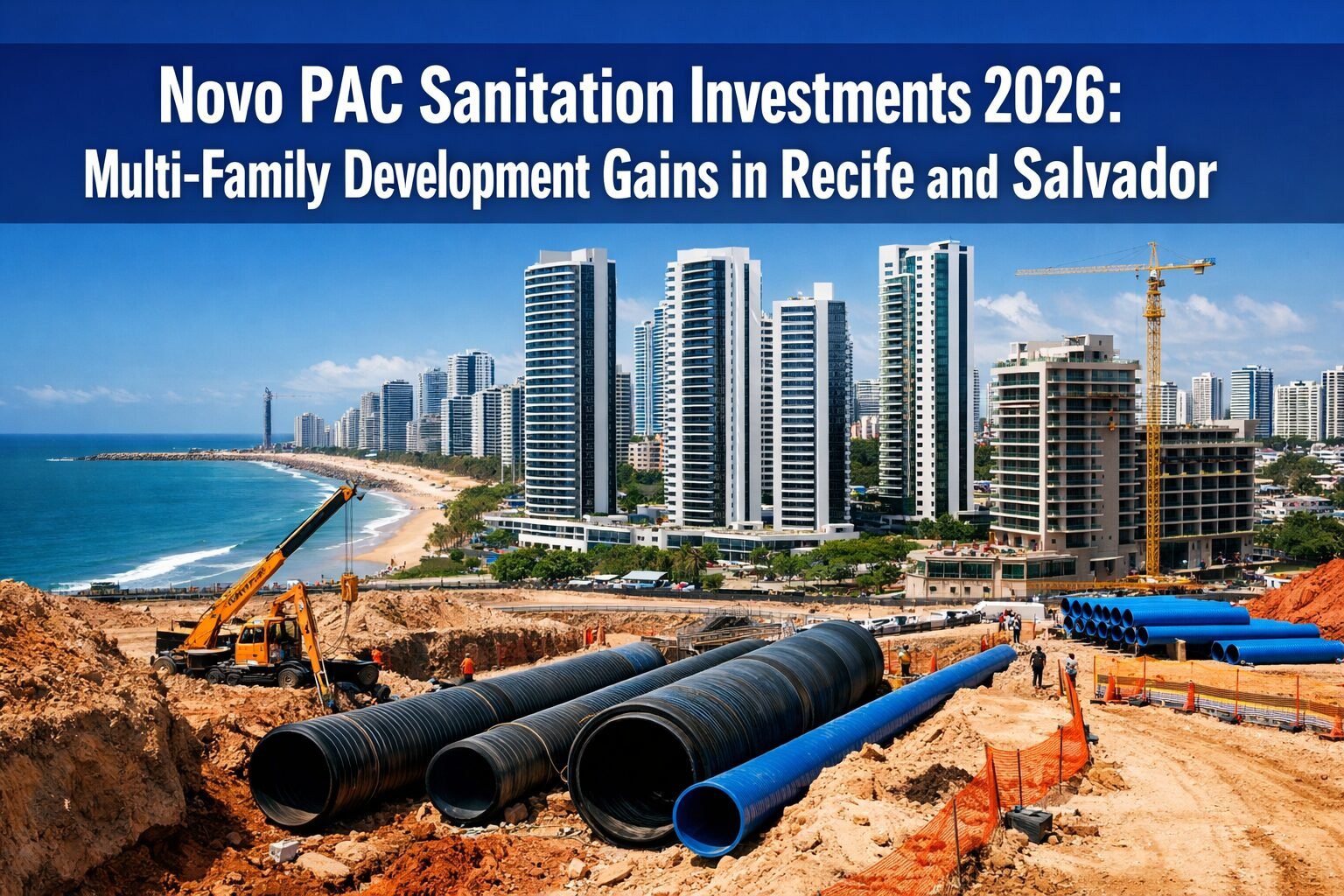
When billions of dollars flow into aging infrastructure, smart developers follow the money. In 2026, Brazil’s Novo PAC (New Growth Acceleration Program) is channeling unprecedented resources into sanitation and mobility projects across Northeast cities, creating a golden opportunity for multi-family residential developers. The Novo PAC Sanitation Investments 2026: Multi-Family Development Gains in Recife and Salvador represent more than just improved sewage systems—they signal a fundamental shift in urban land values and development potential that savvy investors cannot afford to ignore.
With R$ 88.6 billion earmarked for sanitation auctions through 2026 and strategic infrastructure improvements transforming neighborhoods in Recife and Salvador, developers who align their project timelines with government investment cycles are capturing premium valuations of 10-25% above market averages.[1] This convergence of public infrastructure spending and private real estate development is reshaping the investment landscape across Brazil’s Northeast region.
Key Takeaways
✅ Record Investment Cycle: Brazil’s sanitation sector will move R$ 88.6 billion through 27 auctions scheduled between late 2025 and throughout 2026, representing a final “super cycle” of infrastructure contests.[1]
✅ Northeast Development Focus: Novo PAC allocates US$ 5.4 billion specifically for sanitary sewage and US$ 5.4 billion for water supply programs through 2026, with significant concentration in Recife and Salvador metropolitan areas.[2]
✅ Developer Premium Opportunity: Multi-family projects strategically aligned with infrastructure improvement timelines are achieving 10-25% value premiums as improved sanitation directly enhances neighborhood desirability and property values.
✅ Universal Coverage Deadline: The 2033 target for universal water and sewage coverage requires approximately R$ 45 billion annually, creating sustained momentum for infrastructure-adjacent real estate development.[1]
✅ Strategic Timing Advantage: Developers who coordinate land acquisition and project launches with sanitation infrastructure completion dates maximize returns by capturing post-improvement valuations at pre-improvement acquisition costs.
Understanding the Novo PAC Sanitation Investment Framework for 2026
The Novo PAC Sanitation Investments 2026: Multi-Family Development Gains in Recife and Salvador story begins with understanding the massive infrastructure transformation underway. Brazil’s 2020 sanitation legal framework established ambitious targets: universal water and sewage coverage by 2033. Achieving this goal requires approximately R$ 45 billion in annual investments—a dramatic increase from the R$ 29.8 billion invested in 2025.[1]
The 2026 investment cycle represents the culmination of years of planning and auction preparation. Since the 2020 regulatory landmark, 66 auctions across 1,550+ cities have generated R$ 370 billion in contracted investments.[1] The upcoming 27 auctions scheduled for 2026 alone will move R$ 88.6 billion, focusing heavily on Northeast metropolitan regions where infrastructure deficits remain most acute.
Why Recife and Salvador Lead the Investment Wave
Recife and Salvador, two of Northeast Brazil’s largest metropolitan areas, present particularly compelling opportunities within the Novo PAC Sanitation Investments 2026 framework:
Recife Metropolitan Region:
- Population exceeding 4 million residents
- Historic sanitation coverage gaps in expanding peripheral neighborhoods
- Strong demand for modern multi-family housing near improved infrastructure
- Strategic coastal location driving tourism and economic growth
Salvador Metropolitan Region:
- Brazil’s third-largest metropolitan area with 3.9+ million residents
- Significant Novo PAC allocations targeting water supply and sewage treatment
- Rapidly growing middle-class population seeking quality housing
- Tourism and service economy creating sustained housing demand
Both cities benefit from Brazil’s Northeast region leading national growth expectations, with expanding consumer markets and improving economic fundamentals.[4] For investors exploring where to invest in Brazilian property, these infrastructure-driven opportunities deserve serious consideration.
The Novo PAC Funding Allocation Breakdown
The broader Novo PAC framework commits US$ 114.4 billion to infrastructure investments through 2026, with sanitation representing a critical pillar:[2]
| Investment Category | Allocation (USD) | Timeline | Focus Areas |
|---|---|---|---|
| Sanitary Sewage | $5.4 billion | 2023-2026 | Treatment plants, collection networks |
| Water Supply | $5.4 billion | Through 2026 | Distribution systems, quality improvements |
| Urban Mobility | $8.3 billion | 2023-2026 | Transit systems, road improvements |
| Social Housing | $12.1 billion | Through 2026 | Affordable housing programs |
This coordinated investment approach creates multiplier effects for real estate developers. When sanitation improvements arrive alongside mobility enhancements and social housing programs, entire neighborhoods transform—and property values respond accordingly.
Multi-Family Development Gains: How Infrastructure Drives Real Estate Value
The connection between sanitation infrastructure and multi-family residential value isn’t theoretical—it’s measurable and substantial. When the Novo PAC Sanitation Investments 2026: Multi-Family Development Gains in Recife and Salvador materialize on the ground, developers who positioned themselves strategically reap significant rewards.
The 10-25% Premium Phenomenon
Real estate developers coordinating project timelines with infrastructure improvements consistently achieve 10-25% value premiums through several mechanisms:
🏗️ Pre-Infrastructure Acquisition, Post-Infrastructure Delivery Developers who acquire land before sanitation improvements become publicly visible pay pre-improvement prices. When their buildings deliver after infrastructure completion, they sell at post-improvement valuations—capturing the entire appreciation spread.
💧 Enhanced Neighborhood Desirability Modern sanitation infrastructure eliminates odors, health concerns, and flooding risks. These improvements directly translate to higher willingness-to-pay among homebuyers and renters, supporting premium pricing strategies.
🏘️ Accelerated Neighborhood Transformation Infrastructure improvements often catalyze broader neighborhood revitalization. New commercial developments, improved public spaces, and rising average incomes follow sanitation upgrades—further boosting residential property values.
📈 Reduced Development Risk Projects in areas with confirmed infrastructure investment face lower regulatory and operational risks. This risk reduction supports higher valuations and improved financing terms.
Case Study Framework: Timing Infrastructure and Development Cycles
Successful developers master the art of infrastructure-development synchronization. Here’s how the process typically unfolds in Recife and Salvador:
Phase 1: Intelligence Gathering (12-18 months before auction)
- Monitor Novo PAC auction schedules and municipal planning documents
- Identify neighborhoods slated for sanitation improvements
- Conduct preliminary land acquisition research
- Analyze demographic and economic trends
Phase 2: Strategic Land Acquisition (6-12 months before construction begins)
- Secure parcels in infrastructure improvement zones
- Negotiate favorable terms before public awareness drives prices up
- Conduct environmental and regulatory due diligence
- Begin preliminary architectural planning
Phase 3: Development Coordination (During infrastructure construction)
- Time project approvals to align with infrastructure completion
- Design buildings that showcase neighborhood improvements
- Develop marketing messaging emphasizing infrastructure benefits
- Coordinate construction schedules for optimal market entry
Phase 4: Premium Capture (Post-infrastructure completion)
- Launch sales/leasing campaigns highlighting improved infrastructure
- Command premium pricing based on enhanced neighborhood quality
- Achieve faster absorption rates due to improved area perception
- Realize 10-25% value gains versus pre-infrastructure baseline
Developers interested in maximizing returns through strategic timing will find this infrastructure-synchronized approach particularly valuable.
Multi-Family Product Types Benefiting Most from Sanitation Investments
Not all multi-family products benefit equally from infrastructure improvements. The Novo PAC Sanitation Investments 2026: Multi-Family Development Gains in Recife and Salvador create particularly strong opportunities for:
Mid-Market Multi-Family Towers (8-15 stories)
- Target: Growing middle-class families seeking quality housing
- Unit mix: 2-3 bedroom apartments (60-85 sqm)
- Amenities: Pools, fitness centers, children’s play areas
- Price point: R$ 350,000-650,000 per unit
- Premium capture: 15-25% above pre-infrastructure values
Mixed-Use Developments with Residential Components
- Ground-floor commercial with residential above
- Benefit from both residential and commercial value uplift
- Create vibrant neighborhood anchors
- Premium capture: 12-20% above comparable single-use projects
Affordable Housing Projects (Minha Casa Minha Vida aligned)
- Leverage both Novo PAC infrastructure and housing subsidies
- Address critical housing shortages in improved neighborhoods
- Benefit from government support and infrastructure synergies
- Premium capture: 10-15% through reduced development costs and improved marketability
For developers exploring multi-family investment strategies, understanding product-infrastructure fit is essential.
Strategic Implementation: Capitalizing on Novo PAC Sanitation Investments in 2026
Translating the Novo PAC Sanitation Investments 2026: Multi-Family Development Gains in Recife and Salvador opportunity into actual returns requires systematic execution. Developers must navigate auction schedules, municipal planning processes, financing structures, and market timing considerations.
Tracking the 2026 Auction Calendar and Investment Timeline
The 27 sanitation auctions scheduled through 2026 follow a structured timeline that developers can leverage for planning:[1]
Q1 2026 (January-March):
- 8-10 auctions focusing on metropolitan regions
- Emphasis on sewage treatment plant concessions
- Investment commitments: R$ 25-30 billion
- Construction start: 6-9 months post-award
Q2 2026 (April-June):
- Peak auction activity with 10-12 contests
- Focus on integrated water and sewage systems
- Investment commitments: R$ 35-40 billion
- Northeast cities including Recife and Salvador featured prominently[3]
Q3-Q4 2026 (July-December):
- 5-7 final auctions completing the cycle
- Smaller municipal systems and specialized services
- Investment commitments: R$ 20-25 billion
- Preparation for 2027-2033 implementation phase
Developers should maintain detailed tracking systems monitoring:
- Specific neighborhoods targeted for improvements
- Estimated construction timelines for each project
- Municipal zoning changes accompanying infrastructure investments
- Competing developer activity in target areas
Financing Strategies for Infrastructure-Adjacent Development
The Novo PAC Sanitation Investments 2026 create unique financing opportunities for multi-family developers:
Traditional Development Financing Enhanced:
- Banks view infrastructure-adjacent projects more favorably
- Loan-to-value ratios often 5-10 percentage points higher
- Interest rates 0.5-1.5% lower due to reduced perceived risk
- Faster approval processes for projects in designated improvement zones
Public-Private Partnership Opportunities:
- Some Novo PAC programs include residential development components
- Developers can partner with sanitation concessionaires
- Coordinated planning reduces costs for both parties
- Access to preferential financing through development banks
International Investment Capital:
- Foreign investors increasingly interested in Brazilian infrastructure-linked real estate
- ESG (Environmental, Social, Governance) alignment attracts sustainable investment funds
- Sanitation improvements provide compelling ESG narrative
- Currency diversification benefits for international capital
The Inter-American Development Bank’s Brazil Country Strategy 2024-2027 specifically highlights sanitation infrastructure as a priority investment area, creating additional financing pathways for aligned development projects.[7]
Risk Mitigation in Infrastructure-Dependent Development
While the Novo PAC Sanitation Investments 2026: Multi-Family Development Gains in Recife and Salvador present compelling opportunities, developers must manage specific risks:
⚠️ Infrastructure Delay Risk
- Sanitation projects frequently face construction delays
- Mitigation: Build 6-12 month timing buffers into project schedules
- Mitigation: Design projects that deliver value even if infrastructure delays occur
- Mitigation: Maintain flexible construction timelines and phasing options
⚠️ Auction Outcome Uncertainty
- Not all planned auctions successfully award contracts
- Mitigation: Target multiple neighborhoods with auction exposure
- Mitigation: Conduct thorough bidder analysis to assess award likelihood
- Mitigation: Maintain alternative development sites outside infrastructure zones
⚠️ Market Absorption Risk
- Multiple developers may target the same infrastructure-improved areas
- Mitigation: Differentiate product offerings through design and amenities
- Mitigation: Conduct detailed competitive analysis before commitment
- Mitigation: Phase project launches to match market absorption capacity
⚠️ Regulatory and Political Risk
- Changes in government priorities could affect Novo PAC implementation
- Mitigation: Focus on projects with contracted, not just planned, investments
- Mitigation: Diversify across multiple municipalities and infrastructure types
- Mitigation: Maintain strong relationships with municipal planning authorities
Developers experienced in navigating Brazilian real estate market dynamics understand that risk management is as important as opportunity identification.
Competitive Positioning and Market Entry Strategies
As awareness of the Novo PAC Sanitation Investments 2026 opportunity grows, competition for prime sites intensifies. Successful developers employ several competitive strategies:
🎯 Early Intelligence Networks
- Cultivate relationships with municipal planning departments
- Monitor sanitation company capital raising activities[5]
- Track privatization plans for major state-owned sanitation companies[6]
- Participate in industry associations and infrastructure forums
🎯 Land Banking in Strategic Corridors
- Acquire multiple smaller parcels rather than single large sites
- Create optionality across different infrastructure improvement zones
- Maintain flexibility to respond as specific projects advance
- Spread risk across multiple neighborhoods and municipalities
🎯 Partnership and Joint Venture Approaches
- Partner with local developers who possess market knowledge
- Joint venture with international investors seeking infrastructure exposure
- Collaborate with sanitation concessionaires on coordinated development
- Share risk and capital requirements across multiple partners
🎯 Product Differentiation Through Sustainability
- Design buildings that showcase and complement infrastructure improvements
- Incorporate water efficiency and sustainable design features
- Market projects as part of neighborhood transformation narrative
- Attract ESG-focused buyers and investors
For developers seeking to understand broader market trends and opportunities, staying informed about infrastructure investment cycles is essential.
Conclusion: Seizing the Novo PAC Sanitation Investment Opportunity in 2026
The Novo PAC Sanitation Investments 2026: Multi-Family Development Gains in Recife and Salvador represent a rare convergence of public infrastructure spending, demographic demand, and real estate development opportunity. With R$ 88.6 billion flowing into sanitation improvements through 27 auctions in 2026, and billions more allocated specifically to Northeast cities like Recife and Salvador, the stage is set for significant multi-family development gains.[1][2]
Developers who master the art of infrastructure-development synchronization—acquiring land before improvements, designing projects during construction, and delivering units after infrastructure completion—consistently capture 10-25% value premiums. This premium isn’t speculative; it reflects measurable improvements in neighborhood quality, resident willingness-to-pay, and reduced development risk.
Actionable Next Steps for Developers and Investors
For Multi-Family Developers:
Map the 2026 Auction Calendar: Identify which of the 27 scheduled sanitation auctions target Recife and Salvador neighborhoods. Focus on Q2 2026 when auction momentum peaks.[3]
Conduct Neighborhood Infrastructure Audits: Survey target neighborhoods to assess current sanitation infrastructure quality. Identify areas with the largest improvement potential and corresponding value uplift opportunity.
Build Municipal Relationships: Establish connections with planning departments in Recife and Salvador. Access detailed infrastructure improvement schedules and coordinate development approvals.
Develop Timing-Optimized Project Pipelines: Create project schedules that align land acquisition, permitting, construction, and delivery with infrastructure improvement timelines.
Secure Infrastructure-Aware Financing: Approach lenders with detailed infrastructure improvement documentation. Negotiate favorable terms based on reduced risk profiles.
For Real Estate Investors:
Target Infrastructure-Adjacent Opportunities: When evaluating multi-family investments in Northeast Brazil, prioritize projects in neighborhoods with confirmed Novo PAC sanitation improvements.
Verify Infrastructure Timelines: Don’t rely on promises—confirm actual auction awards, contract signings, and construction commencement dates before committing capital.
Assess Developer Infrastructure Expertise: Partner with developers who demonstrate systematic approaches to infrastructure-development coordination, not opportunistic plays.
Build Diversified Infrastructure Portfolios: Spread investments across multiple neighborhoods and infrastructure types to manage timing and execution risks.
Monitor Long-Term Value Creation: The 2033 universal coverage deadline means infrastructure improvements will continue beyond 2026, creating sustained opportunities for patient capital.
The Novo PAC Sanitation Investments 2026 aren’t just about pipes and treatment plants—they’re about transforming neighborhoods, creating healthier communities, and generating substantial returns for developers who align their strategies with this historic infrastructure investment cycle. For those willing to do the research, build the relationships, and execute with precision, Recife and Salvador offer compelling opportunities to capture infrastructure-driven real estate gains.
As Brazil moves toward universal sanitation coverage by 2033, the developers and investors who act strategically in 2026 will position themselves at the forefront of one of Latin America’s most significant urban transformation initiatives. The question isn’t whether infrastructure improvements will drive real estate value—it’s whether you’ll be positioned to capture those gains when they materialize.
For more insights on Brazilian real estate investment opportunities, explore our comprehensive property investment guide and stay updated with the latest market developments.
References
[1] Brazil Will Move R 88 Billion In Sanitation Auctions By 2026 – exame.com
[2] Presentation Pac English – gov.br
[3] Sanitation Agenda Gains Momentum In The Second Quarter In Brazil – bnamericas.com
[4] Brazils Northeast Leads Growth Expectations – coatingsworld.com
[5] Sanitation Companies In Brazil Strengthen Capital With An Eye On Expansion – bnamericas.com
[6] Key Agreement Drives Privatization Plan Of Major Sanitation Company In Brazil – bnamericas.com
[7] Country%20strategy%20with%20brazil%202024 2027 Final%20version – idbinvest.org