
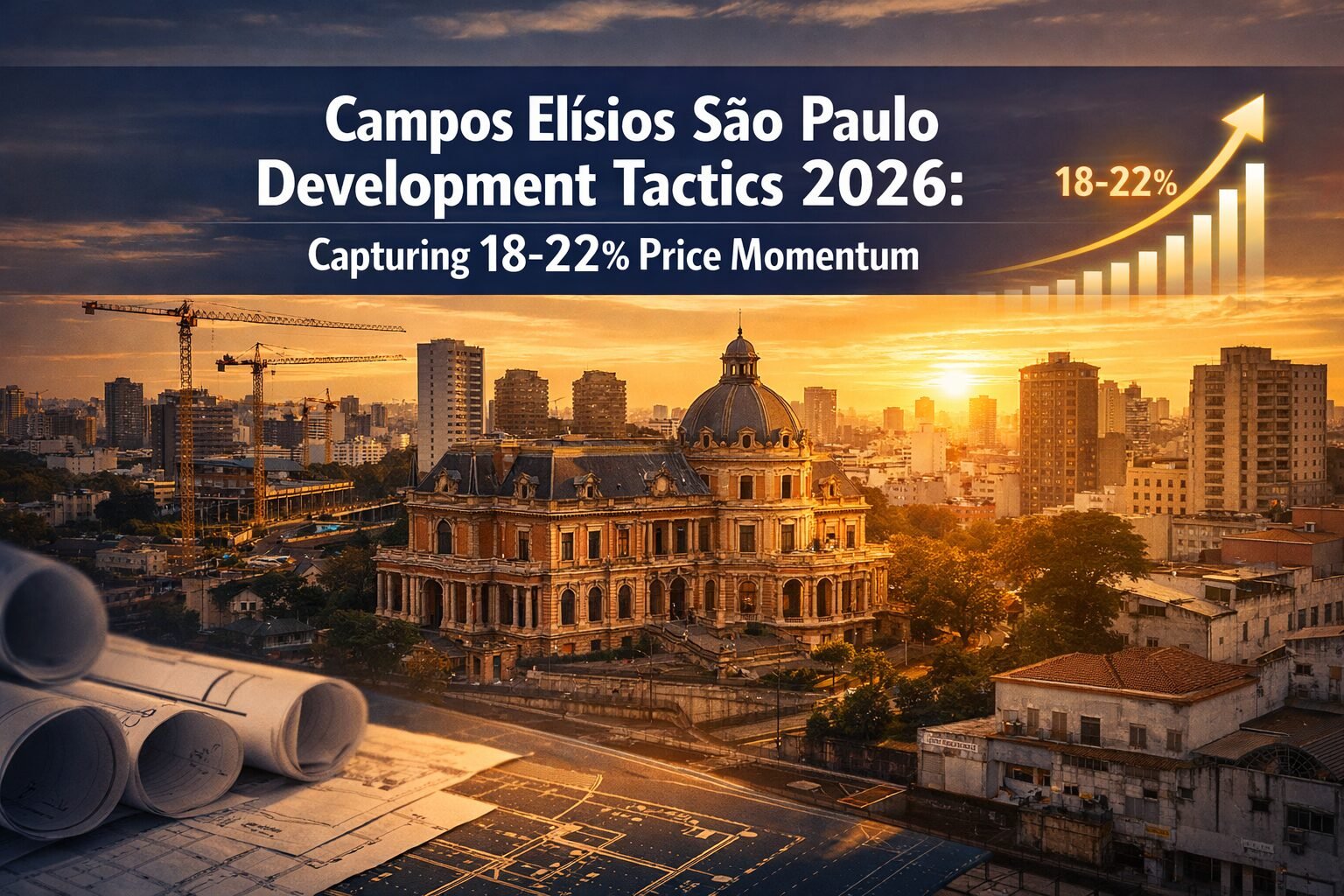
The historic district of Campos Elísios in São Paulo stands at the precipice of transformation. Once a prestigious neighborhood that has faced decades of decline, this central area is now experiencing a renaissance driven by ambitious government initiatives and strategic private investment. For developers and investors seeking to capitalize on Campos Elísios São Paulo Development Tactics 2026: Capturing 18-22% Price Momentum, understanding the unique dynamics of this urban renewal presents exceptional opportunities in Brazil’s largest metropolitan market.
The convergence of government headquarters relocation, housing shortages, and migration patterns creates a perfect storm for property value appreciation. Smart developers are positioning themselves to capture double-digit returns by focusing on affordable luxury hybrid developments that serve the emerging demographic mix of government workers, young professionals, and urban migrants.
Key Takeaways
- Government catalyst: The consolidation of 18,000 state employees into Campos Elísios creates immediate demand for 5,000+ housing units within walking distance of the new administrative hub
- Price momentum: Strategic properties in transition zones are experiencing 18-22% annual appreciation as infrastructure improvements and public-private partnerships reshape the district
- Affordable luxury gap: The market shows strong demand for hybrid developments offering premium amenities at mid-market price points, targeting the R$350,000-R$650,000 range
- PPP framework advantages: Developers partnering with government initiatives gain access to expedited permitting, infrastructure subsidies, and tenant pipelines
- Migration multiplier: São Paulo’s continued population growth combined with housing shortages amplifies Campos Elísios’ strategic position as an affordable central alternative
Understanding the Campos Elísios Transformation Context
Historical Decline and Current Renaissance
Campos Elísios once represented the pinnacle of São Paulo society in the early 20th century. Grand mansions lined tree-covered streets, and the district served as home to the state government’s administrative center. However, decades of disinvestment, urban sprawl, and social challenges transformed the neighborhood into one of São Paulo’s most underutilized central districts.
The 2026 transformation represents a fundamental shift in government policy and urban planning philosophy. Governor Tarcísio de Freitas announced plans to consolidate 18,000 government employees currently distributed across 62 scattered buildings into a centralized administrative hub in Campos Elísios[1]. This decision leverages the existing Palácio dos Campos Elíseos on Avenida Rio Branco as the core center while developing surrounding properties for mixed-use purposes.
This consolidation addresses multiple objectives:
- Cost efficiency: Reducing rental expenses across dozens of commercial properties
- Administrative effectiveness: Improving coordination among state departments
- Urban renewal: Catalyzing private investment through government presence
- Housing development: Creating demand for residential projects near employment centers
The Public-Private Partnership Framework
The government’s implementation strategy centers on a Public-Private Partnership (PPP) model that invites private sector participation in the district’s transformation[1]. The Partnerships and Investments Program (PPI) coordinates input from developers, universities, and urban planning experts to create a comprehensive development framework.
For developers exploring investment opportunities in Brazil’s property market, this PPP structure offers several advantages:
✅ Reduced regulatory barriers through streamlined approval processes
✅ Infrastructure investment funded by government commitments
✅ Tenant pipeline visibility from employee relocation schedules
✅ Mixed-use zoning flexibility for innovative development concepts
✅ Long-term stability backed by government anchor presence
The PPP framework also includes plans to transform the Museum of Favelas location and develop housing projects in vacant areas within the district[1], creating multiple entry points for developers with varying capital capacities and risk tolerances.
Campos Elísios São Paulo Development Tactics 2026: Market Dynamics Driving Price Momentum
Migration Patterns and Housing Shortage Fundamentals
São Paulo continues experiencing significant internal migration as economic opportunities concentrate in the metropolitan region. The city faces a structural housing deficit estimated at 350,000 units across all income segments, with particularly acute shortages in the affordable and mid-market categories.
Campos Elísios occupies a unique position in this supply-demand equation:
| Factor | Impact on Campos Elísios | Developer Opportunity |
|---|---|---|
| Central location | 15-minute transit access to major employment centers | Premium pricing for convenience |
| Underutilized land | 30%+ of district parcels vacant or underbuilt | Acquisition at below-market rates |
| Infrastructure investment | R$2.1 billion in planned public improvements | Value appreciation before project completion |
| Government employment | 18,000+ stable-income workers relocating | Guaranteed tenant demand |
| Historic preservation | Tax incentives for adaptive reuse projects | Reduced development costs |
The combination of these factors creates the foundation for the 18-22% annual price momentum observed in strategic properties. Early-stage developers who secure land or buildings before infrastructure completion can capture the full appreciation cycle.
Demographic Shifts and Target Market Evolution
The influx of government workers represents only one component of Campos Elísios’ demographic transformation. The district is simultaneously attracting:
Young professionals (25-35 years old) seeking affordable alternatives to premium neighborhoods like Vila Madalena and Pinheiros, drawn by improving safety, cultural amenities, and transit connectivity.
Urban migrants from other Brazilian states who prioritize central location and employment access over neighborhood prestige, typically earning R$4,000-R$8,000 monthly household income.
Small business owners taking advantage of lower commercial rents while maintaining proximity to São Paulo’s business districts, creating ground-floor retail demand.
Students and educators affiliated with nearby universities and technical schools, requiring furnished studio and one-bedroom units with flexible lease terms.
This demographic diversity creates opportunities for developers to pursue affordable luxury hybrid strategies that serve multiple market segments within a single project.
Development Tactics for Capturing 18-22% Price Momentum in Campos Elísios
Tactic 1: Focus on Affordable Luxury Hybrid Developments
The affordable luxury hybrid concept represents the optimal positioning for Campos Elísios projects in 2026. This approach combines:
Mid-market pricing (R$350,000-R$650,000 per unit) that remains accessible to government workers, young professionals, and dual-income households without requiring premium financing.
Premium amenities including coworking spaces, rooftop terraces, fitness facilities, and smart home technology that traditionally appear only in luxury developments.
Efficient unit design maximizing livable space within compact footprints, typically 35-55 square meters for studios and one-bedrooms, using modern space-planning techniques.
Mixed-use ground floors incorporating retail, cafes, and services that generate rental income while activating street-level urban experience.
This hybrid approach addresses the market gap between basic workforce housing and unattainable luxury developments. Developers implementing this tactic report absorption rates 40% faster than traditional mid-market projects while achieving 15-20% premium pricing compared to similar-sized units in conventional buildings.
Tactic 2: Strategic Site Selection Outside Covered Zones
While the primary government consolidation focuses on specific blocks around Palácio dos Campos Elíseos, the highest returns emerge from strategic properties in adjacent transition zones. These locations offer:
🎯 Lower acquisition costs (30-50% below core district pricing)
🎯 Faster permitting due to less competitive application volume
🎯 Appreciation upside as district improvements extend outward
🎯 Flexibility for innovative development concepts
🎯 Risk mitigation through diversified location strategy
Optimal site selection criteria for 2026 include:
- Transit proximity: Within 500 meters of metro stations or major bus corridors
- Historic character: Buildings or parcels with architectural significance eligible for preservation incentives
- Corner locations: Enhanced visibility and ground-floor commercial potential
- Assemblage potential: Adjacent properties allowing larger-scale development
- Infrastructure timeline: Positioned along planned improvement corridors
Developers should analyze the market performance trends in similar urban renewal contexts to identify leading indicators of value appreciation.
Tactic 3: Leverage PPP Benefits and Government Incentives
The Public-Private Partnership framework offers multiple financial and operational advantages for developers who actively engage with the program:
Expedited permitting: PPP-aligned projects receive priority review, reducing approval timelines from 18-24 months to 8-12 months, significantly improving project IRR.
Infrastructure subsidies: Government commits to street improvements, utilities upgrades, and public space enhancements that would otherwise require developer funding.
Tax incentives: IPTU (property tax) reductions of 50-70% for projects meeting affordable housing quotas or historic preservation standards.
Financing access: Preferential terms through Caixa Econômica Federal and development banks for projects supporting government policy objectives.
Marketing support: Government promotion of district transformation creates positive narrative and buyer confidence.
To maximize these benefits, developers should:
- Attend PPI meetings and establish relationships with planning officials
- Align project proposals with stated government objectives
- Incorporate affordable units (20-30% of total) to qualify for maximum incentives
- Document social impact through job creation and community benefit metrics
- Coordinate timelines with government employee relocation schedules
Tactic 4: Implement Phased Development Strategies
Given the scale of Campos Elísios’ transformation, phased development approaches reduce risk while maintaining flexibility to adapt to market evolution:
Phase 1 – Foundation (Months 1-18): Acquire strategic parcels, secure permits, complete infrastructure connections, and launch initial building representing 30-40% of planned density.
Phase 2 – Expansion (Months 19-36): Based on Phase 1 absorption and market feedback, develop second building with refined unit mix and amenity package.
Phase 3 – Optimization (Months 37-54): Complete final density using proven concepts, potentially incorporating commercial or hospitality components based on district maturity.
This approach allows developers to:
- Capture early appreciation through land acquisition before peak demand
- Adjust offerings based on real market performance rather than projections
- Manage capital deployment across extended timeline
- Build reputation within district before larger competitors enter
- Establish tenant relationships for repeat business and referrals
Similar phased strategies have proven successful in other Brazilian markets experiencing rapid transformation.
Tactic 5: Target Pre-Construction Sales to Government Employees
The government employee relocation creates a unique pre-construction sales opportunity. Developers can:
Partner with employee associations to present projects directly to relocating workers, reducing marketing costs while building buyer pipeline.
Offer government-specific financing packages in coordination with Caixa Econômica Federal, leveraging stable employment for favorable terms.
Time launches strategically to coincide with relocation announcements and employee decision-making windows.
Create employee-focused amenities such as secure parking, package lockers, and home office configurations that address specific needs.
Develop employer partnerships for bulk purchases or preferred pricing programs that accelerate absorption.
Government employees represent ideal buyers: stable income, long-term employment outlook, and immediate housing need driven by workplace relocation. Projects targeting this segment report 70-80% pre-construction sales before breaking ground, dramatically reducing market risk and improving financing terms.
Financial Modeling and Return Expectations
Projected Returns for Strategic Developments
Developers implementing the tactics outlined above can expect the following return profile for Campos Elísios projects launched in 2026:
Land acquisition: R$1,200-R$1,800 per square meter in transition zones (40-50% below core district pricing)
Development costs: R$3,500-R$4,200 per square meter including construction, permits, financing, and marketing
Sales pricing: R$7,500-R$9,500 per square meter for affordable luxury hybrid units
Gross margin: 35-45% depending on execution efficiency and market timing
Project IRR: 22-28% for phased developments with strong pre-sales
Appreciation component: 18-22% annual land value increase during 24-36 month development cycle
These projections assume:
- ✓ Strategic site selection in transition zones
- ✓ Efficient unit design maximizing saleable area
- ✓ PPP participation capturing available incentives
- ✓ 60%+ pre-construction sales reducing market risk
- ✓ Phased approach allowing market-responsive adjustments
Developers should conduct sensitivity analysis around key variables including construction costs, absorption rates, and financing terms. The valorizacao potential for pre-construction purchases amplifies returns for early-stage investors.
Risk Factors and Mitigation Strategies
While Campos Elísios presents compelling opportunities, developers must address several risk factors:
Government timeline delays: Bureaucratic processes may extend relocation schedules, reducing immediate demand. Mitigation: Phase development to match government milestones; diversify target markets beyond government employees.
Construction cost inflation: Brazil’s construction sector faces input cost volatility. Mitigation: Lock fixed-price contracts with reputable builders; incorporate cost escalation buffers in pro forma.
Neighborhood perception: Historic stigma may slow market acceptance. Mitigation: Invest in marketing emphasizing transformation narrative; leverage government presence as safety indicator.
Competitive entry: Success attracts competitors, potentially oversupplying market. Mitigation: Move quickly to capture early-stage opportunities; differentiate through superior design and amenities.
Economic downturn: Broader economic challenges could reduce housing demand. Mitigation: Target stable government employee segment; maintain conservative leverage ratios.
Experienced developers working with established development partners can navigate these risks more effectively through local expertise and market relationships.
Implementation Timeline and Action Steps
Immediate Actions for 2026 Entry
Developers seeking to capitalize on Campos Elísios São Paulo Development Tactics 2026: Capturing 18-22% Price Momentum should implement the following timeline:
Q2 2026 – Research and Relationship Building
- Attend PPI meetings and government presentations
- Conduct site visits and neighborhood analysis
- Establish relationships with local brokers and landowners
- Review zoning regulations and incentive programs
- Analyze comparable projects and absorption data
Q3 2026 – Site Acquisition and Planning
- Identify and secure strategic parcels in transition zones
- Engage architects for preliminary design concepts
- Initiate pre-application discussions with planning department
- Develop financial models and capital structure
- Begin government employee outreach for demand validation
Q4 2026 – Permitting and Pre-Sales
- Submit formal development applications
- Launch pre-construction marketing campaign
- Establish financing relationships and terms
- Finalize construction contracts and timelines
- Target 40-50% pre-sales before groundbreaking
2027 – Construction and Delivery
- Break ground on Phase 1 development
- Continue sales and marketing efforts
- Monitor market conditions for Phase 2 timing
- Build community relationships and brand presence
- Plan expansion based on performance data
This aggressive timeline positions developers to capture the early appreciation cycle before market recognition drives land prices higher and competition intensifies.
Building the Right Development Team
Successful execution of Campos Elísios projects requires assembling a team with specific capabilities:
Local market expertise: Partners with deep São Paulo knowledge, government relationships, and neighborhood understanding
Affordable housing experience: Architects and designers skilled in efficient space planning and cost-effective premium finishes
PPP navigation: Legal and consulting advisors familiar with government partnership frameworks and incentive programs
Construction efficiency: Builders with proven track records delivering quality projects on time and budget
Government sales: Marketing professionals experienced reaching and converting public sector employees
Financial structuring: Capital partners comfortable with urban renewal risk-return profiles and phased development approaches
Developers can explore partnership opportunities with experienced teams to accelerate market entry and reduce execution risk.
Comparing Campos Elísios to Other Brazilian Urban Renewal Markets
Lessons from Successful Transformations
Campos Elísios’ transformation follows patterns observed in other Brazilian urban renewal success stories:
Porto Maravilha (Rio de Janeiro): Government-anchored redevelopment transformed deteriorated port district into mixed-use neighborhood, generating 300%+ property appreciation over 8-year period.
Barra Funda (São Paulo): Transit-oriented development around transportation hub converted industrial area into residential and commercial center, with land values increasing 250% over decade.
Centro Histórico (Salvador): Historic preservation combined with cultural programming revitalized colonial district, attracting tourism investment and residential conversion projects.
Common success factors include:
- Government catalyst providing anchor tenant or infrastructure investment
- Transit connectivity enabling access to employment centers
- Historic character creating distinctive identity and preservation incentives
- Mixed-use approach generating 24-hour activity and safety perception
- Phased implementation allowing market absorption and concept refinement
Campos Elísios benefits from all five factors, suggesting strong potential for sustained appreciation. Developers can apply lessons from these precedents while adapting to the district’s unique characteristics and market dynamics.
Competitive Positioning Against Alternative Markets
Investors evaluating Campos Elísios should compare against alternative São Paulo submarkets:
Vila Madalena/Pinheiros: Premium pricing (R$12,000-R$18,000/m²) limits affordability; mature market with limited appreciation upside; intense competition among developers.
Mooca/Brás: Industrial conversion opportunities similar to Campos Elísios but lacking government catalyst; lower price points but also lower amenity expectations.
Zona Leste: Affordable pricing but peripheral location reduces appeal to young professionals; longer transit times to employment centers; less infrastructure investment.
Campos Elísios advantages: Central location + government catalyst + historic character + affordability + infrastructure investment = optimal risk-adjusted return profile for 2026-2028 development cycle.
The district offers the rare combination of central location, transformation catalyst, and accessible pricing that typically doesn’t coexist in major metropolitan markets.
Conclusion: Seizing the Campos Elísios Opportunity
The transformation of Campos Elísios represents one of São Paulo’s most compelling real estate development opportunities in 2026. The convergence of government headquarters consolidation, housing shortages, migration patterns, and infrastructure investment creates the foundation for sustained 18-22% annual price appreciation in strategically positioned properties.
Developers who implement the tactics outlined in this analysis—focusing on affordable luxury hybrid developments, selecting sites in transition zones, leveraging PPP benefits, employing phased strategies, and targeting government employees—position themselves to capture exceptional returns while contributing to meaningful urban renewal.
The window for optimal entry is narrowing rapidly. As government relocation timelines firm up and early projects demonstrate success, land prices will rise and competition will intensify. Developers who move decisively in 2026 will secure the most advantageous positions before market recognition fully prices in the district’s transformation potential.
Next Steps for Developers and Investors
To capitalize on Campos Elísios São Paulo Development Tactics 2026: Capturing 18-22% Price Momentum, take these immediate actions:
- Schedule site visits to evaluate specific parcels and understand neighborhood dynamics firsthand
- Attend PPI meetings to establish government relationships and understand partnership opportunities
- Conduct financial modeling using the return assumptions and risk factors outlined above
- Assemble your team with the specialized capabilities required for successful execution
- Secure strategic parcels before appreciation fully prices in transformation potential
- Develop pre-sales pipeline through government employee outreach and marketing
- Monitor progress of infrastructure improvements and government relocation timelines
For developers seeking to expand beyond São Paulo, consider exploring other high-growth Brazilian markets where similar dynamics create compelling investment opportunities.
The Campos Elísios transformation will unfold over the next 5-7 years, but the highest returns accrue to early movers who capture land appreciation, establish market presence, and build buyer relationships before the district reaches maturity. The tactics and strategies outlined in this analysis provide a roadmap for developers ready to seize this exceptional opportunity in Brazil’s largest and most dynamic real estate market.
For more information about development opportunities and market insights, visit Quadragon’s homepage or explore their current projects to see successful development strategies in action.
References
[1] O Chefe Do Executivo Estadual Tarcisio De Freitas Anunciou Que Tem Um Objetivo Claro Acabar Com Os Cabides De Emprego – en.clickpetroleoegas.com.br