
One-bedroom apartments in Brazil have surged 9.44% in value over the past 12 months, nearly doubling the national inflation rate and outperforming every other property category in the country. This remarkable appreciation comes despite Brazil’s central bank maintaining the Selic rate near historic highs, creating an unexpected opportunity for developers who understand how to capitalize on affordability-driven demand. The Small Apartment Boom 2026: 9% Appreciation Tactics for Studios in High Selic Environments represents a fundamental shift in how Brazilian real estate developers must approach project planning, financing, and market positioning.
This phenomenon isn’t just about smaller units performing well—it’s about a complete market recalibration where affordability constraints are driving unprecedented demand for compact living solutions. As mortgage rates hover around 9.8% per annum and the broader economic environment remains challenging, singles and young professionals are increasingly viewing studios and one-bedroom units as their only viable entry point into property ownership.[5]
Key Takeaways
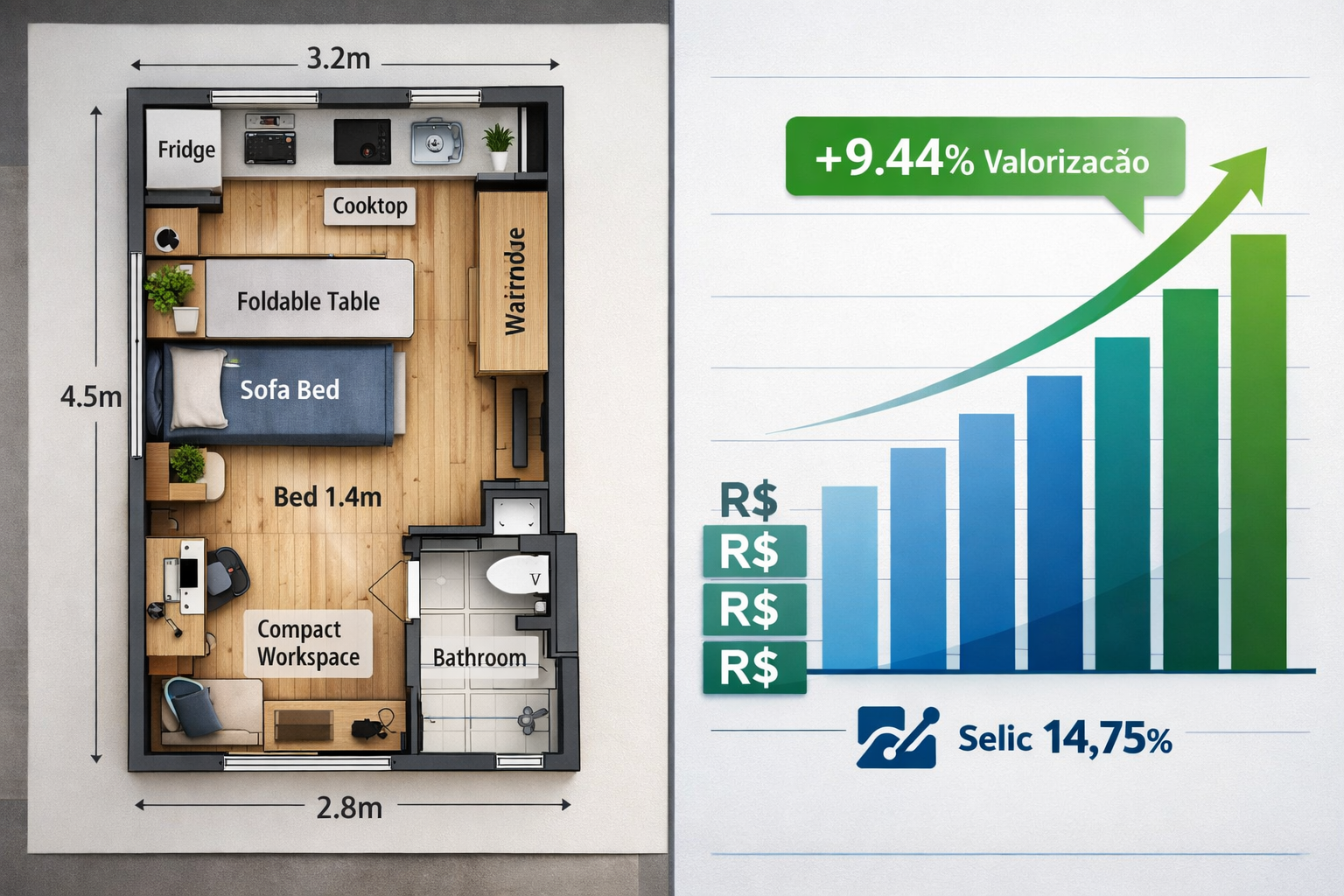
- One-bedroom apartments appreciated 9.44% annually, significantly outpacing two-bedroom (7.79%), three-bedroom (8.25%), and four-bedroom (6.15%) units across Brazil[1]
- High Selic environments create opportunity: Despite 14.75% rates in some markets, strategic developers are launching affordable studios that capture demand from priced-out buyers[4]
- Regional variations matter: Cities like Recife offer 9%+ gross rental yields on small units, while premium markets like Florianópolis command R$11,971 per square meter[1][7]
- Mortgage origination increased 14% year-over-year despite tight credit, indicating sustained middle-income market participation[5]
- Government programs like Minha Casa, Minha Vida 3.0 continue supporting affordable housing segments, creating strategic partnership opportunities for developers[4]
Understanding the Small Apartment Boom 2026: Market Fundamentals
The current real estate landscape in Brazil reveals a clear pattern: smaller properties consistently outperform larger ones in both appreciation and rental yield metrics. This trend accelerated throughout 2025 and into 2026, driven by multiple converging factors that developers must understand to position projects effectively.
The Affordability Crisis Driving Compact Living
Brazil’s residential property prices climbed 8.17% compared to February 2024, with the national average price per square meter reaching R$9,310 ($1,552) as of February 2026.[1] This broad appreciation has created a significant affordability gap for first-time buyers, particularly in major metropolitan areas where prices have risen even faster.
São Paulo recorded an average price increase of approximately 8.5% year-over-year as of Q1 2026, with prices reaching R$10,200 per square meter. Neighborhoods like Vila Madalena, Pinheiros, and Moema experienced particularly strong appreciation driven by infrastructural improvements.[5] For young professionals earning median salaries, purchasing a traditional two or three-bedroom apartment in these areas has become financially unfeasible.
This affordability constraint has fundamentally reshaped buyer behavior. Rather than waiting indefinitely to afford larger properties, singles and young professionals are actively seeking smaller units that provide immediate ownership benefits—equity building, rental income potential, and protection against inflation—even if it means compromising on space.
Regional Performance Variations
The Small Apartment Boom 2026: 9% Appreciation Tactics for Studios in High Selic Environments must account for significant regional variations across Brazil’s diverse real estate markets. Understanding these differences is crucial for developers selecting locations and pricing strategies.
Regional variations show Campo Grande led capital city growth in February with 2.26% monthly appreciation, followed by João Pessoa (2.17%), Salvador (2.10%), Vitória (2.07%), and Belém (1.64%), demonstrating distributed demand across Brazil.[1] These secondary markets are experiencing rapid growth as buyers seek more affordable alternatives to São Paulo and Rio de Janeiro.
Meanwhile, Balneário Camboriú remains Brazil’s most expensive real estate market at R$14,206 per square meter, followed by Itapema (R$12,735), Itajaí (R$12,192), Florianópolis (R$11,971), and São Paulo (R$11,472).[1] These premium coastal markets continue attracting investment despite higher entry prices, particularly for compact units that offer lower absolute purchase prices even with elevated per-square-meter costs.
For developers evaluating where to launch studio and one-bedroom projects, these regional dynamics create distinct opportunities. Markets like Florianópolis offer established infrastructure and strong appreciation potential, while emerging cities provide higher rental yields with lower development costs.
Developer Strategies for the Small Apartment Boom 2026: Launching Studios Amid High Rates
Successfully launching affordable studio and one-bedroom projects in a high Selic environment requires developers to rethink traditional approaches to financing, design, and market positioning. The tactics that worked during low-rate periods must be adapted to current realities.

Optimizing Unit Mix and Floor Plans
The first strategic decision developers face is determining the optimal unit mix for new projects. Data from 2026 clearly indicates that smaller units command premium pricing per square meter while offering better absorption rates and rental yields.
Studios and small one-bedroom apartments show the best gross rental yields in Salvador, thanks to lower entry prices and higher rents per square meter. Premium neighborhoods like Vitória, Graça, and Barra command rents exceeding R$5,000 monthly for two-room apartments.[6] This rental premium relative to purchase price creates compelling investment cases for buyers, accelerating sales velocity.
Developers implementing Small Apartment Boom 2026: 9% Appreciation Tactics for Studios in High Selic Environments should consider these unit mix strategies:
- Maximize studio and one-bedroom allocation: Dedicate 60-70% of total units to compact configurations rather than traditional 40-50% ratios
- Create flexible layouts: Design spaces that can function as work-from-home environments with designated office areas
- Optimize square footage: Target 25-35 square meters for studios and 35-45 square meters for one-bedrooms to balance affordability with livability
- Include smart storage solutions: Built-in furniture, vertical storage, and multi-functional spaces maximize perceived value
These design considerations directly impact both initial sales velocity and long-term appreciation potential. Investing in studios in markets like Florianópolis demonstrates how thoughtful unit design can capture strong demand from both end-users and investors.
Financing Structures That Work in High-Rate Environments
Traditional development financing becomes more challenging when the Selic rate remains elevated. High mortgage rates of 14.75% in Brasília are tempering demand, yet government programs like “Minha Casa, Minha Vida 3.0” continue supporting the market for affordable housing segments.[4]
Developers must structure projects to minimize interest rate exposure while maintaining attractive pricing for buyers. Effective strategies include:
Pre-construction sales acceleration: Launching sales earlier in the development cycle reduces the period of debt service before revenue generation. Offering attractive pre-launch discounts of 10-15% can accelerate cash flow and reduce financing needs.
Partnership with government programs: Aligning projects with Minha Casa, Minha Vida 3.0 eligibility criteria opens access to subsidized financing for qualified buyers, expanding the addressable market significantly.
Flexible payment plans: Structuring longer payment schedules during construction (36-48 months) with lower monthly installments makes units accessible to buyers who might struggle with traditional 24-month construction payment terms.
Alternative financing sources: Exploring real estate investment funds, international capital, and cryptocurrency-based investment structures can diversify funding sources and reduce dependence on traditional bank financing at elevated rates.
Location Selection and Neighborhood Targeting
Geographic positioning remains critical for maximizing the Small Apartment Boom 2026: 9% Appreciation Tactics for Studios in High Selic Environments. Not all locations offer equal opportunity for compact unit development.
Districts like Águas Claras and Guará in Brasília are seeing the strongest growth at 8-12% annually, while luxury segments in Lago Sul remain resilient, indicating bifurcated market dynamics across property segments.[4] This pattern repeats across Brazilian cities—emerging neighborhoods with improving infrastructure consistently outperform established luxury areas for smaller unit appreciation.
Developers should prioritize locations with these characteristics:
✅ Proximity to employment centers: Studios and one-bedrooms primarily serve working professionals who value short commutes
✅ Public transportation access: Metro stations, bus rapid transit, and major transit corridors increase property values and rental demand
✅ Emerging infrastructure improvements: Neighborhoods undergoing infrastructure upgrades experience accelerated appreciation as accessibility improves
✅ Mixed-use environments: Areas with retail, dining, and entertainment within walking distance command rental premiums
✅ University and hospital proximity: Institutional anchors create consistent rental demand from students, medical residents, and staff
The growth of regions like Ingleses in Florianópolis exemplifies how infrastructure development and quality of life improvements drive appreciation in emerging neighborhoods, creating ideal conditions for compact unit development.
Capitalizing on 9% Annual Appreciation: Tactical Implementation
Understanding market fundamentals and strategic positioning is essential, but successful implementation of Small Apartment Boom 2026: 9% Appreciation Tactics for Studios in High Selic Environments requires specific tactical execution across pricing, marketing, and operational dimensions.
Pricing Strategies for Maximum Absorption
Pricing compact units in a high-rate environment demands precision. Price too high, and affordability-constrained buyers cannot qualify for financing. Price too low, and developers leave significant value on the table while potentially signaling quality concerns.
Average home loan interest rates fell to approximately 9.8% per annum following reductions in the Selic rate, improving accessibility compared to earlier 2025 levels, though rates remain high by international standards.[5] This rate environment creates a specific affordability ceiling that developers must respect.
Effective pricing tactics include:
Absolute price positioning: Focus on total purchase price rather than per-square-meter pricing. A R$250,000 studio priced at R$8,333/m² may sell faster than a R$400,000 one-bedroom at R$8,000/m² because the absolute price fits buyer budgets better.
Payment plan engineering: Structure construction-period payment plans to match typical buyer cash flow. Monthly installments of R$2,000-3,000 during construction align with young professional budgets while building equity before mortgage payments begin.
Psychological pricing thresholds: Position units just below major psychological barriers (R$249,000 instead of R$255,000) to maximize perceived affordability and search visibility on property portals.
Early-bird incentives: Offer time-limited discounts for pre-launch buyers to accelerate sales velocity and generate momentum. Discounts of 8-12% for the first 20-30% of units sold create urgency while maintaining healthy margins.
Marketing to Affordability-Driven Buyers
The target demographic for compact units in 2026 differs significantly from traditional luxury apartment buyers. Mortgage origination volumes increased by 14% compared to 2025 despite tight credit standards, indicating cautious but growing market participation in the middle-income segment.[5]
These buyers prioritize different features and respond to distinct messaging:
📱 Digital-first marketing: Young professionals research properties primarily through online channels. Invest heavily in virtual tours, 3D floor plans, and social media advertising rather than traditional print media.
💰 Investment narrative: Position studios not just as homes but as wealth-building tools. Highlight appreciation potential, rental yield projections, and pre-construction value appreciation opportunities.
🏗️ Construction transparency: Provide regular updates on construction progress and project milestones to build confidence in delivery timelines, particularly important for first-time buyers unfamiliar with development processes.
🌟 Lifestyle positioning: Emphasize the lifestyle benefits of compact living—lower maintenance, urban convenience, sustainability—rather than focusing on space limitations.
Rental Yield Optimization for Investor Buyers
While many studio buyers are end-users, a significant portion represents investors seeking rental income. Recife offers the country’s best rental yields in the apartment segment, exceeding 9% on average, with well-located small units surpassing 10% gross yields—significantly higher than the national average of 5-6%.[7]
Developers can enhance investment appeal through:
Furnished unit options: Offering turnkey furnished packages increases rental rates by 20-30% while simplifying the landlord experience for first-time investors.
Property management partnerships: Establishing relationships with professional property management companies and marketing these partnerships to buyers reduces investor concerns about rental management.
Short-term rental readiness: Designing units with features that work for Airbnb and short-term rentals (separate sleeping areas, quality finishes, good WiFi infrastructure) expands revenue options for investor-owners.
Rental guarantee programs: For select projects, offering 12-24 month rental guarantees provides investor confidence during the initial lease-up period, accelerating sales to investment buyers.
Regional Opportunities: Where to Deploy Studio Development Strategies
The Small Apartment Boom 2026: 9% Appreciation Tactics for Studios in High Selic Environments must be adapted to specific regional market conditions. Brazil’s diverse real estate markets offer distinct opportunities for compact unit development.
High-Yield Secondary Markets
Recife’s exceptional rental yields exceeding 9% make it particularly attractive for investor-focused studio development.[7] The city combines lower development costs with strong rental demand from students, medical professionals, and business travelers. Developers can achieve attractive returns while maintaining affordable purchase prices that qualify for government financing programs.
Salvador’s premium neighborhoods commanding rents exceeding R$5,000 monthly for two-room apartments demonstrate strong rental demand in coastal secondary markets.[6] The city’s tourism economy creates additional short-term rental opportunities that enhance investment appeal.
These secondary markets offer developers several advantages:
- Lower land acquisition costs (30-50% below São Paulo/Rio)
- Faster permitting and approval processes
- Less competitive development environment
- Strong local demand from growing middle class
- Government incentive programs for regional development
Premium Coastal Markets
Florianópolis at R$11,971 per square meter represents a premium coastal market where compact units still offer accessible entry points.[1] A 35-square-meter studio priced around R$420,000 provides ownership access in one of Brazil’s most desirable cities, creating strong demand from both end-users and investors.
The real estate market performance in Florianópolis demonstrates sustained appreciation potential even during challenging economic periods. Coastal premium markets benefit from:
- Limited developable land constraining supply
- Strong domestic and international demand
- Tourism-driven short-term rental opportunities
- Quality of life factors attracting remote workers
- Climate advantages supporting year-round occupancy
Emerging Metropolitan Submarkets
Campo Grande’s 2.26% monthly appreciation in February 2026 exemplifies the rapid growth occurring in emerging metropolitan submarkets.[1] These areas offer the highest risk-adjusted returns for compact unit development, combining strong appreciation with lower development costs.
Developers should evaluate emerging submarkets based on:
🚇 Infrastructure investment pipelines: Planned metro extensions, highway improvements, and public facility construction
🏢 Employment growth: New corporate offices, industrial parks, and commercial developments creating local job markets
🎓 Educational institutions: University expansions and new campus developments driving student housing demand
🏥 Healthcare facilities: Hospital construction and medical district development attracting healthcare workers
Navigating Construction and Delivery in 2026
Successfully executing Small Apartment Boom 2026: 9% Appreciation Tactics for Studios in High Selic Environments requires attention to construction efficiency and delivery timelines. In a high-rate environment, every month of delay increases financing costs and reduces project returns.
Accelerated Construction Methodologies
Modern construction techniques can significantly reduce delivery timelines for compact unit projects:
Modular construction: Pre-fabricated bathroom and kitchen modules reduce on-site construction time by 30-40% while improving quality control.
Standardized floor plans: Limiting variation across units simplifies construction sequencing and reduces material waste.
Advanced planning: Detailed pre-construction planning and material procurement reduce delays and cost overruns that plague traditional construction approaches.
Projects demonstrating accelerated construction progress build buyer confidence and reduce financing costs, improving overall project economics.
Quality vs. Cost Optimization
Compact units must balance affordability with quality expectations. Buyers accept smaller spaces but still expect modern finishes and functional design. Strategic cost optimization focuses on:
High-impact visible elements: Invest in quality flooring, kitchen countertops, and bathroom fixtures that buyers see and touch daily.
Cost-effective structural elements: Use standard construction materials and techniques for structural components where buyers don’t perceive differences.
Energy efficiency: Install efficient HVAC, lighting, and appliances that reduce operating costs—a key selling point for budget-conscious buyers.
Smart technology integration: Include basic smart home features (digital locks, app-based building access) that appeal to tech-savvy young buyers at minimal cost.
Future Outlook: Sustaining the Studio Boom Beyond 2026
While current market conditions strongly favor compact unit development, developers must consider longer-term sustainability of the Small Apartment Boom 2026: 9% Appreciation Tactics for Studios in High Selic Environments.
Interest Rate Trajectory Impact
The Selic rate’s future path will significantly influence compact unit demand. If rates decline substantially, buyer purchasing power improves, potentially shifting demand toward larger units. However, several factors suggest sustained compact unit demand:
- Demographic shifts: Growing single-person households and delayed family formation support long-term studio demand
- Urbanization trends: Continued migration to urban centers where land constraints favor compact development
- Lifestyle preferences: Younger generations increasingly value location and experiences over space
- Investment demand: Compact units’ superior rental yields maintain investor appeal across rate environments
Supply Response and Market Saturation
As developers recognize compact unit opportunities, supply will increase. Markets risk oversupply if too many projects launch simultaneously. Developers should monitor:
- Pipeline analysis: Track competing projects in target submarkets to avoid oversaturated locations
- Absorption rates: Monitor sales velocity trends indicating demand softening
- Rental vacancy rates: Rising vacancies signal potential oversupply before sales metrics reflect problems
Strategic developers will continue finding opportunities by targeting underserved submarkets, maintaining quality standards, and adapting to evolving buyer preferences. The broader market trends in Florianópolis and other key markets provide ongoing insights for positioning future projects.
Conclusion
The Small Apartment Boom 2026: 9% Appreciation Tactics for Studios in High Selic Environments represents a fundamental market opportunity for developers who understand how to navigate affordability-driven demand in challenging financing conditions. One-bedroom apartments’ 9.44% annual appreciation, significantly outpacing larger properties and inflation, demonstrates the powerful market forces supporting compact unit development.[1]
Successful implementation requires developers to rethink traditional approaches across multiple dimensions:
Strategic positioning: Select emerging neighborhoods with infrastructure improvements and employment growth rather than established luxury areas. Focus on locations offering public transportation access and mixed-use environments that appeal to young professionals.
Financial engineering: Structure projects to minimize high-rate exposure through accelerated pre-sales, government program partnerships, and alternative financing sources. Design payment plans that align with target buyer cash flow patterns.
Product optimization: Maximize studio and one-bedroom allocation to 60-70% of unit mix, optimize layouts for work-from-home functionality, and include smart storage solutions that maximize perceived value in compact spaces.
Marketing precision: Target digital-first channels reaching affordability-driven buyers, emphasize investment narratives highlighting appreciation and rental yield potential, and provide construction transparency that builds first-time buyer confidence.
Regional adaptation: Customize strategies for specific markets—pursue high rental yields in secondary cities like Recife, capture premium coastal demand in Florianópolis, and target rapid appreciation in emerging metropolitan submarkets.
The current environment won’t last forever. Interest rates will eventually decline, supply will increase, and market dynamics will shift. Developers who move decisively now to launch well-positioned compact unit projects can capture exceptional returns during this unique market window.
Next Steps for Developers
For developers ready to implement these strategies:
- Conduct detailed submarket analysis in target cities to identify specific neighborhoods offering optimal conditions for compact unit development
- Engage with government housing program administrators to understand eligibility requirements and structure projects accordingly
- Develop standardized compact unit prototypes that can be efficiently replicated across multiple projects
- Build strategic partnerships with property management companies, furniture suppliers, and technology providers to enhance investor appeal
- Launch pilot projects in selected markets to validate assumptions before scaling deployment
The Small Apartment Boom 2026 offers a clear path to strong returns for developers who execute strategically. The 9% appreciation potential, combined with superior rental yields and sustained demand fundamentals, creates compelling economics even in high Selic environments. The question isn’t whether to pursue compact unit development—it’s how quickly developers can position projects to capture this opportunity before market conditions shift.
Explore current development opportunities to see how leading developers are implementing these strategies in Brazil’s most promising markets.
References
[1] Brazils Small Apartments Lead Real Estate Boom With Price Surge Near 10 – riotimesonline.com
[4] Brasilia Price Forecasts – thelatinvestor.com
[5] Brazil Real Estate Market Trends 2026 – riotimesonline.com
[6] Invest In Real Estate Salvador Complete Guide Market Returns Neighborhoods – jarniascyril.com
[7] Invest In Real Estate Recife Complete Guide Emerging Market – jarniascyril.com