
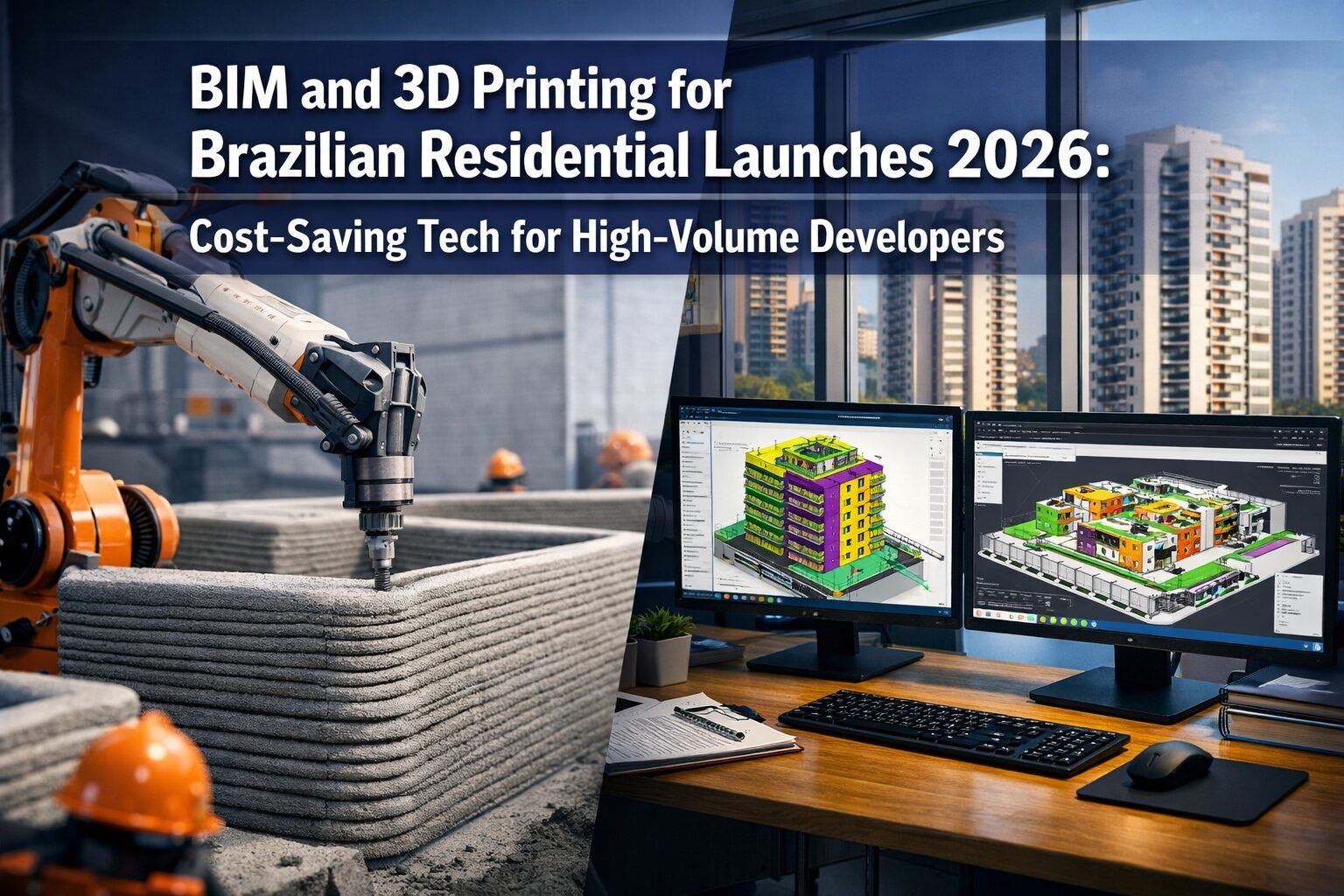
Brazil’s construction sector is poised to grow at a 5.54% compound annual growth rate through 2026, yet many high-volume residential developers still struggle with cost overruns, extended timelines, and cash flow challenges that delay off-plan sales. The convergence of Building Information Modeling (BIM) and 3D concrete printing technology now offers a transformative solution—one that’s already proven in Brazilian markets with real projects delivering 45% cost reductions and construction timelines compressed from months to mere days. For developers launching apartment-heavy projects, BIM and 3D Printing for Brazilian Residential Launches 2026: Cost-Saving Tech for High-Volume Developers represents not just an innovation trend, but a competitive necessity that directly impacts receivables funding and market positioning.
Key Takeaways
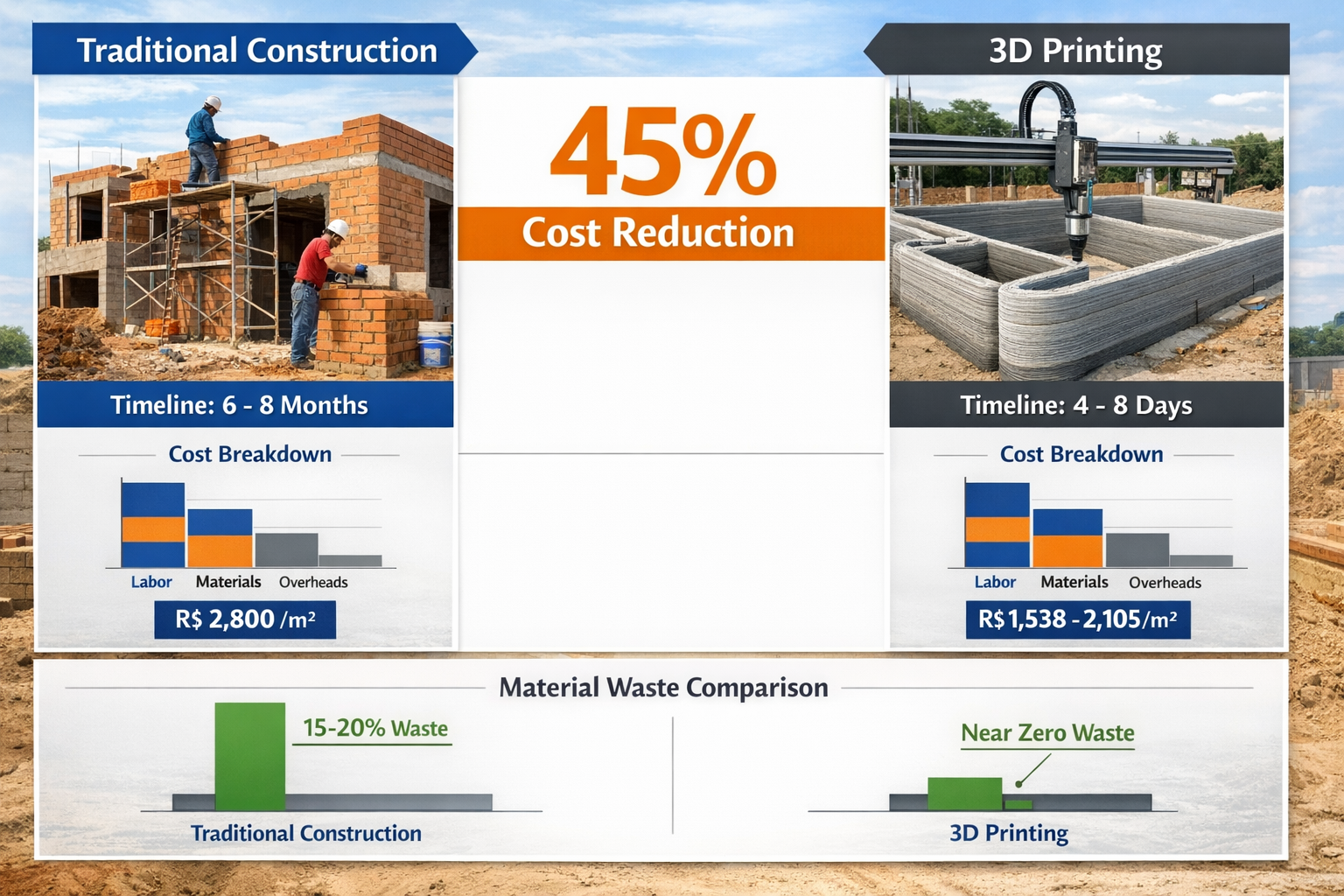
- Dramatic cost reduction: Brazilian 3D-printed residential projects achieve R$1,538-2,105 per m² compared to traditional construction at R$2,800+ per m², representing savings of 25-45%[1]
- Accelerated timelines: Main structural walls can be printed in 4 days with complete assembly in 8 days, versus months for conventional masonry[1]
- Near-zero waste: 3D concrete printing eliminates the 15-20% material waste typical in traditional construction methods[1]
- BIM integration advantage: Combining BIM workflows with 3D printing enables automated scheduling, precise material estimation, and faster off-plan sales through enhanced visualization
- Regulatory evolution: Brazil currently lacks specific ABNT standards for 3D construction printing, creating early-adopter opportunities before market saturation[1]
Understanding BIM and 3D Printing Technology for Residential Development
What Is Building Information Modeling (BIM)?
Building Information Modeling represents a digital-first approach to construction planning that creates intelligent 3D models containing comprehensive data about every building component. Unlike traditional 2D blueprints, BIM systems integrate:
- Parametric geometry that automatically updates throughout the design
- Material specifications with real-time cost calculations
- Construction sequencing and timeline coordination
- Clash detection that identifies conflicts before construction begins
- Facility management data for post-construction operations
For high-volume developers launching multiple residential projects simultaneously, BIM provides centralized control over design standards, cost estimation accuracy, and construction coordination across portfolios.
How 3D Concrete Printing Works
3D concrete printing, also known as Concrete 3D Printing (3DCP), uses robotic systems to deposit specialized micro-concrete mixtures layer by layer, creating structural walls and components without traditional formwork. The process employed by Brazilian pioneers like InovaHouse 3D involves[1]:
- Digital file preparation: BIM models are converted into printer-readable G-code instructions
- Robotic deposition: Large-scale gantry or arm-based printers extrude concrete through precision nozzles
- Layer-by-layer construction: Each layer bonds with the previous one, creating monolithic walls
- Accelerated curing: Specialized concrete formulations achieve structural strength rapidly
- Integration finishing: Traditional elements (windows, doors, roofing) are installed into the printed structure
The technology has matured significantly by 2026, with systems now capable of laying hundreds of blocks per hour or automating 80% of masonry work[3].
Cost-Saving Benefits of BIM and 3D Printing for Brazilian Residential Launches 2026
Quantified Construction Cost Reductions
Real Brazilian projects demonstrate substantial savings that directly impact developer profitability:
| Project | Location | Cost per m² | Timeline | Total Cost |
|---|---|---|---|---|
| InovaHouse 3D Pilot | Nova Lima, MG | R$2,105 | 8 days assembly | R$120,000 (57m²)[1] |
| Bahia Government Initiative | Feira de Santana, BA | R$1,538 (target) | Not disclosed | R$80,000 per unit[1] |
| Traditional Construction | National average | R$2,800-3,200 | 6-8 months | Varies |
The Bahia government’s May 2025 bid for 50 affordable 3D-printed houses targeting R$80,000 per unit represents approximately R$1,538 per m²—a 45% reduction compared to traditional methods[1]. This cost efficiency becomes exponential when applied across high-volume launches of 200-500 residential units.
Material Waste Elimination
Traditional construction generates 15-20% material waste through:
- Excess concrete mixing
- Cut-off materials from standardized dimensions
- Damaged materials during handling
- Over-ordering to prevent shortages
3D printing achieves near-zero material waste[1] by depositing exactly the required amount of concrete where needed. For a 10,000 m² residential development, this translates to:
- Traditional waste: 1,500-2,000 m³ of wasted materials
- 3D printing waste: <100 m³ (primarily from calibration and testing)
- Cost savings: R$150,000-300,000 in material costs alone
Labor Cost Optimization
While 3D printing doesn’t eliminate labor entirely, it dramatically reduces on-site workforce requirements:
- Traditional crew: 15-25 workers for masonry and structural work
- 3D printing crew: 3-5 operators and technicians
- Labor cost reduction: 60-70% for structural phases
This reduction is particularly valuable in Brazil’s tight labor market where skilled masons command premium wages and project delays from labor shortages are common.
Accelerated Timeline Benefits for Off-Plan Sales
The 4-day printing timeline for main structures demonstrated in the Nova Lima project[1] creates cascading financial advantages:
✅ Faster model unit completion: Show apartments ready in weeks instead of months
✅ Earlier sales launch: Revenue generation begins 3-6 months sooner
✅ Improved receivables funding: Banks and investors see tangible progress faster
✅ Reduced financing costs: Shorter construction loans mean lower interest expenses
✅ Competitive market positioning: First-to-market advantage in hot neighborhoods
For developers in competitive markets like those highlighted in best investment locations across Brazil, this speed advantage can mean the difference between capturing buyer demand and missing market windows.
Integrating BIM with 3D Printing for Maximum Efficiency
The Digital-to-Physical Workflow
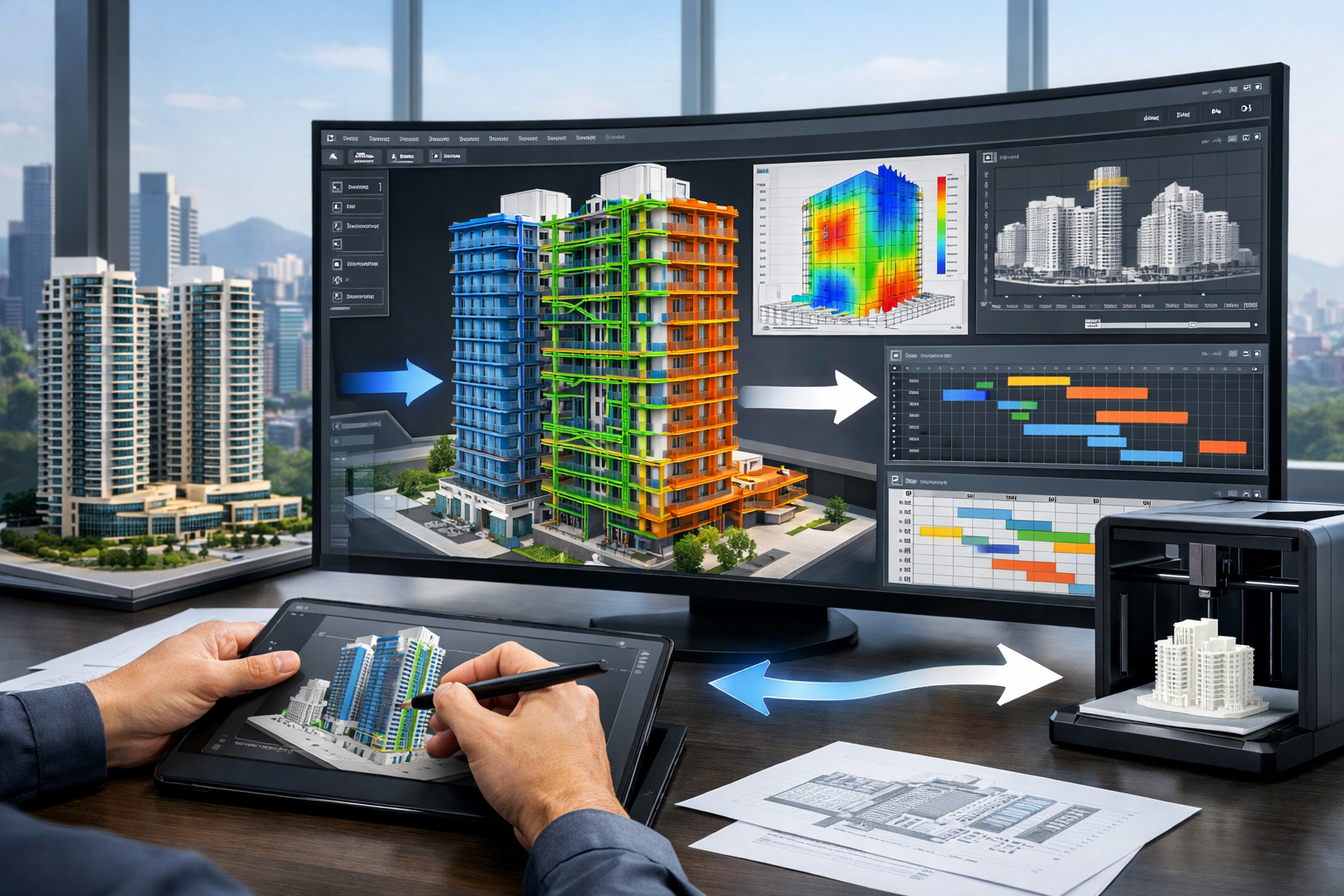
BIM and 3D Printing for Brazilian Residential Launches 2026: Cost-Saving Tech for High-Volume Developers achieve maximum value when fully integrated:
Phase 1: BIM Design Development
- Architects create parametric residential models with all specifications
- Structural engineers optimize for 3D printing constraints (continuous walls, minimal overhangs)
- MEP (mechanical, electrical, plumbing) systems are coordinated within BIM environment
- Cost estimators extract precise material quantities automatically
Phase 2: Printability Analysis
- BIM models are analyzed for 3D printing feasibility
- Wall thicknesses, reinforcement requirements, and print paths are optimized
- Clash detection identifies conflicts between printed and traditional elements
- Construction sequencing is automated based on printer capabilities
Phase 3: G-Code Generation
- BIM geometry is converted to printer-readable instructions
- Layer heights, print speeds, and material flow rates are calculated
- Quality control checkpoints are programmed into the sequence
- Simulation software validates the entire print process virtually
Phase 4: Physical Printing
- Robotic printers execute the BIM-derived instructions with millimeter precision
- Real-time monitoring feeds data back to BIM platform for as-built documentation
- Traditional construction teams install prefabricated components at predetermined locations
- Final inspection compares physical results to BIM model specifications
Enhanced Visualization for Pre-Sales
BIM models provide photorealistic renderings and virtual reality walkthroughs that dramatically improve off-plan sales conversion rates. Buyers can:
- Experience apartment layouts in immersive VR before construction begins
- Customize finishes and see real-time cost implications
- Understand building amenities and common areas with interactive 3D tours
- Review construction progress through BIM-linked project dashboards
This visualization capability is particularly valuable for developments in growing regions where buyers may be unfamiliar with the neighborhood and need confidence-building tools.
Automated Scheduling and Coordination
BIM platforms automatically generate construction schedules based on:
- 3D printing speed: Calculated from wall lengths and printer specifications
- Curing requirements: Concrete strength development timelines
- Traditional work dependencies: Windows, electrical, plumbing installations
- Resource availability: Printer uptime, crew schedules, material deliveries
This automation eliminates the manual scheduling errors that plague traditional construction and provides real-time updates to all stakeholders—critical for maintaining accelerated sales performance.
Real-World Brazilian Applications and Case Studies
InovaHouse 3D: Brazil’s First 3D-Printed Residence
The 57 m² residential unit completed in Nova Lima’s Macacos district represents Brazil’s pioneering achievement in 3D-printed construction[1]. Key project metrics:
- 📍 Location: Nova Lima, Minas Gerais
- 📏 Size: 57 square meters
- ⏱️ Printing time: 4 days for walls
- 🏗️ Total assembly: 8 days complete
- 💰 Total cost: R$120,000 (R$2,105/m²)
- 🏢 Technology provider: InovaHouse 3D using Concrete 3D Printing methodology
The project demonstrated that less than 100 hours of effective printing could replace months of traditional masonry work[1], validating the technology for Brazilian climate conditions, local material availability, and regulatory environments.
Bahia Government Affordable Housing Initiative
In May 2025, the Bahia state government launched an ambitious bid for 50 affordable 3D-printed houses in Feira de Santana[1]. This initiative represents:
- Scale validation: Moving from single-unit pilots to multi-home developments
- Cost targeting: R$80,000 per unit (approximately R$1,538/m²)
- Public sector adoption: Government recognition of technology viability
- Social housing application: Addressing Brazil’s housing deficit with innovative methods
The project’s success will likely catalyze broader adoption across Brazil’s public housing programs and inspire private developers to apply similar approaches to affordable segments.
International Context: South Africa’s Presidential Summit
The University of Johannesburg showcased 3D printing housing technology at the Presidential IBT Summit on February 3-4, 2026[4], highlighting benefits directly applicable to Brazilian markets:
- ✅ Reduced material waste
- ✅ Lower labor intensity requirements
- ✅ Shorter build times for urgent housing needs
- ✅ Scalability for mass housing programs
This international validation demonstrates that BIM and 3D Printing for Brazilian Residential Launches 2026: Cost-Saving Tech for High-Volume Developers aligns with global best practices in construction innovation.
Overcoming Implementation Challenges
Regulatory and Standards Gap
Currently, no specific technical standards exist from ABNT (Brazilian Association of Technical Standards) for 3D printing construction[1]. This creates both challenges and opportunities:
Challenges:
- Uncertainty in building permit approval processes
- Lack of standardized inspection protocols
- Insurance and liability questions
- Financing hesitation from conservative lenders
Opportunities:
- Early adopters can influence standard development
- Less regulatory friction during innovation phase
- Competitive advantage before market saturation
- Potential for proprietary methodologies
Developers should proactively engage with local building departments and document their processes thoroughly to establish precedents for future projects.
Technical Skill Requirements
Successful implementation requires new competencies:
- BIM specialists: Professionals who understand both architectural design and 3D printing constraints
- Robotic operation technicians: Trained personnel to operate and maintain printing equipment
- Specialized concrete engineers: Experts in micro-concrete formulations for 3D printing
- Digital integration managers: Coordinators who bridge traditional construction and digital workflows
Investing in training programs or partnering with technology providers like InovaHouse 3D can accelerate capability development.
Initial Capital Investment
3D printing equipment represents significant upfront costs:
- Industrial-scale printers: R$500,000-2,000,000 depending on capacity
- BIM software licenses: R$50,000-200,000 annually for enterprise solutions
- Training and certification: R$100,000-300,000 for team development
- Facility modifications: Site preparation and infrastructure upgrades
However, these costs amortize rapidly across high-volume launches. A developer building 200+ units annually can achieve ROI within 12-18 months through the cost savings and timeline advantages documented above.
Strategic Implementation for High-Volume Developers
Phased Adoption Approach
Phase 1: Pilot Project (Units 1-10)
- Select a smaller development or building phase for initial implementation
- Document all processes, costs, and timelines meticulously
- Build internal expertise and troubleshoot challenges
- Create case study materials for stakeholder confidence
Phase 2: Scaled Application (Units 11-50)
- Apply learnings to larger project components
- Optimize workflows and reduce cycle times
- Develop standardized design templates for 3D printing
- Establish supply chain relationships for specialized materials
Phase 3: Portfolio Integration (Units 50+)
- Implement BIM and 3D printing across multiple simultaneous projects
- Achieve economies of scale in equipment utilization
- Establish company-wide standards and best practices
- Leverage technology advantage in marketing and sales
Financial Modeling for Receivables Optimization
The accelerated timeline from BIM and 3D Printing for Brazilian Residential Launches 2026: Cost-Saving Tech for High-Volume Developers directly improves cash flow:
Traditional 200-unit development:
- Month 0-6: Design and approvals
- Month 7-24: Construction
- Month 12-30: Sales (overlapping with construction)
- Month 25-36: Delivery and receivables collection
BIM + 3D printing 200-unit development:
- Month 0-4: Design and approvals (BIM acceleration)
- Month 5-14: Construction (3D printing acceleration)
- Month 8-22: Sales (earlier start with model units)
- Month 15-26: Delivery and receivables collection
This 10-month acceleration in receivables collection represents substantial financial value:
- Reduced construction financing costs: R$2-4 million saved
- Earlier reinvestment capacity: Launch next project sooner
- Improved IRR: 15-25% improvement in internal rate of return
- Enhanced bankability: Better terms for property investment funding
Market Positioning and Differentiation
Developers adopting these technologies gain powerful marketing advantages:
🎯 Innovation leadership: Position as forward-thinking, technology-driven developer
🌱 Sustainability credentials: Highlight reduced waste and environmental impact
⚡ Speed-to-market: Emphasize faster delivery timelines for buyers
💎 Quality assurance: Promote precision and consistency of digital construction
💰 Value proposition: Pass some cost savings to buyers for competitive pricing
These positioning elements are particularly valuable in competitive markets where sales performance drives market transformation.
Future Outlook: 2026 and Beyond
Technology Evolution Trajectory
By 2026, 3D printing construction technology has reached mainstream viability[3], with continuing improvements expected:
- Multi-material printing: Simultaneous deposition of concrete, insulation, and finishing materials
- Larger-scale systems: Printers capable of entire mid-rise buildings
- AI-optimized designs: Machine learning algorithms that optimize structures for printability and performance
- Integrated robotics: Coordinated robot teams handling printing, finishing, and installation simultaneously
Market Adoption Predictions
Brazil’s construction sector is positioned for rapid 3D printing adoption driven by:
- Housing deficit pressure: 7+ million housing unit shortage creating urgency for faster construction methods
- Labor market constraints: Skilled worker shortages making automation attractive
- Sustainability mandates: Increasing environmental regulations favoring low-waste technologies
- Financing evolution: Banks and investors becoming comfortable with technology-driven projects
Industry analysts predict 15-20% of new residential launches in major Brazilian markets will incorporate 3D printing technology by 2028, with BIM integration becoming standard practice across the sector.
Competitive Landscape Shifts
Early adopters of BIM and 3D Printing for Brazilian Residential Launches 2026: Cost-Saving Tech for High-Volume Developers will establish significant competitive moats:
- Cost leadership: Sustainable 20-30% cost advantages over traditional competitors
- Speed advantages: Ability to respond to market opportunities 3-6 months faster
- Quality consistency: Reduced defects and warranty claims
- Talent attraction: Appealing to younger professionals interested in construction technology
Developers who delay adoption risk becoming competitively disadvantaged as the technology becomes standard practice, similar to how digital marketing transformed real estate sales approaches.
Conclusion
BIM and 3D Printing for Brazilian Residential Launches 2026: Cost-Saving Tech for High-Volume Developers represents a fundamental shift in residential construction economics. With proven Brazilian projects demonstrating 25-45% cost reductions, timeline compressions from months to days, and near-zero material waste, the technology delivers measurable advantages that directly impact developer profitability and competitiveness.
The convergence of Building Information Modeling’s digital precision with 3D concrete printing’s physical efficiency creates a powerful workflow that optimizes every phase from design through delivery. For high-volume developers operating in Brazil’s 5.54% CAGR construction market, these technologies enable faster off-plan sales, improved receivables funding, and sustainable competitive advantages.
Actionable Next Steps
For developers considering adoption:
- Conduct feasibility analysis: Evaluate your current project pipeline for suitable pilot candidates
- Engage technology providers: Contact established players like InovaHouse 3D for capability demonstrations
- Invest in BIM infrastructure: Implement comprehensive BIM platforms across design and construction teams
- Build regulatory relationships: Proactively engage local building departments to establish approval pathways
- Develop financial models: Quantify the specific ROI for your development scale and market conditions
- Start small, scale fast: Launch pilot projects to build expertise before portfolio-wide implementation
For industry stakeholders:
- Architects and engineers: Develop 3D printing design expertise to serve forward-thinking developers
- Material suppliers: Invest in specialized concrete formulations optimized for 3D printing
- Financial institutions: Create financing products tailored to accelerated construction timelines
- Regulators: Collaborate with industry to develop appropriate standards that enable innovation
The question for Brazilian residential developers in 2026 is no longer whether to adopt BIM and 3D printing technologies, but how quickly they can implement them to capture the substantial competitive advantages these innovations deliver. Those who act decisively will define the next generation of residential development in Brazil’s dynamic property market.
References
[1] Em Minas Gerais A Primeira Casa 3d Do Brasil Foi Impressa Em Quatro Dias E Montada Em Oito A Um Custo De R120 Mil Mhbb01 – en.clickpetroleoegas.com.br
[3] mereja – mereja.com
[4] Uj Civil Engineering Students Showcase 3d Printing Housing Technology At Presidential Ibt Summit – news.uj.ac.za