
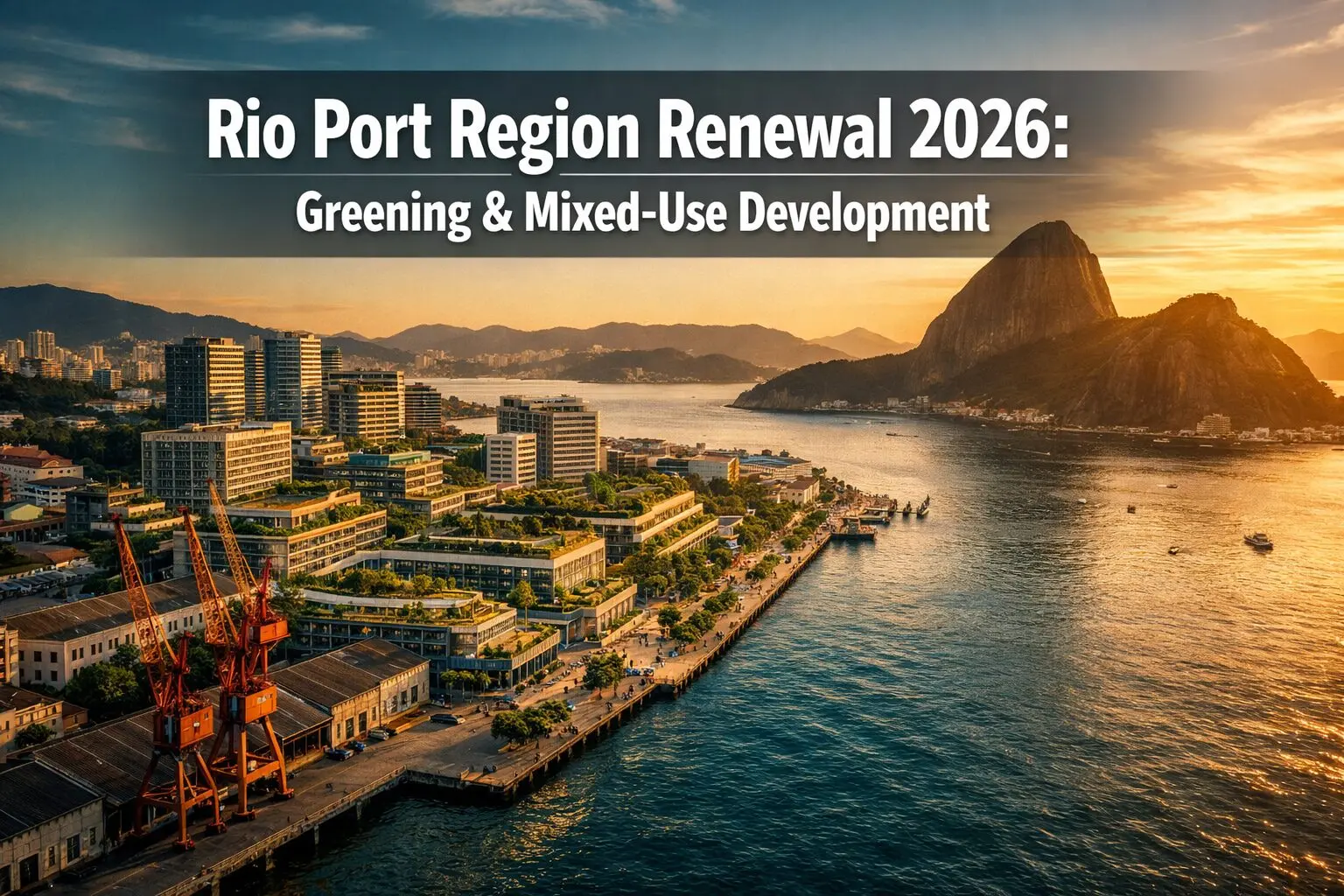
Over R$8 billion in public and private capital has been directed toward Rio de Janeiro’s port zone since the Porto Maravilha concession launched — and in 2026, the next wave of transformation is accelerating faster than most investors realize. The Rio Port Region Renewal 2026: Greening and Mixed-Use Development Opportunities from Urban Revitalization story is no longer a future promise. It is an active development landscape reshaping one of South America’s most strategically located urban waterfronts, creating rare openings for developers, investors, and city planners alike.
Rio’s port district — once dominated by industrial decay, elevated highways, and disconnected neighborhoods — is now a laboratory for sustainable urbanism, logistics-adjacent commercial growth, and waterfront residential demand. Understanding where the opportunities lie requires a clear look at the greening agenda, the mixed-use zoning evolution, and the broader regional investment momentum building across Brazilian port cities.
Key Takeaways 🗝️
- Rio’s port zone renewal combines green infrastructure investment with commercial-residential hybrid development, creating multi-sector opportunities in 2026.
- Greening initiatives — including urban parks, bioswales, and tree canopy expansion — are directly increasing adjacent property values and attracting ESG-aligned capital.
- Mixed-use zoning in the port region supports logistics-adjacent demand from tech, creative, and hospitality sectors alongside residential growth.
- Regional port investment trends across Brazil signal a broader infrastructure upgrade cycle that benefits Rio’s waterfront positioning.
- Early-mover developers who align with sustainability standards and mixed-use design are best positioned to capture value appreciation in this urban renewal corridor.
Understanding the Porto Maravilha Foundation
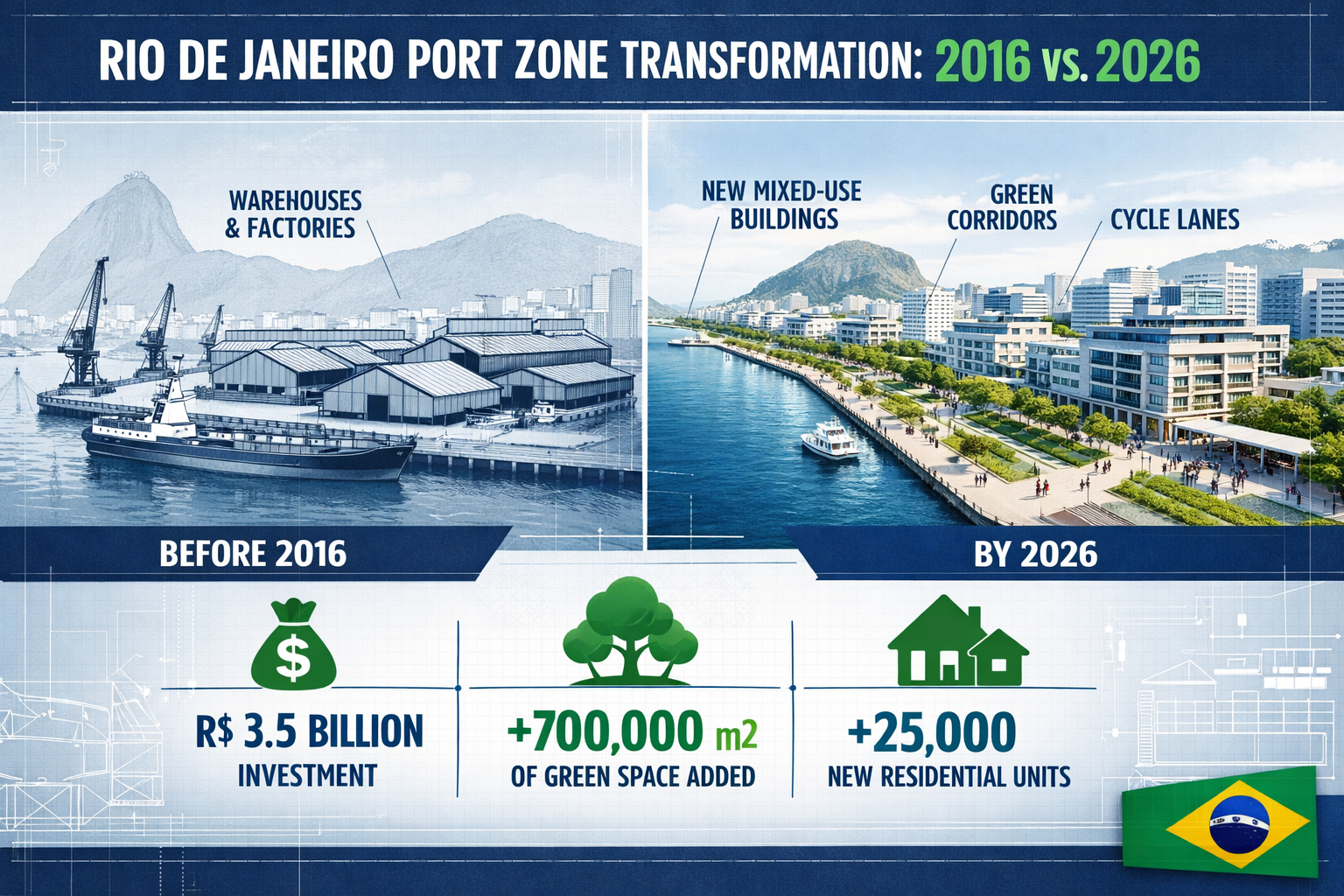
The Porto Maravilha Urban Operation, launched ahead of the 2016 Olympics, created the legal and financial framework that continues to drive Rio’s port zone urban revitalization today. The demolition of the Perimetral elevated highway alone unlocked approximately 70,000 square meters of new public space along the waterfront — a transformation that fundamentally changed how the district connects to the rest of the city.
By 2026, the second and third phases of this renewal are delivering results that the first phase only promised:
| Development Phase | Key Focus | Status in 2026 |
|---|---|---|
| Phase 1 (2010–2016) | Infrastructure removal, basic streetscaping | Completed |
| Phase 2 (2017–2022) | Cultural anchors, transit integration | Largely complete |
| Phase 3 (2023–2026+) | Mixed-use residential, green corridors, private development | Active |
The VLT (light rail) network now connects the port district to Central do Brasil station and the Santos Dumont Airport corridor, dramatically improving accessibility. This transit spine is a critical driver of mixed-use demand — proximity to rail is one of the strongest predictors of commercial-residential hybrid viability in urban markets globally.
💬 “Urban waterfronts that combine transit access, green space, and mixed-use zoning consistently outperform single-use districts in long-term value creation.”
The Greening Agenda: Why Green Infrastructure Is Central to Rio Port Region Renewal 2026
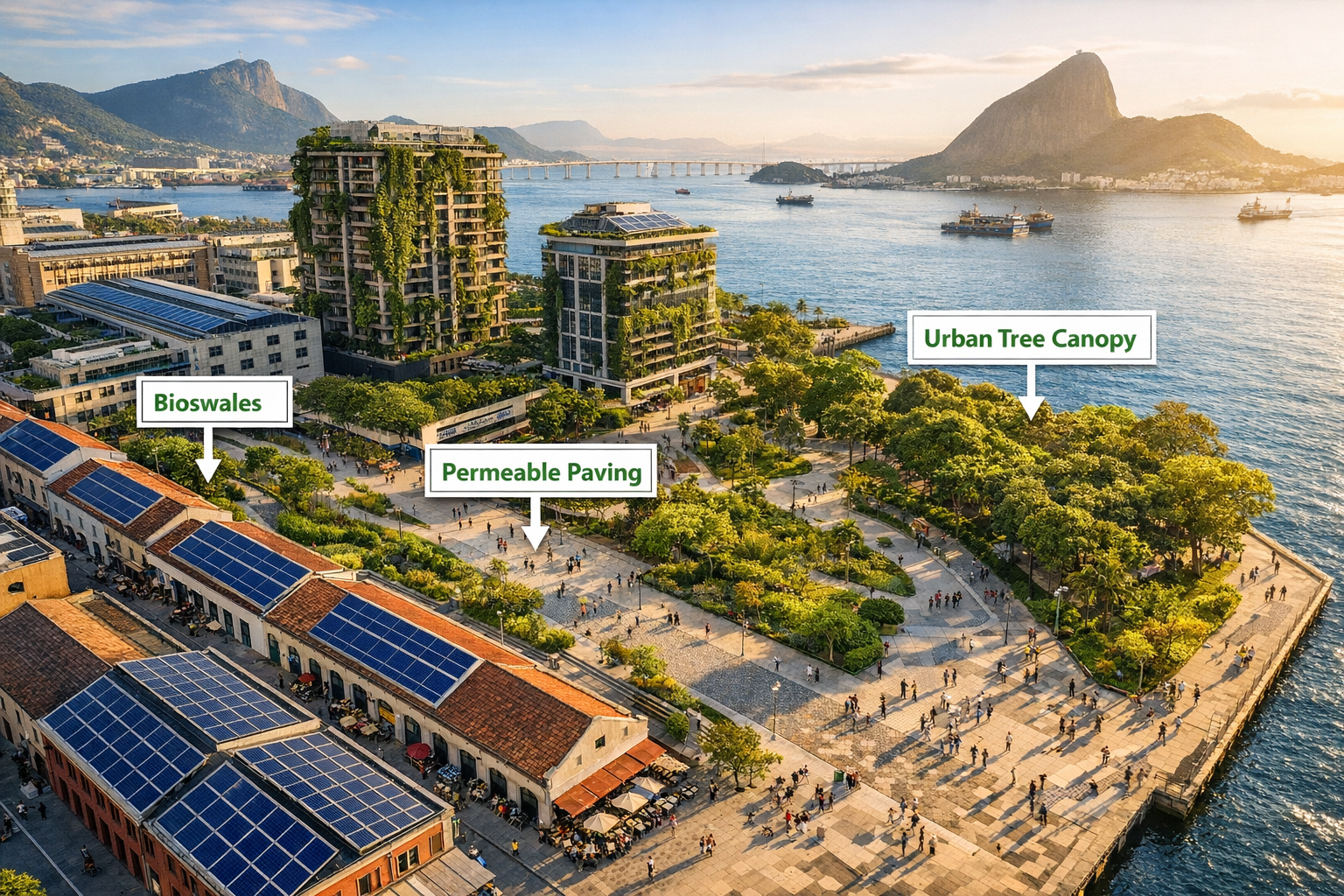
The greening dimension of Rio Port Region Renewal 2026 is not cosmetic. It is structurally embedded in the development approvals, the CEPAC (Certificates of Additional Construction Potential) valuation model, and the ESG requirements increasingly demanded by institutional capital.
Green Space Expansion and Urban Ecology
The Mauá Square revitalization and the new waterfront promenade represent the most visible green investments. But the deeper transformation is happening at the block level:
- 🌳 Urban tree canopy programs targeting 30% shade coverage on key pedestrian corridors
- 💧 Bioswale and permeable paving installations reducing stormwater runoff in flood-prone areas
- 🌿 Rooftop garden requirements embedded in new construction approvals above a certain floor area ratio
- ☀️ Solar-ready building standards aligned with Brazil’s growing renewable energy mandate
This approach mirrors what is happening at port cities across Latin America. Argentina’s Santa Fe, for example, is directing over $500 million in port infrastructure investments with sustainability components built into the capital plan [4]. Brazil’s own Port of Açu has pioneered the continent’s first renewable fuel-powered dredging operation, signaling that the decarbonization agenda is now mainstream in Brazilian port infrastructure [2].
ESG Capital and Green Certification
International investors are increasingly requiring LEED, AQUA-HQE, or EDGE green building certifications as a baseline for participation in Brazilian real estate funds. The port zone’s renewal framework — with its mandated green standards — positions developments in this corridor to access a wider pool of ESG-aligned capital than comparable projects in less regulated urban zones.
For developers exploring opportunities in Brazil’s most dynamic property markets, the Rio port zone’s green certification alignment represents a meaningful competitive advantage in fundraising and exit valuations.
Mixed-Use Development: The Core Opportunity in Rio’s Port Zone
The most significant financial opportunity within Rio Port Region Renewal 2026: Greening and Mixed-Use Development Opportunities from Urban Revitalization lies in the mixed-use development model. This is where logistics-adjacent commercial demand, residential growth, and hospitality converge in a single zoning framework.
What “Mixed-Use” Means in the Port Zone Context
In Rio’s port district, mixed-use is not simply ground-floor retail beneath apartments. The scale and diversity of permitted uses is considerably broader:
- Commercial Grade A offices serving tech, media, and creative economy tenants
- Short-stay and extended-stay hospitality serving business travelers and the growing cruise terminal economy
- Residential units ranging from compact studios to larger family apartments
- Cultural and entertainment anchors (museums, galleries, event spaces) that drive foot traffic
- Last-mile logistics facilities serving the e-commerce demand generated by the dense residential population
This layered demand profile creates natural rent diversification — a key risk management feature that single-use developments cannot offer.
Logistics-Adjacent Demand: A Structural Driver
The port zone’s proximity to Rio’s operational port infrastructure creates a specific category of commercial tenant demand that is often overlooked in residential-focused analyses. Companies requiring bonded warehouse access, customs proximity, or port operations support represent a stable, long-term commercial tenant base.
Brazil’s broader port investment cycle reinforces this demand. The country’s ports ministry has been actively expanding port concession areas — the Santos port zone expansion from 7.8 million to over 20 million square meters illustrates the scale of ambition [9]. As port operations modernize and expand, the demand for adjacent professional services, logistics coordination offices, and workforce housing grows in parallel.
💬 “The smartest mixed-use developments in port-adjacent zones don’t fight industrial heritage — they integrate it, using adaptive reuse of warehouse structures to create distinctive commercial and cultural spaces that command premium rents.”
Property Value Trajectory in 2026
Rio de Janeiro’s broader real estate market has shown resilience and upward price movement, with forecasts pointing to continued appreciation in well-located urban districts [7]. The port zone, historically undervalued relative to Zona Sul neighborhoods, is closing that gap as infrastructure improvements compound.
Key value drivers in 2026 include:
- VLT network maturity — ridership and reliability have improved, making transit-oriented development more credible to buyers
- Cultural anchor completion — the Museum of Tomorrow and MAR (Museum of Art of Rio) have established the district’s cultural identity
- Corporate tenant arrivals — technology and creative sector companies are signing leases in renovated port zone buildings
- Residential pipeline absorption — earlier residential launches have sold through, tightening supply
For investors already tracking real estate market performance trends in Brazil’s urban centers, the port zone’s trajectory follows a recognizable pattern of post-infrastructure-investment appreciation.
Developer Strategies: Positioning for the Renewal Opportunity
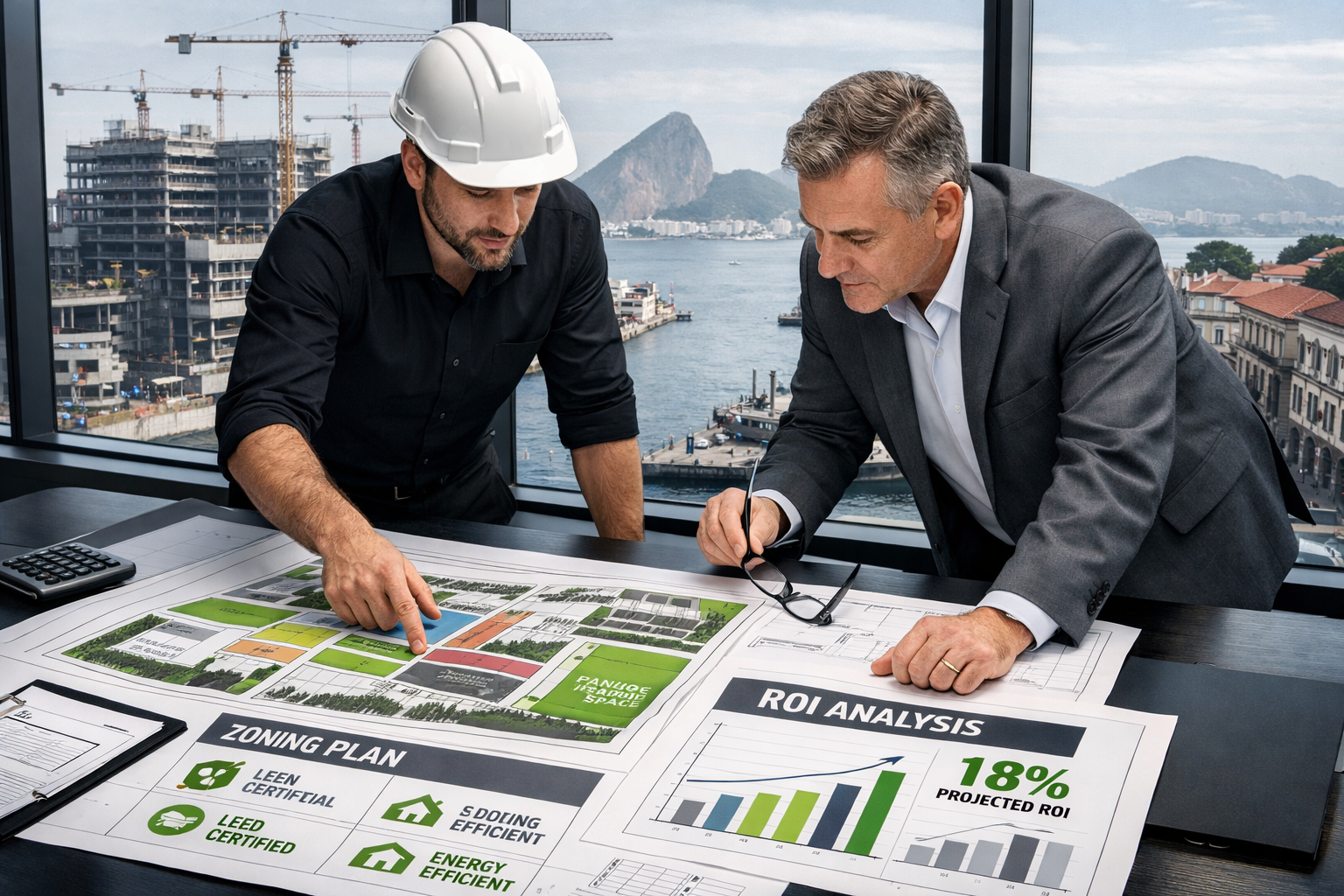
Capturing value from Rio Port Region Renewal 2026: Greening and Mixed-Use Development Opportunities from Urban Revitalization requires deliberate strategic positioning. Not all sites or product types will perform equally.
Adaptive Reuse vs. Ground-Up Development
The port zone contains a significant inventory of historic warehouse and industrial structures that qualify for adaptive reuse incentives under Rio’s heritage preservation framework. These structures offer:
- Lower land acquisition costs relative to cleared sites
- Faster approval pathways when heritage preservation requirements are met
- Distinctive architectural character that commands premium rents from creative and hospitality tenants
- Embodied carbon advantages that strengthen ESG credentials
Ground-up development, by contrast, allows for optimized floor plates, modern mechanical systems, and full green certification compliance from the foundation up. The choice depends on site specifics, capital structure, and target tenant profile.
The Studio and Compact Unit Opportunity
Compact residential units — studios and one-bedroom apartments — are particularly well-suited to the port zone’s demographic profile. Young professionals working in the creative economy, hospitality sector workers, and digital nomads seeking urban connectivity all represent strong demand segments.
This mirrors patterns observed in other Brazilian urban renewal zones. The advantages of investing in studio developments in transit-connected urban districts consistently show strong rental yield and resale performance — a dynamic directly applicable to Rio’s port zone.
Buying Off-Plan: Maximizing Appreciation Potential
For individual investors rather than institutional developers, the off-plan (na planta) purchase strategy remains one of the most effective ways to capture value in an active renewal zone. Projects launched during the construction phase of a renewal cycle typically price at a discount to projected completion values.
Understanding why off-plan purchases can amplify investment returns is essential for anyone considering entry into Rio’s port district before the current renewal cycle matures.
Financing Innovation: Crypto and Alternative Capital
Brazil’s real estate sector is also seeing early adoption of blockchain-based financing structures. Tokenized real estate and cryptocurrency-backed development financing are emerging as supplementary capital sources, particularly for projects targeting international investors.
The intersection of cryptocurrency and real estate development represents a frontier that port zone developers — with their typically larger capital requirements — are beginning to explore as part of diversified funding strategies.
Risks and Mitigation Factors
No investment opportunity exists without risk. The Rio port zone renewal carries specific challenges that informed investors must weigh:
Key Risk Factors ⚠️
- Execution risk: Large-scale urban renewal projects in Brazil have historically faced delays due to permitting complexity and political transitions
- Infrastructure dependency: Property values are closely tied to continued VLT operation and maintenance — service degradation would negatively impact demand
- Social displacement pressure: Gentrification dynamics in adjacent communities (particularly the Morro da Providência favela) create reputational and regulatory risk for developers
- Currency volatility: For USD or EUR-denominated investors, BRL exchange rate movements affect real returns significantly
- Oversupply risk: If multiple large residential projects launch simultaneously, absorption timelines could extend
Mitigation Approaches ✅
- Phased development to match absorption capacity
- Mixed-use diversification to reduce dependence on any single demand segment
- Community benefit agreements with local organizations to address displacement concerns
- Green certification to maintain access to institutional capital regardless of market cycles
- Local partnership with experienced Brazilian developers who understand regulatory navigation
The Regional Context: Brazil’s Port Investment Cycle
Rio’s renewal does not exist in isolation. Across Latin America, port cities are investing heavily in both operational infrastructure and adjacent urban development. Argentina’s Santa Fe has committed over $500 million to port infrastructure upgrades [4], while Brazil’s own port concession program has generated more than $206 million in concessioned infrastructure investment [6].
This regional momentum matters for Rio because it:
- Validates the asset class — port-adjacent urban development is attracting serious capital across the continent
- Creates competitive pressure — Rio must continue delivering on its renewal promises to retain investor attention relative to Santos, Suape, and other Brazilian port cities
- Signals long-term policy commitment — multi-year capital programs are harder to reverse than single-project announcements
For a broader view of where Brazil’s most compelling property investment opportunities are emerging in 2026, the port zone renewal story is one of several converging trends reshaping the national market.
Conclusion: Actionable Steps for 2026
The Rio Port Region Renewal 2026: Greening and Mixed-Use Development Opportunities from Urban Revitalization represents one of the most multidimensional urban investment stories in South America right now. The convergence of green infrastructure mandates, mixed-use zoning flexibility, logistics-adjacent commercial demand, and a maturing transit network creates conditions that rarely align so completely in a single urban district.
Actionable Next Steps for Investors and Developers:
- Conduct site-specific due diligence on port zone parcels, focusing on CEPAC availability and heritage overlay status
- Engage with Rio’s municipal urban planning secretariat to understand current and upcoming zoning amendments
- Prioritize green certification from the earliest design stage to maximize capital access and exit optionality
- Explore adaptive reuse opportunities in the historic warehouse inventory before ground-up sites
- Consider off-plan entry in projects already in the approval pipeline to capture pre-completion appreciation
- Build community engagement into project planning from day one to reduce social license risk
- Monitor the VLT expansion timeline — new station announcements are leading indicators of value movement
The window for early-mover advantage in Rio’s port zone is open in 2026, but it will not remain open indefinitely. As infrastructure matures and the development pipeline fills, entry costs will rise and the most attractive sites will be absorbed.
To explore active development projects and investment opportunities aligned with Brazil’s urban renewal momentum, visit Quadragon’s current developments portfolio or get in touch directly to discuss how these market dynamics apply to your investment strategy.
References
[2] Brazil’s First Renewable Fuel Dredging Move Sets High Stakes For Port Decarbonisation – breakbulk.news
[4] Argentina’s Santa Fe Plans Over 500 Million In Port Investments For 2026 – datamarnews.com
[6] More Than US206mn In Investment In Concessioned Port Infrastructure By 2026 – bnamericas.com
[7] Rio De Janeiro Price Forecasts – thelatinvestor.com
[9] Brazil Plans Major Expansion Of Santos Port Area – bnamericas.com