
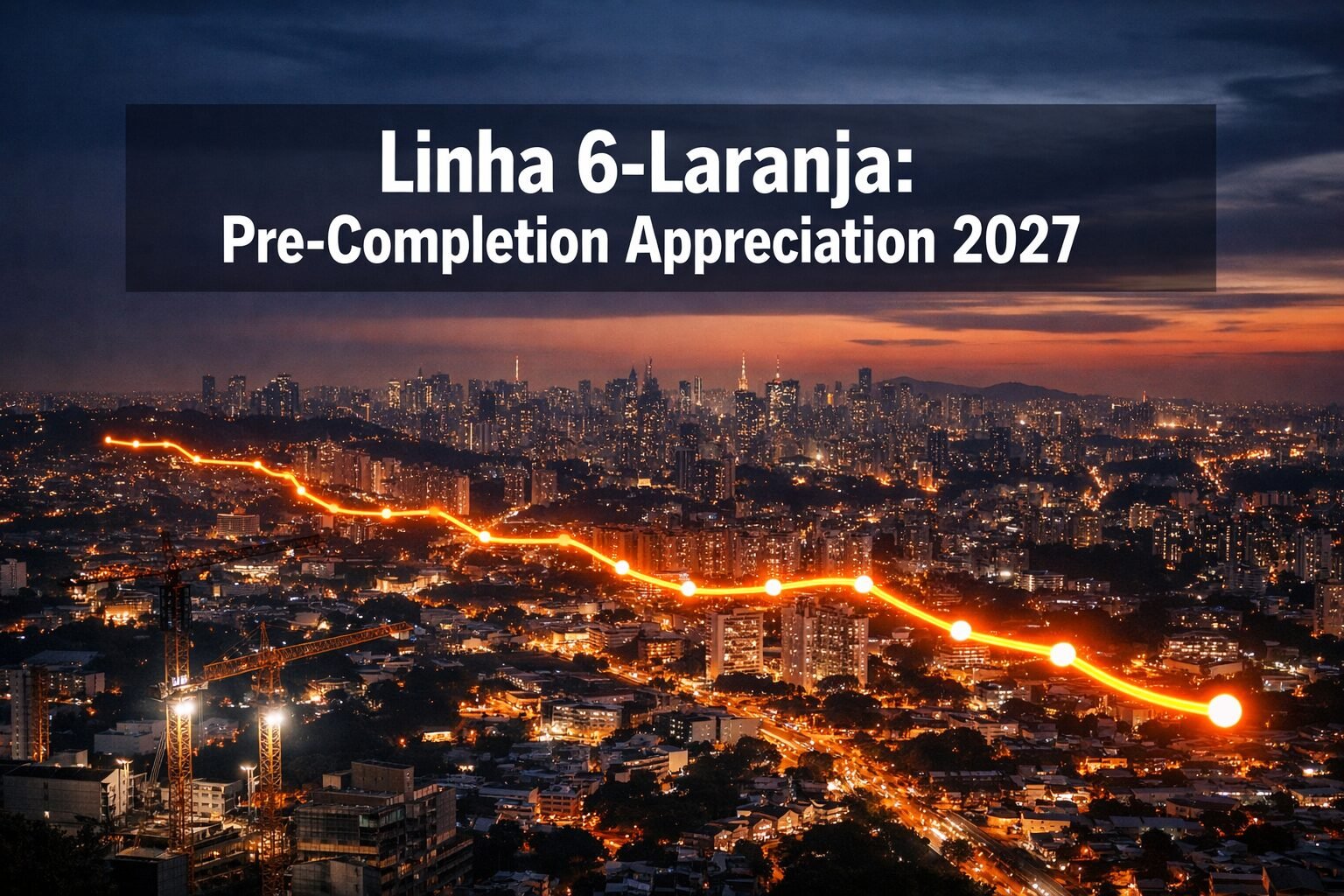
A 90-minute bus crawl through São Paulo’s congested north zone is about to become a 23-minute metro ride — and that single fact is already reshaping property values along one of the city’s most overlooked investment corridors.
The Linha 6-Laranja Metro Completion 2027: Capturing Pre-Completion Appreciation in São Paulo’s Brasilândia-Perdizes Corridor is not a distant promise. With tunnel excavation fully completed as of February 2025, station fit-outs underway, and the first 8 km segment scheduled to open in October 2026, the window for pre-completion positioning is narrowing fast [3][4]. Developers and investors who understand transit-led appreciation cycles know this moment well: the highest gains are captured before the ribbon is cut, not after.
This article breaks down the project’s timeline, the current state of construction, the neighborhoods that stand to benefit most, and the strategic logic behind entering the market now — before the full line opens in 2027.
Key Takeaways 🔑
- 23-minute corridor: Linha 6-Laranja will cut travel time from Brasilândia to São Paulo’s center from ~90 minutes to just 23 minutes [4]
- Two-phase opening: Phase 1 (Brasilândia to Perdizes, ~8 km) opens October 2026; full 15.3 km line completes in late 2027 [1][3]
- 630,000+ daily riders projected from day one, creating immediate and sustained demand for nearby housing [2]
- 77% overall completion as of January 2026, with key stations already above 89% finished [3]
- Pre-completion entry in the Brasilândia-Perdizes corridor offers the strongest appreciation window before full-line operation drives prices to a new baseline
The Infrastructure Case: What Makes Linha 6-Laranja a Market-Moving Project
Scale and Specifications
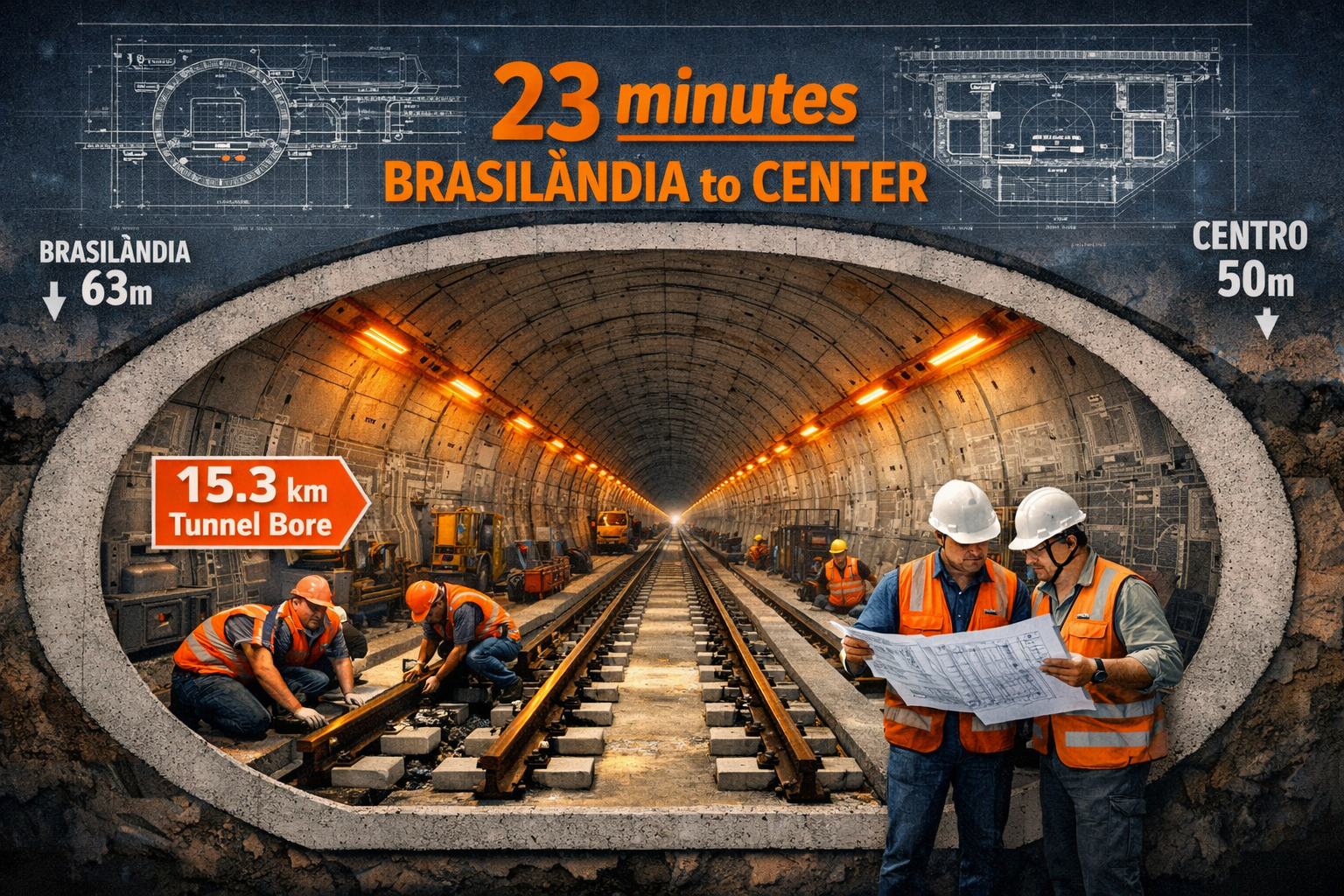
The numbers behind this project are striking. The line runs 15.3 km entirely underground, connecting 15 stations from Brasilândia in the north to São Joaquim station in the central district [4]. Every meter of tunnel boring is now complete — the full excavation was finished in February 2025, a milestone that shifted the project from heavy civil works to systems installation and interior finishing [3][6].
At the Morro Grande operations center — the maintenance yard and administrative hub — 93.79% completion has been reached. The facility spans 213,000 m², houses capacity for 22 trains, and has seen more than 850 tons of metallic structures installed [3][6]. This is not a project in early stages. It is a project in its final sprint.
Station-by-Station Progress (January 2026)
| Station | Completion % | Phase |
|---|---|---|
| Morro Grande Yard | 93.79% | Phase 1 |
| Água Branca | 92.41% | Phase 1 |
| Perdizes | 89.56% | Phase 1 |
| Santa Marina | 89.34% | Phase 1 |
| Brasilândia | PSD installation underway | Phase 1 |
| Maristela | Delayed to Phase 2 | Phase 2 |
Platform screen doors (PSDs) — 720 total devices, 48 per station — are being installed at six stations: Brasilândia, Santa Marina, Água Branca, Sesc Pompeia, Perdizes, and Freguesia do Ó [3]. Escalator and elevator installation has begun at Brasilândia, Santa Marina, Água Branca, and Freguesia do Ó stations [3]. These are finishing-phase activities, not foundational ones.
The “Colleges Line” Advantage
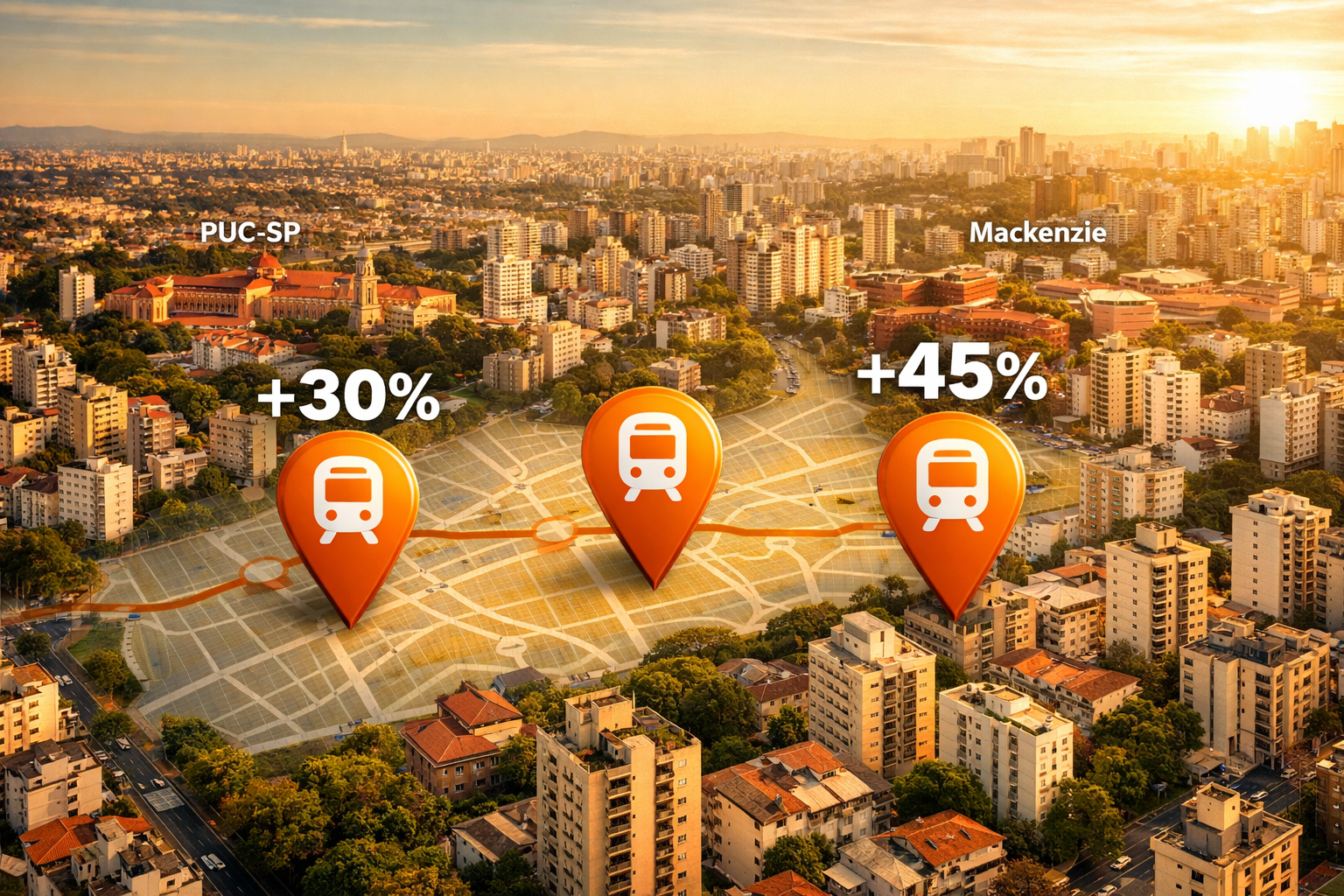
Linha 6-Laranja carries an informal but commercially significant nickname: the “Colleges Line” [7]. The route directly serves three major universities — FAAP, PUC-SP, and Mackenzie — connecting densely populated neighborhoods that currently lack rapid transit access to the city center [7]. This creates a built-in, recurring demand base for rental housing near every station. Students, faculty, and administrative staff represent a stable tenant pool that does not disappear during economic cycles.
💡 Pull Quote: “A metro line serving three universities and projecting 630,000 daily riders from day one is not just infrastructure — it is a permanent demand engine for surrounding real estate.”
The Two-Phase Timeline: Why 2026 and 2027 Are Both Entry Points
Phase 1 — October 2026: Brasilândia to Perdizes
The first operational segment covers approximately 8 km with nine stations, running from Brasilândia south to Perdizes [1]. This opening will mark the end of a four-year period during which São Paulo’s metro network added no new stations — a gap that has amplified pent-up demand along this corridor [1].
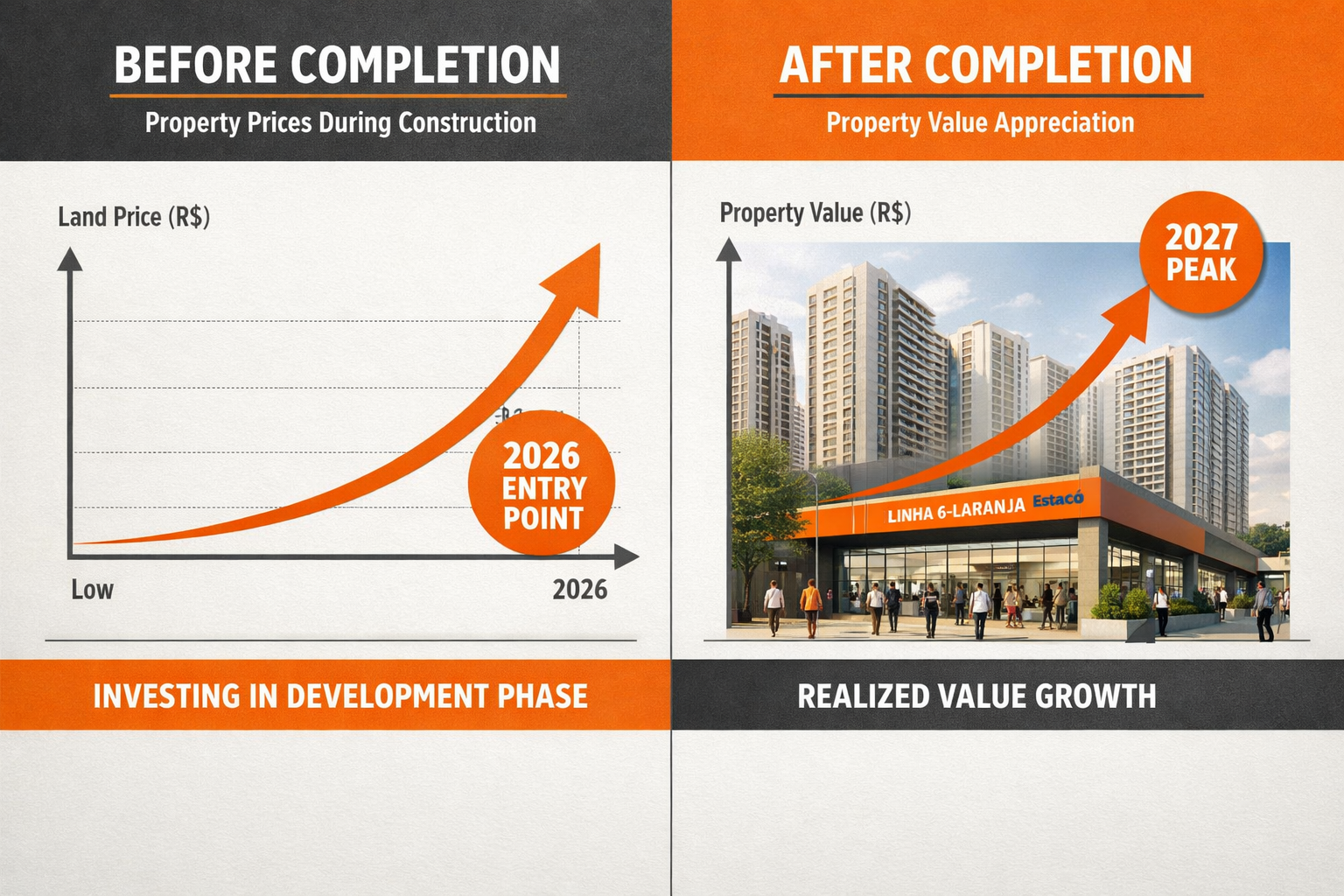
For property investors, Phase 1 is the inflection point. Once trains begin running, price discovery accelerates. Buyers who were waiting for proof of delivery enter the market simultaneously, compressing the appreciation timeline. The pre-opening window — which is closing right now in 2026 — is precisely where early movers have historically captured the widest spread between acquisition cost and post-completion value.
Permanent track installation for Phase 1 is already complete, with more than 8,700 meters of track installed at Morro Grande Yard alone [3][6]. This is not a projection. The physical infrastructure is in the ground.
Phase 2 — Late 2027: Full Line Completion
The remaining 7.3 km from PUC Cardoso de Almeida to São Joaquim — including the Maristela station, which was removed from the 2026 schedule after facing construction obstacles — completes the full line [1][3]. This second phase extends the appreciation corridor southward, connecting the line to São Paulo’s established central business and cultural districts.
The strategic implication is clear: Phase 2 completion in 2027 creates a second appreciation wave for properties near the southern stations. Investors entering during Phase 1 construction benefit from both waves — the 2026 operational proof and the 2027 full-network effect.
Capturing Pre-Completion Appreciation: The Brasilândia-Perdizes Investment Case
Why This Corridor Has Been Undervalued
Brasilândia is one of São Paulo’s most densely populated northern neighborhoods. It has historically been underserved by rapid transit, which has kept property prices below the city average despite its large residential population. The absence of metro access created a persistent discount — a discount that the Linha 6-Laranja Metro Completion 2027 is about to permanently erase.
Transit-led gentrification follows a predictable pattern in major cities:
- Announcement phase — early speculators enter; modest price movement
- Construction phase — visible progress drives broader awareness; appreciation accelerates
- Pre-opening phase — final months before launch; strongest appreciation velocity
- Post-opening — new price baseline established; appreciation stabilizes at a higher floor
São Paulo in 2026 is firmly in stage 3 for the Brasilândia-to-Perdizes segment. The project is 77% complete overall [3], stations are in finishing phases, and the October 2026 opening is a confirmed target, not a speculative date.
Comparing Entry Timing
Understanding when to enter is as important as knowing where. For a deeper look at how pre-launch positioning drives returns in Brazilian real estate, the analysis of why buying off-plan can amplify gains is directly applicable to this transit corridor dynamic.
Similarly, the logic behind investing in studios in Florianópolis — capturing high rental yield in high-demand, supply-constrained zones — translates well to the “Colleges Line” corridor, where student and young professional demand will be structurally elevated from day one.
The 630,000 Daily Riders Multiplier
Projected daily ridership of 630,000 to 633,000 passengers positions Linha 6-Laranja among São Paulo’s highest-capacity transit corridors from its first operational day [2][4]. To put this in context: that volume rivals some of the busiest metro lines in Latin America.
High ridership creates a virtuous cycle for surrounding real estate:
- 🏪 Retail and commercial demand increases near station exits
- 🏠 Residential rental demand rises as commuters seek proximity to stations
- 📈 Land values adjust upward to reflect the new accessibility premium
- 🏗️ Development activity intensifies, further signaling neighborhood transformation
For investors evaluating Brazilian markets, this corridor compares favorably to other high-growth urban zones. A broader review of the best places to invest in Brazil for high returns confirms that transit-adjacent urban real estate consistently outperforms the broader market over 5-10 year horizons.
Strategic Positioning: How to Enter the Market Before 2027 Completion
Station Proximity Hierarchy
Not all stations along the Linha 6-Laranja Metro Completion 2027 corridor offer equal opportunity. A tiered approach to station proximity helps prioritize entry points:
Tier 1 — Highest Appreciation Potential
- Perdizes: 89.56% complete, established middle-class neighborhood, strong rental market, direct connection to Paulista axis
- Água Branca: 92.41% complete, proximity to commercial zones, undergoing active residential development
Tier 2 — Strong Growth, Lower Entry Costs
- Brasilândia: Terminal station, highest accessibility uplift from current baseline, large population catchment
- Freguesia do Ó: Dense residential neighborhood, PSDs already being installed, strong community infrastructure
Tier 3 — Phase 2 Plays
- Stations south of PUC Cardoso de Almeida: Longer wait for full operational benefit but positioned for the 2027 second-wave appreciation
Property Types That Perform Best in Transit Corridors
Based on transit-adjacent investment patterns in major Brazilian cities, three property types consistently outperform in corridors like Brasilândia-Perdizes:
- Compact apartments (studios and 1-bedroom): High rental yield, strong demand from students and young professionals, lower acquisition cost per unit
- Mixed-use ground-floor commercial: Retail and service businesses cluster near station exits; commercial rents rise sharply post-opening
- Mid-rise residential developments near secondary stations: Lower land cost than Tier 1 stations, but strong appreciation as the network effect matures
For investors tracking development-phase opportunities across Brazilian urban markets, monitoring new real estate developments that align with transit corridor timelines is a proven strategy for capturing pre-completion appreciation.
Risk Factors to Monitor
No investment thesis is complete without acknowledging risk. For the Linha 6-Laranja corridor, the key risks include:
- ⚠️ Construction delays: The Maristela station was already removed from the Phase 1 schedule [1]. Further delays to Phase 2 could extend the appreciation timeline
- ⚠️ Financing conditions: Brazil’s interest rate environment affects mortgage accessibility and developer financing costs
- ⚠️ Execution risk in Phase 2: The southern segment’s completion in 2027 is a projection, not a guarantee
- ⚠️ Oversupply in specific micro-markets: Rapid developer interest near Tier 1 stations could create localized supply pressure
Balancing these risks against the structural demand case — 630,000 daily riders, three universities, a 67-minute commute reduction — the risk-reward profile remains strongly favorable for well-positioned entries in 2026.
The Broader São Paulo Infrastructure Cycle
The Linha 6-Laranja project does not exist in isolation. São Paulo is in an active phase of transit expansion, and each new line reinforces the value of the network as a whole. For investors comparing urban growth stories across Brazilian cities, the dynamics seen in the growth of Florianópolis’s Ingleses region — where infrastructure investment drove sustained property appreciation — offer a useful parallel. The mechanism is the same: infrastructure reduces friction, friction reduction drives demand, demand drives price.
The São Paulo metro expansion also intersects with broader real estate market trends. For current market intelligence and emerging opportunities across Brazilian urban centers, the latest news and analysis provides ongoing coverage of the factors shaping investment decisions in 2026.
Conclusion: The Window Is Open — But Not Indefinitely
The Linha 6-Laranja Metro Completion 2027: Capturing Pre-Completion Appreciation in São Paulo’s Brasilândia-Perdizes Corridor represents one of the clearest transit-led investment opportunities in Brazil’s largest city right now. The fundamentals are exceptional: a 15.3 km fully underground line [4], 630,000 projected daily riders [2], a journey time cut from 90 minutes to 23 minutes [4], and a construction project that is 77% complete with finishing work visibly underway at multiple stations [3].
The October 2026 Phase 1 opening is the first price inflection point. The late 2027 full-line completion is the second. Investors who enter the Brasilândia-Perdizes corridor before Phase 1 opens are positioned to benefit from both.
Actionable Next Steps ✅
- Map station proximity: Identify properties within 500m of Perdizes, Água Branca, and Brasilândia stations — these offer the strongest near-term appreciation case
- Prioritize compact residential units: Studios and one-bedroom apartments near university-adjacent stations align with the highest-demand tenant profile
- Track Phase 2 progress: Monitor construction updates for the southern segment; entry near Maristela and São Joaquim stations becomes attractive as 2027 completion approaches
- Evaluate off-plan opportunities: Pre-completion purchases in the corridor lock in today’s pricing ahead of the post-opening baseline reset
- Consult with specialists: Work with real estate advisors who understand transit-corridor dynamics and can identify the best-positioned assets before the October 2026 opening drives broad market awareness
The 23-minute commute is coming. The question is whether the right properties are already in a portfolio when it arrives.
References
[1] Apos 4 Anos Sem Novas Estacoes Metro De Sp Promete Quase 15 Km Em 2026 Linha 17 Ouro Inicia Testes Em Marco E Linha 6 Laranja Abre 8 Km Em Outubro Ctl01 – en.clickpetroleoegas.com.br
[2] Linha 6 Laranja Bndes Breaking New Ground – txfnews.com
[3] Sao Paulo Metro Line 6 Project Reaches Key Milestones – acciona.com
[4] Under Sao Paulo Line 6 Orange Reaches 153 Km And 15 Stations Promising 23 Minutes From Brasilandia To The Center And 633000 Passengers Per D Ctl01 – en.clickpetroleoegas.com.br
[6] Acciona Completes Connection On Sao Paulo Metro Line 6 – tunnelingonline.com
[7] Line 6 (São Paulo Metro) – en.wikipedia.org