
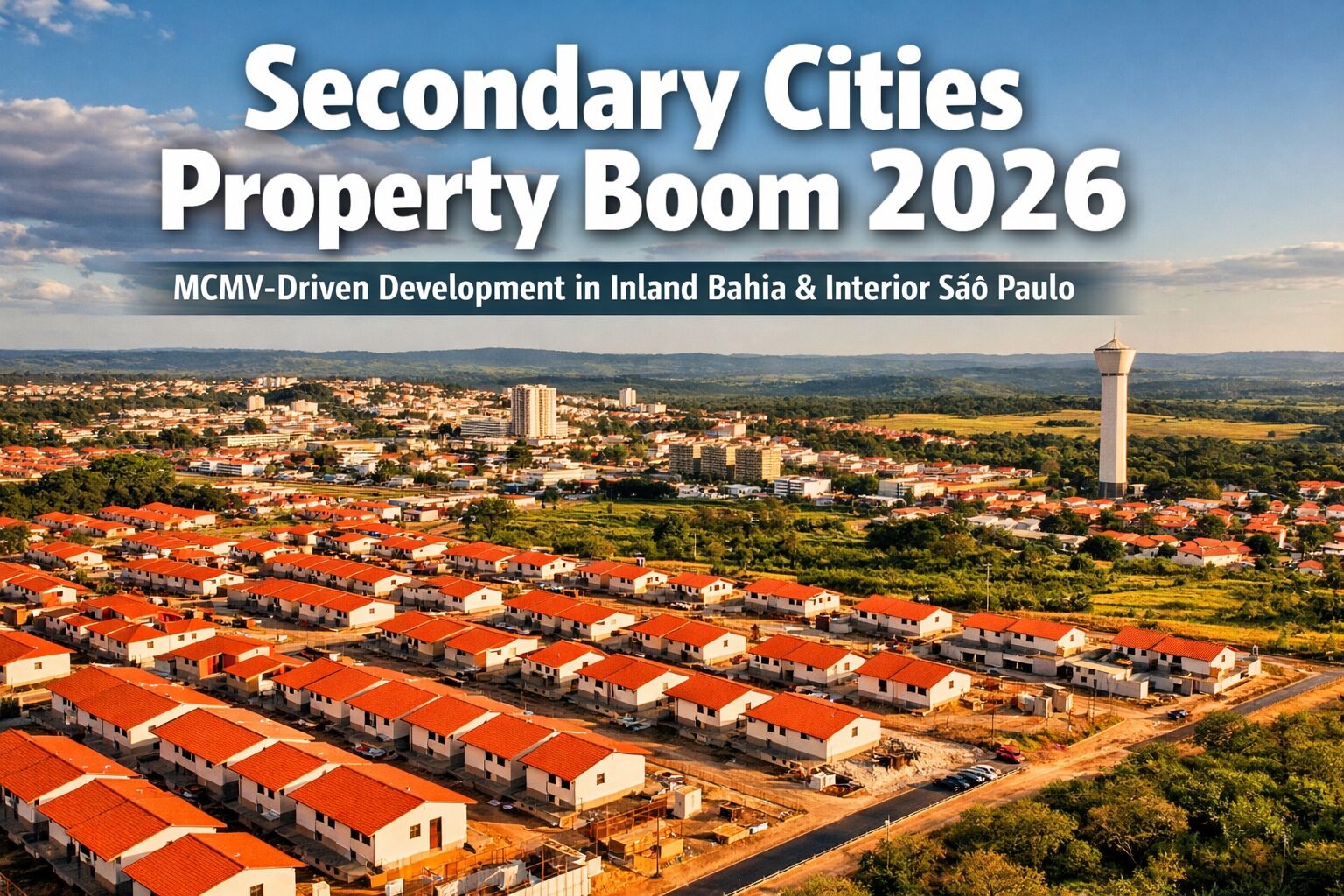
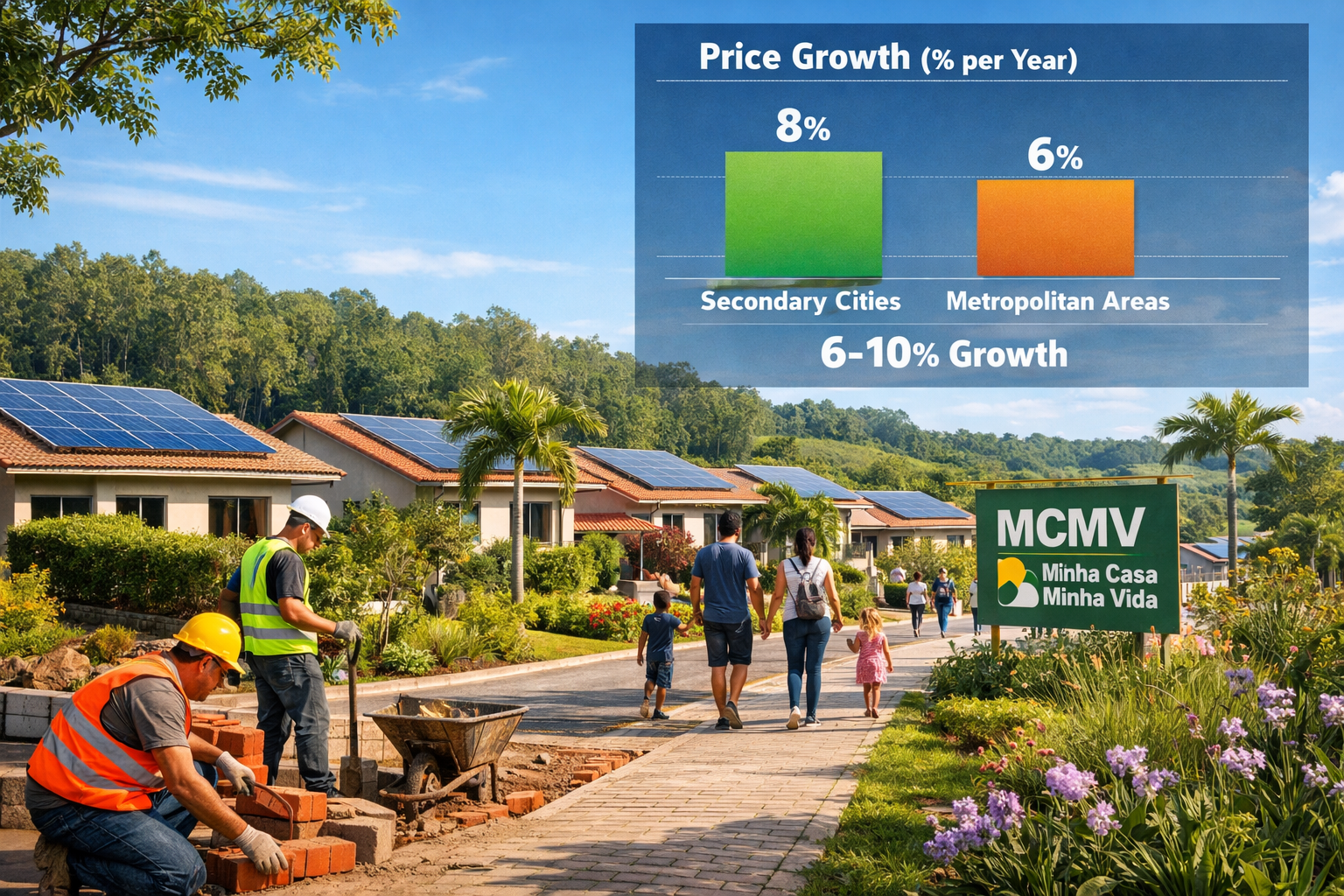
While investors fixate on São Paulo’s Faria Lima corridor and Rio’s Barra da Tijuca, a quieter but potentially more powerful real estate shift is underway: secondary cities in Brazil’s Northeast and interior are recording 6–10% annual price appreciation, outpacing most metropolitan markets. The engine driving this growth is the Minha Casa Minha Vida (MCMV) program, which now accounts for roughly 50% of all new housing launches nationwide [3]. The Secondary Cities Property Boom 2026: MCMV-Driven Development Tactics in Inland Bahia and Interior São Paulo is not a future trend — it is already reshaping land values, supply chains, and investment strategies across regions that were largely ignored just five years ago.
Key Takeaways 📌
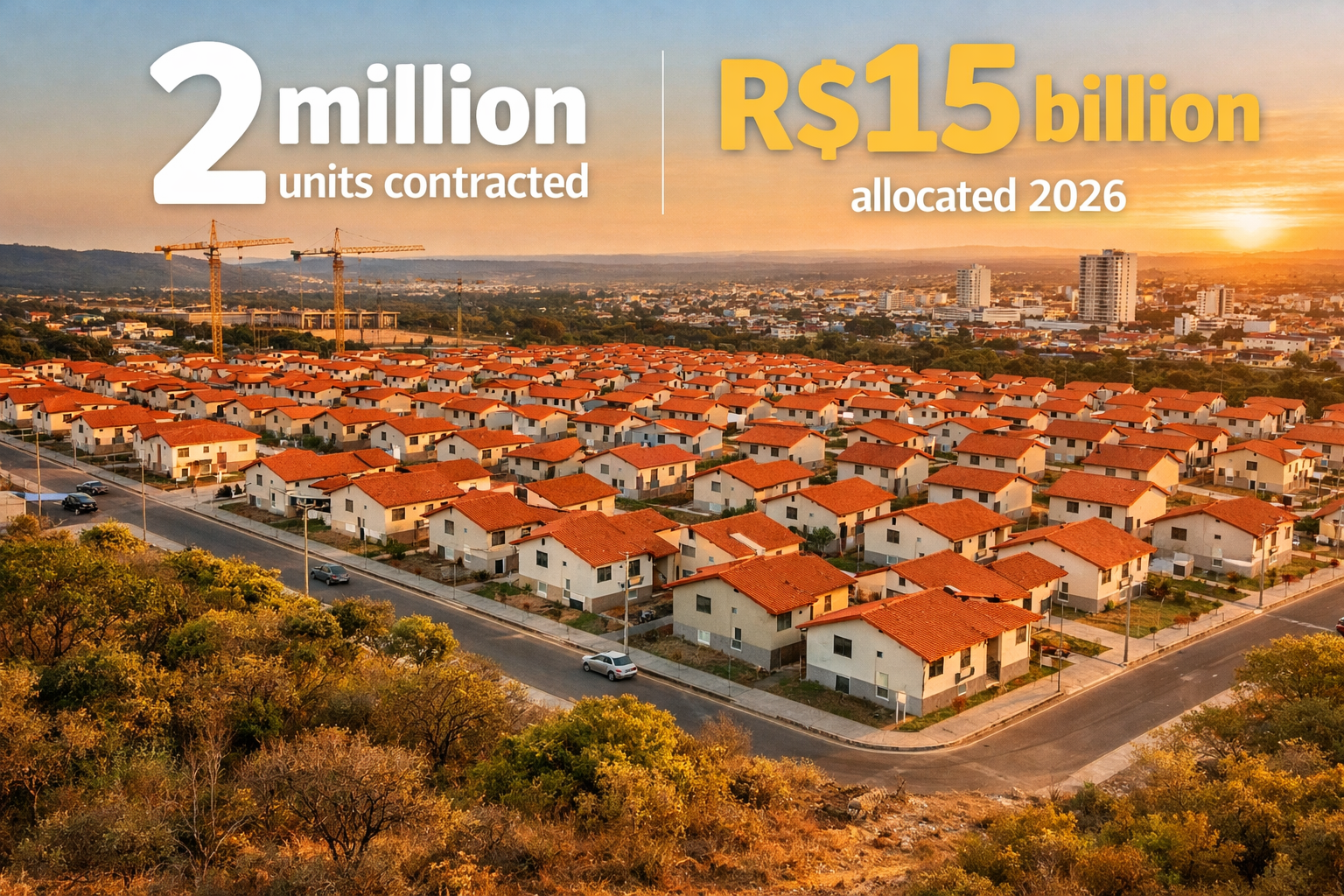
- MCMV is the dominant force in Brazil’s housing market, with the government targeting an additional 1 million contracted units by end of 2026 and R$15 billion in dedicated funding [2][3].
- Inland Bahia and interior São Paulo are priority zones for MCMV deployment, driven by acute housing deficits and lower land acquisition costs.
- Eco-residences near protected areas represent a high-demand, resilient niche that combines MCMV eligibility with premium positioning.
- A US$796 million World Bank loan is accelerating Bahia’s infrastructure competitiveness, creating a multiplier effect for real estate development [4].
- Developers who align projects with enhanced MCMV urban planning standards are best positioned to capture both subsidy benefits and long-term capital appreciation.
Why Secondary Cities Are Winning in 2026
The Deficit-Driven Demand Equation
Brazil’s housing deficit remains one of the largest in Latin America, and it is not concentrated in São Paulo’s financial district. The most acute shortfalls exist in mid-sized cities with populations between 50,000 and 300,000 — precisely the cities that MCMV’s restructured program now explicitly prioritizes.
The Brazilian government allocated approximately R$15 billion to MCMV in 2026, with priority given to regions showing the sharpest housing gaps, including parts of the Northeast and interior areas of São Paulo state [2]. This is not charity spending — it is a targeted capital injection into markets where land is cheap, local governments are eager to cooperate, and demand is structurally guaranteed.
💡 Pull Quote: “In secondary cities, the gap between housing supply and demand is so wide that even a fraction of MCMV’s national budget can move an entire local market.”
Key drivers of secondary city outperformance in 2026:
| Factor | Metropolitan Markets | Secondary Cities |
|---|---|---|
| Land acquisition cost | High | Low to moderate |
| Housing deficit severity | Moderate | Acute |
| MCMV priority status | Partial | High |
| Price growth (2026 est.) | 3–5% | 6–10% |
| Competition among developers | Intense | Moderate |
The MCMV Scale Advantage
The numbers behind MCMV are difficult to overstate. The program has mobilized approximately $140–145 billion in total since 2009, and the current administration contracted 2 million housing units in just three years — exceeding its original four-year target before the deadline [3]. The goal now is to contract an additional 1 million units through the end of 2026 [3].
More importantly for developers and investors, the government expects to deliver over 100,000 MCMV units in 2026 alone, out of 170,000 currently under construction under subsidized lines, with over 1 million units nationwide under construction across all programs [3]. This pipeline creates sustained demand for construction materials, labor, and ancillary services in the regions where projects are concentrated.
For those exploring the best places to invest in Brazilian property, secondary cities with active MCMV pipelines now rank alongside traditional coastal hotspots as high-return opportunities.
Financing Mechanics That Protect Margins
One of the most underappreciated advantages of MCMV-aligned development is interest rate insulation. The program uses FGTS (Brazil’s workers’ severance fund) as its primary funding source, offering rates significantly below the Selic benchmark rate [3]. This means that even as the Selic remains elevated in early 2026, MCMV projects maintain accessible financing for end buyers — protecting developer sales velocity.
Additionally, maximum property values eligible for MCMV financing were recently increased for income brackets 1 and 2 (families earning up to R$4,700 per month), with price ceilings reaching up to R$255,000–270,000 in larger urban centers [3]. In secondary cities, where construction costs are lower, this ceiling creates meaningful margin room for disciplined developers.
MCMV-Driven Development Tactics in Inland Bahia and Interior São Paulo
Inland Bahia: Infrastructure Catalysts Changing the Game
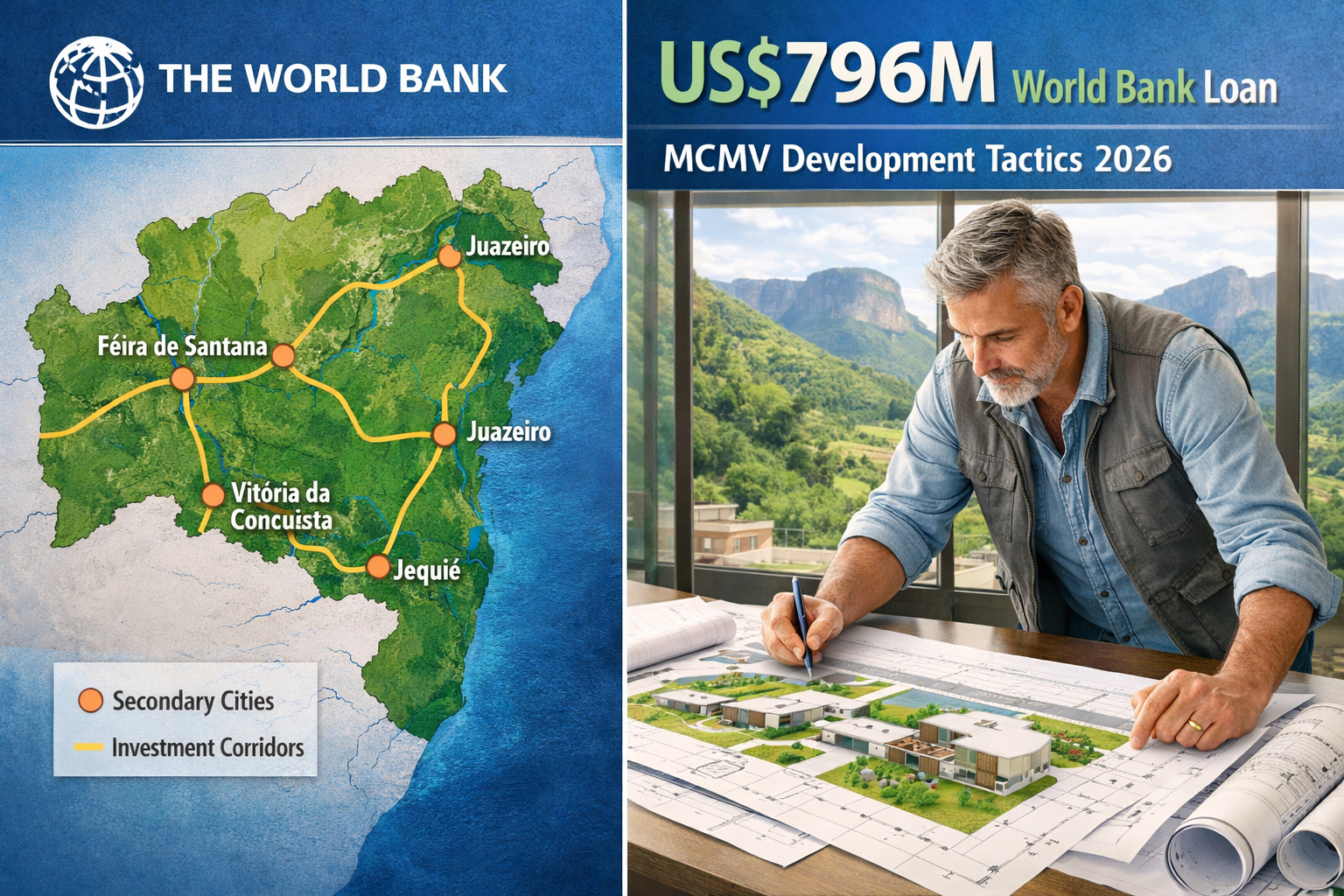
Inland Bahia is experiencing a convergence of forces that rarely align so cleanly. On March 20, 2026, the World Bank approved a US$796 million loan to support Bahia’s economic competitiveness through infrastructure improvements, digital transformation, and clean energy initiatives [4]. The operation includes parameters for electric vehicle charging infrastructure, low-carbon biofuels, biomethane promotion, and expanded distributed renewable energy in rural areas — all designed to generate employment and attract private investment [4].
For real estate developers, this translates into a straightforward thesis: infrastructure investment precedes property appreciation. Cities along Bahia’s interior corridors — including those near the Chapada Diamantina, the São Francisco River valley, and the western agricultural frontier — are seeing improved road connectivity, expanded energy grids, and growing service economies. These are the preconditions for sustained housing demand.
Specific MCMV tactics that are gaining traction in inland Bahia:
- 🏗️ Phased development near municipal growth axes: Partnering with local governments to develop land adjacent to planned infrastructure corridors, securing low entry costs before World Bank-funded improvements are complete.
- 🌿 Eco-residence positioning near protected areas: The Chapada Diamantina National Park and surrounding buffer zones attract eco-tourism workers, environmental professionals, and remote workers — a demographic that values green amenities and is willing to pay above MCMV floor prices.
- ⚡ Renewable energy integration: Incorporating solar panels and biomethane connections into MCMV-eligible projects aligns with the World Bank’s clean energy agenda and qualifies developments for additional state-level incentives.
- 🤝 Municipal partnership agreements (PPPs): Smaller Bahian municipalities actively compete for MCMV allocations, often offering land grants, expedited permitting, and infrastructure co-investment to attract developers.
Interior São Paulo: The Quiet Powerhouse
Interior São Paulo operates differently from Bahia but is equally compelling. The state’s interior cities benefit from Brazil’s most developed agribusiness economy, a dense highway network, and proximity to the country’s largest consumer market. Cities like Ribeirão Preto, Bauru, Presidente Prudente, and Marília have established universities, regional hospitals, and commercial centers — yet their housing markets remain dramatically underserved relative to demand.
The MCMV program’s priority designation for interior São Paulo reflects a calculated recognition: the state’s housing deficit is concentrated outside the capital, where income levels match MCMV brackets 2 and 3 (families earning up to R$8,000 per month). This bracket offers developers the most attractive margin profile — subsidized financing for buyers, but with price ceilings that allow for quality differentiation.
Key development tactics for interior São Paulo:
- Target agribusiness worker housing near processing hubs — Cities adjacent to sugar-ethanol plants, soybean processing facilities, and cold-chain logistics centers have stable, year-round employment bases that guarantee occupancy.
- Leverage off-plan appreciation dynamics — Buying units before construction completion in secondary markets can generate significant appreciation for early investors, particularly when MCMV financing is confirmed at launch.
- Develop mixed-income clusters — Combining MCMV-eligible units with slightly higher-income market-rate units within the same development creates cross-subsidy opportunities and reduces concentration risk.
- Prioritize urban infill over greenfield — Interior São Paulo cities often have underutilized central land parcels. Infill projects benefit from existing infrastructure and command faster appreciation than peripheral greenfield sites.
The Eco-Residence Niche: High Demand, Resilient Returns
Both inland Bahia and interior São Paulo share a geographic characteristic that forward-thinking developers are actively monetizing: proximity to protected environmental areas. Brazil’s cerrado biome, Atlantic Forest remnants, and river basin conservation zones create natural boundaries around which eco-conscious residential projects can be positioned.
The restructured MCMV program incorporates enhanced environmental and urban planning standards, directly addressing past criticisms about infrastructure quality [2]. This is significant: it means MCMV-funded eco-residences are no longer a contradiction in terms. Projects that integrate:
- Native landscaping and permeable paving
- Rainwater harvesting systems
- Solar energy generation
- Proximity to hiking trails, rivers, or conservation areas
…can qualify for MCMV financing while commanding 10–20% price premiums over standard MCMV units in the same city. The buyer profile for these projects — environmentally conscious families, eco-tourism professionals, remote workers — is growing rapidly and shows lower default rates than traditional MCMV income bracket 1 buyers.
Understanding how real estate development can amplify investment gains is particularly relevant here, as eco-residences near protected areas tend to appreciate faster than the broader secondary city average.
Risks, Mitigation, and the 2026 Outlook
Real Risks That Demand Attention ⚠️
The Secondary Cities Property Boom 2026: MCMV-Driven Development Tactics in Inland Bahia and Interior São Paulo narrative is compelling, but disciplined investors must account for genuine risks:
Interest rate sensitivity: While MCMV uses FGTS funding to insulate buyers from Selic fluctuations, market-rate financing for middle-income buyers remains expensive [3]. Developers targeting brackets 3 and 4 face more rate-sensitive demand. Expectations for a Selic reduction during 2026 would provide relief, but timing remains uncertain [3].
Construction cost inflation: Steel and aluminum prices remain elevated globally. MCMV’s scale provides some demand stability for these supply chains [3], but developers with thin margins in secondary cities must lock in material costs early through forward contracts.
Municipal execution risk: Smaller inland municipalities sometimes lack the administrative capacity to process permits, deliver promised infrastructure, or maintain utility connections on schedule. Due diligence on local government track records is non-negotiable.
Liquidity constraints: Secondary city properties are less liquid than São Paulo or Rio assets. Investors must plan for 3–7 year holding periods to capture full appreciation cycles.
Mitigation Strategies That Work
| Risk | Mitigation Approach |
|---|---|
| Rate sensitivity | Focus on MCMV brackets 1–2 with FGTS financing |
| Cost inflation | Forward contracts on steel/concrete; modular construction |
| Municipal risk | Require infrastructure guarantees before land acquisition |
| Liquidity | Structure for rental yield during hold period |
| Environmental compliance | Engage licensed environmental consultants pre-acquisition |
The Broader Investment Context
For investors already familiar with Brazil’s most promising real estate markets, the secondary cities thesis in 2026 represents a diversification opportunity rather than a wholesale pivot. Coastal markets like Florianópolis continue to perform strongly — understanding what to expect from Brazil’s real estate market provides useful benchmarks for comparing secondary city returns.
The key differentiator in 2026 is that government capital is actively flowing into secondary markets at a scale not seen in previous cycles. With R$15 billion in MCMV funding, a US$796 million World Bank infrastructure commitment to Bahia alone [4], and explicit priority designations for Northeast and interior regions [2], the policy environment has never been more aligned with secondary city investment theses.
Developers and investors who understand how sales performance is transforming Brazil’s real estate landscape will recognize that the same dynamics driving coastal market success — strong demand, limited supply, government support — are now converging in inland markets at a fraction of the entry cost.
Conclusion: Actionable Next Steps for 2026
The Secondary Cities Property Boom 2026: MCMV-Driven Development Tactics in Inland Bahia and Interior São Paulo is not speculative — it is backed by R$15 billion in government funding [2], 2 million already-contracted units [3], a US$796 million World Bank infrastructure commitment [4], and structural housing deficits that will take years to close. The question for developers and investors is not whether this opportunity exists, but whether they have the positioning and tactics to capture it.
Actionable next steps:
- ✅ Map MCMV priority municipalities in inland Bahia and interior São Paulo using Caixa Econômica Federal’s updated regional allocation data — focus on cities with populations of 80,000–250,000 and confirmed infrastructure investment pipelines.
- ✅ Evaluate eco-residence sites within 20–50 km of protected environmental areas where MCMV’s enhanced urban planning standards create a premium positioning opportunity.
- ✅ Engage municipal governments early to negotiate land partnerships, permitting timelines, and infrastructure co-investment commitments before competing developers arrive.
- ✅ Structure for FGTS-eligible buyers in brackets 1–3 to maximize financing accessibility and sales velocity regardless of Selic rate movements.
- ✅ Build in a 3–5 year appreciation horizon with rental yield coverage during the hold period to manage liquidity risk in secondary markets.
- ✅ Monitor World Bank disbursement milestones in Bahia — each infrastructure completion event is a price appreciation catalyst for nearby residential developments [4].
The developers who move now — before secondary city land prices fully reflect the incoming capital flows — will be the ones writing the case studies in 2028. To explore current development opportunities aligned with these principles, visit Quadragon’s active projects or get in touch with the team to discuss investment positioning in Brazil’s emerging property markets.
References
[1] Brazil Property Market In 2026 A Strategic Outlook For Investors – https://www.exclusiverealtybrasil.com/article/brazil-property-market-in-2026-a-strategic-outlook-for-investors
[2] Brazil Real Estate Market Trends 2026 – https://www.riotimesonline.com/brazil-real-estate-market-trends-2026/
[3] Brazils Construction Sector 2026 Housing Programs Support Rates High Risks Persist – https://www.fastmarkets.com/insights/brazils-construction-sector-2026-housing-programs-support-rates-high-risks-persist/
[4] World Bank Supports Better Infrastructure And More Jobs In Bahia – https://www.worldbank.org/en/news/press-release/2026/03/20/world-bank-supports-better-infrastructure-and-more-jobs-in-bahia