
Brazil’s two largest cities are quietly pushing Airbnb investors toward its most beautiful coastlines. As Rio de Janeiro and São Paulo move toward stricter short-term rental rules in 2026, a measurable capital shift is already underway — and the winners are resort-oriented markets like Florianópolis and João Pessoa, where regulatory leniency, digital nomad demand, and 20%+ projected yields are converging in a rare alignment.
Understanding Airbnb Regulation Shifts 2026: Compliance Strategies for High-Yield Coastal Developments in Florianópolis and João Pessoa is no longer optional for serious investors. It is the difference between a compliant, high-performing asset and a costly regulatory misstep in a rapidly maturing market.
Key Takeaways 📌
- All 100 ranked Airbnb markets in Brazil currently hold low-regulation profiles in 2026, but Rio and São Paulo are expected to tighten rules — making coastal resort towns far more attractive [2]
- Florianópolis is Brazil’s most stable, fastest-growing southern market, with Jurerê Internacional leading in capital appreciation and seasonal rental rates [1]
- João Pessoa offers an emerging, lower-entry alternative with strong infrastructure and growing international tourist appeal
- Digital nomad demand is driving premium rents for properties with fiber internet and home office spaces — a compliance-friendly differentiator [1]
- Professional property management is the single most critical compliance tool for foreign investors navigating Brazil’s evolving short-term rental landscape [1]
Why Regulatory Pressure in Rio and São Paulo Is Redirecting Capital to Coastal Resorts
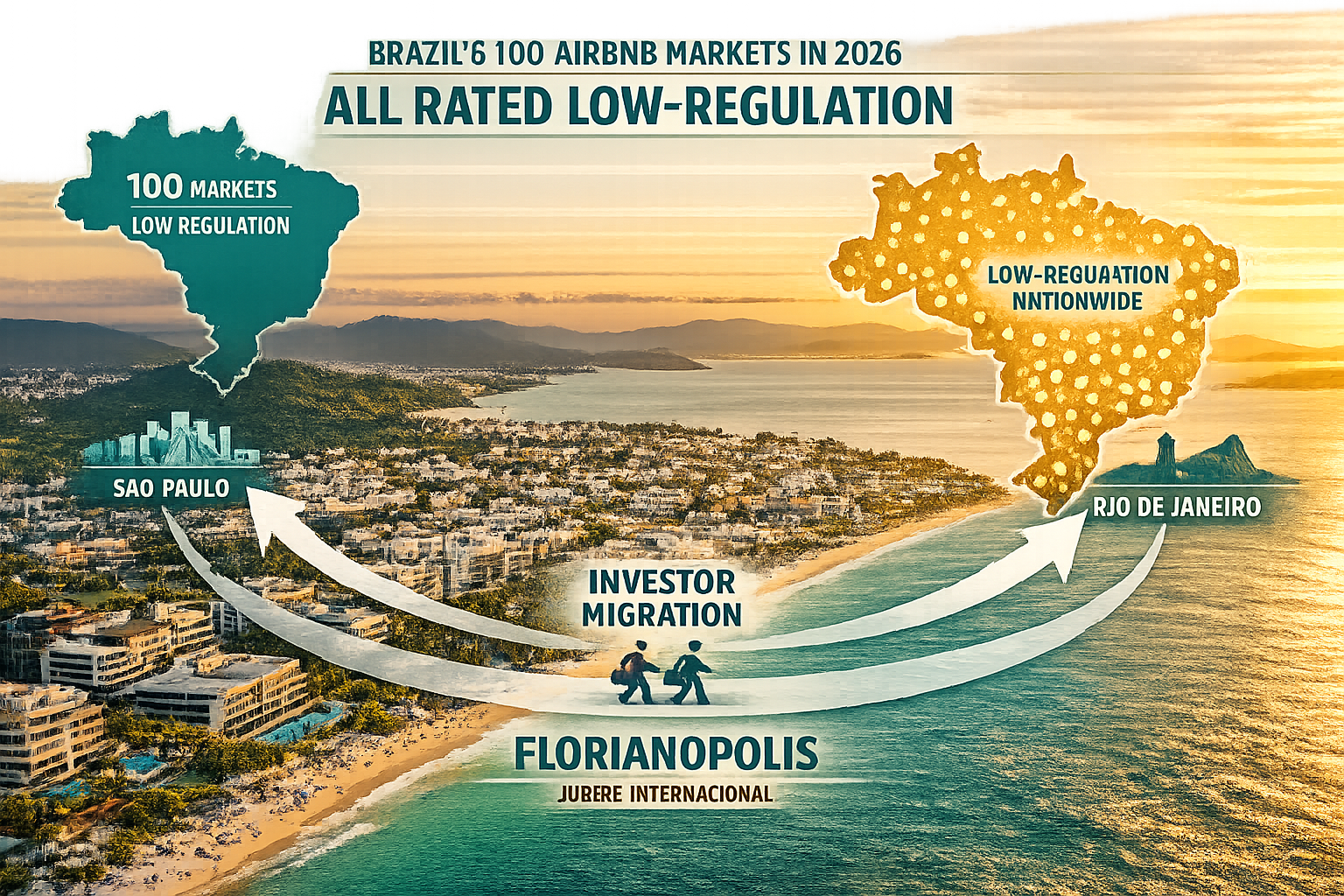
Brazil’s short-term rental market has operated in a uniquely permissive environment. As of 2026, every one of the country’s 100 ranked Airbnb markets maintains a low regulation profile — zero markets are classified as medium or high regulation [2]. However, this landscape is shifting fast, and not uniformly.
Rio de Janeiro and São Paulo — Brazil’s two dominant urban markets — are actively moving toward stricter short-term rental frameworks in 2026. These include potential licensing requirements, zoning restrictions, and increased taxation on Airbnb income [1]. For investors already operating in these cities, the compliance burden is rising. For those evaluating new entry points, the calculus is clear: smaller, dedicated resort communities offer a structurally more favorable regulatory environment [1].
This is precisely where Florianópolis and João Pessoa enter the picture.
💬 “Smaller communities like Florianópolis and João Pessoa present compliance advantages compared to major metropolitan centers — and that gap is expected to widen in 2026.” [1]
The Numbers Behind the Market Opportunity
Brazil’s Airbnb ecosystem, even at its current baseline, is substantial:
| Metric | National Average (Brazil) |
|---|---|
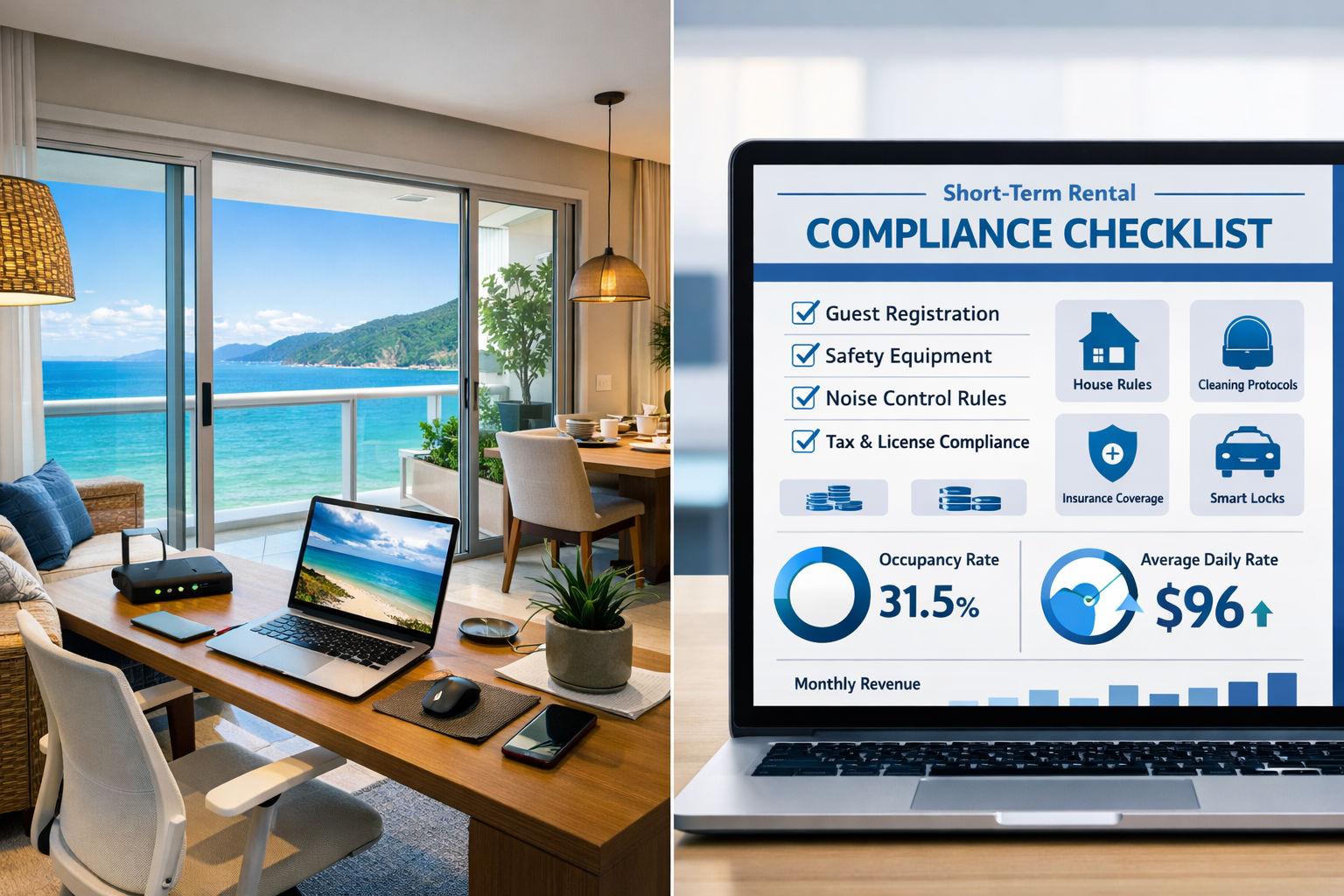
| Average Occupancy Rate | 31.5% |
| Average Monthly Revenue | $605 USD |
| Average Daily Rate (ADR) | $96 USD |
| Largest Market (São Paulo) | 28,184 active listings |
| São Paulo Monthly Revenue | $543 USD [2] |
What these numbers reveal is that São Paulo, despite being the largest market, generates below-average monthly revenue — a signal that scale alone does not guarantee yield. Coastal resort markets, by contrast, can generate significantly higher ADRs during peak seasons, particularly when properties are positioned correctly.
For investors exploring the best places to invest in Brazilian property, the data increasingly points toward the coast over the city.
Florianópolis: The Compliance-Friendly Market With Premium Yield Potential
Florianópolis is not a hidden gem — it is a well-documented success story. Described as “the most stable and fastest-growing market in the South,” the island capital of Santa Catarina combines high quality of life, superior security, and a robust local economy into a package that is almost uniquely attractive for short-term rental investment [1].
The city’s appeal to digital nomads and remote workers is a structural advantage, not a trend. Brazil’s time zone alignment with the U.S. East Coast makes Florianópolis a natural base for North American remote workers, and properties offering dedicated home office spaces and excellent fiber internet consistently command premium rental rates [1].
Jurerê Internacional: The Benchmark for High-Yield Coastal Development
Within Florianópolis, the luxury beach zone of Jurerê Internacional stands out as the benchmark for 2026 investment performance. Analysts predict continued strength in both capital appreciation and seasonal rental rates, driven by:
- 🏖️ Exclusive beach access and resort-grade infrastructure
- 🌐 International guest demand from Europe, the U.S., and Argentina
- 🏗️ Limited new supply relative to demand growth
- 📈 Strong capital gains trajectory even as yield compression affects other markets [1]
The Ingleses region of Florianópolis is another area gaining traction, offering quality of life, growing infrastructure, and strong valuation growth for investors seeking entry at lower price points than Jurerê.
For a broader picture of what daily life and investment conditions look like on the island, the complete guide to living in Florianópolis provides essential context for both lifestyle buyers and pure investors.
Compliance Advantages Specific to Florianópolis
Unlike São Paulo’s increasingly complex regulatory environment, Florianópolis has maintained a developer- and operator-friendly stance on short-term rentals. Key compliance considerations include:
- Municipal licensing: Currently streamlined for resort-zone properties
- Condominium rules: Many purpose-built developments explicitly permit short-term rentals
- Foreign ownership: Permitted in coastal areas, though specific land-use regulations require legal consultation [3]
- Tax treatment: Short-term rental income is taxable in Brazil; proper structuring through a local entity can optimize the tax position
⚠️ Important: Foreign nationals can generally own property in Brazil, but coastal areas carry specific land-use regulations. Always consult a qualified Brazilian real estate attorney before purchasing [3].
João Pessoa: The Emerging Compliance Frontier for Airbnb-Optimized Developments
While Florianópolis commands the headlines, João Pessoa is quietly building a compelling case as the northeast’s premier short-term rental investment destination. As the capital of Paraíba state, João Pessoa offers:
- 🌅 300+ days of sunshine annually, extending the peak rental season
- 💰 Lower entry prices compared to Florianópolis, improving gross yield potential
- 🛫 Growing international connectivity, with expanding flight routes from Europe
- 🏗️ Active development pipeline in beachfront zones like Cabo Branco and Tambaú
The regulatory environment in João Pessoa remains firmly in the low-regulation category as of 2026 [2], and the city’s municipal government has shown interest in attracting tourism investment rather than restricting it. This creates a window of opportunity for developers and investors to establish positions before market maturation triggers the same regulatory tightening seen in Brazil’s major cities.
Digital Nomad Infrastructure as a Compliance-Compatible Differentiator
One of the most powerful — and regulation-proof — strategies for maximizing yield in both Florianópolis and João Pessoa is positioning properties for the digital nomad segment. This approach works because:
- It targets longer stays (30+ days), which often fall outside the strictest short-term rental regulations
- It commands premium rates for verified high-speed fiber internet and dedicated workspaces
- It reduces turnover costs and management complexity
- It aligns with Brazil’s growing digital nomad visa framework, attracting higher-income international tenants [1]
Properties that combine ocean views, private pools, and fiber internet are consistently outperforming standard vacation rentals in both markets [1]. This is not coincidental — it reflects the experience economy shift that has redefined what premium short-term rental guests expect post-pandemic.
Core Compliance Strategies for High-Yield Coastal Developments in 2026
Navigating Airbnb Regulation Shifts 2026: Compliance Strategies for High-Yield Coastal Developments in Florianópolis and João Pessoa requires a structured approach. The following framework addresses the most critical compliance dimensions for international investors.
1. 🏢 Engage a Reputable, Compliant Property Management Partner
This is the single most important step. The ability to engage reputable, compliant property management services is identified as paramount for international owners navigating anticipated regulatory changes [1]. A qualified local manager provides:
- Regulatory monitoring: Tracking municipal and state-level rule changes in real time
- Guest screening and documentation: Ensuring compliance with Brazilian guest registration requirements
- Tax filing support: Managing the monthly and annual tax obligations on rental income
- Maintenance standards: Meeting the quality benchmarks demanded by international guests
For investors considering developments in Florianópolis, projects like Tramonto and Solis are examples of purpose-built developments designed with professional management integration in mind.
2. 📋 Structure Ownership Correctly from Day One
Foreign ownership of Brazilian coastal property is permitted, but the structure matters enormously for both compliance and tax efficiency [3]. Options include:
| Structure | Pros | Cons |
|---|---|---|
| Direct personal ownership | Simple setup | Higher personal tax exposure |
| Brazilian LTDA (LLC) | Tax optimization, liability protection | Setup cost, ongoing compliance |
| Real estate holding company | Best for multiple properties | Most complex, higher cost |
Legal consultation with a Brazilian real estate and tax attorney is non-negotiable before purchase [3].
3. 🌐 Build Fiber Internet and Home Office Infrastructure Into the Development
This is not merely a marketing feature — it is a compliance-compatible yield multiplier. Properties with verified gigabit fiber internet and dedicated home office spaces command higher nightly rates and attract longer-stay guests, reducing regulatory exposure in markets where very short stays face the most scrutiny [1].
4. 📊 Monitor Capital Gains vs. Yield Dynamics
While Airbnb regulations are tightening in 2026, capital-gains prospects are expected to offset yield compression in major markets [3]. In Florianópolis and João Pessoa, the combination of rising property values and strong rental demand means total return (yield + appreciation) remains highly attractive even if net rental yields face modest pressure.
Investors who buy pre-construction (na planta) in these coastal markets have historically captured the strongest appreciation gains, entering at lower prices before infrastructure improvements and demand growth push values higher.
5. 🏗️ Choose Developments Built for Short-Term Rental Compliance
Not all condominiums permit short-term rentals. Condominium bylaws (convenção de condomínio) in Brazil can restrict or outright prohibit Airbnb-style lettings. Investors must verify:
- ✅ Explicit short-term rental permission in the condominium convention
- ✅ Dedicated check-in/check-out infrastructure
- ✅ On-site or affiliated property management services
- ✅ Compliance with municipal tourism licensing requirements
Developments specifically designed for the short-term rental market — such as those listed in the Quadragon developments portfolio — typically address these requirements by design.

The Investment Case: Why 2026 Is the Right Entry Window
The convergence of regulatory pressure in major cities, digital nomad demand, and relatively low entry costs in Florianópolis and João Pessoa creates a time-sensitive opportunity. Here is why 2026 represents an optimal entry window:
- Regulatory arbitrage: The gap between lenient coastal resort regulations and tightening urban rules is at its widest point
- Pre-maturation pricing: Both markets, particularly João Pessoa, are still in growth phases before institutional capital dominates
- Infrastructure investment: Government and private investment in both cities is accelerating, driving property values
- Remote work permanence: The digital nomad demand driver is structural, not cyclical
The Florianópolis real estate market outlook confirms the upward trajectory, with strong sales performance and rising values across key neighborhoods. Investors who understand the advantages of studio apartments in Florianópolis as short-term rental assets will find this format particularly well-suited to the digital nomad segment.
Conclusion: Actionable Next Steps for Compliant, High-Yield Coastal Investment
The Airbnb Regulation Shifts 2026: Compliance Strategies for High-Yield Coastal Developments in Florianópolis and João Pessoa landscape rewards investors who move with both speed and structure. The regulatory window is open, the demand drivers are real, and the compliance framework — while evolving — remains manageable for well-prepared investors.
Here are the concrete next steps to take in 2026:
- Identify compliant developments in Florianópolis (Jurerê Internacional, Ingleses) or João Pessoa (Cabo Branco, Tambaú) that explicitly permit short-term rentals in their condominium conventions
- Engage a Brazilian real estate attorney to structure ownership correctly before signing any purchase agreement — especially for foreign nationals navigating coastal land-use rules [3]
- Partner with a licensed property management company with a proven track record in short-term rental compliance in your target market [1]
- Prioritize fiber internet and home office infrastructure in your property selection or development brief to capture the premium digital nomad segment
- Monitor municipal regulatory developments in both cities quarterly — the low-regulation window will not remain open indefinitely [2]
- Calculate total return, not just yield — factor in capital appreciation projections alongside rental income, particularly in Florianópolis where both are strong [1]
For investors ready to explore specific opportunities, contact Quadragon to discuss compliant, high-yield coastal developments currently available in Florianópolis.
The cities of Rio and São Paulo are tightening their grip on short-term rentals. The beaches of Florianópolis and João Pessoa are welcoming the capital that flows out. The compliance strategies are clear. The window is open. The question is whether investors act before the market catches up.
References
[1] Brazil Property Market Predictions For 2026 – https://esalesinternational.com/2025/11/20/brazil-property-market-predictions-for-2026/ [2] Brazil – https://www.airroi.com/airbnb-data/brazil [3] Brazil Buying Property – https://www.expatfocus.com/brazil/guide/brazil-buying-property [4] The Threat Of Short Term Rentals To Housing En – https://insideairbnb.com/reports/the-threat-of-short-term-rentals-to-housing-en.pdf