

Brazil’s benchmark interest rate, the Selic, spent most of 2025 above 13% — and the hangover is now showing up in every developer’s balance sheet. Thousands of units launched during the post-pandemic boom remain unsold, creating a carryover stock problem that is fundamentally altering how, when, and at what price new projects reach the market in 2026.
The Property Inventory Glut in 2026: Why High Selic Carryover Stock Is Reshaping Developer Launch Strategies is not a theoretical concern — it is a live operational crisis reshaping boardroom decisions from São Paulo to Florianópolis. Understanding the mechanics behind this glut, and the tactical responses developers are deploying, is essential for investors, buyers, and industry professionals navigating this environment.

Key Takeaways 📌
- Elevated Selic rates from 2024–2025 inflated financing costs, slowing absorption and creating a large carryover inventory entering 2026.
- Developers are delaying new launches until existing stock clears, prioritizing cash flow and debt reduction over growth.
- Pricing strategies have shifted toward flexible payment plans, incentive packages, and selective discounting to move legacy units.
- Markets with strong fundamentals — like coastal cities with high demand and limited land — are proving more resilient than oversupplied urban centers.
- Disciplined capital allocation is now the defining competitive advantage, rewarding developers who planned conservatively during the rate cycle peak.
Understanding the Carryover Stock Problem
The term “carryover stock” refers to units that were launched in a prior period but remain unsold when a new sales cycle begins. In a high-interest-rate environment, this inventory accumulates faster than developers can clear it.
How the Selic Rate Created the Glut
When the Selic rate climbed aggressively through 2024 and held elevated through 2025, two forces converged:
- Buyer financing costs rose sharply, reducing purchasing power and disqualifying a segment of previously eligible buyers.
- Developer carrying costs increased, as construction financing tied to benchmark rates became more expensive to service month over month.
The result was a classic demand-supply mismatch. Units that were financially viable for buyers at a 10% Selic became difficult to absorb at 13%+. Developers who had already broken ground — committed to construction timelines and contractor payments — had no easy exit. They had to continue building and selling into a weakened demand environment.
💬 “For owners and developers, 2026 favors disciplined capital expenditure planning and sharper attention to value-driving details.” — BBG Real Estate Solutions [1]
This dynamic is not unique to Brazil. Globally, inventory accumulation is accelerating. U.S. active housing inventory is forecast to rise by an average of 9.9% in 2026 across multiple analyst projections, driven by similar rate-driven demand suppression [6]. The Warren Group notes that inventory volumes are expected to test agents and lenders in 2026, tied to demographic shifts, build rates, and local policy factors [3]. Brazil’s Selic-driven version of this story is simply more acute because of the steeper rate environment.
How the Property Inventory Glut in 2026 Is Forcing a Strategy Reset
The Property Inventory Glut in 2026: Why High Selic Carryover Stock Is Reshaping Developer Launch Strategies is most visible in the tactical pivots developers are making right now. These are not minor adjustments — they represent a fundamental rethinking of the development cycle.
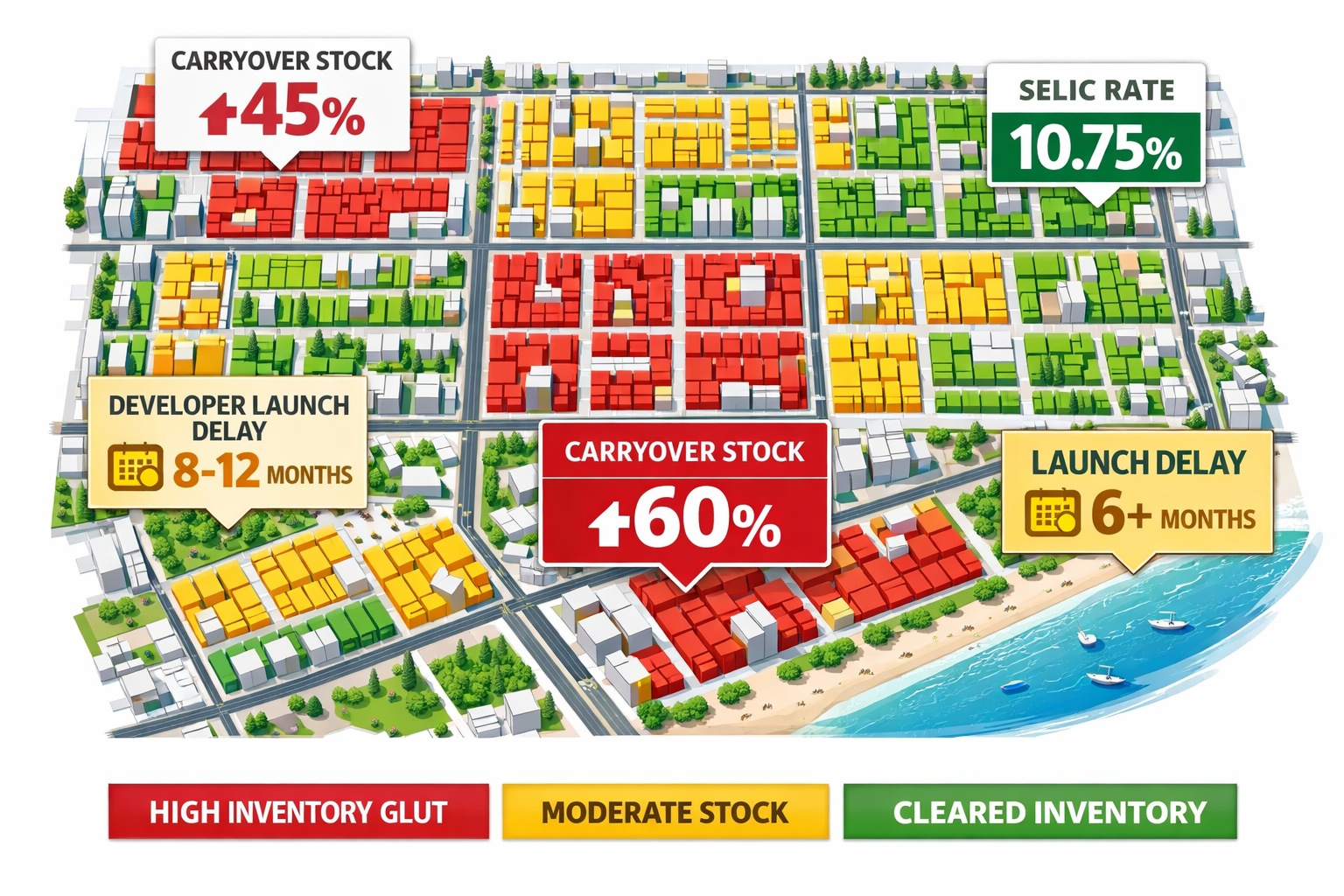
Tactic 1: Launch Moratoriums — Pausing New Projects
The most dramatic response is the simplest: stop launching new projects until existing inventory clears.
This is counterintuitive for growth-oriented developers, but it is financially rational. Launching a new project while carrying unsold units from a prior phase creates several compounding problems:
- Sales teams are split between closing legacy stock and generating pre-sales for new launches.
- Brand perception suffers when buyers see older units still available alongside a shiny new campaign.
- Lender confidence erodes when a developer’s balance sheet shows growing unsold inventory.
Many mid-sized developers in Brazil’s major urban markets have quietly paused their 2026 launch calendars, waiting for absorption rates to improve. This is consistent with global trends — real estate recovery in 2026 is being described as selective and precision-driven rather than broad-based [1].
Tactic 2: Repricing and Incentive Packages
Where pausing is not an option — because construction loans require pre-sales milestones — developers are repricing aggressively and bundling incentives.
Common incentive structures in 2026 include:
| Incentive Type | Description |
|---|---|
| Extended payment terms | Stretching installment plans to reduce monthly buyer burden |
| Furniture/fit-out packages | Adding value without reducing headline price |
| Reduced entry deposits | Lowering the upfront barrier to reservation |
| Rate buydowns | Subsidizing buyer financing costs for a fixed period |
| Guaranteed rental yield | Offering short-term yield guarantees on investment units |
These tactics preserve nominal pricing — important for appraisal comparables and future project valuations — while making the effective cost of ownership more competitive.
Tactic 3: Segment and Market Pivots
Not all product types are equally affected by the inventory glut. Developers are analyzing their portfolios and pivoting toward segments showing stronger absorption:
- Compact studio and one-bedroom units in high-demand urban and coastal locations continue to attract investor buyers less dependent on traditional mortgage financing.
- Mid-market family units in oversupplied suburban corridors face the steepest absorption challenges.
- Premium and luxury segments in supply-constrained markets are holding firmer, as wealthier buyers are less sensitive to financing costs.
For example, the advantages of investing in studios in Florianópolis have become increasingly clear in this environment — compact investment units in coastal markets tend to attract cash-rich or low-leverage buyers who are insulated from Selic-driven financing pressure.
Regional Divergence: Not All Markets Are Equal
One of the most important insights in the Property Inventory Glut in 2026: Why High Selic Carryover Stock Is Reshaping Developer Launch Strategies is that the glut is not uniform across Brazil. Regional fundamentals matter enormously.
Markets Showing Resilience 🟢
Coastal and lifestyle markets — particularly in the Greater Florianópolis region — have demonstrated stronger absorption relative to national averages. Several factors explain this:
- Constrained land supply limits the ability of developers to flood the market with new units.
- Strong lifestyle migration demand from higher-income households relocating from São Paulo and Rio de Janeiro sustains buyer interest.
- Tourism-driven rental demand makes investment units attractive even in a high-rate environment.
The real estate market in Greater Florianópolis has been one of Brazil’s standout performers, with sales performance transforming the Florianópolis market even as national conditions tightened.
Markets Under Pressure 🔴
Oversupplied suburban corridors in major metropolitan areas face the most acute inventory challenges. These markets share common characteristics:
- Large volumes of similar product launched in a short window (2022–2024)
- Buyer profiles heavily dependent on Caixa Econômica Federal financing
- Limited differentiation between competing projects
In these markets, the carryover stock problem is most severe, and developer strategy pivots are most urgent.
The Financial Mechanics: Why Clearing Stock Before Launching Matters
From a pure financial engineering perspective, the case for clearing carryover stock before launching new projects is compelling.
Cash Flow and Debt Service
Every unsold unit represents:
- Ongoing carrying costs (property taxes, maintenance, insurance)
- Construction loan interest still accruing if the project is not fully paid off
- Opportunity cost of capital tied up in unsold inventory
Launching a new project on top of this burden compounds the cash flow strain. Development is favored over acquisition in selected situations due to higher potential IRRs and more control over timing and market entry — but this advantage disappears when the developer’s balance sheet is already stressed by legacy inventory [5].
The Pre-Sales Threshold Problem
Brazilian real estate development is heavily dependent on pre-sales (vendas na planta) to unlock construction financing. Banks typically require 30–40% of units to be pre-sold before releasing credit. When the market is soft and buyers are cautious, hitting this threshold becomes harder — and launching a new project before clearing existing stock makes it even harder, because sales teams and buyer attention are divided.
💡 Key insight: Developers who clear their carryover stock first enter new launch campaigns with a cleaner balance sheet, stronger lender relationships, and undivided sales focus — a significant competitive advantage.
The value of buying off-plan — why off-plan investment can amplify returns — remains intact for buyers, but only when the developer behind the project has the financial stability to deliver. In a glut environment, developer selection becomes as important as project selection.
What Smart Developers Are Doing Differently in 2026
The developers navigating the inventory glut most effectively share a set of common practices.

1. Data-Driven Launch Timing
Rather than launching on a fixed calendar, leading developers are using absorption rate data to time launches dynamically. The question is no longer “when is our project ready?” but “when is the market ready for our project?”
This requires investment in real-time market intelligence — tracking competitor absorption rates, financing approval volumes, and buyer inquiry trends.
2. Phased Development Structures
Developers with large land banks are restructuring projects into smaller, sequential phases. Instead of launching 300 units at once, they launch 80 units, sell through, then launch the next phase. This:
- Reduces pre-sales pressure per phase
- Allows pricing to be adjusted between phases based on market conditions
- Limits exposure if market conditions deteriorate further
3. Strengthening the Value Proposition
In a buyer’s market, product differentiation becomes critical. Developers are investing in:
- Sustainability credentials (LEED, AQUA certifications)
- Technology integration (smart home features, fiber connectivity)
- Community amenities that justify premium pricing
- Location storytelling — emphasizing neighborhood growth and infrastructure investment
The growth of the Ingleses region in Florianópolis is a strong example of how neighborhood development and quality-of-life improvements can sustain demand even in a challenging macro environment.
4. Exploring Alternative Financing Structures
With traditional mortgage financing constrained by high Selic rates, developers and buyers are exploring alternatives:
- Developer-financed installment plans that bypass bank financing entirely
- Consortium (consórcio) structures as a rate-insensitive acquisition path
- Institutional investor partnerships to absorb bulk inventory at negotiated prices
- Cryptocurrency and tokenization as emerging tools — crypto and real estate development represents a growing frontier for innovative developers seeking new capital channels
Investor Implications: Opportunity Within the Glut
The inventory glut is not uniformly bad news. For informed investors, it creates specific opportunities.
Where Value Is Emerging
| Opportunity Type | Why It Works in 2026 |
|---|---|
| Distressed developer inventory | Motivated sellers accepting below-list pricing on completed units |
| Pre-sales in financially strong projects | Developers with clean balance sheets offering competitive terms to hit pre-sales thresholds |
| Supply-constrained coastal markets | Limited new supply means existing inventory clears faster |
| Rental-yield plays | High demand for rental housing as buyers delay purchases |
Global real estate strategy in 2026 is increasingly focused on navigating dispersion — the gap between performing and underperforming assets is widening, and selectivity is the defining skill [9]. The same principle applies in Brazil: the glut creates losers and winners, and the difference lies in market selection and developer quality.
For those exploring the best places to invest in Brazilian property, the current environment rewards research and patience over momentum-chasing.
Looking Ahead: When Does the Glut Clear?
Several indicators will signal the beginning of inventory normalization:
- Selic rate cuts reducing financing costs and re-qualifying sidelined buyers
- Absorption rate improvement in key urban markets
- Developer launch volumes declining as the industry self-corrects
- Pre-sales velocity recovering on new launches
The Warren Group notes that as the spread between older low-rate mortgages and current rates narrows, more sellers enter the market — a dynamic that could eventually accelerate absorption by increasing transaction volume [3]. In Brazil’s context, a similar mechanism applies: as Selic rates ease, the gap between carrying costs and buyer affordability narrows, unlocking pent-up demand.
Morgan Stanley’s real estate outlook for 2026 points to a recovery that is underway but uneven — with fundamentals improving in select segments while others remain challenged [2]. Brazil fits this global pattern precisely.
Conclusion: Discipline Is the New Growth Strategy
The Property Inventory Glut in 2026: Why High Selic Carryover Stock Is Reshaping Developer Launch Strategies is ultimately a story about the cost of optimism meeting the reality of rate cycles. Developers who over-launched during the low-rate window are now managing the consequences. Those who planned conservatively are positioned to capture market share as conditions normalize.
Actionable Next Steps for Key Stakeholders
For developers:
- ✅ Conduct a rigorous inventory audit — know your exact absorption timeline before committing to new launches
- ✅ Restructure incentive packages to move legacy stock without destroying comparable pricing
- ✅ Explore phased development structures for future projects to reduce concentration risk
For investors:
- ✅ Target supply-constrained markets with strong lifestyle or rental demand fundamentals
- ✅ Prioritize developers with clean balance sheets and proven delivery track records
- ✅ Consider off-plan purchases in well-capitalized projects where pre-sales discounts are available
For buyers:
- ✅ Use the buyer’s market conditions to negotiate — incentive packages are available for those who ask
- ✅ Verify developer financial health before committing to off-plan purchases
- ✅ Focus on locations with structural demand drivers that will outlast the current rate cycle
The developers and investors who treat 2026’s inventory glut not as a crisis but as a market-clearing mechanism will be best positioned when the next growth cycle begins. Precision, patience, and financial discipline are the currencies that matter most right now.
To explore developments built on exactly these principles, visit Quadragon’s current project portfolio or get in touch with the team to discuss how these market dynamics apply to specific investment decisions.
References
[1] 2026 Commercial Real Estate Outlook Stabilization Selectivity And A Market That Rewards Precision – https://bbgres.com/2026-commercial-real-estate-outlook-stabilization-selectivity-and-a-market-that-rewards-precision/
[2] Real Estate Market Outlook 2026 Recovery – https://www.morganstanley.com/insights/articles/real-estate-market-outlook-2026-recovery
[3] 2026 Real Estate Mortgage Data Outlook Inventory Credit Access And Tech Shifts To Watch – https://www.thewarrengroup.com/blog/2026-real-estate-mortgage-data-outlook-inventory-credit-access-and-tech-shifts-to-watch/
[5] 2026 Economic Outlook Twin Engines Of Growth Set To Drive Real Estate Recovery – https://www.aprio.com/insights-events/2026-economic-outlook-twin-engines-of-growth-set-to-drive-real-estate-recovery-ins-article-re/
[6] Housing Market Inventory Forecast 2026 Roundup – https://www.resiclubanalytics.com/p/housing-market-inventory-forecast-2026-roundup
[9] Navigating Dispersion Real Estate Strategies For 2026 – https://www.barings.com/en-us/institutional/perspectives/viewpoints/navigating-dispersion-real-estate-strategies-for-2026-realestate-vwpt