
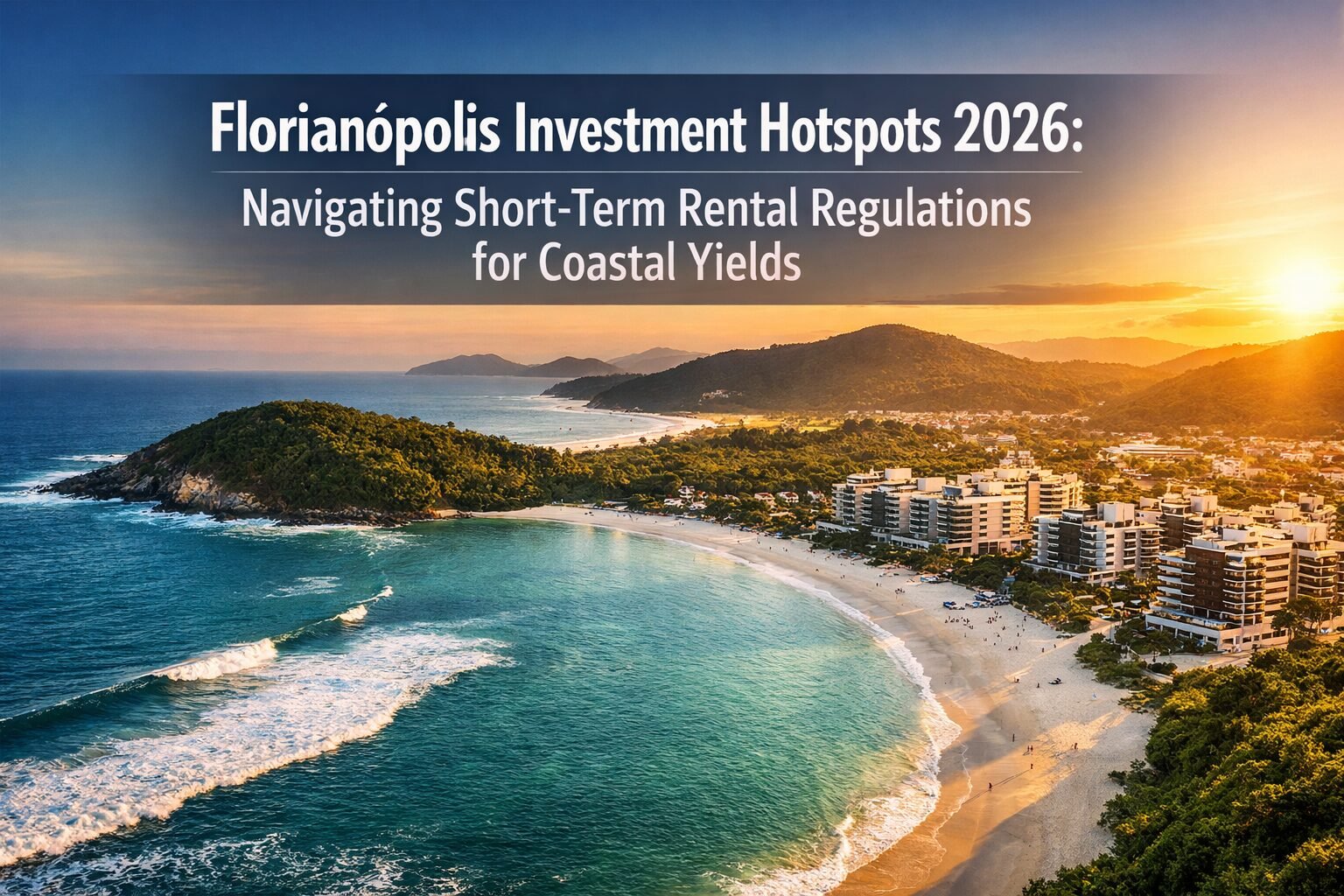
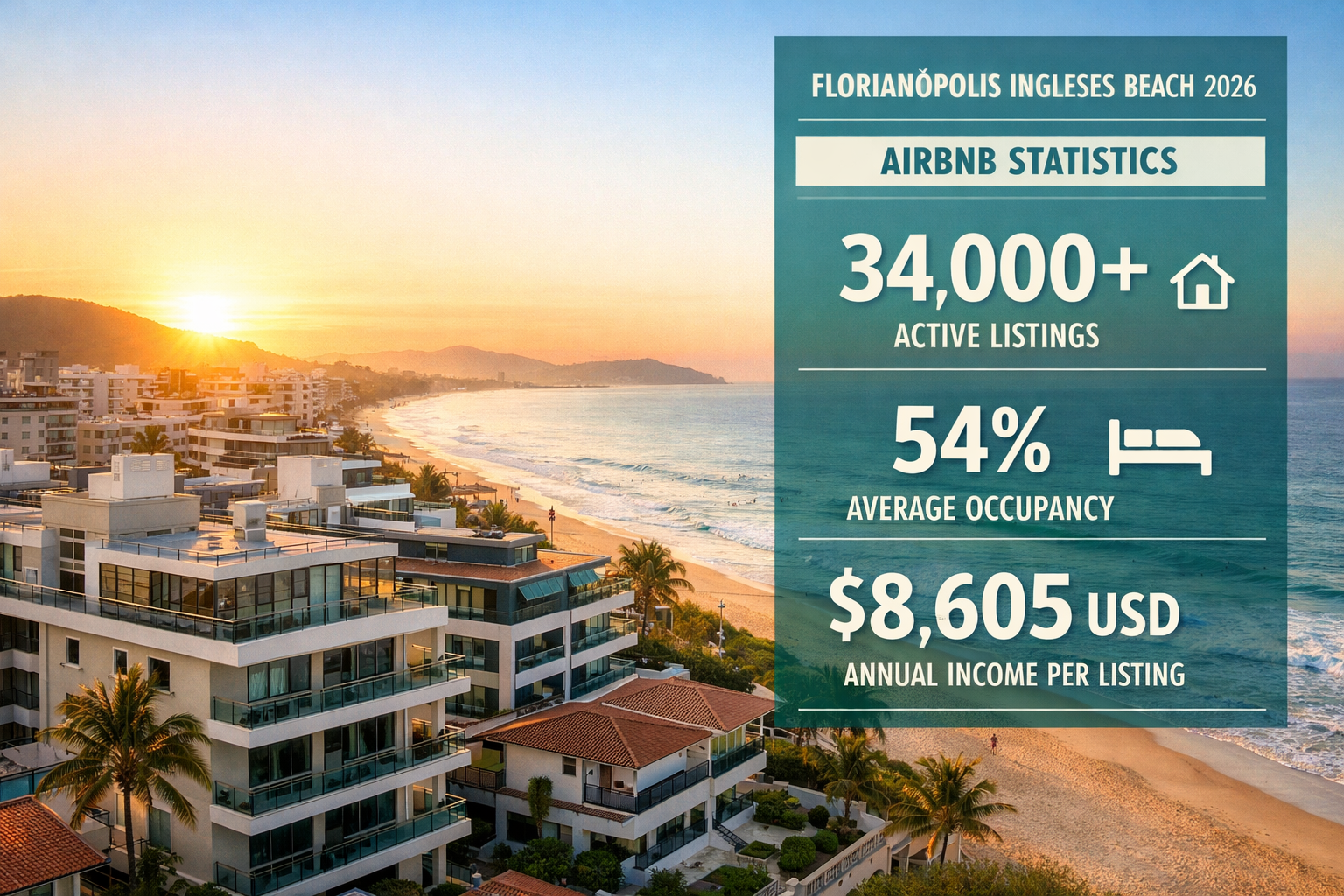
Brazil’s Santa Catarina island attracted over 34,000 active Airbnb listings by early 2026 — making Florianópolis the country’s third-largest short-term rental market after Rio de Janeiro and São Paulo [1]. Yet supply grew by a staggering 64.9% in the 12 months through March 2026, flooding certain neighborhoods with competing units and compressing net yields well below headline figures [2]. For international investors eyeing coastal returns, the gap between gross and net performance has never been wider — or more consequential.
This guide to Florianópolis Investment Hotspots 2026: Navigating Short-Term Rental Regulations for Coastal Yields cuts through the noise. It maps the strongest neighborhoods, decodes the 2026 regulatory environment, and outlines compliant development strategies that protect capital while maximizing Airbnb income. Whether buying off-plan or managing an existing portfolio, understanding the rules is no longer optional — it is the competitive advantage.
Key Takeaways 📌
- Gross yields average 5.6%, but net yields for non-resident foreign owners compress to 3.0–4.0% after taxes, fees, and vacancy [1].
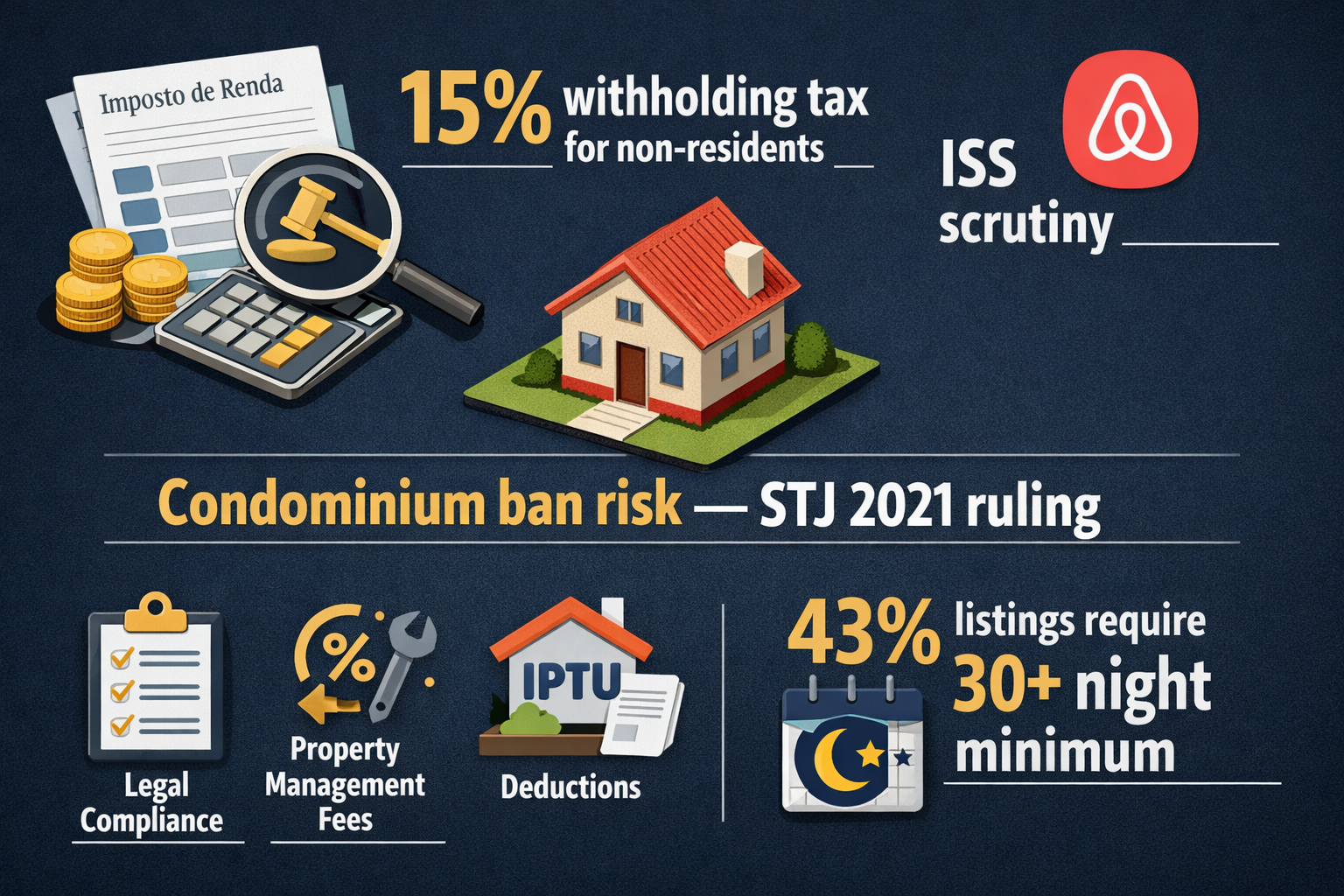
- A 15% flat withholding tax on gross rental income applies to non-residents with no deductions permitted — a critical cost foreign buyers often underestimate [1].
- 43% of listings now require a 30+ night minimum stay, signaling a structural market shift toward mid-term rentals [2].
- Condominium rules — not municipal law — represent the single largest legal risk for short-term rental operators in 2026 [1].
- Neighborhoods like Ingleses, Jurerê Internacional, and Lagoa da Conceição remain the top hotspots for yield-to-risk balance in 2026.
The 2026 Market Landscape: Supply Surge and Yield Compression
The Florianópolis short-term rental market entered 2026 at an inflection point. Rapid supply expansion has not been matched by equivalent demand growth, creating pockets of oversupply in previously reliable neighborhoods.
Key Performance Metrics at a Glance
| Metric | 2026 Figure |
|---|---|
| Active Airbnb Listings | 34,000+ |
| Supply Growth (12 months to March 2026) | 64.9% |
| Average Nightly Rate | ~$92 USD (≈ R$550) |
| Average Annual Occupancy | 54% |
| Average Annual Income per Listing | $8,605 USD |
| RevPAR | $42 USD |
| Gross Rental Yield | ~5.6% |
| Net Yield (non-resident foreign owner) | 3.0–4.0% |
Sources: [1][2]
💡 Pull Quote: “A gross yield of 5.6% sounds attractive until the 15% withholding tax, management fees, and seasonal vacancy are factored in — net returns can halve for unprepared foreign investors.”
Seasonality: The Double-Edged Sword 🌊
Florianópolis is a beach destination first, which creates dramatic seasonal swings. Monthly rental income can range from R$3,600 in the low season to R$8,400+ in peak summer months [4]. Investors who project annual returns using peak-season figures routinely overestimate performance.
Realistic nightly rate range: R$250–R$800 ($42–$135 USD) depending on:
- Neighborhood proximity to the beach
- Property size and quality
- Listing optimization and review score
- Time of year
Average annual occupancy sits at 54%, though well-managed, strategically priced listings in top neighborhoods can achieve 65–70% [1]. Poorly positioned units in oversupplied areas may struggle to reach 35%.
For a broader view of how Florianópolis compares to other top Brazilian investment locations, the city consistently ranks among the country’s most attractive coastal markets — but neighborhood selection is everything.
Regulatory Framework: What Every Investor Must Know in 2026
Understanding the regulatory environment is the cornerstone of any successful strategy within Florianópolis Investment Hotspots 2026: Navigating Short-Term Rental Regulations for Coastal Yields. Three layers of regulation interact — federal tax law, municipal licensing, and condominium rules — and each carries distinct risks.
1. Federal Taxation: The Non-Resident Penalty
Brazil’s federal tax rules create a significant structural disadvantage for foreign, non-resident owners:
- Non-residents: Flat 15% withholding tax on gross rental income — no deductions for IPTU (property tax), condominium fees, or management costs [1].
- Brazilian residents: Can deduct IPTU and condominium fees before calculating taxable income, substantially improving net returns.
Practical implication: A property generating R$60,000 annually in gross rental income will produce a R$9,000 tax bill for a non-resident — regardless of actual expenses. A Brazilian resident in the same property might pay significantly less after legitimate deductions.
⚠️ Critical Note for Foreign Buyers: Obtaining Brazilian tax residency or structuring ownership through a Brazilian legal entity (with qualified local tax advice) can materially change the net yield calculation. Always consult a licensed Brazilian tax attorney before purchasing.
2. Municipal Licensing: Currently Light-Touch, But Evolving
As of early 2026, no specific municipal license is required to operate a short-term rental in Florianópolis [1]. However, this regulatory gap is narrowing:
- If a property is operated in a manner that resembles a hospitality service (e.g., daily housekeeping, front-desk services, branded amenities), the municipal ISS (Imposto Sobre Serviços) may apply.
- Local zoning discussions are ongoing, with several beachside districts under review for potential short-term rental density caps.
Investors should monitor municipal developments closely — the regulatory window that currently exists may tighten within the next 12–24 months.
3. Condominium Rules: The Biggest Legal Risk 🏢
This is the area where investors most frequently encounter unexpected losses. Brazil’s Superior Tribunal of Justice (STJ) confirmed in 2021 that condominium associations have the legal authority to ban short-term rentals entirely through their internal regulations [1].
What this means practically:
- A building’s convenção de condomínio (bylaws) can prohibit Airbnb-style rentals.
- Existing owners can vote to add such restrictions — even after an investor has purchased.
- Violations can result in fines and legal action by the condominium.
✅ Due diligence checklist before buying:
- Request and review the full convenção de condomínio and regimento interno.
- Confirm current and proposed short-term rental rules with the building administrator.
- Check whether a vote to restrict rentals has been proposed or is pending.
- Prefer developments purpose-built for short-term rental with STR-friendly bylaws locked in.
The shift toward 30+ night minimum stays — now enforced by 43% of active listings — partly reflects owners adapting to condominium restrictions by pivoting to mid-term rentals, which typically fall outside short-term rental bans [2].
Florianópolis Investment Hotspots 2026: Top Neighborhoods for Coastal Yields
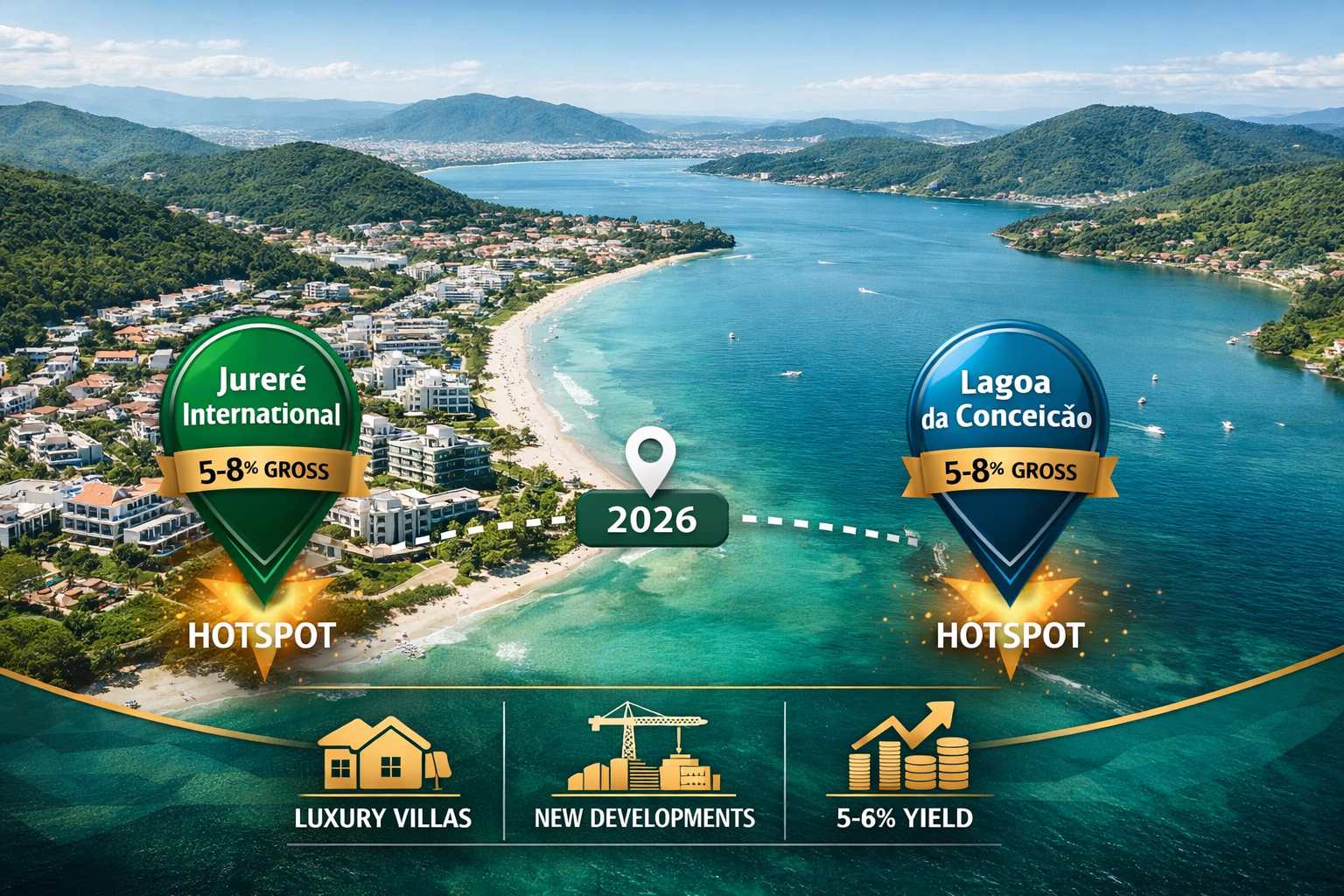
Not all of Florianópolis performs equally. The island’s geography — 42 beaches spread across distinct communities — creates significant variation in yield, demand profile, and regulatory risk. Below are the top neighborhoods for investors focused on Florianópolis Investment Hotspots 2026: Navigating Short-Term Rental Regulations for Coastal Yields.
🏖️ Ingleses do Rio Vermelho (North Island)
Ingleses has emerged as one of the island’s fastest-growing communities, combining strong short-term rental demand with improving infrastructure and relatively accessible entry prices compared to the south.
- Demand profile: Brazilian domestic tourists, digital nomads, mid-term renters
- Yield potential: 5–7% gross for well-positioned units
- Entry price range: R$500,000–R$900,000 for 1–2 bedroom units
- Key advantage: Growing year-round population stabilizes off-season occupancy
The rapid growth of the Ingleses region — in terms of quality of life, infrastructure investment, and property appreciation — makes it one of the most compelling cases for medium-term capital growth alongside rental income.
🏆 Jurerê Internacional (North Island)
Brazil’s answer to the Hamptons, Jurerê Internacional commands the island’s highest nightly rates and attracts an affluent, international guest profile.
- Demand profile: High-net-worth Brazilian and international tourists, luxury events
- Yield potential: 5–8% gross for premium properties
- Entry price range: R$1.2M–R$4M+
- Key advantage: Strong brand recognition, premium pricing power, low supply of truly luxury units
Jurerê Internacional suits investors with larger capital bases seeking prestige assets with strong appreciation potential alongside rental income.
🌊 Lagoa da Conceição (Central Island)
The cultural and social heart of Florianópolis, Lagoa attracts a sophisticated mix of long-stay visitors, expats, digital nomads, and upscale tourists.
- Demand profile: International visitors, remote workers, boutique tourism
- Yield potential: 4.5–6.5% gross
- Entry price range: R$600,000–R$1.5M
- Key advantage: Year-round appeal reduces seasonal volatility; strong mid-term rental market
🌟 Campeche and Morro das Pedras (South Island)
These southern neighborhoods have attracted significant interest from buyers seeking a more authentic Florianópolis experience, with strong surf culture and growing digital nomad communities.
- Demand profile: Surfers, creative professionals, mid-term renters
- Yield potential: 4–6% gross
- Entry price range: R$450,000–R$850,000
- Key advantage: Lower entry prices, growing demand, less saturated than north island
Compliant Investment Strategies to Maximize Returns
Given the regulatory landscape, the most resilient investment strategies in 2026 share common characteristics: purpose-built STR-friendly developments, professional management, and flexible rental models.
Strategy 1: Buy in Purpose-Built STR Developments
Developments designed specifically for short-term rental — with STR-permissive bylaws, on-site management, and hotel-grade amenities — eliminate the condominium risk entirely. These projects often come with integrated property management, simplifying operations for remote or foreign owners.
Exploring purpose-built studio and compact unit developments in Florianópolis reveals a growing segment of the market specifically engineered for short-term rental yields — with layouts, finishes, and common areas optimized for guest experience and operational efficiency.
Strategy 2: Buy Off-Plan for Capital Appreciation + Yield
Purchasing during the pre-launch or construction phase offers two distinct advantages:
- Below-market entry pricing — off-plan units in Florianópolis typically sell at 15–30% discounts to completed market value.
- Capital appreciation during the construction period, before a single rental night is booked.
Understanding how off-plan purchases can amplify investment gains is essential for investors who want to maximize total return — not just rental yield in isolation.
Developments like Tramonto and Solis represent the type of purpose-built coastal projects that combine off-plan pricing advantages with STR-compatible structures — worth examining as benchmarks for what compliant, yield-focused development looks like in practice.
Strategy 3: Pivot to Mid-Term Rentals (30+ Nights)
The data is clear: 43% of active Florianópolis listings already require 30+ night minimum stays [2]. This is not a coincidence — it reflects a rational market response to:
- Condominium restrictions that target short-term (under 30 days) rentals
- Growing demand from digital nomads and remote workers seeking monthly accommodation
- More stable, predictable income with lower turnover costs
Mid-term rentals often escape the strictest condominium prohibitions while still generating strong yields — particularly in neighborhoods with high concentrations of international remote workers.
Strategy 4: Professional Property Management
For foreign, non-resident investors, professional local management is not optional — it is essential. A qualified property manager handles:
- Dynamic pricing optimization (critical given seasonal volatility)
- Guest screening and communication
- Maintenance and compliance
- Local tax reporting and withholding obligations
Management fees typically range from 15–25% of gross rental income, which must be factored into net yield calculations. This cost is not deductible for non-resident foreign owners under current federal tax rules [1].
The Broader Brazilian Context: Why Florianópolis Still Stands Out
Despite yield compression and regulatory tightening, Florianópolis retains structural advantages that keep it competitive within the Latin American short-term rental landscape [5]:
- Currency dynamics: The BRL/USD exchange rate creates attractive USD-denominated entry prices for foreign buyers, while rental income in BRL provides natural inflation hedging.
- Infrastructure investment: Ongoing improvements to road networks, the planned second bridge, and expanded airport capacity continue to support long-term demand growth.
- Quality of life: Florianópolis consistently ranks among Brazil’s highest quality-of-life cities — a key driver of the digital nomad and relocation demand that underpins mid-term rental markets.
Life in Florianópolis — with its combination of natural beauty, safety relative to other Brazilian metros, international community, and growing tech sector — continues to attract both domestic and international buyers who see the city as a long-term hold, not just a rental play.
The Grande Florianópolis real estate market has demonstrated consistent appreciation trends, with demand from São Paulo and international buyers providing a floor under prices even during periods of rental market volatility.
Conclusion: Actionable Next Steps for 2026 Investors
The Florianópolis Investment Hotspots 2026: Navigating Short-Term Rental Regulations for Coastal Yields opportunity is real — but it rewards preparation, not speculation. The investors who will outperform in this market share a common approach: they understand the regulatory environment deeply, choose neighborhoods and developments strategically, and build compliance into their investment structure from day one.
✅ Actionable Next Steps
- Audit the condominium bylaws of any property under consideration before making an offer — this single step eliminates the largest legal risk in the market.
- Model net yields, not gross yields — factor in the 15% non-resident withholding tax, management fees (15–25%), and realistic occupancy (35–54%) before committing capital.
- Prioritize purpose-built STR developments in Ingleses, Jurerê Internacional, or Lagoa da Conceição for the best combination of regulatory safety and demand fundamentals.
- Consider off-plan purchases to capture construction-phase appreciation alongside future rental income.
- Explore mid-term rental positioning (30+ nights) as a compliant, lower-volatility alternative to traditional short-stay Airbnb operations.
- Engage a Brazilian tax attorney before purchasing to structure ownership in the most tax-efficient manner available.
- Monitor municipal regulatory developments in 2026 — the current light-touch licensing environment may not persist through 2027.
Florianópolis remains one of Latin America’s most compelling coastal investment markets. The investors who navigate its 2026 regulatory landscape with precision will be best positioned to capture the yields that less-informed buyers will leave on the table.
References
[1] Florianopolis Buy Rent Out – https://thelatinvestor.com/blogs/news/florianopolis-buy-rent-out [2] Florianópolis Airbnb Data – https://www.airroi.com/airbnb-data/brazil/santa-catarina/florian%C3%B3polis [3] Brazil Property Market Predictions For 2026 – https://esalesinternational.com/2025/11/20/brazil-property-market-predictions-for-2026/ [4] Brazil Airbnb – https://thelatinvestor.com/blogs/news/brazil-airbnb [5] Best Countries Vacation Rental Investment Latin America – https://airbtics.com/best-countries-vacation-rental-investment-latin-america/