

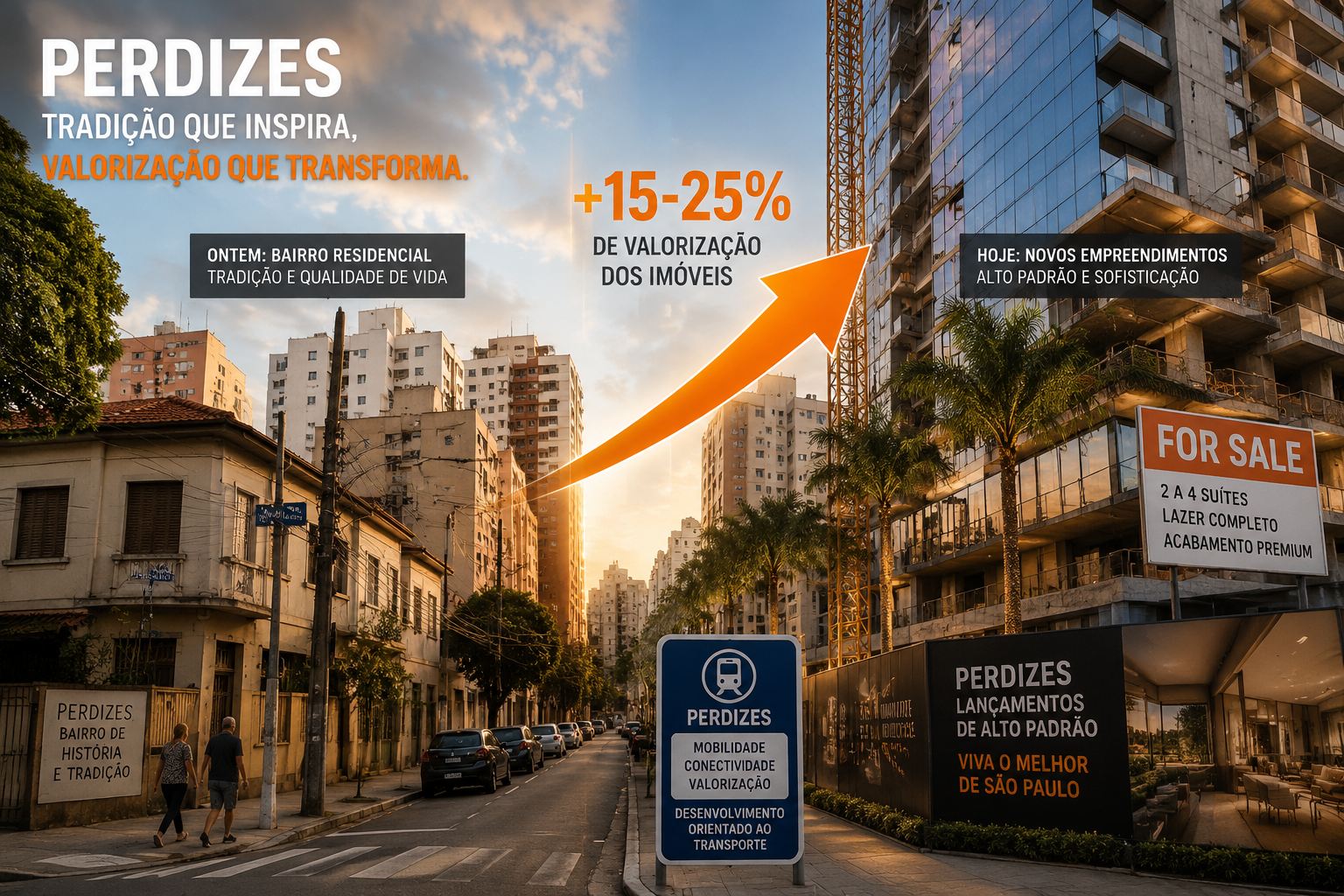
Every major metro opening in São Paulo has triggered a 15–25% surge in residential property values within a 500-meter radius of new stations — and with the Linha 6-Laranja Metro 77% Complete: Developer Strategies for Barra Funda and Perdizes Gentrification Plays in São Paulo 2026 now entering its final stretch, the clock for developers to capture pre-opening appreciation is ticking loudly. The first phase connecting Brasilândia to Perdizes is set to open in October 2026, and the window for buying land, launching pre-sales, and locking in early pricing is narrowing fast. [1][2]
Key Takeaways 🔑
- 77% construction complete as of May 2026, with five stations already exceeding 90% completion and the first phase opening confirmed for October 2026. [1][2]
- 633,000 daily passengers are projected once the full 15-station line operates, creating sustained demand for transit-oriented residential and mixed-use developments. [1][3]
- Barra Funda and Perdizes are the highest-priority gentrification corridors due to existing infrastructure, university density, and direct metro access.
- Pre-launch condo strategies near new stations can yield 15–25% price appreciation between purchase and delivery, even amid elevated Selic rates.
- Site selection near the 15 underground stations requires analyzing zoning, land-use coefficients, and proximity to intermodal hubs to maximize returns.
Understanding the Linha 6-Laranja: Scale, Speed, and Strategic Timing
The Infrastructure Facts That Drive Developer Decisions
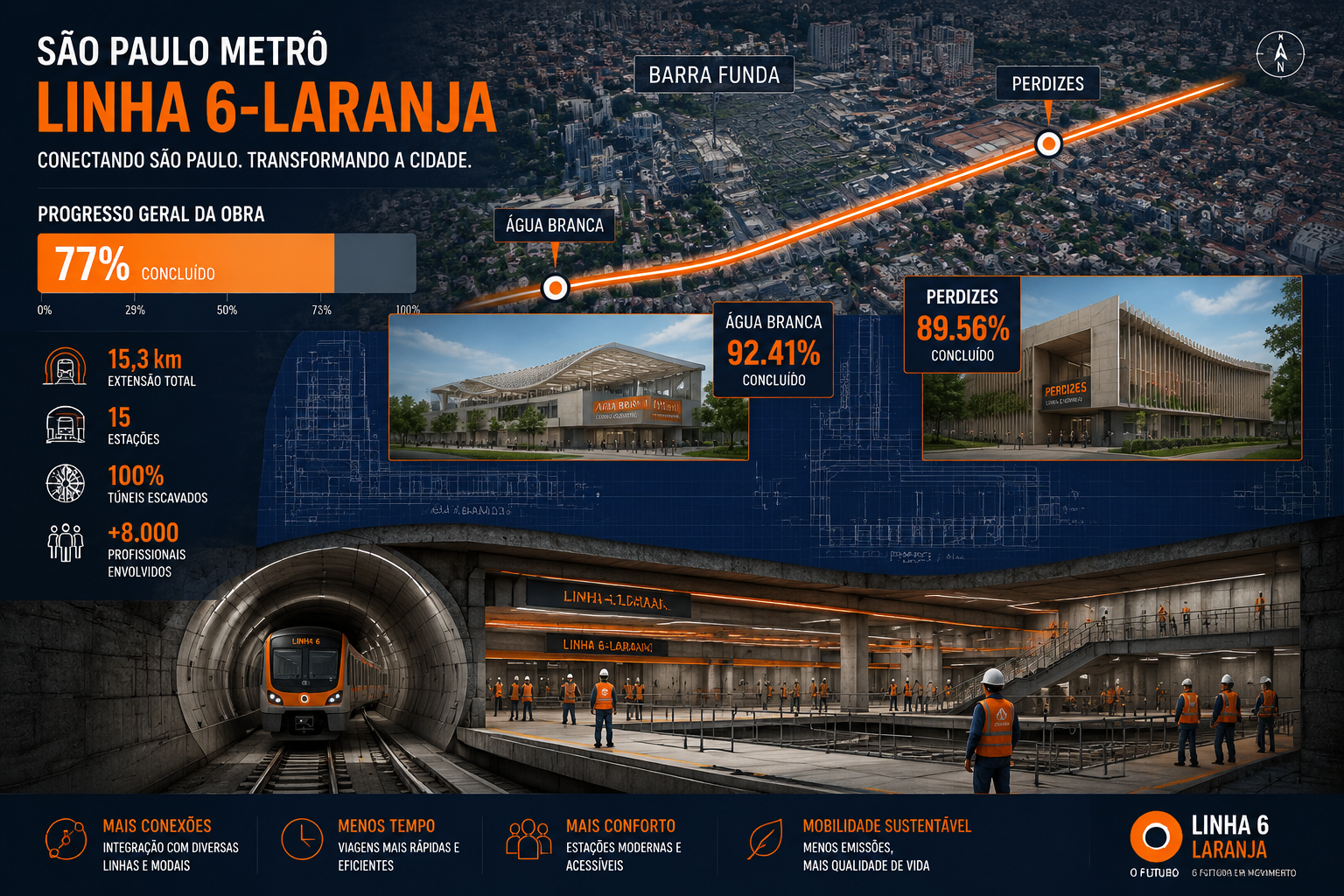
The numbers behind this project are striking. The Linha 6-Laranja spans 15.3 kilometers entirely underground, connecting 15 stations from Brasilândia in the northern zone to São Joaquim near the city center. [3][4] Fully automated trains — with six cars per composition, capacity for up to 2,044 passengers per train, maximum speeds of 90 km/h, and headway intervals between 75 and 90 seconds — will move an estimated 633,000 passengers daily once fully operational. [1]
The travel time transformation is equally dramatic. A commute from Brasilândia to downtown São Paulo currently takes approximately 1 hour 30 minutes by bus. The metro will reduce that to roughly 23 minutes. [1][6] That kind of time compression is a proven catalyst for neighborhood transformation.
💡 Pull Quote: “A 67-minute reduction in commute time is not just a convenience — it is a land-value multiplier. History shows São Paulo neighborhoods within 500 meters of new metro stations regularly appreciate 15–25% in the 24 months surrounding an opening.”
Construction Status: What the Numbers Actually Show
As of May 2026, the project has reached 77% overall completion, with the first phase (Brasilândia to Perdizes) in final testing. [1][2] Five stations already exceed 90% completion:
| Station | Completion Rate |
|---|---|
| Morro Grande (maintenance yard) | 93.79% |
| Água Branca | 92.41% |
| Perdizes | 89.56% |
| Santa Marina | 89.34% |
| Additional Phase 1 stations | 85%+ |
Fourteen of the 15 stations have surpassed 50% completion. Only one station — Station 14-bis — is lagging, due to the discovery of archaeological materials during excavation. [5] This delay is isolated and does not affect the October 2026 opening timeline for the first phase.
The second phase, extending from Perdizes to São Joaquim, is scheduled for 2027 completion, creating a two-stage appreciation window for developers willing to play the long game. [2]
Why the “Linha das Universidades” Label Matters for Developers
The metro has been nicknamed the “University Line” because it directly connects major educational institutions including PUC, Mackenzie, FAAP, Unip, and FMU. [1] The FAAP campus has its own dedicated station. This matters enormously for residential developers because it creates a dual demand profile: young professionals and students seeking compact, well-located units near campuses, and established families in Perdizes and Higienópolis seeking improved connectivity.
For developers interested in understanding how transit infrastructure drives broader Brazilian real estate markets, exploring Brazil’s top property investment locations provides useful comparative context across cities.
Developer Strategies for Barra Funda and Perdizes Gentrification Plays in São Paulo 2026
Why Barra Funda and Perdizes Are the Priority Corridors
Not all 15 stations offer equal developer opportunity. Barra Funda and Perdizes stand out for three compounding reasons:
- Existing transport intermodality — Barra Funda already connects Lines 3-Red and 8-Diamond, plus the Palmeiras-Barra Funda train terminal. Adding the Linha 6-Laranja transforms it into one of São Paulo’s most connected transit hubs.
- Zoning flexibility — Both neighborhoods have significant parcels zoned for mixed-use or high-density residential development under São Paulo’s updated Plano Diretor.
- Gentrification momentum already underway — Perdizes has been experiencing organic price appreciation driven by its proximity to universities and cultural amenities. The metro accelerates a trend that already has inertia.
Site Selection Tactics Near the 15 New Stations 🏗️
Effective site selection in a metro-adjacent development play follows a structured approach:
Tier 1 Zones (0–300 meters from station entrance):
- Prioritize parcels with high land-use coefficients (CA máximo) under São Paulo’s zoning code
- Look for underutilized commercial or light-industrial properties ripe for conversion
- Assess street-level retail potential for ground-floor mixed-use programming
Tier 2 Zones (300–800 meters from station entrance):
- Still within the “walkable catchment” that drives premium pricing
- Often lower land costs than Tier 1, improving margin structure
- Suitable for mid-rise residential with parking optimization
Tier 3 Zones (800 meters–1.5 km):
- Best suited for larger land assemblies where scale compensates for reduced walkability premium
- Consider bus rapid transit (BRT) feeder routes as secondary connectivity validators
⚠️ Critical Due Diligence Point: Always verify ZEIS (Zonas Especiais de Interesse Social) designations before land acquisition. ZEIS-designated parcels carry affordability mandates that can constrain premium residential programming.
Pre-Launch Condo Strategy: Capturing the Appreciation Window
The most powerful developer strategy in a metro-adjacent market is launching pre-sales before the station opens, then delivering units 24–36 months later when the metro is fully operational and the neighborhood has repriced. This is the classic “comprar na planta” appreciation model applied to transit-oriented development.
The mechanics work as follows:
- Land acquisition: Ideally 18–36 months before station opening (the optimal window is closing now for October 2026)
- Pre-launch pricing: Set at a discount to projected post-opening market values to drive velocity
- Delivery timing: Target 24–30 months post-launch, aligning with post-opening market repricing
- Exit or hold decision: Investors who bought at pre-launch can sell at delivery for 15–25% appreciation, or hold for rental yield in a high-demand transit corridor
For a deeper understanding of why buying at the pre-launch stage amplifies investor returns, the analysis of why real estate development can maximize your gains explains the structural advantages of this approach in detail.
Product Mix: What Sells Near University-Adjacent Metro Stations
The “University Line” designation shapes the optimal product mix for Barra Funda and Perdizes developments:
| Unit Type | Target Buyer | Recommended Size | Key Amenity |
|---|---|---|---|
| Studio / 1BR | Students, young professionals | 25–45 m² | Co-working, bike storage |
| 2BR compact | Couples, young families | 55–75 m² | Home office nook |
| 2BR+ | Established families | 80–110 m² | Full amenity package |
| Commercial ground floor | Retail, food & beverage | 40–120 m² | Street-facing visibility |
Compact studios near the FAAP and Mackenzie catchment areas are particularly strong performers, given the consistent student and faculty demand that metro access will amplify.
Developers looking at comparable transit-driven compact unit performance in other Brazilian markets can review data on the advantages of investing in studio units for useful benchmarking.
Financing Hacks and Risk Management Amid High Selic Rates
The Selic Challenge: Structuring Deals That Still Pencil Out
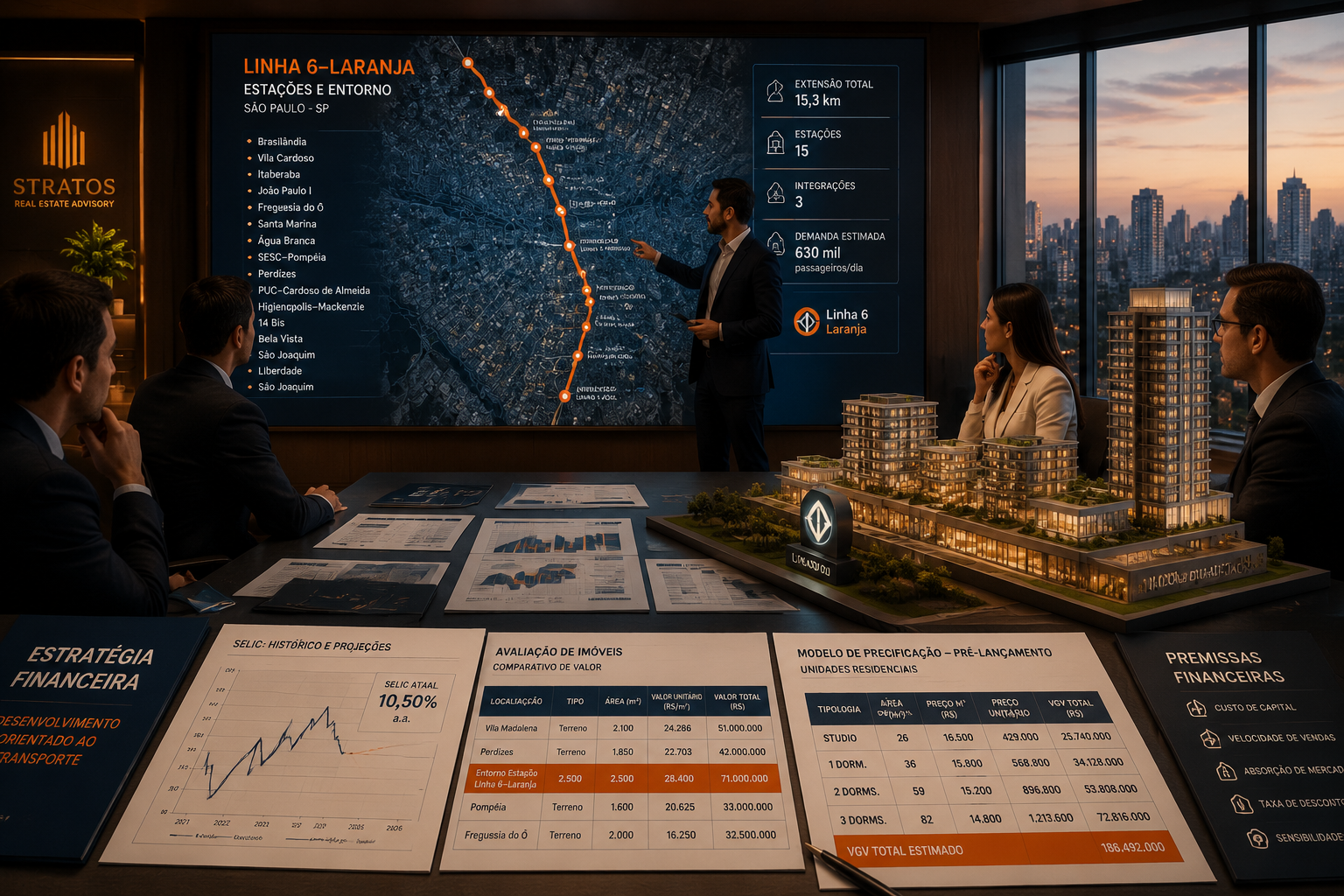
Brazil’s elevated Selic rate environment creates real headwinds for development financing in 2026. When the benchmark rate is high, construction financing costs rise, buyer mortgage affordability compresses, and the opportunity cost of capital increases. Yet metro-adjacent development in São Paulo has historically outperformed these headwinds — provided developers use the right financing architecture.
Key financing strategies for the current environment:
1. Maximize Permuta (Land Swap) Structures Instead of paying cash for land, negotiate permuta arrangements where landowners receive finished units in exchange for the parcel. This eliminates or dramatically reduces the land acquisition cash outlay and the associated financing cost.
2. Use FGTS-Eligible Pricing Tiers Structuring at least a portion of the unit mix within FGTS (Fundo de Garantia do Tempo de Serviço) eligibility thresholds dramatically expands the buyer pool. FGTS-eligible buyers are less sensitive to Selic-driven mortgage rate increases because they access subsidized rates.
3. Pre-Sales Velocity as a Financing Tool Banks typically release construction financing tranches tied to pre-sales velocity benchmarks (often 30–40% pre-sold). A strong pre-launch campaign near a high-profile metro station like Perdizes or Água Branca can hit these benchmarks quickly, reducing the developer’s equity exposure.
4. Explore CRI (Certificados de Recebíveis Imobiliários) Structures For larger developments, packaging receivables from pre-sales into CRI instruments can provide alternative financing at rates below traditional construction credit lines. This is increasingly common among mid-to-large São Paulo developers.
5. Phased Launch Strategy Rather than launching all units simultaneously, phased launches allow developers to reprice upward as construction progresses and the metro opening approaches. Units launched in Phase 3 of a development can be priced 10–15% above Phase 1 pricing, reflecting reduced risk and increased market confidence.
Risk Factors Developers Must Quantify
No investment thesis is complete without an honest risk register:
- 🔴 Delivery delay risk: The Linha 6-Laranja has experienced delays before. The October 2026 date for Phase 1 is firm as of May 2026, but Phase 2 (2027) carries execution risk. [2]
- 🟡 Archaeological discovery risk: Station 14-bis demonstrates that underground excavation near São Paulo’s historic center can trigger compliance delays. [5]
- 🟡 Selic rate trajectory: If rates remain elevated longer than expected, buyer financing costs stay high, compressing demand for premium units.
- 🟢 Demand fundamentals: 633,000 projected daily passengers [1][3] represents structural, durable demand that supports long-term rental yield even if sale prices soften temporarily.
Monitoring Construction Progress as an Investment Signal
Smart developers treat construction completion percentages as real-time investment signals. The jump from 77% to 90%+ overall completion will trigger the next wave of speculative land pricing around key stations. [1][5] Developers who have not yet secured sites near Perdizes, Água Branca, or Barra Funda should treat each percentage point of completion as a countdown to higher land costs.
For developers tracking multiple Brazilian markets simultaneously, staying current with the latest real estate market news provides ongoing intelligence across regions.
The 2027 Phase 2 Play: Positioning Now for São Joaquim
The extension from Perdizes to São Joaquim, scheduled for 2027, [2] opens a secondary investment window. Neighborhoods along the Phase 2 corridor — particularly around Higienópolis and the approaches to São Joaquim — are currently priced without full metro access factored in. Developers with longer time horizons can acquire land in these areas now, at pre-metro pricing, and position for Phase 2 opening appreciation.
This two-phase structure is a rare opportunity to execute the same transit-oriented appreciation strategy twice on the same metro line, with Phase 1 providing proof-of-concept data for Phase 2 underwriting.
For investors comparing São Paulo’s transit-driven opportunities against other high-growth Brazilian markets, a review of Brazil’s best property investment locations helps contextualize relative risk-adjusted returns.
Developers interested in tracking active projects that demonstrate accelerated construction timelines and strong pre-sales performance can also review current development projects for benchmarking purposes.
Conclusion: The Playbook for Acting Before October 2026
The Linha 6-Laranja Metro 77% Complete: Developer Strategies for Barra Funda and Perdizes Gentrification Plays in São Paulo 2026 thesis is straightforward: a fully automated, 633,000-passenger-per-day metro line opening in October 2026 will reprice neighborhoods along its corridor, and the developers who act before that repricing occurs will capture the largest share of appreciation. [1][2][3]
Actionable Next Steps for Developers and Investors:
- Conduct immediate site screening within 800 meters of Perdizes, Água Branca, Santa Marina, and Barra Funda stations — these are the highest-completion, highest-demand nodes. [5]
- Prioritize permuta negotiations with landowners in Tier 1 and Tier 2 zones to minimize cash land acquisition costs in the current Selic environment.
- Design a compact unit mix (studios and 1–2BR) that targets the student and young professional demand profile created by the “University Line” connectivity. [1]
- Structure pre-sales campaigns to hit bank financing thresholds quickly, using the metro opening timeline as a marketing anchor.
- Begin Phase 2 corridor reconnaissance now — the Perdizes-to-São Joaquim extension scheduled for 2027 [2] is the next appreciation wave, and land in that corridor is still priced at pre-metro levels.
- Monitor construction completion updates monthly — each percentage point of progress toward 100% narrows the window for pre-opening land acquisition at current prices.
The October 2026 opening is not just an infrastructure milestone. For prepared developers, it is a starting gun. 🚇
References
[1] Linha 6 Laranja Do Metro Chega A 77 De Obras E Estreia Primeiro Trecho Em Outubro De 2026 – https://technibus.com.br/2026/01/07/linha-6-laranja-do-metro-chega-a-77-de-obras-e-estreia-primeiro-trecho-em-outubro-de-2026
[2] Linha 6 Laranja Do Metro De Sp Entra Na Fase Final De Testes E Primeiro Trecho Deve Ser Entregue Em Outubro – https://g1.globo.com/sp/sao-paulo/noticia/2026/05/07/linha-6-laranja-do-metro-de-sp-entra-na-fase-final-de-testes-e-primeiro-trecho-deve-ser-entregue-em-outubro.ghtml
[3] Linha 6 Laranja Curiosidades – https://www.agenciasp.sp.gov.br/linha-6-laranja-curiosidades/
[4] Linha 6 Do Metropolitano De São Paulo – https://pt.wikipedia.org/wiki/Linha_6_do_Metropolitano_de_S%C3%A3o_Paulo
[5] Watch (Metro News Construction Update) – https://www.youtube.com/watch?v=LMQdD83zZgw
[6] Linha 6 Laranja – https://www.linhauni.com.br/linha-6-laranja
[7] Com Obras 24h Linha 6 Laranja Do Metro Sera Inaugurada Em 2026 – https://revistaferroviaria.com.br/2026/02/com-obras-24h-linha-6-laranja-do-metro-sera-inaugurada-em-2026/