
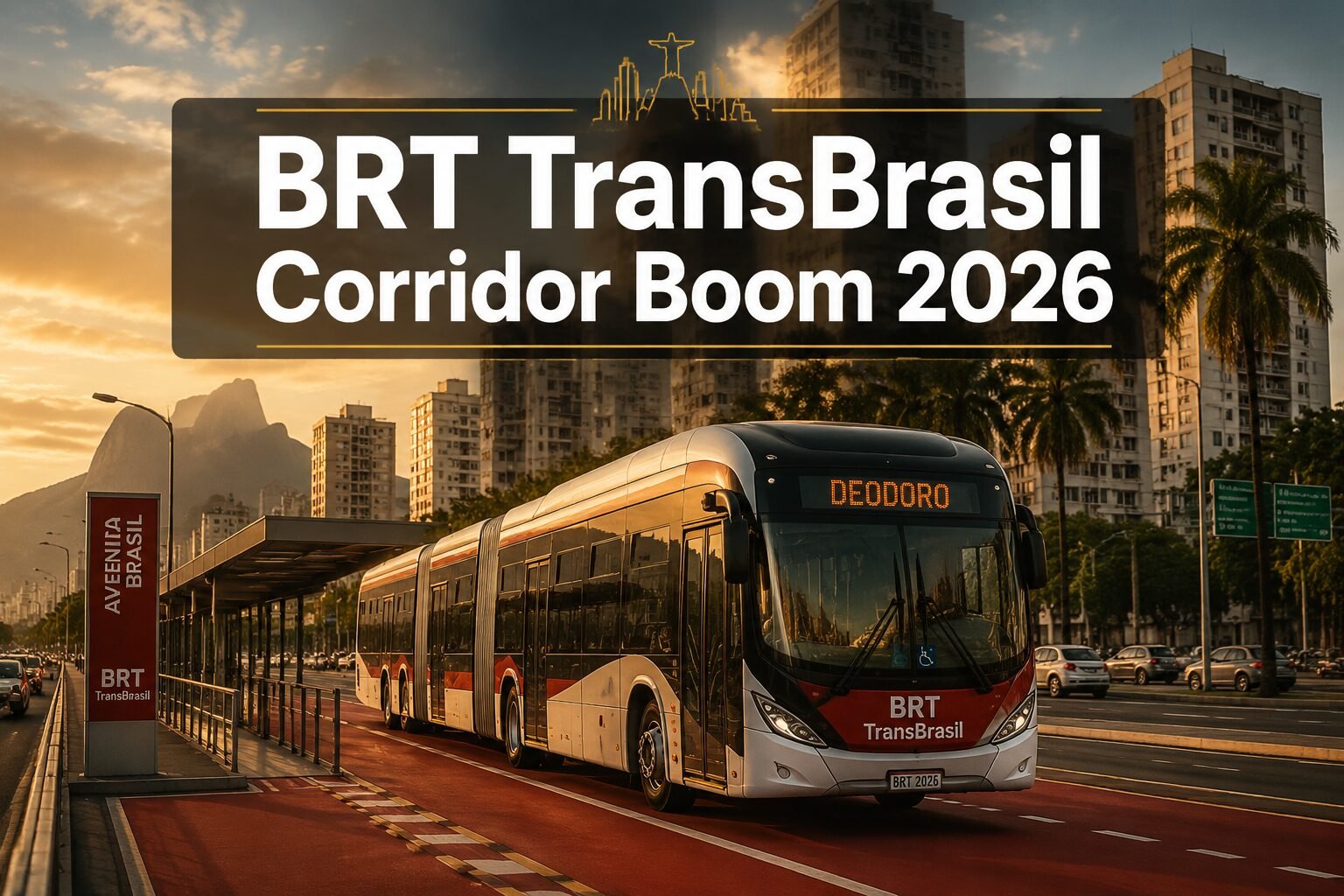
A commute that once consumed 90 minutes on Avenida Brasil now takes under 45 — and that 50% travel time reduction is quietly rewriting property values across Rio de Janeiro’s western and northern zones. The BRT TransBrasil Corridor Boom 2026: Transit-Oriented Residential Developments in Rio’s Deodoro-to-Downtown Zones is no longer a future promise. It is an active economic force reshaping where Cariocas live, how developers build, and where smart capital is flowing right now. [1][2]
Key Takeaways 📌
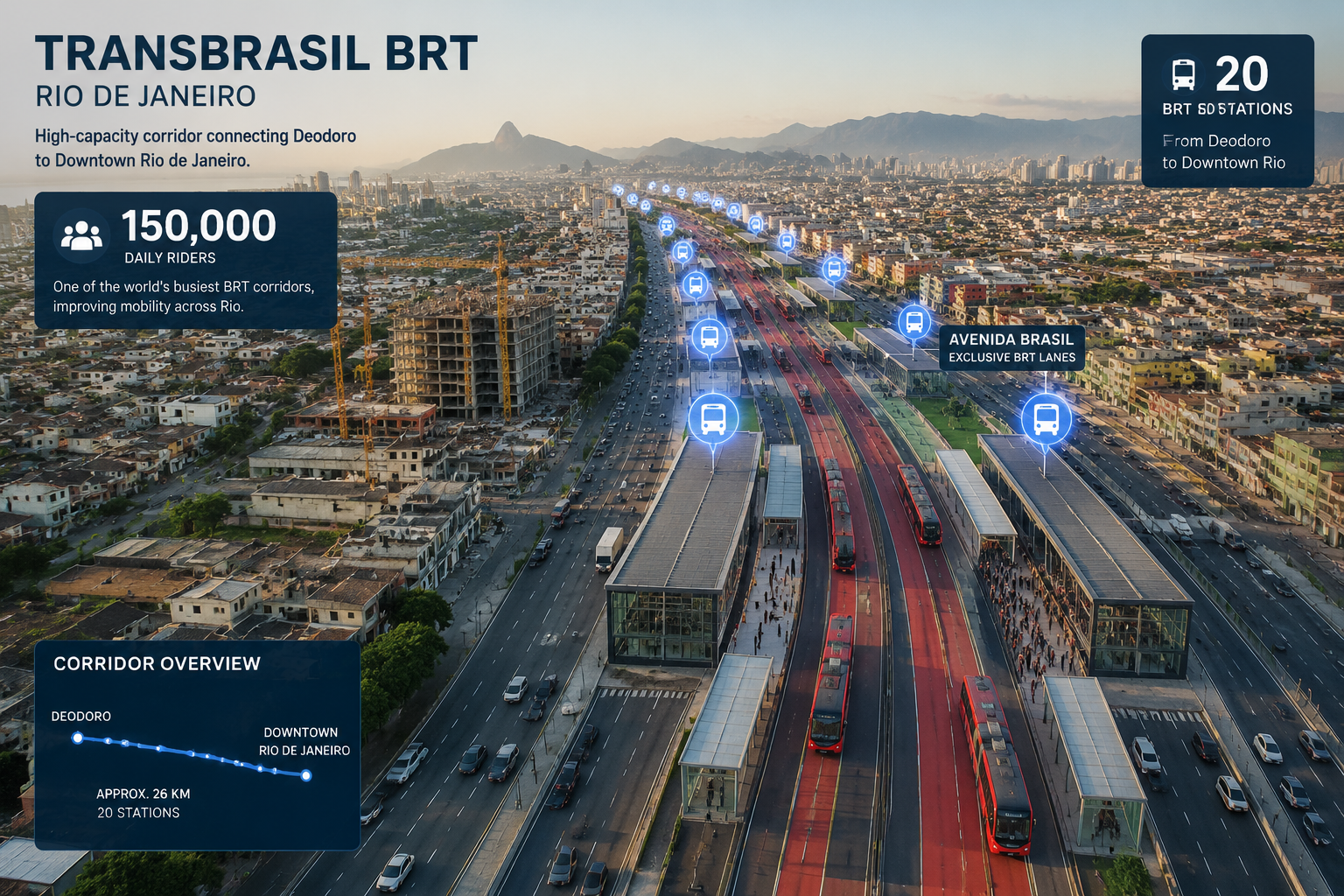
- Nearly 150,000 daily commuters are expected to use the TransBrasil corridor by mid-2026, with projections reaching 250,000 by 2030 [1][2]
- Travel times on Avenida Brasil drop by up to 50% during peak hours, directly boosting residential desirability in peripheral zones [2]
- Phase 2 expansion from Deodoro to Santa Cruz entered the public tender process in December 2025, unlocking a new wave of development corridors [4]
- Property values in transit-connected zones are rising as BRT and VLT integration creates seamless city-wide mobility [1]
- Young professionals and renters represent the dominant demand segment, making compact, amenity-rich multi-family formats the highest-yield development strategy in 2026
Why the TransBrasil BRT Is Changing Rio’s Real Estate Map
For decades, Avenida Brasil was synonymous with gridlock. The 56-kilometer artery connecting Rio’s western suburbs to the city center was one of the most congested roads in Latin America. Residents of neighborhoods like Deodoro, Madureira, and Irajá faced punishing daily commutes that effectively priced them out of professional opportunities downtown — even when housing costs were low.
The completion of the TransBrasil BRT corridor changes that equation fundamentally. According to the City of Rio de Janeiro, the corridor has the potential to cut travel times by up to 50% during peak hours for populations using Avenida Brasil [2]. For a renter choosing between a cramped apartment in Botafogo and a spacious unit in Deodoro, that time savings is now a compelling argument for the periphery.
💬 “Transit infrastructure doesn’t just move people — it moves money. Every minute shaved off a commute adds value to every property along that route.”
The numbers back this up. The Institute for Applied Economic Research found that full metropolitan operation of the BRT could benefit nearly 58% of Rio’s entire population, while increasing access to employment opportunities by 23% for residents in the lowest income bracket [2]. That is not a marginal improvement — it is a structural shift in urban accessibility.
Additionally, approximately 95,000 people gain improved access to intercity bus systems through TransBrasil integration, according to MobiliDADOS, ITDP Brasil’s transport data platform [2]. This multimodal connectivity is precisely the kind of infrastructure that transforms a neighborhood from “affordable but isolated” to “affordable and connected” — the sweet spot for residential investment.
The Ridership Surge and What It Signals for Developers
Near-Term and Long-Term Demand Projections
The scale of TransBrasil’s ridership growth is striking. By June 15, 2026, nearly 150,000 daily commuters are expected to utilize the optimized corridor [1]. Looking further ahead, the system is projected to serve upwards of 250,000 people daily by 2030, connecting 26 neighborhoods along Avenida Brasil across more than 20 stations [2][3].
For developers, this ridership trajectory is a demand signal. High-frequency, high-capacity transit creates what urban economists call a “transit premium” — the measurable increase in residential property values within walkable distance of rapid transit stations. Research from comparable BRT corridors in Latin America consistently shows premiums ranging from 8% to 25% within 500 meters of major stations.
Phase 2: The Santa Cruz Extension Opens New Corridors
The most significant near-term catalyst for the BRT TransBrasil Corridor Boom 2026 is the Phase 2 expansion. In December 2025, Rio de Janeiro opened a public bidding process for studies and basic design services covering the extension between Deodoro and Santa Cruz [4]. This extension will push the corridor deeper into Rio’s West Zone — a vast, underserved area with significant land availability and lower entry costs for developers.
| Metric | Phase 1 (Active) | Phase 2 (Planned) |
|---|---|---|
| Coverage | Deodoro to Downtown | Deodoro to Santa Cruz |
| Daily Riders (2026 est.) | ~150,000 | TBD post-completion |
| Neighborhoods Connected | 26 | 30+ (projected) |
| Station Count | 20+ | Expanded network |
| Land Cost Premium | Rising | Pre-appreciation entry |
Developers who moved early on Phase 1 corridors are already seeing appreciation. The Phase 2 tender represents a second window — one where land prices have not yet fully priced in the transit premium. For investors exploring the best places to invest in Brazilian property for high returns, the Santa Cruz extension zone warrants serious attention in 2026.
Transit-Oriented Development Tactics for Multi-Family Projects
What Young Professionals and Renters Actually Want
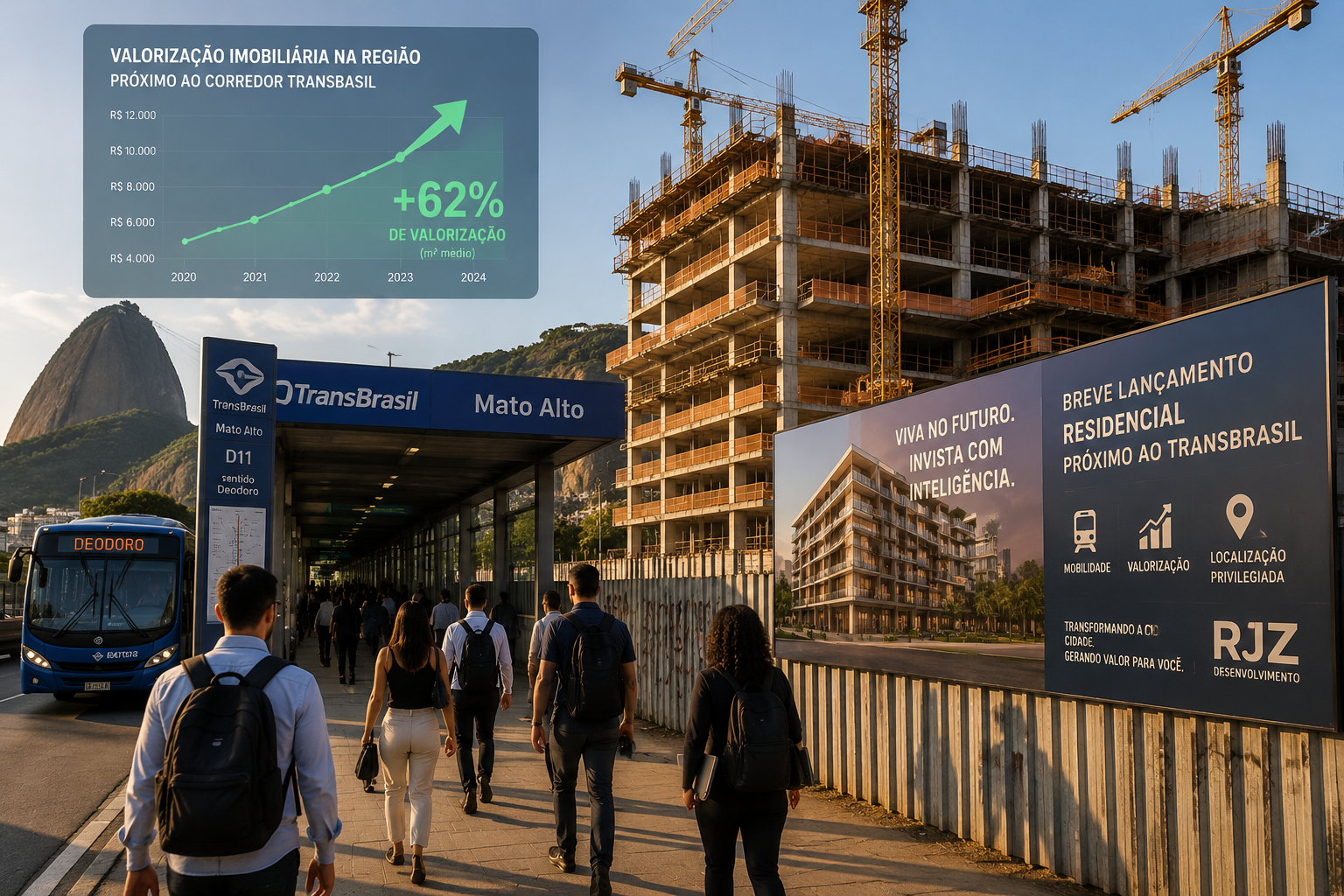
The dominant demand segment along the TransBrasil corridor is clear: young professionals aged 22–38, many of whom are first-time renters seeking proximity to transit rather than proximity to the beach. This cohort prioritizes:
- 🚌 Walking distance to BRT stations (under 600 meters)
- 💻 Co-working or flex-work spaces within the building
- 📦 Compact, efficient floor plans (35–55m² studios and one-bedrooms)
- 🏋️ Amenity packages that substitute for larger square footage
- 📱 Smart building features including app-based access and energy monitoring
Developers who understand this profile are building accordingly. The most successful multi-family projects along the corridor are not trying to replicate South Zone luxury — they are creating transit-optimized living environments where the BRT connection IS the amenity.
This mirrors strategies already proving effective in other Brazilian growth markets. The logic of investing in studio apartments as a high-yield real estate format applies directly to the TransBrasil corridor, where compact units near stations are commanding rental premiums that outperform larger units farther from transit.
Optimal Station-Area Development Zones
Not all stations are created equal. The highest-value development opportunities cluster around interchange nodes — stations where TransBrasil connects with MetrôRio Lines 1, 2, and 4, or with the VLT (light rail) network serving Porto Maravilha and the downtown core [1].
Top-tier development zones along the corridor:
- Deodoro — Military district anchor, Phase 2 launch point, strong institutional employment base
- Madureira — Largest commercial hub in Rio’s North Zone, high foot traffic, retail-residential mix potential
- Irajá — Emerging middle-class neighborhood, strong rental demand, lower land entry costs
- Penha/Brás de Pina — Industrial-to-residential conversion opportunities, proximity to Linha Vermelha interchange
- Centro/Porto Maravilha — VLT integration point, property values rising with seamless BRT-VLT connectivity [1]
Fare Structure and Affordability Considerations
Current transit fares sit at R$7.50 (~$1.35 USD) per trip as of 2026, with the municipal government planning to review subsidies by December 2026 [1]. For developers marketing to budget-conscious renters, this fare level represents a meaningful monthly transport cost — roughly R$300–400/month for a daily commuter. Buildings that offer transit pass integration or employer partnership programs as part of their amenity package are gaining a competitive edge in tenant acquisition.
Investors should also monitor upcoming legislative votes on private-sector subsidies for BRT fleet electrification [1]. If electrification subsidies reduce operational costs, the resulting fare stability (or reduction) would further strengthen the corridor’s residential appeal.
The Broader Transit Network: BRT, VLT, and MetrôRio Integration
A City-Wide Connectivity Upgrade
The TransBrasil BRT does not operate in isolation. Rio’s transit ecosystem in 2026 is undergoing a comprehensive upgrade that amplifies the corridor’s residential impact:
🚋 VLT Expansion: The integration of VLT and BRT systems creates seamless connectivity for the Porto Maravilha district, with property values in connected zones rising in response to improved access [1]. Market analysts expect Rio to announce a new tender for VLT expansion into the South Zone by late 2026, with the project aimed at connecting Santos Dumont Airport directly to Ipanema [1]. This would create a continuous premium transit spine from the West Zone through downtown to the South Zone.
🚇 MetrôRio Integration: MetrôRio Lines 1, 2, and 4 serve as the backbone for premium residential areas connecting to the city’s core business districts [1]. Where TransBrasil intersects with MetrôRio stations, the combined connectivity creates dual-mode accessibility — the strongest possible driver of residential property appreciation.
🚌 Technology Transition: In October 2025, Rio’s City Council approved legislation authorizing the conversion of the Transcarioca and Transoeste BRT corridors into exclusive lanes for Light Rail Vehicles (LRVs) or Light Vehicles on Tires (LVTs) [5]. This signals that Rio’s transit strategy is evolving beyond traditional bus-based rapid transit toward higher-capacity, lower-emission technologies — a long-term positive for corridor property values.
Comparing Rio’s Transit-Oriented Opportunity to Other Brazilian Markets
Rio’s corridor boom is part of a broader Brazilian trend of transit-driven real estate appreciation. Developers and investors already active in high-growth markets like Florianópolis — where the real estate market has shown strong performance driven by infrastructure and quality of life factors — will recognize the pattern: infrastructure investment precedes and then accelerates property value growth.
The TransBrasil corridor offers a higher-volume, lower-price-point version of this dynamic. Entry costs are lower than Florianópolis or the South Zone, but the demand fundamentals — driven by 150,000+ daily riders and a massive underserved rental market — are compelling. For developers tracking current real estate development projects and market trends, the Deodoro-to-downtown corridor deserves a prominent place on the watchlist.
Investment Strategy: Positioning for the BRT TransBrasil Corridor Boom 2026
Developer Playbook for Corridor Projects
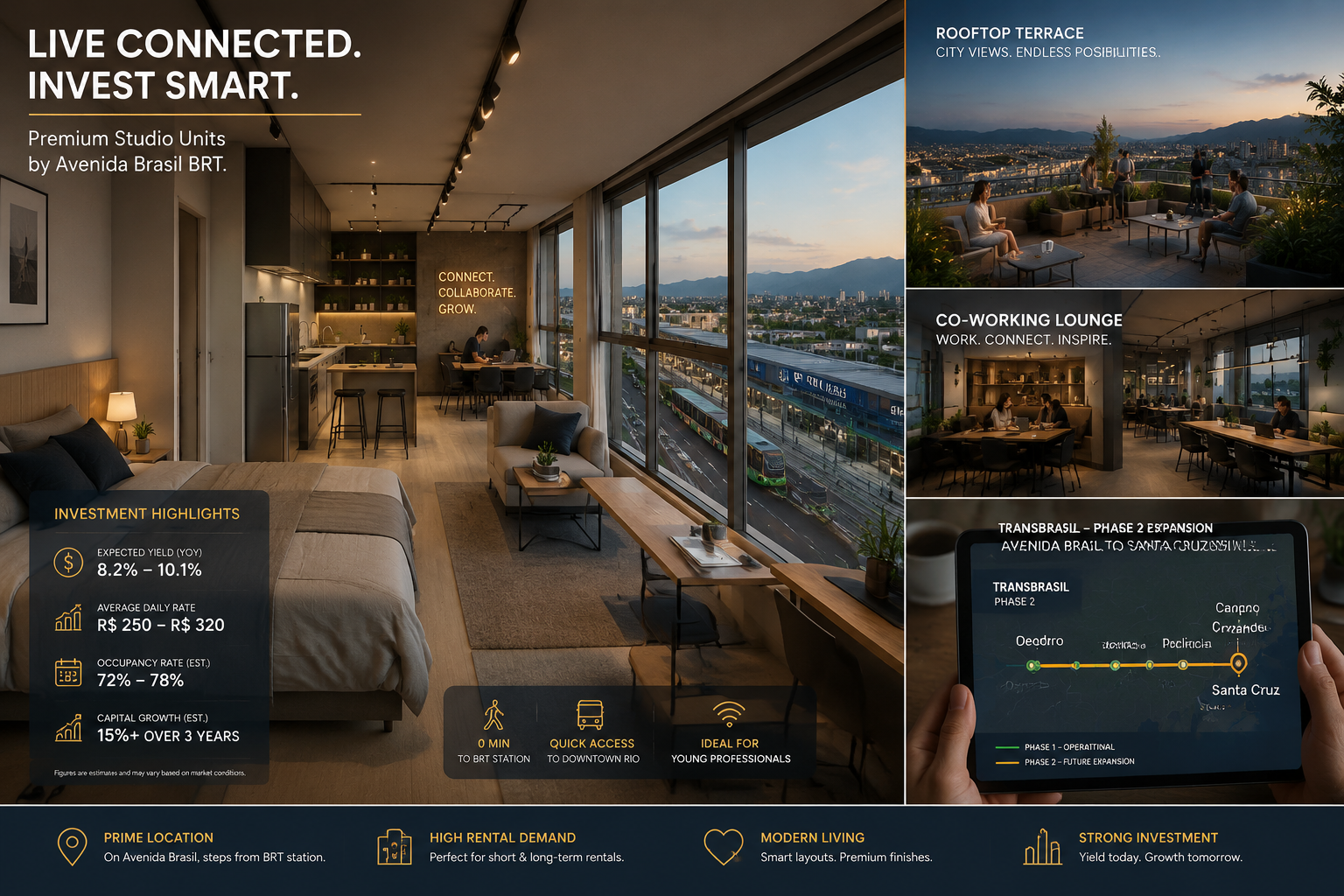
The most effective strategies for multi-family development along the TransBrasil corridor in 2026 share several common elements:
✅ Station-proximity as the primary site selection criterion Projects within 400–600 meters of a TransBrasil station command measurable rental premiums. Beyond 800 meters, the transit premium diminishes significantly.
✅ Compact unit mix optimized for singles and couples 35–55m² studios and one-bedrooms with efficient layouts outperform larger units in both absorption speed and yield. Young professional renters prioritize location and amenities over square footage.
✅ Amenity packages that replace car dependency Bicycle storage, e-bike charging, app-based concierge, and package lockers signal to transit-oriented renters that the building was designed for their lifestyle.
✅ Pre-launch pricing to capture appreciation upside The advantages of buying Brazilian real estate off-plan are amplified in corridor zones where infrastructure completion is still driving appreciation. Early buyers in Phase 2 corridor zones are positioned for the strongest gains.
✅ Phase 2 land banking in the Deodoro–Santa Cruz extension zone With the Phase 2 tender launched in December 2025 [4], the window for pre-appreciation land acquisition in the Santa Cruz extension zone is open — but narrowing quickly.
Risk Factors to Monitor
No investment thesis is without risk. Key variables to watch for the TransBrasil corridor in 2026 include:
- Subsidy review timing: The December 2026 fare subsidy review could alter operational economics [1]
- Phase 2 construction timeline: Tender launch does not guarantee rapid construction; delays are common in Brazilian infrastructure projects
- Technology transition uncertainty: The shift toward LRV/LVT technology on adjacent corridors [5] could eventually affect TransBrasil’s operating model
- Fleet scaling execution: Operational challenges in scaling the BRT fleet have been documented [7], and service reliability directly impacts residential desirability
For investors seeking diversified exposure to Brazilian real estate growth, exploring current development projects across multiple Brazilian markets provides useful context for portfolio construction.
Conclusion: Act on the Corridor Before the Premium Is Fully Priced In
The BRT TransBrasil Corridor Boom 2026: Transit-Oriented Residential Developments in Rio’s Deodoro-to-Downtown Zones represents one of the clearest infrastructure-driven real estate opportunities in Brazil today. The fundamentals are aligned: massive ridership growth, proven travel time reductions, Phase 2 expansion underway, and a large underserved rental market dominated by young professionals who prioritize transit access.
The window for capturing the full transit premium — before it is fully reflected in land and unit prices — is measured in months, not years.
Actionable Next Steps 🎯
- Map station proximity for any target site along the Avenida Brasil corridor — 400–600 meters is the sweet spot
- Monitor the Phase 2 tender process for Deodoro–Santa Cruz extension; early-mover land positions in this zone offer the strongest upside
- Design for the renter profile — compact, amenity-rich, transit-optimized units outperform in this market
- Track the December 2026 subsidy review and VLT South Zone tender announcement for second-order effects on corridor desirability
- Consult with developers and advisors already active in Brazilian transit-oriented markets — connect with real estate development specialists to explore corridor-specific opportunities
The BRT TransBrasil corridor is not just moving buses. It is moving the center of gravity of Rio de Janeiro’s residential real estate market — and the developers who recognize that shift earliest will capture the greatest returns.
References
[1] Public Transport Rio De Janeiro – https://www.riotimesonline.com/public-transport-rio-de-janeiro/ [2] In Rio De Janeiro The New Transbrasil Brt Takes Shape – https://itdp.org/2024/02/27/in-rio-de-janeiro-the-new-transbrasil-brt-takes-shape/ [3] Major Bus System Expansion In Rio Thanks To Itdp Brazil – https://cruxalliance.org/success-story/major-bus-system-expansion-in-rio-thanks-to-itdp-brazil/ [4] Rio De Janeiro Opens Tender For Transbrasil Brt Phase 2 Extension To Santa Cruz Brazil – https://globalmasstransit.net/rio-de-janeiro-opens-tender-for-transbrasil-brt-phase-2-extension-to-santa-cruz-brazil/ [5] Substituicao Do Brt No Rio De Janeiro Caes – https://en.clickpetroleoegas.com.br/substituicao-do-brt-no-rio-de-janeiro-caes/ [7] Scaling Rio De Janeiros Brt For 6x Fleet Growth – https://optibus.com/case/scaling-rio-de-janeiros-brt-for-6x-fleet-growth/