
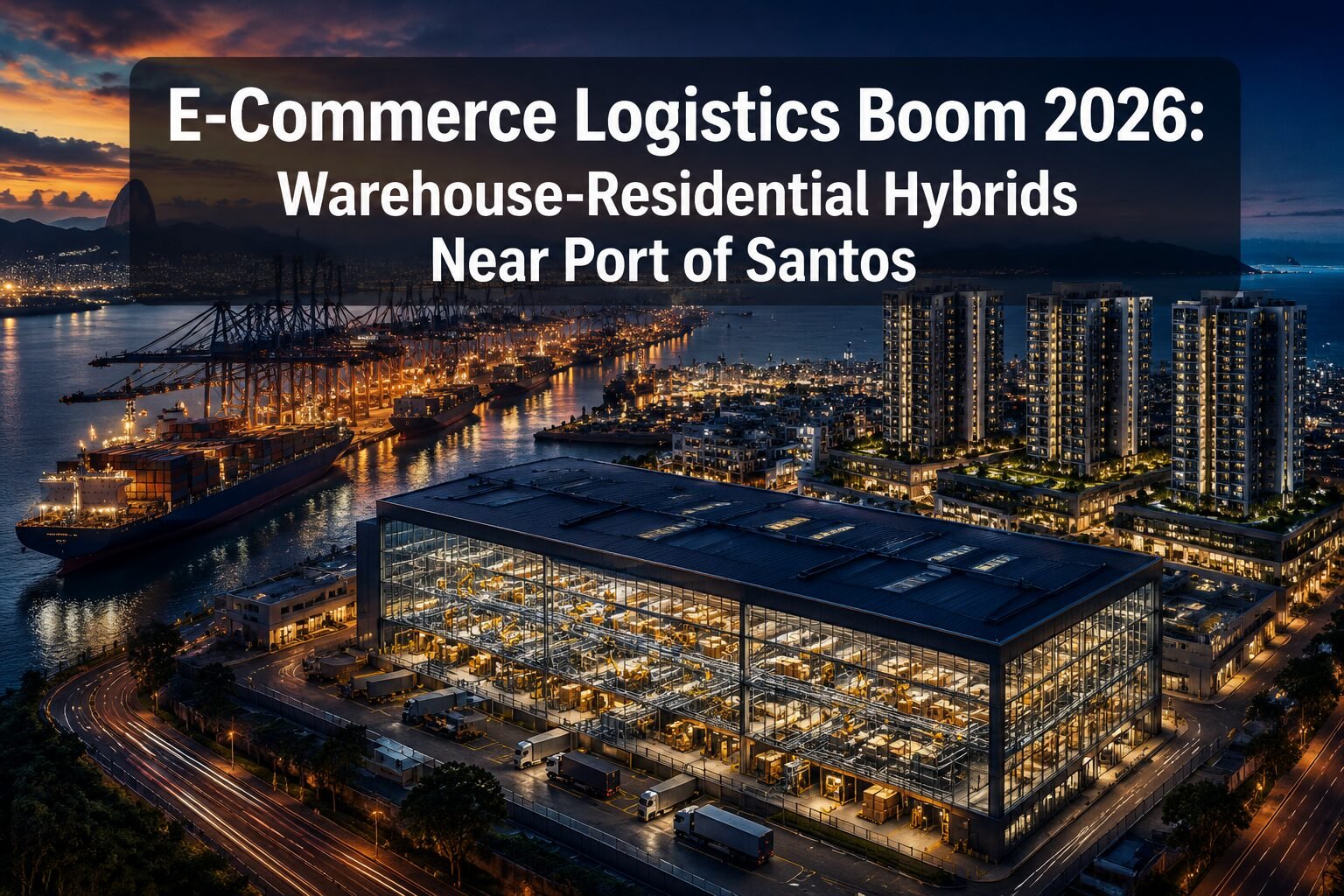
Brazil’s e-commerce sector surged 18.7% in 2026, and the Port of Santos just recorded its strongest January throughput in history — 467,000 TEUs, a 9.5% jump over the same month in 2025 [5]. That combination of digital commerce acceleration and port infrastructure momentum is reshaping how developers, logistics operators, and real estate investors think about land use near Latin America’s most powerful cargo gateway.
The result is a compelling new asset class: high-tech warehouse-residential hybrids — mixed-use developments that place automated fulfillment centers alongside purpose-built worker housing. In the ABC Region (Santo André, São Bernardo do Campo, and São Caetano do Sul), this model is gaining serious traction. The E-Commerce Logistics Boom 2026: High-Tech Warehouse-Residential Hybrids Near Port of Santos ABC Region story is not just about warehouses. It is about a fundamental reimagining of how urban logistics and residential life can coexist — and generate 20–30% yield premiums for early-moving investors.
Key Takeaways 📌
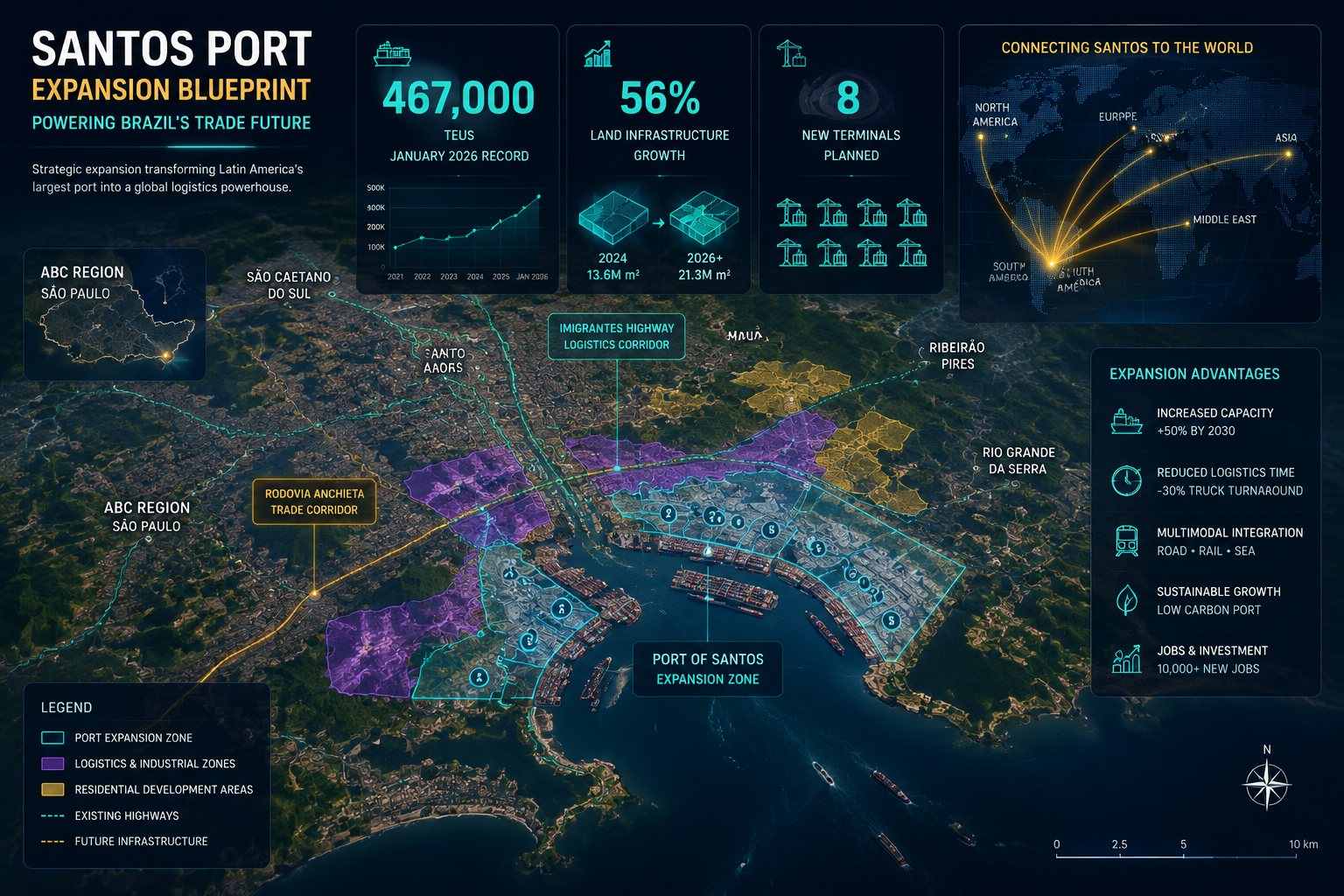
- 🏗️ Port of Santos is set to nearly double its land-based infrastructure — from 9.3 million m² to 14.5 million m² — with eight new cargo terminals planned [1].
- 📦 E-commerce and fashion logistics now represent ~49% of ID Logistics Brazil’s total activity, confirming the sector’s dominance [6].
- 🏘️ Warehouse-residential hybrids near the ABC Region offer 20–30% yield premiums over conventional industrial properties.
- 📈 Port expansion is projected to increase financial volume by at least 20% within 3–4 years of new terminal auctions [1].
- 🌎 Santos handles roughly 40% of Brazil’s container movement, making the surrounding logistics corridor one of the most strategically valuable real estate zones in South America [3].
Why the Port of Santos Is the Engine Behind the E-Commerce Logistics Boom 2026
Record Performance and Unstoppable Expansion
The Port of Santos is not merely keeping pace with Brazil’s growth — it is leading it. January 2026 marked the port’s best-ever monthly opening, with 12.7 million tonnes of total cargo throughput, up 9.5% year-over-year [5]. Container volumes hit 467,000 TEUs, a record for any January period in the port’s history.
These numbers reflect a structural shift, not a seasonal spike. Santos Brasil, one of the port’s key operators, is actively accelerating expansion in response to rising chemicals and agricultural cargo volumes pushing container demand upward [4]. The port is positioned as Latin America’s most strategic trade gateway, connecting Brazil’s industrial heartland — including the ABC Region — to global ocean trade lanes and neighboring South American economies [2].
The expansion plan is ambitious:
| Metric | Current | Projected |
|---|---|---|
| Land-based port area | 9.3 million m² | 14.5 million m² |
| Number of new terminals | — | At least 8 |
| Projected financial volume growth | Baseline | +20% within 3–4 years |
| First concession auctions | — | Scheduled from 2027 |
Sources: [1][3]
💬 “Port of Santos combines scale, connectivity, and ambition — making it the undisputed logistics anchor for all of southeastern Brazil.” — Conqueror Network, 2026 [2]
The port’s expansion objectives also include diversifying cargo types — dedicated space for fuel, pulp and paper, and specialty goods — which broadens the logistics ecosystem well beyond standard container handling [1]. For real estate developers in the ABC Region, this is a long-term demand signal that is difficult to ignore.
The ABC Region’s Strategic Position
The ABC Region sits within 30–60 kilometers of the Port of Santos, connected by major arterial highways including the Anchieta and Imigrantes corridors. This proximity makes it one of the most logistics-efficient zones in Brazil. Land costs remain significantly lower than São Paulo’s central business districts, while access to the port, labor pools, and urban infrastructure is exceptional.
The region’s industrial heritage — historically home to automotive and manufacturing giants — means existing zoning, utilities, and road networks are already calibrated for heavy-use development. That legacy infrastructure is now being repurposed and upgraded to support the next generation of automated logistics facilities.
The Rise of Warehouse-Residential Hybrids in the E-Commerce Logistics Boom 2026
What Is a Warehouse-Residential Hybrid?
A warehouse-residential hybrid is a mixed-use development that combines:
- 🤖 Automated fulfillment centers (robotics, conveyor systems, AI-driven inventory management)
- 🏠 Purpose-built residential units for logistics workers and support staff
- 🛒 Retail and service amenities (convenience stores, childcare, health clinics)
- 🚲 Micro-mobility infrastructure (e-bike stations, pedestrian corridors)
The concept addresses one of the biggest pain points in modern logistics: labor proximity. As fulfillment centers operate 24/7 to meet e-commerce delivery windows, having workers live on-site or within walking distance dramatically reduces absenteeism, turnover, and commute-related delays.
In the context of the E-Commerce Logistics Boom 2026: High-Tech Warehouse-Residential Hybrids Near Port of Santos ABC Region, these developments also unlock a powerful investment dynamic. A single parcel generates dual income streams — commercial leasing revenue from logistics operators AND residential rental income — compressing risk while expanding returns.
Why E-Commerce Is Driving Demand
The numbers behind Brazil’s e-commerce growth are striking. ID Logistics Brazil, a major third-party logistics operator, has doubled its facility size to accommodate surging order volumes. As of April 2026, e-commerce and fashion logistics represent approximately 49% of ID Logistics Brazil’s total operational activity [6]. The company identifies e-commerce as its single most important growth driver in the country.
This is not an isolated data point. Across the logistics sector, operators are scrambling to:
- Expand last-mile delivery networks closer to urban population centers
- Automate picking and packing to handle SKU complexity and speed requirements
- Secure long-term leases on large-format warehouse space near major ports
- Attract and retain skilled labor in an increasingly competitive market
The ABC Region — with its port proximity, highway connectivity, and available land — sits at the intersection of all four priorities.
Technology Inside the Hybrid: What “High-Tech” Really Means
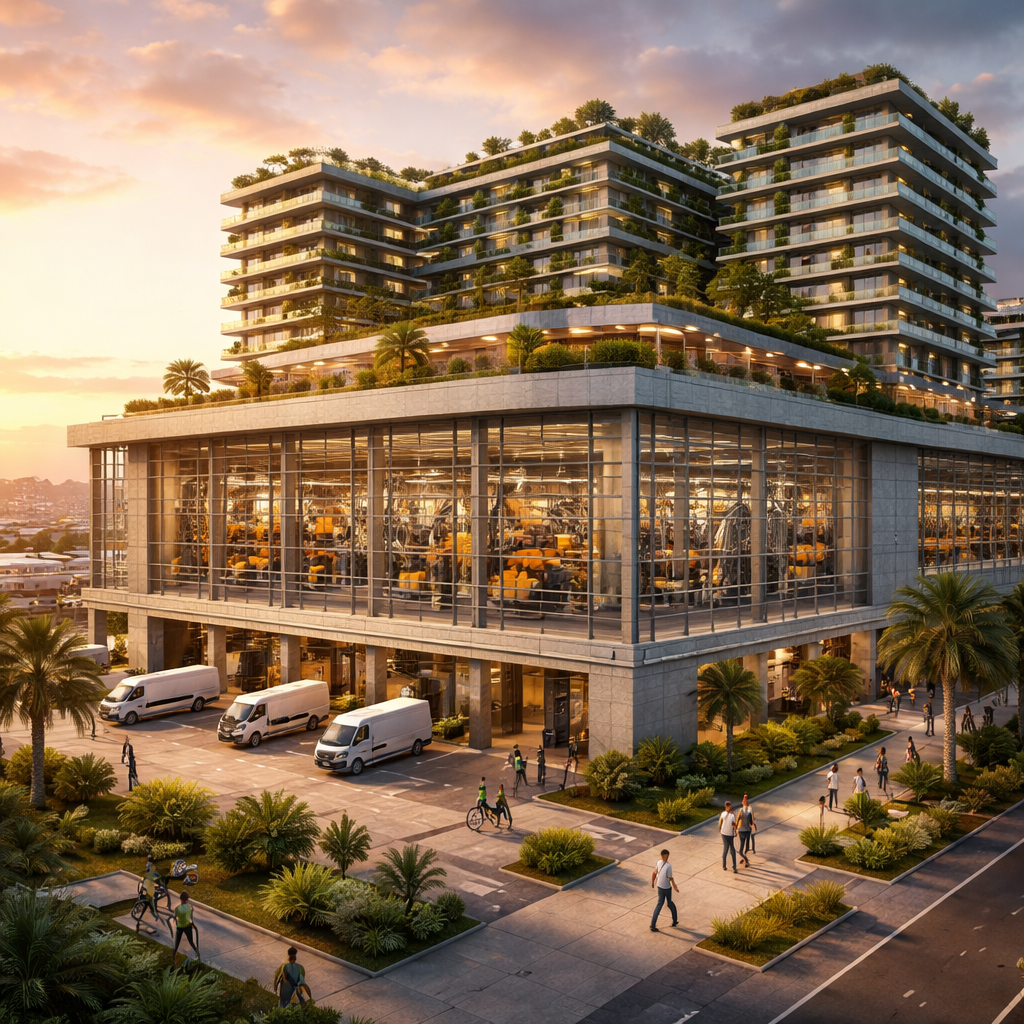
Modern high-tech warehouses in this context are not simply large sheds with forklifts. They incorporate:
- Autonomous Mobile Robots (AMRs) for goods-to-person picking
- Warehouse Management Systems (WMS) with real-time inventory tracking
- Automated Sorting and Conveyor Networks capable of processing thousands of parcels per hour
- IoT Sensors monitoring temperature, humidity, and equipment performance
- Solar Panels and Green Roofs meeting ESG requirements for major logistics tenants
- EV Charging Infrastructure for last-mile delivery fleets
When these facilities are paired with residential towers featuring smart home technology, co-working spaces, and communal amenities, the result is a self-contained micro-community that appeals to the growing class of logistics professionals who prioritize convenience and quality of life.
For developers exploring best places to invest in Brazil property for high returns, the ABC Region’s warehouse-residential hybrid model offers a compelling case study in how industrial and residential demand can be layered into a single, high-performing asset.
Investment Case: Yield Premiums and Market Dynamics
The 20–30% Yield Premium Explained
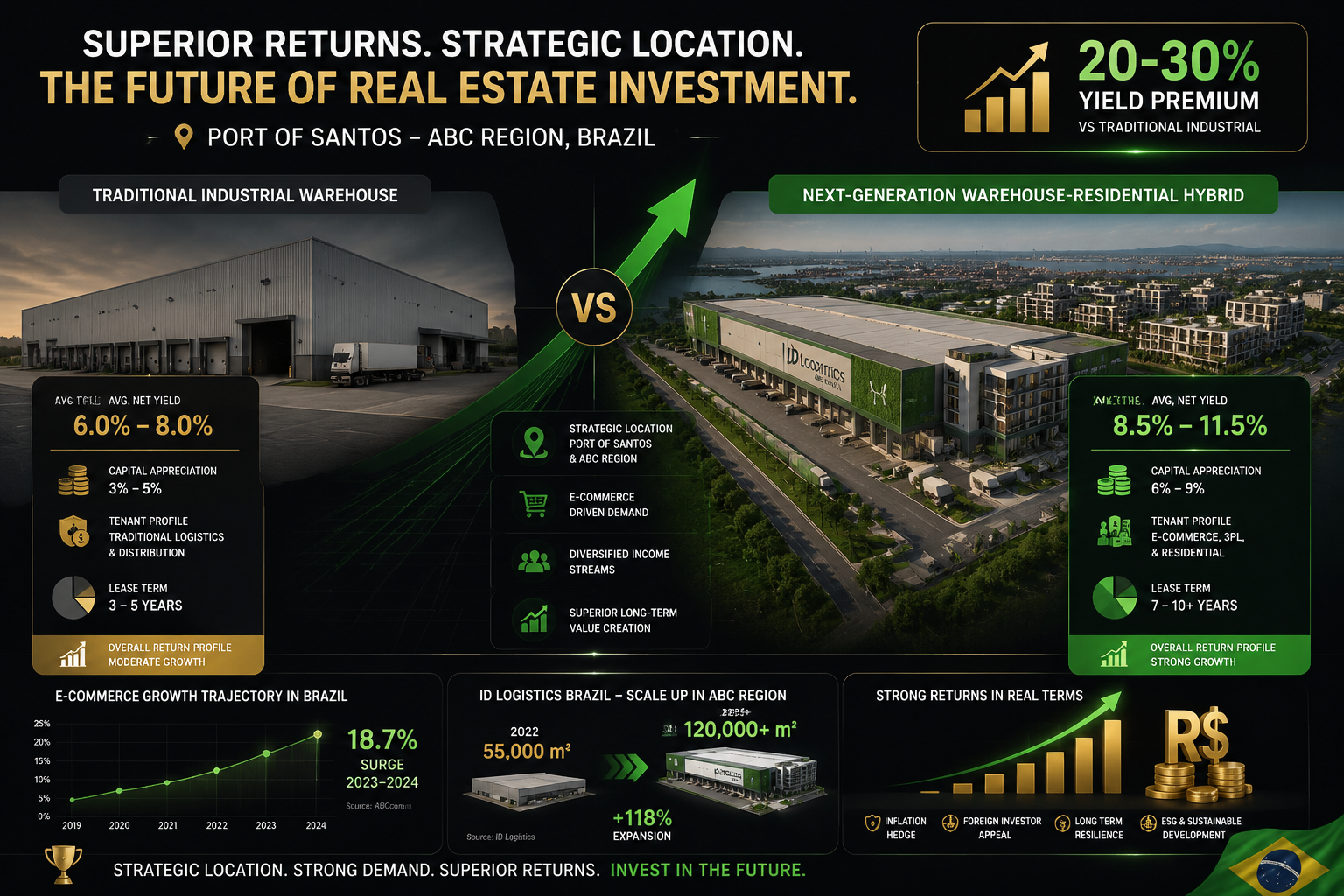
Conventional industrial properties near São Paulo typically yield 6–8% annually in rental income. Warehouse-residential hybrids in prime logistics corridors near Santos are generating yield premiums of 20–30% above that baseline — pushing effective returns into the 8–11% range — for several structural reasons:
1. Dual Revenue Streams Commercial leases to logistics operators (typically 5–10 year terms) combined with residential rentals create income diversification that reduces vacancy risk.
2. Scarcity of Suitable Land The combination of port proximity, highway access, zoning flexibility, and urban amenities in the ABC Region is rare. Supply constraints support premium pricing.
3. Long-Term Tenant Demand E-commerce growth is secular, not cyclical. Logistics operators signing long leases are not going away. The 20% projected increase in port financial volume within 3–4 years [1] will only intensify demand for nearby logistics real estate.
4. ESG Premium Institutional investors increasingly require ESG-compliant assets. Green-certified hybrid developments command higher rents and attract better-quality tenants.
5. Government Infrastructure Investment The port expansion — including eight new terminals and concession auctions starting in 2027 [1] — signals sustained public and private capital flowing into the region’s logistics ecosystem.
💬 “Brazil’s port investment boom is reshaping competitive advantage across the entire logistics value chain — and real estate is one of the clearest beneficiaries.” — DP World Perspective [7]
Comparing Asset Classes
| Asset Type | Typical Yield | Risk Profile | Liquidity |
|---|---|---|---|
| Traditional Industrial Warehouse | 6–8% | Medium | Medium |
| Standard Residential Apartment | 4–6% | Low-Medium | High |
| Warehouse-Residential Hybrid | 8–11% | Medium | Medium |
| Raw Industrial Land (ABC Region) | 3–5% | High | Low |
The hybrid model clearly outperforms on a risk-adjusted basis, particularly when anchored by a long-term logistics tenant.
What Investors Should Look For
When evaluating specific projects within the E-Commerce Logistics Boom 2026: High-Tech Warehouse-Residential Hybrids Near Port of Santos ABC Region opportunity, key due diligence criteria include:
- ✅ Distance from port access roads (ideally under 40km from Santos)
- ✅ Zoning classification allowing mixed commercial-residential use
- ✅ Pre-signed letters of intent from logistics operators
- ✅ Automation-ready floor specifications (clear heights of 12m+, floor load capacity)
- ✅ ESG certifications (LEED, AQUA-HQE, or equivalent)
- ✅ Developer track record in mixed-use or logistics-adjacent projects
Developers with experience in innovative mixed-use formats — such as those behind the Tramonto development — demonstrate the kind of execution capability that complex hybrid projects demand. Reviewing current development projects can offer insight into how leading developers are approaching mixed-use opportunities across Brazil’s high-growth corridors.
For investors who want to understand how buying off-plan can amplify returns in exactly this kind of high-demand corridor, the dynamics of off-plan property investment and yield amplification are directly applicable to the ABC Region hybrid model.
Challenges and Risk Mitigation
Real Obstacles to Acknowledge
No investment thesis is complete without an honest assessment of risks. The warehouse-residential hybrid model near Santos faces several legitimate challenges:
Regulatory Complexity Mixed-use zoning approvals in Brazilian municipalities can be slow. Projects that blend industrial and residential classifications require careful navigation of local planning codes.
Infrastructure Gaps While the ABC Region’s highway network is strong, last-mile connectivity within some municipalities needs upgrading to support 24/7 logistics operations without disrupting residential quality of life.
Labor Market Pressures Brazil’s logistics sector faces a skilled labor shortage in automation-adjacent roles (robotics technicians, WMS operators). Hybrid developments help address this by reducing commute friction, but training pipelines need investment.
Interest Rate Environment Brazil’s monetary policy cycle affects construction financing costs. Developers must stress-test project economics against rate scenarios.
Mitigation Strategies
| Risk | Mitigation |
|---|---|
| Regulatory delays | Engage municipal authorities early; use experienced local legal teams |
| Infrastructure gaps | Partner with port authority on road upgrade co-investment |
| Labor shortages | Integrate vocational training centers within hybrid development |
| Financing costs | Use pre-leasing agreements to secure favorable construction finance |
Understanding how sales performance is transforming Brazil’s real estate market provides useful context for how developer execution quality directly influences project outcomes in competitive Brazilian markets.
The Broader Brazilian Real Estate Context
The ABC Region’s warehouse-residential hybrid opportunity does not exist in isolation. Across Brazil, a convergence of forces is creating exceptional conditions for logistics-adjacent real estate:
- Brazil’s e-commerce market is one of the fastest-growing in Latin America, with mobile commerce and social commerce accelerating adoption beyond major metros
- Port of Santos handles ~40% of Brazil’s container movement [3], making its surrounding region a permanent logistics priority
- DP World and other global operators are increasing Brazilian port investment, signaling long-term confidence in the country’s trade infrastructure [7]
- Institutional capital from pension funds and REITs is flowing into logistics real estate, validating the asset class
For investors already exploring Brazil’s top property investment locations, the Santos-ABC corridor deserves serious consideration alongside more traditional residential markets. And for those curious about innovative financing approaches — including digital assets — the intersection of cryptocurrency and real estate development is opening new capital formation pathways for exactly these kinds of hybrid projects.
Conclusion: Actionable Next Steps for 2026
The E-Commerce Logistics Boom 2026: High-Tech Warehouse-Residential Hybrids Near Port of Santos ABC Region represents one of the most clearly defined, data-backed real estate opportunities in Brazil today. The convergence of record port performance, aggressive infrastructure expansion, surging e-commerce logistics demand, and a structural shortage of quality mixed-use logistics real estate creates a window for investors and developers that is open — but will not remain so indefinitely.
Actionable Next Steps 🚀
Map the corridor now. Identify specific parcels within 40km of Santos port access roads that carry mixed-use or flexible industrial zoning. Land values are still favorable relative to projected post-expansion premiums.
Engage logistics operators early. Approach e-commerce fulfillment operators, 3PLs, and FMCG logistics companies with pre-development conversations. Letters of intent from anchor tenants dramatically improve financing terms.
Design for automation from day one. Retrofitting warehouses for robotics is expensive. New developments should spec 12m+ clear heights, reinforced floors, and high-power electrical capacity as baseline requirements.
Layer in residential thoughtfully. Worker housing should meet urban residential standards — not dormitory minimums. Quality amenities attract and retain the skilled logistics workforce that makes automated facilities run.
Monitor port auction timelines. The first concession auctions for Santos expansion areas are scheduled from 2027 [1]. Properties near newly announced terminal zones will experience the sharpest appreciation.
Consult specialists. Connect with development teams experienced in Brazil’s mixed-use and logistics real estate landscape. Reach out to qualified advisors who understand both the regulatory environment and the investment fundamentals of this emerging asset class.
The Port of Santos is doubling down. E-commerce is not slowing. And the ABC Region is positioned to capture the value that flows from both. The question is not whether this opportunity is real — the data confirms it is. The question is whether investors move before the market fully prices it in.
References
[1] neofeed.com.br – https://neofeed.com.br/negocios/porto-de-santos-vai-dobrar-de-tamanho-e-ganhar-mais-oito-terminais-de-cargas/en/
[2] Port Of Santos Container Hub Why It Remains Latin Americas Most Strategic Gateway – https://blog.conquerornetwork.com/2026/02/25/port-of-santos-container-hub-why-it-remains-latin-americas-most-strategic-gateway/
[3] portolivrebrasil.com.br – https://www.portolivrebrasil.com.br/en/
[4] Port Operator Santos Brasil Speeds Up Expansion As Chemicals Agro Cargo Pushes Volumes Up Exec – https://www.icis.com/explore/resources/news/2026/04/16/11198606/port-operator-santos-brasil-speeds-up-expansion-as-chemicals-agro-cargo-pushes-volumes-up-exec
[5] Port Of Santos Posts Record January Throughput To Open 2026 – https://datamarnews.com/noticias/port-of-santos-posts-record-january-throughput-to-open-2026/
[6] Pr Id Logistics Brazil April 2026 – https://www.id-logistics.com/media/2026/04/PR_ID-LOGISTICS_Brazil_April-2026.pdf
[7] Dp World Perspective Why Brazils Port Investment Boom Reshaping Competitive Advantage – https://www.3blmedia.com/news/dp-world-perspective-why-brazils-port-investment-boom-reshaping-competitive-advantage