
Property values within 500 meters of a new metro station typically surge 20–30% in the 24 months surrounding an opening — but most of those gains are captured before the ribbon is cut. In 2026, three major Brazilian transit projects are approaching completion milestones that have historically triggered exactly this pattern. The Metro-Linked Gentrification Playbook 2026: Timing Entry Points in São Paulo’s Linha 6-Laranja, Rio’s TransBrasil, and Belo Horizonte’s Linha 2 Corridors is the strategic framework every serious investor needs right now — because the window to enter ahead of the price spike is narrowing fast.
Key Takeaways 📌
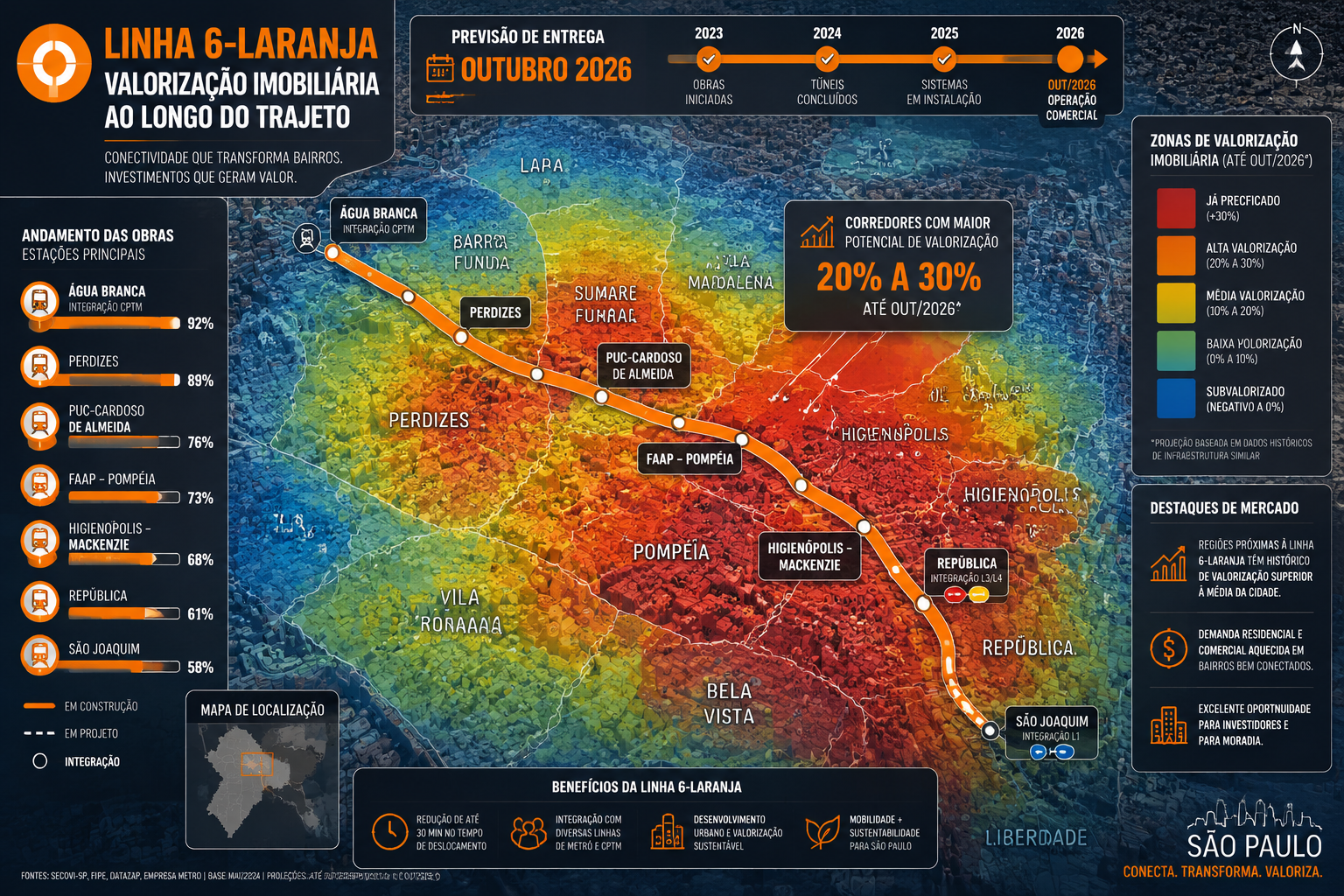
- São Paulo’s Linha 6-Laranja opens its first 8-km segment in October 2026, with stations like Água Branca already 92% complete — the pre-opening entry window is closing rapidly. [2]
- Neighborhoods along all three corridors still contain undervalued pockets where land prices have not yet fully priced in transit-driven appreciation.
- The 20–30% appreciation pattern observed in prior Brazilian metro openings (Lines 4 and 5 in São Paulo) is already beginning to manifest near the most advanced stations.
- Rio’s TransBrasil and BH’s Linha 2 represent slightly earlier-stage opportunities, offering longer runways but requiring higher tolerance for construction-phase risk.
- Timing entry to the pre-completion phase — not post-opening — is the defining variable between average and exceptional returns.
Understanding the Metro-Appreciation Cycle in Brazil
Before applying the Metro-Linked Gentrification Playbook 2026, investors must understand why transit infrastructure drives property values — and more importantly, when the gains actually materialize.
The Four Phases of Transit-Driven Appreciation
| Phase | Timeline | Price Movement | Risk Level |
|---|---|---|---|
| Announcement | Years 1–3 | +5–10% (speculative) | High |
| Construction | Years 3–7 | +10–15% (gradual) | Medium-High |
| Pre-Opening | 12–18 months before launch | +15–25% (accelerating) | Medium |
| Post-Opening | 0–24 months after launch | +5–10% (residual) | Low-Medium |
💡 Pull Quote: “The investor who waits for the grand opening has already missed the best part of the trade. The money is made in the construction dust, not the ribbon-cutting ceremony.”
This cycle has played out consistently across Brazilian metro expansions. When São Paulo’s Line 4-Yellow opened, neighborhoods like Vila Sônia saw appreciation well above the city average in the 18 months preceding operations. The same pattern emerged along Line 5-Lilac. In 2026, three corridors are simultaneously approaching the pre-opening phase — a rare convergence that creates multiple simultaneous entry opportunities.
For investors looking to understand the broader landscape of best places to invest in Brazil property, transit-linked corridors in major metros represent one of the most data-backed strategies available.
São Paulo’s Linha 6-Laranja: The Imminent Opportunity
Of the three corridors covered in this playbook, Linha 6-Laranja is the most time-sensitive. The clock is ticking.
Construction Status: Closer Than Most Investors Realize
São Paulo’s Metro Line 6 Orange is over 77% complete, with 14 of its stations surpassing 50% construction completion. [4] Three stations are essentially ready to operate:
- 🟠 Água Branca — 92.41% complete
- 🟠 Perdizes — 89.56% complete
- 🟠 Santa Marina — 89.34% complete [4]
The Morro Grande Yard, the line’s operations and administrative center, has reached 93.79% completion — a strong signal that the operator is preparing for imminent launch. [4]
The first 8-km segment between Brasilândia and Perdizes, covering approximately 9 stations, is scheduled to open in October 2026 — ending a four-year drought of new metro stations in São Paulo. [2] The full 15.3-km line with 15 stations will connect São Joaquim in the center to the northwest district of Brasilândia. [3] The remaining segment, from PUC Cardoso de Almeida to São Joaquim, is expected by late 2027. [4]
Passenger Impact: Why This Line Matters
Upon full completion, Linha 6 is projected to serve 633,000 passengers daily, cutting travel times from 1.5 hours by bus to just 23 minutes. [3] That kind of time-savings fundamentally reprices neighborhoods — workers who previously couldn’t afford to live near the center suddenly find northwest São Paulo viable.
Neighborhood Entry Points: Where Value Still Exists
Brasilândia and Vila Brasilândia remain the most undervalued stations along the corridor. These neighborhoods have historically been underserved by rapid transit, and land prices have not yet fully absorbed the October 2026 opening. The area sits at the northern terminus, meaning it captures the full commute-time reduction benefit.
Água Branca presents a different profile — already more established, but benefiting from a provisional connection to Lines 7-Rubi and 8-Diamante before the permanent interchange station is completed. [2] This multimodal hub status makes it attractive for commercial and mixed-use development.
Santa Marina sits between these two dynamics: a transitional neighborhood where early-stage gentrification indicators (new cafés, co-working spaces, small galleries) are already visible, but prices haven’t yet spiked to reflect the October timeline.
⚠️ Investor Alert: With Água Branca at 92% completion, the pre-opening appreciation window for that specific micro-market is nearly closed. Brasilândia and Santa Marina offer better risk-adjusted entry points in mid-2026.
Understanding how to maximize gains when buying pre-completion is essential for capturing the remaining upside in the Linha 6 corridor.
Rio’s TransBrasil and BH’s Linha 2: The Medium-Term Play
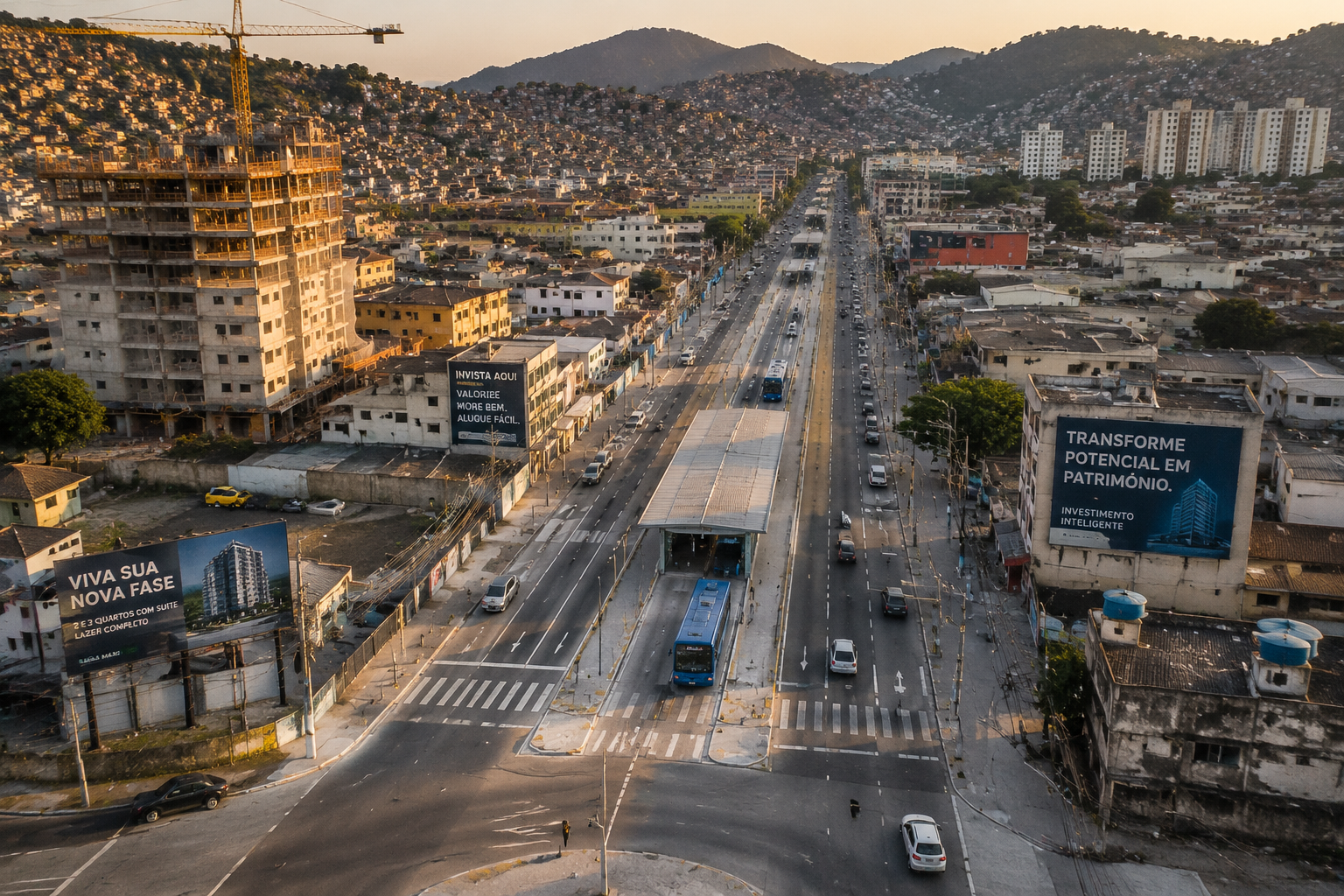
While São Paulo’s Linha 6 demands immediate action, Rio’s TransBrasil BRT and Belo Horizonte’s Linha 2 offer a slightly longer runway — and in some micro-markets, more compelling entry prices.
Rio de Janeiro’s TransBrasil: The Zona Norte Transformation
TransBrasil is Rio’s most ambitious Bus Rapid Transit project, running approximately 32 km along Avenida Brasil — one of the city’s most heavily trafficked arteries — connecting the Zona Norte to the city center. The corridor passes through neighborhoods that have historically suffered from poor transit connectivity despite dense populations.
Why TransBrasil matters for investors:
- 🚌 Avenida Brasil handles over 1 million vehicle movements per day, making any transit improvement here transformative
- The corridor connects neighborhoods like Deodoro, Madureira, and Penha — areas where residential land remains significantly cheaper than equivalent-distance zones in other cities
- Mixed-use zoning changes are already being discussed in municipal planning documents along key station areas
- The 2016 Olympic legacy infrastructure in the Deodoro cluster creates an additional demand catalyst
Key entry neighborhoods along TransBrasil:
| Neighborhood | Current Price/m² (est.) | Transit Accessibility Today | Upside Potential |
|---|---|---|---|
| Madureira | R$ 3,200–4,100 | Moderate | ⭐⭐⭐⭐ |
| Penha | R$ 3,800–4,800 | Low-Moderate | ⭐⭐⭐⭐ |
| Deodoro | R$ 2,900–3,700 | Low | ⭐⭐⭐⭐⭐ |
| Pavuna | R$ 2,400–3,200 | Low | ⭐⭐⭐ |
Madureira deserves special attention. Already a major commercial hub in the Zona Norte, it functions as an informal city center for millions of residents. TransBrasil connectivity would amplify its commercial real estate value significantly.
Belo Horizonte’s Linha 2: The Overlooked Corridor
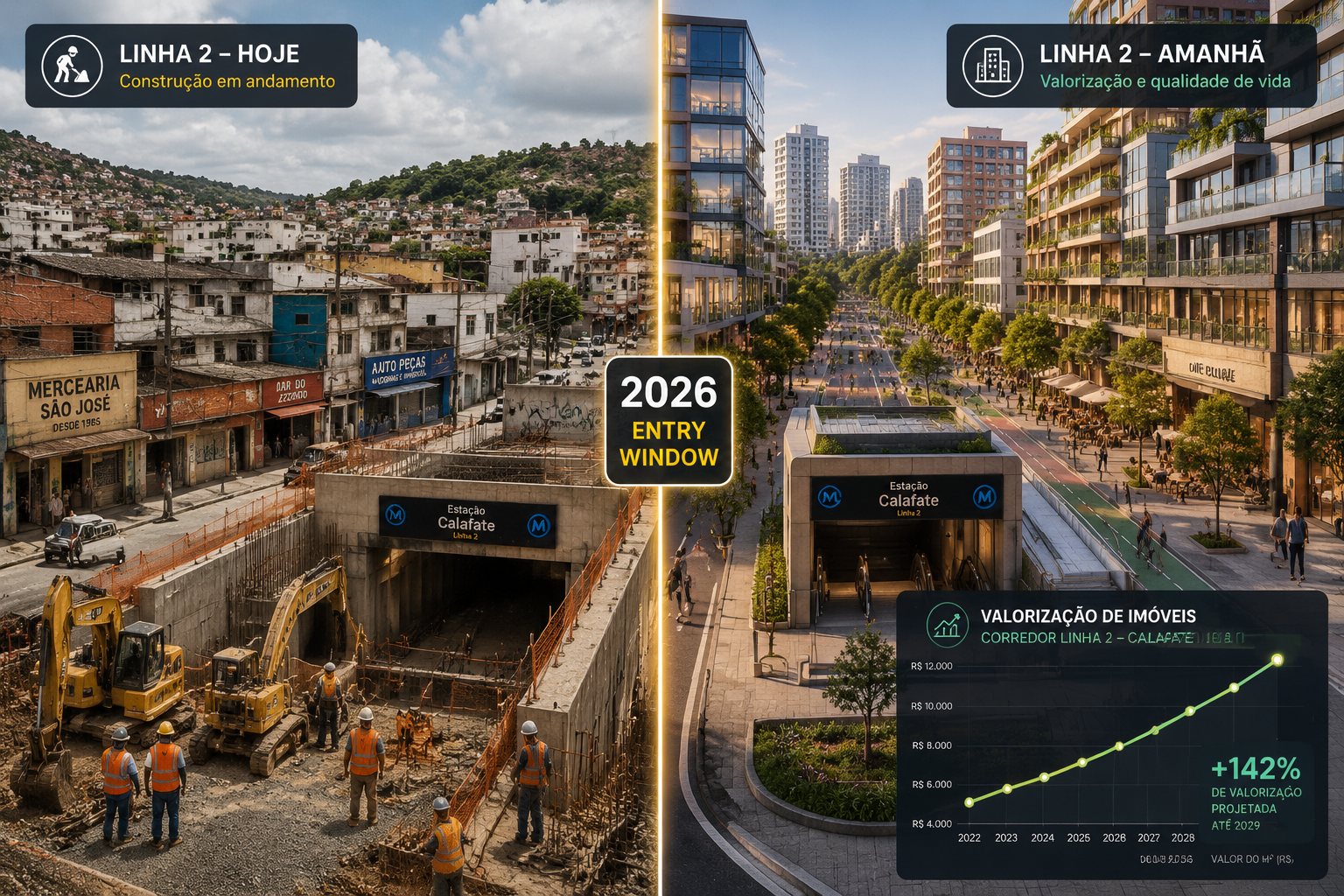
Belo Horizonte’s metro expansion has received far less national media coverage than São Paulo’s projects — which is precisely why it represents a compelling opportunity. Lower media attention = less speculative pricing already baked in.
Linha 2 will extend BH’s metro network along the Vilarinho corridor, connecting underserved northern neighborhoods to the existing network. The project has faced timeline delays, which has paradoxically kept land prices in adjacent neighborhoods suppressed — creating a buying opportunity for patient investors.
BH-specific dynamics to watch:
- 🏗️ Belo Horizonte has a younger demographic profile than São Paulo or Rio, with strong demand for affordable urban housing near transit
- The city’s tech and startup ecosystem has grown substantially, creating a professional class that values transit-accessible urban living
- Linha 2 station areas in Vilarinho and Floramar show early-stage gentrification signals: new restaurants, small retail upgrades, and increased construction permit filings
For investors already familiar with how pre-launch real estate investments generate returns, BH’s Linha 2 corridor represents a textbook pre-completion entry scenario.
Applying the Metro-Linked Gentrification Playbook 2026: Practical Entry Strategies
The Metro-Linked Gentrification Playbook 2026: Timing Entry Points in São Paulo’s Linha 6-Laranja, Rio’s TransBrasil, and Belo Horizonte’s Linha 2 Corridors isn’t just about identifying which neighborhoods to watch — it’s about executing the right strategy for each corridor’s specific stage.
Strategy 1: The Linha 6 Sprint (São Paulo)
Timeframe: Immediate action required — Q2/Q3 2026
Target assets:
- Residential units within 600m of Brasilândia and Santa Marina stations
- Small commercial ground-floor spaces in Vila Brasilândia
- Land parcels suitable for small residential developments
Exit thesis: Post-opening appreciation of 15–20% over 18–24 months, on top of any pre-opening gains already captured.
Risk factors: Construction delays (though at 77%+ completion, this risk is now minimal), and the fact that some micro-markets near Perdizes and Água Branca may already be fully priced.
Strategy 2: The TransBrasil Position (Rio)
Timeframe: 12–24 month accumulation window
Target assets:
- Residential properties in Deodoro and Madureira, prioritizing blocks within 400m of confirmed station locations
- Mixed-use properties with ground-floor commercial potential
Exit thesis: Full BRT operational capacity drives 20–30% appreciation in the most underserved station areas (Deodoro, Pavuna) over a 3–4 year horizon.
Risk factors: Rio’s political and fiscal environment can affect infrastructure timelines; diversification across 2–3 station areas is recommended.
Strategy 3: The BH Patient Play (Belo Horizonte)
Timeframe: 18–36 month accumulation window
Target assets:
- Land and pre-construction units near Vilarinho and Floramar station areas
- Student and young professional housing near Linha 2 interchanges
Exit thesis: Timeline delays have suppressed prices below fair value; completion triggers a catch-up appreciation event of 25–35% in the most undervalued pockets.
Risk factors: Longest timeline to realization; requires higher liquidity tolerance.
Cross-Corridor Principles: What Every Entry Point Has in Common
Regardless of which corridor an investor targets, the Metro-Linked Gentrification Playbook 2026 identifies five universal entry signals:
- ✅ Construction completion above 70% — reduces timeline risk substantially
- ✅ Early gentrification indicators — new food and beverage establishments, co-working spaces, small retail upgrades
- ✅ Zoning changes or upzoning proposals near station areas
- ✅ Institutional developer activity — when large developers start acquiring land, retail investors should pay attention
- ✅ Rental yield compression — as prices rise faster than rents, it signals speculative capital entering the market
Investors exploring Brazil’s broader real estate landscape should consider how transit-linked urban investments compare to other high-growth markets. For perspective on Brazil’s top property investment locations and how different city dynamics affect returns, a comparative framework is essential.
It’s also worth noting that while this playbook focuses on metro-linked urban investments, Brazil’s real estate market offers compelling opportunities across multiple formats. Platforms like Quadragon’s property portfolio demonstrate how well-positioned developments in high-growth corridors — whether transit-linked urban or coastal — can deliver strong risk-adjusted returns.
Risks, Caveats, and What the Data Doesn’t Tell You
No investment playbook is complete without an honest accounting of what can go wrong.
Infrastructure delay risk is the most obvious concern. While Linha 6 at 77%+ completion is well past the high-risk phase [4], TransBrasil and BH’s Linha 2 carry more timeline uncertainty. Brazilian infrastructure projects have historically faced delays — investors should price in a 12–18 month buffer on projected completion dates for the Rio and BH corridors.
Displacement dynamics are a real and growing concern in Brazilian transit corridors. As neighborhoods gentrify, long-term residents face rising rents and cost-of-living pressures. Investors operating in these markets should be aware of both the ethical dimensions and the practical risk: community resistance can slow development approvals and create reputational issues for projects.
Macro-economic sensitivity matters enormously. Brazil’s interest rate environment (the Selic rate) directly affects mortgage availability and property demand. A sustained high-rate environment can dampen the appreciation effect even in transit-adjacent neighborhoods.
Micro-market saturation is already a concern near the most advanced Linha 6 stations. Água Branca at 92% completion has attracted significant institutional attention — entry prices in that immediate zone may already reflect most of the anticipated upside.
For investors who want to understand how different real estate investment vehicles perform in Brazil’s current market, comparing studio and compact unit investments in transit corridors against other formats provides useful benchmarking context.
Conclusion: The Entry Window Is Open — But Not for Long
The Metro-Linked Gentrification Playbook 2026: Timing Entry Points in São Paulo’s Linha 6-Laranja, Rio’s TransBrasil, and Belo Horizonte’s Linha 2 Corridors makes one thing unambiguously clear: the most profitable phase of transit-linked appreciation is happening right now, in the months before these corridors go fully operational.
São Paulo’s Linha 6 opens in October 2026. [2] With key stations already above 89–92% completion [4], the pre-opening window for the most advanced micro-markets is measured in weeks, not months. Brasilândia and Santa Marina still offer viable entry. Água Branca and Perdizes are largely priced.
Rio’s TransBrasil and BH’s Linha 2 offer more time — but “more time” should not be confused with “no urgency.” Institutional capital moves faster than retail investors expect, and the neighborhoods that look undervalued today will look obvious in retrospect.
Actionable Next Steps 🎯
- Map your target stations — identify the 2–3 micro-markets that match your timeline and risk tolerance
- Conduct on-the-ground research — visit neighborhoods, observe early gentrification signals firsthand
- Engage local brokers who specialize in transit-adjacent properties — they see deal flow before it hits listing platforms
- Model your exit before you enter — know your appreciation target and hold period
- Consult a qualified real estate advisor familiar with Brazilian infrastructure investment cycles
- Explore available developments in high-growth corridors through platforms like Quadragon’s current projects to benchmark pricing and structure
- Stay current on construction milestones — each percentage point of completion is a data point that affects your entry price negotiation
The data is clear. The patterns are established. The only remaining question is whether investors act before or after the opening ceremony. History strongly favors those who act before.
For any questions about navigating Brazil’s real estate investment landscape, reaching out to qualified advisors early in the process can make the difference between capturing the pre-completion upside and watching it from the sidelines.
References
[1] Line 6 (São Paulo Metro) – https://en.wikipedia.org/wiki/Line_6_(S%C3%A3o_Paulo_Metro)
[2] Apos 4 Anos Sem Novas Estacoes Metro De Sp Promete Quase 15 Km Em 2026 Linha 17 Ouro Inicia Testes Em Marco E Linha 6 Laranja Abre 8 Km Em Outubro – https://en.clickpetroleoegas.com.br/apos-4-anos-sem-novas-estacoes-metro-de-sp-promete-quase-15-km-em-2026-linha-17-ouro-inicia-testes-em-marco-e-linha-6-laranja-abre-8-km-em-outubro-ctl01/
[3] L6 Metro De Sao Paolo – https://www.fastinfralabel.org/projects/l6-metro-de-sao-paolo
[4] Sao Paulo Metro Line 6 Project Reaches Key Milestones – https://www.acciona.com/updates/articles/sao-paulo-metro-line-6-project-reaches-key-milestones
[5] Orange Line Metro SP – https://saopaulosecreto.com/en/orange-line-metro-sp-en/