
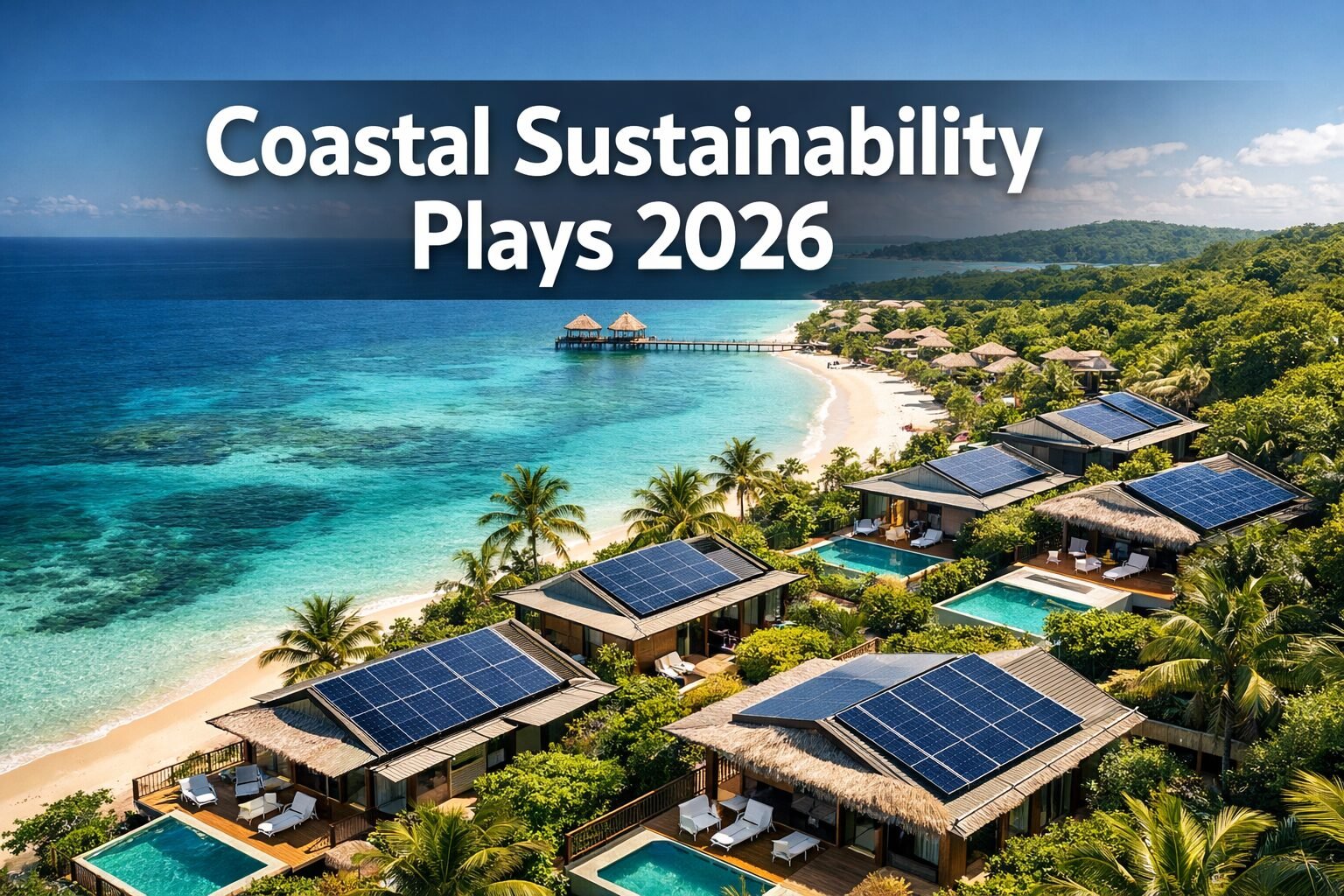
Beachfront land suitable for sustainable development has dropped below 3% of available coastal inventory in the Caribbean and Central America — and the investors who recognized that scarcity early are already commanding 20% price premiums over conventional resort properties. Coastal Sustainability Plays 2026: Eco-Luxury Developments for Remote Work and Niche Tourism Investors represents one of the most compelling intersections of lifestyle demand, environmental constraint, and capital appreciation the real estate market has produced in a decade.
Surging interest from remote executives, wellness travelers, kitesurf enthusiasts, and privacy-focused families is colliding with a shrinking supply of genuinely sustainable coastal land. The result: developers who embed green standards into their DNA — not as a marketing overlay, but as a structural planning requirement — are unlocking a premium tier that traditional resort models simply cannot replicate.
Key Takeaways 📌
- Scarcity drives premiums: Beachfront land with viable sustainability credentials is increasingly rare, giving eco-luxury developers significant pricing power.
- Remote work is reshaping demand: Long-stay remote workers and executives are replacing short-stay tourists as the primary target demographic for coastal eco-developments.
- LEED Platinum is the new baseline: Institutional investors now treat environmental certification as an operational requirement, not a differentiator.
- Extended-stay models outperform transient tourism: Boutique villas and eco-focused residences structured for longer stays generate superior yield per guest metrics.
- Regional diversification is accelerating: From Brandywine Bay in the BVI to Guanacaste in Costa Rica, multiple coastal markets are maturing simultaneously, offering investors genuine portfolio diversification.
Why Sustainability Has Become a Structural Requirement, Not a Selling Point
The old playbook — build a luxury resort, add a solar panel, call it “eco” — no longer fools institutional capital or discerning buyers. Across the Caribbean and Central America, environmental stewardship has shifted from a positioning differentiator to a binding operational standard enforced through zoning requirements and certification frameworks. [4]
“Nature-based experiences and low-density development are now managed through zoning requirements and binding operational standards rather than voluntary best practices.” [4]
This shift has profound implications for investors evaluating coastal sustainability plays in 2026. Developments that fail to meet evolving green benchmarks face not just reputational risk, but regulatory exposure and reduced access to institutional financing.
The LEED Platinum Benchmark 🏆
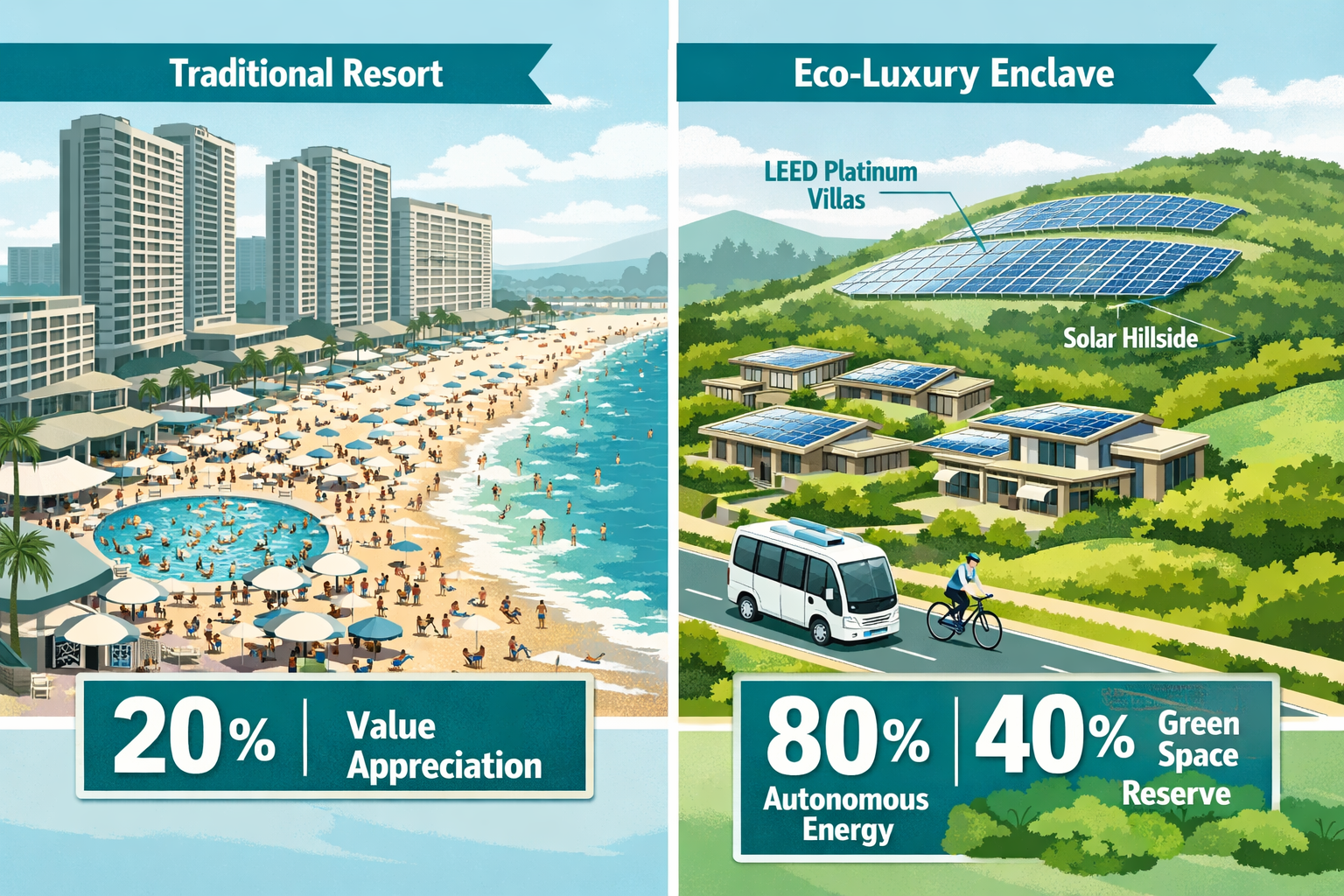
Brandywine Bay in the British Virgin Islands has emerged as perhaps the clearest proof-of-concept for what genuine sustainability integration looks like at scale. The development has achieved LEED Platinum certification with over 40% of developable land dedicated to parks and nature reserves, supported by electric shuttle networks and dedicated bike lane infrastructure. [1]
Its energy model is equally ambitious: a closed-loop micro-grid powered by photovoltaic arrays integrated into surrounding hillsides — deliberately designed to avoid visual pollution — paired with industrial-grade battery storage, projecting 80% autonomous operation capability for extended periods. [1] Backup diesel generators exist only for emergencies.
This is not greenwashing. It is infrastructure-grade environmental engineering, and it is exactly what separates properties commanding premium valuations from those competing on price alone.
Local Supply Chains as a Competitive Moat
One underappreciated element of the Brandywine Bay model is its mandated local supply chain integration. The resort commits to purchasing fixed percentages of agricultural and maritime needs from local farmers and fisheries, contingent on compliance with operational sustainability standards. [1]
This differentiates the model from import-dependent luxury operations in two critical ways:
- It reduces operational cost volatility tied to global supply chain disruptions.
- It builds community goodwill that translates into regulatory cooperation and reduced political risk for investors.
For niche tourism investors evaluating long-term holds, community integration is an often-overlooked moat.
The Remote Work Revolution Is Rewriting Coastal Investment Demand
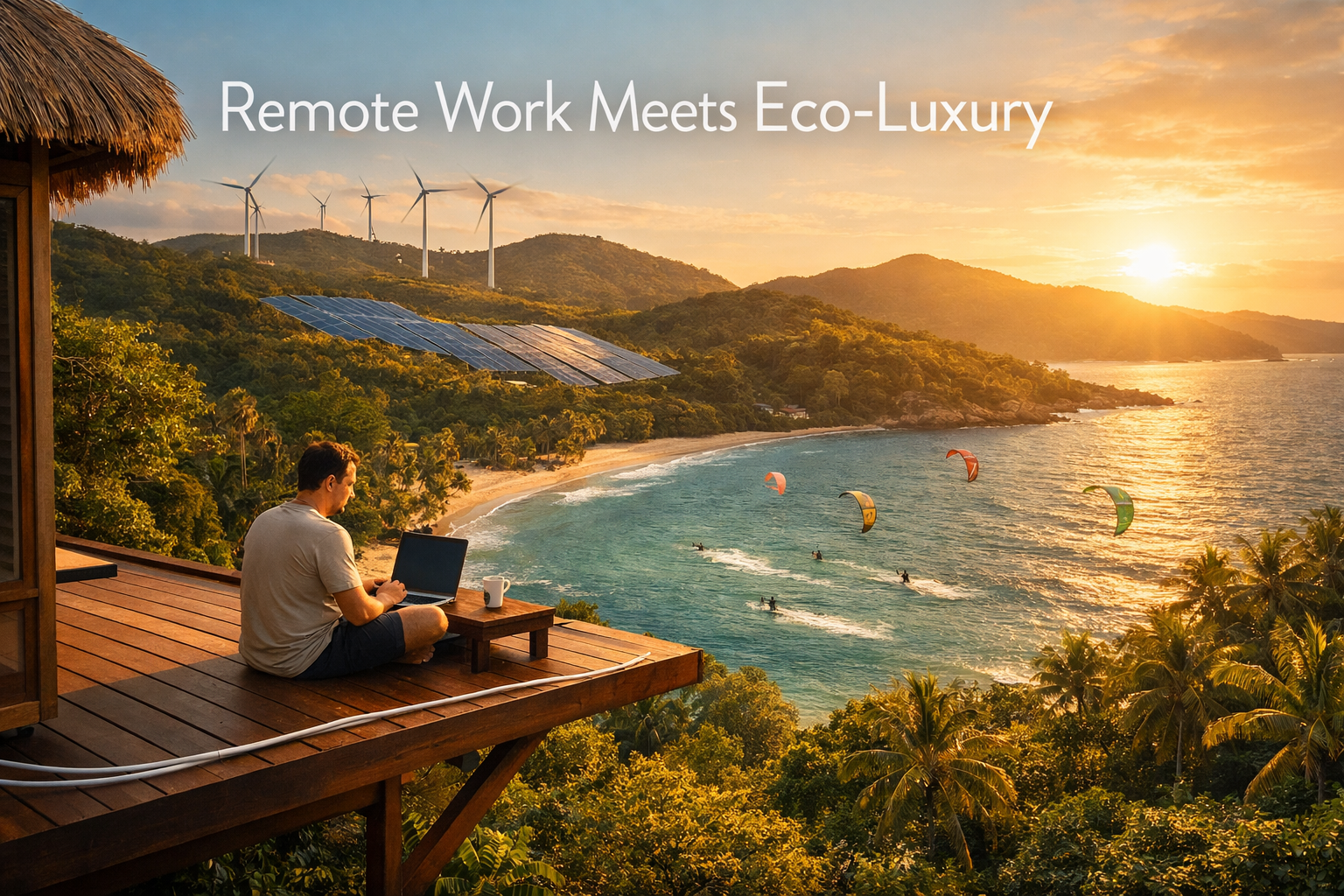
The demographic driving eco-luxury developments for remote work and niche tourism investors in 2026 is not the two-week vacationer. It is the remote executive who needs 500 Mbps fiber, physical isolation, and a wellness environment — and is willing to pay a significant premium to get all three simultaneously.
Brandywine Bay explicitly targets long-stay visitors, remote executives, and privacy-focused individuals requiring high-speed telecommunications paired with physical isolation. Its pricing model prioritizes yield per guest over occupancy rates, deliberately managing visitor density to reduce environmental strain. [1] This is a fundamentally different business model than traditional resort hospitality — and it generates fundamentally different investor returns.
Extended-Stay Economics vs. Transient Tourism
| Metric | Traditional Resort Model | Eco-Luxury Extended-Stay Model |
|---|---|---|
| Average stay | 5–7 nights | 30–90+ nights |
| Yield strategy | High occupancy, moderate rates | Low occupancy, premium rates |
| Environmental impact | High (frequent turnover, logistics) | Lower (stable occupancy, local sourcing) |
| Target guest | Leisure traveler | Remote worker / wellness seeker |
| Staff turnover risk | High | Managed (subsidized housing) [1] |
| Investor appeal | Cyclical | Resilient, institutional-grade |
Across Caribbean and Central American destinations, investor interest is shifting decisively toward boutique villas and eco-focused homes structured for longer luxury stays rather than short vacations. [3] This reflects demand from remote-working families and executives seeking operational bases rather than vacation properties — a structural demand shift, not a cyclical trend.
Staffing Infrastructure as an Investor Signal
One detail that separates institutional-grade eco-developments from aspirational ones is how they handle staffing. Brandywine Bay includes subsidized, storm-resilient housing for operational staff as part of its initial capital expenditure — explicitly designed to minimize employee turnover. [1]
Institutional investors monitor staff turnover as a proxy for operational stability. A development that cannot retain trained staff in a remote coastal location is a development with hidden operational risk. Building staff housing into the capital plan signals maturity and investor readiness.
Regional Diversification: Where the Smart Capital Is Moving in 2026
The coastal sustainability plays of 2026 are not concentrated in a single geography. A clear regional diversification pattern is emerging across the Caribbean and Central America, with distinct value propositions in each market. [2][3]
Brandywine Bay & Nevis: The Privacy-Luxury Corridor 🌊
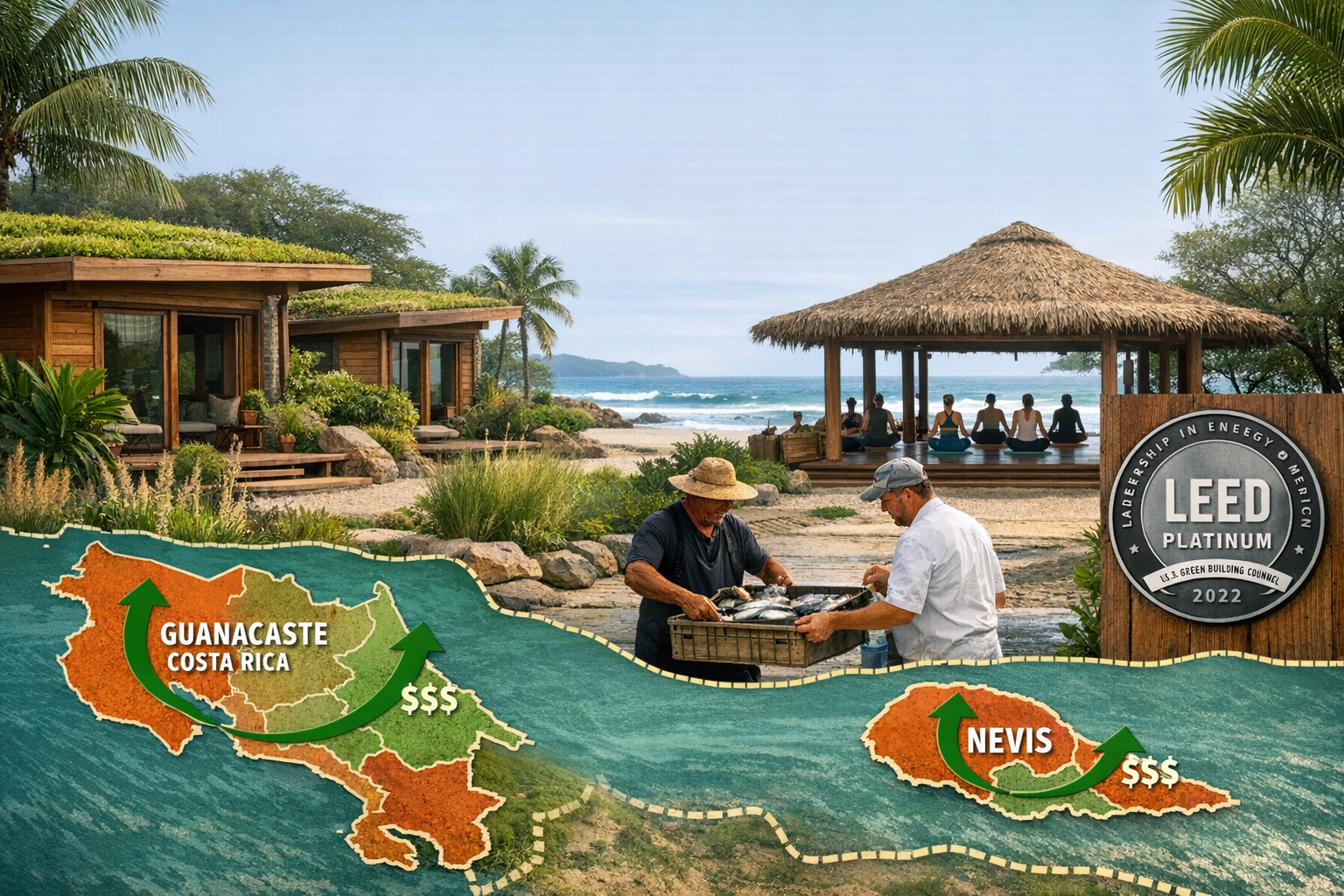
Beyond Brandywine Bay’s headline metrics — including projected 20% value appreciation by 2026 [1] — Nevis is building a parallel reputation for low-density, privacy-focused luxury villa rentals with sustainable construction standards. [3] The island’s strict development controls have inadvertently created exactly the scarcity premium that eco-luxury investors seek.
For investors exploring the best places to invest in Brazil property and comparable emerging coastal markets, the Caribbean privacy-luxury corridor offers a useful benchmark for how regulatory scarcity and sustainability standards combine to create durable value.
Costa Rica: The Diversified Eco-Investment Powerhouse 🌿
Costa Rica has completed a remarkable evolution from tourism icon to diversified investment destination. Its hospitality ecosystem now demonstrates successful coexistence of multiple product types — eco-lodges, experiential resorts, wellness retreats, branded resorts, and residential hospitality — within controlled planning frameworks. [4]
The country’s territorial tax system is a significant draw for high-net-worth remote workers and investors: only locally generated income is taxed, with rates capped at 25%. [2] For a remote executive generating income from overseas clients while residing in Guanacaste or Las Catalinas, the tax efficiency is substantial.
Key demand drivers in Costa Rica’s coastal markets include:
- ✅ Infrastructure investments reducing commute times around Greater San José and Route 32 corridors [2]
- ✅ Accelerated demand for high-end homes integrating modern design with nature-driven living in Guanacaste [2]
- ✅ Integration model prevailing over replacement — eco-lodges and branded resorts coexist rather than compete [4]
- ✅ Strong foreign buyer influx from North America and Europe seeking lifestyle-investment hybrids
Brazil’s Coastal Markets: An Emerging Parallel
Brazil’s coastal real estate market is following a similar trajectory, with Florianópolis emerging as a standout market for eco-conscious buyers and remote workers. The city’s combination of surf culture, natural beauty, and improving urban infrastructure mirrors the demand drivers visible in Caribbean and Central American markets.
The growth of the Ingleses region in Florianópolis — driven by quality of life, infrastructure investment, and property appreciation — offers a compelling case study in how coastal sustainability narratives translate into measurable returns. Investors evaluating studio investments in Florianópolis as entry-level coastal plays will find the market dynamics closely aligned with broader regional trends.
What Institutional Capital Is Watching in 2026
The Brandywine Bay project has attracted explicit institutional investor interest as a “reproducible template” for future coastal developments. [1] The industry is actively monitoring whether environmental constraints can coexist with financial viability in premium markets — and the early evidence suggests they can, provided the development model is built correctly from the ground up.
The Reproducible Template Framework
For a coastal eco-luxury development to qualify as institutional-grade in 2026, it needs to demonstrate:
- Certified environmental performance (LEED Platinum or equivalent)
- Energy autonomy (micro-grid with 70%+ autonomous operation capability)
- Demand-side management (yield-per-guest pricing, not occupancy maximization)
- Staff infrastructure (subsidized housing reducing turnover risk)
- Local supply chain integration (reducing import dependency and building community relationships)
- Extended-stay demand (remote worker and wellness traveler targeting)
- Regulatory alignment (zoning compliance and binding sustainability standards)
Developments meeting all seven criteria are commanding the premium valuations and attracting the institutional capital that defines the top tier of this market.
Niche Tourism as a Demand Multiplier 🏄
Kitesurf destinations, surf breaks, and wellness retreats are not incidental to the eco-luxury investment thesis — they are core demand multipliers. These niche activities attract exactly the demographic that eco-luxury developers are targeting: affluent, active, environmentally conscious individuals with flexible schedules and above-average spending power.
A development adjacent to a world-class kitesurf spot or surf break has a built-in demand generator that conventional resort locations lack. When that development also offers LEED-certified accommodation, high-speed connectivity, and wellness programming, the premium over comparable conventional properties becomes structurally defensible.
Developers and investors exploring current eco-development projects in coastal Brazil are finding that this niche tourism + remote work + sustainability formula is generating strong pre-sale demand, particularly in markets with scarce beachfront land and growing foreign buyer interest.
For those tracking pre-construction investment opportunities, the appreciation dynamics in coastal eco-luxury developments closely mirror the value creation patterns seen in established markets — with the additional tailwind of sustainability premiums.
Risk Factors and Due Diligence Checklist ⚠️
No investment thesis is complete without an honest assessment of risks. Coastal eco-luxury developments in 2026 carry specific risk factors that investors must evaluate carefully:
Physical Risks:
- Climate change exposure (storm frequency, sea-level projections)
- Insurance availability and cost in high-risk coastal zones
- Infrastructure resilience (storm-resilient staff housing is a positive signal) [1]
Regulatory Risks:
- Evolving sustainability standards that may require costly upgrades
- Foreign ownership restrictions in certain jurisdictions
- Zoning changes affecting development density
Operational Risks:
- Remote location logistics for construction and ongoing supply
- Staff recruitment and retention in isolated coastal environments
- Connectivity infrastructure reliability
Market Risks:
- Extended-stay demand sensitivity to global economic conditions
- Currency risk in non-dollar-denominated markets
- Liquidity constraints in niche luxury property segments
Investors should also explore how cryptocurrency and blockchain tools are entering real estate transactions in coastal markets, as tokenized ownership structures are beginning to improve liquidity in previously illiquid niche segments.
Conclusion: Actionable Next Steps for Coastal Eco-Luxury Investors
Coastal Sustainability Plays 2026: Eco-Luxury Developments for Remote Work and Niche Tourism Investors is not a speculative theme — it is a structurally supported investment category backed by institutional capital, demographic demand shifts, and regulatory tailwinds. The convergence of scarce beachfront land, rising remote work demand, and binding sustainability standards has created a premium tier that is both defensible and scalable.
Actionable Next Steps 🎯
- Audit sustainability credentials rigorously. Demand LEED Platinum documentation, energy autonomy data, and binding supply chain commitments — not marketing brochures.
- Prioritize extended-stay demand generators. Evaluate proximity to kitesurf spots, surf breaks, wellness infrastructure, and high-speed connectivity as core value drivers.
- Verify staff infrastructure. Subsidized staff housing is a proxy for operational maturity and institutional-grade management.
- Assess tax jurisdiction efficiency. Costa Rica’s territorial tax system at 25% cap [2] and comparable structures in other jurisdictions can significantly affect net returns.
- Explore pre-construction entry points. Buying at the pre-construction stage in certified eco-luxury developments historically captures the largest share of appreciation.
- Diversify across geographies. The BVI, Nevis, Costa Rica, and Brazil’s coastal markets each offer distinct risk-return profiles within the same macro theme.
- Monitor institutional capital flows. When a development attracts institutional interest as a “reproducible template,” [1] early retail investors benefit from the validation premium that follows.
The window for entry-level positioning in the most compelling coastal eco-luxury markets is narrowing as institutional capital accelerates its deployment. The investors who move with rigorous due diligence — not speculation — in 2026 are positioning themselves at the front of a demand wave that shows no signs of reversing.
References
[1] Emerging Enclaves Why Brandywine Bay Is 2026s Most Anticipated Destination For Sustainable Luxury – https://www.coldwellbankerbvi.com/emerging-enclaves-why-brandywine-bay-is-2026s-most-anticipated-destination-for-sustainable-luxury/
[2] Why Global Buyers Are Choosing Costa Rica Right Now – https://www.benoitproperties.com/news/why-global-buyers-are-choosing-costa-rica-right-now/
[3] Caribbean Property Trends 2026 Rentals Land And Island Living Opportunities – https://sknih.com/caribbean-property-trends-2026-rentals-land-and-island-living-opportunities/
[4] Costa Rica Shifts From Tourism Icon To Diversified Investment Powerhouse – https://www.greenlodgingnews.com/costa-rica-shifts-from-tourism-icon-to-diversified-investment-powerhouse/