
Brazil’s national data center vacancy rate has fallen to approximately 4% in 2026, a figure that tells a story of structural undersupply far more urgent than any headline about digital growth [1]. For commercial real estate developers, industrial land owners, and institutional investors, this single metric signals a market transformation already underway. Data Centers and Power-Constrained Development: Brazil’s New Commercial Real Estate Frontier is not a future trend to monitor. It is an active reshaping of how land is valued, how utilities are planned, and how permitting strategies must evolve across the country’s most competitive urban corridors.
Key Takeaways
- Brazil’s data center vacancy rate sits near 4% in 2026, confirming a structurally undersupplied market with strong tenant demand [1].
- The national data center market is estimated at US$3.38 billion in 2026, with the construction segment projected to reach US$7.01 billion by 2031 [6].
- Power transmission, not generation, is the primary bottleneck constraining new development, prompting Brazil to launch the National Transmission System Access Policy (PNAST) in 2025 [8].
- Hyperscale cloud and AI workloads are the dominant demand drivers, rapidly increasing colocation consumption and reshaping energy requirements [5].
- Secured power access and suitable cooling infrastructure have become the defining factors in industrial property site selection and land valuation [3][7].
Brazil’s Data Center Market: Scale, Demand, and the 2026 Landscape
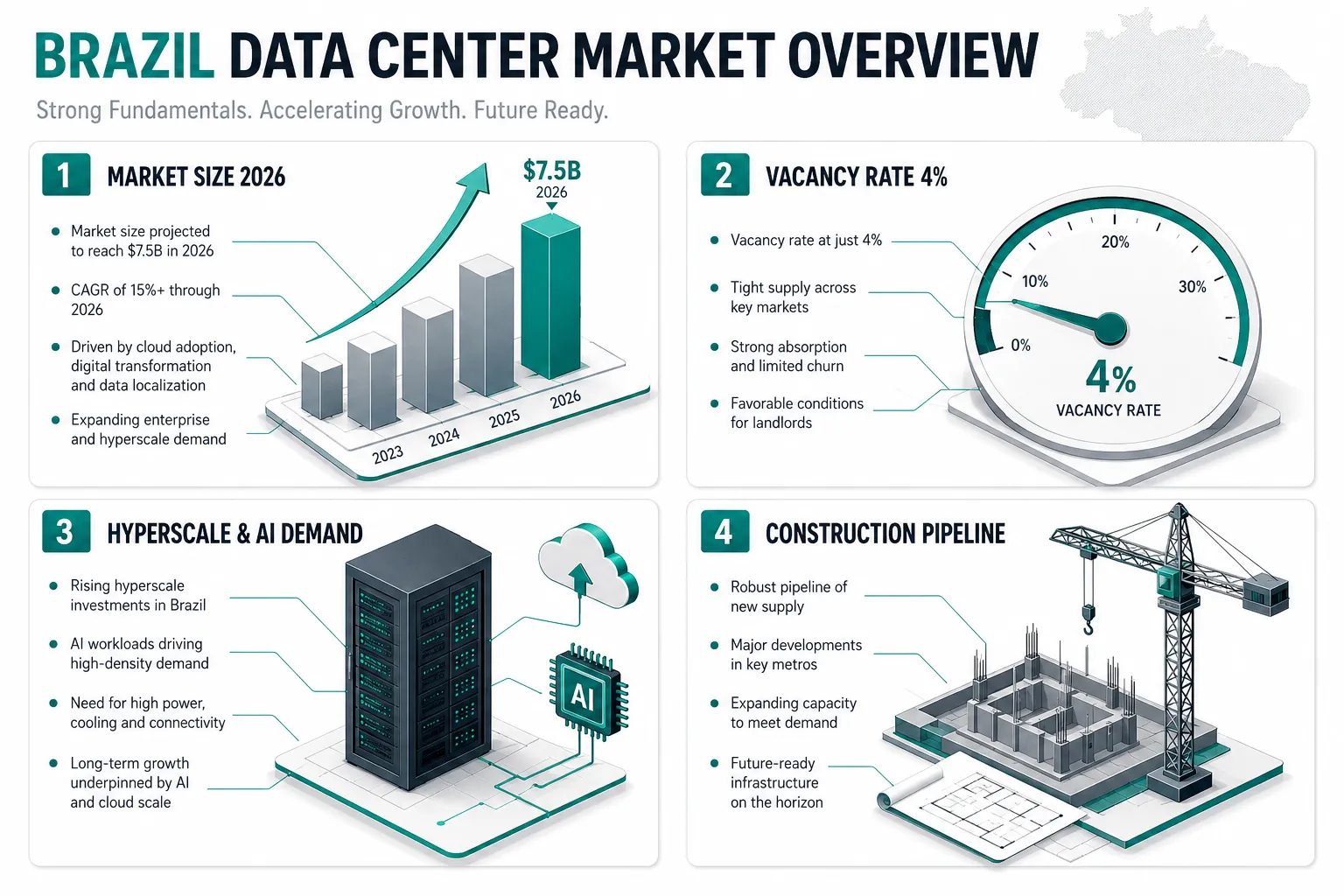
The numbers behind Brazil’s data center sector are striking by any measure. The market is valued at approximately US$3.38 billion in 2026, and the construction segment alone is forecast to grow from roughly US$3.83 billion to US$7.01 billion by 2031, a compound annual growth rate of about 12.9% [6]. This is not speculative froth. It reflects the convergence of several structural forces: rapid cloud adoption by Brazilian enterprises, the expansion of hyperscale operators into Latin America, and the explosive demand for AI compute infrastructure that requires dense, power-intensive facilities [5].
Demand is being led by hyperscale cloud providers and AI workloads. These operators have rapidly increased their use of colocation capacity across Greater São Paulo and are now competing aggressively for any site that offers both connectivity and reliable power [2][5]. The result is a market where vacancy has been squeezed to near-critical lows, and where pricing for power-ready colocation space in core markets reflects a clear premium over standard industrial or commercial assets [2].
For context, Brazil’s broader real estate investment landscape is undergoing significant evolution in 2026. Developers and institutional investors who have historically focused on residential or logistics assets are now confronting a new asset class that demands a fundamentally different due diligence framework. Those interested in understanding the broader investment environment can consult this Real Estate in Brazil 2026 investment guide for context on how data center demand fits within the national property market.
What is driving this demand surge?
- Cloud migration by Brazilian corporations and government agencies
- Expansion of hyperscale providers (global cloud platforms) into Latin American markets
- AI inference and training workloads requiring dense compute clusters
- Growth of streaming, fintech, and e-commerce infrastructure
- Regulatory requirements for data sovereignty and local data storage
The pipeline of planned data center capacity has reached unprecedented scale. Brazil reportedly has a development pipeline of approximately 26 GW of planned data center capacity, a figure that raises serious questions about how much will actually be built given current infrastructure constraints [9]. This gap between announced capacity and deliverable supply is precisely where the real estate opportunity and the risk converge.
Power Transmission: The Bottleneck Reshaping Industrial Real Estate Site Selection
Brazil generates abundant electricity. Its energy matrix is one of the cleanest in the world, with significant hydro, wind, and solar capacity. Yet the country’s transmission infrastructure, the network of high-voltage lines that carries power from generation sources to demand centers, has become the single most critical constraint on data center development [8].
“The bottleneck is not whether Brazil can generate enough power. The bottleneck is whether the grid can deliver it to the right place at the right time.”
This distinction matters enormously for real estate developers. A site with excellent road access, favorable zoning, and proximity to fiber networks may still be unbuildable as a data center if it cannot secure a firm grid connection with sufficient capacity. Power transmission has effectively become a site selection criterion that ranks above almost all others [8][13].
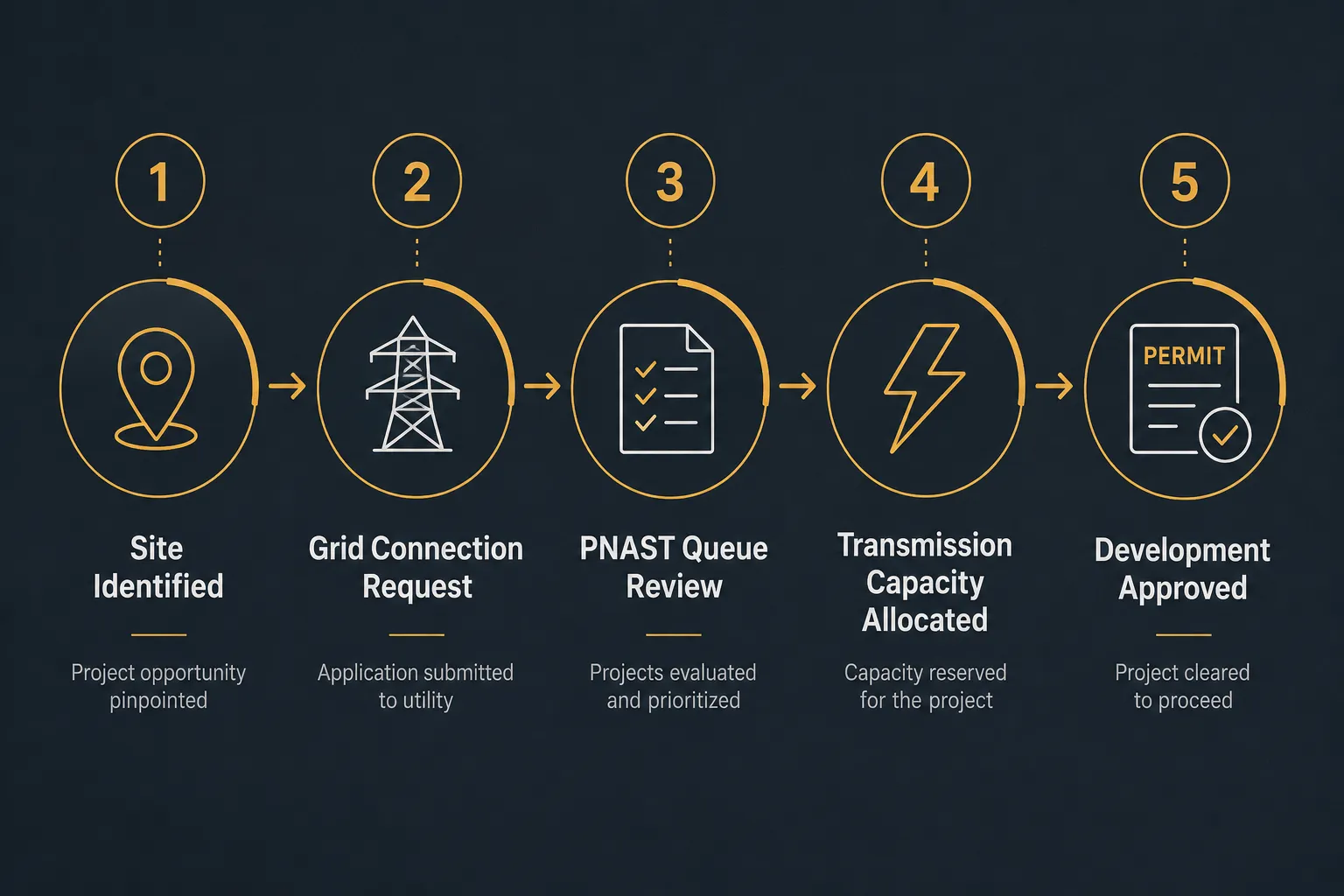
In response to mounting pressure from developers and operators, Brazil created the National Transmission System Access Policy (PNAST) in 2025. This policy reorganizes how projects obtain grid connections, establishing a formal queue and prioritization framework for large power consumers [8]. For developers, PNAST introduces both clarity and complexity: clarity because the rules of engagement are now codified, and complexity because securing a position in the queue requires technical documentation and regulatory navigation that adds time and cost to the development process.
Key implications of PNAST for data center real estate:
- Sites with existing substation infrastructure or proximity to high-voltage transmission lines carry a significant valuation premium
- Developers must engage with grid operators earlier in the planning cycle than traditional industrial projects require
- Speculative land banking near power infrastructure has become a recognized investment strategy
- Projects that cannot demonstrate a credible path to grid connection face difficulty attracting institutional capital
The development pipeline’s scale, that 26 GW figure, far exceeds what the current transmission grid can readily support [9]. Analysts have noted that renewable curtailment and grid congestion could translate into higher and less predictable energy costs for operators and surrounding communities if transmission investment does not keep pace [14][15]. This creates a two-tier market: sites with secured power access command premium pricing and attract anchor tenants quickly, while sites without clear grid connectivity remain speculative and illiquid.
For investors tracking infrastructure-led real estate opportunities, the Port of Santos logistics boom and warehousing developments offer a useful parallel: in both cases, infrastructure access, whether port connectivity or power transmission, is the primary determinant of asset value and yield potential.
The renewable energy dimension adds another layer of complexity. Brazil’s wind and solar resources are concentrated in the Northeast and Central-West regions, while the largest data center demand clusters are in the Southeast, particularly Greater São Paulo. Bridging this geographic mismatch requires long-distance transmission investment that takes years to plan and execute. Developers who secure power purchase agreements (PPAs) directly with renewable generators, combined with transmission rights, are gaining a competitive advantage that is difficult for late entrants to replicate.
Land Valuation, Permitting Strategy, and the New Industrial Real Estate Calculus
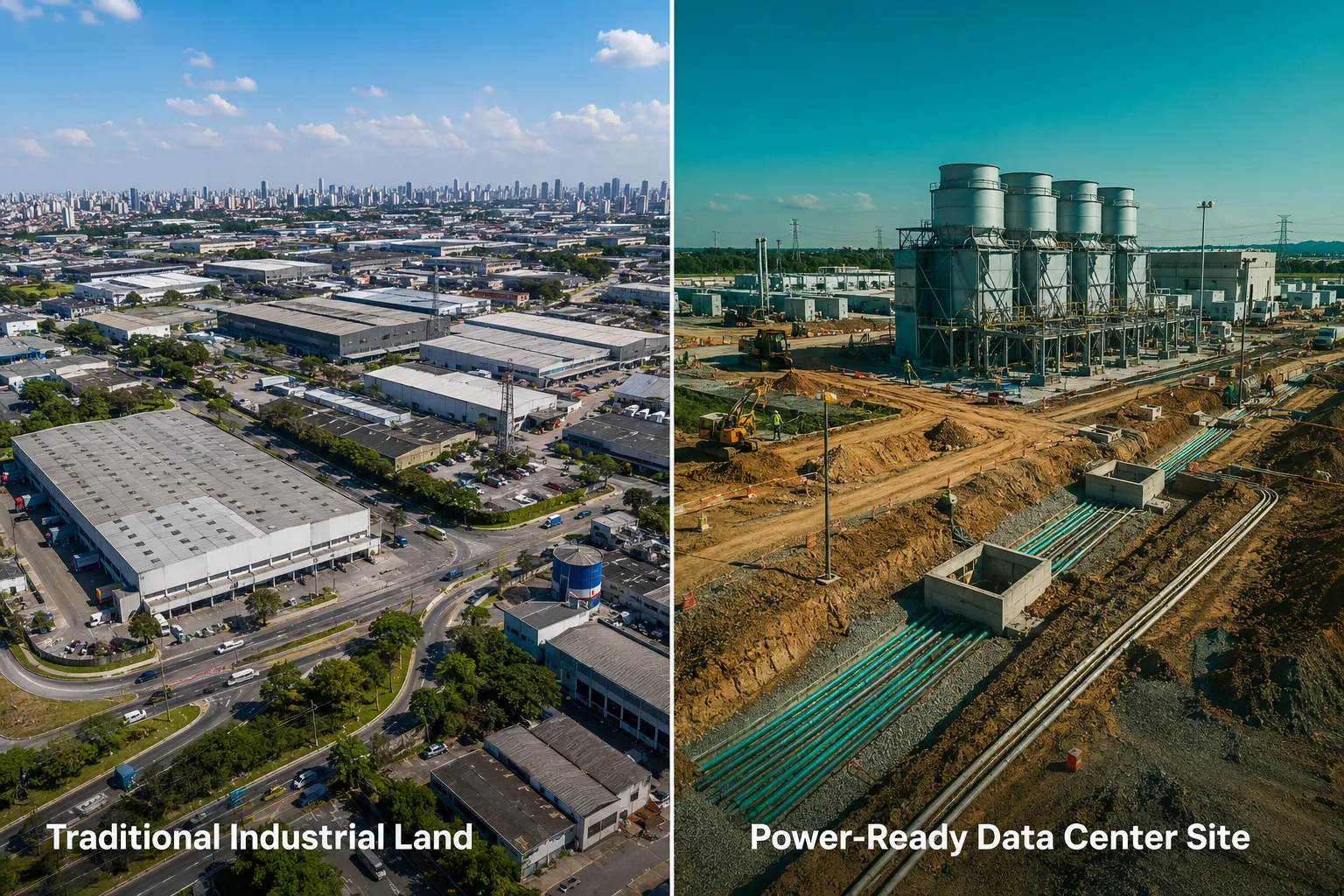
The phrase “data centers are the physical translation of the digital economy” has moved from marketing language to analytical consensus among Brazilian real estate professionals [3][7]. What this means in practical terms is that the industrial and logistics property market, long defined by metrics like floor-plate size, truck access, and clear height, now has a new and dominant demand driver that operates by entirely different rules.
How data centers are changing land valuation:
| Factor | Traditional Industrial Asset | Data Center-Ready Asset |
|---|---|---|
| Primary value driver | Location, logistics access | Power capacity, grid proximity |
| Key infrastructure | Road and rail connectivity | Substation, fiber, cooling water |
| Zoning requirement | Industrial or logistics | Industrial with utility easements |
| Tenant profile | Manufacturers, distributors | Cloud operators, colocation providers |
| Lease structure | Standard industrial terms | Long-term, mission-critical tenancy |
Sites in Greater São Paulo that previously traded as standard industrial land are now being reassessed based on their proximity to substations and their ability to support the power densities that modern hyperscale facilities require [3][7]. Corporate investment announcements in mid-2026 have confirmed that large operators are actively competing for power-rich sites in this corridor, with some transactions reflecting valuations that would have been unrecognizable to industrial property analysts just three years ago [11][12].
Permitting strategy has also been transformed. Data center projects require coordination across multiple regulatory bodies, municipal planning authorities, state environmental agencies, the national electricity regulator (ANEEL), and grid operators. The permitting timeline for a large data center can extend to three or more years when transmission access negotiations are included. Developers who build relationships with regulatory bodies early, and who structure land acquisitions with contingencies tied to grid connection milestones, are better positioned to manage this risk.
Expert commentary from the sector consistently emphasizes that suitable land plus secured power and cooling are now the primary determinants of whether an industrial property can be converted into a data center [3][4][7]. Cooling infrastructure, whether through access to water sources, proximity to rivers, or the ability to deploy advanced air and liquid cooling systems, is the third leg of the site selection triangle alongside power and connectivity.
The sustainability dimension is increasingly non-negotiable for institutional operators. Major hyperscale tenants have made public commitments to 100% renewable energy and carbon neutrality targets. This means that data center developers in Brazil must not only secure power but secure clean power, ideally through direct PPAs with wind or solar generators, or through certified renewable energy certificates. Properties that can demonstrate a credible renewable energy supply chain are commanding premiums from ESG-conscious tenants and investors alike. For a broader view of how sustainability is reshaping Brazilian property values, the discussion of ESG and sustainability premiums for international buyers is directly relevant.
The geographic concentration of current activity in Greater São Paulo does not mean opportunity is limited to that market. Telecom carriers and colocation providers are also evaluating secondary markets where land costs are lower and grid congestion is less severe [10]. Cities with strong university infrastructure, growing tech sectors, and improving fiber connectivity, including some of Brazil’s secondary urban centers, are beginning to attract edge data center investment. Developers tracking secondary cities housing and commercial development plays will find that the same infrastructure logic applies: where connectivity and power access improve, commercial real estate values follow.
Practical steps for developers and investors entering this market:
- Conduct power feasibility assessments before land acquisition. Engage a power consultant to assess substation capacity, transmission headroom, and PNAST queue status for any target site.
- Map fiber infrastructure overlaps. Data centers require diverse, redundant fiber entry points. Sites within carrier-neutral fiber corridors command a structural premium.
- Engage municipal authorities early on zoning and utility easements. Data center projects often require dedicated utility corridors and cooling water access that standard industrial zoning does not anticipate.
- Structure land purchase agreements with grid connection contingencies. Unconditional purchases of sites without confirmed power access expose developers to significant stranded-asset risk.
- Build a renewable energy supply strategy in parallel with site selection. Institutional tenants will require evidence of a clean energy pathway before signing long-term leases.
- Monitor PNAST developments closely. The policy framework is new and will evolve. Developers who track regulatory updates will be better positioned to time their grid connection applications strategically.
For foreign investors and developers seeking to understand the broader legal and financial framework for entering the Brazilian market, the guide to foreign direct investment in Brazil properties provides essential context on currency dynamics, ownership structures, and capital repatriation rules that apply to commercial real estate transactions.
The multi-family residential projects as institutional capital’s gateway to Brazil’s 2026 market article illustrates how institutional investors are already building frameworks for large-scale Brazilian real estate exposure, frameworks that are now being extended to cover data center and industrial assets as the market matures.
Conclusion
Data Centers and Power-Constrained Development: Brazil’s New Commercial Real Estate Frontier represents one of the most significant structural shifts in the country’s commercial property market in a generation. The convergence of near-zero vacancy rates, a multi-billion-dollar construction pipeline, and a power transmission bottleneck has created a market where the rules of site selection, land valuation, and permitting strategy have been fundamentally rewritten [1][2][6][8].
The opportunity is real and substantial. Brazil’s digital economy is growing, hyperscale operators are committing capital at scale, and the country’s renewable energy resources provide a credible long-term foundation for clean data center operations. But the risks are equally concrete: speculative pipeline far exceeds deliverable supply, transmission constraints are structural rather than cyclical, and the regulatory environment around grid access is still evolving [9][14][15].
Actionable next steps for market participants:
- Developers should prioritize power feasibility due diligence above all other site selection criteria and engage grid consultants before committing to land acquisitions.
- Institutional investors should assess portfolio exposure to power-constrained industrial assets and identify which existing holdings have latent data center conversion potential.
- Land owners near high-voltage substations in Greater São Paulo and other major urban corridors should seek independent valuations that reflect the data center premium now embedded in those locations.
- All participants should monitor PNAST implementation closely, as changes to the grid connection queue framework will directly affect project timelines and asset values.
Brazil’s data center frontier is not waiting for the market to catch up. The developers and investors who move with precision, securing power access, building regulatory relationships, and structuring deals around infrastructure milestones, will define the next generation of commercial real estate leadership in Latin America’s largest economy.
References
[1] Brazil Data Center Report Shows Record Growth In 2026 – https://www.jll.com/en-us/insights/brazil-data-center-report-shows-record-growth-in-2026
[2] Mercado Data Centers Brasil – https://forbes.com.br/forbes-money/forbes-real-estate/2026/08/mercado-data-centers-brasil/
[3] Boom Dos Data Centers Impulsiona O Mercado Imobiliario No Brasil – https://www.correiobraziliense.com.br/economia/2026/07/7455931-boom-dos-data-centers-impulsiona-o-mercado-imobiliario-no-brasil.html
[4] What Does 247 Data Centers New Equity Investment Mean – https://www.bnamericas.com/en/features/what-does-247-data-centers-new-equity-investment-mean
[5] Brazil Hyperscale Data Center Market – https://www.mordorintelligence.com/industry-reports/brazil-hyperscale-data-center-market
[6] Brazil Data Center Market – https://www.mordorintelligence.com/industry-reports/brazil-data-center-market
[7] Data Centers Brazil Billions Industrial Properties – https://siila.com.br/news/data-centers-brazil-billions-industrial-properties/8395/lang/en
[8] Data Center Expansion Hits Power Transmission Bottleneck – https://valorinternacional.globo.com/business/news/2026/08/04/data-center-expansion-hits-power-transmission-bottleneck.ghtml
[9] Brazil Has A 26GW Data Centre Pipeline How Much Of It Will Actually Get Built – https://thetechcapital.com/brazil-has-a-26gw-data-centre-pipeline-how-much-of-it-will-actually-get-built/
[10] Verizon Brasil Carriers Telecom Data Centers Ativos Imobiliarios 2026 – https://news.griinstitute.org/pt/mercado-imobiliario/verizon-brasil-carriers-telecom-data-centers-ativos-imobiliarios-2026