
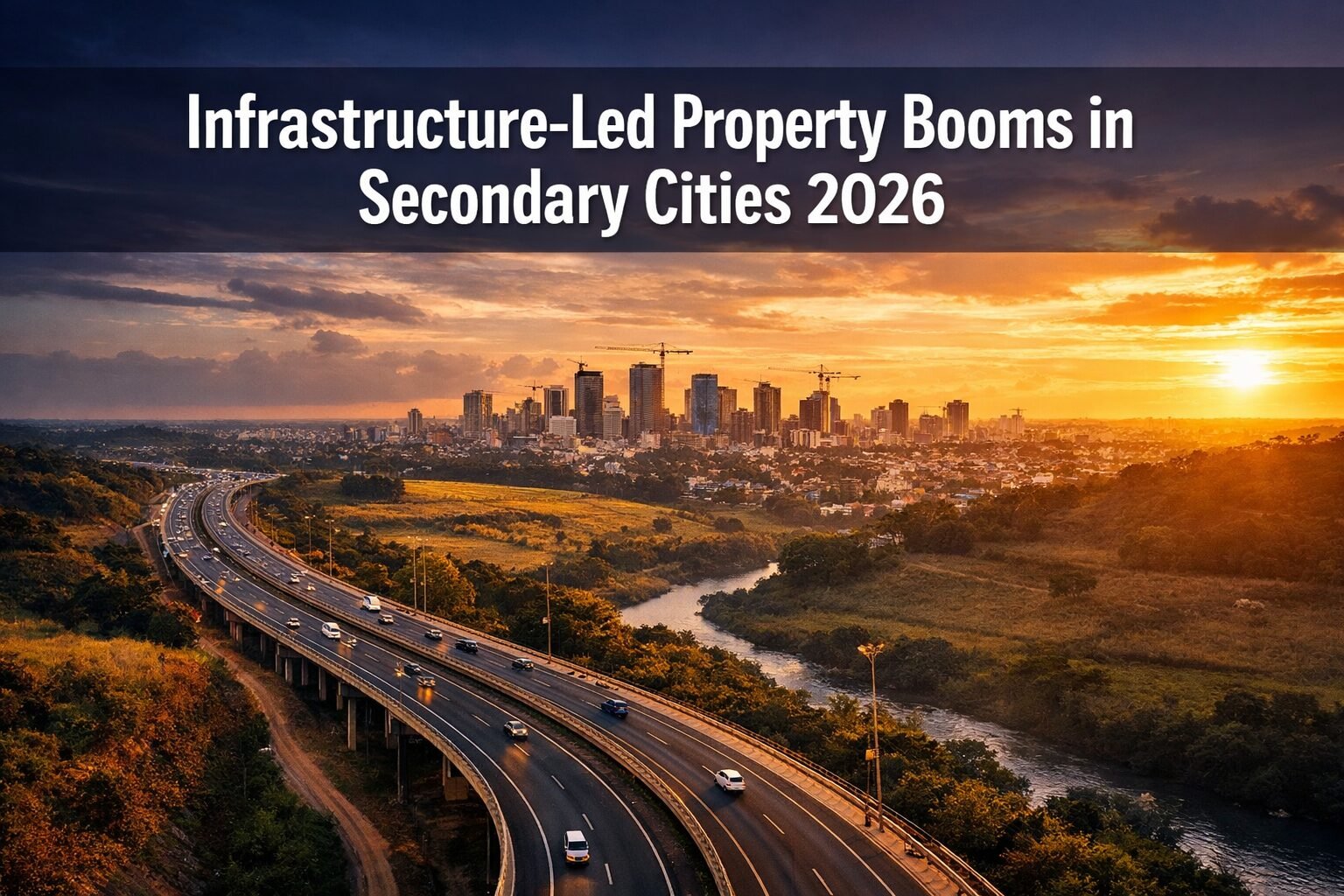
Brazil’s Novo PAC program has committed R$372.3 billion to infrastructure investments between 2025 and 2029 — and the ripple effects on inland property markets are already being felt far beyond São Paulo and Rio de Janeiro. This wave of spending is rewriting the rules of real estate appreciation, making Infrastructure-Led Property Booms in Secondary Cities 2026: Highway and Railway Impacts on Inland Development Values one of the most consequential trends for developers, investors, and urban planners this decade.
The pattern is clear: wherever new highways and railways reach, land values follow. From the cerrado of inland Bahia to the agribusiness corridors of São Paulo’s interior, secondary cities are capturing investment attention that once flowed exclusively to coastal metros. Understanding how transport infrastructure catalyzes these booms — and how to position ahead of them — is now a core competency for serious real estate investors.
Key Takeaways 📌
- R$372.3 billion in Novo PAC infrastructure spending (2025–2029) is directly driving property appreciation in Brazil’s secondary cities.
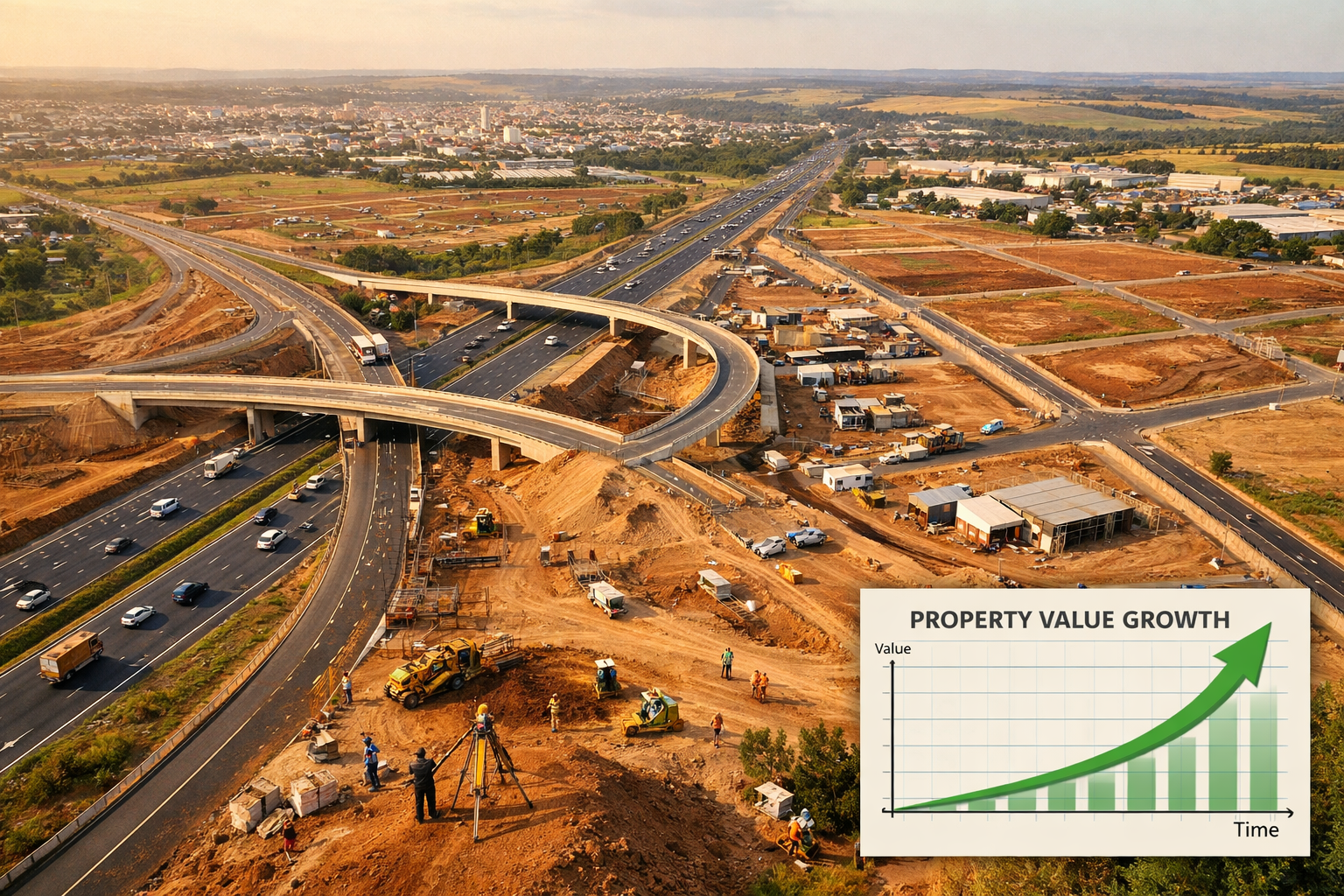
- Highway and railway expansions create measurable land value uplift zones within 5–15 km of new transport corridors.
- Regional markets globally are outpacing capital cities in value growth — Australian regional dwellings grew 3.2% in Q1 2026 vs. 2.1% for capital cities [1].
- Industrial and logistics properties near rail and port upgrades are seeing rent growth of 3–4% annually, as seen in the Baltimore/I-95 corridor [2].
- Land banking and mixed-use launches near confirmed infrastructure routes represent the highest-upside strategy for developers in 2026.
Why Infrastructure Spending Reshapes Property Values
Infrastructure is not just concrete and steel — it is a value redistribution engine. When a new highway cuts travel time between an inland city and a major port, it doesn’t merely improve logistics. It transforms the economic geography of an entire region.
The mechanism works in three stages:
- Announcement Effect — Land prices near confirmed routes begin rising before a single shovel breaks ground, as informed investors and developers move early.
- Construction Phase Appreciation — Local employment rises, population inflows begin, and commercial demand accelerates.
- Operational Maturity — Reduced transport costs attract manufacturing, warehousing, and agribusiness investment, sustaining long-term value growth.
💡 “Infrastructure investment is a key driver, with transport upgrades, healthcare facilities, and commercial developments enhancing liveability and market confidence across regional centres.” [1]
This three-stage model is visible across global markets in 2026. In Australia, regional dwelling values increased approximately 3.2% in the three months to January 2026, compared with a combined capital city average of just 2.1% — a gap directly linked to infrastructure investment in secondary markets [1]. Western Australia’s Albany, Kalgoorlie-Boulder, and Busselton have all recorded notable quarterly value increases underpinned by transport and commercial upgrades [1].
For Brazil, the scale is even larger. The Novo PAC’s R$372.3 billion commitment spans highways, railways, ports, and urban mobility — and secondary cities in Bahia, Minas Gerais, Goiás, and the São Paulo interior are positioned at the center of this transformation.
Infrastructure-Led Property Booms in Secondary Cities 2026: The Brazilian Case Studies
Inland Bahia: Highway BR-116 and the Feira de Santana Effect
Feira de Santana — Brazil’s second-largest city in Bahia — sits at the intersection of three major federal highways. Novo PAC investments in BR-116 duplication and BR-324 upgrades are compressing travel times to Salvador’s port by nearly 40 minutes, fundamentally changing the city’s logistics profile.
The result: industrial land values along the BR-116 corridor have appreciated significantly ahead of broader Bahia averages. Developers who banked land within 10 km of the confirmed duplication route in 2023–2024 are now seeing those positions mature. Mixed-use projects combining light industrial, commercial, and residential components are launching at premiums that would have been unthinkable three years ago.
Key value drivers in inland Bahia include:
- 🚛 Freight cost reduction making Feira de Santana competitive with coastal logistics hubs
- 🏗️ New industrial parks attracted by improved connectivity
- 🏘️ Residential demand from workers relocating from Salvador’s congested metro area
- 📈 Commercial real estate following population and purchasing power growth
São Paulo Interior: The Railway Renaissance
The São Paulo interior — cities like Ribeirão Preto, São José do Rio Preto, Campinas, and Sorocaba — is experiencing a railway renaissance tied to both Novo PAC investments and private freight rail concessions.
The expansion of the Malha Paulista freight rail network is reducing truck dependency for agribusiness exports, while urban rail investments in Campinas (VLT) and Sorocaba are improving intra-city mobility. The combined effect is a dual appreciation dynamic: freight rail boosts industrial and logistics land values on city peripheries, while urban rail drives residential and mixed-use appreciation along station corridors.
| City | Infrastructure Driver | Primary Property Segment Benefiting |
|---|---|---|
| Campinas | VLT urban rail + highway upgrades | Mixed-use, residential TOD |
| Ribeirão Preto | Freight rail + BR-050 improvements | Industrial, logistics warehousing |
| Sorocaba | Urban mobility + Rodoanel access | Residential, commercial |
| São José do Rio Preto | Airport expansion + BR-153 | Commercial, hospitality |
For investors exploring the best places to invest in Brazilian property, these interior São Paulo cities represent a compelling combination of infrastructure catalysts and relatively lower entry prices compared to the capital.
The Railway Multiplier: Industrial and Logistics Value Creation
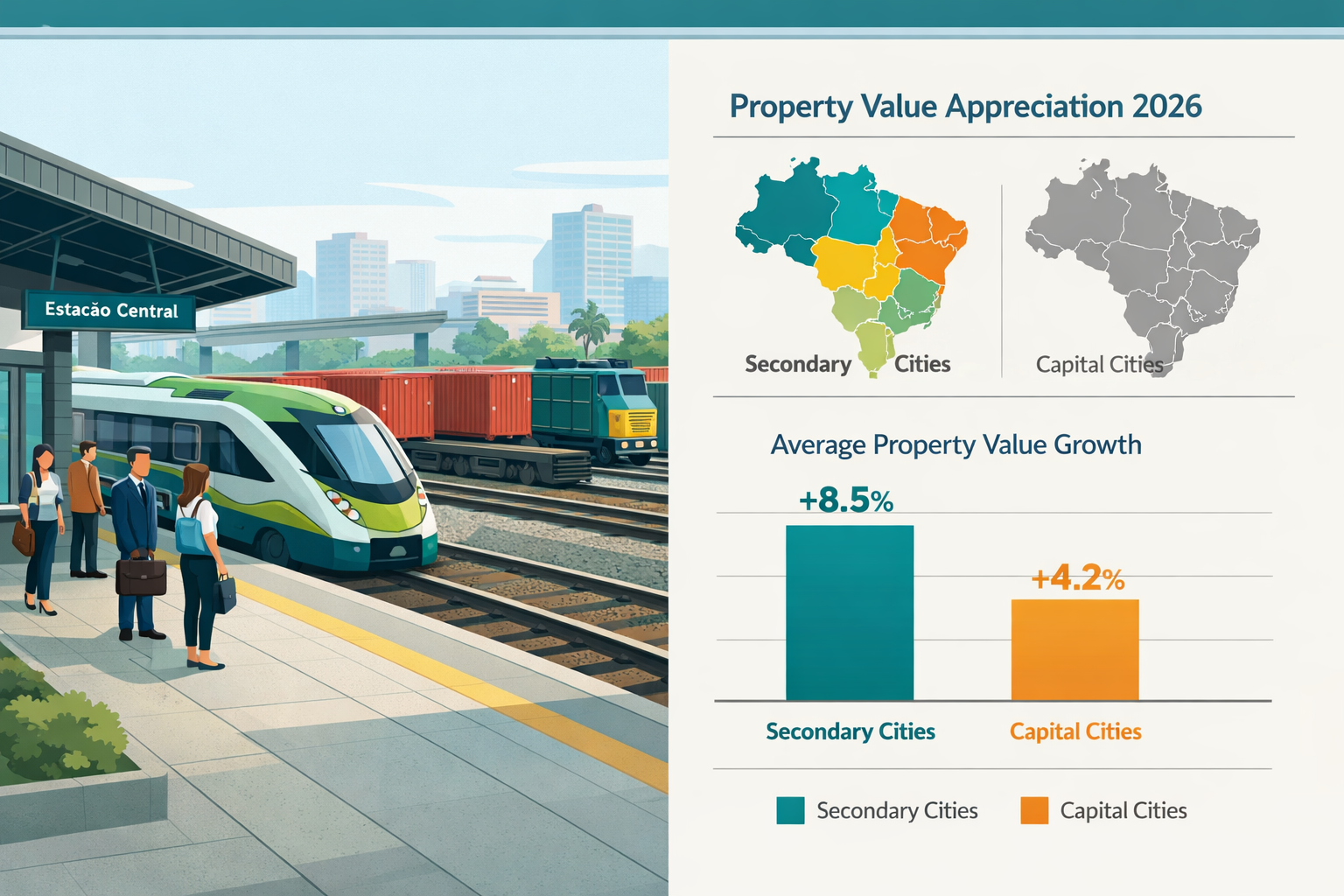
Rail connectivity has a uniquely powerful effect on industrial and logistics property values — a dynamic playing out simultaneously in Brazil and across global secondary markets.
In Baltimore, Maryland, the Howard Street Tunnel expansion — enabling double-stacked rail containers — is projected to increase port volume and drive new demand for nearby industrial space tied to freight handling [2]. The Baltimore/I-95 corridor is forecasting rent growth of 3.0%–4.0% for 2026, driven by port expansion demand meeting stabilizing supply [2]. This is not a coincidence; it is the railway multiplier in action.
The same logic applies directly to Brazilian secondary cities connected to freight rail networks:
- Lower logistics costs attract distribution centers and manufacturing
- Reduced truck traffic improves urban liveability, supporting residential values
- Port connectivity enables export-oriented industries to locate inland, where land is cheaper
- Supply chain resilience drives corporate real estate decisions toward rail-connected secondary cities
🔑 Key Insight: Limited new industrial supply in 2026 — with deliveries expected to fall more than 70% from pandemic-era peaks globally — creates favorable conditions for secondary markets where infrastructure is improving [2].
For developers active in markets like Florianópolis and the broader Santa Catarina coast, understanding the growth trajectory of emerging neighborhoods provides a useful template: infrastructure investment precedes and sustains property appreciation cycles.
Infrastructure-Led Property Booms in Secondary Cities 2026: Strategic Frameworks for Developers
Land Banking: The Early-Mover Advantage
The most significant returns in infrastructure-led property booms accrue to those who move before the market prices in the infrastructure premium. This requires:
- Monitoring official project pipelines — Novo PAC project lists, ANTT (National Land Transportation Agency) concession announcements, and state-level infrastructure secretariat publications
- Mapping value uplift zones — Research consistently shows the strongest appreciation within 5–15 km of new transport nodes, with diminishing returns beyond 20 km
- Assessing absorption capacity — Secondary cities with existing population bases of 200,000–800,000 offer the best balance of demand depth and growth potential
- Evaluating zoning flexibility — Infrastructure investment often triggers zoning reviews; land with mixed-use potential commands premium optionality value
Understanding why buying at the pre-launch phase can potentialize gains is directly applicable here — the same early-mover logic that applies to pre-launch residential projects applies to land banking near confirmed infrastructure routes.
Mixed-Use Launches: Capturing the Full Value Chain
Infrastructure investment creates demand across multiple property segments simultaneously. The most sophisticated developers are responding with mixed-use launches that capture residential, commercial, and light industrial demand within a single project.
This approach is particularly effective near:
- Highway interchanges — High visibility commercial + logistics + residential
- Railway stations — Transit-oriented development (TOD) combining retail, office, and residential
- Port access roads — Industrial + worker housing + commercial services
The Micron expansion in Manassas, Virginia — drawing suppliers and support services requiring nearby flex and industrial space — illustrates how a single anchor investment can transform a secondary city’s entire property market [2]. Brazilian equivalents include large agro-industrial investments in Mato Grosso and Goiás, or automotive supply chain expansions in the ABC Paulista and Sorocaba corridors.
For developers looking at active projects that embody this integrated approach, current developments in the Florianópolis market demonstrate how infrastructure-aware project positioning drives sales performance.
Global Parallels: What International Markets Reveal About Secondary City Dynamics
The infrastructure-led secondary city boom is not uniquely Brazilian — it is a global phenomenon in 2026, and international case studies offer valuable validation.
Australia’s Regional Boom: Queensland regional centres including Toowoomba, Bundaberg, and Cairns are experiencing firm property conditions supported by population growth and infrastructure development [1]. Toowoomba’s Second Range Crossing highway project is a textbook example: completed infrastructure drove a sustained appreciation cycle that outpaced Brisbane for multiple consecutive quarters.
United States Secondary Markets: Cities like Boise, Salt Lake City, and Atlanta are leading real estate activity in 2026 [4], partly driven by infrastructure investment and corporate relocations from high-cost primary metros. The pattern mirrors Brazil’s dynamic: infrastructure makes secondary cities viable alternatives, population follows, and property values appreciate.
The Power Infrastructure Factor: In Northern Virginia, reliable electricity supply has become a primary factor determining which development projects advance [2]. This is a critical lesson for Brazilian secondary cities: infrastructure investment must be holistic. A new highway without reliable power, water, and digital connectivity will underdeliver on its property value potential.
Risks and Mitigation Strategies
No investment thesis is without risk. Infrastructure-led property booms carry specific vulnerabilities:
| Risk | Description | Mitigation |
|---|---|---|
| Project delays | Infrastructure timelines frequently slip, delaying value catalysts | Focus on projects with >60% completion or signed contracts |
| Demand overestimation | Secondary cities may lack population depth to absorb new supply | Validate with demographic trend data, not projections alone |
| Political risk | Government changes can redirect or cancel infrastructure commitments | Diversify across multiple infrastructure corridors |
| Liquidity risk | Land banking in secondary cities can be illiquid | Maintain adequate capital reserves; plan for 3–7 year horizons |
| Zoning uncertainty | Infrastructure doesn’t automatically trigger favorable zoning | Engage local municipalities early; assess master plan alignment |
Staying current with the latest news and market analysis from active development markets helps investors monitor these risk factors in real time.
Florianópolis as a Model: Infrastructure Meets Quality of Life
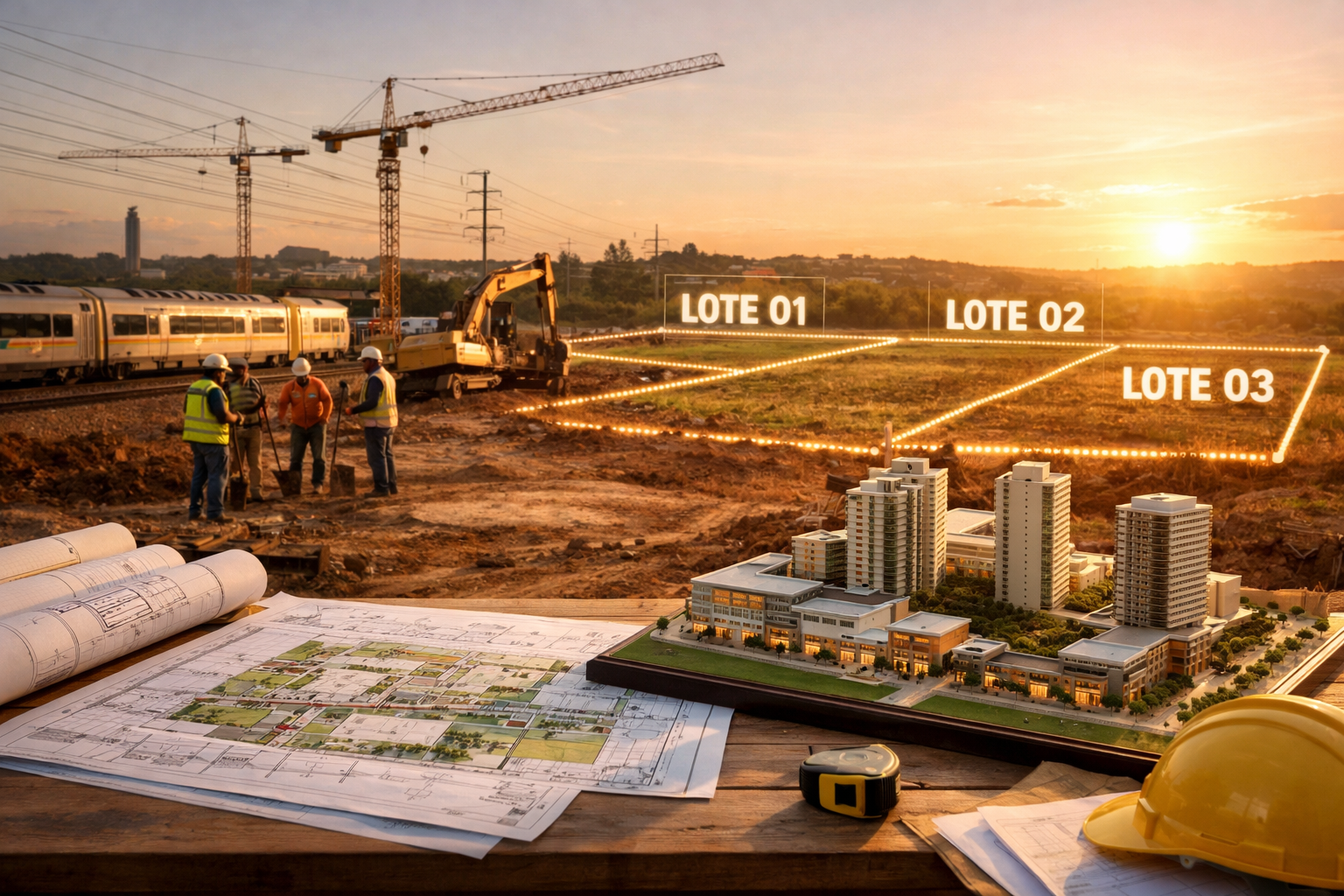
While much of this analysis focuses on inland secondary cities, Florianópolis offers a compelling model of how infrastructure investment — in roads, digital connectivity, and urban mobility — intersects with quality of life to create sustained property appreciation.
The city’s trajectory demonstrates that infrastructure-led booms are most durable when they enhance liveability, not just logistics efficiency. For investors considering life in Florianópolis as both a lifestyle and investment proposition, the city’s infrastructure-driven appreciation cycle provides a useful benchmark for evaluating similar dynamics in emerging secondary cities.
Projects like Solis exemplify how developers can position mixed-use launches to capture infrastructure-driven demand while delivering genuine quality-of-life value — a combination that sustains appreciation beyond the initial infrastructure announcement effect.
Conclusion: Actionable Next Steps for 2026
The convergence of R$372.3 billion in Novo PAC spending, global secondary city outperformance, and constrained new supply creates a rare alignment of conditions for infrastructure-led property investment in 2026. The window for early-mover positioning in inland Bahia, São Paulo’s interior, and other Novo PAC-connected secondary cities is open — but it will not remain open indefinitely.
Actionable next steps for developers and investors:
✅ Map confirmed Novo PAC projects in target regions and identify land parcels within 10 km of highway and railway corridors scheduled for completion by 2028.
✅ Prioritize secondary cities with 200,000–800,000 population that combine infrastructure investment with existing economic bases in agribusiness, manufacturing, or services.
✅ Structure land banking positions with 3–7 year horizons, ensuring capital reserves to weather construction phase delays.
✅ Design mixed-use projects that capture residential, commercial, and light industrial demand simultaneously — maximizing value capture across the full infrastructure appreciation cycle.
✅ Monitor zoning reviews triggered by infrastructure announcements; early engagement with municipal planning departments creates competitive advantage.
✅ Benchmark against global parallels — Australia’s regional boom [1] and Baltimore’s rail-driven industrial appreciation [2] provide validated frameworks for projecting Brazilian secondary city trajectories.
The infrastructure investment is coming. The question is whether investors and developers will be positioned to capture the value it creates — or watch it accrue to those who moved earlier.
To explore active development opportunities shaped by infrastructure-driven market dynamics, contact a specialist team with deep knowledge of Brazil’s evolving secondary city markets.
References
[1] Australia’s Regional Property Boom In 2026: Understanding The Shift In Buyer Demand – https://www.propertyfinanceinvest.com.au/australias-regional-property-boom-in-2026-understanding-the-shift-in-buyer-demand/
[2] The Definitive Industrial Property Forecast For 2026 – https://www.mantoniscre.com/blog/the-definitive-industrial-property-forecast-for-2026
[4] Atlanta Joins Salt Lake City, Boise, Tampa, San Diego, Washington, Las Vegas In Leading Real Estate Boom As American Housing Market Surges Rapidly – https://www.travelandtourworld.com/news/article/atlanta-joins-salt-lake-city-boise-tampa-san-diego-washington-las-vegas-in-leading-in-real-estate-boom-as-american-housing-market-surging-rapidly/